Stratechery Plus Update

  • The Cost of Bitcoin

    Putting aside the particulars of Bitcoin, the potential it represents is absolutely a very big deal.

    As I’ve written multiple times on Stratechery, the defining characteristic of anything digital is its zero marginal cost. Take apps for example:

    What makes the software market so fascinating from an economic perspective is that the marginal cost of software is $0. After all, software is simply bits on a drive, replicated at the blink of an eye. Again, it doesn’t matter how much effort was needed to create said software; that’s a sunk cost. All that matters is how much it costs to make one more copy – $0.

    The implication for apps is clear: any undifferentiated software product, such as your garden variety app, will inevitably be free. This is why the market for paid apps has largely evaporated. Over time substitutes have entered the market at ever lower prices, ultimately landing at their marginal cost of production – $0.

    The same story applies for music, movies, content, etc., and this has fundamentally changed what it means to do business on the Internet. It’s why, for example, WhatsApp was so valuable to Facebook: attention is the true finite resource, and how it’s commanded is, in some ways, besides the point.

    Bitcoin and the breakthrough it represents, broadly speaking, changes all that. For the first time something can be both digital and unique, without any real world representation. The particulars of Bitcoin and its hotly-debated value as a currency I think cloud this fact for many observers; the breakthrough I’m talking about in fact has nothing to do with currency, and could in theory be applied to all kinds of objects that can’t be duplicated, from stock certificates to property deeds to wills and more.

    What makes Bitcoin so clever is how it assumes self-interest and uses incentives. To put it in the simplest possible terms, instead of a paid broker for transactions, tens of thousands of distributed computers working independently do the verification, at no cost to those involved in the transaction. Their reward is the possibility of more Bitcoin – the verification process is also the mining process. Most people are focused on the “mining” part of the process, but it’s the verification aspect that is profound.

    Unfortunately, it’s not clear you can really divorce this verification process from the speculation involved with mining; it’s the speculation that incentivizes the verification. In other words, while the process behind Bitcoin enables unique digital goods beyond currency, the incentives only really work if said digital good has stored monetary value. Absent those incentives those doing the verification would need to earn some sort of commission, and then we’re right back where we started.1

    Still though, currency is something – surely no-fee transfers is worth celebrating! And, as someone who regularly deals with wire transfers, I’m sympathetic to this point. Still, even if zero-fee transfers became seamless, Bitcoin as presently architected would be anything but free, and every one of us would have to pay the price.

    The problem is the externalities of verification/mining. From the Wikipedia article on externalities:

    In economics, an externality is the cost or benefit that affects a party who did not choose to incur that cost or benefit.

    For example, manufacturing activities that cause air pollution impose health and clean-up costs on the whole society, whereas the neighbors of an individual who chooses to fire-proof his home may benefit from a reduced risk of a fire spreading to their own houses. If external costs exist, such as pollution, the producer may choose to produce more of the product than would be produced if the producer were required to pay all associated environmental costs. If there are external benefits, such as in public safety, less of the good may be produced than would be the case if the producer were to receive payment for the external benefits to others. For the purpose of these statements, overall cost and benefit to society is defined as the sum of the imputed monetary value of benefits and costs to all parties involved. Thus, it is said that, for goods with externalities, unregulated market prices do not reflect the full social costs or benefit of the transaction.

    Recall the magic that makes Bitcoin profound: scores of independent computers all over the world running at full speed in the hope of capturing new Bitcoin, and in the process verifying transactions for free. Those computers need power, and that power needs to be generated. True, whoever owns the servers is paying a huge electricity bill, but (in most areas of the world) that electricity bill does not include the societal cost of pollution generated by electricity production.2

    Moreover, the design of Bitcoin guarantees that electrical consumption increases dramatically indefinitely. Normally, you would expect the supply of computing power for a digital currency to initially increase, thus increasing the supply of said digital currency, which then lowers the price, ultimately reducing demand:

    Under normal conditions, as the supply of computing power increases, the amount of a digital currency would increase as well. This lowers the price, eventually reducing demand.
    Under normal conditions, as the supply of computing power increases, the amount of a digital currency would increase as well. This lowers the price, eventually reducing demand.

    That’s not the case with Bitcoin though. Anticipating the amount of power that would be thrown at mining Bitcoin, Satashi Nakamoto built in a simple escalator that ensured new Bitcoin would be released about every 10 minutes no matter the amount of power being applied to mining/verification. This has effectively locked Bitcoin miners into a zero sum contest wherein greater and greater computing power serves only to steal opportunity from fellow miners; there is no corresponding increase in Bitcoin to be had.

    Bitcoin is designed to be released on a regular schedule, no matter how much computing power is applied to it. This means supply will never catch up to demand, resulting in ever higher prices paid for with more computing power, i.e. more electricity.
    Bitcoin is designed to be released on a regular schedule, no matter how much computing power is applied to it. This means supply will never catch up to demand, resulting in ever higher prices paid for with more computing power, i.e. more electricity.

    The only possible increase is in computing power, which ultimately means Bitcoin effectively uses electricity as a release valve for inflation, compounding the externalities that accompany power production.

    For what it’s worth, the structure of Bitcoin dictates that the price continue to rise, presuming it remains a viable currency (which is very much in question). That price, though, is not free, and no one asked me if I were willing to pay.


    1. In fact, Bitcoin, which has a cap on the total amount of Bitcoin that will ever exist, is ultimately headed this way 

    2. For the record, I am a major proponent of carbon taxes as both a means of reducing pollution as well as spurring innovation 


  • Netflix and Net Neutrality

    For anyone remotely connected to technology, the idea that net neutrality is an unabashed good seems incontrovertible, and one of the most popular examples of why it matters is Netflix. Consumers get a video competitor to their cable provider over said cable provider’s pipes; surely the end of net neutrality would mean the end of Netflix! For example, consider this section from Netflix CEO Reed Hastings’ 2014 letter to shareholders:

    Unfortunately, Verizon successfully challenged the U.S. net neutrality rules. In principle, a domestic ISP now can legally impede the video streams that members request from Netflix, degrading the experience we jointly provide. The motivation could be to get Netflix to pay fees to stop this degradation. Were this draconian scenario to unfold with some ISP, we would vigorously protest and encourage our members to demand the open Internet they are paying their ISP to deliver.

    And yet, just last week, Netflix – without much protest – did exactly what Hastings described: they paid Comcast to stop the degradation of Netflix’s services, and are expected to reach a deal with Verizon and other ISPs soon. The stock market promptly punished Netflix, sending the stock down 3.4 percent the day after the announcement.

    Oh, wait, never mind: the stock was up 3.4 percent, hitting an all-time high of $447. This may be the opposite of what most tech observers expected, but Wall Street is not stupid: this is a great deal for Netflix, a company who has every incentive to not support true, end-to-end net neutrality.

    Defining Net Neutrality

    The first problem with the net neutrality debate is that there are three competing definitions:

    • The public definition – For most people, particularly those of us in the tech industry, net neutrality means non-discrimination against packets from origin to destination. A packet from Netflix or YouTube or PornHub or the New York Times is treated and priced the exact same from server to client and back again.

    • The legal definition – The FCC’s Open Internet rules, which were ruled as overreaching by the U.S. Court of Appeals in Washington, yet still apply to Comcast due to an agreement they signed as part of their acquisition of NBC Universal, only ever applied to traffic within an ISP’s network; in other words, once data is within Comcast or Verizon’s network, they can’t discriminate, delivering some data faster or slower. The Netflix/Comcast deal, on the other hand, is about peering: the point at which data enters the Comcast network (there is a useful overview of peering available here). This is not (and never was) covered by net neutrality, as many geeks are now learning to their dismay.

    • The Netflix definition – Netflix has a subtly different view, best articulated by Reed Hastings himself in a Facebook post two years ago:

      Comcast no longer following net neutrality principles.

      Comcast should apply caps equally, or not at all.

      I spent the weekend enjoying four good internet video apps on my Xbox: Netflix, HBO GO, Xfinity, and Hulu.

      When I watch video on my Xbox from three of these four apps, it counts against my Comcast internet cap. When I watch through Comcast’s Xfinity app, however, it does not count against my Comcast internet cap.

      For example, if I watch last night’s SNL episode on my Xbox through the Hulu app, it eats up about one gigabyte of my cap, but if I watch that same episode through the Xfinity Xbox app, it doesn’t use up my cap at all.

      The same device, the same IP address, the same wifi, the same internet connection, but totally different cap treatment.

      In what way is this neutral?

      What Netflix is most concerned about from a non-discrimination standpoint are broadband caps, and, more broadly, usage-based broadband pricing. It’s not that their position differs on a point-by-point basis from most net neutrality advocates; rather, the priorities are different.

    Why the Comcast Agreement is Good for Netflix

    This deal is in many ways a win-win for Netflix: they are likely paying less for better quality.

    Previously Netflix paid backbone providers such as Cogent for transit; it was then Cogent’s responsibility to interface with last mile provides such as Comcast or Verizon. Cogent made a lot of noise about Comcast and other ISPs wanting to get paid on both sides – by customers for Internet access, and Cogent for peering agreements – but the truth is Cogent was just as duplicitous: they wanted to be paid by Netflix on one side, and effectively subsidized by ISPs on the other.

    Free peering agreements between Internet providers were premised on the idea that a roughly equal amount of traffic was going in both directions, meaning there was no net increase in cost as a result of a peering agreement. Netflix, though, changed that equation by moving as much as 30% of all the United States’ internet traffic in one direction (on Cogent’s backbone). Cogent’s insistence on “free” peering, then, was not at all consistent with such previous agreements: Cogent was not carrying an in-kind amount of traffic in exchange for the traffic they were dumping onto ISPs.

    As an analogy, suppose my friend Bob and I agreed to watch the other’s dog in the event of a trip or vacation. We both travel about three weeks of the year, so while I have to watch Bob’s dog for three weeks, he watches mine for three weeks as well. While the specific amount of travel may vary year-by-year, it all evens out in the end, and we’re both happy. A few years later, though, I take a job as a consultant, and am suddenly traveling 30 weeks a year. Wouldn’t it be unfair for me to insist that Bob hold to the terms of our agreement, even though it entails him watching my dog 27 weeks more than I watch his? Yet that is exactly what Cogent was demanding for direct access to ISPs’ networks, and the ISPs in turn demanded compensation (keep in mind, Netflix has always been free to use the open Internet to reach customers; they simply find the performance unacceptable and wants shortcuts into ISP networks).

    With this deal, Netflix has effectively cut out the middleman Cogent, and is sending traffic directly from their servers onto Comcast’s network. Not only will this mean better quality for Netflix customers on Comcast, but it also raises the barrier of entry for potential Netflix competitors. Netflix currently has unique leverage over Comcast due to Comcast’s proposed merger with Time Warner, which, combined with their brand name and favorability amongst customers and regulators likely meant they got a great deal; future Netflix competitors, forced to go over the open Internet or rely on providers like Cogent will be at both a cost and quality disadvantage.

    Most importantly, though, Netflix has to be thrilled that Netflix – not end-users – is paying for better Netflix video, shrouding the extent to which end-users are subsidizing Netflix.

    Who Pays for Broadband?

    There’s no question, at least in my mind, that broadband is just as much a requirement for day-to-day life as is electricity, water, sewage, paved roads, etc. And, like said utilities, broadband lends itself to a natural monopoly; the cost of capital for building out a network are so great that the economics demand a single provider.

    The primary way to deal with natural monopolies is to either have said service provided by the government or provided by a private firm that is heavily regulated with strict requirements about widespread access combined with (relatively) high prices. This is indeed the case with electricity, water, sewage, and roads.1

    The problem with regulating broadband in this way, though, is that the definition of acceptable broadband is much more of a moving target. As Marc Andreessen memorably put it on Twitter:

    Remember, the United States is a country where one of the two major political parties routinely threatens to default on the nation’s debt to score political points. Infrastructure investment is embarrassingly low in things like roads and bridges, much less in environmentally sustainable power like nuclear;2 to put the future of broadband, something that requires continual investment, into the hands of such a dysfunctional government seems foolhardy at best.

    And yet, the fact that wired broadband in particular is a natural monopoly remains, raising the question of how you incentivize investment in ever faster broadband? There are three main options:3

    • Government mandate – Given the assumption that broadband is a economic necessity, this is the prescription that follows. Unfortunately, the same pragmatic problems that make government-provided broadband a likely non-starter plague this as well; Republicans in particular have actively opposed any sort of telecom regulation, even before you get to the incentive problems of mandates versus markets.

    • Discriminatory pricing – Companies like Amazon know that every 100ms delay causes them to lose sales; that makes guaranteed access to end users exceptionally valuable. It’s the same thing with Google, Netflix, and most other Internet companies. Comcast and other ISPs would certainly be incentivized to improve their networks if they knew that said companies would compensate them accordingly.

      To some extent, this is exactly what just happened with the Netflix peering agreement, although true discrimination within their network would incentivize Comcast even more.

    • Usage-based pricing – With usage-based pricing, if you use more data, you pay more; use less, pay less. As we’ve seen with wireless, this strongly incentivizes network providers to increase broadband capacity. It’s no accident that the rollout of LTE in the US was combined with the imposition of data caps, just as it’s not an accident that the US has far better LTE penetration than anywhere else in the world. This despite the fact that providing wireless service in the US is much more difficult than just about anywhere else in the world due to sheer physical size and effective NIMBYism.4 AT&T, Verizon, etc. want you to use as much data as possible as quickly as possible, and to charge you for the privilege.

    Making Tradeoffs

    In the end, each of these options presents a different set of tradeoffs among three competing ideals:

    • Continual investment in faster and more accessible broadband
    • Non-discriminatory treatment of data
    • Unlimited access

    There is no approach, at least given the United State’s political realities, that allows for all three; this is “Fast/Good/Cheap Choose Two” applied to Internet access.

    Thus, we need to make choices based on priorities. From my perspective, the most important of these ideals is the non-discriminatory treatment of data. This is what makes the Internet so profound, and what enables new companies to disrupt the market and improve the lives of millions. It must be protected not just within an ISPs network, but all across the entire Internet including peering.

    The second most important is continual investment in faster and more accessible broadband. The flip-side of the Internet being so profound is that improved access has an exponential return both from an economic as well as from a societal impact perspective.

    That leaves unlimited access on the chopping block. While I love the idea of unlimited data, I also am aware that nothing comes for free; in the case of unlimited data, the cost we are paying is underinvestment and/or discriminatory treatment of data. Therefore I believe the best approach to broadband is usage-based payment by both upstream and downstream, with no payments in the middle.

    The way this would have played out in the case of Netflix is that:

    • Netflix would pay more at the point of origin to compensate backbone providers for the massive amount of data they generate
    • ISP customers who watch the most video would pay more

    It’s the latter result that terrifies Netflix, and is why, in the end, they are not an ally of those of us who desire true net neutrality. Currently non-Netflix broadband subscribers are effectively subsidizing Netflix viewers; they use much less capacity, yet pay the same price. This needs to change for the sake of true net neutrality, and if it results in Netflix losing subscribers, so be it.

    Unfortunately, this agreement and the others that are soon to follow makes such an arrangement unlikely. Comcast and company are getting paid, so they’re happy, and Netflix is disguising their true cost to end users so they are happy as well. It’s non-Netflix users, and, more distressingly, the startups and services that have yet to be created who are ultimately paying the price.


    1. Problems with these models arise when pricing becomes unregulated, or not included at all 

    2. If there is one thing to take away from this article as a whole, it is that everything is a tradeoff. I know my aside on nuclear just upset a lot of you, but when you consider the relative cost and capacity of wind, solar, etc, and the environmental destruction caused by fossil fuels, non-polluting nuclear and its spent fuel risks makes a lot of sense. Tradeoffs. 

    3. Google Fiber is a fourth: building a straight-up competitor, natural monopoly economics be damned. It’s possible because Google already has its own backhaul network, but I have trouble seeing how it will scale at least in the near term 

    4. NIMBY = Not In My BackYard 


  • The Nokia X

    It’s real, and the Verge had a hands on:

    As expected, [the Nokia X, X+ and XL] combine Lumia-style design with low-cost hardware aimed at the masses, from a large 5-inch screen on the 109-Euro XL to the 4-inch display on the 99-Euro X+. The X will be released for just €89 in Eastern Europe, Asia, South America, and a few other global locations, but it won’t be making its way to North America, Japan, Korea, or Western European countries. These aren’t competitors to Samsung’s Galaxy S4 or Apple’s iPhone 5S, and there are certainly no surprising hardware additions like a 41-megapixel camera or a giant 6-inch display. Instead, the standout feature of the Nokia X lineup is the software that powers it: Android.

    During the presentation, Stephen Elop – still at Nokia! – was very explicit that the ability to run Android apps would be a selling point. From the keynote:

    Ladies and Gentleman, the new Nokia X and X+. Both of them run Android applications, they include unique Nokia experiences, and they include a wide array of popular Microsoft services…The Nokia X and X+ are built on the Android Open Source Project software which means people have access to hundreds of thousands of applications right out of the box. People can access free applications from the Nokia store, but as well you can access applications from other application stores. People can sideload applications using an SD card with our file manager…

    The Nokia X takes people to Microsoft’s cloud, not to Google’s cloud. This was very deliberate, because the Nokia X family, with this Microsoft will be able to reach people it has never talked to before around the world.

    ReadWriteWeb has a useful overview of the app situation: The vast majority of apps that don’t use location or notification services will run as-is. Developers need only upload the applications to the Nokia store, or have them already listed in alternate Android stores like Yandex or GetJar. For the rest, Nokia is providing drop-in replacements for payments, location, and notifications, and says it takes less than a day to have an app ready for their store

    Of course, the app situation isn’t as good as it could be: were Nokia a standalone company, their best shot would be to use the Google Android experience with the full Play store, something I argued they should have done many years ago. But Nokia, soon at least, won’t be a standalone company; they will be a part of Microsoft, and if that means Google isn’t an option, then this is clearly the best alternative. There’s little question the Nokia X is in a much better position than Nokia’s ostensible top-of-the-line Lumias when it comes to apps.

    In fact, that’s the biggest hole in the Nokia X’s reason-for-being: it’s supposed to be an entry-level device that will help move people up to Lumias, but if said move requires losing half your apps, in what direction are you moving? It is the Lumias that should be adopting the exact same OS, with the exact same app strategy.

    Think about it: in the big picture, what is the point of having a Microsoft-built OS? If the goal is to make money, as Steve Ballmer so often stated it was, then the only future for Microsoft on mobile is services, not cut-rate devices. And, if both AOSP and Windows Phone can provide access to those services, why not use the platform that is orders of magnitude easier for developers to support?

    Microsoft is so far behind in mobile that they simply cannot afford to fight battles that, in the big picture, don’t matter. And, for a services company, an OS battle is exactly that.


    Some additional notes:

    • Even if it’s trivially easy for Android developers to support the Nokia X, why should they when it’s not clear whether or not it will survive the year? Microsoft may not be able to comment now, but they need to clarify their position as soon as possible.
    • The above point – that Microsoft can’t afford to fight the OS battle – applies even more strongly to Internet Explorer. Just as the web made the Mac viable, Microsoft ought to pray the mobile web makes their devices more viable as well. They can help by adopting WebKit, ensuring every site works perfectly on all their devices. And, to be honest, Apple could probably use the help.
    • It’s too bad this is only being released on such low-end devices. If the Nokia X fails, the cause of failure will be less clear than it might have been.

  • The Social Conglomerate

    When news of the Facebook/WhatsApp deal broke, a lot of people gave me credit for being prescient: after all, I had just written 1,568 words on why messaging was mobile’s killer app. WhatsApp, though, was all but absent from the article, meriting but a single mention, and in parenthesis at that!

    Viber does have strong user numbers, claiming 280 million registered users and 100 million monthly active users, and that is certainly a big part of the battle, but the creation of a meaningful platform is a significant next step that Viber (and WhatsApp) has not taken. A platform is about multi-sided markets; LINE and WeChat are so valuable because they not only have the users, but also advertisers, commerce sites, and developers.

    Thus, while I’m skeptical of Rakuten and Viber, for LINE and WeChat the sky is the limit. Both have effectively built platforms on top of iOS and Android and smack dab in the middle of the most meaningful, and thus most-used, part of our lives: our communication and interaction with those we know and care about.

    Thus the reason for the exclusion: I believe that business models matter, and while WhatsApp had the users, I’d heard enough about their (admirable!) principles to think they weren’t interested in either selling out or in building the sort of platform necessary to convert those users into a multi-billion dollar company.

    I think that’s the first thing to understand about the $19 billion Facebook paid (including $3 billion in RSUs); WhatsApp as a standalone company, at least as presently constructed, with a miniscule staff and $1/user/year revenue model, was not worth anything close to $19 billion. But, that does not mean that Facebook overpaid.

    Facebook Is Solely Focused on Attention, Not Monetization

    There were two primary points I made in Messaging: Mobile’s Killer App:

    1. Messaging on mobile means constant communication with those closest to us. Those two words – constant, and closest – make it inevitable that messaging occupies more of a user’s attention than any other service.
    2. Messaging has a unique monetization model: platforms that combine direct marketing with immediate monetization opportunities

    WhatsApp was hugely competitive when it came to the fight for user attention, but not really in the game when it came to platform-building; that’s why my post was mostly focused on LINE and WeChat: both have more potential as standalone companies than WhatsApp (not that Tencent would ever spin off WeChat!). Facebook, though, also doesn’t care about point number 2 – more about this in a moment – even as they care very deeply about point number 1, and from that perspective, WhatsApp is by far the most valuable of the messaging services. To put it another way, context matters: are you considering only messaging services, or are you considering the entirety of social?

    Facebook is Building a Social Conglomerate

    For several years Facebook-the-company sought to include the entirety of social interaction within Facebook-the-product. I tried to explain why this wasn’t possible last November in a post called The Multitudes of Social:

    Last week Snapchat reportedly turned down a $3 billion dollar all-cash offer from Facebook. Apparently Facebook was worried about losing the teen demographic, or perhaps they were unnerved by the 350 million photos Snapchat claims to process per day. What seems clear, though, is that Facebook is intent on “owning social.”

    The only problem with this strategy is that the very idea of owning social is a fool’s errand. To be social is to be human, and to be human is, as Whitman wrote, to contain multitudes. Multitudes of apps, in my case.

    I obviously underestimated Mark Zuckerberg (I take solace in the fact I have lots of company on this point). While Zuckerberg may have given up on Facebook-the-product owning social, he remains determined that Facebook-the-company do just that. Thus the drive to release multiple standalone apps, and, more pertinently, the acquisition of first Instagram and now WhatsApp.

    It was while writing The Multitudes of Social that I first created the Social/Communications Map; regular readers may be tired of it by now, but I think it’s essential to understanding what is happening:

    The Social/Communications Map
    ]1 The Social/Communications Map

    The big issue for Facebook-the-product is that while it has successfully extended itself into the public permanent broadcast segment (the blue dashed arrow), by doing so it has denied its brand permission to move into the private and ephemeral regions of the map. Facebook is irretrievably associated with content that you don’t want to risk haunting you in the future, and which you can never be sure is totally private. This was an acceptable tradeoff in the PC era; PCs are destination devices, and the relative effort it took to post pictures or status updates meant users were naturally inclined to put their best foot forward.

    Mobile, though, because it is everywhere, captures far more human interaction; the majority of said interaction is ephemeral and private, and thus incompatible with what Facebook-the-product stood for. Facebook tried breaking in with products like Camera and Poke, but the Facebook association – and head start of competitors – was too much. And so, Facebook has bought its way in to the majority position in the category that dominates human interaction.

    This is why I 100% believe Jan Koum when he says that WhatsApp will remain autonomous, at least from a product and branding perspective. To glom WhatsApp onto Facebook-the-product would be to throw away exactly what makes WhatsApp valuable to Facebook-the-company – that it’s not Facebook-the-product. It is better to think of Facebook-the-company as a conglomerate: Facebook-the-company builds, acquires, and manages multiple products that serve all the different segments of social. The largest and most well known product in their portfolio just happens to be called “Facebook” as well.

    Facebook Doesn’t Need to Monetize WhatsApp

    Describing Facebook-the-company as a conglomerate also explains the WhatsApp monetization riddle: namely, there is no need. The Facebook product division is absolutely crushing it and will make more than enough money with an excellent growth rate for many quarters to come. Moreover, its primary product – immersive display ads – are a perfect match for another company in the Facebook portfolio, Instagram, leaving WhatsApp free for the foreseeable future to asymmetrically compete1 with LINE and WeChat for users in the private ephemeral space. I’d imagine the first step will be making WhatsApp completely free.

    Even without immediate monetization, though, WhatsApp will provide immediate value to Facebook-the-company in two ways:

    1. As Facebook works to federate WhatsApp’s userbase with the Facebook userbase they will increasingly be able to harvest signal about users in a way that increases the value of Facebook-the-product’s display ad business.
    2. WhatsApp will provide great option value to FB the stock. Kakao is reportedly filing for a $2 billion IPO, and LINE is expected to do the same later this year for $10 billion; investors will (rightly) presume that Facebook-the-company could similarly monetize WhatsApp if they chose to, increasing FB the stock’s upside.

    The Messaging Space Going Forward

    This deal is both good and bad news for the other messaging services. On the plus side, the eye-popping price should have a significant upward effect on the other messaging services’ valuations. On the other hand, WhatsApp now has significantly more resources, and, perhaps more importantly, significantly different incentives over the long run. Zuckerberg and company’s focus is not on building something sustainable, but rather on dominating the entire space.

    That said, WhatsApp does not dominate everywhere, and its position in Asia in particular – especially the richer countries – has been a bit oversold:

    • WeChat dominates China and is making inroads into Vietnam
    • LINE dominates Japan, Taiwan and Thailand and is making inroads in Vietnam, Indonesia, Spain and Mexico
    • Kakao dominates South Korea

    In several of these countries WhatsApp was originally the leader, but the more full-featured competitors have since taken over. It will be interesting to see if Facebook responds by aping things like stickers, although a pure platform strategy along the lines of LINE seems less likely in the short-term.

    One more note on messaging: it’s both more, and less, sticky than you might think. There are absolutely network effects at play: the best service is the one your friends are on. However, features like push notifications and badges makes it trivial to manage multiple networks; for example, most of my friends in Taiwan are on LINE, but it’s easy to respond to others who prefer WhatsApp, WeChat, Hangouts, or Facebook Messenger. I even make them share a badge!

    Multiple messaging apps are easy to manage
    Multiple messaging apps are easy to manage

    Once again, it’s context that rules the day: different apps for different friends in different countries, but rarely multiple apps for the same groups and/or countries.

    The Age of Conglomerates

    This idea of conglomeration – ever larger companies, delivering ever more specialized and segmented products – isn’t limited to just Facebook. Google is arguably a machine-learning conglomerate with multiple products; Amazon a logistics conglomerate with multiple services; even Apple a personal computer conglomerate offering multiple products with different form factors and interaction models.

    And, considering how computing power increases even as prices decrease, more specialized products that more perfectly fit different use cases is a natural result. So it is with Facebook-the-company: they are the social company, and no one can question their determination to offer a product that fits every use case, no matter the cost, and no matter the brand.


    1. Meaning, they don’t need to worry about monetization 


  • Messaging: Mobile’s Killer App

    Before the Internet, the nodes of communication were houses, and the killer app was the telephone. Presuming both you and I were in our respective houses, I could dial a number, and we could talk. It was marvelous, and in retrospect, primitive; real-time is much less interesting, and much more limiting, when it’s the only means of communication.

    In the late 1970s, the computer came along, and while it made us incredibly more efficient, it didn’t truly alter the definition of communication. That took the world wide web, and its killer app: the browser.

    Now the nodes of communication were computers, and while real-time was still a possibility, it was passive communication that defined the web. I, along with every individual and organization on earth, could create a web page, and you could view it, at a time convenient to you. The place, though, was only at the computer.

    Seven years ago, the computer became pocketable, but the original use cases were about making the passive presentation of information accessible not just at a time convenient to the viewer, but also at any place: the web was now everywhere.

    Still, it’s only recently that the killer app for this era, when the nodes of communication are smartphones, has become apparent, and it is messaging. While the home telephone enabled real-time communication, and the web passive communication, messaging enables constant communication. Conversations are never ending, and friends come and go at a pace dictated not by physicality, but rather by attention. And, given that we are all humans and crave human interaction and affection, we are more than happy to give massive amounts of attention to messaging, to those who matter most to us, and who are always there in our pockets and purses.

    It is only in this context – that mobile dominates because our phones are always with us, and that messaging is its killer app – that you can make sense of Rakuten’s $900 million acquisition of Viber. Or, for that matter, understand why LINE is gearing up for a $10 billion IPO, or why WeChat has helped double Tencent’s stock price in the last year, or why both Twitter and Facebook/Instagram launched enhanced messaging products last fall.


    The demand for attention, though, is only part of what is happening. After all, while capturing attention is critical for advertising-based companies like Twitter and Facebook, it would seem like it’s of lesser importance to an e-commerce giant like Rakuten. To that end, Hiroshi Mikitani, the co-founder and CEO of Rakuten, was remarkably concise about his motivation in an interview with Re/code:

    “Messaging apps are taking over the world and, while search is one of the strongest platforms, what is happening in communications is very, very important…”

    “We have content and games and commerce and markets and services, but they need the ability to reach out and talk to customers wherever they are,” said Mikitani. “With this, we can make buying more secure, but also more human.”

    Think about commerce in the same time periods and contexts I recounted above: in the time of addresses and telephones, most commerce involved driving to the store. It was a purposeful and burdensome activity, rather like a scheduled phone call. In the era of the web, ecommerce became a word, but it still entailed going to a computer, a journey that seems simple, but in reality is often far removed from the motivation to buy, which may arise from an ad seen on TV, or a dress in a windows, or the recommendation of a friend. With mobile though, and particularly with messaging, the omnipresence of both a communications channel as well as a purchasing channel means the separation between the thought of buying and actually making a purchase is very small indeed.


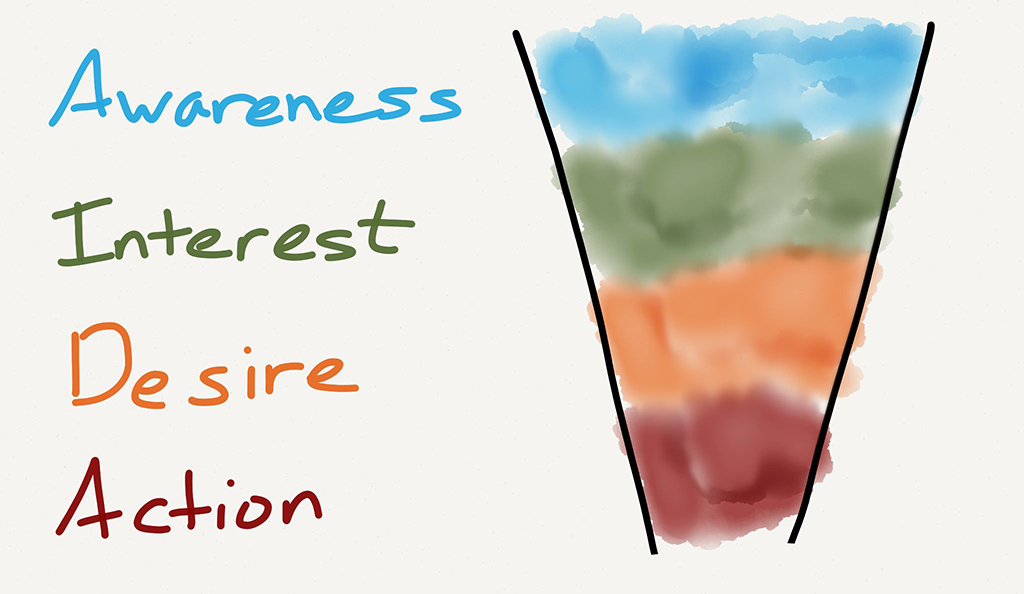
    The path to purchase is usually presented as a funnel, and looks something like this:

    funnel

    Google has made its fortune by living near the bottom of that funnel: people search for items they already desire. Reaching them at that moment means a much shorter and obvious path to action, i.e. purchase, and it’s is worth an incredible amount to advertisers on a per-user basis.

    In absolute volume, though, awareness and interest make up the largest portion of advertising spending. This isn’t a surprise; the very concept of a funnel is that the top must be much wider than the bottom. This has also been the most difficult part of the funnel for technology companies to break into in a meaningful way; up till now the primary means of demand generation has been display advertising, and it hasn’t been very good. Facebook, though, is making massive strides here, particularly in mobile (I detailed why in an article last summer called Mobile Makes Facebook Just an App; That’s Great News).

    Where messaging has a potential to make a mark is in the middle: moving customers from interest to desire and on to action, through one of the oldest and most reliable forms of advertising – direct contact.

    In the house context, direct contact took the form of postal mail, and in the computer context, email. Both certainly became huge targets for abuse in the form of spam, but that’s because direct marketing works. Consider a legitimate marketing mail you might receive (analog or digital):

    • You have already indicated that you like a particularly store or brand and have given them your contact information. There is no need for expensive and intrusive targeting.
    • It’s likely that you have made previous purchases, decreasing the friction in future purchases, particularly if your payment information is stored on the company’s servers1
    • In the case of email, you are likely reading the marketing message in a context that also enables immediate action; simply click a link and the item is in your shopping cart

    All of these positive factors apply to messaging. Here is one way it works (all of the examples I’m going to use are from LINE, but they almost all apply to WeChat as well):

    haagendasz

    • This is a sticker set from Häagen-Dazs; they have paid LINE tens of thousands of dollars (varies by market) to make this set available for free
    • To get the stickers, users must follow the official Häagen-Dazs account
    • Voilà, Häagen-Dazs now has a direct communications channel to millions of users

    Perhaps this summer, when it’s particularly hot, Häagen-Dazs will send out a coupon to all those users for a discounted cup of ice cream. Many of those users will be out-and-about, likely in the vicinity of a Häagen-Dazs retail shop (they’re all over the place in Asia). And just like that customers have been moved to action.

    This is an example using physical retail, but the effect is even more powerful with e-commerce: simply click a link wherever you are and you’re on the verge of action. To that end, LINE has been experimenting in Thailand with flash sales, and the results were pretty incredible: of the 22 million Line users in Thailand, 5.5 million users participated.

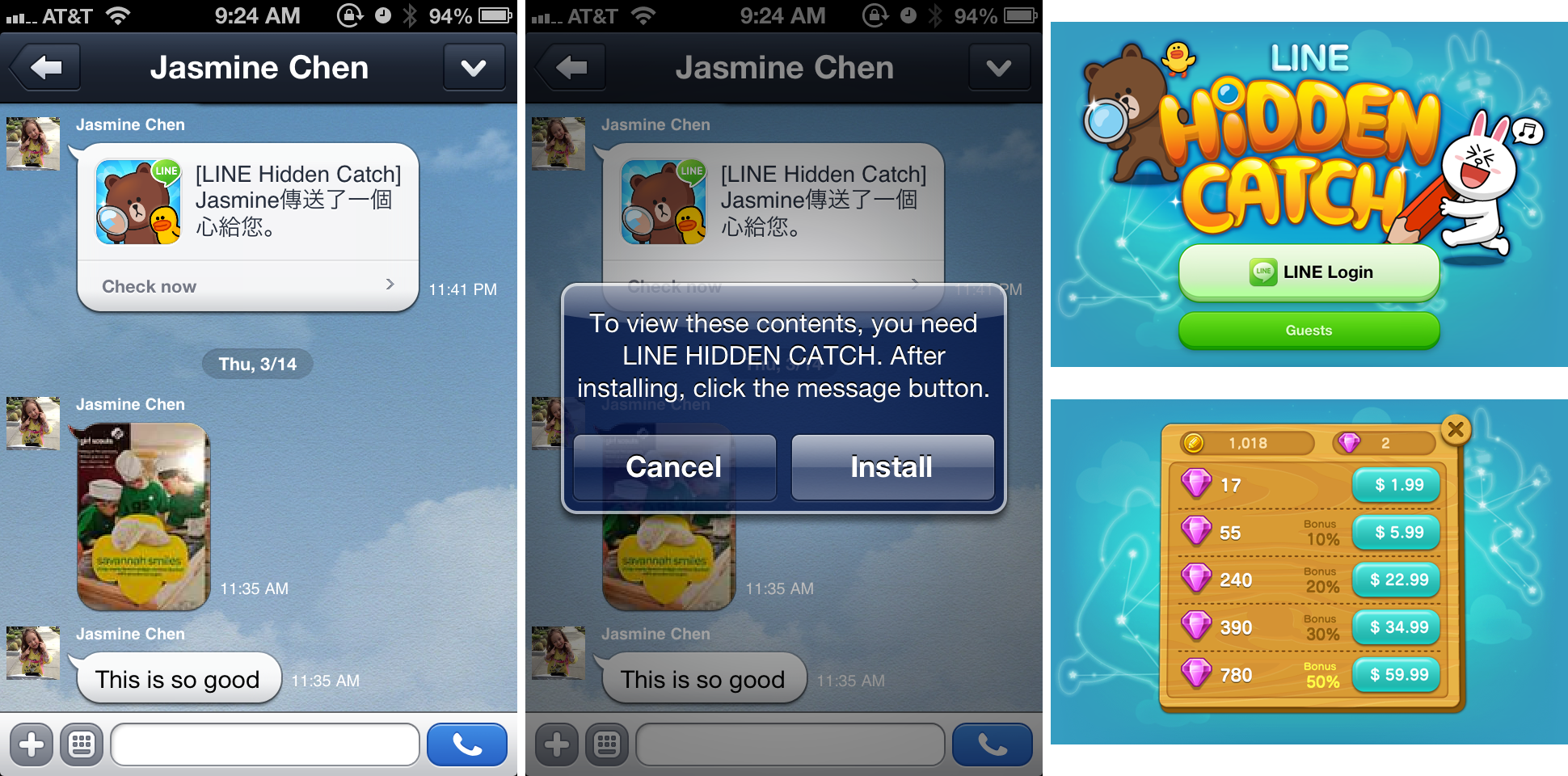
    It’s digital goods, though, that really make this channel shine, particularly apps. Consider this user flow, again from LINE:

    LINE Platform example

    My wife has sent me a notification from a LINE game; to open it I need to download the app, which authenticates with my LINE chat app, and I’m good to go. The game, as you might expect, is simple, fun, and laced with in-app purchases. It’s why gaming revenue made up 60% of the company’s $120 million in revenue in 4Q 2013, which was a 450 percent increase year-over-year (20% was from for-pay sticker packs, and the rest from sponsorships like Häagen-Dazs and merchandise – LINE characters are the next Hello Kitty).


    Revenue and growth numbers like these, along with the potential for mobile commerce, in some sense make $900 million for Viber seem cheap. But I’m not convinced that this purchase is going to turn out for Rakuten any better than Kobo or Buy.com, other 2nd-tier assets the company has acquired over the years. Viber does have strong user numbers, claiming 280 million registered users and 100 million monthly active users, and that is certainly a big part of the battle, but the creation of a meaningful platform is a significant next step that Viber (and WhatsApp) has not taken. A platform is about multi-sided markets; LINE and WeChat are so valuable because they not only have the users, but also advertisers, commerce sites, and developers.

    Thus, while I’m skeptical of Rakuten and Viber, for LINE and WeChat the sky is the limit. Both have effectively built platforms on top of iOS and Android and smack dab in the middle of the most meaningful, and thus most-used, part of our lives: our communication and interaction with those we know and care about.

    The Social/Communications Map
    The Social/Communications Map

    Facebook will continue to own people’s public representation of themselves, and the sort of voyeurism that entails is a good match for their display advertising. LINE and WeChat are similarly aligned with their monetization models: just as their interactions are more intimate, the connections between marketers and users are much more direct. They are perhaps the most important companies to come of age in the mobile era.


    1. This is why companies won’t give up storing credit card details, no matter how many attempted hacks they may have to endure. The dropoff from a customer needing to enter a credit card number is far more expensive than the bad publicity that is the primary punishment 


  • Microsoft’s Mobile Muddle

    Saying “Microsoft missed mobile” is a bit unfair; Windows Mobile came out way back in 2000, and the whole reason Google bought Android was the fear that Microsoft would dominate mobile the way they dominated the PC era. It turned out, though, that mobile devices, with their focus on touch, simplified interfaces, and ARM foundation, were nothing like PCs. Everyone had to start from scratch, and if starting from scratch, by definition Microsoft didn’t have any sort of built-in advantage. They were simply out-executed.

    Not that that should make Satya Nadella sleep any better at night. The power of mobile is that it is always with you; it is impossible for your mobile device to not dominate your computing time. At first, said time was accretive: on the bus, in the waiting room, the seams in your life. Increasingly, though, mobile is stealing time formerly devoted to PCs, making mobile not just a threat to Microsoft’s growth, but also to their cash cows.

    To appreciate the extent of Microsoft’s problems, and the possible solution, I’ve broken things down in five categories:

    1. Business Models
    2. Devices
    3. Services
    4. Patents
    5. Apps

    The realities of mobile

    1. There are two viable business models: device sales and services. Licensing an operating system for profit is a non-viable business model. Android killed it.

    2. A sustainable device sales model requires differentiation (e.g. the iPhone), channel and supply chain dominance (e.g. Samsung), or extremely competitive cost structures (e.g. Lenovo and most other Chinese manufacturers). All require huge volumes to reap economies of scale.

    3. A sustainable services model requires touchpoints on as many devices as possible, a massive cloud infrastructure, and a means of monetization (e.g. Google services on all devices, not just Android, all harvesting signal to be used in advertising).

    4. Patents are a significant part of the cost-of-goods in developed markets, perhaps 15-20% of the selling price. This can be significantly more (or less) depending on the amount of patents that a manufacturer can use for cross-licensing with other smartphone manufacturers (which reduces the amount needed to paid in royalties). However, patents (and their associated costs) are mostly ignored in China, Indonesia, and other large developing markets.

    5. An extensive app store that contains not only well-known titles but day-to-day utilities like banks, airlines, etc. is no longer a differentiator but a price of entry.

    Microsoft’s Situation

    1. Windows Phone (and Windows Mobile before it) was developed with the intent to license the operating system for a profit. That model is no longer viable; only 10% of Windows Phones are built by non-Nokia OEMs, and that percentage is expected to fall.

    2. Microsoft has acquired Nokia with the intent of pursuing a devices business model. However, while Lumia smartphones have great cameras and build quality, they are negatively differentiated by the lack of a competitive app store, are not built at massive scale, and have only sold successfully at extremely low prices with no profit margins.

    3. Microsoft Office has long been available on Windows Phone devices, but has only recently had a limited version published on the Apple and Play App Stores (phone only). Bing and Outlook are options on iOS, but not defaults. Onedrive is available in both the Apple and Play App Stores. Azure offers cloud resources for both iOS and Android app developers.

    4. Microsoft has an extensive patent portfolio and is reportedly earning $2 billion a year from Android device manufacturers.

    5. The Windows Marketplace has slowly captured most top apps (Facebook, Twitter, and finally Instagram), but is always years behind hot new apps (e.g. Snapchat), and has major holes in “utility” apps like banks, airlines, etc. Microsoft has zero leverage over developers.

    What Should Microsoft Do?

    1. Choose between devices and services. The problem with pursuing both, as Microsoft is doing, is that strategy taxes are inevitable. If you favor your devices by giving them better services, you are by definition limiting your services on competing devices. Meanwhile, by offering your services on competing devices, you are limiting the competitive advantage of your devices. Compare this morass of a strategy with Google’s clear focus on services (Google services on iOS are just about as good as on Android) and Apple’s clear focus on devices (iCloud is only available on iPhones).

    2. Abandon devices. The devices business is only worthwhile if you are able to sell at a high margin; while this does not offer the margin percentage of software licensing, the absolute monetary value of a high margin device is significant ($300+ for an iPhone, for example). However, Lumia’s are simply not competitive at the high end; all volume to date is that the very low end (<$150), and is being sold at a loss. Moreover, Lumia volume is too low to be supply chain competitive, at least once the former Nokia feature phone business is spun off. Ideally, sell the entire division to a Chinese manufacturer that is not aligned with Google (Lenovo’s acquisition of Motorola was a blow here; they are committed to Google Android, and it will be mostly stock).

    3. Embrace services. Services seek to touch every device, and, as I’ve written previously, are much more suited to Microsoft’s culture. Moreover, Microsoft has many of the pieces already in place, along with their primary remaining trump card: Office. Microsoft should use this trump card with Apple specifically: offer Office on iPad exclusively for a specified time in exchange for Bing as the default search,1 fuller iCloud integration with Azure, and/or built-in Xcode support for Azure cloud services.2 Apple has most of the best customers – the ones who will pay for services; Microsoft needs those customers desperately, and Nadella should go hat in hand to Cupertino.

    4. Fork Android and offer a version of AOSP (Android Open Source Project) with Microsoft services, app store (more on this below), and, most importantly, patent protection to Chinese manufacturers.

      This is the most misunderstood aspect of the Lenovo-Motorola deal; Motorola was worth more to Lenovo than almost anyone else because the deal included the right to cross-license Motorola’s patents. Without the ability to cross-license patents with other smartphone manufacturers, royalty fees can balloon far beyond the 15-20% of a phone’s cost that I referenced above; this would effectively destroy Lenovo’s cost-structure advantage.3 It is for this reason that Lenovo has only sold phones to date in countries with poor IP-protection; the Motorola patents let them go abroad much more competitively.

      The situation is no different for the other Chinese manufacturers like Coolpad.4 Patents have built an effective wall against Mediatek-powered Chinese manufacturers, leaving Android-powered Samsung dominant in most developed markets; Microsoft is uniquely positioned to enable and encourage said manufacturers, who are already competing strongly against Samsung in China, do the same in the rest of the world. They would all use Microsoft services abroad in exchange for patent protection, just as they use non-Google Chinese services in China.

    5. Build an AOSP Play Store with word-for-word copies5 (to the extent technically possible) of Google GSM APIs, and incentivize Microsoft’s global platform evangelists to encourage every Android developer to change a few lines of code and submit to the Microsoft AOSP App Store. Developers won’t be upset that they are being asked to abandon their Windows Phone app; on the contrary, they will love the fact they no longer need to support a platform that hasn’t come close to providing a return on investment.

      (I am aware of Peter Bright’s article that says Android is unforkable; I find it technically accurate but misleading. Of course there are some APIs in GMS, but a tiny amount relative to AOSP, and almost all related to cloud services which Microsoft by definition wants to replace. Bright waves this away by saying it’s “too much work,” but it’s much more work trying to get developers to build entirely new apps than it is to get them to change a few lines of code to support your store. Sure, Google might try to mess things up, but far better to rely on your own ability to adjust than on developers over whom you have no leverage.)


    To say this strategy would be a stark departure from Microsoft’s current course is, obviously, an understatement. It’s also the point – Microsoft’s current mobile strategy is an objective failure. With the Nokia acquisition Steve Ballmer threw good money after bad, and every moment spent pursuing a devices strategy based on a stillborn platform6 is another day that endangers the strengths Microsoft still possesses in the cloud and especially in the Office franchise.

    One does wonder, probably naively, if this is the reason Bill Gates came back. To abandon an operating system strategy for an operating system company, no matter how improbable the chances of success, and to embrace one’s former rival (Apple), will require extraordinary amounts of political capital – amounts possessed by no one but the founder.

    The precedent, of course, is Steve Jobs telling Macworld in 1997:

    We have to let go of this notion that for Apple to win Microsoft has to lose. We have to embrace a notion that for Apple to win Apple has to do a really good job, and if others are going to help us, that’s great, cause we need all the help we can get…The era of setting this up as a competition between Apple and Microsoft is over as far as I’m concerned. This is about getting healthy, and this is about Apple being able to make incredibly great contributions to the industry, to get healthy and prosper again.

    So it is for Microsoft. They need Apple and iOS, and, just like Apple had to get back to its roots of making great products, Microsoft ought to return to its roots of embracing and extending.


    1. Bing as default would surely be attractive to Apple for strategic reasons, but they could face the same blowback as Maps, and rightly so; Google is better 

    2. One of the three would be a win 

    3. This is one of the many problems facing HTC 

    4. Huawei is an exception; they have a much more extensive patent portfolio because of their telecom infrastructure business 

    5. Google has already provided the legal justification in the Oracle case 

    6. Warning: Tomi Ahonen link, but I swear it’s 80% rational and a good refutation of the spin that Windows Phone is making significant progress 


  • Bill Gates’ Steve Jobs Moment

    Steve Jobs and Bill Gates, once pirates, now legends, are forever linked in tech history. You know the lore: both collaborators and competitors in the 80s; Gates dominant in the 90s; Jobs triumphant in the 00s. Their career arcs were different though: Gates went out on top, retiring to a life of philanthropy, while Jobs spent a decade in the wilderness, returning to Apple at its darkest hour and leading it to impossible heights.

    It turns out, though, the story may not be over.

    Yesterday Satya Nadella was named CEO of Microsoft. In the same press release, though, was Gates:

    Microsoft also announced that Bill Gates, previously Chairman of the Board of Directors, will assume a new role on the Board as Founder and Technology Advisor, and will devote more time to the company, supporting Nadella in shaping technology and product direction.

    It’s been widely reported, particularly by Kara Swisher at Re/code, that Gates has been increasing his involvement at Microsoft, has been driving the CEO search, and has favored Nadella from the beginning. Moreover, it’s highly likely that Gates was the ultimate factor in Steve Ballmer’s abrupt retirement.

    Taken together, it’s difficult to escape the conclusion that Gates is back, with Nadella on board to handle the non-product and time-consuming aspects of being public-company CEO. It’s positively Jobsian. To be clear, unlike Jobs, Gates has remained involved with Microsoft even after his departure, and Microsoft is in much better shape financially then Apple was in the 90s. In other ways, though, the challenge Gates and Microsoft face today are far more formidable.

    Even in the 90s, Apple had a sustainable target market, particularly designers and publishers. That is why Adobe Photoshop was, along with Microsoft’s $150 million investment into Apple, a central focus of Jobs’ first keynote back at Apple. More importantly, though, thanks to painful layoffs instituted by Gil Amelio, Apple was a small enough company that such a limited market was enough if only they could start making good products. And good products is exactly what Jobs helped deliver. Moreover, considering Apple’s marketshare and the portable revolution to come, growth opportunities were effectively infinite.

    Microsoft has strong positions in much larger markets, namely PCs running Windows, productivity software that runs on those PCs, and enterprise data center software that serves those PCs; but a much larger employee base as well – over 100,000 currently, before you add in the 30,000 being added in the Nokia acquisition. Unlike Apple in the 90s, there isn’t much headroom: PC sales are collapsing, and threaten to drag down Office and Server sales if not now, then in the long run. Meanwhile, efforts in search, consoles, phones and tablets aren’t even close to making up the slack, particularly from a profit perspective.

    The issue for Microsoft is that the problem – and relatedly, the solution – is not (just) the quality of the products, or lack thereof. The same kinds of network effects and developer support that Microsoft leveraged to dominate with Windows now work against them in phones and tablets, and it’s too late to build an OS that will contribute in a material way to the bottom line. Meanwhile, PCs are being relegated to specialist devices by more accessible devices like the iPad, which, when combined with the reduction in meaningful advances in computing power for day-to-day use, has stretched out the replacement cycle, effectively reducing Microsoft’s income from Windows. Neither better phones nor a better version of Windows can change these structural headwinds.

    Given this reality, if Gates’ impact is limited to “technology and product direction”,1 then his return is likely to be more Michael Jordan with the Wizards2 than Steve Jobs with Apple. What is needed is a fundamental rethinking of Microsoft’s role in technology:

    • Admit Google and Apple have won the OS war for phones and tablets
    • Refocus Windows on securing the (shrinking) PC market
    • Massively accelerate the buildout of services like Azure and Office365 on all devices, especially iOS and Android

    Simple, right? Unfortunately, anything but, especially for Gates:

    • Gates is insanely competitive, and there is a massive gulf between the reality of the market for phone and tablet OS’s and Microsoft’s perception of itself as an OS company. Moreover, Microsoft’s recent moves, particularly the purchase of Nokia, work in the opposite direction. A sale-off of Nokia3 is not only in order, but almost certainly won’t happen
    • Gates is the chief proponent of Windows everywhere, the opposite of Windows on PCs only
    • Azure and Office365 are competitive with many of Microsoft’s own server products. It’s impressive that they have been as successful as they are, but there remain significant obstacles in getting full buy-in from Microsoft’s field and sales teams who make much more money off of on-premise licensing than they do from SaaS

    However, what is most difficult of all is that pursuing the above strategy, while appropriate for the long-term health of the company, would almost certainly come with significant restructuring and thousands of layoffs. A profitable and growing Microsoft is a smaller Microsoft, and, in all likelihood, that’s not what Gates signed up for.4

    So now we come to Satya Nadella. By all accounts he is a great guy, super sharp, and responsible for Azure, one of those foundational services I mentioned above. Still, he traces his recent success as head of Microsoft’s Enterprise and Cloud group mostly to the Enterprise part – aka on-premise server software – which is intimately tied to Microsoft’s current business model of PC + Office + server, not it’s necessary new model of any device + Office365 + Azure. Moreover, he’s inheriting the current leadership team of which he was recently a part, raising questions about just how much authority he can exert.

    And, ever present, will be not just the specter but the very personage of Bill Gates, pirate, legend, and someone who probably should have stayed retired; as age is to basketball players, disruption is to technology companies, and Microsoft is on the wrong side of 30.


    Two previous pieces on Stratechery that are worth reading in light of yesterday’s news:

    • Skating Towards the Goal, on Gates’ impact on Microsoft’s culture and the problem of having already achieved the goal of “A computer on every desk and in every home, running Microsoft software”
    • Services, Not Devices, which explains how Microsoft is better suited to horizontal opportunities than they are to vertical ones (I explored this further in this piece on the Nokia acquisition)

    For what it’s worth, I hope I’m wrong. I have many friends at Microsoft, and it’s difficult to overstate how important the company is to the Seattle area. Moreover, I think it’s good for tech that they succeed and act as a counterweight to Google in particular.


    1. And hopefully better product direction than that exhibited during the development of Windows Vista, née Longhorn 

    2. Michael Jordan, the greatest basketball player in history, retired from the Chicago Bulls in 1998. However, in 2001, he returned to play two seasons with another team, the Washington Wizards. Jordan was old and frequently injured, and the seasons were mostly forgettable 

    3. Which isn’t even closed yet 

    4. The best thing Steve Ballmer could have done for Microsoft would have been to make cuts last summer while restructuring the company, even if said reorganization was a bad idea. Instead he added another 30,000 employees while a lame duck in a deal that made no sense 


  • Two Bears, Revisited

    One of the more annoying aspects of the late great PC area was how review sites treated Macs: for all intents and purposes, they were just another PC. Consider this CNET review of the 2007 MacBook Pro:1

    The good: Updated CPUs and graphics without an updated price; LED-backlit display for better battery life; 802.11n support.

    The bad: Minimal configuration options; only 90 days of toll-free technical support; still no media card reader.

    Or this PC Mag review of the 2006 Macbook:

    PROS: Core 2 Duo upgrade completes the laptop line. Only one inch thick. Excellent performance. iSight Camera. More hard drive options. Front Row interface and remote.

    CONS: DVD burner doesn’t come standard.

    Conspicuous by its absence is OS X, and the fact that these were the only laptops that ran it. Sure, configuration options or media card readers may be important, but if I cared that my computer ran OS X then none of the cons – including price – mattered. Yet review after review, lost in their analysis of hardware speeds and feeds, ignored the fundamental differentiation provided by software, making their conclusions narrowly correct and broadly useless.

    Sadly, things haven’t improved; indeed, as Apple has become one of the largest companies in the world, largely because of the iPhone, the obtuseness has spread to analysis. Consider this from Strategy Analytics (emphasis mine):

    Samsung and Apple together accounted for almost half of all smartphones shipped worldwide in 2013. Large marketing budgets, extensive distribution channels and attractive product portfolios have enabled Samsung and Apple to maintain their grip on the smartphone industry. However, there is clearly now more competition coming from the second-tier smartphone brands. Huawei, LG and Lenovo each grew their smartphone shipments around two times faster than the global industry average and captured a combined 14 percent marketshare. Huawei is expanding swiftly in Europe, while LG’s Optimus range is proving popular in Latin America, and Lenovo’s Android models are selling at competitive price-points across China. Samsung and Apple will need to fight hard to hold off these and other hungry challengers during 2014.

    The problem with lumping Samsung and Apple together, particularly in the last sentence, is that they face two markedly different challenges: saturation for Apple, and differentiation for Samsung. After all, only iPhones run iOS, while those “hungry challengers” run Android.

    I wrote about these differences in one of the first articles I posted on Stratechery, Two Bears:

    Bear Argument #1 is the imminent collapse of the iPhone in the face of significantly lower-cost alternatives…Bear Arguments #1 rests on the assumption that the iPhone is competing on hardware, and is therefore susceptible to lower-cost alternatives. However, the iPhone is not simply a device. Rather, it’s a ticket into an ecosystem

    Bear Argument #2 is the end of growth for the iPhone…In this case, the iPhone has saturated the high end, and while current iPhone users replace their iPhones, their overall numbers don’t increase significantly…

    The iPhone faces little threat in the differentiated high-end of the market. Suggesting this market is limited in size is fair; counting the days until customers flee for cheap phones is silly.

    That’s not to say that Bear Argument #1 is invalid; in fact, it’s the Bear Argument for Samsung. There is precious little that differentiates high-end Android from low-end Android…and not only are low-end devices increasingly “good enough,” they’re also impossibly cheap.

    Indeed, over the last two weeks both Apple and Samsung have had worrisome earnings reports, but for very different reasons: namely, both bear arguments are coming true.

    Samsung is being challenged by lower-cost competitors; the company’s average price per phone fell by $30 last year, and its share of >$400 phones slipped from 40 percent to 21 percent. This kept up Samsung’s volume – they now account for one in three smartphone sales – but the result was their first profit decline in nine quarters.

    Apple had the exact opposite problem: the iPhone’s average selling price jumped from $577 to $636 quarter-over-quarter, and was only down $6 year-over year. Apple also increased its share of the >$400 market from 35 percent to 65 percent. Growth, though, was meager: a mere 7%, despite the addition of NTT DoCoMo and a much earlier China launch for the iPhones 5S and 5C as compared to the iPhone 5. According to Tim Cook, this was compounded by stricter upgrade policies amongst North American carriers.

    There isn’t much that Apple can do. The market is clearly – and predictably – bifurcating between customers who care about differentiation and those who care about price; the 5S is dominating the former, the 5C was targeted at a middle ground that is disappearing, and Apple will never make a phone cheap enough for the latter.2

    Still, growth primarily matters for its impact on AAPL the stock.3 The iPhone as a platform is in fine shape: the iPhone is increasing its dominance of high end customers, and its those high end customers who dominate usage. More importantly, they aren’t going anywhere. User experience is a sustainable differentiator in consumer markets, and any analysis that ignores iOS and Apple’s integrated approach as a differentiator is as useless as a Macbook review that ignores OS X.

    Samsung is a different story. They have no meaningful software-based differentiation, and have seen the iPhone’s increased distribution eat into their high-end sales. A larger-screen iPhone would likely erode these sales further. Meanwhile, Samsung has to deal with Chinese Android-based manufacturers driving down prices not only in China, but, particularly now in the form of Lenovo, globally. Lenovo is crushing the traditional PC OEMs with both superior cost structures and superior R&D; at first glance there’s no reason to expect any different result in smartphones.

    Still, Samsung has a much more integrated and impressive supply chain than any of the PC dinosaurs that Lenovo surpassed over the last decade, and they have a dominant position when it comes to distribution and carrier relationships especially, a complication that makes the smartphone market much different from the PC market. It will be fascinating to see the degree to which these strengths overcome Samsung’s lack of product-based differentiation.4


    1. I just searched for a year at random, but long-time observers know these examples are hardly unique 

    2. There is, though, one obvious area for growth: high end customers for whom the top priority is screen size. I have been banging the large-screen iPhone drum for quite some time now, likely because I live in Asia. As I noted a couple of weeks ago:

      Anecdotally speaking, I don’t know a single person who doesn’t long for a larger iPhone, but I know plenty who switched to Android for this reason.

      Remember, large-screen phones have significantly higher average selling prices; even if >4.5″ is a small part of the market, it’s all high-end, and if Apple wants iPhone growth it ought not leave any high-end stone unturned. 

    3. The stock market is not an awards show; prices are about future earnings, and skepticism about Apple’s profit upside in light of the law of large numbers is warranted 

    4. Samsung’s fate will be the true ultimatum on Stephen Elop’s decision to go with Windows Phone. I’ve argued strongly that Nokia should have gone with Android and leveraged their supply chain and carrier relationships. If Samsung continues to do well in the face of Lenovo and other Chinese manufacturers then that strengthens my case that Nokia could have succeeded as well 


  • Google’s Tasty Lemonade

    It’s good to see one of the more tiresome myths of the last couple of years – that everyone is trying to be like Apple, just look at Google buying Motorola! – get put to bed once and for all.

    Earlier today Google sold the remains of Motorola Mobility to Lenovo for $2.91 billion,1 closing the door on an expensive mistake that never made a lick of sense.

    There’s not much to say on this point beyond what I wrote in Understanding Google:

    The surest route to befuddlement in the tech industry is comparing a vertical player, like Apple, with a horizontal one, like Google.

    Vertical players typically monetize through hardware, only serve a subset of users, and any services they provide are exclusive to their devices. Horizontal players, on the other hand, monetize through subscriptions or ads, and seek to serve all users across all devices.

    Google certainly isn’t confused; they are 100% a horizontal player [footnote link]

    Footnote: Well, except for that bizarre Motorola thing. My best guess is that the decision was ultimately a combination of misguided kingdom-building by Andy Rubin, patent panic, and delusions of Steve-Jobs-esque grandeur from Larry Page. Give them credit for treating it as a sunk cost (and by sunk cost, I don’t mean abandoned; rather, they are treating Motorola pretty rationally, not trying to justify $12 billion)

    Credit to Google indeed: there will be a lot of deserved mockery over the next few days over the money that was lost, but the company has smartly limited the strategic damage and in some respects come out of the deal in a stronger position. Specifically:

    • While the Motorola patents are not worth nearly as much as it seems due to FRAND, Android is still in a much stronger position than 2012, particularly with this week’s cross-licensing patent deal with Samsung. Keep in mind that most of the Samsung patents are newer and likely more relevant than the Motorola ones. This deal was likely a win for Google.
    • Speaking of Samsung, Re/code reported this morning that the leading Android OEM will dial back its OS differentiation efforts in favor of a purer – and more Google-centric – Android experience. Another win for Google.

    While Re/code attempted to paint the latter deal as some sort of intimidation on Google’s part, it seems obvious that the reason Google “won” both of these deals was Motorola: specifically, Google likely offered to get out of hardware if Samsung cross-licensed their patents and stopped pseudo-forking Android. Given Samsung’s dominant position in the Android ecosystem, the Motorola bargaining chip very well may have been worth several billion dollars.

    And don’t sleep on Lenovo. I’ve long considered them the most likely global Samsung challenger. As they have demonstrated in PCs, they have the cost structure and market knowledge to compete and win in low margin hardware, and they now have the channel and brand to keep Samsung honest in North America – another win from Google’s perspective.2

    All things considered, this deal deepens my appreciation for Google’s strategic acumen. Motorola was a mistake, but they didn’t chase sunk costs, and they made some rather tasty lemonade out of some very expensive lemons.


    1. Which is actually overstating the price: only $660 million of that is cash, $750 million is Lenovo shares, and $1.5 billion is a 3-year promissory note that has a present value of ~$1.24 billion assuming a discount rate of 6.53% 

    2. One does wonder where this leaves HTC. I’ve long assumed that Lenovo would buy them for the same reason: channel and brand 


  • The General-Purpose iPad and the Specialist Mac

    I’ve written previously that the iPad was helping to unbundle the general-purpose PC:

    From the Humpty Dumpty PC:

    The iPad and other appliance-like devices have actually had the opposite effect [as compared to the iPhone] on computing. Many of the activities one used to do on a general-purpose personal computer are now done on machines better suited to the task at hand.

    I think I got this precisely backwards.


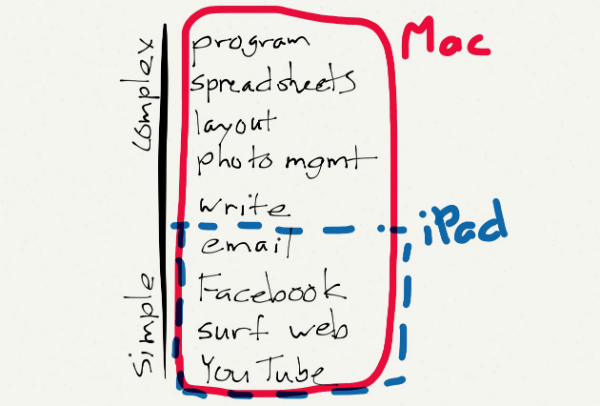
    If you start with the Mac (or PC – they’re interchangeable in this analysis), then the benefit of the iPad is all about its simplicity: touch and the limited nature of iOS make some computing activities easier and more approachable, especially for people like my mom. A Mac (or PC), meanwhile, can do everything an iPad can do and more (although it must bear the cost of complexity):

    gpipad-1

    The problem with this thinking is the focus on “computing.” The things we humans wish to do are so much more varied: sing, play, dance, even, I suppose, make spreadsheets. It is a spectrum, of which traditional “compute” activities are only a small part:

    Computing is only a small part of what people do
    Computing is only a small part of what people do

    What makes the iPad so magical is that its simplicity – a piece of glass that becomes whatever app you choose to run – allows it to serve a much broader range of potential human activity than your typical Mac or PC.

    The iPad can do many more things than a Mac, such as draw, make music, game, etc.
    The iPad can do many more things than a Mac, such as draw, make music, game, etc.

    iPads are used for traditional computer activities, but they’re also used for gaming, for music-making, for drawing, even, apparently,1 for sumo wrestling. What is interesting, though, is that for almost all of these activities, the iPad is not the best possible tool.

    Consider gaming:

    There are dedicated devices that are superior for gaming, but an iPad is simpler and can do other things as well.
    There are dedicated devices that are superior for gaming, but an iPad is simpler and can do other things as well.

    A dedicated device like a console will, at least according to some measures of performance, deliver a superior gaming experience (and a gaming PC, even better). But a console can only play games, and it is complex (and, again, a gaming PC even moreso). An iPad is simple, and it does other things as well.

    Or music:

    A real instrument is better for music, but it's hard to learn and an iPad does other things.
    A real instrument is better for music, but it’s hard to learn and an iPad does other things.

    An actual instrument is a superior music experience, but said instrument can only do one thing, and there is nothing simple about it. An iPad is infinitely more approachable, and it does other things as well.

    It’s the exact same role the iPad plays with regards to the Mac or PC. A Mac or PC is a superior experience for traditional computing activities, at least according to traditional measurements like speed or efficiency, but an iPad is simpler and more approachable, and it does other things as well.

    (This, of course, is why Macs aren’t going away. In fact, as Phil Schiller noted at the end of this great Macworld piece marking the Mac’s 30-year anniversary, the iPad has freed the Mac to focus even more on power users going forward.)

    Ultimately, it is the iPad that is in fact general purpose. It does lots of things in an approachable way, albeit not as well as something that is built specifically for the task at hand. The Mac or PC, on the other hand, is a specialized device, best compared to the grand piano in the living room:2 unrivaled in the hands of a master, and increasingly ignored by everyone else.


    1. Because I’ve been asked a million times…I like the idea of Your Verse, but the actual execution is a bit pretentious for my tastes 

    2. Or yes, a truck. The point I’m trying to make is that iPads will be more widely used not just because they are simpler than Macs or PCs, but because they can actually do more. The car/truck analogy doesn’t quite capture that