Stratechery Plus Update

  • Black Box Strategy

    With the announcement of the Amazon Fire TV and the leak of the alleged Android TV, all of the major players have (or soon will have) a TV offering. There’s been a lot of talk about how similar the products are, but those similarities are for good reason; what is more interesting to me are the very different motivations.

    Note: The specifics of this article are going to be US-centric

    Why TV is So Attractive

    As I’ve written multiple times, the scarcest resource for consumer tech companies, especially ad-supported ones, is user attention. There are only so many minutes in the day, and their consumption is zero-sum: a moment spent doing activity A is not spent doing activity B, and then that moment is gone.

    Meanwhile, TV continues to monopolize a significant amount of that user attention. Although digital products have overtaken the amount of time spent on TV, primarily due to the accretive time spent on smartphones, the absolute time spent on TV has remained stubbornly persistent at about four-and-a-half hours per day per U.S. adult (source).

    That four-and-a-half hours really is the gold at the end of the rainbow for tech companies: just over the next hill/technical hurdle, yet never actually attainable.

    Why TV is So Persistent

    The primary reason I haven’t written much about TV recently is that I really haven’t had much to add to my series from last year. Everything still applies:

    • The Cord-Cutting Fantasy discussed why unbundling cable is economically unworkable
    • Why TV Has Resisted Disruption was primarily about great content; it’s expensive to make and doesn’t have many substitutes
    • The Jobs TV Does identified the role TV plays in our lives; traditionally it has kept us informed, educated, given a live view of sporting events, delivered enlightenment and story-telling, and provided escapism

    While the Internet has unbundled information and education, the final three remain, and they are proving much more of a challenge.

    Bunches of Black Boxes

    Most of the tech players are coalescing around the little black box strategy Apple pioneered with the Apple TV: an inexpensive add-on with most of the major streaming services built-in. Crucially, none of them live on HDMI1, the primary input on your TV that is usually owned by your cable box. The strategy seems to be centered on chipping away at the time spent on HDMI1, until you finally realize it’s really not worth however much you’re paying. It’s not a particularly inspiring strategy, but like I said, TV has resisted disruption for good reason. The exception to both points is Microsoft: their box (the Xbox One), while black, isn’t little by any means, and they are absolutely gunning for HDMI1.

    What is interesting is that while the products (except for Xbox One) are increasingly homogenous, the motivations of the various companies making these little black boxes differ tremendously, and that may give a hint as to who will be successful, and who will simply fade away.

    Apple TV

    Apple has one of the most differentiated black box offerings: it’s the only one to include iTunes content, and it’s the only one with Airplay. While iTunes has long been a differentiator for Apple’s devices,1 I believe that over time it is Airplay that will be of increasing importance as a way of differentiating and thus selling more iPhones and iPads. This makes sense: while Apple differentiates primarily through software, they make their money through hardware.

    To that end I expect a new Apple TV soon with a specific focus on improving the Airplay experience, perhaps by combining the Apple TV with an Airport to reduce Airplay lag, thus enabling more and better iDevice/TV gaming scenarios (with the additional benefit of increasing the Apple TV’s reason-to-buy). It’s a rather elegant solution if you think about it: most people’s Internet comes in through their cable line anyways, so it’s already in the correct physical location.

    Amazon Fire TV

    I know I don’t spend nearly enough on Amazon, which is a shame: they have a dominant strategy based on superior selection AND superior pricing, and everything they do is primarily focused on driving ease-of-purchase, primarily through Amazon Prime.

    Fire TV fits right in: it’s another reason to be an Amazon Prime customer, which isn’t really about streaming video. Instead, the end result is you buying everything from Amazon without thinking twice. The decision to add gaming was a curious one though: on one hand, it’s more stuff to sell, and another reason-to-buy; on the other, it made the device more expensive, which reduces the addressable market. If the end-game is Prime, as I believe it is, then trying to get digital game sales seems shortsighted.

    Android TV

    Given that attention is the lifeblood of advertising, Google has more motivation to succeed in TV than just about anyone. As I noted when Google acquired Nest, there’s reason to believe that Google’s growth could start to flatten soon, and TV is an obvious place to reverse that trend, particularly with Google’s valuable YouTube asset.

    Google’s problem, though, is that their business needs aren’t necessarily aligned with consumer needs: what would an Android TV offer that the other black boxes don’t? YouTube is already available everywhere, befitting its role as a horizontal service. Just as it would make no sense for a vertical company like Apple to share iTunes, it makes no sense for a horizontal company like Google to hoard YouTube. The Android TV, if it exists, seems to be primarily for Google’s benefit, not consumers, and I would expect sales numbers to reflect that. I’m a much bigger fan of the Chromecast, primarily because of its price, and again, sales numbers seem to agree with me.

    Roku

    The last of the black boxes is a bit of a misfit: Roku is a relatively tiny company for whom the black box is their raison d’être. Unsurprisingly, this means they have many consumer-friendly features like lower prices, innovative designs,2 and the ability to search for shows across services. However, it’s difficult to see how they compete effectively as a standalone company.

    In fact, there is an obvious acquirer: Facebook. They are the one technology giant without a TV play, and, like Google, they are advertising based. TV watching is certainly a social activity: it’s thought of as a Twitter stronghold, although Facebook has challenged that assumption. I think the angle for Facebook, though, would be more on the data side: what you watch is likely incredibly valuable information, and better targeting is the most sustainable way to increase ad revenue. Facebook could buy Roku, sell the device at cost, and increase the richness of their profile information, even as they increase their optionality when it comes to the most attractive advertising medium of all.

    Microsoft

    Once again, Microsoft was early to a category; from day one the strategy for the Xbox has extended far beyond gaming to a dominant presence in the living room. Unfortunately, once again Microsoft erred in the details. The advantage of starting with a console is that there is a built-in market; for all of the little black boxes I discussed the various reasons-to-buy, which aren’t always clear, whereas the reason-to-buy an Xbox is obvious – you can play games on it. However, this reason-to-buy comes at a cost, quite literally. The Xbox One launched at $499, putting it far beyond the reach of non-gamers, and making it wildly uncompetitive with the little black boxes. There is also a cost when it comes to flexibility; Microsoft must focus first-and-foremost on gamers, whose needs are not necessarily aligned with normal consumers, and this is compounded by the long console cycles driven by the massive upfront development costs.

    What is most worrisome for Microsoft is that this strategy duality has hurt them with gamers, too. The Xbox cost $100 dollars more at launch than the PS4 despite having slightly less power, primarily because of the built-in Kinect. While this does have a gaming function, the main reason it was included was to enable the Xbox to make a play for HDMI1. Microsoft has certainly made it much further down this road than any of the other players, but close doesn’t cut it; without DVR functionality and full programming guides, it’s simply not a viable competitor for the lowly cable box. This is a truly distressing outcome for Microsoft: they handicapped themselves in gaming in pursuit of their original goal, which they’re not going to realize. It’s another muddle.

    I expect the Xbox One to have decent success as a console, due to Microsoft’s dominance of first-person shooters if nothing else, but after three generations it doesn’t seem any closer to fulfilling the original Xbox charter of winning the living room.

    So Now What?

    All that said, and despite all these new products, nothing substantial has changed on the content front; we have the system we have because, all our kvetching aside, it benefits most of the main players most of the time, including consumers. Whatever finally topples TV will win not because it delivers the same content better, but because it steals more and more user attention.

    To that end, I actually ranked these companies in the order I like their chances, and I still give Apple the clear lead. Airplay remains very compelling both from a technical and business model perspective; Amazon has the business model, while it’s more difficult to see the long term upside for Google or Roku, and Microsoft is stuck in its niche.


    1. Seriously people: iTunes is not going to be on Android 

    2. I love the headphone jack in the remote 


  • When CEOs Matter

    Sometime in 2012, during the runup to Windows 8, I was on a call with a Microsoft Developer & Platform Evangelist (DPE) strategizing how we would approach a particular partner.1 I asked his opinion of a specific feature in this partner’s iPad app, and was shocked at his response:

    “I don’t own an iPad, and never will. I’m a Microsoft man.”


    When Steve Ballmer resigned, Horace Dediu had one of the sharpest albeit unintuitive takes on his tenure:

    The most common, almost universally accepted reason for company failure is “the stupid manager theory”. It’s the corollary to “the smart manager theory” which is used to describe almost all company successes. The only problem with this theory is that it is usually the same managers who run the company while it’s successful as when it’s not. Therefore for the theory to be valid then the smart manager must have turned stupid at a specific moment in time, and as most companies in an industry fail in unison, then the stupidity bit must have been flipped in more than one individual at the same time in some massive conspiracy to fail simultaneously.

    So the failures of Microsoft to move beyond the rapidly evaporating Windows business model are attributed to the personal failings of its CEO. The calls for his head have been getting loud and rancorous for years. Taking this theory further, now that he’s leaving, the prosperity of the company depends entirely on the choice of a new (smarter) CEO.

    It’s all nonsense of course.

    In general, I agree. What has befallen Microsoft over the last half-decade is a fundamental shift from desktop to mobile, and contrary to most commentary, there is no particular reason to think that Microsoft “missed” mobile. As I wrote in Microsoft’s Mobile Muddle:

    Saying “Microsoft missed mobile” is a bit unfair; Windows Mobile came out way back in 2000, and the whole reason Google bought Android was the fear that Microsoft would dominate mobile the way they dominated the PC era. It turned out, though, that mobile devices, with their focus on touch, simplified interfaces, and ARM foundation, were nothing like PCs. Everyone had to start from scratch, and if starting from scratch, by definition Microsoft didn’t have any sort of built-in advantage. They were simply out-executed.

    You can, of course, pin the lack of execution on Ballmer, but any fair ascription of blame falls not only on him, but on thousands of other employees, not to mention just about every other tech company in the world, including companies like Google and Samsung.

    What made Google and Samsung different from Microsoft (and Nokia and Blackberry and many others) was the speed with which they recognized that the world had changed with the launch of the iPhone. Setting aside whatever distaste you may have about features that Android and Galaxy phones borrowed from iOS and the iPhone, the fact remains that Google and Samsung are the only two companies who were relevant in 2007 who are still relevant today. It turns out seeing and accepting reality are powerful differentiators.

    Steve Ballmer, on the other hand, “liked his chances”:

    I know this clip has been played to death; I was hesitant to even include it for that reason alone. And I also get that a CEO has a certain responsibility to talk up his company’s prospects. But the consequence of statements like this, and the general arrogance endemic of a company that has forgotten why it succeeded in the first place, results in rank-and-file like the evangelist I spoke to – who, to be clear, was very smart and a very hard worker – who wouldn’t even touch an iPad.

    This is the power CEOs have. They cannot do all the work, and they cannot impact industry trends beyond their control. But they can choose whether or not to accept reality, and in so doing, impact the worldview of all those they lead.

    This is why it matters that the first public event Satya Nadella appeared at was Office for iPad. This is why it matters that Microsoft released it even though the Windows Touch version wasn’t finished. This is why it matters that Microsoft gave up the pretense of Windows Phone license payments that were already effectively zero2 and simply made it free.

    Microsoft is by no means in the clear. There is still that whole matter of execution, and an industry that is moving away from the PC. But accepting reality is the necessary first step in fighting back, and it seems Nadella has passed that test with flying colors.


    1. I was a category manager for the Windows Store, dealing with top partners directly, and giving direction to our DPE colleagues who were “boots on the ground” all over the world 

    2. Microsoft was paying OEM partners marketing development funds that basically made up for licensing costs 


  • Box, Microsoft, and the Next Enterprise Platform

    Let’s get one thing out of the way: there is nothing about Box’s S-1 filing that suggests tech is in a bubble. Indeed, the fact Aaron Levie and company are not yet profitable is a good thing.

    To understand why, you must read Should Startups Focus on Profitability or Not by VC Mark Suster:

    There are certain topics that even some of the best journalists can’t fully grok. One of them is profitability. I find it amusing when a journalist writes an article about a prominent startup (either privately held or preparing for an IPO) and decries that, “They’re not even profitable!”

    I mention journalists here because they perpetuate the myth that focusing on profits is ALWAYS the right answer and then I hear many entrepreneurs (and certainly many “normals”) repeating the same mantra.

    There is a healthy tension between profits & growth. To grow faster businesses need resources in today’s financial period to fund growth that may not come for 6 months to a year.

    The basic gist is that in situations where costs come before revenue (like, say, a sales force for selling to enterprise), chasing growth over making money increases the amount of long-term profitability. Seriously, read the whole thing.1

    Suster’s article was not about Box specifically; for that I refer you to Dave Kellogg’s piece, Burn Baby Burn: A Look at the Box S-1. He concludes that the Box numbers are very reasonable and that the business is scaling well:

    In many ways you see a typical “go big or go home” cloud computing firm, burning boatloads of cash but acquiring customers in a reasonably efficient manner and doing a nice job with retention/cross-sell/up-sell as judged by their retention numbers. When you look big picture, I believe they see themselves in a winner-take-all battle vs. DropBox and in this case, the strategy — while amazingly cash consumptive — does make sense.

    It’s a great analysis, and I also very much recommend it, but I think he got one thing wrong: Box isn’t (just) focused on beating Dropbox in storage. In fact, they are making a play to be the new Enterprise platform, and that means taking on Microsoft.

    Windows: The Old Platform

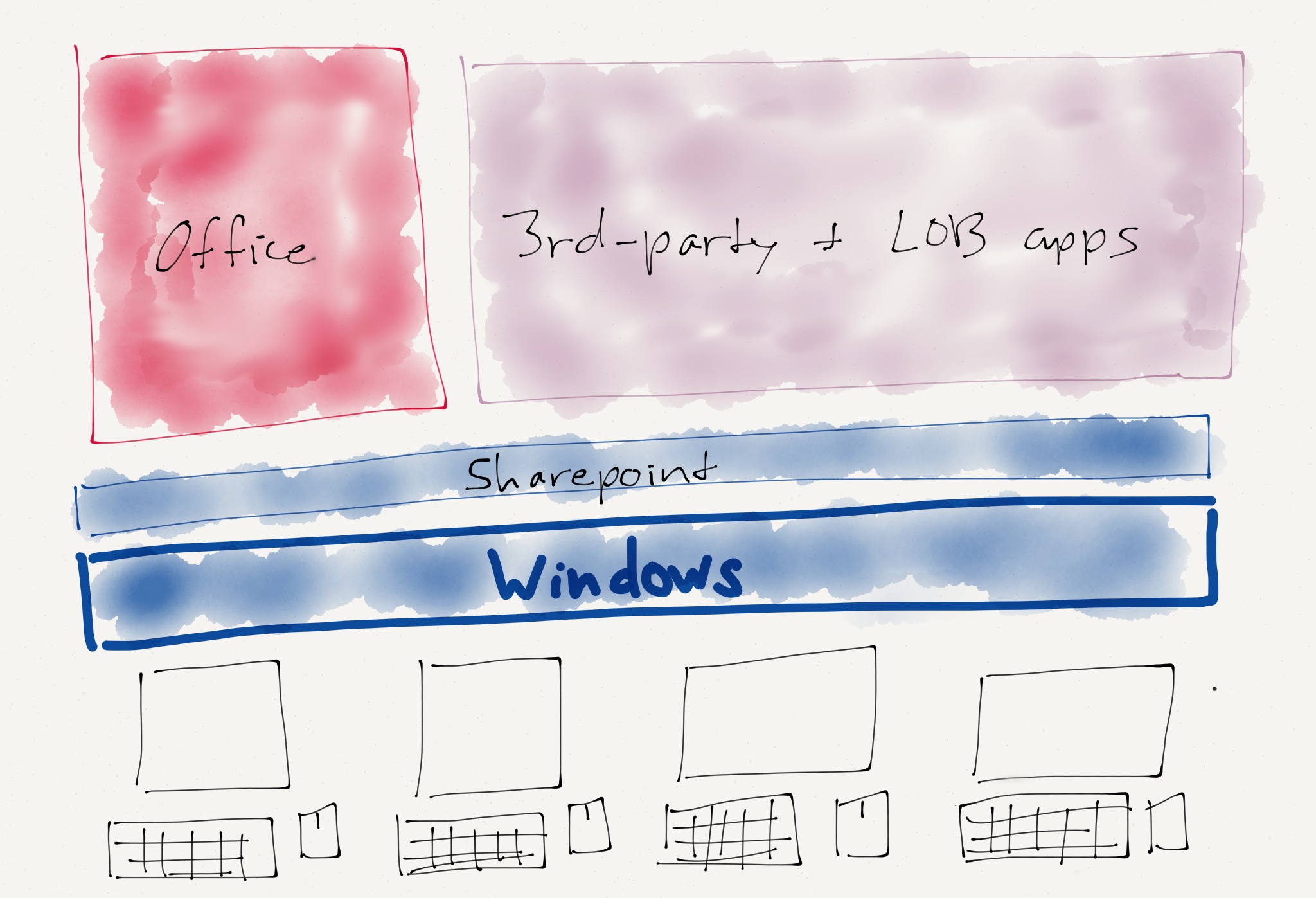
    Back when all computers were PCs, the dominant platform was Windows. Office obviously ran (better) on Windows, but so did an untold number of 3rd-party apps and custom-build line-of-business (LOB) apps. Considering the fact that enterprises bought most PCs, this meant Windows dominated.

    Windows was the platform that mattered in the PC era
    Windows was the platform that mattered in the PC era

    The browser began to break this hegemony apart,2 especially when it came to LOB apps, but the true fracturing has happened in just the last few years with the advent of smartphones and tablets. Now, only a portion of computing devices run Windows:

    While this chart covers the entire industry, it’s reflective of what is happening in the enterprise as well. Multiple devices with multiple operating systems are in daily use, but, at the end of the day, they all need to access the same data.

    Enter Box.

    Data: The New Platform

    Pure storage isn’t a great business. The cost is trending towards zero, as noted by Levie himself:

    Data, though, is priceless; it can’t be replaced, and it’s the essence of what makes a particular organization unique. For this reason, and for regulatory ones, there are all kinds of specialized controls that IT departments need for data. This is where Box has worked diligently to differentiate themselves from consumer-focused competitors like Dropbox (for more, see my article from January Battle of the Box).

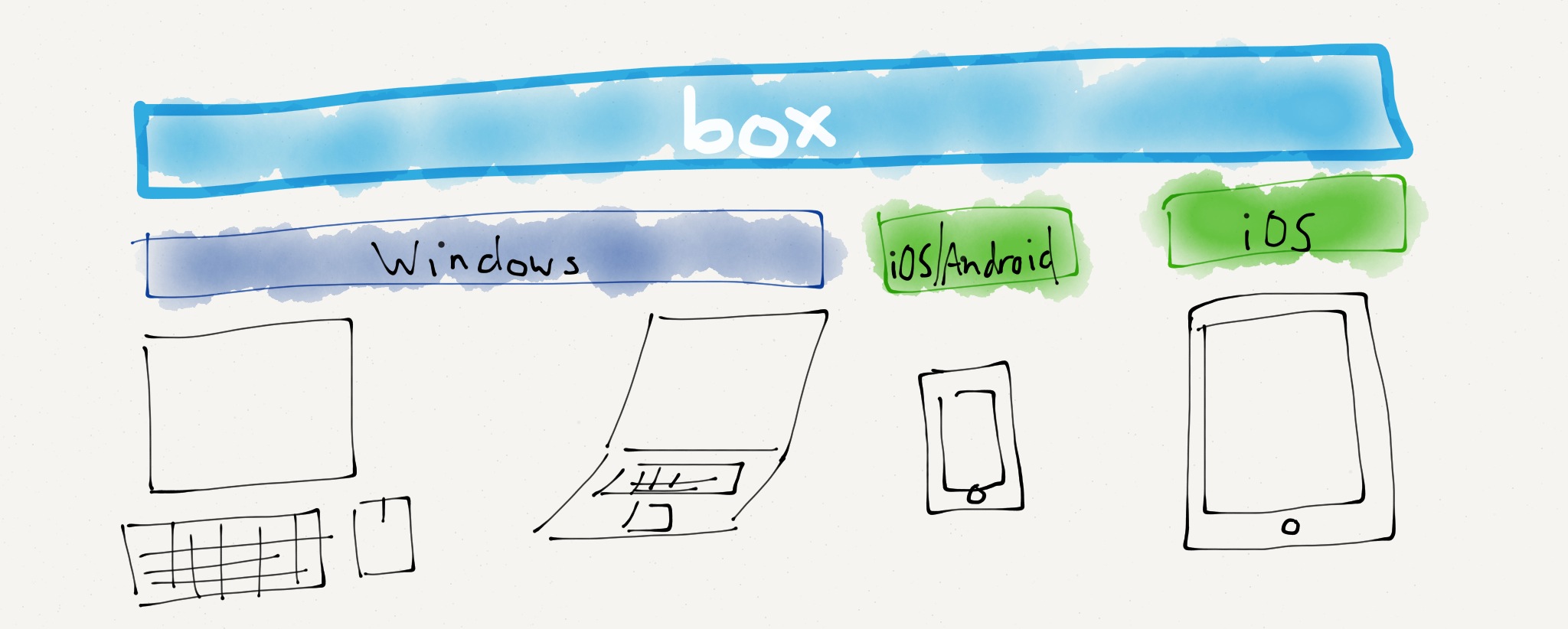
    At the same time, Box has embraced smartphones and tablets, building and updating apps on all the platforms, often well before competitors. This results in a service that looks something like this:

    By handling the data that needs to be available everywhere, Box is well-placed to be the new platform
    By handling the data that needs to be available everywhere, Box is well-placed to be the new platform

    This image explains why the arguably more significant news from Box last week was not the unveiling of their S-1, but rather the first Box developer’s conference. Just because the operating system is no longer the platform does not mean that the need – and opportunity – for a platform does not exist. Something needs to tie together all those computing devices, and data, which needs to be everywhere, is the logical place to start.

    This ups the stakes considerably. Platforms are multi-sided; in the case of Box, they need to have all the data, serve all the devices, and, most critically, have developers. Developers, though, are very pragmatic: they care about opportunity, and opportunity is a function of market size and ability to monetize. The latter is much less of an issue in the enterprise as compared to the consumer, which leaves scale as the most important differentiator from a developer perspective when they decide which platform to support.

    Spending a whole lot of money to scale quickly suddenly doesn’t seem like such a bad idea.

    The Microsoft Trump Card

    Last week, though, was not all good news for Box; on the same day as their developer conference, Microsoft held its own event to announce Office for iPad. Until now, Microsoft has been largely absent from the iPhone and especially the iPad, leaving some of the most important enterprise data – Office docs – available on basic viewers or 3rd-party editors only. This worked in Box’s favor, as their excellent iPad support made Office docs accessible, if not particularly usable.

    Office for iPad, though, is designed to work exclusively with Microsoft’s cloud services. Now, the best solution for dealing with Office docs anywhere is to use Microsoft’s data layer. In this way Apple’s sandboxed approach and lack of inter-app communication is working very much in Microsoft’s favor; you can open files stored in Box or other Cloud services with the Office apps, but the communication is one-way. Any changes you made can only be saved to your iPad or to your Microsoft cloud account (OneDrive, OneDrive Pro, or SharePoint).

    To be clear, SharePoint is a pain to use, particularly for end-users, and especially relative to Box. Less-than-full access to some of your most important data, though, is very painful as well, and it’s here that Microsoft just played their trump card. Office still matters for a whole lot of businesses, and the best Office experience is only available in conjunction with the Microsoft cloud/platform.

    Does Office Matter?

    The opportunity that Box is pursuing is the exact reason I have been so outspoken about Microsoft’s misplaced devices strategy. Steve Ballmer and his Windows obsession missed the fact that operating systems as a whole were increasingly irrelevant; Satya Nadella, whose background is in Microsoft’s cloud business, is actually pursuing the same old Microsoft strategy – use Office to prop up the Microsoft platform – he’s just leveraging it for the platform of the future, not the past.

    What is tricky is that future almost certainly includes fewer and fewer Office documents; the degree to which enterprises have transitioned away from ready-to-print documents to constant communication and collaboration will determine if Microsoft’s new strategy is successful – and, by extension, the degree to which Box realizes the growth they have so extravagantly invested in.


    1. James Bright made charts to better illustrate some of the concepts made in Suster’s article 

    2. Microsoft killed Netscape for a reason 


  • Face Is Not the Future

    There is certain logic to any Facebook acquisition given the current stock price. The current market valuation of $156 billion implies significant revenue growth on an annual basis far greater than simply converting desktop revenue streams to mobile ones; if you assume the stock price will decrease in the future, then making largely stock-based purchases makes a ton of sense. Moreover, Zuckerberg is highly incentivized to spend Facebook’s money; he only owns 28% of that money, but has 100% control of Facebook – and of whatever is purchased.

    So why not buy an option on what could be the next platform? That is Fred Wilson’s argument:

    But the roadmap has been clear for the past seven years (maybe longer). The next thing was mobile. Mobile is now the last thing. And all of these big tech companies are looking for the next thing to make sure they don’t miss it.. And they will pay real money (to you and me) for a call option on the next thing.

    Zuckerberg said much the same thing:

    Our mission is to make the world more open and connected. For the past few years, this has mostly meant building mobile apps that help you share with the people you care about. We have a lot more to do on mobile, but at this point we feel we’re in a position where we can start focusing on what platforms will come next to enable even more useful, entertaining and personal experiences.

    I have two very significant problems with this:

    • Buying WhatsApp was the first step in making Facebook competitive in the messaging space, but the job is not even close to being done. When I wrote Messaging: Mobile’s Killer App I barely mentioned WhatsApp simply because it is barely competitive with the platform that LINE and WeChat are building; for most users, it’s simply free SMS, and if Zuckerberg thinks Facebook is home safe in mobile, particularly in Asia, he is sorely mistaken.
    • More significantly, while Oculus’ technology is by all accounts incredible, I, quite strongly, don’t believe it is what is next for general purpose computing.1

    In this regard, perhaps the most pertinent article I’ve written wasn’t about Facebook at all; it was about Apple, and their new digital hub. I argued that Apple is positioning the iPhone as the center of your digital existence, with a potential iWatch as an extension of that, and, perhaps over time, the future hub.

    Setting aside implementation details for a moment, it’s difficult to think of a bigger contrast than a watch (or ring) and an Occulus headset that you, in the words of Zuckerberg, “put on in your home.” What makes mobile such a big deal relative to the PC is the fact it is with you everywhere. A virtual reality headset is actually a regression in which your computing experience is neatly segregated into something you do deliberately.

    The power of computing, at least in my world view, was best articulated by – who else – Steve Jobs years ago:

    What is so powerful about this analogy – that the computer is a bicycle for the mind – is that it elevates the humanity of a desired action, in this case transportation, and inserts the computer as an aid. This is exactly what the iPhone and the smartphones that followed have done for people: instead of a computer being a destination, it’s something that is always with us, ready to call up a map, or a restaurant recommendation, or simply fill time with a flapping bird. To put it another way, mobile is a big deal not because we use computers more, but because a computer is with us in more places.

    Envisioning a future in which Oculus’ technology is the dominant platform is diametrically opposed: it’s a reality where humans retreat from day-to-day activities in favor of computers. This idea – a life lived in computers – is something that appeals to the technically predisposed; who among us spends all day in front a glowing screen, and then goes home to do the exact same? I’m sure Zuckerberg is in that boat. But it’s a much smaller boat than many technologists realize.

    For most people, computers are a means, not an end. Computers help them create music, or write novels, communicate, wayfind, or hookup. To use Jobs’ analogy, it’s not that people want to ride a bicycle for a bicycle’s sake, but because they want to go from Point A to Point B; offering such a person a full-featured massage chair simply misses the point.

    Zuckerberg’s biggest strength is his willingness to adjust and adapt, as seen by Facebook’s mobile pivot. This acquisition, though, suggests that pivot was rooted more in a response to the facts on the ground than it was in a fundamental appreciation of why smartphones are the best bicycle yet, and that is concerning.


    1. Killer game platform though 


  • Newspapers Are Dead; Long Live Journalism

    This is Part 3 in a series on the future of news and newspapers. Previously:

    • Part 1: FiveThirtyEight and the End of Average link
    • Part 2: The Stages of Newspapers’ Decline link

    Newspapers are held up as an irreplaceable tentpole of a free society, especially by the journalists who work at them, but the people who actually started our most august institutions had a rather more pragmatic view: they saw a great opportunity to make money.

    Consider the New York Times, widely considered one of if not the best newspaper in the world. According to the History of the New York Times:

    One day early in 1851, Jones and Raymond [the founders of the Times] were walking across the Hudson on the ice when Jones observed that he had heard that The Tribune had made a profit of $60,000 — in those days an enormous sum — in the past year. This renewed Raymond’s enthusiasm, and before they reached the other shore he had obtained Jones’s promise to join him, if the re-demption bill passed, in the establishment of a new daily in New York. The bill did pass. Jones closed up his business, and he and his business associate, E. B. Wesley, prepared to put their money, with Raymond’s experience, into the new venture.

    And, for 150 years afterwards, newspapers were fantastic businesses, not just for Jones and Raymond. Understanding why, though, explains why the modern newspaper, with a few possible exceptions (such as – hopefully – the Times), is doomed.

    Ethical Wall = Value Wall

    Journalists pride themselves on an ethical wall1 between the editorial and business sides of the newspaper. This, in theory, allows the journalist to pursue the “truth”, without concern for undue influence. As far as I know, this is nearly universally accepted as a good thing. It’s also a big red flag, at least if you are someone like me who is interested in how businesses are built.

    The problem with this arrangement is a familiar one: the end user is the product, not the customer, no different than advertising-based businesses on the web, such as Google or Facebook. While this sort of division usually inspires concern that the quality of the end-user product will suffer, the opposite is also the case: it doesn’t matter how good the end-user product is if the money-making side of the business isn’t in good shape. This is exactly what is wrong with newspapers, and why, to journalists especially, the demise of newspapers feels like such an intractable problem: the quality of their work is mostly irrelevant to the financial well-being of their employer.

    How the Internet has Changed Advertising

    In There Are Two Twitters; Only One is Worth Investing In, I explained how the Internet has changed advertising (I’m going to extensively quote from that article; if you’ve read it, you can skip the quote):

    Previously, advertising channels like newspapers or television channels were the only means to a captive audience. For example, if you wanted to reach those living in Chicago, the Chicago Tribune or Sun Times were your primary options. This proved highly lucrative for those in the middle; their job was to create compelling content to ensure customers bought their product, which was in turn laden with advertising, from whence they made most of their money.

    The old advertising model involved a captive audience; a middle-man needed only to deliver content
    The old advertising model involved a captive audience; a middle-man needed only to deliver content

    The Internet has changed this in a few fundamental ways:

    • On the Internet, consumers are no longer captive. I have an effectively infinite array of choices for news, entertainment, etc., meaning the content that attracts me must truly stand out
    • The infinite array of content = an infinite amount of advertising inventory, destroying its worth
    • The nature of Internet advertising makes it possible to gather much richer data about consumers than was ever possible offline
    On the Internet, those in the middle have to deliver superior content and also collect superior targeting information
    On the Internet, those in the middle have to deliver superior content and also collect superior targeting information

    This has made life in the middle much more difficult, particularly for old-school advertising middlemen like newspapers. Commanding top rates depends not only on capturing consumers versus infinitely more competitors, but also knowing more about those consumers than anyone else. Targeting information is the new scarcity in advertising. It is the only way to sustainably increase average revenue per user.

    Let me be more blunt than I was in the original article: life is not “more difficult” for traditional newspapers; it’s unsustainable. They don’t have the best content, it’s not personalized, and they really don’t know anything about most of their readers.

    “But [Insert Newspaper Name Here] has great journalists! They’ve won Pulitzer Prizes! And our democracy needs newspapers!” Unfortunately, advertisers don’t, and newspapers are paying the price for having long ago divorced the cost of their content from the value readers place upon it. To put it another way, it’s not that “the Internet has unbundled advertising from content creation,” it’s that advertisers (rightly) don’t give a damn about journalistic ideals. It is incredibly tiring to hear newspaper defenders talk as if advertising dollars are their god-given right, and that Google and Facebook are somehow stealing from them, when in reality Google and Facebook are winning in the fairest way possible: providing better value for the advertiser’s dollar.

    The Internet Upside

    Throughout this series, I’ve been very careful about separating the “news” from “newspapers.” The Internet has killed the latter, but is the impetus behind a new golden age for the former. Crucially, that golden age is not only for readers, but writers, too. The Internet provide three huge advantages over newspapers:

    • Distribution is, for all intents and purposes, free. WordPress, which powers most blogs (including at many newspapers) is open source,2 and hosting is extremely cheap. With minimal effort and with no support your writing can be published.
    • The addressable market – everyone with an Internet connection who can read the writer’s language – is multiple orders of magnitude larger than that of any traditional newspaper
    • The potential reach of any given post is equal to the addressable market, thanks to social networks like Twitter, Facebook, and even email

    Remember how the New York Times was started as a means of making money? After the first year the paper had a circulation of 26,000 in a city of over half a million, but had incurred up-front capital costs of $50,000, and first-year expenses of $78,000 (In 1851 dollars; the modern equivalent would be $1.4 million and $2.2 million respectively). Compare that to this blog (which, by happy coincidence, turns one year old tomorrow, making this comparison timely): FiveThirtyEight and the End of Average, the first article in this series, has been read by over 30,000 people; meanwhile, I’ve spent less than $2,000. More readers, way less money.

    You may consider the comparison unfair – an entire newsroom putting out a daily edition as compared to a solo blogger posting one article – but the unfairness is the point. No one shared my article because it was from Stratechery, but then again, no one shares an article today just because it’s from the New York Times; all that matters is the individual article and its worth to the reader and potential sharer. As a writer, this is amazing. When it comes to reader attention, I am competing on an equal footing with The New York Freaking Times! Unfortunately for The New York Times, when it comes to making money they’re competing with Google and Facebook. Most distressingly, though, when it comes to costs, they’re competing with the last 150 years. Everything from printing presses to sales and marketing is deadweight if advertising is not a sustainable model.

    Business Models of the Future

    The reason why I find business models so fascinating is because your business model is your destiny; newspapers made their bed with advertisers, and when advertisers left for a better product, the newspaper was doomed. To change destiny, journalists need to fundamentally rethink their business:

    • More and more journalism will be small endeavors, often with only a single writer. The writer will have a narrow focus and be an expert in the field they cover. Distribution will be free (a website), and most marketing will be done through social channels. The main cost will be the writer’s salary.
    • Monetization will come from dedicated readers around the world through a freemium model; primary content will be free, with increased access to further discussions,3 additional writing, data, the author, etc. available for-pay.
    • A small number of dedicated news organizations focused on hard news (including the “Baghdad bureau”) will survive after a difficult transition to a business model primarily focused on subscriptions, with premium advertising4 as a secondary line of revenue. This is the opposite of the traditional model, where advertising is the primary source of revenue, with subscriptions secondary.

    This transition will be a painful one: the number of traditional journalists and newspapers will decrease dramatically. Moreover, those that succeed will need to have a much expanded skillset from journalists of yore, including basic website management, self-promotion, business skills, speaking ability, etc. (teaching these skills is an important opportunity for journalism schools). What is sure to be most frightening – or exciting, depending on your outlook – is that the market will, for the first time in the history of news, be the ultimate arbiter of what writers are worthwhile.

    I know that last sentence sent chills down the spine of many a journalist and many a reader; you believe that people only care about the popcorn, not the movie. That no one will cover the local school board, or the Crimea. If you’re nodding your head, then I have a challenge for both of you:

    • For the journalist, do you believe that your work is valuable? Then start a blog, and start experimenting with business models. Go door-to-door or start a kickstarter. If you think it’s hopeless, then get out now. There will be a few big winners, but it won’t be you.
    • For the reader, how often do you visit the New York Times or the Wall Street Journal? Do you pay? Do you love tech? Well, then, have you even considered trying out The Information? It’s exceedingly easy to sit on the sidelines laughing at journalists freaking out about the end of the newspaper, but if you always go for free you will, eventually, get exactly what you pay for.

    I don’t think the future of news is an easy problem; my solution, such that it is, entails the death of journalism as we know it (i.e. employed by newspapers). But that’s exactly how new business models are born: a thousand new flowers in the burnt-out forest of what no longer works.


    1. This is commonly called a Chinese Wall, but the term strikes me as an unfortunate one. Its origins are unclear 

    2. Disclosure: I work for Automattic, which contributes to WordPress and offers WordPress hosting at WordPress.com 

    3. Why are comments free? 

    4. These news organizations will be able to charge a significantly higher rate because most of their readers are paid customers; they are worth more 


  • The Stages of Newspapers’ Decline

    The second-most common objection to FiveThirtyEight and the End of Average was along these lines:

    That’s very true; those same people – and there are a lot of them – didn’t read the news in a newspaper either. Instead they read the Style section, or Sports, the comics or Dear Abby. It doesn’t really matter though – the same principle of the best killing the average still applies. What is Buzzfeed if not funnies for grownups?

    Even that, though, undersells what is happening: it’s not only that the Internet lets you find the objectively best content, but that it also lets you find the subjectively best content based on your interests.

    To return to the same Columbia Journalism Review article I quoted in the last post:

    But the control of distribution that was so profitable IRL hasn’t ended online. It just moved, passing from newspapers, TV stations, and the post office to the companies in Andreessen’s portfolio, which happen to have zero cost of content: Google, Facebook, and Twitter (plus the ISPs).

    Google’s gross profit margins were 57 percent last year and Facebook’s were 76 percent, which is just bananas. Gannett at the peak of its labor-cutting and advertiser-milking could never have dreamed of those kinds of margins.

    Google has 67 percent of the search market. It alone hauls in 41 percent of all online advertising in the entire country.

    And why shouldn’t it? The entire premise of Google is that it finds exactly what I am looking for. The potential of Twitter is that it can be perfectly tailored to my interests. A newspaper designed to appeal to the largest cross-section of people with a bundle that includes everything from international news to the horoscope is much, much less likely to have exactly what I’m looking for, and only a small percentage of what it has will be close.

    It’s interesting to map the demise of newspapers against the evolution of communication on the Internet:

    • Stage 1 was simply moving offline content online. This let anyone anywhere access the objectively best, like the New York Times. This decimated a lot of local newspapers, like the Wisconsin State Journal (per my last post)
    • Stage 2 was the introduction of user-generated content broadly, and social specifically. This dramatically increased the range of content available, even as it made it easier to find content subjectively better for any one person. This is when even the objectively best newspapers really started to feel the pain
    • Stage 3 is the mobile and contextual stage, highlighted by the rise in messaging. This is about delivering content that is not just personalized but contextually appropriate to my specific situation. What chance does an industry based on broad reach and the idea of daily editions have?

    In case you’re wondering, the most-common objection to FiveThirtyEight and the End of Average was that I didn’t address the demise in advertising. That was intentional; while I plan on talking business models – and it’s an important topic – I think that people in the news industry are too quick to attribute their problems to ads, and too slow to understand how incompatible the Internet is with their definition of a newspaper. Newspapers may be screwed, but we can’t start fixing news until we understand what we’re trying to save, and what is simply a relic.


  • FiveThirtyEight and the End of Average

    Just a few minutes ago, Nate Silver’s new FiveThirtyEight site launched. While it’s not known how much ESPN is paying Silver, it’s certainly a substantial amount, especially when you consider 20% of visitors to the New York Times stopped by Silver’s blog.

    Silver’s FiveThirtyEight is one of a growing number of personality-driven sites and blogs, including Ezra Klein and Vox, Andrew Sullivan and his eponymous blog, and Silver’s colleague at ESPN, Bill Simmons of Grantland. All three are successful because of the Internet, their readers (including myself) love them, what’s not to like?


    The ongoing death of the newspaper is, particularly among newspaper folks, attributed mostly to the loss of advertising dollars. For example, writing in response to Marc Andreesen’s bullish tweets about the future of news, Ryan Chittum wrote at the Columbia Journalism Review:

    The existential problem for the news is that the Internet has unbundled advertising from content creation. The new digital monopolies all have hundreds of millions of people creating free content for them. That’s where the big profits are. Oh, sure, there are major differences between the old newspaper monopoly distribution model and the digital one. But the similarities are greater.

    The equivalent of Google, Facebook, and Twitter in the pre-Internet days would be a newspaper that shut down its newsroom, kept the ad department (though replacing much of it with robots), and printed stuff other people wrote. Today, Facebook’s got your weddings, baby announcements, and soccer pictures. Twitter’s got your breaking news. And Google’s got your stock listings, sports scores, news, recipes, etc. Oh yeah, and Craigslist has your classifieds.

    The problem with Chittum’s analysis – and why I think he missed Andreesen’s point – is, ironically, his choice of words. “News” does not mean “newspapers,” and while the latter is surely dead, the former is, for readers anyway, entering a golden age.


    My father has always subscribed to the paper; The Wisconsin State Journal, specifically, which makes sense, given that I grew up in Madison. As far as newspapers go, the Wisconsin State Journal that I grew up with was probably about average, right in the middle of the bell curve:

    Pre-Internet, some papers were great, some were terrible, most were average.
    Pre-Internet, some papers were great, some were terrible, most were average.

    Long a news hound, I read that paper cover-to-cover throughout high school, and, when I headed off to college, marked the occasion with a subscription to the New York Times. I was moving up in the world.

    Today, though, I don’t subscribe to the Times, and I only read an article in the Wisconsin State Journal when I’m visiting my parents and forget to bring my phone into the bathroom. Instead I get most of my news via Twitter, and it’s amazing. Take, for example, this piece I read yesterday about “anonymous” apps like Secret and Twitter: it was posted on Medium, a site built on the idea that nothing matters beyond the content of an individual post, and it was probably the best thing you’ll read on the subject. Over the last 24 hours I’ve also enjoyed this tech piece at Daring Fireball, this basketball piece by Zach Lowe at Grantland, this literary piece from the Guardian, and this culture piece in the New York Times.

    The net result is that my news consumption looks a lot more like a power curve than a bell curve:

    Today I can afford to read only the best, regardless of where it is published
    Today I can afford to read only the best, regardless of where it is published

    Most of what I read is the best there is to read on any given subject. The trash is few and far between, and the average equally rare.

    This, of course, is made possible by the Internet. No longer are my reading choices constrained by time and especially place. Why should I pick up the Wisconsin State Journal – or the Taipei Times – when I can read Nate Silver, Ezra Klein, Bill Simmons, and the myriad other links served up by Twitter? I, and everyone else interested in news, politics, or sports, can read the best with less effort – and cost – than it ever took to read the merely average just a few short years ago.


    Nate Silver’s manifesto for his new site is 3500 words long, meaning it would take the average adult just under 12 minutes to read. That 12 minutes is then gone forever, a bit of attention taken from whatever other activity said reader would have otherwise consumed, and instead gave to Nate Silver. That is why Nate Silver is so valuable.

    The implication of my news consumption being dominated by the tall skinny part of the power curve is that those who can regularly appear there – the best of the best – are going to win the zero sum game for my attention. And, for that, they will be justly rewarded.

    What then, though, of the tens of thousands of journalists who formerly filled the middle of the bell curve? More broadly – and this is the central challenge to society presented by the Internet – what then of the millions of others in all the other industries touched by the Internet who are perfectly average and thus, in an age where the best is only a click away, are simply not needed?

    This is the angst that fills those in the news business, and society broadly. The reality of the Internet is that there is no more bell curve; power laws dominate, and the challenge of our time is figuring out what to do with a population distribution that is fundamentally misaligned with Internet economics.


  • Samsung’s Disappearing Differentiation

    Earlier this week Samsung, and I’m quoting the headline of the press release, “Unveil[ed] Comprehensive, Lifestyle-Focused Galaxy Gifts Package for Next Generation Galaxy S5”:

    Samsung Electronics Co., Ltd. today announced its collaboration with 16 of the world’s leading mobile content and service providers to offer Galaxy S5 users more than $600 worth of exclusive, pre-paid and discounted subscriptions. From fitness to news to productivity apps, the Samsung Galaxy S5 comes with meaningful rewards, to make the Galaxy S5 experience even more enjoyable and productive…1

    Designed for what matters most to consumers, the Galaxy S5 is redefining how technology innovation enhances everyday life by providing a refined experience focused on the most essential features for day-to-day use. Samsung’s Galaxy S5 combines an advanced camera, the fastest network connectivity, dedicated fitness tools and enhanced device protection features so consumers can stay fit and connected in style.

    I would love to know in what direction the money is flowing with these deals:

    • If Samsung is getting paid, it’s basically stealing from the PC OEM playbook; most of the profit in PCs comes from so-called “crapware,” and Samsung is certainly feeling margin pressure in its smartphone business
    • If Samsung is paying, that’s even more telling – they’re effectively trying to buy differentiation. This, too, has precedent: Samsung has used its cash position very effectively for advertising, spiffs for salespeople, etc.

    Regardless, both scenarios highlight Samsung’s increasingly vulnerable position in smartphones. So does the fact that Samsung’s American business hired a former P&G VP as vice president of marketing strategy and operations. P&G is the king of consumer packaged goods (CPG), with well-known brands like Tide, Pampers, and Gillette. That business is all about block-and-tackle marketing2 and brand-building such that you can sell a relatively undifferentiated good – like laundry detergent, diapers, or razors – at a premium. Sound familiar?

    Were every smartphone in the world Android, I’d feel a lot better about this strategy; there absolutely are consumers who buy based on brand and/or value the small bits of differentiation provided by the higher-cost option. Unfortunately for Samsung, Apple also makes smartphones, and they have effectively skimmed off all the customers who care about such things. The number of people who both prefer Android and care about brand and cutting-edge tech is only going to decrease as the delta between a $650 S5 and a $200 Chinese brand diminishes. Expect the margin pressure to continue.


    1. The companies involved: RunKeeper, MapMyFitness, Skimble, Lark, Paypal, Wall Street Journal, Bloomberg Businessweek+, LinkedIn, Cut the Rope 2, Flick Dat, Box, Dropbox, Bitcasa, Blurb, EasilyDo Pro, and Evernote 

    2. Non-flashy marketing basics. For P&G, think things like coupons, direct mail, store displays, etc. 


  • Digital Hub 2.0

    My question last week – How Much Will CarPlay Cost – was not an idle one. Most readers – and I include myself in this group – presume that CarPlay is, as I wrote, “a strategy that is based more on propping up the iPhone than on building a separate revenue stream.”

    Another way of putting it is that Apple is constructing a world with accessories that connect with and are powered by their flagship device. Call it Digital Hub 2.0.

    Digital Hub 1.0

    The articulation of the original “Digital Hub” strategy remains one of my favorite Steve Jobs keynotes. Jobs began by recounting the conventional wisdom about the PC – boring and dead:

    This is what everybody else is telling us: that our PC is waning, if not the hole being dug. One of the smartest journalists in our business, this guy named Walt Mossberg, somebody I admire because he cares about the same things we do. And even Walt, a few weeks ago said, “The PC, which has carried the digital revolution for the last 24 years, has matured into something boring.” That hurt, but Walt’s really smart, and we listen to him very carefully. Mike Capellas, who runs Compaq, “We don’t think of it in terms of the PC business anymore.” Hm. And Jeff Weitzen, who runs Gateway, “We’re clearly migrating away from the PC as the centerpiece.”

    An animated Jobs adamantly disagreed:

    We are living in a new digital lifestyle with an explosion of digital devices. It’s huge. And we believe the PC, or more importantly the Mac, can become the digital hub of our new emerging digital lifestyle, with the ability to add tremendous value to these other digital devices.

    Jobs’ prime example was the effect iMovie had on your camcorder, making it worth 10x as much:

    And we saw that the benefit here was a combination of a bunch of things. It was hardware, the computer and other hardware, the operating system, the application, the Internet, and marketing to create this solution…So we thought this was very important and it took all these components and we realized that Apple is uniquely suited to do this because we’re the last company in this business that has all these components under one roof. We think it’s a unique strength. And we discovered this with iMovie 2, that it could make a digital device called the camcorder worth 10x as much. It’s 10x more valuable to you.

    The parallels to today should be obvious. The consensus from this year’s Mobile World Congress was that smartphones are boring now, innovation has peaked, even as Apple remains the sole vendor in control of the entire stack. So why not Digital Hub 2.0?

    Whither iCloud

    It was Steve Jobs himself who, in his final keynote, declared that the Digital Hub strategy had run its course:

    About ten years ago, we had one of our most important insights. And that was that the PC was going to become the digital hub for your digital life…but it’s broken down in the last few years. Why? Well, because the devices have changed…

    So, we got a great solution for this problem. And we think this solution is our next big insight. Which is we’re going to demote the PC and the Mac to just be a device, just like an iPhone, an iPad, or an iPod Touch, and we’re going to move the digital hub, the center of your digital life into the cloud, because all these new devices have communications built into them, they can all talk to the cloud whenever they want…we call it iCloud.

    Apple’s shortcomings with cloud services are well-documented (even Jobs cracked a joke about MobileMe while introducing iCloud), and iCloud hasn’t improved things much. And, frankly, no wonder:

    • Apple, which prides itself on perfection and big releases, isn’t well-suited culturally to building cloud services that depend on iteration and failing gracefully.
    • Apple’s business model is about selling devices, not monetizing cloud services
    • Apple won’t lose customers if their cloud services are subpar (the flipside of the previous point)

    In other words, were iCloud truly the center of Apple’s strategy going forward, they would be at a disadvantage. I think, though, that while iCloud did indeed supersede the old Digital Hub strategy, it’s not the end-all-be-all.

    The Three Types of Services

    “Services” is a word that is well on its way to being meaningless; you might as well ask what isn’t a service. I think it makes more sense to consider three clear categories:

    1. Device-agnostic services – These services are native to the web, and work the same everywhere. Think email, calendar, search, etc. In the consumer market, these are primarily funded through ads, and while iCloud provides things like Mail and Calendars, it’s not a differentiator, and hasn’t been for many years now.

    2. Content services – Content was at the heart of the old Digital Hub strategy: things like movies, videos, music, etc. Apple has long been exceptionally strong here, and iCloud is actually a continuation of that strength. iTunes Match, for example, is a great service, and Photo Stream, for all its limitations, works well, particularly when it comes to private sharing. The cloud is clearly superior to the old sync model at the heart of Digital Hub 1.0.

    3. Device services – This is new, and it’s a place where Apple has a significant opportunity. Device services are physical devices that are improved by means of your primary device. Think Nest, the Nike Fuel Band, or Sonos. In fact, you’ve almost certainly encountered the other name for device services: the “Internet of Things.”

    A computing company that manages the entire stack around their device almost certainly has an advantage in this new services frontier.

    Digital Hub 2.0

    Think again about the CarPlay announcement. Your iPhone plugs into the car, and projects a control surface onto the dash; nothing is done by the car, it’s simply a conduit. It is, in fact, rather like an Apple TV with a car-specific UI. Again, a passive screen, effectively rendered an extension of the device in your hand. Were I to illustrate, it might look something like this:

    The iPhone as a new kind of digital hub
    The iPhone as a new kind of digital hub

    What is your iPhone if not a digital hub? And, if that is true, might we be entering a new smartphone golden age?

    iWatch

    It’s true, of course, that the “Digital Hub” was the last golden age of the PC; one of the digital accessories for the PC was the iPod, which led the way to the iPhone and iPad, which relegated the PC to a specialized device. It wouldn’t surprise me if, over the course of the next decade, the alleged iWatch follows a similar path with regards to the iPhone.

    Imagine a device that initially launches with limited functionality and is dependent on an iPhone (similar to the iPod, or the first iPhone). Perhaps it monitors fitness and health, and slowly, year-by-year, adds additional functionality. More importantly, assume that Moore’s Law continues, batteries make a leap forward, flexible displays improve, etc. Suddenly, instead of a phone that uses surrounding screens, like the iPhone does in the car and the living room, why might not our wrist project to a dumb screen (with a phone form-factor) in our pocket as well? Imagine all of our computing life, on our wrist, ready to project a context-appropriate UI to whichever screen is at hand. Moreover, by being with us, it’s a perfect wallet as well.

    To be clear, this is certainly years off, but then again, the iPhone was decades off when NeXT was founded in 1985. The NeXTStep operating system is at the heart of iOS, and the iPhone wouldn’t be possible without it, or without OS X in 2001, iTunes and the iPod in 2001, or the App Store in 2008. Innovation is not the result of a moment in time, but of painstaking progress over years, even decades, and to my eyes, Apple is building something really interesting.


  • How much will CarPlay cost?

    Wes Miller has a useful summary of CarPlay:

    In short, Apple hasn’t done a complete end around of the OEM – the automaker can still have their own UI for their own in-car functions, and then Apple’s distinct CarPlay UI (very familiar to anyone who has used iOS 7) is there when you’re “in CarPlay”, if you will. It seems to me that CarPlay can best be thought of as a remote display for your iPhone, designed to fit the display of your car’s entertainment system. Some have said that “CarPlay systems” are running QNX – perhaps some are. The head unit manufacturer doesn’t really appear to be important here. The main point of all of this is it appears the OEM doesn’t have to do massive work to make it functional, it really looks to primarily be integrating in the remote display functionality and the I/O to the phone.

    In fact, the UI of the Ferrari as demonstrated doesn’t look to be that different from head units in previous versions of the FF (from what I can see). Also, if you watch the Apple employee towards the end, you can see her press the FF “app”, exiting out to the FF’s own user interface, which is distinctly different from the CarPlay UI. The CarPlay UI, in contrast, is remarkably consistent across the three examples shown so far. While the automakers all have their own unique touches, and controls for the rest of the vehicle, these distinct things that the phone is, frankly, better at, are done through the CarPlay UI.

    It’s fascinating to think about who owns the power here. On one hand, geeks like myself may very well base a car purchasing decision on CarPlay; then again, it was geeks like myself who were willing to change carriers to get an iPhone. Many simply stayed with their carriers and waited for the iPhone to come to them.

    The proportion between those two types was the basis of one of the more interesting bets in recent years; Apple originally wanted to launch the iPhone on Verizon, but Verizon refused to give Apple carte blanche over the user experience and phone appearance. AT&T née Cingular, on the other hand, gave over said control in exchange for exclusivity, and, ultimately, Apple (and AT&T) won the bet: enough users left Verizon that they had no choice but to acquiesce to Apple.

    If that is the case with cars, then a CarPlay option is likely to be more expensive than a standard entertainment system, not less. Apple will push the idea that CarPlay will drive purchase intent, and that car makers ought to pay for the privilege.

    On the other hand, the car industry is far more concentrated than even the carrier industry, with only about 10 players that really matter. Moreover, when it comes to a 10s of thousands of dollars purchase, just how much of a role can an Apple-designed entertainment system play? The Mercedes and Ferrari systems, with control-knob and resistive touch display control respectively, certainly suggest that Apple – who would certainly prefer a Volvo-like capacitative display – doesn’t have as much control over the interface as they would normally be accustomed to. This would suggest a much lower price, and a strategy that is based more on propping up the iPhone than on building a separate revenue stream.

    Regardless, the primary takeaway remains, as always, that the product itself is not nearly sufficient to fully understand the strategic intent.