Stratechery Plus Update

  • Promotion in the App Store

    Two interesting articles last week, better together.

    First came TheInformation’s1 maiden piece about How Apple Gives Some Apps an Edge (subscription required):

    Being featured [in the App Store] can be a developer’s jackpot. Developers say that it could cost them between $100,000 and $300,000 in marketing to buy as many downloads as they receive from being highlighted in Apple’s “Editors’ Choice” section of the App Store or listed as a “top app.” Eyeballs in the App Store are particularly valuable because the store reaches users in the mood to find a new app.

    But for developers, the connections yield more than promotional buzz. Developers also get key product advice and access to Apple engineers starting long before a product launch.

    Apple, in turn, gets a way to shape the multi-billion dollar app market. The company says the system is designed to find and promote great apps. In practice, the criteria for “great” can include not only a well-designed app, but also whether it includes features Apple wants to push. Those might include whether the app runs the latest version of its iOS mobile operating system or whether it is tailored to international users. It also helps if the app is exclusive to Apple’s App Store.

    The next day came news that Cut the Rope 2 was launching in two weeks, and that it would be exclusive to iOS. From VentureBeat:

    Misha Lyalin, the CEO of Russian mobile developer ZeptoLab, announced the Dec. 19 release date of Cut the Rope 2 at a press event Thursday night.

    The sequel to the best-selling physics-based puzzle game will debut exclusively on iOS devices, at a limited time discounted price of 99 cents. This new adventure has franchise mascot Om Nom embarking on a journey to restore his collection of candies, which has been stolen by a mischievous gang of spiders. Lyalin described the game as hard but still definitely accessible to children, particularly through a story with many animated cutscenes and an interactive Om Nom on the main menu.

    To be sure, the timing of the articles was pure coincidence, and perhaps the content of the articles was coincidence as well. But I don’t think so. This is smart business on both sides:

    • Apple gets yet another example of a must-have app that is only on iOS. While there is no doubt Cut the Rope 2 will eventually make its way to Android, and probably to Windows Phone and Windows as well, even those launches will simply reinforce the idea that if you care about apps, you ought to buy an iOS device
    • ZeptoLab will certainly get massive app store promotion for their launch, guaranteeing a hit. And, when something is a hit on iOS, then it will likely be a hit on Android whenever it finally comes over

    The truth is that paying for apps, as Windows Phone is famous for (but not Windows, at least while I worked there as an app store category manager), is very rare, and for good reason: it results in low quality ports and added support costs for the developer, not to mention terrible PR that reinforces a platform’s weakness. But there remain lots of tools in the app store manager’s chest:

    • App store promotion can be traded for exclusives (or, in the case of a lower profile app store, ports)
    • The withdrawal of promotion can be threatened to retain exclusives. As an app store category manager for Windows in the runup to the launch of Windows 8, I heard this more than once: some marquee developers who were predisposed to support Windows 8 (again, this was pre-launch) ultimately didn’t for fear they would lose favorable treatment from Apple
    • Exclusive or desired ports could be promised favorable treatment in marketing
    • Platform owners could buy paid marketing on an app’s website or other properties. This is more pertinent to content owners, particularly magazines and newspapers, which have lots of paid marketing for sale
    • Apps could be featured in retail stores, or in keynotes and other public events

    I have no idea the degree to which Apple (or Google or Microsoft) uses these tools, but I’ve heard various iterations of all of these. The bigger question is where does that leave the small, independent developers?

    At a disadvantage, to be honest. App Store promotion, is, as TheInformation details, a bit of a black box that favors large developers.2 And that shouldn’t be a surprise.

    The truth is that the app stores are really just that – stores. Your typical grocery store, for example, stocks thousands of items, but the ones with large branded sections or on the ends of aisles aren’t there by accident: there is negotiation and favors traded, and usually money, and the small guys are at a disadvantage. In fact, much more of a disadvantage than those in app stores. At least app stores have unlimited capacity, unlike a grocery store, and algorithmic lists that are outside of human control. Moreover, in my experience, money changing hands isn’t really part of the equation.

    This is why, while I have been very critical of Apple’s reticence in enabling sustainable business models, I haven’t really said much about top lists or the structure of the App Store itself. The best means of promoting your app is to do it yourself, and, more importantly, build it with a cost structure that is sustainable.

    The vast majority of apps are lifestyle businesses; hoping they’ll be something more – and accepting VC/Angel money to make it so – simply doesn’t make sense. And those with higher aspirations best start valuing marketers just as highly as their engineers.


    1. A quick aside about TheInformation’s business model: I’m actually relatively bullish. TheInformation has only eight employees, a few of whom look to only be part-time. That means costs are low (and the entire venture is bootstrapped), which means TheInformation only needs a few thousand folks to expense a subscription in order to turn a nice profit. There is, in fact, a lesson here that applies to the conclusion of this piece 

    2. Microsoft, to its credit, originally refused to play this game at all. The Windows 8 app store was designed to be completely meritocratic; as a category manager I could not guarantee an app would be featured. The idea was this would increase the appeal to said independent developers, placing them on an equal footing with the big guys. Over time, though, this stance softened out of necessity 


  • Amazon and the Benefits of Vision

    In case you missed it – and how could you? – this happened:

    While professional skeptics have been skeptical, the sheer audaciousness – and frankly, awesomeness – of Amazon’s drone proposal has attracted a near unanimous outpouring of amazement and adulation, at least if my Twitter feed is to be believed.

    It truly is a masterstroke, and perhaps the purest expression of the unbounded vision Jeff Bezos has. The benefits are manifold (even if the drones never actually come to pass):

    • Positive PR: To say that the drone story generated positive PR is a dramatic understatement. Amazon, particularly in the holiday season, is susceptible to horror stories about work conditions in their distribution centers, and this helps blunt that
    • Increased Sales: The happy coincidence of the drone reveal happening the day before “Cyber Monday” was certainly noted by the aforementioned skeptics, and there is likely some truth to the claim that Amazon saw great benefit in being front-of-mind for consumers planning holiday purchases
    • Improved stock performance: While Amazon’s stock is up over the last few days, the added justification of their insane P/E ratio is the more important takeaway. The most elementary valuation of a stock is the sum of all future (discounted) growth, and talking about drones leaves open the possibility that Amazon’s business isn’t even close to being fully fleshed out
    • Improved morale: My timeline, both on Twitter and Facebook, is full of Amazon employees simply in love with their company. That translates into that many longer hours at too little pay during the most difficult month of the year
    • Competitive pressure: In this case I’m referring to the pressure Amazon is putting on not just its competitors, but also its partners. Small surprise that UPS suddenly announced that they too are looking into drones. This helps keep them on their toes.

    And yet, vision that moves the needle like this drone announcement is exceedingly difficult to pull off for a few reasons:

    • Vision must be aligned to the company’s mission: What is great about the drones is that they actually make a lot of sense given Amazon’s core business model. As I wrote previously in Amazon’s Dominant Strategy:

      Jeff Bezos’ critical insight when he founded Amazon was that the Internet allowed a retailer to have both (effectively) infinite selection AND lower prices (because you didn’t need to maintain a limited-in-size-yet-expensive-due-to-location retail space). In other words, Amazon was founded on the premise of there being a dominant strategy: better selection AND better prices – the exact same as Sears.

      And, just like Sears, Amazon has added convenience. No, they haven’t opened retail stores; instead they created the amazing Amazon Prime. Prime is the reason my family made 173 separate orders from Amazon in 2012: it’s so much more convenient to order toothpaste the moment you open the last tube than it is to make a trip to Target. And Amazon is pushing even further down this route, testing same-day delivery in multiple markets for everything from said toothpaste to TVs to tomatoes.

      And, now, potential 30-minute delivery

    • Vision must be surprising, yet (just) plausible: Vision that is totally predictable is likely attainable, but doesn’t garner any of the aforementioned benefits. On the other hand, vision that simply isn’t possible destroys credibility.

      Amazon Prime Air came out of nowhere, and yet, if you squint your eyes just enough, you can see it coming true. Talking about marginally decreasing page load times may be impactful (and you can be sure Amazon is focused on this), but it doesn’t exactly inspire

    • Vision must come from a trustworthy source who has done it before: Companies that regularly promise a fantastic new future and then fail to deliver lose vision because they lose credibility. This isn’t an issue for Amazon:


    The benefits of vision are clear, and yet, given the necessary conditions, vision that resonates is quite rare. Just take a look at some of the largest consumer technology companies (in order):

    1. Amazon: Still laser-focused on completely owning shopping. Infinite selection, lowest prices, and, in the future, immediate delivery
    2. Google: Still laser-focused on organizing all of the world’s information, even if it makes folks uncomfortable that that information includes you. Things like self-driving cars and Google Glass fit the vision criteria nicely as well
    3. Apple: Still laser-focused on iterating great products that people love to use, but there are reasons for concern, particularly when it comes to the iPad. That’s not a surprise, actually: the iPhone and the Mac are operating in defined markets; while the iPad is defining a new one, and is thus more dependent on vision. This is precisely why I find recent iPad marketing so concerning; if Apple isn’t getting that right, is it for lack of vision? And if so, what does that mean for future products?
    4. Facebook: The challenge for Facebook is not a lack of vision – clearly, they wish to connect everyone – but rather, that they have just about accomplished their founding goal. What’s next?
    5. Twitter: Twitter is in many ways the exception that proves the rule. It’s not clear what vision, if any, the current management team has, but the product is so good that it hardly matters. Except, of course, it does, particularly now that Twitter is a public company. Will they maximize their potential?
    6. Microsoft: Microsoft suffers from a more advanced case of Facebook’s malady: they have long since accomplished their goal of a PC on every desk. From Skating Towards the Goal:

      But again, what is the new goal? What is Microsoft’s reason for being? What ends are achieved by a massive conglomerate spanning CRM systems to database software to gaming consoles? Microsoft, perhaps more than any other company, needs focus, vision, and a problem worth solving. To be sure, that falls on the next CEO, but the bigger question that must be asked is if such a problem – one suitable for the unwieldy behemoth that is Microsoft – even exists.

      This uncertainty is why Microsoft’s impressive R&D arm is still rather irrelevant. How can you create something aligned to the company’s mission when said mission is so murky? And, of course, this is compounded by Microsoft’s tendency to overpromise and underdeliver

    7. Yahoo: Marissa Mayer is nice, but does anyone yet know what the point is? At least Microsoft’s core business – enterprise software – seems more stable than Yahoo’s display advertising.

    I could go on for quite some time, particularly with earlier stage companies, but the bigger conclusion is that vision at a minimum seems correlated with relevance on one hand, and stock performance on the other.

    Unfortunately, by definition, it’s not something that can be learned through “best practices.”


  • Happy Thanksgiving

    As noted in my last post, my parents are here for the week and I’ve been rather busy entertaining.

    I did want to take the time, though, to thank all of you for what has been an absolutely incredible first eight months for Stratechery. I know you’re not all American (and I’m not even in America), but Happy Thanksgiving to all of you just the same.

    See you next week.


  • Whose iPad Life?

    My mom just emailed me.

    Normally, that would be unremarkable. She’s getting older, but isn’t that old, and surely an email isn’t that difficult of a task. This email, though, speaks volumes:

    An email from my mom to me
    An email from my mom to me

    Start with the subject. HK is Hong Kong. My parents are flying from Chicago to Taiwan to see their grandchildren, and while they’ve done it before, they’re not exactly tech savvy. They certainly don’t have an international data plan – heck, they don’t even have smart phones! They don’t see the point in paying that much every month.

    What my mom does have, though, is an iPad – you can see it there in her signature. It’s likely she doesn’t know how to change it, but that’s kind of the point: that signature speaks volumes. What it says is that she managed to connect to the Hong Kong airport Wi-Fi, agree to the Wi-Fi agreement, get online, and then email her son – and after a 15 hour flight no less!

    The very idea of her doing this on a PC – Windows or Mac – is laughable. I doubt she would even take said PC out of her bag. And that’s what’s so amazing! It’s not only that she was able to connect to Wi-Fi, but that she was even willing to try. That is the power of the iPad, that is the magic. That is the sort of life that the iPad enables and that surely appeals to millions around the world.

    Yesterday, Apple released several short vignettes that accompanied the video they showed at the iPad introduction. The series is called Life on iPad. They are remarkable, both in presentation and content, and multiple people thoughtfully reached out to me suggesting this was the magic I was looking for.

    I can see where they’re coming from: there’s no question the iPad has unlocked amazing new use cases. But – and this gets at the trouble I have with Apple’s messaging – how many people work on windmills? How many people are surgeons? Who are these vignettes for? What is more meaningful? Is it these impressive but rather obscure examples, or is it the confidence and ability to connect to Wi-Fi in a foreign country, to contact your son and let him know you’re almost there?

    The magic of the iPad is twofold: one, it empowers all kinds of people who find a PC just a bit intimidating to have their own bicycle of the mind – and, let’s be honest, that’s almost everyone but us geeks. Two, the iPad does enable brand new use cases, which these vignettes get at, but what about these use cases resonates broadly? Where are the examples of making music, drawing, or designing – things that unlock the creativity I, naive as it may be, truly believe exists in all of us just waiting for the means to burst out?

    What excites me, what makes me so passionate about this subject, is the deep belief that there are millions of people whose lives could be made genuinely better by the iPad, and who may see these vignettes, and have no thought beyond “that life isn’t me.”


    One aside: what these “Life in iPad” does emphasize is the developer opportunity. While I argue Apple should be selling the value of the iPad to everyday consumers, truly lucrative apps are likely to be found serving niches like windmills, speedskating, etc. The only limit is the developer’s willingness to find the right niche.


  • The Social/Communications Map

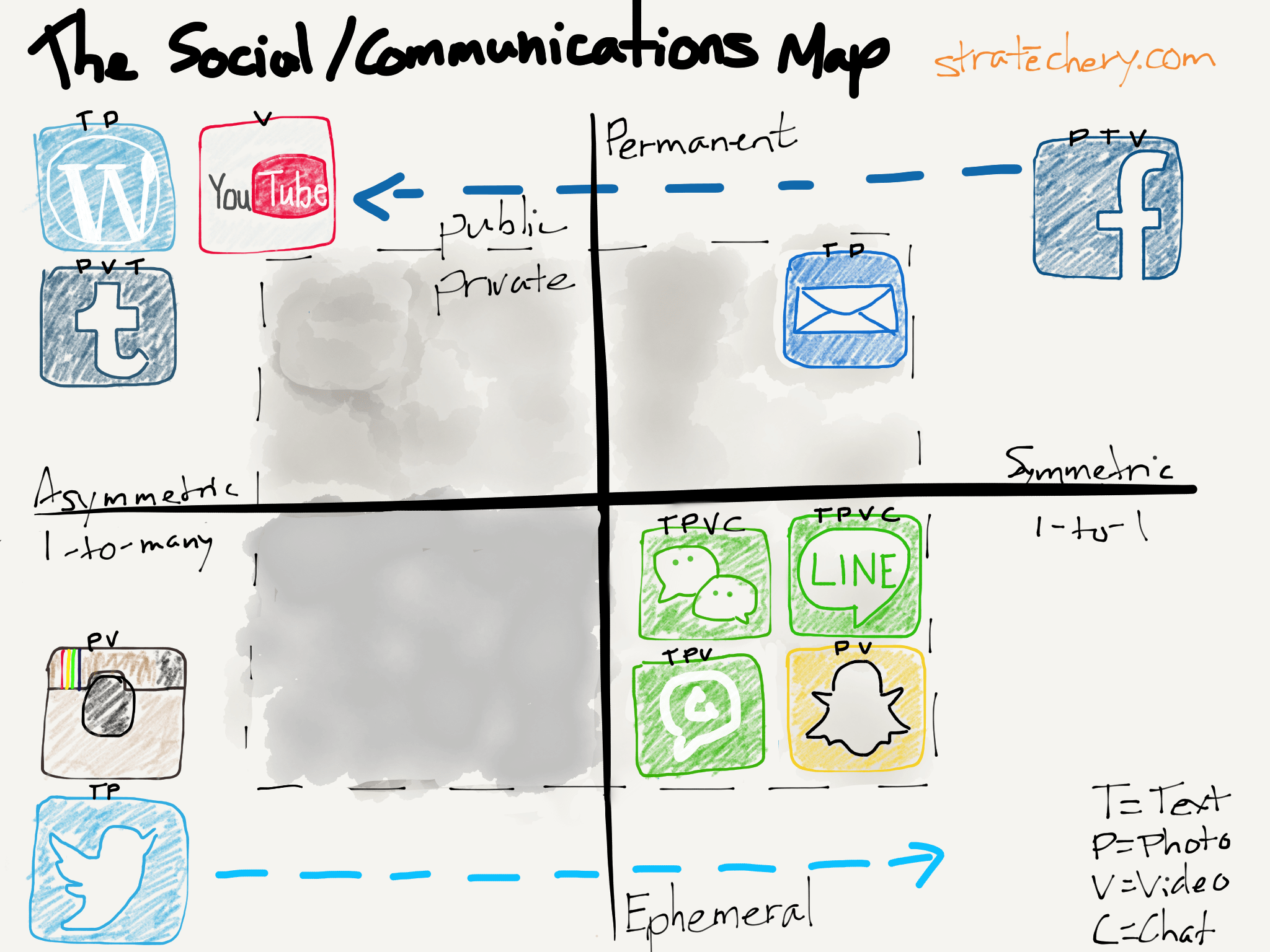
    I took another turn at my map of the social networking space I made for yesterday’s post The Multitudes of Social:

    The Social/Communication Map
    The Social/Communication Map

    I made a few changes:

    • The primary change is relabeling the horizontal axis. Originally I had “Interest/Topic-
      Based” on the left, and “Real-life Relationship-Based” on the right, but as Victor Pope pointed out on Twitter, the real difference is really about the symmetry of relationships.
    • Relabeling this axis necessitated moving email and Skype to the right, which I think makes sense and is an indication that this is a a good change.
    • I added Tumblr and YouTube, and removed Photostream and Facetime. The original was based on networks I personally use; this new drawing is more representative of usage worldwide. I did leave LINE, but consider that representative of WhatsApp, Kik, Kakao Talk, WeChat, etc.

    Finally, I’ve changed the title to make the broader point: social is about communication, and communication is, and always has been, conducted through multiple mediums.

    Some additional observations, beyond Facebook and Snapchat (which were the focus of the original post):

    • There are three primary means of communication: text, photo, and video/voice. Usually a particular service, beyond competing in a specific quadrant, will also specialize in one of these mediums, and then grow into an adjacent medium over time (e.g. Instagram video).1

    • It is not an accident that most of the companies towards the top of the graph – the more permanent type of content – were founded in the PC era. The PC itself has always been a destination-type device; normal people weren’t using a PC most of the time, but rather made a point to use it.

      It’s the exact same with the type of content created for these PC-originated services: more permanent, thoughtful content is intentional; ephemeral content is much more whimsical and meaningful only at a specific moment in time. It follows that this type of content is really only possible in mobile on a device that is always with us.

    • The exception to the last point is Skype; in retrospect, it’s rather remarkable Skype was able to create such a foothold on the ephemeral side of the map despite its PC origins. It goes to show what value the original product had. Unfortunately, that value is fast disappearing as more and more apps like LINE incorporate VOIP, and Skype’s former strength – its network of users based on nicknames – is a liability relative to services like LINE or WhatsApp that ride along on phone numbers as unique identifiers.

    • The placement on these axis is not a technical description, but rather how users experience the particular services. For example, while tweets and Instagram photos have easily-accessible URLs, while Facebook posts don’t, the experience of Twitter and Instagram is more ephemeral from a user perspective relative to Facebook, which itself presents posts and videos as one specific moment in your lifelong timeline.

    • While I created this map in order to talk about Facebook, it turns out it is among the most difficult to categorize correctly. Facebook is, well, a book of faces; your permanent place on the network, centered on your identity and seen by those you connect with one-to-one. And yet, the primary mechanic on Facebook – the wall post – is a one-to-many medium. There is no question Facebook is good enough for a certain segment of the population that may have once upon a time started a blog or Tumblr.

      Yet, the nature of Facebook, and its drive to capture everything, ultimately devalues everything as well, making your content ever more ephemeral and just more digital flotsam. Facebook is pulling itself in two different directions – to the left, and downwards – and it’s not good for the product long term. Being everything to everyone is, as they say, the best way to be nothing to no one.

      Make no mistake: Facebook is a triumph. It completely dominates text, photo, and video sharing for the majority of the population, and it remains the most likely connection point for anyone I know in real life. What Facebook clearly is not, though, is something private or well-suited to conversations you may one day hope to forget. In other words, they’re not Snapchat, and wanting to be is to forget what makes it great.

    One more point worth noting: Facebook remains the most valuable property on this chart, especially if they successfully crack effective brand advertising .2


    The Social/Communications Map has been updated over time. This is the most recent version:


    1. Vine is clearly aspiring to be in the bottom left corner, but I haven’t seen any indication it’s really gotten much traction 

    2. YouTube is a clear second, with Twitter a very distant third 


  • The Multitudes of Social

    Do I contradict myself?
    Very well then I contradict myself,
    (I am large, I contain multitudes.)

    – Walt Whitman, Song of Myself

    Last week Snapchat reportedly turned down a $3 billion dollar all-cash offer from Facebook. Apparently Facebook was worried about losing the teen demographic, or perhaps they were unnerved by the 350 million photos Snapchat claims to process per day. What seems clear, though, is that Facebook is intent on “owning social.”

    The only problem with this strategy is that the very idea of owning social is a fool’s errand. To be social is to be human, and to be human is, as Whitman wrote, to contain multitudes. Multitudes of apps, in my case.

    In the last two days I have used 10 apps you might characterize as “social”. In no particular order:

    • Twitter, for keeping up on news and commenting on tech and stratechery
    • Facebook, for posting personal status updates and checking in
    • LINE, for text messaging with my wife and friends in Taiwan
    • Snapchat, for exchanging photos with my wife
    • Skype, for instant messaging with my colleagues
    • Facetime, for talking with my wife and kids
    • Instagram, for posting cool photos
    • Email, for all types of content, both work and personal
    • Photostream, for sharing photos with my family
    • WordPress, for posting to this blog1

    In Mark Zuckerberg’s world, my behavior is at best nonsensical and inefficient, at worst a threat to Facebook in a zero-sum social face-off. After all, this isn’t the first time Facebook has tried to unify communications – that was the point of Facebook Messages, way back in November, 2010. From Wired:

    Facebook is seeking to replace email with what it calls a “modern messaging system” that combines all the ways people send messages — including email, IM and SMS — into a single interface…

    The new system, Facebook Messages, was announced Monday. It allows you to simply click on a friend’s face, type a message and hit Enter. Facebook handles the rest. And it comes with an optional “facebook.com” email address. But a new email address isn’t the point. Rather it is the unification of a variety of means of communication.

    Unification, in 2010. Given the reality of what has happened since, it’s an idea that is positively quaint. However, for Facebook investors, $3 billion isn’t quaint at all: it would have been a massive waste of money for an app that is in fact not competitive with Facebook at all.

    Look again at my list of apps: each of them has their own place. Some are for communicating with friends-and-family, others for a different audience centered around my interests. Some are more meaningful and permanent, others ephemeral and quickly forgotten. Some are for public consumption, and others are private. Some are photo-centric, others are about text. In fact, there is hardly any overlap at all – and none with Facebook:

    photo-1

    Facebook has made their choice: they are the public record of your life and the best way to connect with your friends and family. Snapchat works with friends, but in every other respect it’s the exact opposite product.

    Facebook would do better to continue investing in improving their advertising signal. As I’ve written previously, Facebook is sitting on a display ad gold mine; they just need the targeting to match. That’s why Waze was such a loss. If they want to buy out a competitor, better to focus on one that either threatens their public-permanent space, or others – like Instagram – that are a great fit for their display business.

    Most of all, though, Facebook needs to appreciate that their dominance of social on the PC was an artifact of the PC’s lack of mobility and limited application in day-to-day life. Smartphones are with us literally everywhere, and there is so much more within us than any one social network can capture.


    1. Disclosure: I work for Automattic, which owns WordPress.com. This article represents my personal views 


  • A Technological Optimist, but Just

    In June, in response to claims that nine Internet companies were willingly passing information to the NSA, Apple released Apple’s Commitment to Customer Privacy:

    Apple has always placed a priority on protecting our customers’ personal data, and we don’t collect or maintain a mountain of personal details about our customers in the first place. There are certain categories of information which we do not provide to law enforcement or any other group because we choose not to retain it.

    For example, conversations which take place over iMessage and FaceTime are protected by end-to-end encryption so no one but the sender and receiver can see or read them. Apple cannot decrypt that data. Similarly, we do not store data related to customers’ location, Map searches or Siri requests in any identifiable form.

    We will continue to work hard to strike the right balance between fulfilling our legal responsibilities and protecting our customers’ privacy as they expect and deserve.

    In response, I proposed the term Strategy Credit:

    A Strategy Credit is an uncomplicated decision that makes a company look good relative to other companies who face much more significant trade-offs.

    User information of this type isn’t important to Apple’s business model, so they “choose not to retain it.” There’s nothing worth praising here – or denigrating – but it’s worth acknowledging.

    Apple admitted as such in their recent report on government information requests:

    Unlike many other companies dealing with requests for customer data from government agencies, Apple’s main business is not about collecting information. As a result, the vast majority of the requests we receive from law enforcement seek information about lost or stolen devices, and are logged as device requests.

    We have no interest in amassing personal information about our customers. We protect personal conversations by providing end-to-end encryption over iMessage and FaceTime. We do not store location data, Maps searches, or Siri requests in any identifiable form.

    Many were quick to praise Apple for this very fact, but let’s be clear: there is nothing here worth praising. It’s an artifact of their business model.

    John Kay, in an unrelated article, made the same broad point this week in Being ethical in business is not as simple as ‘doing the right thing’:

    The slogan that good business is profitable business is superficial – an attempt to make moral dilemmas dissolve in a warm bath of goodwill. When the right thing to do is also in your own self interest, you do not need advice from philosophers and theologians. Ethics are about what to do when good behaviour and profitable business are not necessarily the same thing.

    Bishop Whately noted the difference between the honest man and the man for whom honesty is the best policy. When you deal with the man for whom honesty is the best policy, you never know when it might be the occasion on which honesty is no longer the best policy. Bankers, not bishops, deliver lectures extolling their own personal integrity; the man who repeatedly reminds us how honest he is rarely acquires, or deserves, our trust. The integrity we value is a personal or organisational characteristic, not a business strategy.

    Apple, unlike Google, or Facebook, or even Microsoft, is not a services company (as long-suffering iCloud/MobileMe/.Mac/iTools customs can attest), and so, to prescribe any sort of goodness to their decision to not retain user data is much less useful than an examination of what actually matters to their bottom line. And, as a hardware company, that means the supply chain. And that means people like Bibek Dhong. From Bloomberg Businessweek:

    Staffing production lines in Malaysia, where 28 plants run by 24 companies worked on Apple contracts last year, usually goes this way: Companies tap an informal, largely unregulated, and transnational network of thousands of recruiters. They fan out, often hiring subrecruiters, into the farm fields and impoverished cities of Indonesia, Cambodia, Myanmar, Vietnam, and even into the Himalayas in Nepal. The positions they’re trying to fill are so coveted that they’re not merely offered, they’re sold. The brokers take fees from families, representing as much as a year or more of wages; frequently the fees are paid with loans that can take years to pay off… The hunt reached then-27-year-old Bibek Dhong on his mobile phone, while he was packing milk crates at a Kathmandu dairy to support his wife, a newborn daughter, and his extended family. The call would change his life.

    The entire article is worth a read, and, as you might suspect, it doesn’t end well.


    I don’t come to sit in judgment on Apple. How can I? After all, the very next article I read was this piece by Rick Reilly on the carnage that is American Football:

    I see too much sorrow and ugliness to love football like I used to.

    I watch Indianapolis quarterback Andrew Luck take a brutal lick now and I think of former Packers quarterback Brett Favre, who told a Washington radio show the other day he can’t remember most of his daughter’s soccer games. “That’s a little bit scary to me,” Favre said. “… That put a little fear in me.” He’s 44 years old.

    I watch New England tight end Rob Gronkowski get up from wreck after wreck, and I think of former Colts tight end Ben Utecht, who said the other day he couldn’t remember being at a friend’s wedding until the friend showed him the photo album. See, you were a groomsmen. And you sang, remember? He’s 32 years old.

    I watch Minnesota running back Adrian Peterson fling himself into crashing whirlpools of men and I think of former Cowboys running back Tony Dorsett, who said he sometimes finds himself driving on a highway and can’t remember where he’s going. “I’m just hoping and praying I can find a way to cut it off at the pass,” Dorsett said recently. He’s 59 years old.

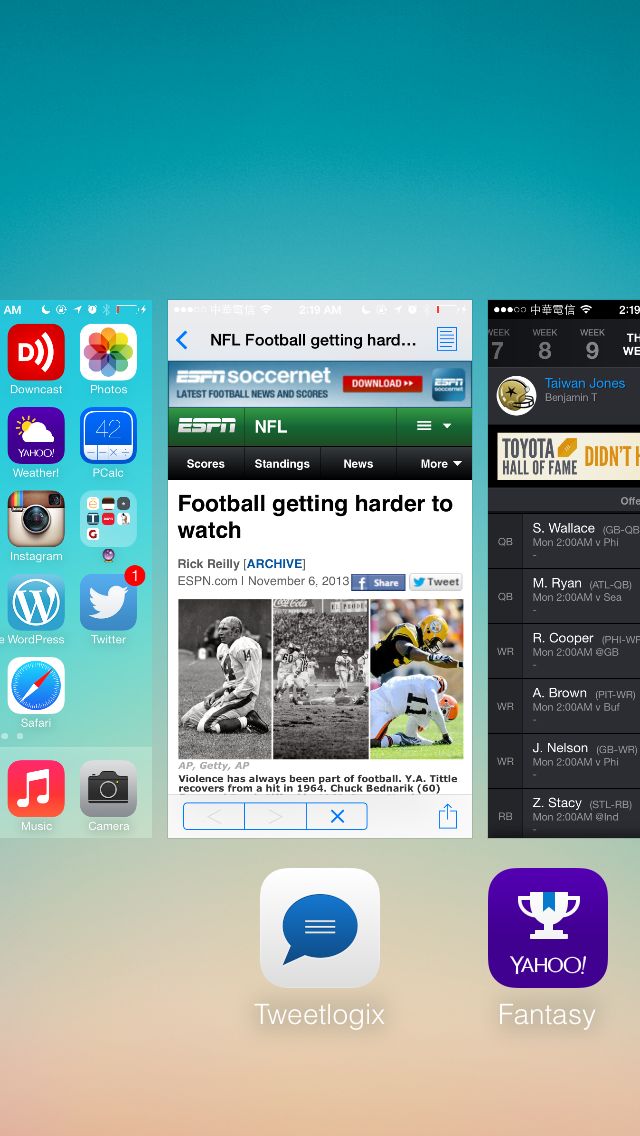
    I immediately set out to write a self-righteous tweet on how I’ve given up football, conveniently ignoring the fact I’m in Taiwan (football is only good live – which is 2 in the morning), and the fact I watched when I was in America. And then, the iOS 7 task switcher really brought my hypocrisy home:

    Setting my fantasy football lineup one moment, feeling smug about not watching football the next
    Setting my fantasy football lineup one moment, feeling smug about not watching football the next

    Apparently the last thing I did before penning said self-righteous tweet was set my lineup for fantasy football, an activity that reduces flesh-and-blood humans risking their futures to the equivalent of Magic cards.

    So much for a self-righteous screed.


    I don’t know where morals and ethics sit in business, especially in technology, where we celebrate the idea of disruption and failure, giving no heed to the real world implications of what we are building, or how we are building it. Moreover, it’s not as if I’m going to give up my iPhone, or Google’s search, or any of the stuff I’d prefer to feel smug about. Heck, I can’t even give up fantasy football.

    And yet, how will things change? How will they get better? How will technology be a force for good, instead of a tool for evil? I remain a technological optimist, but just. The power of software and the Internet is truly awesome, and we best start taking it – and our personal roles in that – seriously.


  • Skating Towards the Goal

    First things first: I do not subscribe to the idea that a Bill Gates return would be a good outcome for Microsoft. Indeed, much of what troubles Microsoft today is directly attributable to Gates, particularly the Vista disaster/distraction and the Windows obsession.

    Still, though, there is something to be said for the power and inspiration that can only be provided by a founder, and two fascinating pieces about Gates really give a great perspective on the challenges today’s Microsoft faces.

    The first article is from Harvard Magazine, called Bill Gates, Inside the Gates, and is an excerpt from a book Walter Isaacson is writing. It concerns the creation of the Altair BASIC interpreter, Microsoft’s first product:

    It may have been the most momentous purchase of a magazine in the history of the Out of Town Newsstand in Harvard Square. Paul Allen, a college dropout from Seattle, wandered into the cluttered kiosk one snowy day in December 1974 and saw that the new issue of Popular Electronics featured a home computer for hobbyists, called the Altair, that was just coming on the market. He was both exhilarated and dismayed. Although thrilled that the era of the “personal” computer seemed to have arrived, he was afraid that he was going to miss the party.

    Slapping down 75 cents, he grabbed the issue and trotted through the slush to the Currier House room of Bill Gates, a Harvard sophomore and fellow computer fanatic from Lakeside High School in Seattle, who had convinced Allen to drop out of college and move to Cambridge. “Hey, this thing is happening without us,” Allen declared. Gates began to rock back and forth, as he often did during moments of intensity. When he finished the article, he realized that Allen was right. For the next eight weeks, the two of them embarked on a frenzy of code writing that would change the nature of the computer business.

    The second was a great interview by Richard Waters in the Financial Times:1

    It takes more than money to rid the world of a scourge such as polio – though having buckets of cash certainly helps. Also needed are ambitious thinking, organisational know­how and the ability to bring new ideas to bear on old problems…

    When the Gates Foundation made polio eradication a priority five years ago, the global anti-polio effort was running into the sand. More than 10 years of progress had given way, at around the turn of the millennium, to a stalemate as vaccination efforts in the countries still harbouring the disease failed to reach the coverage levels needed to push it into extinction. The organisations behind the existing drive – such as Rotary International, the business group that had long led the effort – “had sort of naively assumed it was on track, but it wasn’t”, Gates says. “The idea that business as usual was going to get us there – it had to be broken out of that, because it wasn’t going to succeed. It probably would have been better to just give up than do business as usual. But that would have been horrific.”

    Gates seems to relish nothing more than challenging business as usual, often by applying a dose of more ambitious thinking. It was the same impetus that led him to rethink familiar approaches to philanthropy, throwing his money into the urgent pursuit of solutions to big problems rather than attempting a drip-feed of donations that would amount to little more than a Band-Aid.

    What is so striking about these two totally different excerpts is how they bely the exact same approach: the identification of a goal, and the application of total effort to achieve it, no matter the obstacles.

    It’s the exact same sort of feeling evoked by one of the greatest corporate mission statements of all time: A computer on every desk and in every home, running Microsoft software.

    This is Gates’ – and by extension, Microsoft’s – modus operandi. Massive ambition, identified opportunity, clear goals, and the relentless determination to achieve them.

    I’ve written previously, in the context of Apple, that “while a company can reinvent itself around new products and new categories, and continue to thrive, I believe culture is the sort of pie that can only be baked once.” And there’s no reason to think Microsoft should be any different.

    And that, right there, is what is wrong with Microsoft. It’s not they don’t have talent – they do. It’s not that they don’t have great technology – they do. In fact, it’s not even that they lack a CEO. Rather, it’s that they achieved their goal. There IS a computer on every desk and in very home, and nearly all of them run Microsoft software. So now what?

    Steve Jobs famously used the Wayne Gretzky quote: “I skate to where the puck is going to be, not where it has been” to wrap up the iPhone introduction.

    Steve Jobs introducing the iPhone at MacWorld in 2007
    Steve Jobs introducing the iPhone at MacWorld in 2007

    Since then, a popular criticism of Microsoft is directly ripped off from this: that they are continually skating to where the puck has been. And while that’s arguably true in a narrow sense, it misses the bigger picture: Apple may very well be Wayne Gretzky, performing ballet on skates and seeing what others don’t see. But the second greatest goal scorer in NHL history is Gordie Howe, known not for his grace but for his strength, durability, and willingness to mix it up.2 There is virtue in the single-minded pursuit of a goal, and the absolute refusal to be deterred.

    But again, what is the new goal? What is Microsoft’s reason for being? What ends are achieved by a massive conglomerate spanning CRM systems to database software to gaming consoles? Microsoft, perhaps more than any other company, needs focus,3 vision, and a problem worth solving. To be sure, that falls on the next CEO, but the bigger question that must be asked is if such a problem – one suitable for the unwieldy behemoth that is Microsoft – even exists.

    Maybe4 in the end, just like at the beginning, Paul Allen is right:

    Microsoft’s next chief executive should consider spinning off consumer businesses including search advertising and the Xbox games console, according to the private investment vehicle of Microsoft co-founder Paul Allen.

    Mr Allen, who started the company with Bill Gates in 1975 and still holds a $2bn stake, is “intrigued and interested” by forthcoming changes, said Paul Ghaffari, who manages the tech investor’s $15bn fortune.

    Mr Ghaffari, chief investment officer of Mr Allen’s family investment office Vulcan Capital, said the successor to Steve Ballmer ought to perform radical surgery on Microsoft.

    The goal of a breakup is usually to “unlock value.” In the case of Microsoft, though, what needs to be unlocked is that old Gates culture of massive ambition, identified opportunity, clear goals, and the relentless determination to achieve them by focused, distinct product groups companies no longer burdened by the need of Microsoft to simply exist.


    1. Yes, you have to register. I think this article is worth it 

    2. You may have heard of the “Gordie Howe Hat Trick” – a game with a goal, an assist, and a fight 

    3. The current mission statement is the opposite of focus: “At Microsoft, our mission and values are to help people and businesses throughout the world realize their full potential.” I could write an entire article on what’s wrong with this 

    4. The “maybe” is deliberate. I can see both sides of this argument and look forward to people’s responses 


  • The Magical iPad

    This is part three in a series on last week’s iPad event. Part 1: Whither Liberal Arts? | Part 2: The Missing “Why” of the iPad | Part 3: The Magical iPad

    In The Missing “Why” of the iPad I wrote:

    Yesterday’s presentation covered the “What” and “How” of the iPad, but it had nothing about “Why.” Why does the iPad exist? Why should consumers buy it? Why does it matter? These are answers that cannot be found in a spreadsheet or focus group, but only in experience, empathy, and philosophy – i.e. in the liberal arts.

    To be clear, not knowing the “why” is a rather common affliction. Microsoft, for one, has been rather explicit in characterising the iPad as just a (poor) PC. In response to last week’s iPad event, Frank Shaw, Microsoft’s Corporate VP of Communications wrote:

    Since we launched the Surface line of tablets last year, one of the themes we’ve consistently used to talk about them is that they are a terrific blend of productivity and entertainment in one lightweight, affordable package. In fact, we’re confident that they offer the best combination of those capabilities available on the market today.

    That’s not an accident, it’s exactly what we set out to design. We saw too many people carrying two devices around (one for work and one for play) and dealing with the excess cost, weight and complexity that “dual carrying” entails. We believed that there was another, better way: A tablet built to offer great touch-based entertainment activities combined with a productivity powerhouse that helps people crank through the stuff they have to get done before they watch zombies or flick birds.

    That’s what Surface is. A single, simple, affordable device that helps you both lean in and kick back. Let’s be clear – helping folks kill time on a tablet is relatively easy. Give them books, music, videos and games, and they’ll figure out the rest. Pretty much all tablets do that.

    But helping people be productive on a tablet is a little trickier. It takes an understanding of how people actually work, how they get things done, and how to best support the way they do things already.

    The good news is that Microsoft understands how people work better than anyone else on the planet.

    This statement is true in a way that I very highly doubt Shaw – or just about anyone at Microsoft – truly understand or appreciates. It’s not so much that Microsoft knows how people work; rather, their thinking about everything pertaining to tablets – their imagination about what is possible – is limited by what can be done on a PC.

    And so, the Surface is first marketed based on an accessory – a keyboard – that makes it more like a PC. The second wave of ads are spec comparisons focused on the PC-lite features like multi-tasking and multiple-accounts. And the presence of Windows is a feature, not a bug.

    In short, Microsoft may know how people work now, but cannot imagine the type of work that people want to do, but cannot or will not do on a PC.


    Mickey is a musician. He falls asleep with his guitar in hand, and has done so since he was a teenager, finding refuge from an uncertain adolescence in rock-and-roll. He experiences life through music, and when a line or a riff enters his head, he has learned to lay it down sooner rather than later. He uses an iPad to do just that; after all, an iPad is not a PC, but rather the most portable recording setup ever.

    Jane is an artist, at least at heart. She showed remarkable ability as a child, but her parents ultimately passed up the opportunity to send her to art school in favor a more practical education. She always wondered what might-have-been, but now art seems more like a dream, one she doesn’t even know how to begin to pursue. Now in her 30’s, Jane discovered Paper on her iPad, and started sketching. There was no investment needed to get started, simply touch the screen. Her iPad is not a PC, but rather the most accessible art studio ever.

    Richard is a student. As is the norm in his education-obsessed country, he commutes nearly two hours a day on the bus and subway to his elite high school. Formerly he lugged along backpack so full of books it had wheels; now he has a simple messenger bag with a notebook and a textbook with the brandname iPad. And, when his brain is fried, it magically turns into a television.

    Selina is a child. She and her family live abroad, and she attends the local school taught in a different language than her own. It’s ok though; Selina’s father buys her English books to read on her English reader (also known as an iPad), at a price far cheaper than the local foreign-language bookstore. And sometimes, when she’s finished reading, she simply plays; last week she created a photo collage of herself and her brother, without any training.

    Monica is retired, free to finally devote her time to her children and grandchildren. Fortunately – or unfortunately, depending on your perspective – Monica’s children have done well for themselves and are scattered all over the country, even world. Monica, though, who has never used a computer, keeps close tabs on all of them through Facebook and Facetime, on an iPad she bought on her own, a fact that Monica is all too happy to share with anyone who asks.


    Each of these individuals is using an iPad, but none of them are using an iPad. Rather:

    • Mickey is using a portable recording studio
    • Jane is using an accessible art studio
    • Richard is using a one-pound library
    • Selina is using a foreign-language reader
    • Monica is using a family-connector

    Moreover, they are all doing work. They are all being productive. And what they are doing would be prohibitively more difficult on a PC.

    If your worldview of productivity is limited to what can be done on a PC – documents, spreadsheets, presentations, coding – then of course you will produce a product that is like a PC, but worse for having tablet features. Of course you’ll produce a Surface.

    If, though, your worldview of productivity is defined not by the PC, but rather by people – by the liberal arts – then you will produce a product that is nothing like a PC, but rather an intimate, responsive object that invites people in, and transforms itself into whatever you need it to be.

    You’ll produce an iPad.


    Watching Steve Jobs at D8 in 2010, it’s clear he came up with the now famous “iPads are cars, PCs are trucks” analogy on the spur of the moment.1 The entire exchange, though, is worth a rewatch:

    The transcript:

    Walt Mossberg: Is the tablet going to eventually replace the laptop do you think? There are a lot of people who say “Well you’ll never do content creation on it” for instance.” Talk about what you think where it’s going, not just the iPad, but the tablet itself as a form factor.

    Steve Jobs: You know, uhm, [long pause], uh, I’m trying to think of a good analogy.

    When we were an agrarian nation all cars were trucks because that’s what you needed on the farm. But as vehicles started to be used in the urban centers, and America started to move into those urban and then suburban centers, cars got more popular and innovations like automatic transmissions and power steering and things you didn’t care about in a truck as much started to become paramount in cars. And now, probably, I don’t know what the statistics, maybe 1 out of every 25 vehicles, 30 vehicles is a truck, where it used to be 100%.

    PCs are going to be like trucks. They’re still going to be around. They’re still going to have a lot of value. But they’re going to be used like 1 out of X people.

    WM: And when you say PC, just so I’m clear, it’s not PC versus Mac, you mean…

    SJ: Personal computers

    WM: Personal computers and you’re including laptops and desktops.

    SJ: Yeah! And this transformation is going to make some people uneasy. People from the PC world, like you and me. It’s going to make us uneasy, because the PC has taken us a long ways. It’s brilliant. But, and we like to talk about the post-PC era, but when it really starts to happen I think it’s uncomfortable for a lot of people, because it’s change, and a lot of vested interests are going to change, and it’s going to be different. So, I think that we’re embarked on that. Is it the iPad? Who knows. Will it happen next year or five years from now or seven years from now, who knows? But I think we’re headed in that direction.

    Here then, is my concern for Apple: it’s the PC guys – or Mac guys, if you prefer – who have taken over iOS, and last week’s presentation was a little too truck-heavy. It’s not so much that Frank Shaw was mistaken; rather, it’s that Apple even gave him the opening to attack. It was Apple that decided to spend more time on the Mac than on the iPad. It was Apple that saved the most-extensive software demo for iWork, and even then, only on a Mac and browser (and just as well: PC software works best on a PC. It’s not really the best selling point for the iPad). It was Apple that was unable to focus on the product and experience that is far more magical and transformative than the PC/Mac will ever be, and instead deliver a smorgasbord of product announcements, most of which are (relatively) unimportant.

    I’ve written previously that the iPad is a truly disruptive product. It is inferior to a PC on the attributes that matter to PC-users, even as it excels on orthogonal attributes that appeal to a new type of customer. Those orthogonal attributes certainly include things like portability and battery life, features highlighted in last week’s event. But the more essential attributes are those that make the iPad very much not a PC. The immersiveness of apps, and responsiveness of touch. The safety of iOS, and the discoverability of the app store. None of these attributes were highlighted; indeed, the iPad was not even demoed. It’s as if Apple is doing its darndest to undisrupt itself.

    Again, from D8:

    SJ: You know, people laugh at me because I have used the phrase “magical” to describe the iPad.

    KS: Yes, they do.

    SJ: But that’s what I really think. There is something magical about it. It’s like you have a much more direct and intimate relationship with the Internet and media, your apps, your content. It’s like something’s, some intermediate things has been removed and stripped away.

    KS: Like the keyboard.

    SJ: You know, like that Claritin commercial where they strip away the film, it’s like that. And, is it the direct action? Is it the fact you can move it all around? Is it the fact that you have no cables and 10 hour battery life? I don’t know. It’s all these things plus other things which I don’t understand yet. But there’s something about it that’s magical. And, I think we have, we are just scratching the surface on the kinds of apps we can build with it. I think one can create a lot of content on a tablet.

    “Magical” as an adjective is deeply uncomfortable for us geeks especially. The very idea of believing in something that can’t be explained, much less quantified, is so foreign that it is almost immediately rejected. And yet, cultures the world over believe in the supernatural. Humans believe in that which they cannot explain, or fully understand. And they respond to that, and it’s the liberal arts that helps us comprehend their response.

    The “why” of the iPad, then, lies in its magic. It’s in the experience, and, crucially, it’s in the apps.2 The iPad is not an iPad, yet-another-Apple device to weigh down your bag and your wallet. Rather, it is whatever, and exactly, you need it to be.

    If you are a musician, the iPad is your instrument, your studio.
    If you are an artist, the iPad is your paint brush, your easel.
    If you are a student, the iPad is your textbook.
    If you are a child, the iPad is your storybook, or your entertainment.
    If you are a grandma, the iPad is your connection to your family.

    If you are human, the iPad is your magic wand. And, honestly, who does not want a magic wand? And why isn’t Apple selling it as such?


    1. One wonders if Jobs, had he had more time to think, wouldn’t have gone with bicycle instead 

    2. Apple’s reluctance to help build a sustainable model for apps is particularly problematic for the iPad 


  • The Missing "Why" of the iPad

    This is part two in a series on last week’s iPad event. Part 1: Whither Liberal Arts? | Part 2: The Missing “Why” of the iPad | Part 3: The Magical iPad

    Christina Warren took issue with my article, Whither Liberal Arts:

    To this I have just one response. It’s the best Apple commercial in years – maybe of the decade:

    And it debuted in April 2013. This advertisement – which is virtually perfect in every single way, is all about story. It is the absolute personification of story and emotion…

    So are we really going to say that liberal arts are gone from Apple because of an ad designed to show off the amazing industrial design of the iPad Air? Let’s be serious.

    This, unfortunately, completely misses the point (and misrepresents my argument to boot):

    • My disconcernment was not only with the iPad Air ad, but with the entire keynote. Everything was about Apple, from the opening repeat video to the self-praise for free to the ridiculous demo about the Eddy Cue poster. What was absent was any demo or discussion about the way humans might actually use Apple’s products for real (the Life on iPad spot being the clear exception).
    • My argument was about the iPad, not the iPhone. I have written that Apple’s strategy and storytelling around the iPhone are spot-on and a good idea. Moreover, I think Apple is doing great things with the Mac, upping the software value prop and lowering the price at a time when Windows has never been more vulnerable in the consumer space.

      It’s the iPad, though, that is devoid of a story (in fact, as Pavan Rajam points out, Apple has not done a single on-stage demo for the iPad this year). The difference in clarity and specificity between Apple’s iPhone strategy – increase value, both in features and in higher order benefits – and whatever it is they’re doing with the iPad is reflected in the marked contrast between the humanity of the spot Warren references and the abstract iPad Air ad.

    • The larger problem, though, is a misunderstanding of what the liberal arts reference is all about. It’s not about the story, or lack thereof, although that is a symptom. It’s not about the ad, and it’s not about emotion. Rather, the question that the liberal arts answer is “Why.”

      Yesterday’s presentation covered the “What” and “How” of the iPad, but it had nothing about “Why.” Why does the iPad exist? Why should consumers buy it? Why does it matter? These are answers that cannot be found in a spreadsheet or focus group, but only in experience, empathy, and philosophy – i.e. in the liberal arts.

    Moreover, these are not idle questions. Tim Cook himself showed why they are so pressing:

    Plateauing iPad Growth
    Plateauing iPad Growth

    That line is flattening much too soon for a product as truly revolutionary as the iPad.1 It is not obvious to customers what the iPad is and why it matters.

    This, then, is what makes the iPad different – and yesterday’s event more alarming – from a story-telling perspective: a phone and a computer are known quantities. There is no need to answer why. And so Apple’s continued excellence on the “What” and “How” truly shine. The iPad, though, has always been different by virtue of being not only a new product, but a new category. It needs not only the design of “What” and the technique of “How,” but the meaning of “Why.”

    There is no one in the world better at “What” than Jony Ive, and no one better at “How” than Tim Cook. But who at Apple knows “Why”?


    1. Why is it revolutionary? Stay tuned…