Stratechery Plus Update

  • The Facebook Reckoning

    Earlier this week the New York Times reported that Facebook was offering publishers a deal:

    With 1.4 billion users, the social media site has become a vital source of traffic for publishers looking to reach an increasingly fragmented audience glued to smartphones. In recent months, Facebook has been quietly holding talks with at least half a dozen media companies about hosting their content inside Facebook rather than making users tap a link to go to an external site.

    Such a plan would represent a leap of faith for news organizations accustomed to keeping their readers within their own ecosystems, as well as accumulating valuable data on them. Facebook has been trying to allay their fears…To make the proposal more appealing to publishers, Facebook has discussed ways for publishers to make money from advertising that would run alongside the content.

    The prevailing wisdom seems to be that this is a bad idea. The late great David Carr, who first broke the news about Facebook’s initiative last fall, said, “Media companies would essentially be serfs in a kingdom that Facebook owns.” Robinson Meyer at The Atlantic recounted Facebook’s previous efforts in this space, particularly its Social Reader, and concluded:

    The company will work very hard to satisfy the altar of engagement—in fact, it’s a business imperative that it always work harder. But history shows just how fickle, and how unpredictable, that idol can be.

    Ryan Chittum at the Columbia Journalism Review declared flatly: “The news business should refuse Facebook’s deal,” adding:

    The point is not that news organizations and other publishers can ignore Facebook and Google and the like. The point is that it’s intolerably risky to build their business models around them.

    Perhaps my favorite warning, though, came from John Gruber:

    I can see why these news sites are tempted by the offer, but I think they’re going to regret it. It’s like Lando’s deal with Vader in The Empire Strikes Back.

    For those who don’t remember, or who (gasp!) have never seen Star Wars, Darth Vader, thanks to a tip from bounty hunter Boba Fett, arrives at Lando Calrissian’s Cloud City to set a trap for the Millennium Falcon and its crew. We find out later that this is when Vader and Lando made their deal: Vader will get Luke Skywalker, Boba Fett will get Han Solo, while Calrissian can keep the Millenium Falcon, Chewbacca, and Leia. Ultimately, though, Vader intends on keeping everyone, delivering his famous line: “I am altering the deal; pray I don’t alter it any further.”

    The problem with Gruber’s criticism is that Lando never really actually had a choice. Vader was far more powerful than he was; taking a chance on a deal was the best of a bunch of bad options. That, I think, is the case with most publishers when it comes to Facebook.

    Publications’ Mobile Problem

    I’ve written several times about the dramatic impact that the Internet has had on journalism, in particular Newspapers are Dead; Long Live Journalism and just a few weeks ago in Why BuzzFeed is the Most Important News Organization in the World. Succinctly, the Internet dramatically increased competition, not only for readers, but also for advertisers. Many newspapers with obsolete print-centric cost structures were ill-equipped to compete; however, many online-only publications, built from the ground-up for Internet economics, quickly appeared to take their place.

    This mixture of online newspapers and online-only publications primarily monetized with display ads that appeared alongside the content, and the results have been decidedly mixed. The problem is that online ads are inherently deflationary: just as content has zero marginal cost, so does ad inventory, which means it’s trivial to make more. A limited amount of total advertising dollars spread over more inventory, though, means any individual ad is worth less and less. This resulted in a bit of a prisoner’s dilemma: the optimal action for any individual publication, particularly in the absence of differentiated ad placements or targeting capability, is to maximize ad placement opportunity (more content) and page views (more eyeballs), even though this action taken collectively only hastens the decline in the value of those ads. Perversely, the resultant cheaper ads only intensify the push to create more content and capture more eyeballs; quality is very quickly a casualty.

    What is interesting is the particular impact that mobile has had on this dynamic:

    • First, mobile display ads stink. Unlike a PC browser, which has a lot of space to display ads alongside content, content on mobile necessarily takes up the whole screen (and if it doesn’t, the user experience degrades significantly, making quality a casualty once again). This results in mobile ad rates that are a fraction of desktop ad rates (and remember, desktop ad rates are already a fraction of print ad rates)
    • Second, on mobile, clicks are expensive from a user experience perspective. Not only do PCs typically have faster broadband connections to download assets and more powerful processors to render pages, they also have multiple windows and tabs. On a phone, on the other hand, clicking on a link means you can do nothing but wait for it to open, and open quite slowly at that. The cost of clicking a link, already quite high because of the deluge of crap content and particularly-annoying-on-mobile ads, is even higher because of the fundamental nature of the device

    Note that all of these issues with mobile affect new online-only publications just as much as they do old-school newspapers; the problem stems from the display ad business model.

    Enter Facebook.

    Facebook and Native Advertising

    There are three ways to combat the deflationary trend in online advertising:

    • Sell/display more ads (which is problematic for the reasons listed above)
    • Sell more effective ads that better engage the viewer
    • Sell better targeted ads that reach the advertiser’s target audience

    Facebook, in stark contrast to publishers, is dominant in all three areas:

    • Facebook’s fantastic targeting capabilities are well known, and the company is pushing to make tracking, particularly for brand advertising that results in offline purchase, even more effective
    • The company is actually selling fewer ads on the desktop – increasing the price per ad – even as it continues to grow its mobile inventory
    • Perhaps most importantly, Facebook has an incredibly effective ad on mobile: a native one

    Native advertising has a bit of a bad rap thanks to poor executions like The Atlantic’s Church of Scientology disaster, leading to accusations that native advertising only succeeds to the degree to which it “tricks” the reader. And, for the record, I completely agree that this sort of native advertising is a bad idea, particularly for the publications that employ it: not only does it ruin the publication’s credibility, it doesn’t even work that well.

    Instead, the sort of native advertising that is interesting is the type that lives in a stream like the Facebook news feed. I detailed a couple of years ago how Facebook had the best digital ad unit in the world:

    The Facebook app owns the entire screen, and can use all of that screen for what benefits Facebook…You can’t help but see the advertising, which makes it particularly attractive to advertisers. Brand advertising, especially, is all about visuals and video (launching soon!), but no one has been able to make brand advertising work as well on the web as it does on TV or print. There is simply too much to see on the screen at any given time.

    This is the exact opposite experience of a mobile app. Brand advertising on Facebook’s app shares the screen with no one. Thanks to the constraints of mobile, Facebook may be cracking the display and brand advertising nut that has frustrated online advertisers for years.

    There’s just one catch to this sort of advertising: it depends on people immersing themselves in the stream. Clearly, that’s not a problem for Facebook; incredibly, despite its dominance both in terms of users and engagement, the company continues to grow both! Twitter, too, although suffering from a small user base, is monetizing very well because of its immersive nature. Similar opportunities await Instagram, Pinterest, and Snapchat. Each of these services has hundreds of millions of users voluntarily opening their app daily.

    Destination Sites

    That bit about visiting directly is critical: native advertising only really works if customers go directly to your site or app; it’s much less effective if your site is only ever at the end of a link in another stream (which is the case for the majority of publications). It follows, then, that if native advertising is the only truly sustainable advertising on mobile, that the only sites or apps that can succeed with ads are “destinations” – sites or apps that users go to directly.

    Most people don’t have many destinations: a few social networks, and maybe a web page or two; I suspect my list is on the high side when it comes to quantity (and truthfully, the news sites are mostly visited via Twitter or Nuzzel):

    My destination apps and sites
    My destination apps and sites. The full list: Twitter, Facebook, Instagram, Nuzzel, Snapchat, Grantland, Techmeme, The Information, ESPN, Daring Fireball, Brew Hoop, The Wall Street Journal, The New York Times, and the Financial Times

    The problem is that it’s really hard to become a destination: you need compelling content of consistently high quality. Notice, though, that that is precisely the opposite of what most online publications have focused on: in their race for ever more content and ever more clicks most publications have lowered their quality bar and made themselves uniquely unsuited to making money on mobile.

    Of course native advertising is not the only option: three of my “destination” sites (The New York Times, Wall Street Journal, and Financial Times) require a subscription. The quality and consistency bar for a subscription is even higher than for a destination site though, because it requires customers to actually pay money.

    The Facebook Future

    I believe the vast majority of publications, particular newspapers and older online-only outfits, are in serious trouble on mobile. Not only does their chosen business model (display ads) monetize incredibly poorly, but the incentives that model creates work against those sites becoming destinations capable of supporting effective native advertising.

    In this light the Facebook offer is a lifeline:

    • Facebook will enforce a quality user experience
    • Facebook will utilize its superior targeting and ad unit to generate revenue
    • Publishers will be incentivized to create content that is shared, not just clicked

    In fact, the incentives will look a lot like BuzzFeed’s – and that’s a good thing. As I noted a few weeks ago:

    By not making money from display ads, and by extension deprioritizing page views, BuzzFeed incentivizes its writers to fully embrace Internet assumptions, and just as importantly disincentivizes pure sensationalism. There is no self-editing or consideration of whether or not a particular post will make money, or if it will play well on the home page, or dishonestly writing a headline just to drive clicks. The only goal is to create – or find – something that resonates.

    As an aside, there should be zero surprise that BuzzFeed is a pilot member of Facebook’s initiative: their entire business is predicated on understanding how to get content shared. The fact that they make money by selling this ability to brands is what makes them independent (and is why they are important).

    Of course most publishers won’t replicate that part of the BuzzFeed model, which means by partnering with Facebook they are committing their future to a company that has very different priorities and could change course at any time, just as they did with the old Social Reader. The problem, though, is that while the Facebook path leads to an uncertain future, uncertainty is preferable to what is probably certain irrelevance (and death). After all, there’s little question in my mind that Facebook will over time favor content that is on site, slowly freezing out everyone else; I think this likely explains the New York Times’ involvement: I just noted the New York Times is unique in that it is a destination, and one that can charge a pretty steep subscription fee to boot. Absent Facebook, though, its growth is almost certainly limited.

    That said, even with Facebook’s offer, I think the next few years are going to be difficult ones for the journalism industry. Too many sites have bad business models with bad incentives, and there will be a shakeout. I think, though, this will on the whole be a positive transition for consumers especially. Creating a destination,1 giving customers content that resonates, or building up alternative revenue streams that benefit from a site’s journalism2 all argue against the sort of content-farming and click-bait writing that dominates the web today. If it takes Facebook to hasten that shift, so be it.


    1. I think Vox Media fits here; check out this excellent profile of The Verge on Nieman Lab, and note that one of my destinations – BrewHoop – is an SB Nation site; note also, though, that the company also has a very thoughtful Facebook strategy as well 

    2. Recode is an excellent example here; the journalism drives the prestige and access of the Recode Conferences 


  • The Changing — and Unchanging — Structure of TV

    The on-again/off-again rumor mill about Apple’s TV efforts is spinning again, thanks to a new report in the Wall Street Journal that Apple Plans Web TV Service in Fall:

    The technology giant is in talks with programmers to offer a slimmed-down bundle of TV networks this fall, according to people familiar with the matter. The service would have about 25 channels, anchored by broadcasters such as ABC, CBS and Fox and would be available on Apple devices such as the Apple TV, they said.

    For now, the talks don’t involve NBCUniversal, owner of the NBC broadcast network and cable channels like USA and Bravo, because of a falling-out between Apple and NBCUniversal parent company Comcast Corp., the people familiar with the matter said.

    I wrote extensively about the TV industry in a series of articles back in 2013 (here, here, and here), but the most pertinent part to this discussion was my conclusion in The Cord-Cutting Fantasy:

    Cable TV is socialism that works; subscribers pay equally for everything, and watch only what they want, to the benefit of everyone. Any “grand vision” Apple, or any other tech company, has for television is likely to sustain the current model, not disrupt it directly.

    That certainly seemed to be the plan for Apple; from what I understand, the Wall Street Journal’s characterization of Apple’s talks with Comcast is correct: Apple originally sought to work with Comcast much as they have worked with telecoms around the world – Apple would provide the user interface (the cable box) and Comcast the infrastructure and live content. However, I can’t say I’m surprised those talks fell apart; to understand why a disagreement was probably inevitable, as well as why Apple’s Plan B looks the way it does,1 it’s useful to step back and consider the overall structure of the TV industry and how and why that structure is evolving with the advent of the Internet and mobile devices.

    The Structure of Television

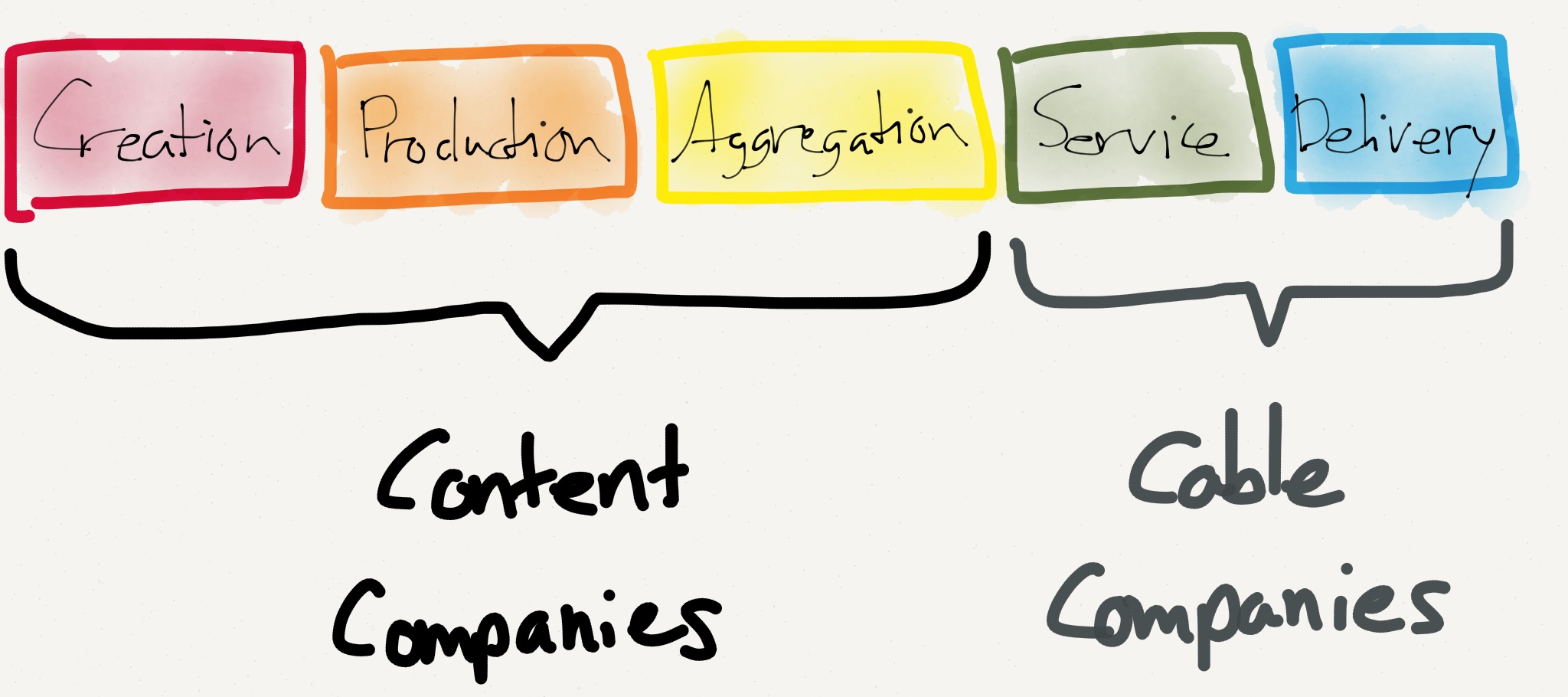
    TV can be broken up into five distinct parts:

    • Content Creation is the actual creation, filming, and production of a TV show
    • Content Production is the commissioning and funding of a TV show, usually by a studio
    • Content Aggregation is the packaging of several different TV shows into a single offering, usually by a network/channel
    • Service Offering is the marketing of multiple networks and channels to consumers, usually on a subscription basis
    • Delivery is the actual transfer of television content into your home

    FullSizeRender

    In most markets, including the United States, these five parts have been under only two roofs:

    • Content creation, production, and aggregation are frequently handled by conglomerates that manage multiple channels, including Disney, Viacom, Fox, etc.
    • Service offering and delivery were handled by cable or satellite companies

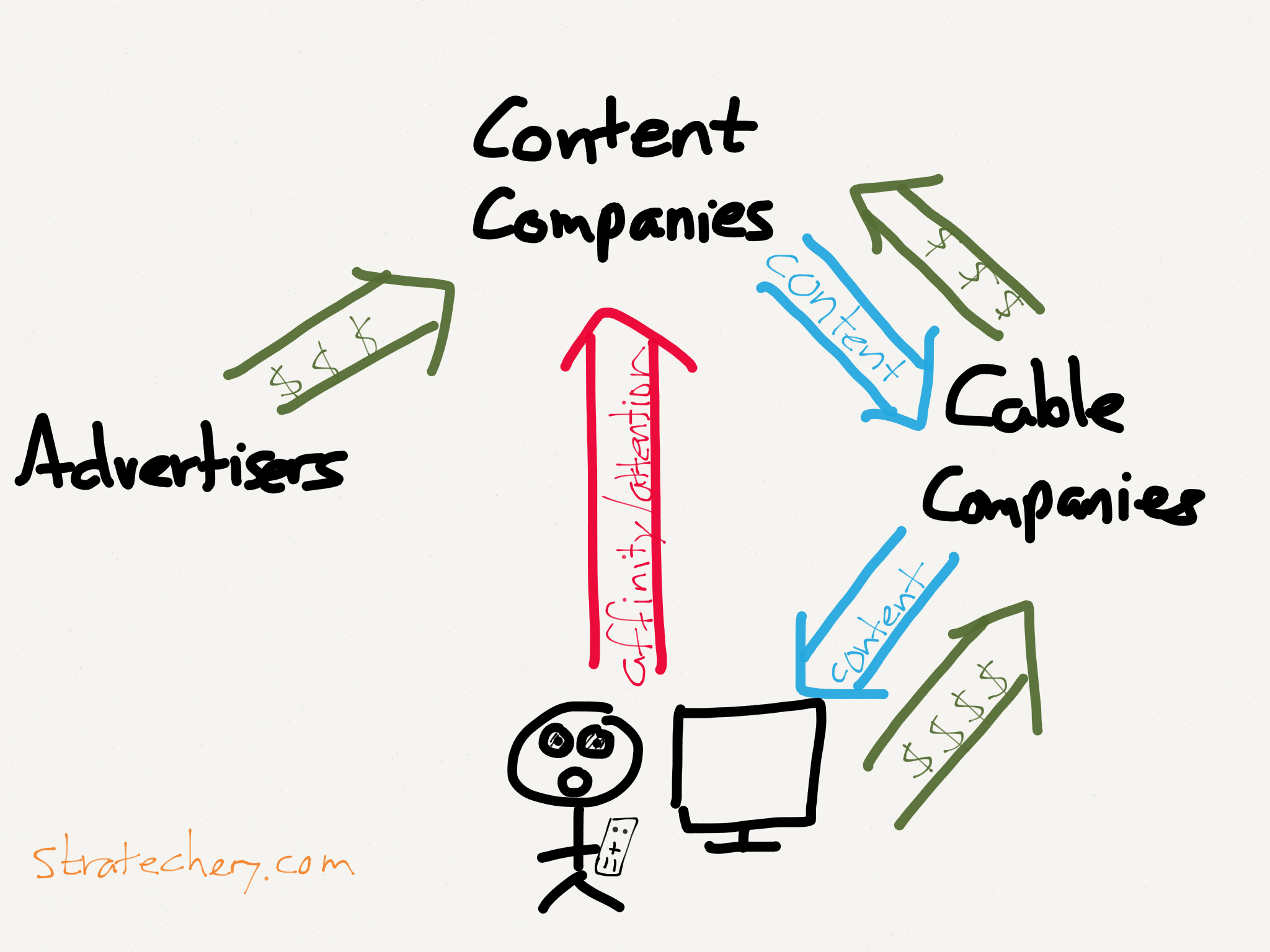
    This division of labor has resulted in two distinct business models:

    • The cable or satellite companies own the customer relationship and make most of their money from rent on content delivery
    • The content creators, on the other hand, own attention and have traditionally made most of their money from advertisers

    This neat division, though, misses an essential piece: affiliate fees. Way back in 1982 ESPN was just a startup struggling to make a profit with advertising when a new vice-president, Roger Werner, came up with the idea of charging cable companies for the privilege of carrying the sports network. As you might expect cable operators were not interested, but when ESPN, already cable’s largest network, threatened that they were about to go out of business, about half of cable operators gave in. Within a few years, especially after ESPN secured the rights to National Football League games in 1987, they all had.

    The way in which affiliate fees came to be foreshadowed a shift in power from the cable companies to the content creators. Over the ensuing years content companies realized that the reason consumers paid cable companies was because they wanted access to the creator’s content (like the aforementioned NFL deal); that meant content companies could make the cable companies pay them ever increasing affiliate fees for that content. Even better, if multiple channels banded together, the resultant conglomerates – Viacom, NBCUniversal, Disney, etc. – could compel the cable companies to pay affiliate fees for all their channels, popular or not. And best of all, it was the cable companies who had to deal with consumers angry that their (TV-only) cable bills were rising from around $22 in 1995 to $54 in 2010.2

    Poor cable companies…well, not so poor. The cable companies weren’t exactly on the road to the poor house thanks to their natural monopoly. Cable TV was originally called “Community Antenna Television” as its purpose was providing access to broadcast TV for communities unable to receive strong over-the-air signals, but over time, particularly with the rise of multi-unit housing, even communities with strong broadcast signals saw the need for cable systems and contracted with private companies to build out the physical infrastructure. These companies didn’t just get to leverage local governments’ unique powers such as eminent domain, but they also retained control of the lines themselves, eventually adding new cable-only stations in addition to the broadcast networks3. Over time various alternatives have arisen, including TV delivered over DSL and satellite, but by and large the cable companies have had significant pricing power.

    The end result was an industry that looked like this:

    IMG_0991

    Everyone is making money: the cable companies make rent on their infrastructure while the content creators earn affiliate fees on top of advertising. And truthfully, while this seems like a raw deal for subscribers – they are the ones paying for those rising affiliate fees in particular – the reality is that this system has resulted in an absolute golden age in content. The advertising-only model of the 60s and 70s resulted in blah, lowest-common-denominator content; the affiliate fee model, on the other hand, meant content creators had to have must-see content for some fraction of subscribers – that was their leverage for jacking up affiliate fees. Some, like ESPN, have bought that must-see status with exclusive sports rights deals, while others, like AMC, have earned it with compelling content like Mad Men or Breaking Bad.

    It should be pointed out that HBO has never quite fit this model; unlike most cable companies HBO does not earn affiliate fees from every single cable customer whether or not they care for HBO. Rather, HBO charges a higher fee (~$15/month) only of customers who explicitly want the network (pursuant to the above industry model, though, HBO has long relied on the cable companies to actually manage the customer relationship). This means that the burden has long been especially high on HBO to not just earn customers’ attention but also their money: small wonder the network has produced amazing TV like The Sopranos, The Wire, or Game of Thrones.

    All in all, I think this is a win-win-win: consumers pay a monthly fee that seems steep but that is actually quite cheap when you consider how much TV the typical home watches, cable companies collect rent and manage the customer relationship (poorly, but that’s the nature of monopolies), and content companies compete on quality for the sake of charging ever increasing affiliate fees on top of advertising.

    The Impact of the Internet

    The Internet and spread of mobile devices has impacted this model in several ways, many of which bring to mind the classic Jim Barksdale quote: “There are only two ways to make money in business: One is to bundle; the other is unbundle.”

    • Individual TV shows – even individual episodes – could be unbundled from channels, bypass the cable provider service offering, and be delivered directly to the customer
    • New forms of integration became possible. Netflix, for example, is doing all of the jobs in the middle: they are commissioning the content, bundling it together, and managing the customer experience
    • This entire middle part became optional; individual content creators are able to connect directly with end users

    Still, none of these shifts necessarily threatened the TV model; too many people had too many shows (especially sports) that were only available on cable, and the content owners had little incentive to break up a good thing.

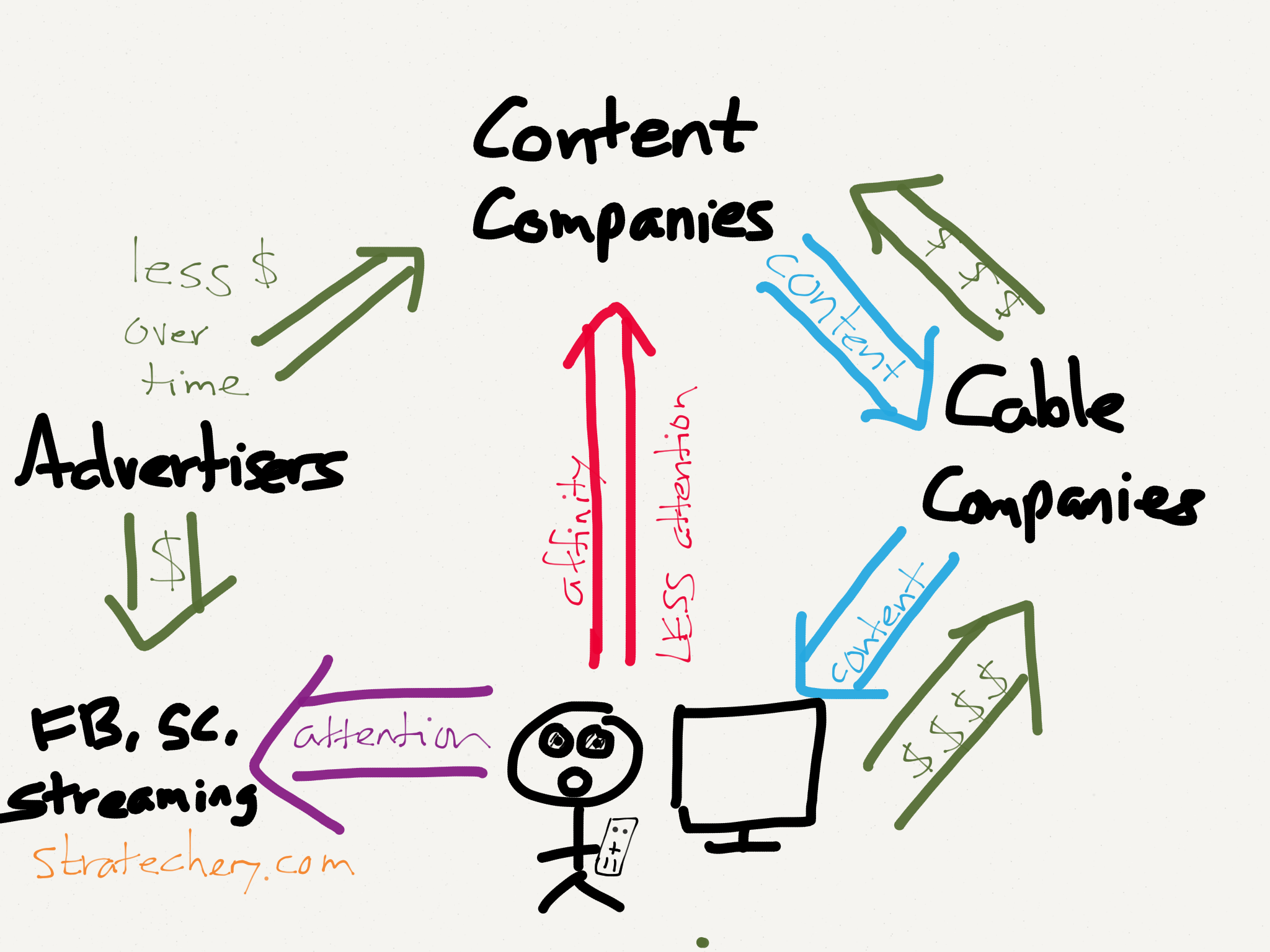
    However, there is one important stakeholder in this model that doesn’t care about subscriber numbers, affiliate fees, or quality for that matter: advertisers. They care about attention, and as I noted in Old-Fashioned Snapchat, it is attention that is under assault from Internet services broadly and mobile devices in particular:

    There is more and more evidence that actual viewership is in decline. According to Nielsen, after remaining steady for years average monthly viewing time in 2014 decreased by six hours; January was particularly bad, with viewership down 12.7 percent year over year. The biggest culprit is streaming, up 60% year over year. The problem with streaming, though, is that it too is for-pay; there are no ads on Netflix or Amazon Prime Video. In short, TV is increasingly shifting away from advertising, to affiliate fees on the network side and subscription fees on the streaming side.

    The result is this:

    IMG_0990

    In that article my intent was to explain why it is that Snapchat is potentially so valuable: if advertisers are increasingly unable to reach their intended audience on TV, they will seek other channels, and Snapchat is fashioning itself into a likely recipient (the same argument applies even moreso to the serially under-appreciated Facebookmembers-only). The question, though, is what about the content companies who have been relying on advertising revenue for decades?

    As I noted, the answer is an increasing reliance on money from the consumer. In part this is affiliate fees, but it’s also direct payment for shows on iTunes, streaming deals with Netflix and Amazon Prime, and now, potentially, this deal with Apple.

    The Dynamics of Apple’s Rumored TV Service

    Make no mistake: the content owners have had a golden goose when it came to the current TV model: provided their content is “must-see TV” content creators can charge ever increasing fees and force cable companies to deal with customer angst. The fracturing of attention, though, is not only a threat to their advertising revenue, but also makes it harder for customers – particularly young ones, the ones that advertisers covet – to justify paying ever higher monthly fees. Losing them would be a double-whammy.

    On the other hand, there is great opportunity as well: in the old model the billing unit was the “home”, no matter how many people might live there. With mobile devices, though, it becomes possible, even preferable, to deliver content to individuals. And, by definition, there are a lot more individuals than homes. The problem for content creators is that, as noted previously, they have never developed the capabilities to deal with consumers directly; cable companies were always their intermediaries.

    These factors make Apple (and later, Google, Amazon, etc.) a particularly attractive partner for content companies. Apple can provide access to individuals, increasing the addressable market; Apple is one of the few companies that has successfully gotten young people to pay for content; and Apple is experienced at managing the customer relationship. I believe these factors explain why it is that HBO Now is launching first with Apple: the people willing to pay for HBO are likely already using Apple devices, Apple can get them to pay, and Apple has the infrastructure to manage the relationship.

    Apple has one more unique offering: data. The New York Post reported yesterday:

    Apple is offering to share data with programming partners to get them on board with its cable-like TV network package, The Post has learned. The company is willing to share details on who its viewers are, what they watch and when they watch it to entice broadcast networks and others to go along with the service, sources said. The information could help programmers better target shows to viewers and advertisers, who are increasingly chasing niche audiences.

    This is even more valuable than it seems: a huge problem for content owners is that as viewing has shifted to mobile devices traditional TV-centric tracking services like Nielsen are increasingly unreliable. Apple, on the other hand, has a view across every device. There’s potentially one more interesting part of Apple’s data offer, too: the 2013 purchase of social-media analytics firm Topsy. Sentiment analysis is increasingly more important to both content creators and especially to advertisers, and Apple owns one of only three companies with access to the Twitter firehose. In short, there are a lot of reasons for content companies to sign on.4

    The dynamics are much different when it comes to the cable companies, in particular Comcast. Cable companies have long viewed their ownership of the customer relationship as their core competency and the key to avoiding becoming a dumb pipe. Indeed, this is almost certainly where the Apple-Comcast negotiations broke down: an Apple TV box would be based on your Apple ID, relegating Comcast to a (theoretically) easily substitutable piece of infrastructure. That, of course, is exactly what Apple did to wireless carriers: Apple commanded tremendous loyalty from customers who wanted an iPhone regardless of which carrier they had to switch to to get it. This is intolerable to Comcast, and the deal broke down.

    What is particularly interesting is the fate of NBCUniversal, the media company that Comcast acquired in 2013. They are noticeably absent from the list of partners that Apple has lined up for their Web TV service, and the reason is almost certainly a strategy tax: Comcast wants to see Apple fail, and it’s likely they view withholding NBCUniversal as their best bit of leverage.

    I’m dubious; many of NBCUniversal’s channels including NBC, USA Network, and Bravo are widely watched, but few of them are “must-see”: only USA and CNBC rank in the top 25 in affiliate fees, and NBC has relatively few dominant sports packages outside of the Olympics, Premier League (less important in U.S.) and Sunday Night Football (which is owned by Verizon for mobile anyways).

    More importantly, though, I think Comcast is likely overreacting: the fact of the matter is that the Internet has made the cable companies even more powerful than they were in the days when TV dominated. All of the investment required for supporting hundreds of high definition channels lent itself wonderfully to supporting the fastest – and in many locations, only – broadband access to the Internet. Moreover, while Congress regulated just how much rent cable companies could collect on television, the latest net neutrality regulations largely give broadband providers free rein as long as they treat all content equally (the explicit model is the wireless industry, as I explained here).5 I would argue that the future for Comcast – even as a dumb pipe – is quite bright.

    Moving Money Around

    Let’s assume that the Apple Web TV service is successful. That means:

    • The cost will be higher than perhaps many people may have hoped; the Wall Street Journal reported $30~$40/month. This really shouldn’t be a surprise though: content companies aren’t going to abandon the lucrative cable model for any amount of money less than they currently earn
    • Comcast may lose the relatively low-margin revenue they make on TV services, but they will make it back on their exceptionally high margin (97 percent!) Internet service. Moreover, it’s only a matter of time until Comcast switches from speed-based pricing to data-based pricing along the lines of the U.S. wireless industry. This would be particularly convenient given the amount of data that an Apple TV service would require. In fact, I would bet that Comcast’s per-customer profit would increase under such a scenario (much like wireless carriers have financially benefited from the iPhone)
    • Apple will finally, at least for some number of (likely wealthy) customers, own the interaction layer for the final frontier for tech companies: the TV. Everyone has been gunning for Input 1, and maybe, just maybe, Apple will finally pull it off.

    Notice, though, who is not winning here, at least financially: consumers. The money is simply moving around. In fact, of the three major players in this proposed deal, Apple will likely earn the least:

    • Content owners have pricing power because they create must-see TV
    • Cable companies have pricing power because they own the pipe
    • Apple is simply proposing to be content’s customer service layer in place of the cable companies

    The benefit for Apple is the strengthening of their ecosystem: owning the TV will make the iPhone and Watch more valuable (see Apple’s New Market); this too is the main way in which consumers win, and why they will switch: a better UI, better integration with their devices, and a company that actually cares. Just be prepared to pay the same, if not more, than you pay today.

    UPDATE: What will truly disrupt TV? See part three of the aforementioned TV series: The Jobs TV Does


    1. I believe this most recent Wall Street Journal report is largely correct 

    2. From the FCC  

    3. The broadcast networks were carried for free for many years, until the 1992 Cable Act gave broadcast networks the right to charge retransmission fees 

    4. I presume that all data would be anonymized and aggregated. That said, in some respects it does seem like a departure from Apple’s focus on privacy, but I don’t think so: the data isn’t tied to an individual for the purpose of serving targeted data, but that is admittedly a fine distinction 

    5. I have seen a whole bunch of people suggesting that net neutrality will stop Comcast from raising prices; it will stop Comcast from raising prices on Apple data specifically, but not data generally. Expect the latter 


  • How Apple Will Make the Wearable Market

    Last fall, Apple CEO Tim Cook described the Apple Watch as the “next chapter” in Apple’s history, placing it at the same level as the Mac, iPhone and iPod. I get the sense that a lot of people don’t believe him; they just don’t see the need for a wearable.

    There is ample precedent for this sort of shortchanging, particularly when it comes to an entirely new market: look no further Thomas Watson’s 1943 claim that “There is a world market for maybe five computers,” or more recently Steve Ballmer’s insistence that “there is no chance that the iPhone is going to get any significant market share.”

    The problem with this sort of criticism is that it nearly always arises from looking at the world as it is, not as it will be. In the case of Watson, a “computer” in 1943 was a house-size collection of vacuum tubes; to his credit Watson himself, as CEO of IBM, led the way in proving his own prediction wrong. Ballmer, famously, was less fortunate, but the forgotten context of his iPhone skepticism was that in a very narrow sense, he was right! The original iPhone cost $600, was only 2G, and had neither apps nor even the most rudimentary of enterprise support. Had it always remained as such than Ballmer’s prediction of 2 to 3 percent marketshare may have even been been optimistic.

    The iPhone, though, did not remain frozen in time, and crucially, neither did the world around it. Indeed, the iPhone catalyzed changes that Apple subsequently benefited from, including a huge amount of investment by telecom carriers in providing first 3G data and later LTE to data-thirsty iPhones,1 as well as the development of the app ecosystem through the creation of the App Store.

    Thus, in order to estimate just how important the Apple Watch might be, it’s essential to step back from the world as it is and consider the world as it might be, and, having done that, consider just how significant a role Apple’s offering might play.

    The World As It Might Be

    For all of the changes that have been wrought by technology, a huge amount of our daily existence really hasn’t changed in a very long time. Consider keys: in my bag I have several pieces of metal, hopefully unique, that unlock doors or start up machines that run on controlled explosions. It’s positively barbaric! Money has improved a bit – cash is certainly a very old concept, although credit cards are more modern – but the idea that we physically hand someone access to a huge amount of money (i.e. our credit cards) without even thinking about it is odd. We operate lights with switches, print disposable tickets for everything from airplanes to concerts, and pack identification from a whole host of authorities, including the government and workplace.

    It’s increasingly plausible to envision a future where all of these examples and a whole host of others in our physical environment are fundamentally transformed by software: locks that only unlock for me, payment systems that keep my money under my control, and in general an adaptation to my presence whether that be at home, at the concert hall, or at work.

    The Importance of a Wearable

    To fully interact with this sort of software-enabled environment, I will of course need some way to identify myself; for all the benefits of the human body, projecting a unique digital signature is not one of them. The smartphone clearly works, but it’s not perfect: the more you need it for interacting with your environment, the more noticeable is the small annoyance of retrieving it from your pocket or handbag.

    A wearable is different, particularly if it’s on your wrist: simply raising your arm is trivial. This makes it much more likely you will actually interact in a meaningful way with software-enabled objects around you, which makes even having said objects much more likely. To put it another way, I don’t think it’s an accident that the two hot new technologies are wearables and the Internet of Things; they are related such that each is made better by the other.

    Getting From Here to There

    So imagine a world that I have described, filled with software-enabled objects that I can interact with if I have a compatible wearable. It’s a better world than the one we live in today, reliant as it is on physical objects that have barely evolved in centuries.

    The trouble is that this future world is only better if both essential components – wearables and software-enabled physical objects – are widespread. Having one without the other is much less interesting, but it’s not obvious which should come first: software-enabled objects can interact with the smartphone, but as I noted there is real friction that accumulates over time; wearables by themselves, though, have limited use cases.

    One solution to this conundrum is simply to have one single company bring all of the relevant pieces to market; in broad strokes Xiaomi is pursuing this strategy (although it’s still primarily smartphone-based), and others like Samsung, which makes both a wide array of appliances as well as smartphones and wearables, seem uniquely suited to make this vision reality.

    The Problem With Wearables

    Samsung, though, along with most of their competitors, faces a particularly vexing problem: wearables need to be worn. In other words, having all of the pieces that work together is a second order problem; you have to first get the actual wearable on the wrist. To put it a different way, the utility of wearables and software-enabled objects are significantly increased in the presence of each other, but the customer being willing to actually wear the wearable is itself a precondition to unlocking this utility.

    Cook captured this conundrum and Apple’s response to it in his segue to Apple’s wearable, the Apple Watch, at this week’s “Spring Forward” event:

    Apple Watch is the most personal device we have ever created. It’s not just with you, it’s on you. And since what you wear is an expression of who you are, we’ve designed Apple Watch to appeal to a whole variety of people with different tastes and different preferences. But the one thing that is consistent is that we crafted each one of them with the care that you would expect from Apple and used incredibly beautiful materials.

    There has been a bit of consternation about Apple’s focus on “fashion” and all that entails, but there is a very practical aspect to this focus: people need to be willing to actually put the wearable on their body. While “form may follow function” for tools, the priorities are the exact opposite when it comes to what we wear: function is irrelevant without a form we find appealing. In this case, design actually is how it looks.

    It’s on this point specifically that most critics – including myself – have failed to appreciate Apple’s approach. After last fall’s presentation I compared the Watch’s introduction to that of the iPod, iPhone, and iPad and found it lacking for its lack of focus on functionality. What I now appreciate, though, is that this was almost certainly on purpose: there was focus in that keynote, it just happened to be on the Watch’s appearance; since I’m a geek I dismissed it, but normal consumers, especially in the case of a wearable, absolutely will not.

    In fact, at last fall’s introduction, Cook was quite explicit on this point:

    Apple Watch is made to be worn. And it can be worn all day for any occasion. It’s as much about personal technology as it is style and taste. It seamlessly combines materials and software and technology, and we thought not only of the function but the way it looked.

    The number one problem with most wearables is that no one wants to wear them. Apple rightly addressed this problem first, and it’s fascinating how we in the industry all just kind of wrote it off as some sort of dalliance with the fashion world. In fact, anyone seeking success in the category would have no choice but to do the same.

    Moreover, it’s difficult to think of any company other than Apple that has the capability of designing desirability. It’s not just a matter of taste, but also manufacturing, and here Apple is unmatched. The company’s operations are one of its biggest advantages, along with retail stores that will enable something as basic and critical as trying the watches on in a way that other manufacturers will struggle to match.

    Bootstrapping the Ecosystem

    Having addressed this first order challenge with wearables last fall, Apple this week had a much more explicit focus on the actual utility of a wearable, specifically, how the Apple Watch enables you to interact with your physical environment. Demonstrations included Siri, Apple Pay, Uber, Passbook with an airplane QR code, SPG room unlock, and more. Every one of these demonstrations is a realization of the potential I noted at the beginning: allowing the wearer to interact with his or her physical environment in a way that was not previously possible.

    What is particularly noteworthy is that these demonstrations all came in the context of showing off 3rd-party applications; Apple is depending on other companies to build or provide the software-enabled physical objects with which the Apple Watch will interact.2 In this Apple is able to bring to bear its most powerful asset: the leverage the company gains from its devoted customer base. No matter what Apple will sell millions of watches simply because it is made by Apple; this, then, will indirectly make the Watch more useful because those millions of sales mean there is instantly a reason for a Internet of Things ecosystem to spring up to complement the wearable.

    That’s not to say interaction with one’s physical environment is the only function of a wearable (although I do think it is the most profound and the chief reason to be bullish about the Watch). The wrist is an obvious place for notifications and brief interactions, especially (and perhaps counterintuitively) ones we want to ignore and dismiss. This benefit though, is cumulative over time as our smartphone is pulled out of our pocket or purse fewer and fewer times over the course of a day, something that is hard to appreciate in a demo. That is where Apple’s built-in customer base will again be critical: word-of-mouth will be more important to the Watch’s success than any other Apple product to date (the closest is probably the iPad, another category-defining product).3

    Only Apple

    I’m a bit miffed that Cook has adopted the phrase “Only Apple” because, well, it’s really the only way to explain why I think the Apple Watch is primed for more success than most anticipate. Only Apple can create a wearable people will be excited to wear and manufacture it at scale; only Apple has a retail operation that will let people discover which model looks best on them; and most importantly only Apple has the customer base necessary to bootstrap the ecosystem that will enable the Apple Watch’s functionality to fully match its form.

    To be sure, this is a product that still needs iteration. I found some aspects of the UI to be confusing, and as long as the Watch is tethered to iPhone the total utility is capped just as much as the addressable market is. Most critically, to truly maximize the Watch’s potential Apple is counting on an ecosystem of software-enabled physical objects4 that will take time to develop. In the meantime the company needs to hope the elimination of small annoyances compensates for the addition of one big annoyance – daily charging.

    Ultimately, I suspect this interim period, where the primary reason to own the Watch is notifications, will be brief (if it’s not, the Watch will only be a minor success). The big prize is being to the physical world what the iPhone is to the virtual one: the best possible way to interact anywhere and everywhere.


    1. To be clear, the carriers would have built this regardless; the iPhone spurred carriers to build more rapidly and with more capacity 

    2. This is Why Apple Released the Watch when they did 

    3. I discussed this more extensively in both my Apple Watch event preview and review of the event  

    4. I think pure software plays are much less interesting; I suspect the “app” phenomenon won’t match the iPhone 


  • Why BuzzFeed is the Most Important News Organization in the World

    Like a great many such things, some of journalism’s most precious ideals were the happy result of geography and economics. That is, in any given geography, the dominant newspaper tended towards a natural monopoly for two reasons:

    • When it came to costs, the ownership of expensive printing presses and distribution channels made entrance difficult for potential competitors
    • As for revenue, broad-based advertising, at least in the pre-targeting era, naturally flowed to the channel with the greatest reach

    The interaction of these two economic realities made newspapers fabulously profitable and veritable cash machines; the editorial side, meanwhile, freed from the responsibility to directly make money, could instead focus on things like far-flung bureaus, investigative journalism that in many cases took months to develop, and a clear separation between the business and editorial sides of a newspaper. The latter was important not just for the avoidance of blatant corruption, but also because it imbued the editorial side with a certain responsibility to focus on stories that deserved to be written because they mattered, not because they were sensationalistic.

    This last point was best exemplified by The New York Times’ famous slogan, “All the news that’s fit to print” and by the paper’s legendary Page One meetings where editors would pitch stories for inclusion on the most valuable real estate in journalism. It’s important to appreciate that this was more than just a slogan and meeting; there are important assumptions underlying this conceit:

    • The first assumption is that there is a limited amount of space, which in the case of a physical product is quite obviously true. Sure, newspapers could and did change the length of their daily editions, but the line had to be drawn somewhere
    • The second assumption is that journalists, by choosing what to write about, are the arbiters of what is “news”
    • The third assumption is that the front page is an essential signal as to what news is important; more broadly, it’s an assumption that editors matter

    With the New York Times in particular, it’s striking how deeply embedded these assumptions are. For example, as part of its response to its internal innovation report, New York Times executive editor Dean Baquet announced last month that the paper would retire the traditional Page One pitch meeting. Baquet wrote:

    We’re retiring our system of pitching stories for the print Page 1. Desks will instead pitch their best enterprise pieces for digital slots on what we’re calling Dean’s List. (I didn’t come up with that name, but I like it!) Stories that the masthead selects for Dean’s List will receive the very best play on all our digital platforms – web, mobile, social and others yet to come…

    It’s worth noting that the tradition of selecting Page 1 stories under the old system has long made The Times distinctive. We are seeking to preserve the rigor of this process, but update it for the digital age. Desks will compete for the best digital, rather than print, real estate.

    It’s a lovely idea, and makes sense on the surface, but in fact Baquet’s proposal isn’t as groundbreaking as it seems, precisely because it preserves those old assumptions:

    • The very concept of “pitching” and “competing” reflects the assumption that there is a limited amount of space available for stories
    • “Enterprise stories” are stories generated by New York Times journalists (as opposed to breaking news stories)1; the fact only enterprise stories are considered for the “Dean’s List” reflects the assumption that journalists create the stories
    • The prize – “the best digital…real estate” reflects the assumption that this decision matters: that prime placement on “our digital platforms” makes a difference

    The problem, though, is that the Internet has not only dismantled newspaper’s geographic monopoly – and thus journalism’s business model – but it has also upended the core assumptions underlying the actual journalism:

    • There is no limit on the amount of space available for stories (to put it in economic terms, the marginal cost of one more “page” is obviously zero)
    • Every single person on the Internet has the same addressable market – the entire world – as the New York Times; “news” can come from anywhere
    • Because of the hyperlink individual stories can be accessed without visiting the home page; this means link distribution channels, particularly social, are far more important when it comes to raising awareness of a story

    I suspect this last point is the most difficult for Baquet specifically and traditional journalists broadly to truly grok: when it comes to driving traffic and deciding what matters, editors don’t really matter like they used to. Specifically, I find it fascinating that Baquet in his memo refers to social as “our digital platform”; in fact, social, at least superficially, belongs to Facebook in particular, but in practice it belongs to no one and everyone. Social is our collective consciousness, sometimes serious, sometimes silly, and always unpredictable, and there is no better example than last Thursday: the morning was dominated by net neutrality (serious!), the afternoon by escaped llamas (silly!), and the evening by “The Dress” (WTF!). And no single outlet owned Thursday, particularly The Dress, like BuzzFeed.

    You almost certainly know the story: a seemingly nondescript photograph of a dress that appeared to some as being white-and-gold, and to others as being black-and-blue, was posted to Tumblr. It started to spread as folks argued about the color, but it truly took off when BuzzFeed staffer Cates Holderness created this BuzzFeed post that asked reader to vote on which color; I viewed the page when it was already at 300,000 views, mere minutes after it was posted. Just a few minutes later, the post had crossed one million, then three million, then five. BuzzFeed said the site at one point had 670,000 visitors on site simultaneously, half of them viewing the dress, and as of today, five days later, the post has had over 38 million views.

    What’s interesting is how the existence and popularity of this post was made possible by BuzzFeed’s embrace of Internet assumptions:

    • The photo may have seemed frivolous, but hey, why not make a post? It’s not like it cost BuzzFeed anything beyond a few minutes of Holderness’s time
    • Like a huge amount of BuzzFeed’s content, the photo wasn’t produced by BuzzFeed; it was discovered on the Internet (Tumblr in this case)
    • The post blew up first on Twitter, and then Facebook: millions of people were exposed directly to the link within minutes. Few if any arrived via BuzzFeed’s homepage

    In fact, while it’s theoretically possible that the post could have been created anywhere, I don’t think it was an accident that it happened at BuzzFeed.


    There is a famous parable in the book Art and Fear that goes like this:

    The ceramics teacher announced on opening day that he was dividing the class into two groups. All those on the left side of the studio, he said, would be graded solely on the quantity of work they produced, all those on the right solely on its quality.

    His procedure was simple: on the final day of class he would bring in his bathroom scales and weigh the work of the “quantity” group: fifty pound of pots rated an “A”, forty pounds a “B”, and so on. Those being graded on “quality”, however, needed to produce only one pot – albeit a perfect one – to get an “A”.

    Well, came grading time and a curious fact emerged: the works of highest quality were all produced by the group being graded for quantity. It seems that while the “quantity” group was busily churning out piles of work – and learning from their mistakes – the “quality” group had sat theorizing about perfection, and in the end had little more to show for their efforts than grandiose theories and a pile of dead clay.

    Perhaps the single most powerful implication of an organization operating with Internet assumptions is that iteration – and its associated learning – is doable in a way that just wasn’t possible with print. BuzzFeed as an organization has been figuring out what works online for over eight years now, and while “The Dress” may have been unusual in its scale, its existence was no accident.

    What’s especially exciting about BuzzFeed, though, is how it uses that knowledge to make money. The company sells its ability to grok – and shape – what works on social to brands; what they don’t do is sell ads directly2 (in a narrow sense BuzzFeed almost certainly lost money spinning up servers and paying for bandwidth to deliver “The Dress”). The most obvious benefit of this strategy is that, contrary to popular opinion, and contrary to its many imitators, BuzzFeed does not do clickbait. Editor-in-chief Ben Smith wrote last year:

    Clickbait actually has its origins in old media, not the web, and specifically in the don’t-touch-that-dial antics of television and radio. Because you won’t believe what happens next…after the break. It’s a pretty rough consumer experience to demand your audience sit through an ad, online or off. The banner ad, whose decline Farhad Manjoo recently celebrated, was also born during this era and created a business model in which clicks are tied directly to dollars — something many people assume is still how all online publishers make their money. But BuzzFeed has never sold a banner, and I couldn’t even tell you how many monthly page views we get. And so our business model at least moderates that incentive to drag every last click out of our audience.

    If your goal — as is ours at BuzzFeed — is to deliver the reader something so new, funny, revelatory, or delightful that they feel compelled to share it, you have to do work that delivers on the headline’s promise, and more. This is a very high bar. It’s one thing to enjoy reading something, and quite another to make the active choice to share it with your friends. This is a core fact of sharing and the social web of Facebook, Twitter, Pinterest, and other platforms.

    In short, by not making money from display ads, and by extension deprioritizing page views, BuzzFeed incentivizes its writers to fully embrace Internet assumptions, and just as importantly disincentivizes pure sensationalism. There is no self-editing or consideration of whether or not a particular post will make money, or if it will play well on the home page, or dishonestly writing a headline just to drive clicks. The only goal is to create – or find – something that resonates.

    More importantly, with this model BuzzFeed has returned to the journalistic ideal that many – including myself – thought was lost with the demise of newspapers’ old geographic monopolies: true journalistic independence. Just as journalists of old didn’t need to worry about making money, just writing stories that they thought important, BuzzFeed’s writers simply need to write stories that people find important enough to share; the learning that results is how they make money.3 The incentives are perfectly aligned.

    It’s not just journalistic independence though; all the other accoutrements of the golden age of newspaper journalism – international correspondents, long-running investigations, so on and so forth – flow from the fact that BuzzFeed is building something sustainable. A perfect example comes from an unexpected place: How The New York Times Works, a deeply-reported feature that ran last month in Popular Mechanics. The author sat in on the aforementioned Page One meeting:

    [Tom] Jolly, the paper’s associate masthead editor—one of the most senior positions in the newsroom…turns over the floor to an editor from international, who has a piece about the ransom demanded by Islamic State militants for James Foley, the journalist who had recently been beheaded in Iraq. It’s an obvious candidate for the paper’s top story — front page, top-right corner — but some editors have concerns…

    The Times is occasionally mocked for its staid and deliberate pace, but it is in moments like these that the seriousness with which it approaches every aspect of its operation becomes clearest. There are few organizations with the resources to spend such time and consideration on stories that aren’t primed to go viral — though search-engine optimization and other tricks of the digital age do receive plenty of consideration. When the conversation turns to a vivid story from Liberia, where Ebola has overtaken a particular neighborhood in Monrovia, one editor proudly reports that she believes the Times is the only outlet with a reporter on the ground, which makes everyone happy until another editor says, “I think BuzzFeed actually has somebody there.” There is momentary silence.

    This – like the post about The Dress – is not simply a happy coincidence. The world needs great journalism, but great journalism needs a great business model. That’s exactly what BuzzFeed seems to have, and it’s for that reason the company is the most important news organization in the world.


    1. In 2005 then-public editor Byron Calame wrote about The Origin of Enterprise Stories  

    2. By ads I mean the sort of display ads you see on just about every other publishing site; your typical BuzzFeed page will have links to stories they have created for brands for pay 

    3. Specifically, BuzzFeed makes money by creating BuzzFeed-type stories for brands; in some respects they’re an advertising agency (and how they scale long term is an open question)  


  • Old-Fashioned Snapchat

    One of the most fascinating aspects of the Evan Spiegel emails that were leaked in the Sony Pictures hack was his seemingly changing view of Facebook. Spiegel was originally not a fan, arguing that Facebook’s revenue was much too dependent on VC-funded app install ads; some time later, though, Spiegel had was urged to change his tune by Twitter CFO Anthony Noto:

    If the growth in Ads is primarily all driven by higher click-through rates due to better relevant ads on mobile, than all of the private mobile companies that have a great medium for advertising will be viewed much more favorably and be more valuable…Specifically if ads on mobile are more engaging for consumer and more relevant than desktop ads than the addressable ad market for mobile will be bigger than desktop ad market and the valuations of mobile companies will be greater than desktop all else equal on audience size etc. This would be a very positive factor for Snapchat.

    If Facebook knows this to be true it would result in them being willing to pay higher valuation for mobile companies than other acquirers because Google won’t know nor will yahoo msft etc because none of them have scale in mobile to understand these powerful secular trends and in essence they under value mobile vs FB and thus under invest and fall farther and farther behind.

    Correction: Snapchat has clarified that this section of the email was written by Anthony Noto, Twitter CFO, not Evan Spiegel; the introduction thus originally said that Spiegel “had changed his tune.” I deeply regret the error

    In fact, just a couple of months earlier Facebook had shocked the world by buying WhatsApp for $19 billion; two months before that it had tried to buy Snapchat itself for $3 billion. At the time of the failed acquisition, beyond expressing (misplaced) shock at the dollar figure, many attributed Facebook’s effort to some sort of existential struggle for relevance. I myself wrote in The Multitudes of Social:

    Last week Snapchat reportedly turned down a $3 billion dollar all-cash offer from Facebook. Apparently Facebook was worried about losing the teen demographic, or perhaps they were unnerved by the 350 million photos Snapchat claims to process per day. What seems clear, though, is that Facebook is intent on “owning social”…

    Facebook needs to appreciate that their dominance of social on the PC was an artifact of the PC’s lack of mobility and limited application in day-to-day life. Smartphones are with us literally everywhere, and there is so much more within us than any one social network can capture.

    I already knew then that Facebook had the best (non-search) ad unit in tech; my concern was that Facebook shared the peanut gallery’s concerns that Snapchat was somehow a threat to Facebook when there was clearly room for both. Like Spiegel Noto, though, my appreciation for Facebook’s approach has only grown over time: I strongly suspect that the Snapchat CEO Twitter CFO had it exactly right: Facebook was making (or attempting) acquisitions like Instagram, WhatsApp, and Snapchat not for defensive reasons but for offensive ones. Mark Zuckerberg, earlier than just about anyone, clearly saw just how much money is going to be made on mobile.1 And, rumor has it, Snapchat’s investors completely agree: Bloomberg reports the company will soon be valued at $19 billion.

    To understand why you need to look not at other social networks, but rather TV.

    The Shift in TV

    In May 2013 I wrote a series about TV arguing against the widely-held sentiment that cord-cutting was imminent:

    Cable TV is socialism that works; subscribers pay equally for everything, and watch only what they want, to the benefit of everyone. Any “grand vision” Apple, or any other tech company, has for television is likely to sustain the current model, not disrupt it directly.

    The piece was primarily focused on affiliate fees; ESPN, the most profitable cable network of them all, was then making $6.1 billion in affiliate fees a year, nearly twice the $3.3 billion it made in advertising.2 This shift made sense not just for macro reasons – in particular, the rise of “time-shifting” – but also for strategic ones: much like Apple ESPN – and several other “must-see” networks like AMC – use customer demand as leverage for better deals. ESPN, for example, has spent a tremendous amount of money to secure rights to must-see sporting events, which, by extension, makes the network a “must-have” for cable operators; this ultimately leaves ESPN’s revenue dependent on the much more predictable – and profitable – true “fans” than they are on the casual viewers that drive total ratings. That is why ESPN in 2012 could have an average of 1 million viewers as compared to USA Network’s 1.3 million, yet charge $5.04/month in affiliate fees, over 7x USA Network’s $0.68.3 And while there have been some small-scale shifts in this model – I think Sling TV is very interesting (members-only) – I continue to believe that cable is stickier than most people in tech think; there simply are too many must-see events that enable customers to justify the monthly cost.

    That said, note again that the affiliate model does not depend on total viewership, which is a good thing for the cable channels; after all, there is more and more evidence that actual viewership is in decline. According to Nielsen, after remaining steady for years average monthly viewing time in 2014 decreased by six hours; January was particularly bad, with viewership down 12.7 percent year over year. The biggest culprit is streaming, up 60% year over year. The problem with streaming, though, is that it too is for-pay; there are no ads on Netflix or Amazon Prime Video. In short, TV is increasingly shifting away from advertising, to affiliate fees on the network side and subscription fees on the streaming side.

    Advertising’s Inevitability

    The question, then, is whither advertising? Surprisingly, advertising has had a remarkably consistent share of U.S. GDP. From Bloomberg:

    The advertising business is about as static and boring as they come. The industry has never grown in scale. Looking at data since the 1920s, the U.S. advertising industry has always been about 1 percent of U.S. GDP. It’s surprisingly consistent, mostly tracking between 1 percent and 1.4 percent—and averaging 1.29 percent…This 1.29-percent number combines advertising spending on television, radio, billboard, newspaper, magazine, trade journals, and the Internet…

    That means the only way to expand in this business is to steal share. “Everything is a share game,” says [db5 Chief Strategy Officer Daniel] Goldstein, as declines in older media give way to growth in newer media.

    This particular article concludes on a pessimistic note with the assumption that Internet advertising has reached the limits of growth:

    There appears to be a predictable growth rate for new media. For each “new” medium at the time—radio, television, and Internet—the growth pattern has seen similar curves. The first five years saw rapid (but declining) growth rates, and after the fifth year, growth rates steadied. The Internet is certainly disruptive, but no more disruptive than TV and radio in the past.

    I think, though, this isn’t quite right. For while you can look at the “1 percent” rule as a cap, it is is also a floor, and the Internet is not just decreasing live TV’s share of advertising, it is decreasing live TV’s share of time. Here’s one more data point, this time about the most coveted 18-34 demographic: earlier this month Nielsen reported:

    Traditional TV usage — which has been falling among viewers ages 18 to 34 at around 4 percent a year since 2012 — tumbled 10.6 percent between September and January…

    In 2011, 21.7 million young adults tuned in to their TV sets. By the end of last month, that figure had fallen to 17.8 million, according to Nielsen figures. If the TV-as-an-anachronism trend holds, the implications for the media industry are huge, possibly causing a seismic shift in the $80 billion TV ad market.

    How on earth are advertisers going to reach those young people?

    What Matters for Branding

    The one weird thing about TV advertising is how hard it is to measure; unlike, say, a Google search ad, which pays by the click and can be tracked all the way through conversion, your traditional TV ad is more about establishing a brand that theoretically will influence a viewer’s purchase for years to come.4 Sure, outfits like Nielsen try to track effectiveness,5 but at the end of the day TV makes its money because of the old John Wanamaker adage:

    Half the money I spend on advertising is wasted; the trouble is I don’t know which half

    Indeed, get a few drinks in any brand advertiser and they’ll admit that the number one reason they know that brand advertising works is that, if they stop, sales inevitably drop.

    Tech companies, as you might expect, can’t stand this level of uncertainty, and a central selling proposition of digital ads have been the ability to measure effectiveness. This is easiest to do with direct marketing campaigns, which are designed to drive an immediate purchase, and no one is better at this than Google. Facebook, though, is trying to provide the same sort of feedback for brand advertising with Atlas, an attempt to connect a Facebook ad to an offline purchase some time in the future.

    Still, the fact remains that for brand advertising in particular, tracking is less important than simply ensuring your target customers are actually experiencing your ad. And there is no more attractive target for brand advertisers than young people, because their choices in everything from detergent to underwear will likely persist for decades.


    And so we are back to Snapchat’s rumored $19 billion valuation; it has nothing to do with “stealing teens” from Facebook, but rather the decline of TV viewership (again, a separate question from cord-cutting). Brands:

    • Want to reach young people
    • Value immersive engagement that enables emotional connections
    • View tracking as a “nice-to-have” (as opposed to a “must-have” for direct marketing)6

    Here is what Snapchat offers:

    • Nearly 200 million monthly active users, including greater than 50% penetration among users 18-24 (33% among users 18-34), and those numbers continue to grow rapidly
    • Very immersive ads that can only be viewed by holding your finger on the screen; brands can have a very high confidence their message is being viewed
    • Not a single bit of tracking. No gender, no age, nothing

    In fact, that sounds a lot like TV – particularly TV in the pre-time shifting age. A captive audience that you don’t know that much about, except that it’s the single best spot to build a brand. Slate’s TV critic, Willa Paskin, wrote of the service’s new Discovery service:

    If this sounds nothing at all like a “channel” to you, and just another way for Snapchat and its partners to make money while giving teens a way to waste time—well, that is, in fact, exactly the way in which Snapchat channels feel like television. Channel surfing, in which you plop down on the couch, pick up the remote, and make your way through your particular stations of the cross (TBS-TNT-FX-TCM-AMC-Bravo-E!-VH1-MTV-etc.-etc., or whatever your personal catechism), letting the TV offerings wash over you, is not as popular as it once was. DVRs, streaming television services, and cord-cutting have made it much more common to turn the television or computer on with a certain kind of intentionality, a will to watch something in particular.

    But Snapchat channels are a throwback to the couch potato mode of passive consumption. Every day, Cosmo and CNN and their ilk have selected five or so stories for you to flip through, read, watch, or skip. The content may also be available on the Web, but consuming it here is even easier: You don’t have to search for anything, click on anything, seek out anything. It has already been picked out for you. Everywhere you and your phone are has become the proverbial couch.

    Thanks to smartphones we live in a mobile first world, and messaging is the killer app; perhaps, though, that just as advertising hasn’t really changed, neither have we humans, much to the benefit of Snapchat, the mobile messaging app with the rather old-fashioned business model ready and willing to take the place of TV.


    1. Note I specified “money”; Zuckerberg was famously late to mobile as a product, but before Facebook proved otherwise, everyone assumed that mobile would monetize worse than the desktop (as it still does for Google in particular)  

    2. Last quarter Disney’s cable networks jointly made $2.9 billion in affiliate fees and $1.2 billion in advertising 

    3. Numbers from the Wall Street Journal. There are more numbers in part 2 of my series, Why TV Has Resisted Disruption  

    4. I wrote more about brand advertising in Peak Google  

    5. All those “Nielsen says” stories are just lead generation 

    6. To be clear, brands would love to track too; needless to say I remain hugely bullish on Facebook 


  • Redmond and Reality

    There’s reality, and there’s Redmond, and if one thing marked the last few years of Steve Ballmer’s tenure as the CEO of Microsoft, it was the sense that those were two distinct locales. In reality, Android (plus AOSP in China) and iOS were carving up the world phone market; in Redmond Ballmer doubled-down on the losing Window Phone bet by buying Nokia. In reality Office was losing relevance because of its absence on the mobile platforms that mattered; in Redmond Ballmer personally delayed Office on iOS until the Windows Modern née Metro version was finished.1 And in reality, all kinds of startups were taking aim at the Microsoft enterprise stack; in Redmond, Microsoft was determined to own it all, just as they had in the PC era.

    This attitude was laid out clearly in Ballmer’s One Microsoft memo that introduced his misguided reorganization of Microsoft:

    We will reshape how we interact with our customers, developers and key innovation partners, delivering a more coherent message and family of product offerings. The evangelism and business development team will drive partners across our integrated strategy and its execution. Our marketing, advertising and all our customer interaction will be designed to reflect one company with integrated approaches to our consumer and business marketplaces.

    The problem with an integrated approach for Microsoft in particular is that the company’s bread-and-butter – enterprise software – was even then undergoing a dramatic transformation from on-premise software to cloud-based services. The benefits of cloud offerings are well known: flexibility, scalability, access from anywhere, automatic seamless updates, predictable operating expenses instead of lumpy capital expenditures, the list goes on and on. There is, though, in the penumbras and emanations of these well-known advantages, particularly flexibility and seamless updates, an even more significant – and disruptive – advantage to the cloud.

    Consider your typical Chief Information Officer in the pre-Cloud era: for various reasons she has bought in to some aspect of the Microsoft stack (likely Exchange). So, in order to support Exchange, the CIO must obviously buy Windows Server. And Windows Server includes Active Directory, so obviously that will be the identity service. However, now that the CIO has parts of the Microsoft stack in place, she is likely to be much more inclined to go with other Microsoft products as well, whether that be SQL Server, Dynamics CRM, SharePoint, etc. True, the Microsoft product may not always be the best in a vacuum, but no CIO operates in a vacuum: maintenance and service costs are a huge concern, and there is a lot to be gained by buying from fewer vendors rather than more. In fact, much of Microsoft’s growth over the last 15 years can be traced to Ballmer’s cleverness in exploiting this advantage through both new products and also new pricing and licensing agreements that heavily incentivized Microsoft customers to buy ever more from the company.

    The cloud, though, changes that. Once you remove the burden of support and maintenance – that’s handled by the service provider – it suddenly doesn’t necessarily make sense to buy from only one vendor simply because they are integrated. There is more freedom to evaluate a particular product on different characteristics, like, say, how easy it is to use, or how well it supports mobile. And it’s here that Microsoft products, particularly the hated SharePoint, were found to be lacking.

    This is the context to view yesterday’s announcement from the Microsoft Office team:

    We want Office to be the preferred way to work with documents no matter where they’re stored. In November we announced a special partnership with Dropbox to make it easy to access, edit and share Dropbox files from the Office apps. And today, in addition to the existing Dropbox integrations, we’re pleased to announce two new integration features for an even broader set of cloud services: First, file picker integration for the iPad and iPhone; and second, Office Online integration for viewing and editing.

    The file picker is pretty straightforward: on iOS devices you can use the built-in picker to open, edit, and save documents from any storage service that is plugged in to the document picker extension, whether that be Dropbox, iCloud Drive, Box, or even Google Drive. The Office Online integration, though, is even more interesting: you could, for example, access your Box folder through any browser, click on a Word document, and edit and save it from Word online (just as you can do today through One Drive).

    Continuing with the blog post:

    While these may seem like small enhancements, these new features represent a big step forward for Office integration into the apps and services that are important to our customers.

    This move is more than a big step forward for Office integration; it’s a big step forward in Microsoft’s fundamental positioning when it comes to the cloud. To date Microsoft’s cloud strategy, particularly around Office 365, has mostly mimicked their behind-the-firewall strategy: leverage one service to drive usage (and revenue) from another. Thus, Office 365 only worked with SharePoint, for example. In the cloud, though, absent a CIO’s desire for an integrated solution, this is a purely artificial limitation that instead of propping up SharePoint threatened to hold Office 365 back.

    That is because there is in fact a need for an integrated solution on mobile. Look at Box, for example: the company obviously has a cloud component, but they also have multiple apps for every relevant – and non-relevant! – platform resulting in much better functionality than what Microsoft previously had to offer. Multiply that advantage across a whole host of services and it starts to make sense for the CIO to modularize her backend services in order to achieve integration when it comes to how those services are accessed:2

    image-30

    Before today, though, Office was disadvantaged in two ways: first, the productivity applications couldn’t fully partake in this new modularity because they weren’t well tied-in to other services. Secondly, though, and most importantly, this limitation meant the mobile experience just wasn’t as good as it could be. And to not be good at mobile is to not be good period.

    Office 365 cannot afford to risk not being good on mobile, because there is one final piece to this puzzle: identity. The primary reason all of these modularized services work together is because access is tied to a centrally-managed identity store, and a very important feature of Office 365 is that it includes Azure Active Directory, the cloud-version of Microsoft’s identity service. This is Microsoft’s single best hold on the enterprise, and thus making Office 365 as useful as possible not only makes the service itself attractive but also positions Microsoft well to continue its hold on identity.

    All that said, I must admit, as much as I think this move makes sense, I didn’t see it coming. When Microsoft announced the previous deal with Dropbox I wrote in the Daily Update (members-only):

    I highly doubt that Microsoft will ever strike a similar deal with Box: the company is simply too competitive with SharePoint, one of Microsoft’s core offerings.

    That sort of integration strategy is dead, though, killed by the cloud with an assist from mobile. And, fortunately for Microsoft, it seems the alternate reality that a mere year-and-a-half ago made said integration the company’s stated strategy is just as dead.3


    There will be no Daily Update February 19-20 as I will be celebrating Chinese New Year


    1. Ignore the pro-Ballmer spin that he is responsible for iOS Office. Sure, he allowed it to be built; he also didn’t allow it to be released 

    2. This is exact way to understand Microsoft’s acquisition of Accompli (since re-branded Outlook) and Sunrise: Exchange is only as relevant as its mobile experience, and Microsoft has far more money than they do time. I wrote about this at the time in the Daily Update; Felix Salmon posted a public version of that update here  

    3. This piece originally concluded: “Welcome to reality Redmond. It’s the the first stop on the road to relevance.” I think it came across the wrong way 


  • Apple’s New Market

    There is perhaps no idea this blog has litigated against more fiercely than the idea of low-end disruption and the inevitable doom of the iPhone. It’s hard to imagine now, but when I started Stratechery in 2013, conventional wisdom held that Apple had peaked as Android devices became increasingly “good enough” and half the price to boot, all thanks to their modularity. The integrated iPhone would soon have to lower prices or start an inevitable decline – most likely both. In fact, though, this past quarter the iPhone not only grew tremendously on a unit basis, but the average selling price went up by an incredible $50.

    To be perfectly honest, as much as I would like to claim I predicted this growth, my previous treatises – most notably, What Clayton Christensen Got Wrong – were more concerned with arguing that the iPhone would not collapse, an endgame that Christensen seems to still believe in. From an interview last fall with Business Insider:

    In the early years of an industry’s life, almost always the dominant products are proprietary and interdependent in their architecture. In the smartphone world, the first one was Nokia — excruciatingly interdependent architecture — then RIM, which was an even more excruciatingly interdependent architecture, and then Apple. And Apple was kind of halfway. Inside of the device, it’s proprietary, but it initiated the modularity in that you could develop apps and stick them in. But then just like IBM identified modularity with the PC, Google gave us Android. And now I think the Android operating system as a platform, modularity, accounts for about 90% of the units, even while Apple makes all of the profit.

    So if Apple keeps its strategy of very high prices, their share of that market will diminish. And so ultimately they’ll make a lot of profit on 100 units. And Samsung, if they win, they will be making all of the units in the industry but no profit. Either way you’re screwed, but that’s the theory behind why I said Apple won’t succeed, because in the end modularity always wins.

    My objection to this line of argument has been that Christensen’s model only applies to business-to-business markets where the buyer is not the user; in consumer markets, on the other hand, markets are not monolithic, and some segment of the market cares about and is willing to pay for aspects of the user experience that can’t be measured but can only be delivered through an integrated experience.

    I do still think this critique holds, but I also believe there are three additional factors to consider:

    • The iPhone – and all of modern Apple’s products1 – is far more modular than it appears. It’s critical to understand where Apple has integrated, and why
    • Apple is creating an entirely new class of services that mix integration and modularization
    • The market in which the iPhone is competing is unimaginably large – far larger, in fact, than the smartphone market

    I’ll explore each of these in turn, and explain why Apple is extremely well-placed to not just preserve its position, but to in fact continue its growth.

    The iPhone is a Mix of Integration and Modularity

    I am always confused when discussions about integration and modularity are reduced to questions about who makes the operating system. After all, the idea of integration and modularity have traditionally been concerned with industrial production and supply chains. Henry Ford, for example, in order to meet demand for his Model T, vertically integrated to the point where the company owned rubber plantations in Brazil to provide the raw material for tires; General Motors in part upstaged Ford through a more modular approach that allowed for more customization and differing levels of quality.

    From this perspective – the hardware perspective – the iPhone is quite modular. Apple has 785 different suppliers, and while not all of them contribute to the iPhone, the vast majority do, making everything from screws to memory to camera lens assemblies. In fact, while I don’t know how many suppliers are in the Samsung supply chain, I’d wager it’s fewer than the iPhone’s, simply because Samsung itself is a component manufacturer. In other words, from a pure hardware perspective, it is Samsung that is more integrated than Apple.

    The glaring exception, of course, is the A-series of Systems-on-Chip first introduced with the iPad back in 2010. In retrospect, though, this is the exception that proves the rule: it is in the design of the processor that Apple can best take advantage of the fact they make the software that runs on that chip, improving performance, battery life, and enabling key technologies like Touch ID. These are factors that are directly experienced by the customer (and, in the case of Touch ID, quite literally touched); that is where Apple integrates.

    On the software side, Christensen is exactly right that the iPhone is modular by virtue of the App Store. Apps are the components of the iPhone software experience (and sadly for developers, similarly commoditized); even there, though, Apple controls as many of the customer experience points as possible, both through the App Store and App Review.2 It’s a similar arrangement to the iTunes Store (albeit without the review): effectively unlimited selection in an Apple-controlled wrapper.

    The result is that the iPhone stack looks something like this:

    Apple products have many modular components wrapped inside an integrated experience
    Apple products have many modular components wrapped inside an integrated experience

    Hundreds of components, millions of apps, and tens of millions of songs and videos, all wrapped in an Apple-controlled experience.

    Redefining Services

    Absent in my drawing of the iPhone stack was iCloud, a surprising omission given that Tim Cook has started referring to Apple’s ability to integrate not just hardware and software, but services as well.

    In fact, I think that iCloud is the least interesting – and least important – aspect of Apple’s services offering, and I think the company agrees. Notice how much of iCloud’s functionality is becoming less differentiated, not more: iCloud Core Data, which sought to integrate iCloud into Apple’s data API, has been abandoned in favor of CloudKit, a rather generic offering similar to what a developer might get from AWS or Microsoft Azure. Similarly, iCloud Drive isn’t really any different from Dropbox – the per-application integration is gone.

    Moreover, you don’t really need to use iCloud to get a full iPhone experience; you can manage your email, contacts, and calendar with Google or Microsoft, and most major apps like Facebook or Twitter are simply interfaces for their company’s cloud application. True, iCloud can do things like “Find my iPhone”, but iCloud is by no means a reason to be particularly optimistic about the iPhone’s long-run prognosis.

    The problem is this narrow definition of services, something I first tackled in Xiaomi’s Ambition:

    There’s come to be a bit of a cliché when it comes to writing about Xiaomi…They sell smartphones at cost, or close to it, and will make money through services. The trouble with a lot of this commentary surrounding Xiaomi1 comes in determining exactly what those “services” are. The easy assumption are traditional Internet services like those offered by Google, including an app store, online portals, so on and so forth. That, though, hardly validates a $45 billion valuation…

    Instead, the way to understand Xiaomi and why exactly they are so valuable is to more deeply understand what Lei Jun means by “services”, and, in the end, why Xiaomi actually is a lot like Apple after all.

    In that piece I concluded that Xiaomi was seeking to create an entire ecosystem around the home; true, the smartphone margins may be thin, but by integrating everything from air purifiers to wearables to TVs into MiUI, the Xiaomi smartphone layer, Xiaomi would both increase stickiness for their smartphones and make a lot of money selling to an entire generation entering both the middle class economically and their own homes physically.

    Apple, though, is making the exact same play, but with an even broader ambition: they want the iPhone to be an essential part of not just your home but nearly every aspect of your life, and for that the company is building five foundational services:

    • HomeKit is Apple’s solution to the Internet of Things, and given both the disposable income and strong preferences of Apple customers, I expect Apple to get more traction here than just about anyone else (Xiaomi is an exception, largely because they are building – or funding companies to build – everything themselves). Everything in your house, controlled by your iPhone
    • CarPlay is self-explanatory: Americans especially spend a lot of time commuting, and Apple is attempting to make your iPhone the center of your experience in the car
    • Apple Pay is for the world at large; most of our interactions outside of the home are predicated on money changing hands, and Apple Pay is seeking to be the default mechanism. I’m bullish on its chances
    • Siri is for information and everything in the cloud: through your iPhone you can find out the answer to anything, just by asking
    • Finally, HealthKit is perhaps the most profound, because it is about interacting with and tracking your own body. A service doesn’t get much more sticky than that

    These five services extend the iPhone’s importance to your daily life in nearly every dimension:

    Apple's services are extending the iPhone's impact to every part of our lives
    Apple’s services are extending the iPhone’s impact to every part of our lives

    Note, though, that each of these services follows a similar model to the one Apple uses for the iPhone itself: Apple isn’t creating the furniture for HomeKit, the cars for CarPlay, the banks or retailers for Apple Pay, or information services for Siri. Instead they are leaving that up to the market in a modular fashion; the only integration is the actual interaction between the Apple layer and your iPhone.

    To be sure, Apple’s success in each of these areas is by no means assured, particularly Siri where Apple is competing with Google. The iPhone, though, is Apple’s trump card, as Cook explained at yesterday’s Goldman Sachs Technology and Internet Conference:

    We’ve taken iOS and we’ve extended it into your car, your home, into your health. All of these are really critical parts of your life and none of us want to have different platforms in different parts of our lives. We want one seamless kind of life. I think that’s huge for our future. It’s not every day you can plant that many foundational technologies.

    Apple’s New Market

    Christensen has previously explained that he got the iPhone wrong because it was disruptive to laptops, not cell phones. This, though, doesn’t particularly make sense given that the worldwide smartphone market vastly dwarfs laptops, and that while PCs aren’t growing, they still very much exist. Instead, as I argued in Obsoletive, the iPhone made the old idea of a cellphone obsolete: it was just another app on a computer that fit in your pocket.

    The implications of this are even more profound than the fact nearly every person on planet earth will soon have a smartphone. Recall how Steve Jobs, after describing how a human on a bicycle is more efficient than even a condor, characterized computers:3

    We humans are tool builders and we can fashion tools that amplify these abilities that we have to spectacular magnitudes. And so for me a computer has always been a bicycle for the mind.

    That bicycle is now with us every where we go; what Apple is building are new paths.

    In that respect, suppose Christensen is right: maybe in the long run everything Apple does will be modularized. However, if modularization wins in a mature market, that means – as Christensen says – that integration wins in a new one. And a new market is exactly where the iPhone is headed: Apple is on the verge of leaving the narrowly-defined smartphone market behind entirely, instead making a play to be involved in every aspect of its consumers’ lives. And, if the importance of an integrated experience matter more with your phone than your PC, because you use it more, how much more important is an integrated experience that touches every detail of your life?

    AplWatch-Hero-Tumble-PRINT


    1. By “modern” Apple I mean Apple since Steve Jobs’ return 

    2. As I’ve noted several times, I’m also in the camp that believes Steve Jobs did not want an App Store, and this point explains why: software is experienced by the consumer, ergo, Apple would make all the software 

    3. I’ve discussed Jobs’ bicycle of the mind analogy previously here  


  • Blogging’s Bright Future

    Andrew Sullivan1 is, as undoubtedly you’ve heard, leaving his eponymous blog:

    I am saturated in digital life and I want to return to the actual world again. I’m a human being before I am a writer; and a writer before I am a blogger, and although it’s been a joy and a privilege to have helped pioneer a genuinely new form of writing, I yearn for other, older forms. I want to read again, slowly, carefully. I want to absorb a difficult book and walk around in my own thoughts with it for a while. I want to have an idea and let it slowly take shape, rather than be instantly blogged. I want to write long essays that can answer more deeply and subtly the many questions that the Dish years have presented to me. I want to write a book.

    In the hours and days after that post, it became a meme to say that “blogging is dead” (BuzzFeed’s Ben Smith has led the charge for a while now). You’ll be unsurprised to know that I disagree, but it seems Sullivan anyways wouldn’t understand why this rebuttal has taken four full days to appear. After all, according to Sullivan’s definition of blogging — “daily, hourly, always-on-deadline stress” consisting of “idea[s]…instantly blogged” — my having first enjoyed a weekend with my family while I turned over this debate in my head, and only then written what I hope is a thoughtful reply, means I’m doing it wrong.

    Unbundling the Blog

    The truth, though, is that blogging has evolved. It is absolutely true that the old Sullivan-style — tens of posts a day, mostly excerpts and links, with regular essays in immediate response to ongoing news — is mostly over. No one said it better than blogger extraordinaire Jason Kottke:

    Sometime in the past few years, the blog died. In 2014, people will finally notice. Sure, blogs still exist, many of them are excellent, and they will go on existing and being excellent for many years to come. But the function of the blog, the nebulous informational task we all agreed the blog was fulfilling for the past decade, is increasingly being handled by a growing number of disparate media forms that are blog-like but also decidedly not blogs.

    Instead of blogging, people are posting to Tumblr, tweeting, pinning things to their board, posting to Reddit, Snapchatting, updating Facebook statuses, Instagramming, and publishing on Medium…

    A month prior to Kottke’s piece I created the Social/Communications Map:2

    image-23

    In many respects, this map — indeed, the entire history of social media, particularly the public-facing services — is a story of unbundling the old-school blog. Twitter has replaced link-posts and comments, Instagram has replaced pictures, and Facebook has replaced albums and blogrolls; now Medium is seeking to replace the essay. None of this is a bad thing: literally billions more people now have a much simpler way to express themselves online thanks to the ease-of-use that is characteristic of any service that seeks to focus on one particular aspect of communication, a big contrast to a blog’s ability to do anything and everything relatively poorly. It’s fair to ask just what a blog is good for anyway.

    Defining “Blog”

    A big problem with this entire discussion is that there really isn’t a widely agreed-upon definition of what a blog is, thanks in part to the rise of sites like TechCrunch that ran on WordPress and presented posts in reverse-chronological order and so, at least in the beginning, were called “blogs”; add to that the thinly-disguised PR-channels known as “company blogs” and it’s easy to get confused.

    And so, to be clear, when I speak of the “blog” I am referring to a regularly-updated site that is owned-and-operated by an individual (there is, of course, the “group blog,” but it too has a clearly-defined set of authors). And there, in that definition, is the reason why, despite the great unbundling, the blog has not and will not die: it is the only communications tool, in contrast to every other social service, that is owned by the author; to say someone follows a blog is to say someone follows a person (This applies both for amateur and professional bloggers; most of the rest of this post is concerned with the latter).

    Blogging and Business Models

    This is more than a semantic point; Ezra Klein, one of the first journalists to truly build his career through blogging, and now the editor-in-chief of Vox, wrote in What Andrew Sullivan’s exit says about the future of blogging:

    I think we’re getting better at serving a huge audience even as we’re getting worse at serving a loyal one.

    That, though, is good for Vox, given their dependence on advertising. As I’ve noted previously while writing about newspapers, your business model is your destiny, and an advertising business model demands huge amounts of inventory served to a large number of readers targeted with a massive amount of data.3 Note carefully those words: “huge,” “large”, and “massive” are antithetical to my definition of a blog – something defined by a single individual.

    It turns out, though, that there are more business models than simply advertising, as Sullivan himself sought to show. Sullivan was, for the last two years, supported by reader subscriptions to the tune of nearly one million dollars a year, and while many were skeptical of Sullivan’s efforts when he started, his ability to raise money shouldn’t have been a surprise: his is a singular voice — to put it in economic terms, Sullivan’s writing had a low elasticity of substitution — so people were happy to pay for something they couldn’t get anywhere else.4 Right there was the exact loyalty that Klein fears has been lost.

    Scale Versus Reach

    Moreover, Klein is wrong about blogging and scale:

    Sullivan was the closest we had to someone trying to run a blog with real scale. He was trying to make his blog — and its sizable audience — into a business. But blogging, for better or worse, is proving resistant to scale.

    But Sullivan did have a viable business, and it scaled wonderfully: it cost him the same amount of both time and money to serve 1,000 subscribers as it would have to serve 100,000, or 1 million,5 and he didn’t need to change a thing about himself or his content to do it. No, it’s not scale that is the problem, but rather reach.

    I am, of course, acutely aware that there is a tradeoff when it comes to the subscription business model: by making something scarce, and worth paying for, you are by definition limiting your number of readers.6 Stratechery, though, serves a niche, and niches are best served by making more from customers who really care than from milking pennies from everyone.

    Here’s the thing, though: the upside of my business model is that Stratechery has all of the things that Klein claims are being lost:

    • An assumption my readers (especially my subscribers) read everything I write7
    • A single voice
    • Loyalty

    It’s this last part that is the most rewarding: Vox, in its desire for reach, asks nothing of its readers beyond tolerance for posts they don’t care about, which means no one should be surprised the user experience of the site is increasingly annoying. I, on the other hand, ask for money and am heavily motivated to deliver value in return – the relationship is reciprocal. That means not wasting my readers’ time; it means focusing on quality over quantity; indeed, it means waiting four days to write something thoughtful (hopefully!) instead of simply trying to be first.8

    That Would Be Fine For Ezra

    Whenever I write about Stratechery’s business model I constantly hear objections along the lines of “That’s fine for Ben,” the insinuation being that what I do is not replicable. And, to be sure, I am by no means arguing that you can make money from a blog just because you want to. At the risk of humblebragging, you need to offer something unique, and at least 2,000 people believe I do.9

    Klein, though, is unique, and he has 732k Twitter followers and a history of success to show for it. That, more than anything, is why I found his piece in particular so frustrating to read: blogs are not dead, but Klein’s is, and while I don’t begrudge him his choice, I question the degree to which he knows he made one.10

    Moreover, there are reasons to be optimistic beyond Sullivan’s success, or my own:

    • While WordPress has long been an effective free option for managing the content-side of blogging, only recently are there useful tools for managing the business-side. First and foremost amongst these is Stripe which, for the first time makes managing subscription-payments simple and straight-forward. However, there are still holes, particularly when it comes to actually managing membership lists and communities
    • Klein is right that social media drives a huge amount of traffic; the key for the independent blogger, then, is not to treat social media as the primary source of traffic, but as a marketing channel for their free content.11 In my case, Twitter is to my marketing needs what WordPress is to my content-management needs: essential, incredibly powerful, and completely free
    • Perhaps most importantly, I believe that more and more consumers are coming to grips with the reality of online media: when everything is free, you too often end up getting exactly what you paid for. If you consider the time wasted reading clickbait, a few bucks a month for content you trust isn’t such a bad deal

    Forgive me if this article read a bit too much like an advertisement for Stratechery; the honest truth is my fervent belief in the individual blog not only as a product but also as a business is what led to my founding this site, not the other way around. And, after this past weekend’s “blogging-is-dead” overdose, I almost feel compelled to note that my conclusion — and experience — is the exact opposite of Klein’s and all the others’: I believe that Sullivan’s The Daily Dish will in the long run be remembered not as the last of a dying breed but as the pioneer of a new, sustainable journalism that strikes an essential balance to the corporate-backed advertising-based “scale” businesses that Klein (and the afore-linked Smith) is pursuing.12


    1. This post is about blogging, not Andrew Sullivan’s politics. Whatever your opinion on the latter, there is no denying his influence on the genre 

    2. This is the most-current version, last updated for this Daily Update (members-only); SnapChat – and all the chat services – are expanding into the broadcast space, and I need to add Medium  

    3. This last point is why Vox’s – and all the other new media sites’ – valuation is relatively modest 

    4. In fact, I would argue Sullivan earned far less from his blog than he could have; his paywall was quite leaky (you needed to read a relatively high number of full-length articles before you were cut off, and even then only for the rest of the month) and his rate ($19/year) quite low. 

    5. Hosting costs are an exception of course, but the marginal cost of one more subscriber is infinitesimal 

    6. In the case of Stratechery, surely my audience would be significantly larger were my Daily Updates broken up into their 8~10 component pieces and posted for free. More importantly, though, they would not exist because I would not reach nearly a large enough audience to pay for that attention through advertising, which means Stratechery wouldn’t be my job. 

    7. The Daily Update has a nearly 80% open rate, over triple the industry average  

    8. There is a third business model, as well, best personified by John Gruber and Daring Fireball. This entails being dominant within a niche such that you attract sponsors seeking to reach a highly targeted market. It works very well, both for Gruber and for sponsors, although it takes a much larger audience than a subscription-based model 

    9. After passing 1,000 late last year I passed 2,000 late last month. I didn’t plan on another numbers update, but my passion for this argument outweighs my Midwestern reticence 

    10. For what it’s worth, I bet Klein probably wouldn’t change a thing; reach is useful if you’re seeking to change the course of national politics. Personal ambition, though, isn’t grounds for saying blogs aren’t a viable business model 

    11. I post at least one free item a week and four members-only Daily Updates 

    12. As I noted, I’m optimistic about Vox (and especially BuzzFeed), poop posts notwithstanding. Sustainable, broad-based publications are important; in fact, that’s why I blog about them regularly (members-only)  


  • Bad Assumptions

    John Gruber is, as only he can, relishing the claim chowder – his collected bits of analyst wisdom sure, again and again, that Apple is doomed.

    Apple, of course, is not doomed. In fact, the company is the very opposite of doomed, having just posted the best quarter of any company, ever.1 The analysts Gruber mocks were not just wrong (and, as everyone knows, they are only a small part of a much larger sample), they were hilariously wrong, and cost their clients millions of dollars.

    And yet, the perception that Apple is somehow hanging on by the skin of their teeth persists. I was speaking to someone about Apple’s particularly excellent China results this afternoon, and was struck at how their questions were so focused on threats to Apple – “How will Apple respond to Xiaomi” for example. This is in stark contrast to the way most think about a company like Google, where their dominance in whatever field they choose to enter is assumed, just as Microsoft’s was a decade ago. Apple, though, is always a step away from catastrophe.

    It’s difficult to overstate just how absurd this is, but here’s my best attempt: last quarter Apple’s revenue was downright decimated by the strengthening U.S. dollar; currency fluctuations reduced Apple’s revenue by 5% – a cool $3.73 billion dollars. That, though, is more than Google made in profit last quarter ($2.83 billion).2 Apple lost more money to currency fluctuations than Google makes in a quarter. And yet it’s Google that is feared, and Apple that is feared for.

    I’ve previously, in one of the first ever posts on Stratechery, tried to figure out why it is that people keep getting Apple so wrong; I chalked it up to an over-reliance on modeling and magical manager syndrome. And, while I think that is still true, it’s hard to escape the conclusion that much of the reporting and analysis about Apple specifically and tech broadly is governed by bad assumption on top of bad assumption on top of bad assumption:

    Bad Assumption 1: Markets are monolithic

    If you look at a market monolithically, simple math dictates that the average will be most heavily influenced by the majority. And, income distributions being what they are, the majority of customers in any market will have less money, and likely be inclined to prioritize price. Ergo, monolithic market analysis necessarily concludes that customers prioritize price.

    Markets, though, are not monolithic. They are wildly disparate, able to be endlessly segmented not just by income, but by a whole host of demographic and psychographic factors. In every market there is a segment of people who have the means to buy nice things, and there is a segment that values a superior experience. These segments quite often overlap, to Apple’s benefit.

    Bad Assumption 2: Consumers only care about speeds, feeds, and price

    The old hoary chestnut that “Apple only wins because its advertising tricks people into paying too much” was raised in my Twitter feed last night, and while the holders of such an opinion are implicitly saying others are stupid, my take runs in the opposite direction: it’s not that people are irrational, it’s that human rationality is about more than what can be reduced to a number. Delight is a real thing, as is annoyance; not feeling stupid is worth so much more than theoretical capability. Knowing there is someone you can ask for help is just as important as never needing help in the first place.

    Apple spends an inordinate amount of time and resources on exactly these aspects of their products. Everything is considered, from the purchase to the unboxing to the way a webpage scrolls. Things are locked down and sandboxed, to the consternation of many geeks, but to the relief of someone who has long been conditioned to never install anything for fear of bad actors. Stores – with free support – are just a few miles away (at least in the US), a comfort blanket that you ideally never need. All of this is valuable, even though much of it is priceless, only glimpsed in an average selling price nearly triple the industry average.

    Bad Assumption 3: Apple’s talk about “making the best products” is for show

    Apple executives have again and again stated some variation of the line Tim Cook delivered during his prepared remarks on yesterday’s earnings call:

    Apple’s mission is to make the greatest products on earth and enrich the lives of others

    Surely it can’t be so simple! Surely to believe such tripe is the ultimate in fangirl-hood. And, in fact, I hesitate to write about stuff like this, for fear of the fanboy angle. This blog prides itself on calling things as I see them, not as I wish they were. At a more fundamental level, I’m much more concerned with the underlying strategies and trends that govern companies, and the incentives that ultimately decide how effective those strategies are.

    It’s incentives, though, that make Cook’s line so believable. If you believe, as I do, that there is a segment of the market that is not strictly governed by the lowest price, and if you further believe that customers value products that deliver more value than what can be reduced to a number, then you believe there is an opportunity to create best-in-breed experiences for a handsome price. In this view, Apple’s focus on “making the best products” is perfectly aligned with their market opportunity.

    To put it another way, is Apple concerned with making the best product, or with making the most money? The answer is yes.

    And so they have.


    1. My analysis of the earnings is here (members-only)  

    2. Google has since reported its 4Q 2014 results; its profit is $4.76 billion 


  • Dear Zoë Keating: Tell YouTube to Take a Hike

    Cellist Zoë Keating is asking What Should I Do About YouTube?:

    My Google Youtube rep contacted me the other day. They were nice and took time to explain everything clearly to me, but the message was firm: I have to decide. I need to sign on to the new Youtube music services agreement or I will have my Youtube channel blocked.

    This new music service agreement covers my Content ID account and it includes mandatory participation in Youtube’s new subscription streaming service, called Music Key [a Spotify-like service that costs $9.99/month], along with all that participation entails.

    Keating primarily focuses on the fact that YouTube is basically giving her no choice in the matter:

    The catalog commitment is the biggest issue for me. All these years I’ve yet to participate fully in any streaming service although I’ve chosen to give a handful of recordings to a few of them. If anyone wants more and they balk at paying for it, they can always stream all my music for free on Bandcamp or Soundcloud or they can torrent it (I uploaded my music to Pirate Bay myself many years ago). I’ve heard all the arguments about why artists should make all their music available for streaming in every possible service. I also know the ecosystem of music delivery made a shift away from downloading last year. Streaming is no longer advertising for something else, it is the end product. It’s convenient. Convenience is king. Yup, got all that, thanks.

    This is the important part: it is my decision to make.

    Certainly, YouTube owns their service, and they get to choose the terms they offer. And it’s easy to look at Keating – who uploaded her entire catalog to The Pirate Bay – and dismiss her as some sort of radical. I get the impression from Keating’s article that that is exactly how she is perceived:

    A year ago my Youtube rep let me know there was a new music service coming and she sent along a new agreement. I read it and raised my concerns and asked if I could return the contract with those particular terms struck out. Alas no but the product folks seemed genuinely curious about my concerns and I had a phone meeting with them. The meeting was similar to one I had with DA Wallach of Spotify a couple years ago. Similar in that I got the sense that no matter how I explained my hands-on fan-supported anti-corporate niche thing, I was an alien to them. I don’t think they understood me at all…

    In fact, while Keating may be a radical, I think she’s also entirely rational: I’m increasingly of the opinion that all-you-can-eat subscription services like YouTube Music Key or Spotify are a downright bad idea for niche artists.

    The Problem with Niche Artists and Subscription Services

    Stepping back, in one of my favorite episodes of Exponent, James Allworth and I coined the idea of The Internet Rainforest (although, now that I think about it, we mostly refer to it as the Internet jungle). The idea is that the economics of the Internet work for two types of businesses:

    • Massive businesses that can take advantage of the Internet’s scale to reach a huge number of people very cheaply and efficiently
    • Niche businesses that can take advantage of the super low costs involved in running an Internet business to reach a very narrow niche of people all over the world very cheaply and efficiently

    Think of any potential audience as following a power curve:

    The two business models on the Internet
    The two business models on the Internet

    With this audience there are two ways to maximize revenue:

    • You can try to make a little bit of money from a lot of people – this entails getting a little bit of money from everyone on the curve
    • You can try to make a lot of money from a few people – this entails maximizing the gain from the people on the left side of the curve

    Think about a company like Facebook: true, there may be some Facebook-aholics who live in the service and would love if Facebook would just go crazy on the features, but serving those customers would endanger the right side of the curve – the people who are more take-it-or-leave-it. Ultimately, because Facebook monetizes through advertising, more eyeballs are more important than more intensive ones, so their product decisions are made with an eye towards appealing to as many people as possible. Of course Facebook doesn’t stop here – you can think of targeting as a way for them to make more money from some consumers than from others. Still, the goal is more users, not fewer.

    A site like mine, on the other hand, or any number of niche-focused sites and services, is much more concerned with people on the left-side of the curve. We don’t want pennies from millions, but tens or hundreds of dollars from thousands. This, though, means that our motivations when it comes to our product are far different: if we appeal to everyone, we are necessarily loved by no one.

    True Differentiation

    Tim Wu has a piece in The New Yorker about the rise of small businesses, with a particular focus on craft brewers:

    Consider the story of craft beer. Large-scale breweries destroyed their smaller rivals in the twentieth century because they were able mass produce the stuff for cheaper (reaching wholesale prices of about fifty cents a beer or less) and because their fat margins allowed them to pay for things such as television advertising…

    But the small breweries came back. Their beers were not better advertised and certainly not better priced. Rather, the crafts went after an enormous blind spot for the big breweries—namely, flavor. I don’t entirely mean to be snide; more precisely, craft beer succeeded by opting not to compete directly, instead pursuing what can be called a “true differentiation” strategy. That means they established a product that, in the mind of the consumer, is markedly and undeniably different…

    Here’s the thing: a lot of people dislike many of these craft beers, or at least some of the more unique and radical brews. But that’s a good thing! You can only succeed against a low-cost competitor by being different, and to be different is to be polarizing. More than that, though, you need a different business model: craft breweries make money by charging more; big breweries make money by reducing costs.1

    The difference in business models is far more stark on the web; at scale, advertising is the obvious solution. For niches, though, I strongly believe that direct payment is superior. It’s simply easier to get a lot of money from your best fans than it is to get a little bit of money from many. This, though, is the problem with all-you-can-eat subscription services: they only afford the chance to make a little bit of money from any one customer, even as they increase the friction over free. And, I agree with Keating that the subscription services, including YouTube, don’t understand this:

    The Youtube music service was introduced to me as a win win and they don’t understand why I don’t see it that way. “We are trying to create a new revenue stream on top of the platform that exists today.” A lot of people in the music industry talk about Google as evil. I don’t think they are evil. I think they, like other tech companies, are just idealistic in a way that works best for them. I think this because I used to be one of them. The people who work at Google, Facebook, etc can’t imagine how everything they make is not, like, totally awesome. If it’s not awesome for you it’s because you just don’t understand it yet and you’ll come around.

    I think it’s more that nearly everyone at tech – and I’ve witnessed this first hand again and again – is deeply conditioned to think at scale. It is the first question out of anyone’s mouth when it comes to a new service or product – “Can it scale?” Niches, though, don’t scale; they go deep. More importantly, they go deep in a way that wasn’t possible previously. Note again this line:

    We are trying to create a new revenue stream on top of the platform that exists today.

    I suspect this was in reference to the monetization options already on YouTube, but I have a much more profound objection to this idea: the thing about craft brewers is that they didn’t even have the option to be different until 1978 when President Carter signed Senate Amendment 3534 which deregulated home brewing. Similarly, the vast majority of niches – particularly for rock-and-roll cello players – were economically unviable before the Internet drastically reduced the cost of both production and distribution. In other words, there is nothing to “build on top of.” Spotify and YouTube Music Key and other all-you-can-eat services are ultimately suited for music that is broadly appealing – the same sort of music that has ruled the radio for decades. For anything truly different, though, anything with a limited but intensely interested audience, they are nothing but a bad idea – a way to both limit your audience and limit the amount of money you can make from your best fans.

    The Proof is in the Revenue

    In fact, Keating is the best example of this: she revealed her revenue figures last year. From The Guardian:

    Keating’s biggest source of income last year was Apple’s iTunes Store, where sales of 32,170 single tracks and 3,862 albums netted her just over $38,195. Meanwhile, 185 tracks and 2,899 albums sold through her profile on direct-to-fan site Bandcamp earned a further $25,575, while a mixture of physical and MP3 sales on Amazon earned her a further $11,571.

    403,035 Spotify streams earned Keating $1,764, while more than 1.9m views of videos on YouTube – mostly those uploaded by other people featuring her music – earned her $1,248. US personal radio service Pandora generated $3,258 of royalties – but from an undisclosed number of streams.

    To be sure, downloads are dying broadly, but that’s my entire point: the mistake YouTube and Spotify and nearly everyone else makes when considering media of all types is to put everyone in the same boat. In fact, it’s the middle that is doomed but things are looking up for the truly differentiated. There are more ways to reach more fans who really care and who will relish the opportunity to pay.2

    So there’s your answer Zoë: tell YouTube to take a hike (but hey, keep it for marketing).


    1. As Joe Cieplinski noted on Twitter, “Your update today made me think of indie app devs. Most make craft beer and try to sell it at Bud Light prices.” 

    2. Concerts are one way to make money, but they’re really expensive especially for niche artists (and they’re obviously not an option for non-musicians). I don’t believe they are a sustainable answer