Stratechery Plus Update

  • Why Do Carriers Subsidize the iPhone?

    Horace Dediu at Asymco used the data I compiled1 in “The Case for the Low-Cost iPhone” to further elucidate why carriers tolerate the iPhone’s industry-leading subsidies.

    The presumption behind smartphone usage is that it leads to more browsing which leads to more network usage which in turn, leads to more network revenues and, finally, more network investment. If there is no additional browsing then there is a far smaller economic incentive to network operators to invest in infrastructure. It is this link between usage and revenues which I hypothesize drives operators to carry, subsidize and promote the iPhone. And the resilience of this link indicates that it still works.

    The ASP data seems to support this hypothesis and so does the ARPU data. The more iOS is in relative use, the higher the network revenue per user. Correlation is not causation, but when combined with data about Android, we can also say that the presence of the primary iOS alternative does not lead to more revenue. In other words, if a lot of iOS is present then revenues are higher and if there is little iOS present then revenues are not higher.

    This is true as far as it goes – critical, in fact – but I find it unsatisfying as a complete explanation for carrier behavior with regards to the iPhone.

    Take three quick examples: Verizon, NTT DoCoMo, and China Mobile. If the iPhone as “Premium Network Services Salesman” is the only explanatory factor,2 then all three should have been clamoring for the iPhone from Day One. Yet Verizon resisted for years, and NTT DoCoMo and China Mobile have yet to give in. In fact, the iPhone has generally launched on the 2nd or 3rd-place carrier in any given geography.

    My hypothesis is as follows:

    • The carriers see the iPhone as a strategic threat because Apple owns the customer relationship; the carrier is reduced to a utility. Therefore the leading carriers do not carry the iPhone
    • Customers strongly prefer the iPhone; in fact, they prefer it so much that they switch carriers to get the iPhone (something that is very difficult and rare). Second-and-third place carriers add the iPhone in order to steal customers from the leader
    • The leading carrier is forced to choose between losing the customer relationship to Apple or losing the customer completely

    The fact that iPhone users are fabulously profitable makes this situation (and the associated subsidies) tolerable.

    To put it in theoretical terms, the Bargaining Power of Buyers (i.e. wireless consumers) drives iPhone carrier adoption:

    In 2010, Verizon acceded to the iPhone because customers were leaving for AT&T
    In 2010, Verizon acceded to the iPhone because customers were leaving for AT&T — Ben Thompson

    In this view, instead of carriers hiring the iPhone to attract high use/high revenue wireless buyers, the lack of iPhone repels wireless buyers and drives them to rival carriers, forcing the holdouts to give in to Apple’s demands.

    UPDATE: Unsurprisingly, Dediu himself best made this case with respect to Verizon back in 2010. Worth a re-read.


    1. On top of his original data 

    2. To be fair, I am sure Dediu does not think it is the only explanatory factor either; I trust he’ll forgive the strawman 


  • Observations on the App Annie Index

    App Annie posted their quarterly app report this week, and there were three big-picture trends that jumped out at me.

    1. Google Play is getting over the monetization hump, and it’s likely due to in-app purchase

    From the report:

    Over the past quarter, Google Play has achieved higher growth rates than the iOS App Store for both downloads and revenues. While Google Play reached close to 90% of the iOS App Store downloads in Q1 2013, the iOS App Store maintained its strong lead in monetization, earning about 2.6x the app revenue of Google Play. In comparison, the multiple was roughly 4x for Q4 2012 overall.

    The iOS lead may still be strong, but 4x to 2.6x is a pretty substantial decrease. Unsurprisingly, most of that revenue growth comes from games.

    Games remained the leading growth driver, even more so for revenue. By Q1 2013, the category had grown to cover approximately 70% of revenue in the iOS App Store and 80% in Google Play.

    I think Play is closing the gap because of in-app purchase.

    Over the last year in-app purchase has become the preferred app store business model, especially for games. This makes sense: it’s much easier to spend money on something you are already engrossed in than it is to spend on an unknown quantity. The small-picture consequence is that free games with in-app purchases dominate the top-grossing charts in both stores. A bigger result, from a strategic standpoint, is that in-app purchase seems to be solving the Play Store’s attach problem.

    One of Apple (and Amazon’s) biggest advantages is their huge base of attached wallets. It is so much easier – and thus, so much more likely – for customers to simply enter a password to make a purchase than it is to find their credit card and enter their information, especially when free apps are widely available.

    The lack of credit card attach was a significant factor in the Play Store’s poor monetization record, and I don’t think it’s an accident that the rise of in-app purchase as a monetization model is correlated with the Play Store making significant gains in revenue vis a vis the iOS app store. The incentives for in-app purchases are so powerful that it overcomes the attach challenge. Users will go to the trouble of adding a credit card if they are already committed and invested in a game. They did it for Facebook games, and now they’re doing it for Google Play. And, you only need to get over the attachment hump once.

    This is a significant development.

    2. Google Play is not very sticky

    While Play is monetizing significantly better, the vast majority of that spending is going towards games – 80%, as opposed to 70% for iOS.

    That’s fine as far as it goes, and it may increase the incentives for games developers to build for Android sooner, but I don’t know that it is making Android users more loyal to the platform.

    The idea that software purchased for a particular platform raises switching costs is an old one; it was certainly a factor in Windows dominance. However, I don’t think that all apps are created equal. Games are much more “faddish”, for lack of a better word. Users engage in them very deeply for a short period of time, and then move on to the next title. They are unlikely to return to an old game, or even notice when it’s gone.

    This means that when users are considering a new phone, they’re unlikely to be swayed by the number of games they have purchased for their current platform. Thus, given that most of the purchases on Play are games, I would argue that Android is not achieving much lock-in, despite the increase in revenue.

    On iOS, on the other hand, only 70% of revenue is from games, and both productivity and education are in the top 4. Productivity and education both feature higher-priced apps that are more likely to be used for an extended amount of time. They are the sorts of apps that quickly become indispensable: think of your favorite to-do, sketching, or calendar app.

    These types of apps are much “stickier” and significantly increase switching costs.

    • They are more expensive
    • The user experience is much more important to the app, and much more dependent on the underlying OS
    • The best productivity apps are often made by individual or boutique developers, and thus less likely to be cross-platform
    • They are much more ingrained in every day life, meaning the thought of going without your favorite productivity app is much more disconcerting than going without the flavor of the day in gaming

    iOS clearly has a significant revenue advantage in these types of “sticky” apps, and there is little sign of this advantage decreasing, especially as apps like Mailbox continue to launch on iOS first.

    3. Some observations on markets

    The country rankings are of particular interest:

    iOS Downloads iOS Revenue Play Downloads Play Revenue
    1 U.S. U.S. U.S. Japan
    2 China Japan South Korea South Korea
    3 U.K. U.K. India U.S.
    4 Japan China Russia U.K.
    5 France Australia Russia Germany

    A few observations:

    • Much has been written about Google’s China problem. There, Android is dominant but is sold as the base layer with a plethora of Chinese services on top; Google services are nowhere to be found. And so we see in these rankings: for Play, China is nowhere to be found.

      For iOS on the other hand, China is impressively strong (and growing). This gives further credence to the idea that China Mobile is the single greatest opportunity for iPhone growth.

    • Japan is strong for both stores; the iPhone’s second greatest opportunity for growth is NTT Docomo.

    • Samsung has an incredible home court advantage in South Korea.

    • India is very high for Play; it’s increasingly difficult to understand Cook’s dismissal of the country, although the complete absence of carrier subsidization surely played a part. It’s a poster child for the “Apple needs a low-cost iPhone” idea.

    • Android’s customer base in the U.S. is clearly inferior to the iPhone when it comes to monetization. This jibes with data showing little cyclicality in Android purchases.

      US Smart Sales - Benedict Evans
      US Smart Sales – Benedict Evans

      It seems increasingly clear that Android purchases are people who need a cell phone, go to their carrier, and pick out what appeals to them (or is pushed on them). They may download some games, but that’s about it.

      iPhone users, on the hand, want the iPhone, and are highly driven by launch dates and seasonality. They are much more likely to see the iPhone as a central object and invest accordingly, both in time spent on the device as well as money spent in the app store.

      It’s not surprising the U.S. is unique: the carrier subsidization model means an iPhone is cost-competitive to Android. Probably the single biggest question for iPhone growth (beyond the distribution deals noted earlier) is:

      • Will Apple make a low-cost iPhone?
      • Will customer response to a low-cost iPhone in the rest of the world mirror customers in the U.S.?

  • Apple the Black Swan

    Apple does everything wrong. They don’t do market research. They don’t segment the market with multiple models. They don’t have promotions. They don’t diversify. They don’t have divisions. They don’t have multiple P&Ls. They don’t pursue market share above all else. They don’t take on debt.1 They don’t pay dividends (or big enough ones, now). They don’t buy back their stock.2

    They don’t make sense, especially to Wall Street (where today AAPL was pummeled yet again).

    I believe the market thinks of Apple as a Black Swan: their success is so inexplicable, wrong even, that they simply have no idea how to value the company – in fact, they don’t even try.


    The idea of a Black Swan was coined and popularized by Nassim Taleb, who defined a Black Swan as follows:

    A Black Swan (and capitalize it) is an event with the following three attributes.

    First, it is an outlier, as it lies outside the realm of regular expectations, because nothing in the past can convincingly point to its possibility. Second, it carries an extreme impact. Third, in spite of its outlier status, human nature makes us concoct explanations for its occurrence after the fact, making it explainable and predictable.

    The most well-known example is the 2008 financial crash. Financial models didn’t account for the possibility, the impact was absolutely massive, and everyone today has a pet theory as to why it happened. In fact, it was the financial crash that truly made The Black Swan theory famous — and Taleb rich:

    Mr. Taleb last year published “The Black Swan,” a best-selling book about the impact of extreme events on the world and the financial markets. He also helped start a hedge fund, Universa Investments L.P., which bases many of its strategies on themes in the book, including how to reap big rewards in a sharp market downturn. Like October’s.

    Separate funds in Universa’s so-called Black Swan Protection Protocol were up by a range of 65% to 115% in October, according to a person close to the fund. “We’re discovering the fragility of the financial system,” said Mr. Taleb, who says he expects market volatility to continue as more hedge funds run into trouble.

    However, Black Swans are not necessarily bad. Rather, they are highly improbable, often for the better. Taleb writes:

    Think about the “secret recipe” to making a killing in the restaurant business. If it were known and obvious then someone next door would have already come up with the idea and it would have become generic. The next killing in the restaurant industry needs to be an idea that is not easily conceived of by the current population of restaurateurs. It has to be at some distance from expectations. The more unexpected the success of such a venture, the smaller the number of competitors, and the more successful the entrepreneur who implements the idea. The same applies to the shoe and the book businesses-or any kind of entrepreneurship. The same applies to scientific theories-nobody has interest in listening to trivialities. The payoff of a human venture is, in general, inversely proportional to what it is expected to be.


    Wall Street is predicated on understanding probability. Every financial model makes ostensibly “reasonable” assumptions about the future, firmly grounded in probabilities. The less probable an event, the riskier it is, and the greater a premium for investing in it. Again, this swings in both directions: greater risk means a greater likelihood that you will make money, along with a greater likelihood you will lose it.

    But there are some things that are so unlikely, they literally break the model.

    Suppose there is a 90% chance that you will earn 20% on an investment, but a 10% chance you will lose it all. If you planned to invest $100, the expected return would be calculated as such:

    ($100 x 1.2) x 0.9 + ($100 x 0) x 0.1

    = $120 x 0.9 + $0 x 0.1

    = $108

    Your expected return is $108. It’s a good investment, even if you might lose it all.

    Now, what if your likelihood of success was 99.999%, but if the investment failed, you would lose $1 billion?

    ($100 x 1.2) x 0.99999 + ($100 x -10000000) x 0.00001

    = $120 x 0.99999 + -$1,000,000,000 x .00001

    = -$9,880.00

    It’s a bad investment. The potential damage from the investment going wrong overwhelms the upside, even though the investment will in all likelihood not go wrong.

    The problem is that all investments have the potential of going catastrophically wrong. What if the US defaults on its debt? What if there is a terrorist attack? What if? What if? Any model that properly accounted for every risk would be unworkable.

    So the extreme events are ignored. That investment I just calculated? It’s expected return is modeled as $119.988. It’s not as if the 0.0001 is actually going to happen. It’s a Black Swan.


    Apple has released three major products in the last 12 years: the iPod, the iPhone and the iPad. Each created a new market, and made Apple the most profitable company in the world. To Wall Street, such success is arbitrary. Sometimes a company happens on a hit, usually they don’t. Very rarely do they have two, and three is a .001% chance.

    Apple’s string of success is effectively impossible. Yet it happened. They are a Black Swan.

    Look at Taleb’s criteria:

    • It is an outlier — check
    • It carries an extreme impact — check
    • It is explained after the fact — in the case of Apple, the explanation is Steve Jobs. He was a genius, and now he is gone

    And so, AAPL continues its downward descent; it was great to ride it on the upside, but now that Apple is a normal company, the probability of another hit are so remote, it’s best to assume it simply won’t happen.

    This is the disconnect many of us in the blogosphere have with Wall Street. We actually believe that design matters, that taste is objective, and that culture can be developed. And, by definition, none of these can be measured or quantified — or modeled.

    I’ll close with the same conclusion I wrote for “Apple and the Innovator’s Dilemma,” which examined in detail Apple’s approach. I think it’s apt:

    Many will…despair at ever having a Steve Jobs run their company. But I believe that for all of Jobs brilliance, the secret of Appleʼs success is about design and a different way of thinking. Design at its essence, is not just about form, and not just about function. Instead, itʼs both, and more. It is ultimately about the user and delivering exactly what they need, not just what they say they want. Apple takes it as their responsibility — what customers pay them for — to both know technology and customers better than customers know themselves and deliver products that truly surprise and delight. And it is suprise and delight that builds a powerful and long-lasting brand that goes from success to success without any dilemma at all.

    Moreover, it is a way of thinking that Apple does not have a monopoly over. It requires acknowledging that there are product attributes that cannot be measured, and that value means much more than money. It also requires thoughtfulness and patience, and a broad appreciation of people and culture. Escaping the Innovatorʼs Dilemma is about escaping the operational mindset that is the current ideal in much of business. In short, there are few other companies like Apple because no one dares or is allowed to think different, not because it is impossible.

    But it is rare. Rare like a Black Swan.


    1. Strangely enough, it is always financially advisable for U.S. corporations to take on debt for tax reasons 

    2. Update 5/15/2013: Obviously some of this has since changed; Apple took on debt, bought back stock, and increased their dividend. The broader point still holds 


  • Apple, Samsung, and the Parable of the Model-T

    Steve Jobs was famously fond of the Henry Ford adage:

    “If I had asked people what they wanted, they would have said faster horses.”

    It’s true! New products – new categories – require vision and an unflinching focus on the job to be done (i.e. transport), not simply enhancing or extending solutions that already exist (i.e. horses).

    So it was with the iPhone. Instead of creating a better phone, Apple created a pocket-sized computer that accomplished multiple jobs; the addition of the app store extended exponentially the potential jobs that could be done by an iPhone.

    But the story of Henry Ford didn’t end with the Model T.


    Henry Ford didn’t invent the car. Instead, he made it accessible, reliable, and affordable.

    He was able to do so by being vertically integrated: raw materials ranging from rubber to iron ore would enter Ford’s massive 100,000 employee complex on one end, Model T’s on the other – 15.5 million in all.

    Each one was painted black.

    “Any customer can have a car painted any color that he wants as long as it is black.”

    Ford’s snark notwithstanding, there was a legitimate reason for the lack of color: given the speed with which Model T’s flew off Ford’s assembly lines, paint simply took too long to dry; Ford instead used a black enamel that could be baked on.

    In many respects, this focus on on the efficiency of production was admirable; Ford lowered the price of a Model T from $880 at its 1908 launch to a mere $290 in 1924. But it was in 1924 that Ford’s sales peaked.

    In Denial: Why Business Leaders Fail to Look Facts in the Face–and What to Do About It Richard Tedlow writes:

    Henry Ford began his business career with a sharp focus on customer benefit. By putting America on wheels, he liberated a nation from the tyranny of distance. During the 1920s, his focus shifted from making customers happy to making more Model T’s.

    It turns out customers wanted colors, but Ford didn’t care. His production process was more important.

    GM cared. They figured out colors, and they figured out brands. They figured out that cars were a status symbol, highly individualistic, and aspirational. Your car is on display everywhere you go, and it says something about your place in life. So GM made cars in every color, and created brands “for every purse and purpose.” They also introduced the idea of the annual refresh, with the assumption it would drive demand. And starting in 1924, they began to take over the market.

    Ford would only outsell GM three times in the next 80 years.


    Today Samsung announced the Galaxy Mega. The Twitter snark was strong.

    All right — I’ll be the one to say it: “Samsung, please: Stop the madness” – @jr_raphael

    New from Samsung. Galaxy Waffle Iron. – @JohnPaczkowski

    I am waiting for Samsung’s Ultra Mega. I want to wear it over my eyes like an Oculus Rift and just walk into things while I text. – @tomwarren

    But no one was re-tweeted more than Derek Kessler:

    Of course, Samsung sells more smartphones than anyone. Turns out customers want different sizes.


    And now for the caveat: Samsung leads the way in units, but not profits. That’s fair, and Apple is in a much stronger position than Ford was in 1924. Ford’s problem was that they primarily appealed to first-time car buyers; Apple’s ecosystem advantage means they’re much more likely to retain current customers.

    Still, the idea that Ford became overly focused on production as opposed to customer needs is a worrying one; if this fall brings nothing more than a 5S, with the same form factor as the 5, well, that will be great for production costs, but not so great for customers who prefer a larger phone, or a cheaper one (and remember, Cook is a production guy, not a product one).

    It’s not 1908, and it’s not 2007. I hope for Apple’s sake it’s not 1924.


  • Apps, People, and Jobs to Be Done

    I read two great interviews tonight, and its the combination of the two that really captures why I’m skeptical about Facebook Home.1

    First off was Mark Suster interviewing Clayton Christensen. The interview – as is the case with most things Christensen related – is fascinating and instructive, and well worth a read. However, I want to focus on the idea of “Jobs to be Done.”2

    As a general rule, if you have a product that doesn’t get the job done that a customer is needing to get done, then often you have to offer it for zero. Because if you ask for money for it – because if it doesn’t do the job well, they won’t pay for it. So go back in the early years of downloading music. You’ve got Kazaa and a bunch of people – it was free, right? But it was an open, modular system at the beginning, and you had to be a teenager to be able to use this stuff. Adults couldn’t. And Apple came along with a proprietary interdependent architecture. And because they were proprietary and interdependent they could take it all the way from iStore all the way through. People were so delighted to have something that did the job well that they were willing to pay!

    This is the key point: people value tools that help them get jobs done; the particulars of the job differ by person, but the means of valuation is universal.

    The second piece was this Wired interview with Mark Zuckerberg on the occasion of the launch of Facebook Home. Again, I urge you to read the whole thing, but for the purposes of this article, this quote jumped out at me:

    Home turns your phone into a Facebook device. Even with the lock screen on, a photo stream of your friends’ activities fills the screen. Updates appear on your home screen, too. What’s more, Home makes Facebook the primary means of communication on your device. The company’s messaging software merges with SMS, and you can continue using its “chat heads” to text while inside another app. Zuckerberg believes that the social network plays too big a role in its users lives to be drowned out by a vast sea of apps. “Apps aren’t the center of the world,” he says. “People are.”

    Apps versus People. According to Zuckerberg, that’s the dichotomy. And he’s wrong. He forgot about jobs to be done.


    Here are my (carefully curated) home screens:

    My iPhone Home Screens
    My iPhone Home Screens

    I’m sure few take the time to arrange their home screens so carefully. So ignore that.

    Rather, focus on how many of the icons are about “People.” By my count:

    • Dock: 1 (Messaging – the second folder in the dock). You could make an argument for Twitter and email (the fourth folder in the dock), but for me those represent information and work, respectively. Still, three at most, although in the most important spot on my screen.
    • Screen 1: 1 (Facebook)
    • Screen 2: 1 (Contacts)
    • Screen 3: 1 (the Social Networks folder on the third row, which is actually mostly alternative Twitter clients)

    That’s four in total across three screens. People matter to me, but I use my phone for so much more.

    So what if I consider “Jobs to be Done”?

    • Dock: 4 – Keep current on news, use my phone as a communications device, track my time, track work and logistical information (email)
    • Screen 1: 14 – Access websites directly, take pictures, get directions, track time, calculate numbers, translate Chinese, take notes, check up on friends (mostly my wife), control AppleTV, listen to music, listen to podcasts, track to-dos, read, work on this blog
    • Screen 2: 12 – Get apps, look up words, look for places to eat, look up contact information, look at photos, access my files, check the weather, find new beer, look up scores, look for specific locations, find that web page that I opened from another app, approve my daughter’s jobs-to-be-done (how meta!)
    • Screen 3: 50 – All the other jobs that I do on my phone, albeit too infrequently to take up space on the first two screens; look up travel information; watch video; connect on specific social networks (or switch Twitter clients – again); go directly to specific web pages; waste time; entertain my daughter; entertain my son

    Total tally: 151 apps, 80 jobs to be done, 4 foci on people

    Apps aren’t the center of the world (or of the preceding sentence, for that matter). But neither are people.

    The reason why smartphones rule the world is because they do more jobs for more people in more places than anything in the history of mankind. Facebook Home makes jobs harder to do, in effect demoting them to the folders on my third screen.

    Who is Facebook to prioritize my jobs?


    1. Beyond being skeptical about addressable markets for the First, Facebook and Mobile, or Facebook versus mobile-native OTT messaging apps like LINE, of course 

    2. I wrote extensively about disruption theory, of which “Jobs-to-be-done” is a part, in “Apple and the Innovator’s Dilemma“ 


  • The iPad and the Disaggregation of Computing

    In the 10 days this blog has been online I’ve spent a lot of time on mobile, and understandably so! It’s the biggest business in tech, and the entry point to computing for much of the world. But, like many geeks, it is traditional computers that have always been closest to my heart, and what is happening to computers by way of the iPad – launched three years ago today – is in many ways the opposite of what happened in mobile.

    What made the iPhone so revolutionary was the fact that it wasn’t actually a phone. The phone was just another app on the (single) start screen, alongside a calendar, a camera, a calculator, a map, a notepad, a clock, and an iPod.

    The Original iPhone
    The Original iPhone

    Previously, one’s satchel included each of these items; the iPhone aggregated them into one general purpose computer. The iPhone was a truly personal PC, always with you, fully adaptable to any language or input method, and always connected. Every iteration of the iPhone, or Android for that matter, has been to make it more like a computer, more capable, more powerful, and more indispensable. Today I feel perfectly comfortable leaving the house with nothing but my phone, certain I have everything I need.

    The iPad, despite being so closely related to the iPhone, has actually gone in the opposite direction. It is not so much a computer as it is an appliance, significantly better at some use cases – reading, drawing, playing games – and significantly worse at others – writing, organizing, editing. In this way it began the disaggregation of personal computing. Instead of using one device for all of our computing needs, we used two. True, you can use the iPad as your only computing device, but most don’t; they simply keep their old laptop a little bit longer than they would have otherwise, and use both.1 And, unlike the iPhone, the iPad has become less like a computer over time; many, including myself, consider the Mini the best iPad yet, despite the fact it is less powerful and less capable.

    The divergent effects of the iPhone and iPad make total sense when looked at from a human-centered perspective. The phone is often the only device you have when out-and-about, so the more capable the better; the iPad is usually used when stationary, when it’s more conceivable to have multiple devices at hand. In fact, while my Mini is perfect for reading, a larger iPad would be nice for the graphics I make for this blog. And, if one has a choice, why wouldn’t one want to use the best possible tool for the job?

    So here’s to the iPad, and here’s to perfect tools.


    Although this blog only launched last Monday, I did pre-populate it with posts from a former Tumblr circa 2010. Here are three posts I wrote on the iPad, in honor of today’s three-year anniversary:

    • The iPad: It’s For Everyone Else link
    • The Dusk of the Computer Age link
    • On the iPad link

    1. The Chromebook is another such appliance. It is wonderful for writing. 


  • Strategy 101 and the Wall Street Journal: A Fisking

    The Wall Street Journal has 531 words in a news item about Apple’s plans to start production on a new iPhone in the second quarter. 155 of the words are useful:1

    Apple Inc plans to begin production of a refreshed iPhone similar in size and shape to its current one in the second quarter of the year, according to people familiar with the device’s production, teeing up a possible summer launch for the next version of its flagship device.

    At the same time, Apple continues to work with its manufacturing partners in Asia on a less expensive iPhone that could be launched as soon as the second half of this year, these people said. The four-inch device likely will use a different casing from the higher-end iPhone. Apple has been working on different color shells for the phone but its plans remain unclear.

    The other 376 are absolute garbage and actively make the reader dumber.

    A sampling:

    The two devices reflect new pressures on Apple. The Cupertino, Calif., company has long commanded unique premiums for the iPhone, but consumer demand for cheaper products is spiking.

    But is a conjunction is commonly used to list two contrasting facts about the same topic.

    • “The box is small but heavy.”
    • “The movie is two-and-a-half but goes by quickly.”
    • “The WSJ is a business paper but doesn’t seem to understand basic strategy.”

    The problem with this sentence is that Apple commanding unique premiums doesn’t necessarily have anything to do with consumer demand for cheaper products. Turns out not all consumers are the same! Some will pay more for a better phone, some only think about price. And some live in the United States where an iPhone 4 can be had for…$0!2

    Of course, any “good” article needs a supporting quote, and a Neil Mawston from the unfortunately named “Strategy Analytics” is happy to help:

    A flood of smartphone entrants and the rise of Samsung Electronics Co. have commoditized the market, squeezing margins and dividing profits among an array of devices.

    “There isn’t really any major differentiator between the players at this phase,” said Neil Mawston, an analyst at research firm Strategy Analytics. He said to cope, Apple needs to take a page from Samsung and launch more products faster.

    “The panacea is to transform the industry with a revolutionary design,” Mr. Mawston said. Until then “you have to do the traditional business school implementations like manage costs and move quicker than rivals.”

    Interestingly enough, the panacea for Mr. Mawston may be attending business school! He would see something like the following in Strategy 101:

    Sustainable Competitive Advantages
    Sustainable Competitive Advantages

    Mawston, like most analysts, seems unaware that phones can be differentiated by more than speeds and feeds, and is thus fixated on the lower right corner. Here there is no differentiation, everything is commoditized, and the day is won with volume, supply chain dominance, and wide distribution. And Samsung is winning in all three areas. They have the greatest volume, the own what is likely the most efficient supply chain, and they are available on basically every single carrier in world. (The vast majority of that volume is actually at low price points. The Galaxy S is only about 10% of their total volume of smartphone – the article wrongly suggests it is 100%.) Kudos to them!

    But it turns out there are two sustainable positions in an industry (and to be clear, this isn’t exactly rocket science. Again, business school…). The low cost leader – Samsung – and the highly differentiated one. See, Apple already did “transform the industry with a revolutionary design.” And while Android has made significant gains on the hardware, software, and even ecosystem fronts, the overall package offered by Apple is still highly differentiated. The evidence bears this out: Apple charges the highest prices for phones, happily subsidized by carriers (especially in the US), because customers will change carriers to get the iPhone. This results in by far the highest margins in the industry with only a small portion of the overall volume.

    What’s funny is the article actually provides said evidence in the last paragraph:

    Samsung’s share of global handset shipments rose to 25% in 2012 up from 21% in 2011, according to Strategy Analytics. Apple’s rose to 8.6% from 6.0%. Last year, Apple captured nearly two-thirds of the profits in the industry, up from 62% in 2011. Samsung’s share rose to about a third from 19%.

    The total disconnect between this final paragraph and the rest of the article is mind-boggling, and truly does a disservice to the reader. Not just because it’s wrong – although it is – but because it overlooks the much more interesting truth that Apple is facing challenges with the iPhone. While their current position is very secure – and suggesting it isn’t is where this article, like many others, goes wrong – they are moving ever closer to saturation in the markets where carrier subsidies shield customers from the iPhone’s true cost. In fact, Apple’s stock slide is understandable; theoretically, the stock price accounts for future growth, and the flipside of saturation is continued high profits but lower (or even negative) growth.

    Apple dominates every market, like the US, where price is immaterial. They are not under much threat from Samsung or from anyone.3 A lower-cost iPhone, which is still differentiated but approachable on a full-cost basis, is about growth in unsubsidized markets (like India for example), and is the key to avoiding saturation (and unlocking the stock price).

    While the company is widely believed to have innovative products up its sleeve, many analysts think the next developments that could really disrupt the market—like bendable displays or mainstream wearable devices—are years away.

    I mean, seriously.


    1. Although I highly doubt an iPhone will launch in the second quarter; production may begin for a September launch 

    2. To be sure, in much of the rest-of-the-world device makers sell direct to customers, which makes iPhones more of a tough sell. But that doesn’t mean consumer demand for cheaper products is “spiking;” it means that as the iPhone pursues greater growth it is necessarily moving down the demand curve 

    3. Although I do think the lack of a large screen is an issue. My wife, to take a sample size of one, is planning to switch to Android this fall if there isn’t a large screen iPhone by then 


  • Facebook’s Mobile Failure: A Compare/Contrast With LINE

    Facebook is in the news for an imminent Android-related announcement; speculation is heavy that this is fabled Facebook phone.

    Techcrunch:

    Facebook just invited press to an event at its headquarters on April 4th to “Come See Our New Home On Android”. Sources tell us it will be a modified version of the Android operating system with deep native Facebook functionality on the homescreen that may live on an HTC handset. The evidence aligns to say this is the Facebook Phone announcement people have been speculating about for years.

    One source recently told us to be on the look out for a Facebook mobile press event in early April where the social network would reveal an altered Android OS running on HTC. It’s said not to be a full-on rewrite of Android, but rather a “flavor” that will have all sorts of extra Facebook functionality built in. We’ve also heard it referred to as an “application layer”. Imagine Facebook’s integration with iOS 6, but on steroids, and built by Facebook itself. It could have a heavy reliance on Facebook’s native apps like Messenger, easy social sharing from anywhere on the phone, and more.

    Coincidentally, the Wall Street Journal had another, seemingly unrelated article on Wednesday about the rise of Mobile messaging apps:

    Messaging apps—with funny names like WhatsApp, WeChat and KakaoTalk [and LINE, named in the opening paragraph]—have become an indispensable form of communication for hundreds of millions of people world-wide.

    They are also rankling technology giants from Silicon Valley to Seoul. That is because when users like Mr. Dijkland send messages using LINE, his mobile carrier Vodafone Group and iPhone maker Apple Inc. don’t directly profit from the interaction.

    And as Mr. Dijkland’s use of the free app LINE grows—he estimates he spends three to four hours a day on LINE sending dozens of messages and stickers—his time using other conversational channels such as social network Facebook Inc. has declined.

    It’s difficult to overstate how massively popular these messaging apps are. Most folks have heard of WhatsApp (not coincidentally, it’s based in Silicon Valley), but the really interesting developments are happening with Asian apps – LINE and Kakao Talk in particular. They are social networks that are built for mobile in everything from business model to use case, and they are absolutely eating Facebook’s lunch.

    I’m most familiar with LINE, so I’ll use that to illustrate what I mean. Here are five ways in which LINE is a superior experience to Facebook on mobile:

    1. LINE has better, faster, and more fun means of communication on mobile — Beyond standard text and pictures, LINE includes “stickers” that let you express a surprisingly wide array of emotions and reactions without typing a thing. For example, here I am telling my wife that my plane has arrived, I’m rushing through the airport, and waiting for the train:

      Line Sticker Example

      Three clicks, and a lot more fun to boot. More critically,while typing on a phone is a pain for English-speakers; it’s much, much worse for character-based languages like Chinese and Japanese. LINE’s central feature is not just about being cute; it has very real functional gains relative to Facebook.1

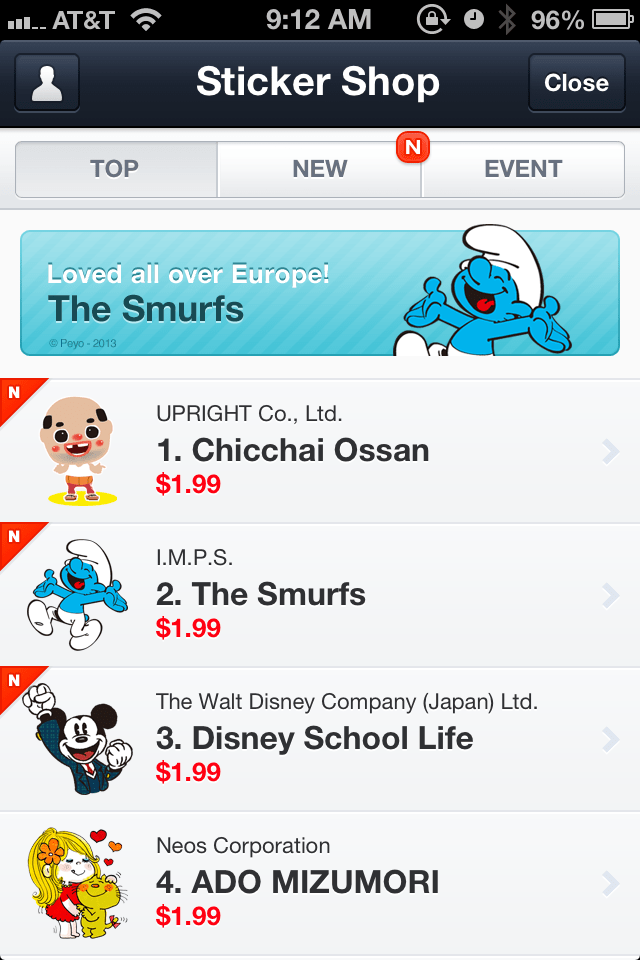
    2. LINE has a mobile-based monetization model that *enhances* the user experience — The app comes with a default pack of stickers, and the characters in that default pack are quickly becoming iconic in many Asian countries; however, you can buy new sticker packs for $1.99 using in-app purchase.

      LINE Sticker Store

      Advertising is tolerable on PC’s because there is screenspace to spare; not so on mobile. LINE’s monetization model enhances the the user experience (more stickers!); Facebook’s detracts. Moreover, the fact that LINE is a much smaller company means their revenue needs are much lower.

    3. LINE is inherently personal, like your phone — Messaging is a natural fit for your phone, which is always on your person, is not shared, and has a small screen, and it’s LINE’s core competency. Facebook, on the other hand, is about being public and sharing. Were Facebook a piece of hardware, it would be much more akin to a 27″ iMac. Sure, both can stretch in the opposite direction – LINE has a Windows 8 app, for example – but the best experience is a fusion of app and form factor.
    4. LINE plays nicely with platform owners — I already noted that LINE being a small company (albeit one backed by Naver, the massive Korean portal) means they need less revenue; it also means their ambitions are not in conflict with any of the major platform owners. They are happy to abide by Apple’s rules, for example, and strive to be as cross-platform as possible. Facebook is much more likely to butt heads, particularly if they build their own hardware.
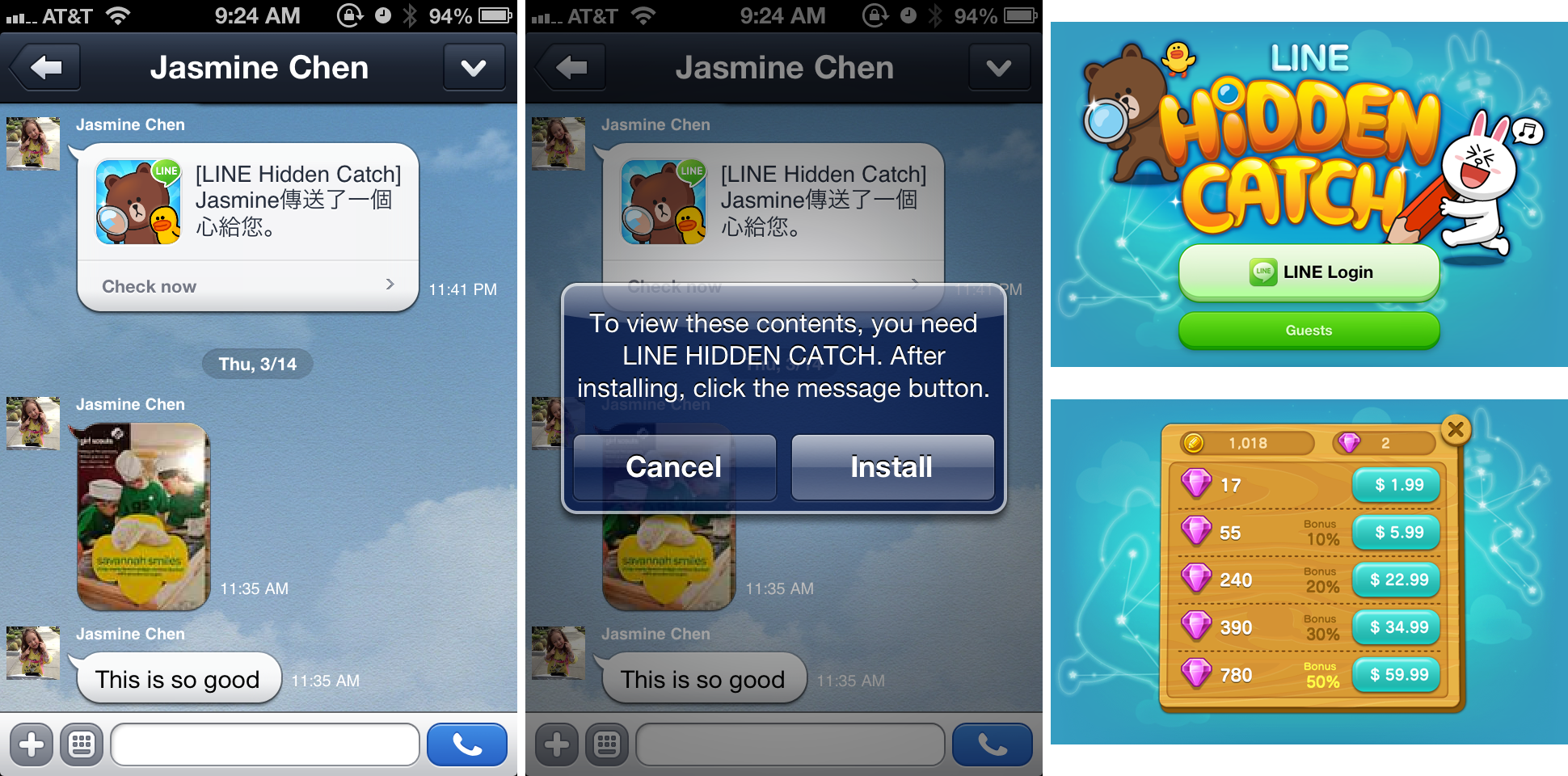
    5. LINE is building a platform on top of App Stores — I’ve only talked about the LINE messaging app; there are actually multiple LINE apps in the store, including photo-editing apps, painting apps, and most importantly, games. All are fully integrated with the core messaging app, and all monetize through in-app purchase. All encourage you to advertise the app to your friends (“Get more coins by telling a friend”), and all are massively popular (keep in mind that Facebook’s penetration in Asia was almost completely driven by Facebook games).

      After being told about a new game, I'm prompted to download it. The game uses the LINE messaging app to authenticate. The game monetizes through in-app purchase.
      After being told about a new game, I’m prompted to download it. The game uses the LINE messaging app to authenticate. The game monetizes through in-app purchase.

    Each of these factors makes LINE better than Facebook on phones, especially in Asia where mobile is even more likely to be the primary form of computing, particularly for young people. Facebook engagement is steadily decreasing throughout the region, and apps like LINE are the primary reason why.

    The broader lesson extends far beyond LINE; Facebook’s weakness on each of these points is directly related to the fact that Facebook is the last great PC company. The same things that made them such a formidable force on the desktop are fundamentally limiting on mobile, yet mobile is the place where the growth is occurring. And so the things that Facebook sees as a problem (Apple control, for example, which limits the utility of the Facebook platform), LINE sees as a positive (super low friction in-app purchases).

    Like other PC companies flush with cash, there is a certain allure to brute-forcing a mobile solution that deals with these constraints by, in effect, taking your ball and building your own game.

    I highly doubt anyone else will want to play.2

    UPDATE: I no longer think of Facebook as a mobile failure. See this article: Mobile Makes Facebook Just an App; That’s Great News. I was, though, right about Facebook Home.


    1. LINE is the first app that really made me wish for a larger iPhone. A sticker takes up almost all of the messaging space on my 4S, especially when the keyboard is up 

    2. Some more problems, because why not?
      – Will the Facebook phone be fully compatible with Android, offering full access to the Play store (including apps like LINE)?
      – If the Facebook phone is expensive, why would someone buy it instead of an iPhone (who values greater Facebook integration instead of a better App Store)?
      – If it’s cheap, how cheap will it be? HTC has never competed on the very low end; moreover, cheap gets you no where in the U.S., where the carriers obstruct the true cost of superior phones 


  • Value Chains

    The Samsung Galaxy 4 reviews should be rolling in shortly. They will recount the screen, processor, camera, face detection tech — every speed and feed there is will be dissected, discussed, and scored. Said features will be compared, first to the recently released HTC One, and most certainly to the iPhone 5. And most of it will have little to no use in explaining Samsung’s success. Speeds and feeds don’t matter in the mobile value chain.

    But first a step back.

    Value chains track the flow of money in an industry. Basically, who pays who. If there is a choice in whom to pay, you usually pay less. If you only have one choice, or if switching costs are high, you pay a lot more.

    Much of the tech blogosphere came of age in the PC era. The PC value chain is relatively straightforward:

    The PC Value Chain circa 2000, Ben Thompson
    The PC Value Chain circa 2000, Ben Thompson

    Nearly every part of the PC value chain was competitive. The exceptions were Intel1 and Microsoft – and that is why those were two of the most valuable companies in the world. However – and this is critical – neither sold directly to customers.2 It was the OEMs who owned the customer relationship, which, beyond forcing them to shoulder Microsoft’s support costs, left them with little to compete on beyond speeds and feeds. After all, all of the computers ran Windows, and they were fully compatible.3 And so, meaningful comparisons between computers amounted to little more than arguments about speeds and feeds, and thus did a thousand gadget review sites bloom.4

    Not so in mobile, at least in the US.

    Mobile Value Chain, Ben Thompson
    Mobile Value Chain, Ben Thompson

    Ignore the spaghetti at the top. Instead, observe how the carriers effectively block said spaghetti from consumers. It has been well documented that consumers in the US choose their carrier first, device second, which ultimately means speeds and feeds – the aforementioned spaghetti – don’t matter (I’ll preempt the objection now: yes, Apple is unique. But their approach and why it was effective can only be understood in the context of this value chain).

    This makes the mobile market completely different from the PC market:

    • PC buyers chose freely from every OEM; mobile buyers choose only from devices (and associated OEM’s) blessed by their carrier
    • PC buyers are guaranteed compatibility no matter which PC they buy; mobile buyers have to first ensure their desired device works on their preferred carrier
    • PC buyers purchase through multiple channels, including retail, value-added resellers, and direct, and pay full cost. Mobile buyers purchase subsidized phones that are sold through carriers

    In short, carriers are the gatekeepers, and their revenue reflects that:

    Global Handset Revenue
    Benedict Evans, TechnologyReview.com (click image for article)

    So read those S4 reviews with interest, but know that if they don’t account for the relationship between the manufacturer and carrier, and carrier and customer they are largely useless in the attempt to identify winners and losers.

    Over the next few weeks I plan to dive into different parts of both of these value chains: the PC one, which is dying, and the mobile one, which is evolving.5 And I haven’t forgotten the rest of the world; it looks a lot different:6

    Yes, I know I'm missing China
    World Mobile Value Chain, Ben Thompson

    One final note: you may have noticed that Google is nowhere to be found (except in the form of Motorola). That is because value chains track the flow of money; Android is (famously) free.7


    1. Yes, AMD was nominally competitive, but only meaningfully so for a brief stretch around 2000. For all intents and purposes Intel was a monopoly — and priced accordingly. 

    2. Microsoft sold boxed copies of Windows, but those only every accounted for a small percentage of its overall revenue. The vast majority of Windows revenue comes from the sale of new PCs. In other words, Windows has historically made most of its money from OEMs, not consumers. Yet another reason why the Surface was such a surprise. 

    3. The history of the PC is an article I can not wait to write. So much – like widespread compatibility – was such a pure accident! 

    4. Yes, I’ve ignored the Mac here. For one, it was largely ignorable, especially in 2000. Two, the way it fit in this value chain is quite interesting and gets at the heart of Microsoft v Apple 

    5. T-Mobile’s announcement today was meaningful in this regard 

    6. Yes, I’m missing China. 

    7. If anything, I should include patent payments, but the drawings are complicated enough as it is! 


  • Welcome to Stratechery

    I don’t know much about sailing. So perhaps it’s not the best analogy with which to launch this blog. But here goes…

    Sailboats, Ben Thompson
    Sailboats, Ben Thompson

    A simple image. Two boats, and a big ocean. Perhaps it’s a race, and one boat is winning — until it isn’t, of course. Rest assured there is breathless coverage of every twist and turn, and skippers are alternately held as heroes and villains, and nothing in between.

    Yet there is so much more happening. What are the winds like? What have they been like historically, and can we use that to better understand what will happen next? Is there a major wave just off the horizon that will reshape the race? Are there fundamental qualities in the ships themselves that matter far more than whatever skipper is at hand? Perhaps this image is from the America’s Cup, and the trailing boat is quite content to mirror the leading boat all the way to victory; after all, this is but one leg in a far larger race.

    It’s these sorts of questions that I’m particularly keen to answer about technology. There are lots of (great!) sites that cover the day-to-day. And there are some fantastic writers who divine what it all means. But I think there might be a niche for context. What is the historical angle on today’s news? What is happening on the business side? Where is value being created? How does this translate to normals?

    Some topics I look forward to exploring:

    • How a company’s “founding myth” shapes its product decisions
    • Why Wall Street is not completely insane
    • Why Samsung has come to dominate Android
    • Was Android a good idea?
    • Why ChromeOS is a very big deal
    • Why Windows beat the Mac (hint: it was never a contest)
    • What is going on with Windows 8?

    I do still have a day job, but I’m committing to at least one of these bigger picture topics a week. Keep up @stratechery, with RSS, a weekly email summary, or simply bookmark this page.

    I look forward to making it worth your attention.