

Netflix
-
Netflix is driving the Hollywood end game, likely confident it can increase the value of IP, and fend off YouTube.
-
Netflix waited out Blockbuster with better economics, and it’s seeking to do the same with its competitors today; the key to the company’s differentiation, though, is increasingly creativity, not execution.
-
Netflix has been resolutely opposed to selling ads, prioritizing the user experience; however, the market conditions for streaming have changed, and so should Netflix
-
Netflix is an Aggregator, with a value chain that lets it drive demand, raise prices, and dismiss competition.
-
Netflix has a lot more in common with Uber and Airbnb than you might think: it all comes back to the Law of Conservation of Attractive Profits, a core principle of disruption

-
Brexit and Tech: The Narrow View, HBO Versus Netflix, Amazon Dash Buttons
There is a broader story to be told about Brexit and tech, but today the narrower view of its impact. Then, why Netflix and HBO are different, and how Amazon’s Dash buttons demonstrate the company’s strength and the CPG industry’s weakness.
-
Semil Shah: How FANGAM Impacts Startups, How Startups Adjust to FANGAM, Investing in a FANGAM World
Ben is on vacation, so Semil Shah wrote a guest post about startups in a world dominated by FANGAM: Facebook, Amazon, Netflix, Google, Apple, and Microsoft.
-
The FANG Playbook
The FANG companies — Facebook, Amazon, Netflix, and Google — are far more similar than you might think. Their rise in value is no accident, and it is connected to Aggregation Theory.
-
Netflix Goes Global, iPhone Worry
Netflix’s surprising announcement that the company was extending its service to nearly every country on earth was impressive in its execution, what it said about the company’s strategy, and it raised interesting points about Aggregation Theory and Netflix’s future opportunities. Plus, there is a lot of smoke when it comes to worries about the iPhone.
-
Ballmer’s Bad Bundle Economics, Netflix Loses Epix Movie Deal
The Daily Update is back with a renewed focus on streaming, bundling, and over-the-top offerings. First up is an analysis of Steve Ballmer’s rumored plans to launch an over-the-top network for Clippers games, and more broadly, a discussion about why bundling works. Then, Netflix loses movies, but it’s the content companies that are losing more from…
-
Why Disney and ESPN Will Be OK
An increasing number of questions are being raised about the future of the pay-TV bundle, and of ESPN. The former may indeed be doomed, but that doesn’t mean the latter is in as much trouble as people think: after all, Disney is the master of differentiated content.
-
Aggregation Theory
The disruption caused by the Internet in industry after industry has a common theoretical basis described by Aggregation Theory.
-
Google’s Integration of Retail and Hotels, Facebook Page Shops, Netflix’s Earnings
Google’s “buy button” for ads and experiments in hotels fit the pattern of Internet-based disruption. Facebook, meanwhile, is meeting needs it itself created, and Netflix has started a virtuous cycle.
-
Correcting the Netflix Story, ESPN’s Challenge — and Opportunity, Yahoo to Stream NFL Game
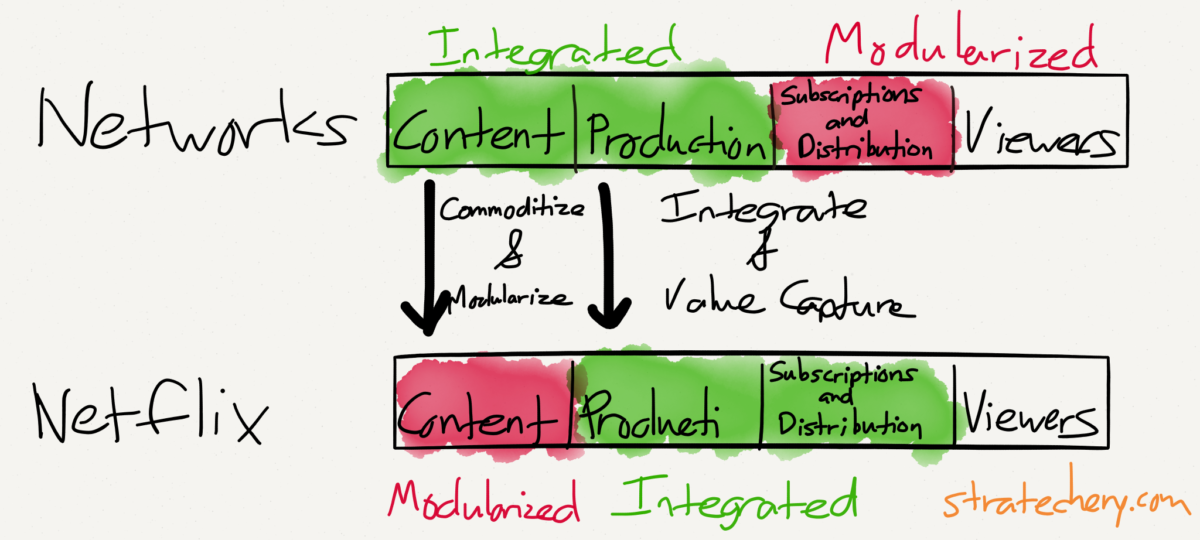
My Netflix chart from Netflix and the Conservation of Attractive Profits wasn’t quite right: after all, I was talking about time, and networks and studios are already modularized. Still, fixing my error provides an interesting view on ESPN and its challenges and opportunities.
-
Netflix and the Conservation of Attractive Profits
Netflix has a lot more in common with Uber and Airbnb than you might think: it all comes back to the Law of Conservation of Attractive Profits, a core principle of disruption