

Modular versus Integrated
Modularity and integration happens throughout the value chain, and is the key to providing a superior user experience and extracting profits.
-
Google Shopping is changing its model, suggesting Google is joining the Anti-Amazon Alliance; 3rd-party merchants should do the same.
-
The fate of Harry’s and other DTC companies, particularly relative to companies like Credit Karma, highlight how the Internet elevates the importance of demand over supply.
-
Apple has won through integration, but integration combined with network effects and economies of scale can result in bad outcomes that look a lot like monopolies.
-
Companies succeed or fail not based on technology but rather according to their ability to integrate within their value chains.
-
Intel is in an increasingly bad position in part because it has been captive to its integrated model. Or, you could simply say they were disrupted.
-
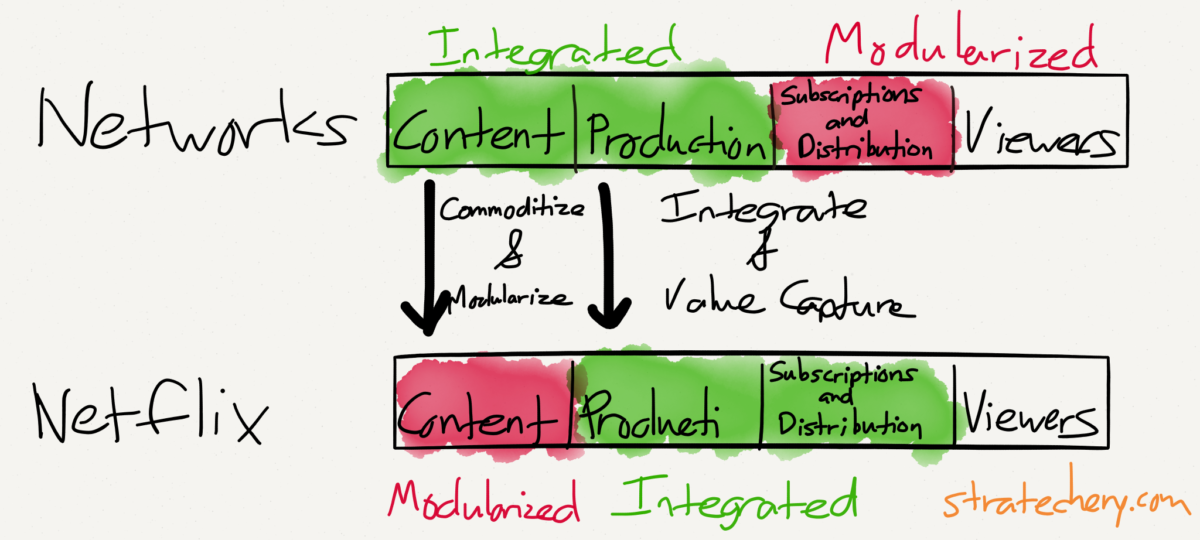
Netflix has a lot more in common with Uber and Airbnb than you might think: it all comes back to the Law of Conservation of Attractive Profits, a core principle of disruption


-
Apple and the Monopoly Question, iPhone Market Share, Apple’s Durability
More on the Apple antitrust case, and the pertinent question of whether or not the iPhone has dominant market share. Then, why the DOJ’s theory of the case is fundamentally flawed.
-
United States v. Apple
Apple is being sued by the DOJ, but most of the complaints aren’t about the App Store. I think, though, Apple’s approach to the App Store is what led to this case.
-
An Interview with Rescale CEO Joris Poort About Building High-Performance Computing in the Cloud
An Interview with Rescale CEO Joris Poort about building high-performance computing in the cloud.
-
An Interview with Netflix co-CEO Greg Peters About Strategy and Execution
An interview with Netflix co-CEO Greg Peters about owning the customer relationship, Netflix culture and execution, advertising, games, and content strategy.
-
Google’s True Moonshot
Google could do more than just win the chatbot war: it is the one company that could make a universal assistant. The question is if the company is willing to risk it all.
-
The OpenAI Keynote
OpenAI’s developer keynote was exciting, both because AI was exciting, and because OpenAI has the potential to be a meaningful consumer tech company.
-
Google Earnings, Microsoft Earnings, AI Leverage
Google’s ad business looks good, but the cloud is slowing; Microsoft’s results suggest that is because the latter is winning in AI.
-
More on Google and AI; OpenAI, Integration, and Microsoft
Follow up on AI’s impact on Google, and the weird relationship between OpenAI and Microsoft
-
Chips and China
Understanding the path the semiconductor industry took to today both shows where China needs to go and also explains why the risks for geopolitical conflict are higher than ever.
-
Microsoft Full Circle
Microsoft has come full circle from the company that cared more about Windows than Office; the retirement of the Office name is possible precisely because Microsoft gave up on Windows and went to the cloud.