

Modular versus Integrated
Modularity and integration happens throughout the value chain, and is the key to providing a superior user experience and extracting profits.
-
Google Shopping is changing its model, suggesting Google is joining the Anti-Amazon Alliance; 3rd-party merchants should do the same.
-
The fate of Harry’s and other DTC companies, particularly relative to companies like Credit Karma, highlight how the Internet elevates the importance of demand over supply.
-
Apple has won through integration, but integration combined with network effects and economies of scale can result in bad outcomes that look a lot like monopolies.
-
Companies succeed or fail not based on technology but rather according to their ability to integrate within their value chains.
-
Intel is in an increasingly bad position in part because it has been captive to its integrated model. Or, you could simply say they were disrupted.
-
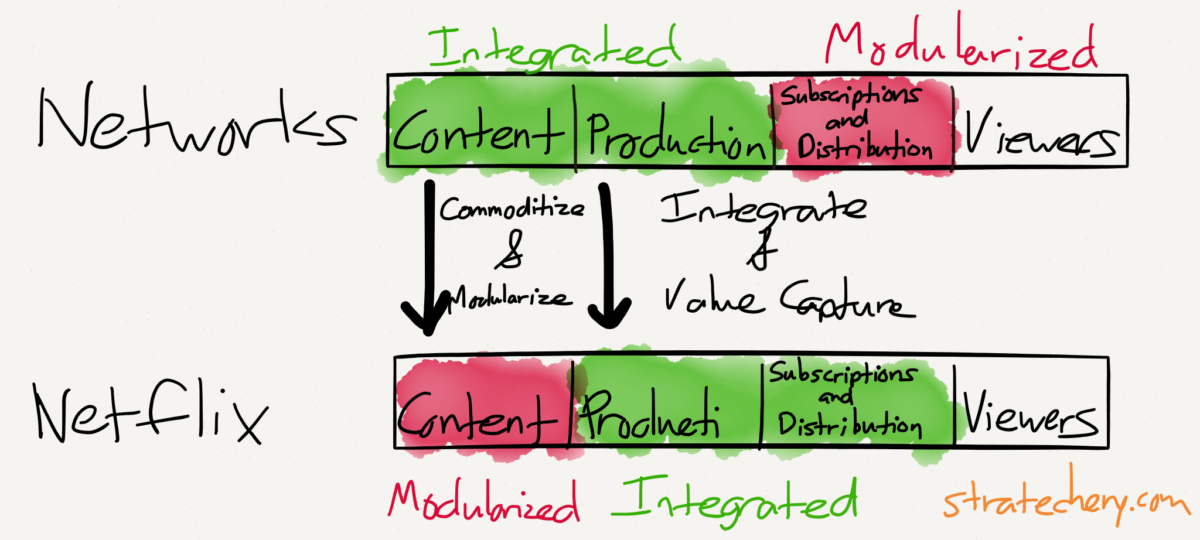
Netflix has a lot more in common with Uber and Airbnb than you might think: it all comes back to the Law of Conservation of Attractive Profits, a core principle of disruption


-
Zillow, Aggregation, and Integration
Zillow fits the description of an aggregator, but it hasn’t transformed its industry due to a lack of integration. Now it is trying to do exactly that.
-
The Aggregator Paradox
Google is winning with AMP and blocking ads in Chrome: both seem bad, but aren’t they actually good for consumers? That is the paradox of aggregation.
-
Amazon Health
Amazon Health doesn’t seem like much now, but there are hints it could be the ultimate application of Aggregation Theory.
-
Apple’s Bad Week, Reputation Risk, Integration and Focus
Apple has had a recent spat of bad software bugs. Software is hard, but Apple has more to lose from its reputation than most. Could there be too much integration?
-
Apple at Its Best
Apple’s original competitive advantage — the integration of hardware and software — is more durable than disruption theory would suggest.
-
Roku’s IPO and Origin Story, Netflix Versus Roku and the Conservation of Attractive Profits, “Weak” Aggregators
Roku’s origin story explain Netflix’s strategic acumen — which, by extension, explains why Roku is a risky bet. Then, Roku explains “weak” aggregators, that aren’t really aggregators at all.
-
Everything is Changing; So Should Antitrust
WPP is dealing with not only a changing advertising industry but a changing world, thanks to the Internet. Antitrust needs to change as well.
-
ARCore, Google’s Benefit to Apple, AR’s Killer App and Apple’s Business Model
Google announced ARCore, which is basically copying ARKit (and abandoning Project Tango). The company that stands to benefit the most from the news is actually Apple.
-
Spotify Follow-up, Nutanix and Hyper-Convergence, The Conservation of Attractive Data-Center Profits
A correction and follow-up on Spotify, and why the streaming service and the labels need each other. Then, the theory behind Nutanix and hyper-convergence in the data center.
-
Beyond Disruption
Clayton Christensen claims that Uber is not disruptive, and he’s exactly right. In fact, disruption theory often doesn’t make sense when it comes to understanding how companies succeed in the age of the Internet.