Stratechery Plus Update

  • The Net Neutrality Wake-up Call

    Sometime in the summer of 2002, having just graduated from university and determined to change the world, I was driving home from Albert Lea, Minnesota formulating my resignation letter.

    After graduating I had, rather naively I suppose, assumed that politics was the best means to effect the change I desired, and so had taken a job on a significant political campaign. The work was hardly glamorous – lots of parades and handing out stickers – but that meeting in Albert Lea, where I had to listen to a local bemoan how immigrants were ruining the country, force a smile and say “The [candidate] hears your concerns” or some other sort of drivel, was simply too much. Real politics, I had come to learn, was a whole lot different than the ideal I imagined as an editor of the university paper. Real politics was about looking naked bigotry in the face, and somehow controlling my gag reflex.

    So I quit.


    Last week the FCC held a hearing about Net Neutrality, complete with protesters and stern editorials from tech sites everywhere. The message was uniform: net neutrality must be preserved, no ifs ands or buts. It was all deeply unserious.

    I’ve written and spoken about net neutrality a fair bit at this point – see Netflix and Net Neutrality, or listen to this podcast – so I won’t dwell on this specific point for too long, but the basic issue is that broadband capacity needs continue to increase, which requires ongoing investment. It ought to go without saying, but said investment is not free; I understand and in principle agree with the argument that internet access should be regulated as a common carrier under Title II of the Telecommunications Act, but that does not address the need for ongoing broadband investment, and calls for reclassification, to be taken seriously, must include proposals for ensuring the US doesn’t fall even further behind the rest of the world in broadband penetration, speed, and capacity.

    Specifically:

    • Government control of the “last mile” would guarantee net neutrality, but then taxes must cover the investment necessary for upgrading our infrastructure. If this is the best plan, then calls for net neutrality ought to be combined with local activism pressing city and state governments to prioritize funding accordingly

    • Open loop unbundling, which means separating ownership of the last mile infrastructure from the provision of Internet services, requires compelling Comcast et al to open their infrastructure to anyone who wants to be an ISP (this is how it works in many countries in the world, including almost all of those with vastly superior broadband speeds and capacity). However, the P/E ratio of your typical utility is far lower than that of a monopolistic ISP; enforcing open loop unbundling would truly be a battle, threatening billions in shareholder value (this is the best outcome in my opinion)

    • Usage-based pricing, where you pay for the capacity that you use, would properly incentivize ISPs to support net neutrality, but would be strongly opposed by many in the tech industry who do not want customers keeping track of what services are bandwidth hogs (Hi Netflix!), or choosing slower speeds to save money

    Or, we could have the situation we have now: emotional appeals for net neutrality on one side, with ISPs arguing they have the right to maximize the economic utility of their networks by means that most consumers will never see (i.e. making content providers pay for fast lanes) on the other, and only the latter includes a solution for incentivizing ongoing investment.

    I presume many of my readers work in technology; if you were deciding between two potential alternatives, one backed with an emotional appeal about one priority, and the other by data and a clear articulation of how a different priority would be addressed, which would you choose? I suspect most would choose the one supported by data. In other words, it’s not enough to insist that a position is morally right; it behooves us who believe in net neutrality to work through how the US can balance net neutrality with the need for ongoing broadband investment, fashion a case for our position, and then build a political movement that makes our plan a reality. That is being serious.


    I sometimes fear that the tech industry as a whole learned the wrong lesson from the SOPA debate a few years ago. In that case much of the tech world came together at the last minute to defeat a terrible piece of legislation. It was certainly a great outcome, but I very much wonder how often the last-minute protest card can be played. Wouldn’t it be better if we never got to the moment of crisis at all?

    The Daily Dot posted a list of companies that have spent money lobbying for and against net neutrality. It’s their introductory paragraph, though, that gets at the real problem:

    With the Federal Communications Commission’s (FCC) decision to move forward with a controversial proposal that threatens net neutrality and the open Internet, lobbying activity looks like it has reached a fevered pitch. But for the companies involved—especially the telecom companies that are eager to be allowed to charge more for a “fast lane” of Internet service—lobbying has been at a fevered pitch for almost a decade.

    Perhaps you will be surprised to hear that the “real problem” I am referring to is not lobbying per se.1 Rather, it’s the fact that only net neutrality opposers have been playing the game for “almost a decade.” Just like SOPA supporters, “fast” lane advocates have been making their case for a very long time, and the tech industry has been largely absent. Sure, we’re making a fuss now, but note that at last week’s hearing the FCC approved the fast lane approach. Last minute protests didn’t work.

    It’s no longer enough to just complain. We as an industry need to complain with solutions, and do it on an ongoing basis.


    I care deeply about the net neutrality debate, but the reason I am writing this is my fear that what we are witnessing is the start of a pattern that will hurt tech industry in the long run. Those who are injured by the impact of technology will diligently make their case in the political realm, while we in the industry who genuinely believe we are changing the world ignore the messiness of politics. And then, suddenly, we will be blindsided again and again by unfavorable legislation or regulation, at which point we will raise a fuss, with ever decreasing effectiveness.

    The truth isn’t just that technology has had an impact on society, but that it is only getting started. A few months ago, in FiveThirtyEight and the End of Average I wrote about the power curve in journalism; this idea, though, is broadly applicable to every field touched by technology. The ease of communication and distribution on the Internet is rendering vast swathes of the economy uncompetitive, even as certain sectors, companies, and individuals reap absolutely massive profits. I am by no means saying this is a bad thing, but I am certainly sympathetic to those who can no longer compete. I am also extremely concerned that recourse for these changes will increasingly be sought through the political process without tech having a seat at the table, much less a coherent solution for dealing with the human fallout of technological progress.

    We as an industry absolutely need to wake up. SOPA, net neutrality, the Google bus protests – all of these are of a piece, and they are only the beginning.


    I understand that politics is messy, and leaves one feeling just a bit queasy. I’ve been there, driving home from Albert Lea. But that queasiness is not a function of politics in the abstract, but the reality of any institution concerned with the behavior of humans. I am familiar with the desire to escape, to put one’s head down and do work that makes one proud, but I don’t know how much longer we as an industry have the luxury. I also know how easy it is to look at politics with a defeatist attitude: how much of a difference can one person make? And yet, working at scale is exactly what we as an industry are good at! Every business model in the Valley is predicated on the idea of serving massive groups of customers with easily repeated processes and software. We can do this.

    The world is changing because we are changing it, just like we all wanted to, and now it’s time to grow up and deal with the consequences in a serious way. I truly hope that the fight for net neutrality will only be the beginning.


    1. Although I absolutely agree that we need to reform how we deal with money in politics 


  • Announcing Exponent, my podcast home going forward

    tl;dr: My weekly podcast will from now on be at Exponent.FM. Please resubscribe.

    As those of you who follow me on Twitter may know (or who heard my appearance on The Talk Show with John Gruber), I kind-of-sort-of started a podcast with James Allworth called Exponent. Unfortunately we ran into some difficulties and, wanting to have a podcast to accompany this site, I instead launched Stratechery.FM with Jon Nathanson.

    However, James and I have figured out a way to move forward with Exponent, and I’m super excited to be moving forward with the original plan: Exponent (not Stratechery.FM) will be my primary podcast from now on.

    I want to thank Jon for being a really great co-host; we’re exploring ways to continue to work together on Stratechery.FM with a slightly different format, so don’t unsubscribe just yet, but for now, I’d love it if you checked out Exponent (especially if you decided Stratechery.FM wasn’t for you). Exponent will be the podcast that I do weekly.


    This week we recorded a fresh episode focused on Apple’s (alleged) acquisition of Beats. I think it was really interesting, and absolutely builds upon the piece I wrote earlier this week. James is quite the skeptic, and echoes the concerns of many of you.

    Topics covered include:

    • The rationale for the acquisition
    • The difference between making and recognizing market opportunities
    • What makes Apple uniquely capable of building revolutionary products
    • Apple’s previous responses when threatened in music
    • How to think about mergers and acquisitions
    • How to best motivate employees

    You can find the episode here.

    To reiterate, this is a separate podcast from Stratechery.FM, so you will need to resubscribe. I apologize for the back-and-forth, but I think Exponent has a chance to be really great, and I hope you check it out.

    Feed | iTunes | Twitter | Feedback

    Thanks for listening.


  • Why Apple Is Buying Beats

    That’s a bit of a presumptuous headline:

    1. The sale is not yet confirmed UPDATE: The deal was confirmed on May 28
    2. It’s likely no one outside of 1 Infinite Loop will ever likely know the true reasons

    Indeed, as Benedict Evans wrote in his weekly newsletter:

    The deal [is] something of a Rorschach Blot – people who think Apple has lost its way see this as proof, while people who don’t assume there must be some other piece to the puzzle (TV? wearables?) that we can’t see to make this deal makes sense.

    I’ve consistently placed myself somewhere in the middle on Apple: I believe their high end position is secure, but that the high end market is increasingly saturated, making consistent growth a challenge. I think that reality is as good a place as any to start when thinking about this deal.

    Apple’s Need for Growth

    In an ideal world, Apple could simply focus on making the best possible Macs, iPhones, and iPads, and sell what the market would bear. Unfortunately, life as a publicly traded company isn’t so simple, particularly one with the scrutiny of Apple. Stock price has little if anything to do with past performance (this is why pointing to record quarters as evidence the stock is underpriced misses the point). Rather, a stock’s price is about future earnings. If those earnings are expected to grow, then the stock will be higher relative to today’s earning; if the earnings are expected to be flat, it will be significantly lower; if the earnings are expected to decline, it will be lower still.

    This matters for Tim Cook and the Apple executive team not only because of activist shareholders, but also because of the role an appreciating stock plays in employee retention. While a sense of mission is the primary driver for those willing to endure a very difficult workplace, knowing you’re getting rich certainly helps.1

    So the need is evident; it’s the means that are much trickier.

    Apple Has No Clear Means of Growth

    Apple’s growth, or lack thereof, is dominated by the iPhone. Last quarter it accounted for 57 percent of Apple’s revenues after fully realizing the upside from the China Mobile deal (the iPad was 17 percent, the Mac 12 percent, and iTunes nine percent); unfortunately, that was the last of the low-hanging fruit when it came to obvious levers for iPhone growth. I don’t think Apple will ever truly go downmarket; beyond the risk of cannibalization, it’s absolutely the case that the iPhone’s premium status is one of the leading reasons-to-own in China in particular. That said, I don’t think the iPhone is at risk for disruption either. Instead it will grow by single digits, befitting its ~20% share of the still-growing smartphone market.

    Meanwhile, the iPad has plateaued, the Mac is growing in a shrinking market, and iTunes app revenue is growing as music revenues decline. None are likely to dramatically offset the iPhone.

    There is no next iPhone

    The standard response of Apple’s defenders is confidence that the “next iPhone” will solve the growth conundrum. After all, Apple created the Mac, iTunes, the iPod, the iPhone, the iPad, surely something else is just around the corner. But while I agree that Apple is a black swan, uniquely able to create revolutionary new products, this confidence sells the iPhone’s massive success and place in history short.

    If you look back over the history of technology, there have been four epochs: the mainframe, the PC, the Internet, and mobile. Each of the first three lasted for about 15 years; we’re in year seven of mobile, and there are no challengers in sight. Based on history, I think it’s fair to assume that iOS and Android will be the primary platforms until 2020, give or take a few years.

    In other words, I believe the iPhone will be Apple’s chief revenue driver for at least the next five years. Something like the iWatch may be interesting, but it’s unrealistic to expect it or any other product category to drive Apple’s growth in a meaningful way, at least in the short term. So Apple needs lots of small revenue drivers in place of one big one. And that means accessories.

    Apple Accessories and the Case for Beats

    Apple has long had two types of products: personal computers (the Mac, iPhone, and iPad), and accessories for those personal computers (the LaserWriter, iPod, and AppleTV). These accessories have been the manifestation of how Apple sees its personal computers being used: the LaserWriter enabled the Mac to be used for desktop publishing; the iPod made the Mac your digital hub; and the AppleTV emphasizes the iPad as the center of your entertainment.2 Notably absent is a leading accessory for the iPhone.

    This, then, is the first justification for buying Beats. As I noted immediately after the iPhone 5S launch, Apple has clearly decided to position the iPhone as an aspirational device, embracing its upmarket status and emphasizing its “coolness”. And, given that positioning, it’s difficult to think of a better accessory than Beats.

    I’ve been alternately amused and annoyed at geek kvetching over Beats “quality.” For the majority of the population, sound accuracy ranks very low on the list of what makes a pair of headphones great (and, for those that prefer an unnatural bass-heavy sound, accurate sound is a detriment). What Beats realized is that a pair of headphones is one of the most visible items you own; most people don’t choose their apparel based primarily on technical appropriateness, but rather on fashion and comfort, yet most headphone makers emphasize the former. Thus, when it comes to fashion and comfort Beats is so far ahead of the competition that it’s laughable.3 Meanwhile, you can’t find a picture of a musician or athlete without Beats headphones, leading to massive mindshare among young people especially.

    The Beats business model is also very Apple-esque: sell a commodity hardware product with a significant markup based on the experience of owning them. And, like Apple, it’s a lucrative one: Beats was reportedly on track to earn $1.4 billion in revenue in 2013, with a commanding 60%+ share of the over-$100 headphone market. Apple’s worldwide distribution could drive that figure significantly higher over the next few years, providing a small but noticeable impact on, you guessed it, growth, both top and bottom line.

    Moreover, the Beats music service fills a big hole for Apple; iTunes downloads are declining rapidly, which is problematic not just for revenue but also as an indicator that iTunes is increasingly not a differentiator for Apple hardware. Beats Music could potentially plug both holes.4

    Ultimately, Beats solves a lot of problems for Apple: it provides a meaningful revenue stream, it fixes their streaming music hole, and it’s an aspirational music brand that is increasingly rivaling Apple itself with the next generation.

    Why, then, the angst among Apple fans in particular?

    What is Apple

    I think the overriding sentiment among Apple fans is that this move feels so un-Apple-like. Sure, $3.2 billion isn’t much for a company that made $9.5 billion in profit last quarter, but Apple’s previous largest purchase was Next for a mere $400 million. Moreover, Beats’ best attribute is its brand; would Apple really allow that to live on? And if you’re going to make a streaming music service, why not build it on the most popular digital music service in the world? And while Beats may provide an experience, where is the software differentiation that makes Apple’s hardware unique?

    Furthermore, as impressive as Jimmy Iovine and team might be, there doesn’t seem to be a great fit with Apple’s tight-lipped culture. And, in general, acquisitions are hard, require a lot of executive attention, and rarely turn out well in the consumer space in particular.

    As I’ve contemplated this acquisition, I’ve returned often to my time at Apple University. A central tenet the team emphasized again and again was that Apple was an interlocking organism that relied on multiple characteristics to make it go. One of these was that Apple was functionally organized; there were no product divisions, and the only P&L was the one reported every quarter by the CEO. As I wrote after Microsoft’s reorganization (here and here), this sort of organization is great for developing a few very high quality products, but it does not scale to multiple product lines. Everything connects at the executive level, and there simply isn’t enough time in the day to provide the appropriate level of focus and coordination to make an acquisition like this work.

    However, Joel Podolny, the head of Apple University, repeatedly noted that Apple was so big now that change was inevitable; managing and understanding that change would be paramount.

    This, then, is what brings this meandering article full circle. Apple Computer the name may have been retired in 2007, but Apple the personal computer company is 38 years old, and very well may have grown as big as it can grow. Is it doomed to simply slowly fade, delivering massive profits and interesting side projects along with a stagnant stock, much like Microsoft in the 2000s? It wouldn’t be a failure of Tim Cook, but more the natural order of such things.

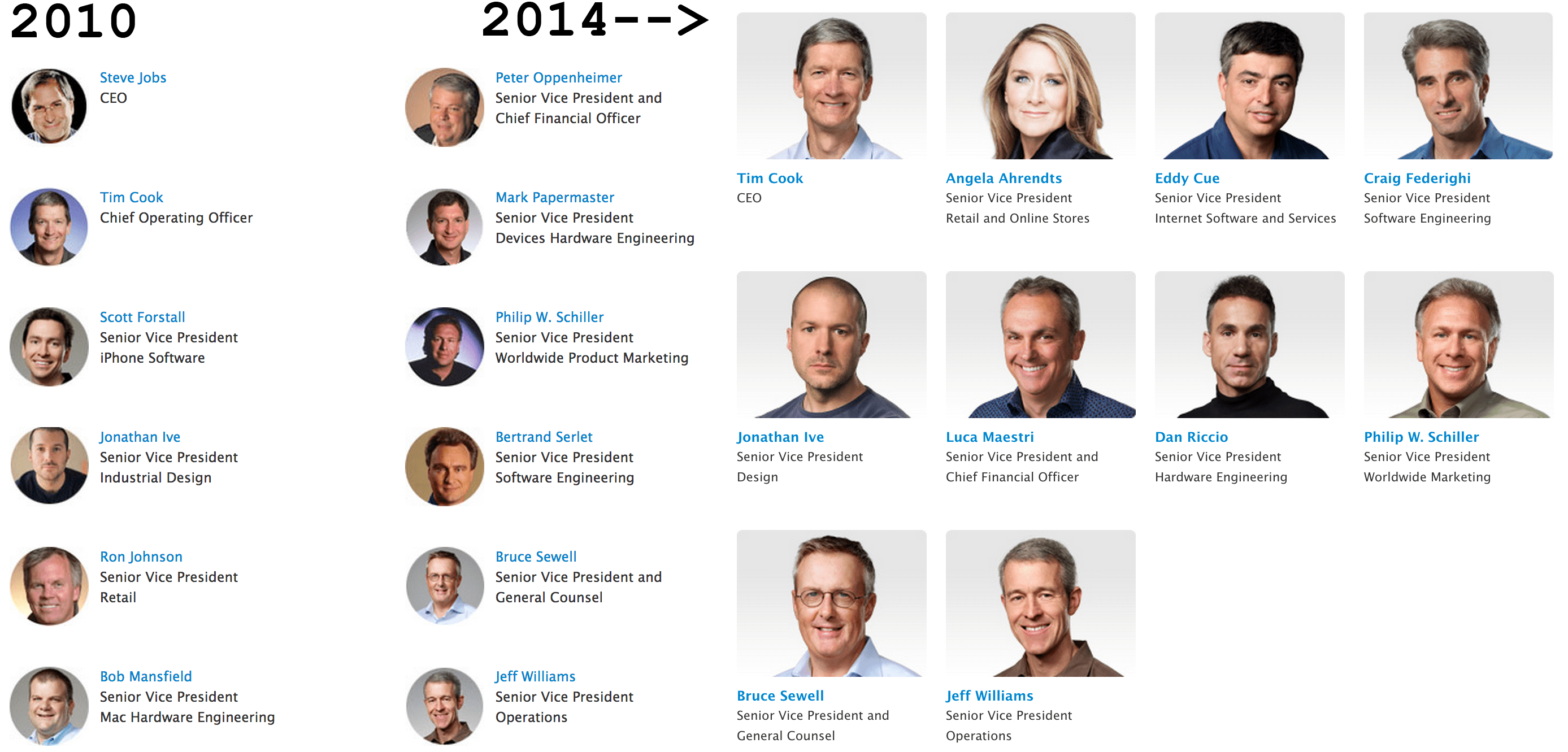
    Or are we witnessing a reinvention, into the sort of company that seeks to transcend computing, demoting technology to an essential ingredient of an aspirational brand that identifies its users as the truly with it? Is Apple becoming a fashion house? Think about it: you have Jony Ive as all-up head of design, the equivalent of a Tom Ford or Donatella Versace. There is the hire of Angela Ahrendts – why would she leave the CEO position of Burberry for a Senior VP role? You have an iPhone framed as an experience, not a product. And now you acquire an accessory maker differentiated almost completely by its brand, not its inherent technical quality.

    Consider the financial allure: LVMH’s P/E ratio of 21 is low for a fashion brand, yet is 50% higher than Apple’s 14. Tiffany & Co is 62! Moreover, it is high-end fashion that is dominant in the fastest-growing region in the world, Asia, and especially in the fastest-growing country, China. Even with a recent slowdown prompted by an anti-corruption crackdown, China accounted for 29 percent of the worldwide luxury market, although Southeast Asia has recently eclipsed China in growth.

    Still, I can imagine the very thought of Apple positioning itself as a fashionable luxury brand is somewhat nauseating for many of my readers. It’s an understandable reaction, and one I somewhat share. I worry that Apple is losing what makes Apple, Apple, especially that desire to make the power of computing accessible for normal people. But I also know that stasis means stagnation, and over the long-run, death.

    In the end, I don’t know for sure where Apple is heading, just like I don’t know for sure why they did this deal, but it just might be worth something that they’re headed somewhere.


    1. Microsoft suffered through this problem over the last 15 years 

    2. Admittedly, this last one is a bit of a stretch 

    3. I am a geek; I own a pair of Sennheiser HD 380 Pros; I am also very aware of how ridiculous they look, and how much cooler every Beats model is 

    4. Although there is an inherent tradeoff; it will be fascinating to see if Apple keeps the Android and Windows Phone apps. I suspect not. Apple is a vertical company, which means their services exist to differentiate their hardware, not to be primary money makers 


  • Dependent on Digital Whales

    It was very hard to find fault with anything that Facebook announced at F8 last week. Unlike their past developer efforts, which were all about pulling content onto Facebook, this year was about pushing Facebook’s infrastructure out into all kinds of mobile apps. The win for Facebook is that much more signal about their users, particularly about their app usage; the win for developers is being a part of the new Facebook Audience Network. The latter is a very big deal.

    One of the key lessons I learned working with developers is that, at the end of the day, everything pales in comparison to the question: “How do I make money?” Developer tools are important, languages are important, exposure is important, but if there isn’t money to be made – or if more money can be made elsewhere – then you’re not going to get very far in getting developers on your platform.

    Facebook, meanwhile, is crushing it when it comes to mobile revenue. In the last quarter, mobile ad revenue surpassed non-mobile ad revenue for the first time, bring in nearly $1.3 billion dollars. As I noted last week in a piece on Bloomberg View, “These ad units are largely purchased by free-to-play game publishers such as King (maker of Candy Crush Saga) and Big Fish Games, which leverage Facebook’s incredible demographic data to target the small percentage of players who will spend hundreds of dollars on in-app purchases.”

    Both Google and Twitter are looking to edge in on Facebook’s territory; Twitter launched app install ads of their own last week, and Google is doing the same for search and YouTube, with the killer advantage of knowing exactly which apps Android users are already using.

    Meanwhile, Google and Apple are both raking in 30% of every virtual sword and extra life, and Apple in particular isn’t shy about talking about it, continually bragging about the amount they have paid out to developers with nary a mention that 95 of the top 100 apps1 are free-to-play.2

    So to recount, Facebook is going gangbusters because of ads for free-to-play games, developers are excited about the chance to cash in via Facebook ads, Google and Twitter are trying to mimic Facebook’s success, and Google and especially Apple are hanging their app store hats on the amount of revenue generated by in-app purchases.

    App stores take 30% of in-app purchases; the remainder goes to free-to-play publishers like King. These publishers, in turn, drive the majority of Facebook mobile advertising, as that is the best channel to find more digital whales. And now, 3rd-party developers can get their piece.
    App stores take 30% of in-app purchases; the remainder goes to free-to-play publishers like King. These publishers, in turn, drive the majority of Facebook mobile advertising, as that is the best channel to find more digital whales. And now, 3rd-party developers can get their piece.

    In other words, billions of dollars in cold hard cash, and 20x that in valuations are ultimately dependent on a relatively small number of people who just can’t stop playing Candy Crush Saga.


    1. As of May 9, 2014 

    2. Technically, not all are “free-to-play”, which means games; there are some freemium applications as well, but the overwhelming majority are games 


  • Apple Retail and the Innovator’s Dilemma

    Angela Ahrendts officially took over as head of Apple Retail last week, and just in time. Same store sales were down five percent last quarter, and have been hovering around zero for several quarters prior. To be fair, that decline is mostly due to Apple’s slowed growth; more concerning is the declining rate of store openings: 37 in 2011, 40 in 2012, but only 24 in 2013. Most concerning is the paucity of locations in Asia, the fastest growing region in the world; Apple only has 19 stores in Japan, China, and Hong Kong.

    It’s easy enough to dismiss the importance of the Apple Stores; after all, if sales move largely in line with Apple’s top-line revenue, surely they are simply another channel, no? Sure, Apple’s relative share for all of its products roughly corresponds to the number of Apple Stores in a particular region, but again, might that not be a trailing indicator?

    I would argue no. In fact, as much as people have come to appreciate Apple Stores, I believe that they are not only still undervalued, but actually increasing in importance; moreover, Ahrendts is a potentially valuable addition not just because of her experience opening stores in Asia, but because of the type of company whence she came.


    Over the last few years, as Apple has retained its dominance of the high end in all the sectors it competes in, some (not all) former doomsayers have come to begrudgingly accept that perhaps not all consumers are focused solely on price (how said doomsayers manage to ignore nearly every other consumer product category is beyond me). Instead they have seized upon tech’s favorite word “disruption” as the cause of Apple’s certainly impending slide. The argument goes something like this:

    “OK, I will grant you that Apple has locked up the premium end of the market. However, even basic smartphones are increasingly ‘good enough’; Apple will soon be over-serving the market. No one will want to pay $650 for a smart phone, no matter the brand, especially if operator subsidies go away.”

    Leaving aside the operator subsidy question (I’m of the opinion operators like them more than they let on), this criticism of Apple is sound in theory but mistaken in reality; the truth is that Apple doesn’t sell phones (or computers or tablets); they sell iPhones. And iPhones are not just hardware, but also the software that runs on them. But even that is missing the whole picture. To buy an iPhone is to buy into an experience that includes everything from advertising to following the news to visiting a store to buying a phone to unboxing to downloading apps to visiting a genius and so on and so forth.

    It’s no accident that the Apple Store appears twice in that sequence. It’s a critical part of the Apple experience that increases the value of an iPhone (and Mac and iPad) and works in a very specific way to counteract over-serving and help prevent disruption.


    In the “Innovator’s Solution,” the follow-on to “The Innovator’s Dilemma,” Clay Christensen diagrammed the process of low-end disruption:

    The incumbent product is originally not good enough, but over time it improves and eventually over-serves consumer needs. This leaves room for the good-enough lower-prices new entrant.
    The incumbent product is originally not good enough, but over time it improves and eventually over-serves consumer needs. This leaves room for the good-enough lower-prices new entrant.

    The market leader (in this case, the iPhone) starts out not good enough, but better than anything else. Over time it improves, until it perfectly meets consumers needs. However, driven by the need to maintain profit margins and the demands of high-end consumers, the product continues to improve beyond what most consumers value. Meanwhile, new entrants are not as good, but also cheaper; they begin to peel off the lower end of the market, and as they improve, eventually take it all.

    Certainly low-cost phones powered by the various flavors of Android have been very successful in the low-end market, and there’s no question that a great many consumers are first and foremost driven by price. However, the iPhone has stubbornly held on to the high end, even increasing its share. As I wrote in What Clayton Christensen Got Wrong:

    Not all consumers value – or can afford – what Apple has to offer. A large majority, in fact. But the idea that Apple is going to start losing consumers because Android is “good enough” and cheaper to boot flies in the face of consumer behavior in every other market. Moreover, in absolute terms, the iPhone is significantly less expensive relative to a good-enough Android phone than BMW is to Toyota, or a high-end bag to one you’d find in a department store.

    It’s that last example that resonates when talking about retail especially. To buy a designer bag is an event: you’re greeted at the door, given a drink, have an attendant on hand at all times (who will model the bag for you, if need be); if you purchase it’s almost like a ceremony, complete with special packaging, congratulations (for them taking your money!), and perhaps a follow-up call a day or two later. Obviously given its scale an Apple Store isn’t quite the same, but it’s in the ballpark, especially relative to the buying experience for most electronics. Moreover, it’s the after-sale experience that is arguably the best part: you’re given help setting up your new device, transferring files, invited to classes to learn how to use your purchase, and assured that a genius is ready-and-waiting to take care of any problems that arise.

    All of this activity surrounding the Apple Store has a direct effect on all three disruption curves:

    The “try-before-you-buy” accessibility of the Apple Store raises the customer needs curve

    By being able to experience new features in the Apple Store, consumers come to demand those features, effectively increasing consumer needs
    By being able to experience new features in the Apple Store, consumers come to demand those features, effectively increasing consumer needs

    My favorite example of this is Facetime when it first launched: Apple actually set up a special 1-800 number that you could call to try out Facetime from any Apple Store. Instantly Facetime moved from being something abstract to being something real, and something you just had to have.

    This is an area where Apple Stores are going to be increasingly critical. Our computing devices are becoming more and more personal, particularly the (alleged) iWatch, and making that experience real to potential customers at scale will be a big challenge (this was one of the many reasons why the Facebook First was a failure). This is also an area where the Apple Store has slipped; the TouchID in-store demonstration is pretty weak, in my opinion, especially compared to the Facetime example. Still, thanks to its stores Apple is alone in its ability to make these kinds of features must-haves.

    In-Store education lowers the Apple products’ feature curve

    Workshops and Apple Store employees enable consumers to use more features; previously unused features (that would have been over-serving) now are consumer needs
    Workshops and Apple Store employees enable consumers to use more features; previously unused features (that would have been over-serving) now are consumer needs

    Although Apple is famous for its focus on simplicity, the reality is computers are complicated, and that includes iOS devices. It’s very easy for less tech-savvy consumers to never really use a large percentage of their device’s capabilities, increasing the risk that they see the price premium as not being worth it (leaving aside the fact the cheaper products are usually more complex).

    Enter Apple Store Workshops. One-to-many classes are available for free, and one-to-one for $99/year. I’m sure few of you reading this have even given these classes a second-thought, but my dad sure has; they completely changed his relationship with the iPad I gave him, and became something he really looked forward to. He told me, and I quote, “It’s the first time in my life I haven’t felt like an idiot [with a computing device].” And, ever since, he’s been counting the days until he can get what-he-previously-considered-to-be-an-overpriced iPhone. It’s worth it, because he knows he can learn how to use everything it has to offer.

    The Genius Bar “safety-net” lowers the relative value of low-end products

    The lack of something similar to the Genius Bar makes low-end products a much less attractive alternative
    The lack of something similar to the Genius Bar makes low-end products a much less attractive alternative

    I don’t know about you, but one thing I’ve realized as I’ve gotten older is that the non-technical dislike calling you for support just as much as you dislike being called. That’s one of the biggest reasons why it’s hard to overstate the impact of the Genius Bar. Even if you never visit, the knowledge that you can if you buy an Apple product, but that you can’t if you buy another, significantly diminishes the relative value of the competing product. Numerous industries have been built on the premise that people will pay for peace of mind, and the Genius Bar is no different. The lack of something similar means that competing products may be good enough from a feature perspective, but in the full calculus of the overall ownership experience never can be.


    What is particularly compelling about each of these factors is that they work to Apple’s advantage even if you don’t buy your Apple product from an Apple Store. You can try out a product there, then order it online. You can take a class with a second-hand device, and you can visit the genius bar no matter what. Thus, I don’t think looking at direct Apple Store sales fully captures the impact they have on Apple’s business.

    That said, anecdotally speaking (albeit echoed in numerous places), visiting an Apple Store is not quite the experience it once was. Many are crowded, it’s confusing to check out, and the product presentation is feeling a bit tired. There is significant room for improvement in current stores, improvements that makes them feel even more like the premium retailers they are. Enter Ahrendts, recently-departed CEO of Burberry, purveyor of the sort of experience the Apple Store has long emulated.

    I actually agree with the consensus that Ahrendts success in Asia broadly and China in particular were major factors in her hiring, but don’t discount what she might improve in the stores that already exist. While I disagree with those that say Apple’s disruption is imminent, I’m not one to ignore the possibility; I do think, though, that even these more nuanced doomsayer serially underestimate the totality of the Apple experience, of which Retail is and will continue to be a major part.

    Note: I first introduced many of these ideas in a 2010 paper called Apple and the Innovator’s Dilemma


  • Twitter’s Marketing Problem

    Twitter’s unconventional path is well-documented at this point. From failed podcasting company to playground sketch (actually, probably not) to a revolving door of CEOs fueled by founder and board infighting has emerged what is, even after yesterday’s stock plunge, a $23 billion company. And, more importantly, a product absolutely beloved by many of its users, including me. You could argue it’s the canonical example of how nothing matters but the product.

    Maybe.

    One of the most common Silicon Valley phrases is “Product-Market Fit.” Back when he blogged on a blog, instead of through numbered tweets, Marc Andreessen wrote:

    The only thing that matters is getting to product/market fit…I believe that the life of any startup can be divided into two parts: before product/market fit (call this “BPMF”) and after product/market fit (“APMF”).

    When you are BPMF, focus obsessively on getting to product/market fit.

    Do whatever is required to get to product/market fit. Including changing out people, rewriting your product, moving into a different market, telling customers no when you don’t want to, telling customers yes when you don’t want to, raising that fourth round of highly dilutive venture capital — whatever is required.

    When you get right down to it, you can ignore almost everything else.

    I think this actually gets to the problem with Twitter: the initial concept was so good, and so perfectly fit such a large market, that they never needed to go through the process of achieving product market fit. It just happened, and they’ve been riding that match for going on eight years.

    The problem, though, was that by skipping over the wrenching process of finding a market, Twitter still has no idea what their market actually is, and how they might expand it. Twitter is the company-equivalent of a lottery winner who never actually learns how to make money, and now they are starting to pay the price.

    The price I’m referring to is the truly disconcerting slowness in user growth and engagement that Twitter reported earlier this week. Twitter reported they increased monthly-active-users (MAUs) by 5.8% from the previous quarter, and 25% year-over-year (YoY), and that timeline views increased 15%. That was down from a 30% YoY increase in MAUs and 26% increase in timeline view last quarter. On the flipside, Twitter posted excellent financial numbers, increasing revenue by 119% YoY, and increasing their ad revenue per MAU by 65%. This too, though, is very unconventional. Ad-supported services are supposed to grow their user base first, and then figure out how to monetize later.

    This actually is about what I predicted back when Twitter announced their IPO. From There Are Two Twitters; Only One is Worth Investing In:

    If an advertiser wants to reach someone like me – and they certainly do, given my spending habits – Twitter is by far the best way to find me. Were Twitter able to consistently capture this signal and deliver effective ad units that caught their user’s attention, they could command some of the highest average revenues per user on the Internet.

    The problem for Twitter is that getting a user as finely tuned as myself is not at all an easy process. My interests are so easily identified because I constantly edit who I follow to make sure my signal-to-noise ratio is as high as possible. However, this sort of behavior is totally unnatural and overwhelming to a new user. I hesitate to tell others how valuable I find Twitter, simply because I don’t know how to explain to them how to make Twitter as useful to them as it is to me.

    Nothing has really changed: Twitter continues to know a lot about me and other heavy users, and is figuring out how to monetize that, but there just aren’t enough people like me. I know Twitter is trying to spin MoPub as giving them access to a billion users, but without the data derived from Twitter usage, those billion users and the ad impressions they see are just more undifferentiated inventory; there’s a good reason display ad companies are worth a lot less than social network ones.

    What Twitter has is a marketing problem. To be clear, while advertising is a part of marketing, marketing is about much more than advertising. It’s also about understanding your market, what their needs are, and how your product meets those needs. I continue to see little evidence Twitter has any idea, and I think their accidental success is largely to blame.


    An interesting side effect of Twitter’s inability to articulate their core value prop is that anyone and everyone has advice for how they might improve (including me!). Combine that with the fact that Twitter serves so many different use cases – real-time news, de facto RSS reader, public chat, just to name a few – and you have a paralysis of choice not only for new users but also for Twitter’s marketing and onboarding teams.

    So why not embrace the complexity? Instead of trying to teach new users how to built a curated follower list, build the lists for them. Don’t call them lists, though; embrace Twitter’s TV connection and make them “channels.” Big basketball game? Go to the basketball channel, populated not with the biggest celebrities but with the best and most entertaining tweeters. Build similar channels for specific teams in all sports. Do the same for Apple, Google, and technology; liberals, conservatives, and politics in general; have channels for the Oscars, the Olympics and so on and so forth. And make them good, devoid of the crap that pollutes most hashtags and search results. If the ideal Twitter experience is achieved with a curated list, then provide curated lists and an easy way to switch among them.

    Now you have a value prop: easily join the conversation about what is happening in the areas you care about, without the months-long process of building a perfectly customized Twitter feed. Oh, and by the way Ad Person, here is a very easy-to-understand ad unit built around a specific topic filled with self-selected followers.

    Sure, this is a bit of a dramatic change, but there’s no need for individualized timelines to go away. More importantly, Twitter needs to do something dramatic. $250 million in revenue is nice, but:

    LINE is mostly strong in countries that Twitter isn’t, but the important point is that more and more channels are competing for advertiser’s dollars. Twitter is in real danger of being reduced to a niche; useful for reaching a specific type of audience, but an afterthought for meaningful ad spending, and that certainly is not worth $23 billion.

    Twitter is truly a special company with a special product, but not even they can escape the fact that product is a necessary but insufficient ingredient. Market matters, and it’s past time Twitter found theirs.


  • The Problem with Payments

    Payments are one of the eternal tech rainbows,1 enticing startups and established companies alike with the promise of priceless data and incredible volumes. Many who dive in, though, like Google with Wallet, find it’s incredibly tough going. Square, for example, is burning through cash and may be acquired whether they want to be or not. From the WSJ:

    With losses widening and cash shrinking, representatives of mobile-payments startup Square Inc. have discussed a possible sale to several deeper-pocketed rivals, according to people familiar with the matter…

    Square recorded a loss of roughly $100 million in 2013, broader than its loss in 2012, according to two people familiar with the matter.

    The five-year-old company paid out roughly $110 million more in cash last year than it took in, according to two people familiar with the matter. Over the past three years, the startup has consumed more than half of the roughly $340 million it has raised from at least four rounds of equity financing since 2009, two people familiar with the company’s performance said.

    There are two broad categories of payment “opportunities”: building on top of credit cards, and replacing them. Square falls into the former. The challenge here is that margins are incredibly tight. Consider a $50 transaction paid for with a Visa card swiped through a Square reader:

    • The interchange fee (which goes to the card-issuing bank) for swiped Visa cards is 1.51% + $0.10, which in this example is $0.855
    • Various assessment charges (where Visa actually makes its money) come to ~.11% + $.03, which in this example is $0.085
    • Square charges merchants 2.75% for swiped cards, which in this example is $1.375

    Square’s final takeaway is at most $0.435.2 Were the card issued by American Express, Square would actually lose money (assuming a $1.75 fee from a 3.50% discount rate).

    Those aren’t great margins, to state the obvious.

    Yet Square cannot really charge more. Credit card processing fees are one of the largest expenses a business faces3, and every percentage point increase is a significant incentive for said business to go to the trouble of setting up and managing their own merchant account.

    This is the blessing and curse of building on credit cards: you get instant ubiquity, but massive competition. The end result means Square is unprofitable, and getting the scale to make these numbers work – or, as Square tried to do, the user experience that makes paying these fees worthwhile – is a challenge that would be faced by anyone looking to build a payment system on top of credit cards, including Apple, Amazon, or Google.

    The alternative is to go around credit cards and build something completely new. This leaves much more room for a sustainable margin, but then you’re left with the absolutely massive network problem. If you think getting a social network off the ground is hard, when the only obstacle is getting people to enter in an email address and password, imagine having to simultaneously distribute a means of accepting payments to merchants and a means of making payment to consumers, all at the same time, because if you only have one you basically have nothing.

    This is why I, for the foreseeable future, expect to see little if any progress in the United States.

    Note the caveat, though: “in the United States.” The problem with building a new payment system or service in the US is that credit cards, all things considered, aren’t that bad. Sure the fees are high, but the network problems are largely solved; rare is the location where you can’t use a credit card (and almost always by the merchant’s choice), and almost all consumers have one. Small wonder, too: the benefits of credit cards relative to checks and/or cash far outweighed the pain it took to roll them out:4

    How new payment systems are — or are not — adopted
    When the benefit (vertical distance) is greater than the pain (horizontal distance) of establishing a new network, a new technology can breakthrough. However, if the benefit is only incremental, then the status quo is likely to prevail.

    This is much less the case when it comes to alternative payment methods. The pain of establishing a new two-sided network remains just as significant, but the upside to the new payment systems relative to credit cards is much less than the benefits of credit cards relative to cash.

    That is why the most interesting places to think about when it comes to new payment systems are countries with low credit card penetration. Here in Taiwan, for example, when I first arrived in 2003 almost everything was cash only.5 Just a year earlier, however, in 2002, the EasyCard Corporation née Smart Card Corporation had rolled out an RFID stored value card for use on Taipei’s new MRT (subway) system with the ability to add cash to your account at any convenience store or MRT station. Within a few years you could use the card everywhere: buses, trains, taxis, parking, government fees, and now, 10 years on, almost every retailer, and the RFID chip is no longer limited to cards, but is embedded in some phones, key fobs, and more. The EasyCard was modeled on Hong Kong’s Octopus card, which is even more ubiquitous in Hong Kong retail; the common thread in both systems was significantly lower credit card penetration relative to the US.

    The point is not to say that RFID stored-value cards are the future (although they are much more merchant-friendly than credit cards). Rather, the reason that contact-less payment systems have taken off in sectors beyond transportation is that their relevant competitor was the obviously inferior cash, not the slightly less-good credit card. The gain was worth the pain of creating a new two-sided network of merchants and consumers.

    The broader takeaway, though, is that more and more breakthroughs, especially those that involve significant network effects, are likely to come from outside the United States. You already see this in the messaging space:

    • SMS is effectively free for most American’s on post-paid plans
    • SMS is charged on a per-message basis in many other parts of the world
    • Ergo, services like WhatsApp and LINE take off in non-US markets where they are a massive leap in value relative to the status quo and are worth the pain of getting all your friends on board

    The vast majority of IT innovation over the last two decades has started in the US, and the quality of services available to the US consumer is now quite high; this means the hurdle for something new to breakthrough is higher still. In many other parts of the world, though, which are only now getting connected – and usually via a smartphone, not a PC – there are all kinds of opportunities that are leaps and bounds better than what was previously available, even as they aren’t enough of an improvement over the US status quo for consumers in the US to care. Relativity matters, and both investors and startups would be well-served by looking for geographies where their ideas have leapfrog potential.


    1. Along with TV 

    2. I didn’t calculate the card markup fee; presumably Square gets a very favorable rate 

    3. Said fees are Stratechery’s largest cost already 

    4. Although even then, it took decades 

    5. Credit cards are much more widespread now 


  • Don’t Give Up on the iPad

    When people think about the first iconic Apple product, it’s probably the Macintosh that leaps to mind. But Apple Computer was actually built on the back of the Apple II. In fact, for quite a long while it was the Apple II that provided the profits that made the Macintosh possible, as Guy Kawasaki recounts:

    (Note: Ironically, the video doesn’t work on an iOS device; is Vimeo really flash only? Anyhow, the video isn’t essential for the article)

    If you squint you can see the parallels between the Mac and the iPad (although the iPad already provides far more revenue and profits than the Mac). In both cases you have the new machine, with a new interaction model, not selling as well as many think it ought to, and the same prescription for both: make it more like the old thing.

    The Macintosh was eventually able to run Apple II software with the release of the Apple IIe card, but that actually had nothing to do with why the Macintosh finally broke through as Apple’s primary moneymaker. Rather, it was the advent of desktop publishing, made possible only because of the Mac’s unique GUI and mouse input. To put it another way, the Mac was legitimized by a type of application that could not have existed without the Mac, and thus, by definition, came along several years later.

    This is worth keeping in mind when it comes to the iPad. After explosive early growth that outpaced even the iPhone the iPad has stalled, to put it kindly. Last quarter Apple sold 16.4m iPads, a 16% drop-off from the year-ago quarter. While a good portion of this difference was due to a different inventory situation after last year’s Mini shortage,1 even the most positive spin is one of no growth. And, predictably, the Internet is full of advice.

    Jean-Louis Gassée got things started in earnest with an article entitled The iPad is a Tease:

    The iPad represents about 20% of Apple’s revenue; allowing iPad numbers to plummet isn’t acceptable. So far, Apple’s bet has been to keep the iPad simple, rigidly so perhaps, rather than creating a neither-nor product: No longer charmingly simple, but not powerful enough for real productivity tasks. But if the iPad wants to cannibalize more of the PC market, it will have to remove a few walls.

    Specifically, the iPad is a computer, it has a file system, directories, and the like — why hide these “details” from users? Why prevent us from hunting around for the bits and bobs we need to assemble a brochure or a trip itinerary?

    This sounds suspiciously like the recommendation that the only thing holding the Macintosh back was its inability to run Apple II programs. It’s also of a piece with the vast majority of geek commentary on the iPad: multiple windows, access to the file system, so on and so forth.

    I also think it’s misplaced.

    The future of the iPad is not to be a better Mac. That may happen by accident, just as the Mac eventually superseded the Apple II, but to pursue that explicitly would be to sacrifice what the iPad might become, and, more importantly, what it already is.


    There is nothing in life that is not a tradeoff. My favorite example of this is multitasking in iOS. Up until iOS 4, when you exited an iOS app, it closed down completely; when you returned, you were back at the first screen. With iOS 4, your app’s state was finally kept in memory; for at least the last few apps, going back meant returning to the exact same spot you had left. An unequivocal win, right?

    Well, no. iOS 4 came out in 2010, when my daughter was 3 years old, and for her it was a major step back. She had learned of her own volition that, whenever she didn’t know what to do – like how to leave a playing video, for example – all she needed to do was press the home button and restart the app; now she was back at a familiar place and could go where she wanted, such as to another video. After the update, though, it was incredibly enlightening to see her grow frustrated with my iPhone; her “Get Out of Jail Free” card – the home button – was no longer her saviour, because the app put her right back in the place she was trying to leave. That was the multitasking tradeoff.

    To be clear, I think that was a tradeoff worth making. But I’m much less sure about other “features” that geeks are clamoring for, like multiple windows and access to the file system. It’s the absence of these features that makes the iPad so accessible to so many who have never felt comfortable with traditional computers; there is always a cost to complexity. Moreover, for those geeks clamoring for Mac features, why not just use a Mac? It was built explicitly with multi-windows, access to the file system, and a WIMP interface in mind, and the Mac hardware line right now is absolutely fantastic (and will be even better if WWDC features a Retina MacBook Air). Let the iPad be the computer for those for whom computers are too much, even if this population by definition isn’t likely to upgrade frequently.

    That, though, is not the end game for the iPad, at least in my opinion. What I am most excited about are the new things the iPad will enable that simply wouldn’t have been possible on the Mac, just like desktop publishing wasn’t possible on the Apple II. We already see hints in specific niches, like art, music, and gaming. Apple’s ads point to some of these as well, featuring everything from photography to windmill maintenance to sumo wrestling. Obviously none of these have broken out to the degree necessary to drive significant growth, but the iPad has only been on the market for four years; the fact it’s already significantly outselling the Mac puts it far ahead of the Mac relative to the Apple II, and use cases need time to catch up with brand new possibilities.

    Apple, though, does deserve some of the blame for the slower development of these new opportunities. Their reticence in enabling sustainable businesses on the app store makes building a business on apps, particularly new-to-the-world concepts, a risky proposition. This is unfortunate; after all, it was a 3rd party – Adobe – that truly drove desktop publishing. Unfortunately, the way Adobe treated Apple in the late 90s likely contributes to Apple’s current attitude towards developers, but it’s to Apple’s own long-term detriment.

    Still, though, Apple has done well to preserve the structural simplicity of iOS,2 and I strongly urge them to keep that simplicity as their northern star, stalled growth and geek demands be damned. Something will sell iPads, and if you criticize me for not knowing what, then criticize all those who couldn’t have imagined desktop publishing in 1984.3


    1. I know this sounds like Tim Cook making excuses, but it’s a very real thing 

    2. Even though the reduction of affordances in iOS 7 made the operating system unnecessarily harder to use 

    3. I do think there is a very real question about the cannibalistic effect a large-screen iPhone will have on the iPad; Apple’s response should be to better incentivize developers to build new iPad use cases, not to make an iPad like a Mac 


  • Apple and Nike

    What kind of company is Apple, anyway?

    They certainly have great technology, but to call them a technology company doesn’t seem quite right. They have great marketing, but to call them a marketing company isn’t true either. They have an incredible retail chain, but to call them a retailer is clearly off base as well.

    You could ask a similar question about Nike.

    They started with shoes, but their product line has extended far beyond that. Certainly they are a marketing company, one of the best in the world, but they also make many genuinely innovative products. Over the last few years they’ve been expanding their push into software and wearables, yet no one thinks of them as a technology company. And, despite self-owned and franchised stores in almost every neighborhood in the world,1 no one thinks of them as a retailer either.

    Interestingly, both Apple and Nike have markedly similar business models: as various pundits never tire of telling us, Apple is selling a commodity and is doomed to inevitable margin pressure and/or massive loss of share in the face of good-enough cheap Android. For better or worse we in tech are stuck with these folks, because who knows what they would make of a company like Nike, selling pieces of leather and bits of fabric. Talk about a commodity! And yet, there is Nike, sporting a ~45% gross margin in an industry that averages 33%. Clearly they are more than just an apparel maker.


    My wife just registered for the Nike Women’s Half Marathon here in Taipei; in order to register, you had to have logged at least 50km using the Nike+ Running App over the last month; immediately after registering you were presented with specially made products featuring the race logo. Typing that out sounds, well, rather annoying, but the reality was quite the opposite. My wife downloaded the app, clocked up the miles, counted down to the deadline, and joyfully bought a new pair of running pants (I was impressed at her restraint). It was fun.

    What Nike is selling is the experience of being a runner (or a basketball player or a tennis player or a golfer, etc.) It’s not just the athletes in their advertisements, or the quality of their shoes, the sportiness of the clothes, or the sophistication of the apps. It’s the whole, and it’s greater than the sum of its parts. Nike is an experience company. They sell a commodity product, and make their profit off of the differentiation provided by the Nike experience. And they’re better at it than just about any company in the world, except maybe Apple.

    After all, Apple too is an experience company. They are not selling you a computer, or a phone, or a tablet; they are selling an experience that encapsulates everything from their ads to their stores to their packaging to the actual user experience of their devices. They sell a commodity product, and make their profit off of the differentiation provided by the Apple experience.


    Serving on corporate boards is fairly common for C-level executives, but not at Apple under Steve Jobs. To my knowledge the only exception was Tim Cook, who joined Nike’s board in 2005.2 A year later Nike and Apple released the Nike+iPod, a hugely successful collaboration that made an iPod Nano about as omnipresent as a water bottle for a great many runners, and a pair of Nikes the default choice for anyone with an iPod.

    Since then the collaboration has continued, especially with the FuelBand, which has an app only for the iPhone, along with significant shelf space in Apple Retail stores. Of course the FuelBand also always seemed a potential stumbling block: would Tim Cook really release a competing product (the alleged iWatch) to the company on whose Board he sat?

    Well, now that stumbling block is gone: CNET reported over the weekend that Nike fired a majority of the FuelBand team and will stop making wearable hardware:

    The company informed members of the 70-person hardware team — part of its larger, technology-focused Digital Sport division comprised of about 200 people — of the job cuts Thursday. About 30 employees reside at Nike’s Hong Kong offices, with the remainder of the team at Nike’s Beaverton, Ore., headquarters.

    Nike’s Digital Sport hardware team focused on areas like industrial design; manufacturing operations; electrical and mechanical hardware engineering; and software interface design. Products included not only the FuelBand but also the Nike+ sportwatch and other, more peripheral sport-specific initiatives.

    First off, I highly doubt this was directly connected to Apple. By all accounts the FuelBand was a money pit and the Secret thread that first revealed the firings suggested the same. Secondly, the FuelBand was interesting in a product sense but didn’t make much business sense for Nike. It didn’t lead to the direct sale of any of their products, since it was meant for wearing around the home and office; relatedly, while there may have been some brand utility in people sporting a Nike+ wearable, a product meant to make you take the stairs doesn’t exactly remind you of an athletic lifestyle.

    All that said, Nike can read the rumor sites just as well as we can, and do happen to have particularly special access to Tim Cook and a history of partnering with Apple. And Apple is certainly better at “industrial design; manufacturing operations; electrical and mechanical hardware engineering; and software interface design.” I would not at all be surprised if Nike were happy to cast aside the FuelBand in favor of recreating the Nike+iPod with the (alleged) iWatch.

    The question, then, is were such a partnership to come about, what might Apple gain from Nike? Obviously we are well into the realm of speculation, but certainly the biggest question about a potential iWatch is what job it might do. And, perhaps, it really is there right in front of us.

    Think about the iPhone: before it could make a call or go on the Internet, there was the iPod, which did nothing more than play music. But the foundation built by the iPod, iTunes, and the iTunes Music Store helped the iPhone tremendously, leading not only to software innovations like the App Store, but also hardware breakthroughs in miniaturization and battery life. You have to start somewhere.

    So it is with a wearable. It’s not too difficult to imagine a future where your wrist is the center of your digital life, projecting a contextually appropriate user interface to the nearest dumb screen, but it’s even easier to see how that’s just not possible now – just like the iPhone wasn’t possible when the iPod launched in 2001. But you have to start somewhere.

    So then, if you want a beachhead, is there a population that is already in the habit of wearing electronic accessories and loves measuring themselves? And, if you wanted the absolute best chance of winning that market, might you not want to partner with the company that sells the experience you want to provide?

    Truthfully, the only reason to think Apple might not want to partner with Nike in this way is, well, because they’re Apple. But remember, Apple was quite pleased to launch the iPhone with Google services,3 and has cooperated with Microsoft for years; they’ve also long had by far the best and most comprehensive content deals. Apple’s business development acumen is one of its least appreciated competitive advantages, and their products are better when it is utilized. I bet that’s exactly the case with the iWatch.


    1. There are five Nike-branded locations I can think of off the top of my head within a kilometer of my house, none owned directly by Nike 

    2. Eddy Cue joined the Ferrari Board of Directors in 2012 

    3. Yes, I’m quite aware of how that turned out 


  • Free Stratechery and the Daily Email

    I hope you will forgive one more solipsistic post; I’m as eager as you to get back to the kind of writing that you are here for.

    First off, thanks for your support. I’ve been pretty overwhelmed with the number of signups so far; it’s a great affirmation of what I’m doing here.

    As expected, launching a membership program has not been without its hurdles; beyond the payment gate snafu, there has been lots of folks that have expressed concern about my erecting a “paywall,” cutting them off from content they had come to expect.

    My sincere belief is that this is not a paywall, which I view as being punitive and arbitrary. Instead, I wanted memberships to be additive, giving my most loyal readers more and different premium content, while the long-form articles this site is known for remained free.

    It was, however, around the 10th time I was explaining this that I realized I was making the most classic of mistakes: blaming the customer for my complexity.

    The truth is while I perfectly understand the distinction between content types, I am also heavily invested in that understanding: after all, it’s my livelihood. My readers have busy lives with their own cares and worries particular to them, and to assume they would take the time to understand what I am selling was unfair to them, and ultimately, unfair to me as a proprietor.

    To that end, I am making a change to the membership plans, specifically the additional content portion:

    The Linked List Content Will Become the Daily Stratechery Email

    The additional premium content that I plan on writing daily (~3-4 500 word items) will be moved to a daily email, fresh in your inbox every morning (an advantage of being 15 hours ahead).

    This has lots of advantages:

    • If something is on this site, it’s free to read and share. Period. (Update 4/30/14: At the request of members, I’ve archived the daily updates to the side. However, they will not appear in the main feed and will have no impact on the experience of non-members) No need to think twice or wonder if your friend or coworker will be able to read the link you share, which ultimately, helps me grow.
    • What I am selling will be much clearer and easier to explain: a daily email, with my opinion on the most important stories and articles of the day. It’s something that doesn’t exist now, but will if you pay for it.
    • Significantly reduced complexity in the design of the site, including a return to one full RSS feed.

    There are disadvantages:

    • I’m changing what I sold. If anyone strongly prefers the linked list and objects to receiving the same content in email, I will gladly refund your money.
    • I’m removing the additional traffic on site that would have been generated by the daily content, which may affect sponsorships. To that end I’m also reducing the sponsorship price to $750.
    • It will be much easier for people to share premium content. Once or twice would be ok, but I trust my readers would not do so systematically.

    The price will remain $100 a year with gifts or $10 a month. The signup flow is the same – I automatically enroll you when you buy a membership.

    The Conversation Plan

    I’m changing this to the t-shirt plan and reducing the price: $30 for the year with a t-shirt, $3 a month without. I will issue refunds to those who have bought conversation plans (but there were many fewer than the other plans).

    The Community Plan

    No changes. I’m very happy with the response and can’t wait for our first meetup. Email and Glassboard access coming soon (it’s been one of those weeks).

    Donations

    I’ve received several request for a donation option, and will offer one soon.

    Also, please note it will take a few days to incorporate these changes fully, but I wanted to make this announcement sooner rather than later.


    It’s humbling to, on one hand, preach clarity in product offering and the importance of clear value propositions in my articles, and then stumble when it’s my turn. However, I think flexibility of mind and action are important as well, and I hope I’ve demonstrated that.

    Above all, though, I want to express how grateful I am for the many who have already bought in. I aim to make it a bargain – and a less confusing one at that!

    If you haven’t signed up, and don’t intend on it, I still welcome you as a reader and hope you will continue to share content you like. Again, everything on this site is free. If you’d like to come on board and get that daily email, or access to me, or just a t-shirt, the membership page is here.

    Thanks so much for your support. I look forward to getting back into the tech next week.