

Microsoft
-
Microsoft argued there is an AI platform shift, and the fact that Windows is interesting again — and that Apple is facing AI-related questions for its newest products — is evidence that is correct.
-
Microsoft has come full circle from the company that cared more about Windows than Office; the retirement of the Office name is possible precisely because Microsoft gave up on Windows and went to the cloud.
-
The Windows division no longer exists at Microsoft, marking the end to a four-year process of changing Microsoft’s culture.
-
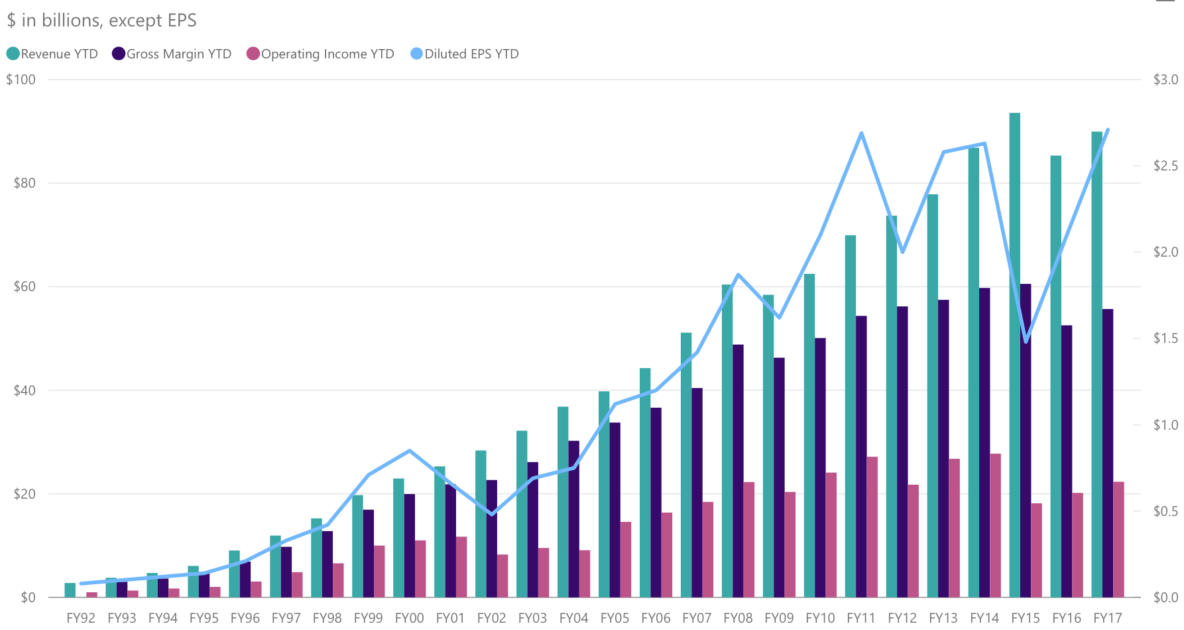
There are striking similarities between Microsoft today and IBM in the Lou Gerstner era, but today’s IBM should be a warning to Redmond.
-
It is very fair to say that Apple is threatened by the potential rise of AI. Google, though, is also threatened by its inability to own customers’ attention. The solution for both companies may entail…
-
Microsoft needs to first understand the type of company it is, and choose its strategy accordingly. That means focusing on services, not devices.


-
Windows 8 and the Cost of Complexity
PCs just suffered their worse quarter ever. From the WSJ: World-wide PC shipments fell 10% last year, research firms Gartner Inc. and IDC said Thursday, the worst-ever sales slump for the industry. Both companies have been tracking personal computer sales since the 1980s. Computer makers have been hurt as consumers and businesses spend more time […]
-
Chromebooks and the Cost of Complexity
While there is a question of degree, it seems quite certain that Chromebooks had a pretty good 2013. Many are attributing this to price – most Chromebooks cost $300 or less – and they’re almost certainly right. It seems like yet another case of disruption: a cheaper, inferior product enters the market against a competitor […]
-
Skating Towards the Goal
First things first: I do not subscribe to the idea that a Bill Gates return would be a good outcome for Microsoft. Indeed, much of what troubles Microsoft today is directly attributable to Gates, particularly the Vista disaster/distraction and the Windows obsession. Still, though, there is something to be said for the power and inspiration […]
-
An Interview with Eric Jackson at Forbes
Eric Jackson recently interviewed me for his column at Forbes. I’m cross-posting here my answers to the tech industry related questions. Check out the full interview to read more about me personally and the background of stratechery. Q: Where is Apple at right now as a company in this post-Steve Jobs period? A: I think, […]
-
HTC’s – and Windows Phone’s – Missing Market
According to Digitimes, HTC won’t use the top-of-the-line Qualcomm processor in their new phablet: HTC reportedly will adopt an old Qualcomm processor, the quad-core 1.7GHz Snapdragon S4 Pro APQ 8064, for production of its first large-size HTC One Max to be launched in October 2013, according to sources in the supply chain. Some sources said […]
-
Another Nokia Explanation; The Same Tragic Conclusion
While I remain convinced that Microsoft’s Nokia acquisition was largely driven by fear of losing Nokia as an OEM, either to Android or bankruptcy, there is something else curious about the timing. (The following scenario is conjecture, but not the analysis that follows) ValueAct, who is opposed to Microsoft’s push into devices, was dissuaded from […]
-
The Deal That Makes No Sense
Early this morning Microsoft acquired Nokia for €3.79 billion (plus €1.65 billion for patents). It is a deal that makes no sense. While industry observers love to pontificate about mergers and acquisitions, the reality is that most ideas are value-destroying. It is far better to form an alliance or partnership; most of the benefits, none […]
-
If Steve Ballmer Ran Apple
Bear with me, I know my premise is ridiculous. Imagine Steve Ballmer was right now the CEO of Apple, with the same set of products and opportunities. Suspend disbelief about cultural clashes, or organizational structure. Presume Ballmer could set the strategy, and that Apple would execute it accordingly. In this scenario Apple would make more […]
-
Services, not Devices
Microsoft needs to first understand the type of company it is, and choose its strategy accordingly. That means focusing on services, not devices.
-
The Uncanny Valley of a Functional Organization
Consider this Part 2 in an accidental series on Microsoft’s recent reorganization, and functional and divisional organizations. Part 1 focused on a divisional organization, while today’s Part 2 focuses on functional ones. The “Uncanny Valley” is most typically associated with animated films (although it was originally about robots). From Wikipedia: The uncanny valley is a […]