Stratechery Plus Update

  • WannaCry About Business Models

    For the users and administrators of the estimated 200,000 computers affected by “WannaCry” — a number that is expected to rise as new variants come online (the original was killed serendipitously by a security researcher) — the answer to the question implied in the name is “Yes.”

    wannacryscreenshotpng

    WannaCry is a type of malware called “ransomware”: it encrypts a computers’ files and demands payment to decrypt them. Ransomware is not new; what made WannaCry so destructive was that it was built on top of a computer worm — a type of malware that replicates itself onto other computers on the same network (said network, of course, can include the Internet).

    Worms have always been the most destructive type of malware — and the most famous: even non-technical readers may recognize names like Conficker (an estimated $9 billion of damage in 2008), ILOVEYOU (an estimated $15 billion of damage in 2000), or MyDoom (an estimated $38 billion of damage in 2004). There have been many more, but not so many the last few years: the 2000s were the sweet spot when it came to hundreds of millions of computers being online with an operating system — Windows XP — that was horrifically insecure, operated by users given to clicking and paying for scams to make the scary popups go away.

    Over the ensuing years Microsoft has, from Windows XP Service Pack 2 on, gotten a lot more serious about security, network administrators have gotten a lot smarter about locking down their networks, and users have at least improved in not clicking on things they shouldn’t. Still, as this last weekend shows, worms remain a threat, and as usual, everyone is looking for someone to blame. This, time, though, there is a juicy new target: the U.S. government.

    The WannaCry Timeline

    Microsoft President and Chief Legal Officer Brad Smith didn’t mince any words on The Microsoft Blog (“WannaCrypt” is an alternative name for WannaCry”):

    Starting first in the United Kingdom and Spain, the malicious “WannaCrypt” software quickly spread globally, blocking customers from their data unless they paid a ransom using Bitcoin. The WannaCrypt exploits used in the attack were drawn from the exploits stolen from the National Security Agency, or NSA, in the United States. That theft was publicly reported earlier this year. A month prior, on March 14, Microsoft had released a security update to patch this vulnerability and protect our customers. While this protected newer Windows systems and computers that had enabled Windows Update to apply this latest update, many computers remained unpatched globally. As a result, hospitals, businesses, governments, and computers at homes were affected.

    Smith mentions a number of key dates, but it’s important to get the timeline right, so let me summarize it as best as I understand it:1

    • 2001: The bug in question was first introduced in Windows XP and has hung around in every version of Windows since then
    • 2001–2015: At some point the NSA (likely the Equation Group, allegedly a part of the NSA) discovered the bug and built an exploit named EternalBlue, and may or may not have used it
    • 2012–2015: An NSA contractor allegedly stole more than 75% of the NSA’s library of hacking tools
    • August, 2016: A group called “ShadowBrokers” published hacking tools they claimed were from the NSA; the tools appeared to come from the Equation Group
    • October, 2016: The aforementioned NSA contractor was charged with stealing NSA data
    • January, 2017: ShadowBrokers put a number of Windows exploits up for sale, including a SMB zero day exploit — likely the “EternalBlue” exploit used in WannaCry — for 250 BTC (around $225,000 at that time)
    • March, 2017: Microsoft, without fanfare, patched a number of bugs without giving credit to whomever discovered them; among them was the EternalBlue exploit, and it seems very possible the NSA warned them
    • April, 2017: ShadowBrokers released a new batch of exploits, including EternalBlue, perhaps because Microsoft had already patched them (dramatically reducing the value of zero day exploits in particular)
    • May, 2017: WannaCry, based on the EternalBlue exploit, was released and spread to around 200,000 computers before its kill switch was inadvertently triggered; new versions have already begun to spread

    It is axiomatic to note that the malware authors bear ultimate responsibility for WannaCry; hopefully they will be caught and prosecuted to the full extent of the law.

    After that, though, it gets a bit murky.

    Spreading Blame

    The first thing to observe from this timeline is that, as with all Windows exploits, the initial blame lies with Microsoft. It is Microsoft that developed Windows without a strong security model for networking in particular, and while the company has done a lot of work to fix that, many fundamental flaws still remain.

    Not all of those flaws are Microsoft’s fault: the default assumption for personal computers has always been to give applications mostly unfettered access to the entire computer, and all attempts to limit that have been met with howls of protest. iOS created a new model, in which applications were put in a sandbox and limited to carefully defined hooks and extensions into the operating system; that model, though, was only possible because iOS was new. Windows, in contrast, derived all of its market power from the established base of applications already in the market, which meant overly broad permissions couldn’t be removed retroactively without ruining Microsoft’s business model.

    Moreover, the reality is that software is hard: bugs are inevitable, particularly in something as complex as an operating system. That is why Microsoft, Apple, and basically any conscientious software developer regularly issues updates and bug fixes; that products can be fixed after the fact is inextricably linked to why they need to be fixed in the first place!

    To that end, though, it’s important to note that Microsoft did fix the bug two months ago: any computer that applied the March patch — which, by default, is installed automatically — is protected from WannaCry; Windows XP is an exception, but Microsoft stopped selling that operating system in 20082 and stopped supporting it in 2014 (despite that fact, Microsoft did release a Windows XP patch to Fix the bug on Friday night). In other words, end users and the IT organizations that manage their computers bear responsibility as well. Simply staying up-to-date on critical security patches would have kept them safe.

    Still, staying up-to-date is expensive, particularly in large organizations, because updates break stuff. That “stuff” might be critical line-of-business software, which may be from 3rd-party vendors, external contractors, or written in-house: that said software is so dependent on one particular version of an OS is itself a problem, so you can blame those developers too. The same goes for hardware and its associated drivers: there are stories from the UK’s National Health Service of MRI and X-ray machines that only run on Windows XP, critical negligence by the manufacturers of those machines.

    In short, there is plenty of blame to go around; how much, though, should go into the middle part of that timeline — the government part?

    Blame the Government

    Smith writes in that blog post:

    This attack provides yet another example of why the stockpiling of vulnerabilities by governments is such a problem. This is an emerging pattern in 2017. We have seen vulnerabilities stored by the CIA show up on WikiLeaks, and now this vulnerability stolen from the NSA has affected customers around the world. Repeatedly, exploits in the hands of governments have leaked into the public domain and caused widespread damage. An equivalent scenario with conventional weapons would be the U.S. military having some of its Tomahawk missiles stolen.

    This comparison, frankly, is ridiculous, even if you want to stretch and say that the impact of WannaCry on places like hospitals may actually result in physical harm (albeit much less than a weapon of war!).

    First, the U.S. government creates Tomahawk missiles, but it is Microsoft that created the bug (even if inadvertently). What the NSA did was discover the bug (and subsequently exploit it), and that difference is critical. Finding bugs is hard work, requiring a lot of money and effort. It’s worth considering why, then, the NSA was willing to do just that, and the answer is right there in the name: national security. And, as we’ve seen through examples like Stuxnet, these exploits can be a powerful weapon.

    Here is the fundamental problem: insisting that the NSA hand over exploits immediately is to effectively demand that the NSA not find the bug in the first place. After all, a patched (and thus effectively published) bug isn’t worth nearly as much, both monetarily as ShadowBrokers found out, or militarily, which means the NSA would have no reason to invest the money and effort to find them. To put it another way, the alternative is not that the NSA would have told Microsoft about EternalBlue years ago, but that the underlying bug would have remained un-patched for even longer than it was (perhaps to be discovered by other entities like China or Russia; the NSA is not the only organization searching for bugs).

    In fact, the real lesson to be learned with regard to the government is not that the NSA should be Microsoft’s QA team, but rather that leaks happen: that is why, as I argued last year in the context of Apple and the FBI, government efforts to weaken security by fiat or the insertion of golden keys (as opposed to discovering pre-existing exploits) are wrong. Such an approach is much more in line with Smith’s Tomahawk missile argument, and given the indiscriminate and immediate way in which attacks can spread, the country that would lose the most from such an approach would be the one that has the most to lose (i.e. the United States).

    Blame the Business Model

    Still, even if the U.S. government is less to blame than Smith insists, nearly two decades of dealing with these security disasters suggests there is a systematic failure happening, and I think it comes back to business models. The fatal flaw of software, beyond the various technical and strategic considerations I outlined above, is that for the first several decades of the industry software was sold for an up-front price, whether that be for a package or a license.

    This resulted in problematic incentives and poor decision-making by all sides:

    • Microsoft is forced to support multiple distinct code bases, which is expensive and difficult and not tied to any monetary incentives (thus, for example, the end of support for Windows XP).
    • 3rd-party vendors are inclined to view a particular version of an operating system as a fixed object: after all, Windows 7 is distinct from Windows XP, which means it is possible to specify that only XP is supported. This is compounded by the fact that 3rd-party vendors have no ongoing monetary incentive to update their software; after all, they have already been paid.
    • The most problematic impact is on buyers: computers and their associated software are viewed as capital costs, which are paid for once and then depreciated over time as the value of the purchase is realized. In this view ongoing support and security are an additional cost divorced from ongoing value; the only reason to pay is to avoid a future attack, which is impossible to predict both in terms of timing and potential economic harm.

    The truth is that software — and thus security — is never finished; it makes no sense, then, that payment is a one-time event.

    SaaS to the Rescue

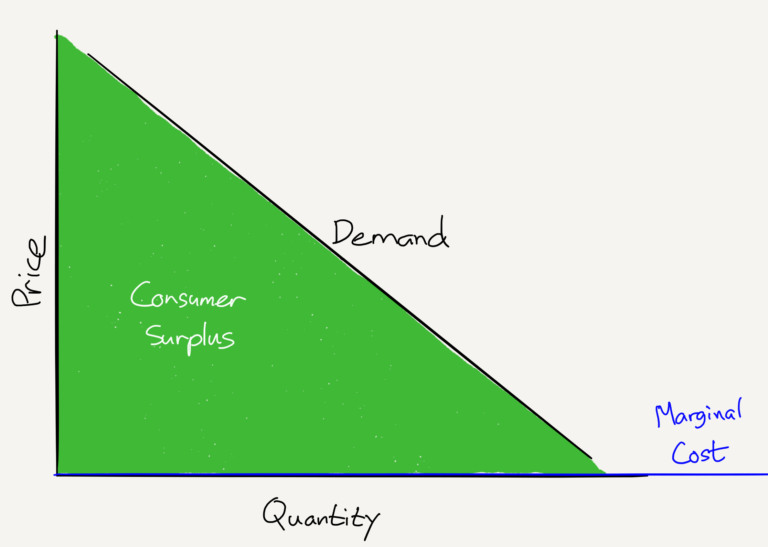
    Four years ago I wrote about why subscriptions are better for both developers and end users in the context of Adobe’s move away from packaged software:

    surplus2

    That article was about the benefit of better matching Adobe’s revenue with the value gained by its users: the price of entry is lower while the revenue Adobe extracts over time is more commensurate with the value it delivers. And, as I noted, “Adobe is well-incentivised to maintain the app to reduce churn, and users always have the most recent version.”

    This is exactly what is necessary for good security: vendors need to keep their applications (or in the case of Microsoft, operating systems) updated, and end users need to always be using the latest version. Moreover, pricing software as a service means it is no longer a capital cost with all of the one-time payment assumptions that go with it: rather, it is an ongoing expense that implicitly includes maintenance, whether that be by the vendor or the end user (or, likely, a combination of the two).

    I am, of course, describing Software-as-a-service, and that category’s emergence, along with cloud computing generally (both easier to secure and with massive incentives to be secure), is the single biggest reason to be optimistic that WannaCry is the dying gasp of a bad business model (although it will take a very long time to get out of all the sunk costs and assumptions that fully-depreciated assets are “free”).3 In the long run, there is little reason for the typical enterprise or government to run any software locally, or store any files on individual devices. Everything should be located in a cloud, both files and apps, accessed through a browser that is continually updated, and paid for with a subscription. This puts the incentives in all the right places: users are paying for security and utility simultaneously, and vendors are motivated to earn it.

    To Microsoft’s credit the company has been moving in this direction for a long time: not only is the company focused on Azure and Office 365 for growth, but even its traditional software has long been monetized through subscription-like offerings. Still, implicit in this cloud-centric model is a lot less lock-in and a lot more flexibility in terms of both devices and services: the reality is that for as much of a headache Windows security has been for Microsoft, those headaches are inextricably tied up with the reasons that Microsoft has been one of the most profitable companies of all time.

    The big remaining challenge will be hardware: the business model for software-enabled devices will likely continue to be upfront payment, which means no incentives for security; the costs are externalities to be borne by the targets of botnets like Mirai. Expect little progress and lots of blame, the hallmark of the sort of systematic breakdown that results from a mismatched business model.


    1. I will update this section as necessary and note said updates in this footnote 

    2. Windows XP was still available for Netbooks until 2010 

    3. The answer for individual security is encryption 


  • The Local News Business Model

    It’s hardly controversial to note that the traditional business model for most publishers, particularly newspapers, is obsolete. Absent the geographic monopolies formerly imposed by owning distribution, newspapers have nothing to offer advertisers: the sort of advertising that was formerly done in newspapers, both classified and display, is better done online. And, contra this rather fanciful suggestion by New York Times media columnist Jim Rutenberg that advertisers prop up newspapers for the good of democracy, nothing is going to change that.

    I already explained the problems with Rutenberg’s idea in yesterday’s Daily Update: advertisers are (rightly) motivated by what is best for their business, plus there is a collective action problem. I added, though, mostly in passing, that the future of “local news” would almost certainly be subscription, not advertising-based.

    I think it’s worth expounding on that point. What most, including Rutenberg, fail to understand about newspapers is that it is not simply the business model that is obsolete: rather, everything is obsolete. Most local newspapers are simply not worth saving, not because local news isn’t valuable, but rather because everything else in your typical local newspaper is worthless (from a business perspective). That is why I was careful in my wording: subscriptions will not save newspapers, but they just might save local news, and the sooner that distinction is made the better.

    The Unnecessary Newspaper

    To be clear, I agree with Rutenberg when he states that “A vibrant free press…keeps government honest and voters informed.” Local government needs oversight, which is another way of saying local news is necessary for a well-functioning democracy. The problem is that assuming oversight must be provided by a newspaper is akin to suggesting that a tank be used to kill a fly: sure, it may get the job done, but there is a lot of equipment, ordnance, and personnel that is really not necessary when a flyswatter would not only be sufficient, but actually more effective.

    For newspapers, the analogies to equipment, ordnance, and personnel are physical infrastructure, business operations, and editorial staff; just about none of them (yes, including most of the editorial staff) are actually necessary for covering local news.

    Infrastructure

    Printing presses are obviously obsolete: while some newspapers have finally closed them down, others hold on because there is still a modicum of print advertising to be earned. It’s the most prominent example of how newspapers are fundamentally incapable of evolving. Naturally, this extends to distribution centers, delivery trucks, newsstands, and all of the administrative infrastructure that goes into moving around pieces of paper that have zero connection to the actual distribution of local news.

    The infrastructure overhead, though, does not stop there: without a print edition there is no need for layout, for high-end photography, or a centralized office space to assemble everything on deadline. There is also a drastically reduced need for editors: when text was printed copy was permanent, raising the cost of a mistake high enough to justify editing workforces nearly as numerous as journalistic ones. Digital stories, though, can be updated after-the-fact. Moreover, digital stories are interactive: readers can submit feedback instantly, and as I noted while writing about Wikitribune, the collective knowledge of readers will always be greater than the most seasoned set of editors.

    Moreover, given that local news requires little more than text and images and perhaps some video, there is no need for expensive digital infrastructure either; a basic WordPress site is more than sufficient. In short, the entire infrastructure category, which makes up probably 60%~70% of a newspaper’s cost structure (possibly more if you include the editors), has nothing to do with sustainable local news.

    Business Operations

    Monetizing via print advertisements requires a lot of staff: salespeople to sell the ad, graphic artists to lay it out, account managers to collect the money, plus all the management required to make it work. For large national newspapers like The New York Times, this may all still be necessary, thanks to the ability to sell premium advertising online. However, all of this can be eliminated for most digital-only operations: simply use an ad network. Of course, those come with their own problems: ad networks make web pages suck, and just as importantly, most consumption is shifting to mobile where ad network monetization is particularly ineffective; to the extent advertising is part of the business model relying on Facebook is (still) probably the best option. Or better yet, don’t have any ads at all.

    A purely subscription-based business model not only drastically cuts costs, it also makes for a better user experience, a particularly attractive point given that users are the paying customers. Even better, thanks to services like Stripe, digital subscriptions not only cost far less to administer than traditional newspaper subscriptions, but are far more user-friendly as well.

    The reality is that for local news this entire category probably only needs to be one person: handle customer service for self-service subscriptions, do the books, and that’s about it. The 15~20% of revenue newspapers are paying for business operations has nothing to do with local news.

    Editorial

    This is the biggest blindspot for those lamenting the travails of local newspapers: it may be obvious that printing presses don’t make much sense with the Internet, and most websites have moved to ad networks for the obvious reasons; in fact, though, nearly all of the content in most newspapers is not just unnecessary but in fact actively harmful to building a sustainable future for local news.

    Start with the front page (of a physical newspaper, natch): most newspapers have given up on having international, national, or even regional reporters, instead relying on wire services. Even that, though, is a waste: those wire services have their own websites, and international publications are only a click away. Maintaining the veneer of comprehensive coverage is simply clutter, and a cost to boot.

    The same thing applies to the opinion section: any column or editorial that is concerned with non-local affairs is competing with the entire Internet (including social media). It’s the same thing with non-local business coverage. Moreover, the cost is more than clutter and dollars: almost by definition the content is inferior to what is available elsewhere, which reduces the willingness to pay.

    It’s the same story in what were traditionally the most valuable parts of newspapers:1 sports and the (variously named) lifestyle sections. There are multiple national entities dedicated to covering sports all the way down to the university level, augmented by a still-thriving sports blogosphere. Granted, there may still be a market for local sports coverage, but that is a different market than local news: there is no reason it has to be bundled together.

    As for the lifestyle section, it is everywhere. BuzzFeed has set its sight on cooking, crafts, and the horoscope;2 there are all kinds of sites covering gossip and advice; meanwhile, not only are there web comics, but social media provides far more humor than the funny pages ever did. What’s left, bridge? Why not simply play online?

    A lot of this content has long since been standardized across newspapers, but the broader point remains the same: absolutely none of it has anything to do with local news, and it should not exist in the local news publication of the future.

    Bundles and Business Models

    What is critical to understand is that everything in the preceding section is interconnected: by owning printing presses and delivery trucks (and thanks to the low marginal cost of printing extra pages), newspapers were the primary outlet for advertising that didn’t work on (or couldn’t afford) TV or radio — and there was a lot of it. Maximizing advertising, though, meant maximizing the potential audience, which meant offering all kinds of different types of content in volume: thus the mashup of wildly disparate content listed above, all focused on quantity over quality. And then, having achieved the most readership and the ability to expand to fit it all, the biggest newspaper could squeeze out its competitors.

    In short, the business model drove the content, just as it drove every other piece of the business. It follows, though, that if the content bundle no longer makes sense — which it doesn’t in the slightest — that the business model probably doesn’t make sense either. This is the problem with newspapers: every aspect of their operations, from costs to content, is optimized for a business model that is obsolete. To put it another way, an obsolete business model means an obsolete business. There is nothing to be saved.

    The Subscription Business Model

    I’ve already hinted at the general outline of a sustainable local news publication, but the critical point is the one I just made: everything must start with the business model, of which there is only one choice — subscriptions.

    It is very important to clearly define what a subscriptions means. First, it’s not a donation: it is asking a customer to pay money for a product. What, then, is the product? It is not, in fact, any one article (a point that is missed by the misguided focus on micro-transactions). Rather, a subscriber is paying for the regular delivery of well-defined value.

    Each of those words is meaningful:

    • Paying: A subscription is an ongoing commitment to the production of content, not a one-off payment for one piece of content that catches the eye.
    • Regular Delivery: A subscriber does not need to depend on the random discovery of content; said content can be delivered to the subscriber directly, whether that be email, a bookmark, or an app.
    • Well-defined Value: A subscriber needs to know what they are paying for, and it needs to be worth it.

    This last point is at the crux of why many ad-based newspapers will find it all but impossible to switch to a real subscription business model. When asking people to pay, quality matters far more than quantity, and the ratio matters: a publication with 1 valuable article a day about a well-defined topic will more easily earn subscriptions than one with 3 valuable articles and 20 worthless ones covering a variety of subjects. Yet all too many local newspapers, built for an ad-based business model that calls for daily content to wrap around ads, spend their limited resources churning out daily filler even though those ads no longer exist.

    A sustainable local news publication will be fundamentally different: a minimal rundown of the news of the day, with a small number of in-depth articles a week featuring real in-depth reporting, with the occasional feature or investigative report. After all, it’s not like it is hard to find content to read on the Internet: what people will pay for is quality content about things they care about (and the fact that people care about their cities will be these publications’ greatest advantage).

    It’s also worth noting what a subscription business model does not — must not — include:

    • Content that is widely available elsewhere. That means no national or international news (except what has a local impact, and even that is questionable), no non-local business content, no lifestyle section.
    • Non-journalistic costs centers. As I noted above, a publication might need one business operations person, and maybe a copy editor; they can probably be the same person. Nearly everything else, including subscription management, hosting, payments, etc. can leverage widely available online services (and you can include social networks: treating all content the same hurts big media companies, but it’s a big opportunity for small ones).
    • Any sort of wall between business and editorial. This is perhaps the easiest change to make, and the hardest for newspaper advocates to accept. A subscription business is just that: a business that must, through its content, earn ongoing revenue from customers. That means understanding what those customers want, and what they don’t. It means focusing on the user experience, and the content mix. And it means selling by every member of the organization.

    Notice how different this looks from a newspaper, as it must. After all, the business model is different.


    I strongly believe the market for this sort of publication is there. My hometown city of Madison, WI has around 250,000 people (500,000 in Dane County), primarily served by The Wisconsin State Journal. To the paper’s credit the website is almost all local news; unfortunately, most of it is uninteresting filler. Worse, to produce this filler took a staff of 52 people, of which only 10 by my count are local reporters (supported by at least 8 editors).

    Were a new publication to come along, offering a five minute summary of Madison’s local news of the day, plus an actually relevant story or two a week with the occasional feature or investigative report,3 I’d gladly pay, and I don’t even live there anymore. What I won’t do, though, is bother visiting the Wisconsin State Journal because there simply is too much dreck to wade through, created at ridiculous cost in service of an obsolete business model.4

    Indeed, the real problem with local newspapers is more obvious than folks like Rutenberg wish to admit: no one — advertisers nor subscribers — wants to pay for them because they’re not worth paying for. If newspapers were actually holding local government accountable I don’t think they would have any problem earning money; that they aren’t is a function of wasting time and money on the past instead of the future.


    1. Other than the classifieds, that is 

    2. “Choose these foods and we will tell you your ideal mate!” 

    3. With typos 

    4. This is where news foundations and benefactors can actually make a difference: stop supporting local newspapers and instead fund new startups until they build a critical mass of subscribers 


  • Apple’s China Problem

    Did you hear about the new Microsoft Surface Laptop? The usual suspects are claiming it’s a MacBook competitor, which is true insomuch as it is a laptop. In truth, though, the Surface Laptop isn’t a MacBook competitor at all for the rather obvious reason that it runs Windows, while the MacBook runs MacOS. This has always been the foundation of Apple’s business model: hardware differentiated by software such that said hardware can be sold with a margin much greater than nominal competitors running a commodity operating system.

    Moreover, the advantages go beyond margins: the best way to understand both Apple’s profits and many of its choices is to understand that the company has a monopoly on not just MacOS but even more importantly iOS. That means Apple can not only capture consumer surplus on hardware, but developer surplus when it comes to app sales; that some apps are not made is deadweight loss that Apple has chosen to bear to ensure total control.

    And yet, as far as regulators are concerned (and rightly so), the iPhone is simply another smartphone, and the MacBook really is competing with the Surface Laptop. The functionality is mostly the same, and if users value a sustainable advantage in the user experience Apple deserves the profits — and power — that follow.

    Apple’s Earnings

    Apple announced its second quarter earnings yesterday; from Bloomberg:

    Apple Inc. reported falling iPhone sales, highlighting the need to deliver blockbuster new features in the next edition of the flagship device if the company is to fend off rivals like Samsung Electronics Co. Investor confidence has been mounting ahead of a major iPhone revamp due later this year. Yet competitors released new high-end smartphones recently, putting pressure on Apple to deliver a device that’s advanced enough to entice existing users to upgrade and lure new customers.

    Oh look! It’s an example of what I was just complaining about: yes, Samsung makes smartphones, and yes, they have high-end features. But — and this is the point that was forgotten the last time Samsung was held up as an iPhone threata Samsung smartphone does not run iOS. That has always been Apple’s trump card, and it was once again this past quarter. On the earnings call CFO Luca Maestri stated in his prepared remarks:

    Revenue for the March quarter was $52.9 billion, and we achieved double-digit growth in the U.S., Canada, Australia, Germany, the Netherlands, Turkey, Russia and Mexico. Our growth rates were even higher, over 20% in many other markets, including Brazil, Scandinavia, the Middle East, Central and Eastern Europe, India, Korea and Thailand.

    The numbers back that up:

    Apple Revenue (in billions)

    Q2 2017 Q2 2016 Q2 2015
    Americas $21.2 (+11%) $19.1 (-10%) $21.3 (+19%)
    Europe $12.7 (+10%) $11.5 (-5%) $12.2 (+12%)
    Japan $4.5 (+5%) $4.3 (+24%) $3.5 (-15%)
    Rest of Asia Pacific $3.8 (+20%) $3.2 (-25%) $4.2 (+48%)
    Total $42.1 (+11%) $38.1 (-8%) $41.2 (+15%)

    To be clear, these numbers reflect more than just the iPhone; in the most recent quarter Apple’s most important product contributed 63% of revenue, which means some of the change in overall revenue was due to Mac (mostly thanks to increased ASP), Services, and Other Products (primarily Apple Watch and AirPods) growth, counterbalanced by the iPad’s continued slippage. Still, the iPhone is the most important factor, and while it seems quite clear that the iPhone 6 did pull forward upgrades from the iPhone 6S, the iPhone 7 is growing quite nicely.

    Moreover, this sort of growth is exactly what you would expect given Apple’s iOS monopoly: iPhone users very rarely switch to Android, while a fair number of Android users switch to iPhone, which means that even in a saturated market Apple’s share should grow over time. Plus, that share increase will result in not only increased iPhones sales but ever-growing Services revenue, and, in the long run, increased sales of other Apple products as well.

    This picture, though, is incomplete: it doesn’t include China.

    Apple’s China Problem

    Here are those revenue numbers once again, this time with the Greater China region:

    Apple Revenue (in billions)

    Q2 2017 Q2 2016 Q2 2015
    Americas $21.2 (+11%) $19.1 (-10%) $21.3 (+19%)
    Europe $12.7 (+10%) $11.5 (-5%) $12.2 (+12%)
    China $10.7 (-14%) $12.5 (-26%) $16.8 (+71%)
    Japan $4.5 (+5%) $4.3 (+24%) $3.5 (-15%)
    Rest of Asia Pacific $3.8 (+20%) $3.2 (-25%) $4.2 (+48%)
    Total $52.9 (+5%) $50.6 (-13%) $58.0 (+27%)

    I was from the very beginning of Stratechery both a big advocate of large-screen iPhones and a big bull on Apple’s prospects in China. I wrote after the launch of the iPhone 5C:

    Is [the iPhone] out-of-reach for the vast majority of consumers? Yep. But it will be aspirational, something you put on the table to show others you can afford it. And, to be clear, there are a lot of people that can afford it. Saying stupid things like “the iPhone 5C is equivalent to the average monthly salary in China” belies a fundamental misunderstanding of China, its inequality, and its sheer size specifically, and all of Asia broadly. Moreover, when you consider a Mercedes is tens of thousands of dollars more than a Toyota (and on down the line in luxury goods, for whom Asia generally and China specifically is the largest market by far), $300 more isn’t that much.

    Moreover, in China it’s Apple’s brand that is, by far, the biggest allure of the iPhone. Apps are free (piracy is mainstream), larger screens are preferred, and specs and customization move the needle with the mainstream far more than they do in the US. But no one else is Apple.

    Of course those large screens did eventually arrive in the same timeframe that Apple launched on China Mobile: that is why those Q2 2015 numbers are so eye-popping (71% growth!). And you could certainly argue last year that, much like the rest of the world, Apple had pulled forward a huge number of would-be buyers (China was down more than the rest of the world, but about the same as the rest of Asia).1 However, that does not explain the weak results this year: every region in the world — especially the rest of Asia — is up, except for China, which is down 14%. Apple has a China problem.

    iOS Versus WeChat

    In rather stark contrast to just a couple of years ago, when, in the midst of the iPhone 6 boom, Tim Cook was eager to sell the story of how many iPhone customers had not yet upgraded, this quarter the Apple CEO preferred to move the goalposts, telling analysts to wait for the next iPhone:

    We’re seeing what we believe to be a pause in purchases on iPhone, which we believe are due to the earlier and much more frequent reports about future iPhones. And so that part is clearly going on, and it could be what’s behind the data.

    But that is not what is going on in most of the world: plenty of folks — more than last year — are happy to buy the iPhone 7, even though it doesn’t look much different than the iPhone 6. After all, if you need a new phone, and you want iOS, you don’t have much choice! Except, again, for China: that is the country where the appearance of the iPhone matters most; Apple’s problem, though, is that in China that is the only thing that matters at all.

    The fundamental issue is this: unlike the rest of the world, in China the most important layer of the smartphone stack is not the phone’s operating system. Rather, it is WeChat.2 Connie Chan of Andreessen Horowitz tried to explain in 2015 just how integrated WeChat is into the daily lives of nearly 900 million Chinese, and that integration has only grown since then: every aspect of a typical Chinese person’s life, not just online but also off is conducted through a single app (and, to the extent other apps are used, they are often games promoted through WeChat).

    There is nothing in any other country that is comparable, particularly the Facebook properties (Facebook, Messenger, and WhatsApp) to which WeChat is commonly compared. All of those are about communication or wasting time: WeChat is that, but it is also for reading news, for hailing taxis, for paying for lunch (try and pay with cash for lunch, and you’ll look like a luddite), for accessing government resources, for business. For all intents and purposes WeChat is your phone, and to a far greater extent in China than anywhere else, your phone is everything.

    Naturally, WeChat works the same on iOS as it does on Android.3 That, by extension, means that for the day-to-day lives of Chinese there is no penalty to switching away from an iPhone. Unsurprisingly, in stark contrast to the rest of the world, according to a report earlier this year only 50% of iPhone users who bought another phone in 2016 stayed with Apple:

    Screen Shot 2017-05-03 at 8.58.25 PM

    This is still better than the competition, but compared to the 80%+ retention rate Apple enjoys in the rest of the world,4 it is shockingly low, and the result is that the iPhone has slid down China’s sales rankings: iPhone sales were only 9.6% of the market last year, behind local Chinese brands like Oppo, Huawei and Vivo. All of those companies sold high-end phones of their own; the issue isn’t that Apple was too expensive, it’s that the iPhone 6S and 7 were simply too boring.


    Perhaps the most surprising takeaway from this analysis is that Cook is right: there is reason to be optimistic about the iPhone 8. Rumors are that there will be an all-new edge-to-edge design that will stand out in the hand, or on the coffee shop table. And, of course, like any modern smartphone, it will run WeChat. And to be sure, an iPhone is still status-conferring: Apple is by no means doomed, and it’s possible if not probable that those China numbers will turn positive this fall.

    That, though, is a long-term problem for Apple: what makes the iPhone franchise so valuable — and, I’d add, the fundamental factor that was missed by so many for so long — is that monopoly on iOS. For most of the world it is unimaginable for an iPhone user to upgrade to anything but another iPhone: there is too much of the user experience, too many of the apps, and, in some countries like the U.S., too many contacts on iMessage to even countenance another phone.

    None of that lock-in exists in China: Apple may be a de facto monopolist for most of the world, but in China the company is simply another smartphone vendor, and being simply another smartphone vendor is a hazardous place to be. To be clear, it’s not all bad: in China Apple still trades on status and luxury; unlike the rest of the world, though, the company has to earn it with every release, and that’s a bar both difficult to clear in the abstract and, given the last two iPhones, difficult to clear in reality.


    1. As an aside, Apple continues to blame Hong Kong for weak China numbers, but as I have explained in the Daily Update, I don’t buy this excuse: I suspect a huge number of Hong Kong sales were for China; once distribution in China increased those sales went down. Plus, Hong Kong’s dollar is pegged to the U.S. dollar, so currency isn’t an excuse either 

    2. Or, to put it another way, the operating system of China is WeChat, not iOS/Android 

    3. Well, at least until earlier this month when Apple, accustomed to being able to dictate terms to app developers, banned WeChat tipping  

    4. This originally said 90%, but retention numbers have slipped globally 


  • Not OK, Google

    I was, frankly, amazed when I saw this tweet:

    Let me remind you that Washington Post Editor-in-Chief Marty Baron’s industry — newspapers — is one without a business model (Baron’s newspaper is more fortunate than most in its reliance on a billionaire’s largesse). Said lack of business model is leading to a dwindling of local coverage, click-chasing, and, arguably, Donald Trump. That seems like a pretty big problem!

    Fake news, on the other hand, tells people who’ve already made up their minds what they want to hear. Certainly it’s not ideal, but the tradeoffs in dealing with the problem, at least in terms of Facebook, are very problematic. I wrote last fall in Fake News:

    I get why top-down solutions are tempting: fake news and filter bubbles are in front of our faces, and wouldn’t it be better if Facebook fixed them? The problem is the assumption that whoever wields that top-down power will just so happen to have the same views I do. What, though, if they don’t? Just look at our current political situation: those worried about Trump have to contend with the fact that the power of the executive branch has been dramatically expanded over the decades; we place immense responsibility and capability in the hands of one person, forgetting that said responsibility and capability is not so easily withdrawn if we don’t like the one wielding it.

    To that end I would be far more concerned about Facebook were they to begin actively editing the News Feed; as I noted last week I’m increasingly concerned about Zuckerberg’s utopian-esque view of the world, and it is a frighteningly small step from influencing the world to controlling the world. Just as bad would be government regulation: our most critical liberty when it comes to a check on tyranny is the freedom of speech, and it would be directly counter to that liberty to put a bureaucrat — who reports to the President — in charge of what people see.

    As if to confirm my worst fears, Zuckerberg, a few months later, came out with a manifesto committing Facebook to political action, leading me to call for checks on the company’s monopoly. What was perhaps the most interesting lesson about that manifesto, though, was that most of the media — which to that point had been resolutely opposed to Facebook — were by and large unified in their approval. It was, I suspect, a useful lesson for tech executives: ensure the established media controls the narrative, and your company’s dominance may proceed without criticism.

    Google’s Algorithm Change

    Today Google announced its own fake-news motivated changes. From Bloomberg:

    The Alphabet Inc. company is making a rare, sweeping change to the algorithm behind its powerful search engine to demote misleading, false and offensive articles online. Google is also setting new rules encouraging its “raters” — the 10,000-plus staff that assess search results — to flag web pages that host hoaxes, conspiracy theories and what the company calls “low-quality” content.

    The moves follow months after criticism of Google and Facebook Inc. for hosting misleading information, particular tied to the 2016 U.S. presidential election. Google executives claimed the type of web pages categorized in this bucket are relatively small, which is a reason why the search giant hadn’t addressed the issue before. “It was not a large fraction of queries — only about a quarter percent of our traffic — but they were important queries,” said Ben Gomes, vice president of engineering for Google.

    I noted above that deciding how to respond to fake news is a trade-off; in the case of Facebook, the fact that fake news is largely surfaced to readers already inclined to believe it means I see the harm as being less than Facebook actively taking an editorial position on news stores.

    Google, on the other hand, is less in the business of driving engagement via articles you agree with, than it is in being a primary source of truth. The reason to do a Google search is that you want to know the answer to a question, and for that reason I have long been more concerned about fake news in search results, particularly “featured snippets”:

    My concern here is quite straightforward: yes, Facebook may be pushing you news, fake, slanted, or whatever bias there may be, but at least it is not stamping said news with its imprimatur or backing it with its reputation (indeed, many critics wish that that is exactly what Facebook would do), and said news is arriving on a rather serendipitous basis. Google, on the other hand, is not only serving up these snippets as if they are the truth, but serving them up as a direct response to someone explicitly searching for answers. In other words, not only is Google effectively putting its reputation behind these snippets, it is serving said snippets to users in a state where they are primed to believe they are true.

    To that end I am pleased that Google is making this change, at least at a high level. The way Google is approaching it, though, is very problematic.

    Google and Authority

    Danny Sullivan, who has been covering Google for years, has one of the best write-ups on Google’s changes, including this frank admission that the change is PR-driven:

    Problematic searches aren’t new but typically haven’t been an big issue because of how relatively infrequent they are. In an interview last week, Pandu Nayak — a Google Fellow who works on search quality — spoke to this: “This turns out to be a very small problem, a fraction of our query stream. So it doesn’t actually show up very often or almost ever in our regular evals and so forth. And we see these problems. It feels like a small problem,” Nayak said.

    But over the past few months, they’ve grown as a major public relations nightmare for the company…“People [at Google] were really shellshocked, by the whole thing. That, even though it was a small problem [in terms of number of searches], it became clear to us that we really needed to solve it. It was a significant problem, and it’s one that we had I guess not appreciated before,” Nayak said.

    Suffice it to say, Google appreciates the problem now. Hence today’s news, to stress that it’s taking real action that it hopes will make significant changes.

    Sullivan goes on to explain the changes Google is making to autocomplete search suggestions and featured snippets, particularly the opportunity to provide immediate feedback. What was much more convoluted, though, was a third change: an increased reliance on “authoritative content”.

    The other and more impactful way that Google hopes to attack problematic Featured Snippets is by improving its search quality generally to show more authoritative content for obscure and infrequent queries…

    How’s Google learning from the data to figure out what’s authoritative? How’s that actually being put into practice? Google wouldn’t comment about these specifics. It wouldn’t say what goes into determining how a page is deemed to be authoritative now or how that is changing with the new algorithm. It did say that there isn’t any one particular signal. Instead, authority is determined by a combination of many factors.

    This simply isn’t good enough: Google is going to be making decisions about who is authoritative and who is not, which is another way of saying that Google is going to be making decisions about what is true and what is not, and that demands more transparency, not less.

    Again, I tend to agree that fake news is actually more of a problem on Google than it is Facebook; moreover, I totally understand that Google can’t make its algorithms public because they will be gamed by spammers and fake news purveyors. But even then, the fact remains that the single most important resource for finding the truth, one that is dominant in its space thanks to the fact that being bigger inherently means being better, is making decisions about what is true without a shred of transparency.

    More Monopoly Trade-offs

    I wrote last week about Facebook and the Cost of Monopolies: Facebook wins because, by virtue of connecting everyone on earth, its apps both provide a better user experience even as they build impregnable moats. The moat is the network is the superior user experience. The cost, though, as I sought to quantify, at least in theory, is the aforementioned decay in our media diet, increasing concentration of advertising, and, in the long run, diminished innovation.

    That raises the question, though, of what to do about it; I noted in a follow-up that Facebook hasn’t done anything wrong, and under the current interpretation of the law, isn’t even really a monopoly. The fact of the matter is that people like Facebook1 and that it generates a massive amount of consumer surplus. It follows, then, that any action to break up that monopoly is inherently anti-consumer, at least in the short-run.

    The conundrum is even worse with Google, in large part because the company’s core service is even more critical to its users: being able to search the entire Internet is a truly awesome feat, and, thanks to that capability, it is critical that Google get the answer right. That, though, means that Google’s power is even greater, with all of the problems that entails.

    Indeed, that is why Google needs to be a whole lot more explicit about how it is ranking news. Perhaps the most unanticipated outcome of the unfettered nature of the Internet is that the sheer volume of information didn’t disperse influence, but rather concentrated it to a far greater degree than ever before, not to those companies that handle distribution (because distribution is free) but to those few that handle discovery. The result is an environment where what is best for the individual in the short-term is potentially at odds with what is best for a free society in the long-term; it would behoove Google to push off the resolution of this paradox by being more open, not less.

    Sadly, it seems unlikely that my request for more transparency will get much support; Google’s announcement was widely applauded, and why not? It is the established media that will have a leg up when it comes to authority. That, it seems, is all they ever wanted, even if it means Google and Facebook taking all of the money.


    1. Even if you don’t personally, dear reader 


  • Facebook and the Cost of Monopoly

    The shamelessness was breathtaking.

    Having told a few jokes, summarized his manifesto, and acknowledged the victim of the so-called “Facebook-killer” in Cleveland, Facebook founder and CEO Mark Zuckerberg opened his keynote presentation at the company’s F8 developer conference like this:

    You may have noticed that we rolled out some cameras across our apps recently. That was Act One. Photos and videos are becoming more central to how we share than text. So the camera needs to be more central than the text box in all of our apps. Today we’re going to talk about Act Two, and where we go from here, and it’s tied to this broader technological trend that we’ve talked about before: augmented reality.

    If that seems familiar, it’s because it is the Explain Like I’m Five summary of Snap’s S-1:

    In the way that the flashing cursor became the starting point for most products on desktop computers, we believe that the camera screen will be the starting point for most products on smartphones. This is because images created by smartphone cameras contain more context and richer information than other forms of input like text entered on a keyboard. This means that we are willing to take risks in an attempt to create innovative and different camera products that are better able to reflect and improve our life experiences.

    Snap may have declared itself a camera company; Zuckerberg dismissed it as “Act One”, making it clear that Facebook intended to not simply adopt one of Snapchat’s headline features but its entire vision.

    Facebook and Microsoft

    Shortly after Snap’s S-1 came out, I wrote in Snap’s Apple Strategy that the company was like Apple; unfortunately, the Apple I was referring to was not the iPhone-making juggernaut we are familiar with today, but rather the Macintosh-creating weakling that was smushed by Microsoft, which is where Facebook comes in.

    Today, if Snap is Apple, then Facebook is Microsoft. Just as Microsoft succeeded not because of product superiority but by leveraging the opportunity presented by the IBM PC, riding Big Blue’s coattails to ecosystem dominance, Facebook has succeeded not just on product features but by digitizing offline relationships, leveraging the desire of people everywhere to connect with friends and family. And, much like Microsoft vis-à-vis Apple, Facebook has had The Audacity of Copying Well.

    I wrote The Audacity of Copying Well when Instagram launched Instagram stories; what was brilliant about the product is that Facebook didn’t try to re-invent the wheel. Instagram Stories — and now Facebook Stories and WhatsApp Stories and Messenger Day — are straight rip-offs of Snapchat Stories, which is not only not a problem, it’s actually the exact optimal strategy: Instagram’s point of differentiation was not features, but rather its network. By making Instagram Stories identical to Snapchat Stories, Facebook reduced the competition to who had the stronger network, and it worked.

    Microsoft and Monopoly

    Microsoft, of course, was found to be a monopoly, and, as I wrote a couple of months ago in Manifestos and Monopolies, it is increasingly difficult to not think the same about Facebook. That, though, is exactly what you would expect for an aggregator. From Antitrust and Aggregation:

    The first key antitrust implication of Aggregation Theory is that, thanks to these virtuous cycles, the big get bigger; indeed, all things being equal the equilibrium state in a market covered by Aggregation Theory is monopoly: one aggregator that has captured all of the consumers and all of the suppliers. This monopoly, though, is a lot different than the monopolies of yesteryear: aggregators aren’t limiting consumer choice by controlling supply (like oil) or distribution (like railroads) or infrastructure (like telephone wires); rather, consumers are self-selecting onto the Aggregator’s platform because it’s a better experience.

    This self-selection, particularly onto a “free” platform, makes it very difficult to calculate what cost, if any, Facebook’s seeming monopoly exacts on society. Consider the Econ 101 explanation of why monopolies are problematic:

    • In a perfectly competitive market the price of a good is set at the intersection of demand and supply, the latter being determined by the marginal cost of producing that good:1

      stratechery Year One - 336

    • The “Consumer Surplus”, what consumers would have paid for a product minus what they actually paid, is the area that is under the demand curve but over the price point; the “Producer Surplus”, what producers sold a product for minus the marginal cost of producing that product, is the area above the marginal cost/supply curve and below the price point:

      stratechery Year One - 339

    • In a monopoly situation, there is no competition; therefore, the monopoly provider makes decisions based on profit maximization. That means instead of considering the demand curve, the monopoly provider considers the marginal revenue (price minus marginal cost) that is gained from selling additional items, and sets the price where marginal revenue equals marginal cost. Crucially, though, the price is set according to the demand curve:

      stratechery Year One - 332

    • The result of monopoly pricing is that consumer surplus is reduced and producer surplus is increased; the reason we care as a society, though, is the part in brown: that is deadweight loss. Some amount of demand that would be served by a competitive market is being ignored, which means there is no surplus of any kind being generated:

      stratechery Year One - 337

    The problem with using this sort of analysis for Facebook should be obvious: the marginal cost for Facebook of serving an additional customer is zero! That means the graph looks like this:

    stratechery Year One - 327

    So sure, Facebook may have a monopoly in social networking, and while that may be a problem for Snap or any other would be networks, Facebook would surely argue that the lack of deadweight loss means that society as a whole shouldn’t be too bothered.

    Facebook and Content Providers

    The problem is that Facebook isn’t simply a social network: the service is a three-sided market — users, content providers, and advertisers — and while the basis of Facebook’s dominance is in the network effects that come from connecting all of those users, said dominance has seeped to those other sides.

    Content providers are an obvious example: Facebook passed Google as the top traffic driver back in 2015, and as of last fall drove over 40% of traffic for the average news site, even after an algorithm change that reduced publisher reach.

    So is that a monopoly when it comes to the content provider market? I would argue yes, thanks to the monopoly framework above.

    Note that once again we are in a situation where there is not a clear price: no content provider pays Facebook to post a link (although they can obviously make said link into an advertisement). However, Facebook does, at least indirectly, make money from that content: the more users find said content engaging, the more time they will spend on Facebook, which means the more ads they will see.

    This is why Facebook Instant Articles seemed like such a brilliant idea: on the one side, readers would have a better experience reading content, which would keep them on Facebook longer. On the other side, Facebook’s proposal to help publishers monetize — publishers could sell their own ads or, enticingly, Facebook could sell them for a 30% commission — would not only support the content providers that are one side of Facebook’s three-sided market, but also lock them into Facebook with revenue they couldn’t get elsewhere. The market I envisioned would have looked something like this:

    stratechery Year One - 338

    However, Instant Articles haven’t turned out the way I expected: the consumer benefits are there, but Facebook has completely dropped the ball when it comes to monetizing the publishers using them. That is not to say that Facebook isn’t monetizing as a whole, thanks in part to that content, but rather that the company wasn’t motivated to share. Or, to put it another way, Facebook kept most of the surplus for itself:

    stratechery Year One - 327

    In this case, it’s not that Facebook is setting a higher price to maximize their profits; rather, they are sharing less of their revenue; the outcome, though, is the same — maximized profits. Keep in mind this approach isn’t possible in competitive markets: were there truly competitors for Facebook when it came to placing content, Facebook would have to share more revenue to ensure said content was on its platform. In truth, though, Facebook is so dominant when it comes to attention that it doesn’t have to do anything for publishers at all (and, if said publishers leave Instant Articles, well, they will still place links, and the users aren’t going anywhere regardless).

    Facebook and Advertisers

    There may be similar evidence — that Facebook is able to reduce supply in a way that increases price and thus profits — emerging in advertising. In a perfectly competitive market the cost of advertising would look like this:

    stratechery Year One - 337

    Facebook, though, will soon be limiting quantity, or at least limiting its growth. On last November’s earnings call CFO Dave Wehner said that Facebook would stop increasing ad load in the summer of 2017 (i.e. Facebook has been increasing the number of ads relative to content in the News Feed for a long time, but would stop doing so). What was unclear — and as I noted at the time, Wehner was quite evasive in answering this — was whether or not that would cause the price per ad to rise.

    There are two possible reasons for Wehner to have been evasive:

    • Prices will not rise, which would be a bad sign for Facebook: it would mean that despite all of Facebook’s data, their ads are not differentiated, and that money that would have been spent on Facebook will simply be spent elsewhere
    • Prices will rise, which would mean that Facebook’s ads are differentiated such that Facebook can potentially increase profits by restricting supply

    To put the second possibility in graph form:

    stratechery Year One - 332

    Note that Facebook has already said that revenue growth will slow because of this change; that, though, is not inconsistent with having monopoly power. Monopolists seek to maximize profit, not revenue. Alternately, it could simply be that Facebook is worried about the user experience; it will be fascinating to see how the company’s bottom line shifts with these changes.

    Monopolies and Innovation

    Still, even if Facebook does have monopoly power when it comes to content discovery and distribution and in digital advertising, is that really a problem for users? Might it even be a good thing?

    Facebook board member Peter Thiel certainly thinks so. In Zero to One Thiel not only makes the obvious point that businesses that are monopolies are ideal, but says that models like the ones I used above aren’t useful because they presume a static world.

    In a static world, a monopolist is just a rent collector. If you corner the market for something, you can jack up the price; others will have no choice but to buy from you…But the world we live in is dynamic: it’s possible to invent new and better things. Creative monopolists give customers more choices by adding entirely new categories of abundance to the world. Creative monopolies aren’t just good for the rest of society; they’re powerful engines for making it better.

    The dynamism of new monopolies itself explains why old monopolies don’t strangle innovation. With Apple’s iOS at the forefront, the rise of mobile computing has dramatically reduced Microsoft’s decades-long operating system dominance. Before that, IBM’s hardware monopoly of the ’60s and ’70s was overtaken by Microsoft’s software monopoly. AT&T had a monopoly on telephone service for most of the 20th century, but now anyone can get a cheap cell phone plan from any number of providers. If the tendency of monopoly businesses were to hold back progress, they would be dangerous and we’d be right to oppose them. But the history of progress is a history of better monopoly businesses replacing incumbents. Monopolies drive progress because the promise of years or even decades of monopoly profits provides a powerful incentive to innovate. Then monopolies can keep innovating because profits enable them to make the long-term plans and to finance the ambitious research projects that firms locked in competition can’t dream of.

    The problem is that Thiel’s examples refute his own case: decades-long monopolies like those of AT&T, IBM, and Microsoft sure seem like a bad thing to me! Sure, they were eventually toppled, but not after extracting rents and, more distressingly, stifling innovation for years. Think about Microsoft: the company spent billions of dollars on R&D and gave endless demos of futuristic tech; the most successful product that actually shipped (Kinect) ended up harming the product it was supposed to help.2

    Indeed, it’s hard to think of any examples where established monopolies produced technology that wouldn’t have been produced by the free market; Thiel wrongly conflates the drive of new companies to create new monopolies with the right of old monopolies to do as they please.

    That is why Facebook’s theft of not just Snapchat features but its entire vision bums me out, even if it makes good business sense. I do think leveraging the company’s network monopoly in this way hurts innovation, and the same monopoly graphs explain why. In a competitive market the return from innovation meets the demand for customers to determine how much innovation happens — and who reaps its benefits:

    stratechery Year One - 330

    A monopoly, though, doesn’t need that drive to innovate — or, more accurately, doesn’t need to derive a profit from innovation, which leads to lazy spending and prioritizing tech demos over shipping products. After all, the monopoly can simply take others’ innovation and earn even more profit than they would otherwise:

    stratechery Year One - 334

    This, ultimately, is why yesterday’s keynote was so disappointing. Last year, before Facebook realized it could just leverage its network to squash Snap, Mark Zuckerberg spent most of his presentation laying out a long-term vision for all the areas in which Facebook wanted to innovate. This year couldn’t have been more different: there was no vision, just the wholesale adoption of Snap’s, plus a whole bunch of tech demos that never bothered to tell a story of why they actually mattered for Facebook’s users. It will work, at least for a while, but make no mistake, Facebook is the only winner.


    1. If any individual firm’s marginal costs are higher, they will go out of business; if they are lower they will temporarily dominate the market until new competitors enter. Yes, this is all theoretical! 

    2. I’m referring to the fact the Xbox One had a higher price and lower specs than the PS4, thanks in large part to the bundled Kinect 


  • The Walt Mossberg Brand

    It is a momentous day not just for those of us who write about the tech industry, but anyone who has paid any attention at all to consumer products for the last 26 years. From Walt Mossberg, at The Verge:

    It was a June day when I began my career as a national journalist. I stepped into the Detroit Bureau of The Wall Street Journal and started on what would be a long, varied, rewarding career. I was 23 years old, and the year was 1970. That’s not a typo.

    So it seems fitting to me that I’ll be retiring this coming June, almost exactly 47 years later. I’ll be hanging it up shortly after the 2017 edition of the Code Conference, a wonderful event I co-founded in 2003 and which I could never have imagined back then in Detroit…

    In the best professional decision of my life, I converted myself into a tech columnist in 1991. As a result, I got to bear witness to a historic parade of exciting, revolutionary innovation — from slow, clumsy, ancient PCs to sleek, speedy smartphones; from CompuServe and early AOL to the mobile web, apps, and social media. My column has run weekly in a variety of places over the years, most recently on The Verge and Recode under the Vox Media umbrella, where I’ve been quite happy and have added a podcast of which I’m proud.

    So I see retirement as just another of these reinventions, another chance to do new things and be a new version of myself.

    Mossberg undersells himself: a necessary prerequisite to “convert[ing him]self into a tech columnist” was inventing the very concept. That I had to make such an observation — was there really a time in recent history in which major publications did not have someone focused on technology? — is itself a testament to Mossberg’s vision.

    Mossberg and the Birth of Consumer Technology

    What made Mossberg unique was tied up into his job description: there were certainly tech journalists and reviewers and publications like PC Magazine, but they were writing for people who already cared about technology, whether because they worked in the industry or because it was their hobby (like it had been Mossberg’s in his time as a reporter for the Wall Street Journal). Mossberg, as he told The New Yorker for this 2007 profile, had a different audience in mind:

    The Journal may have an élite business audience, but, as Mossberg puts it, “I write my column for the average person.” He adds, “That’s one of the reasons I write about it as a class war” — techies vs. consumers…

    In a seven-page, single-spaced prospectus that Mossberg sent to [then-Wall Street Journal managing editor Norman] Pearlstine on May 1, 1991, he wrote:

    If it works as I envision it, this column…would be the voice, the champion, of the individual person actually faced with buying and using the core hi-tech devices — the customer whom industry calls the “end user.”

    When the new job was settled, and Mossberg told [Secretary of State James A.] Baker and [Assistant Secretary of State Margaret] Tutwiler that he was leaving the national-security beat, Baker was baffled. “To this day,” Tutwiler told me, “Jim Baker has never owned or operated a computer, or a BlackBerry, or a cell phone.”

    In fact, Baker’s obliviousness to technology, at least in 1991, was pretty normal: computers were increasingly prevalent in businesses, but still, there were only 18 million personal computers sold that year (as a point of comparison, there were about 18 million smartphone sold every four days in 2016), and the majority didn’t even have a graphical user interface (Windows 3.0 had come out the year before, but DOS was dominant until Windows 95).

    Moreover, there wasn’t much of a consumer market at all, in part because many of the apps we associate with consumer usage barely existed: Microsoft Word and Excel had launched, but trailed the market leaders — WordPerfect and Lotus 1-2-3, respectively — while Adobe Photoshop had launched the year before. id Software, perhaps the company most responsible for making the PC into a gaming device, was founded in 1991, but its first game, Wolfenstein 3D, wouldn’t come out until the following year.

    However, it turned out that Mossberg’s timing was far more momentous than he probably knew when he sent that prospectus to Pearlstine: it was around the same time, in January 1991, that Tim Berners-Lee switched on the servers that hosted the first ever web page; in other words, Mossberg invented the position of technology columnist right when the technology that would ensure the industry’s impact was felt by every single person on earth was invented.

    Mossberg and the Evolution of Media

    As I’ve noted on multiple occasions, including in a recent appearance at the Code Media conference (itself a creation of Mossberg and Kara Swisher), the industry that has most dramatically felt the impact of the Internet is the media, and the arc of Mossberg’s career as a technology columnist reflects that.

    Mossberg’s first column, How to Stop Worrying And Get the Most From Your PC, was only available in print — remember, the World Wide Web had only been invented a few months prior.

    OB-QJ335_ptech1_G_20111101115026

    The role of the Wall Street Journal in Mossberg’s rise to prominence, though, went deeper than just owning printing presses and delivery trucks: it was the Journal’s brand name and status in the world that gave Mossberg credibility right off the bat. From a 2004 Mossberg profile in Wired:

    When Mossberg “launched “Personal Technology,” Pearlstine wanted him to move to Silicon Valley. Mossberg refused to uproot his family. “How will you see all the new products?” Pearlstine asked. “I’ll go there a few times a year,” Mossberg responded, “but they’ll come to me whether I’m in Juneau or Fargo, because I’m The Wall Street Journal.”

    Indeed, a big reason Pearlstine even gave Mossberg the opportunity to launch his Personal Technology column, over the objections of many at Dow Jones, was that Mossberg had long since proven his value over the 18 years he had spent at the Journal as a reporter: at least when Personal Technology started, the power flowed from the masthead, and it took Mossberg nearly two decades to earn the right to wield it.

    It didn’t take long, though, for Mossberg to make that power his own; Personal Technology was immediately a hit, both amongst Journal subscribers and, just as importantly, the company’s ad salespeople. And, five years later, when “The Wall Street Journal Interactive Edition” (i.e. the online version of the Wall Street Journal1) launched, Mossberg’s influence only increased as his column was now available to everyone in the world. Along the way, as noted in The New Yorker profile, something interesting happened:

    Eric Schmidt suggests that, while the Internet may yield enormous amounts of information, it is easy to drown in it. So consumers, Schmidt says, “go to brands they trust.” He adds, “Walt is a brand.”

    For the next decade Mossberg was, as that Wired profile is titled, the “Kingmaker.” Mossberg is credited with helping AOL overtake Prodigy, for killing Microsoft’s abusive and intrusive Smart Tags, and, perhaps most of all, for chronicling the rise of Apple.

    Mossberg and Apple

    There have always been grumblings that Mossberg is “biased” towards Apple. In fact, though, while Mossberg did by and large favor Apple products — Apple made five of Mossberg’s 12 most influential products — the bias, such as it was, was right there in his first column:

    Personal computers are just too hard to use, and it’s not your fault.

    Mossberg was Steve Jobs’ favorite columnist — and Mossberg a frequent admirer of Apple’s products — because both had the same vision: bringing these geeky, impenetrable, and rather ugly boxes of wires and chips and disks called personal computers to normal people, convinced said computers could, if only made accessible, fundamentally transform a user’s life.

    What always made Apple different from other PC manufacturers, to its detriment in the 80s and 90s, and its tremendous benefit this century, was its resolute focus on the user experience, even at the expense of business-focused priorities like compatibility or extensibility. The payoff was a computer that was actually approachable for normal people, which is what always mattered to Mossberg. Mossberg wrote in a lovely column after Jobs’ death:

    This quality was on display when Apple opened its first retail store. It happened to be in the Washington, D.C., suburbs, near my home. He conducted a press tour for journalists, as proud of the store as a father is of his first child. I commented that, surely, there’d only be a few stores, and asked what Apple knew about retailing. He looked at me like I was crazy, said there’d be many, many stores, and that the company had spent a year tweaking the layout of the stores, using a mockup at a secret location. I teased him by asking if he, personally, despite his hard duties as CEO, had approved tiny details like the translucency of the glass and the color of the wood. He said he had, of course.

    That mattered to Mossberg just as much as it did to Jobs, and if caring about the entire experience meant he was biased towards Apple, then I rather wish not just every tech writer but also every product manager and CEO would be biased as well.

    Mossberg and the Internet

    Probably the ultimate manifestation of the Mossberg brand was the “D: All Things Digital” conference he started in partnership with Kara Swisher, then a reporter for the Wall Street Journal covering the tech industry. Steve Jobs was an annual guest, from the first iteration of the conference in 2003 on, and nearly every major executive in the industry sat in those famous red chairs at one time or another, including a memorable joint appearance by Steve Jobs and Bill Gates:

    2048px-Steve_Jobs_and_Bill_Gates_(522695099)

    Ten years later Mossberg and Swisher would take the conference and the tech-focused news website they had built around it independent, rebranding it from All Things D to Recode. By all accounts the conference (and its various offshoots, including the aforementioned Code Media conference) continue to be a success, but the website struggled, drawing only around 2.5 million unique visitors a month 18 months after launch, leading Mossberg and Swisher to sell their new company to Vox Media.

    It was tempting after the sale to presume that an individual brand can only take you so far, that you need a big media company behind you, but I think that’s a mistake; as a counter-example, consider John Gruber’s Daring Fireball, which as of 2011 had over 4 million visits a month. Granted, many of those are repeat visitors — Daring Fireball’s unique visitors were about a fifth of that — but that’s kind of the point: if you care about Apple, for example, would you rather read Mossberg once a week or Gruber once a day?

    Obviously this point is personal: three months after Recode launched, Stratechery added the Daily Update, a subscription offering for people that wanted daily content about the business and strategy of technology. Note the narrowing: Mossberg was the arbiter of all consumer products; my goal is to not really cover products at all. Not only do I not have Mossberg’s eye, I am also cognizant of the fact there are a multitude of sites and hundreds if not thousands of writers focused on nothing else but doing what Mossberg did alone way back in 1991. Consumer technology used to be niche, and on the Internet, niche is powerful; now it’s a commodity, and the economics reflect that.

    Mossberg and Trailblazing

    Still, that shouldn’t take away from the fact that Mossberg is just as much of a trailblazer as the companies and products he covered: that writers like myself can build businesses and brands independent of established publications is simply the natural evolution of how Mossberg built a brand bigger than the Wall Street Journal, fueled by the Internet and its atomitization of media. Mossberg told Wired in that profile:

    As PC sales skyrocketed in the early ’90s, he sensed a historic shift: “I believed that the tech market was about to broaden and democratize, and the column could catch the wave.”

    Catch the wave Mossberg did, and in the process, created the blueprint for another. That’s a pretty good career.


    1. My favorite tidbit from a New York Times story about the launch:

      The news will be posted on the Web site about midnight, said Neil Budde, the Interactive Edition’s editor in chief. A few articles will be withheld until 2 or 3 A.M., he said, so that competing newspapers will not be able to see them until the day’s editions are printed.

      Apparently it didn’t occur to anyone that the stories could be posted to other websites! 


  • The Arrival of Artificial Intelligence

    Chris Dixon opened a truly wonderful piece in the Atlantic entitled How Aristotle Created the Computer like this:

    The history of computers is often told as a history of objects, from the abacus to the Babbage engine up through the code-breaking machines of World War II. In fact, it is better understood as a history of ideas, mainly ideas that emerged from mathematical logic, an obscure and cult-like discipline that first developed in the 19th century. Mathematical logic was pioneered by philosopher-mathematicians, most notably George Boole and Gottlob Frege, who were themselves inspired by Leibniz’s dream of a universal “concept language,” and the ancient logical system of Aristotle.

    Dixon goes on to describe the creation of Boolean logic (which has only two values: TRUE and FALSE, represented as 1 and 0 respectively), and the insight by Claude E. Shannon that those two variables could be represented by a circuit, which itself has only two states: open and closed.1 Dixon writes:

    Another way to characterize Shannon’s achievement is that he was first to distinguish between the logical and the physical layer of computers. (This distinction has become so fundamental to computer science that it might seem surprising to modern readers how insightful it was at the time—a reminder of the adage that “the philosophy of one century is the common sense of the next.”)

    Dixon is being modest: the distinction may be obvious to computer scientists, but it is precisely the clear articulation of said distinction that undergirds Dixon’s remarkable essay; obviously “computers” as popularly conceptualized were not invented by Aristotle, but he created the means by which they would work (or, more accurately, set humanity down that path).

    Moreover, you could characterize Shannon’s insight in the opposite direction: distinguishing the logical and the physical layers depends on the realization that they can be two pieces of a whole. That is, Shannon identified how the logical and the physical could be fused into what we now know as a computer.

    To that end, the dramatic improvement in the physical design of circuits (first and foremost the invention of the transistor and the subsequent application of Moore’s Law) by definition meant a dramatic increase in the speed with which logic could be applied. Or, to put it in human terms, how quickly computers could think.

    50 Years of AI

    Earlier this week U.S. Treasury Secretary Steve Mnuchin, in the words of Dan Primack, “breezily dismissed the notion that AI and machine learning will soon replace wide swathes of workers, saying that ‘it’s not even on our radar screen’ because it’s an issue that is ’50 or 100 years’ away.”

    Naturally most of the tech industry was aghast: doesn’t Mnuchin read the seemingly endless announcement of artificial intelligence initiatives and startups on Techcrunch?

    Then again, maybe Mnuchin’s view makes more sense than you might think; just read this piece by Maureen Dowd in Vanity Fair entitled Elon Musk’s Billion-Dollar Crusade to Stop the A.I. Apocalypse:

    In a startling public reproach to his friends and fellow techies, Musk warned that they could be creating the means of their own destruction. He told Bloomberg’s Ashlee Vance, the author of the biography Elon Musk, that he was afraid that his friend Larry Page, a co-founder of Google and now the C.E.O. of its parent company, Alphabet, could have perfectly good intentions but still “produce something evil by accident”—including, possibly, “a fleet of artificial intelligence-enhanced robots capable of destroying mankind.”

    The rest of the article is pre-occupied with the question of what might happen if computers are smarter than humans; Dowd quotes Stuart Russell to explain why she is documenting the debate now:

    “In 50 years, this 18-month period we’re in now will be seen as being crucial for the future of the A.I. community,” Russell told me. “It’s when the A.I. community finally woke up and took itself seriously and thought about what to do to make the future better.”

    50 years: that’s the same timeline as Mnuchin; perhaps he is worried about the same things as Elon Musk? And, frankly, should the Treasury Secretary concern himself with such things?

    The problem is obvious: it’s not clear what “artificial intelligence” means.

    Defining Artificial Intelligence

    Artificial intelligence is very difficult to define for a few reasons. First, there are two types of artificial intelligence: the artificial intelligence described in that Vanity Fair article is Artificial General Intelligence, that is, a computer capable of doing anything a human can. That is in contrast to Artificial Narrow Intelligence, in which a computer does what a human can do, but only within narrow bounds. For example, specialized AI can play chess, while a different specialized AI can play Go.

    What is kind of amusing — and telling — is that as John McCarthy, who invented the name “Artificial Intelligence”, noted, the definition of specialized AI is changing all of the time. Specifically, once a task formerly thought to characterize artificial intelligence becomes routine — like the aforementioned chess-playing, or Go, or a myriad of other taken-for-granted computer abilities — we no longer call it artificial intelligence.

    That makes it especially hard to tell where computers end and artificial intelligence begins. After all, accounting used to be done by hand:

    3753191500_c28898135a_o

    Within a decade this picture was obsolete, replaced by an IBM mainframe. A computer was doing what a human could do, albeit within narrow bounds. Was it artificial intelligence?

    Technology and Humanity

    In fact, we already have a better word for this kind of innovation: technology. Technology, to use Merriam-Webster’s definition, is “the practical application of knowledge especially in a particular area.” The story of technology is the story of humanity: the ability to control fire, the wheel, clubs for fighting — all are technology. All transformed the human race, thanks to our ability to learn and transmit knowledge; once one human could control fire, it was only a matter of time until all humans could.

    It is technology that transformed homo sapiens from hunter-gatherers to farmers, and it was technology that transformed farming such that an ever smaller percentage of the population could support the rest. Many millennia later, it was technology that led to the creation of tools like the flying shuttle, which doubled the output of weavers, driving up the demand for spinners, which drove its own innovation like the roller spinning frame, powered by water. For the first time humans were leveraging non-human and non-animal forms of energy to drive their technological inventions, setting off the industrial revolution.

    You can see the parallels between the industrial revolution and the invention of the computer: the former brought external energy to bear in a systematic way on physical activities formerly done by humans; the latter brings external energy to bear in a systematic way on mental activities formerly done by humans. Recall the analogy made by Steve Jobs:

    I remember reading an article when I was about 12 years old, I think it might have been in Scientific American, where they measured the efficiency of locomotion for all these species on planet Earth, how many kilocalories did they expend to get from point A to point B. And the condor came in at the top of the list, it surpassed everything else, and humans came in about a third of the way down the list, which was not such a great showing for the crown of creation.

    But somebody there had the imagination to test the efficiency of a human riding a bicycle. The human riding a bicycle blew away the condor, all the way off the top of the list, and it it made a really big impression on me that we humans are tool builders, and we can fashion tools that amplify these inherent abilities that we have to spectacular magnitudes. And so for me, a computer has always been a bicycle of the mind.

    In short, while Dixon traced the logic of computers back to Aristotle, the very idea of technology — of which, without question, computers are a part — goes back even further. Creating tools that do what we could do ourselves, but better and more efficiently, is what makes us human.

    Machine Learning

    That definition, you’ll note, is remarkably similar to that of artificial intelligence; indeed, it’s tempting to argue that artificial intelligence, at least the narrow variety, is simply technology by a different name. Just as we designed the cotton gin, so we designed accounting software, and automated manufacturing. And, in fact, those are all related: all involved overt design, in which a human anticipated the functionality and built a machine that could execute that functionality on a repeatable basis.

    That, though, is why today is different.

    Recall that while logic was developed over thousands of years, it was only part way through the 20th century that said logic was fused with physical circuits. Once that happened the application of that logic progressed unbelievably quickly.

    Technology, meanwhile, has been developed even longer than logic has. However, just as the application of logic was long bound by the human mind, the development of technology has had the same limitations, and that includes the first half-century of the computer era. Accounting software is in the same genre as the spinning frame: deliberately designed by humans to solve a specific problem.

    Machine learning is different.2 Now, instead of humans designing algorithms to be executed by a computer, the computer is designing the algorithms.3 It is still Artificial Narrow Intelligence — the computer is bound by the data and goal given to it by humans — but machine learning is, in my mind, meaningfully different from what has come before. Just as Shannon fused the physical with the logical to make the computer, machine learning fuses the development of tools with computers themselves to make (narrow) artificial intelligence.

    This is not to overhype machine learning: the applications are still highly bound and often worse than human-designed systems, and we are far, far away from Artificial General Intelligence. It seems clear to me, though, that we are firmly in Artificial Narrow Intelligence territory: the truth is that humans have made machines to replace their own labor from the beginning of time; it is only now that the machines are creating themselves, at least to a degree.4

    Life and Meaning

    The reason this matters is that pure technology is hard enough to manage: the price we pay for technology progress is all of the humans that are no longer necessary. The Industrial Revolution benefitted humanity in the long run, but in the short run there was tremendous suffering, interspersed with wars that were far more destructive thanks to technology.

    What then are the implications of machine learning, that is, the (relatively speaking) fantastically fast creation of algorithms that can replace a huge number of jobs that generate data (data being the key ingredient to creating said algorithms)? To date automation has displaced blue collar workers; are we prepared for machine learning to displace huge numbers of white collar ones?

    This is why Mnuchin’s comment was so disturbing; it also, though, is why the obsession of so many technologists with Artificial General Intelligence is just as frustrating. I get the worry that computers far more intelligent than any human will kill us all; more, though, should be concerned about the imminent creation of a world that makes huge swathes of people redundant. How many will care if artificial intelligence destroys life if it has already destroyed meaning?


    1. This is only Part 1! Definitely read the whole thing  

    2. Not, to be clear, re-named analytics software 

    3. Albeit guided by human-devised algorithms 

    4. And, by extension, there is at least a plausible path to general intelligence 


  • Ad Agencies and Accountability

    It’s never a good thing when a news story begins with the phrase “summoned before the government.” That, though, is exactly what happened to Google last week in a case of what most seem to presume is the latest episode of tech companies behaving badly.

    From The Times:

    Google is to be summoned before the government to explain why taxpayers are unwittingly funding extremists through advertising, The Times can reveal. The Cabinet Office joined some of the world’s largest brands last night in pulling millions of pounds in marketing from YouTube after an investigation showed that rape apologists, anti-Semites and banned hate preachers were receiving payouts from publicly subsidised adverts on the internet company’s video platform.

    David Duke, the American white nationalist, Michael Savage, a homophobic “shock-jock”, and Steven Anderson, a pastor who praised the killing of 49 people in a gay nightclub, all have videos variously carrying advertising from the Home Office, the Royal Navy, the Royal Air Force, Transport For London and the BBC.

    Mr Anderson, who was banned from entering Britain last year after repeatedly calling homosexuals “sodomites, queers and faggots”, has YouTube videos with adverts for Channel 4, Visit Scotland, the Financial Conduct Authority (FCA), Argos, Honda, Sandals, The Guardian and Sainsbury’s.

    Let me start out with what I hope is an obvious caveat:

    • I believe that free speech is a critical right, and that includes speech with which I strongly disagree (that’s the entire point)
    • That said, a right to free speech does not include a right to be heard, much less a right to monetize; anyone can host their own site and sell their own ads, but there is no right to Google’s or Facebook’s platforms or ad networks
    • To that end, it is perfectly legitimate to be upset at the fact proponents of hate speech or fake news or any other type of objectionable content are monetizing that content on YouTube or through DoubleClick (Google’s ad display network)

    What is more interesting, in my opinion, is with whom should you be upset?

    Google’s Responsibility

    At first glance this seems like a natural place to extend my criticism of Google from two weeks ago after The Outline detailed how some of Google’s “featured snippets” contained blatantly wrong and often harmful information:

    The reality of Internet services is such that Google will never become an effective answer machine without going through this messy phase. The company, though, should take more responsibility; Google told The Outline:

    “The Featured Snippets feature is an automatic and algorithmic match to the search query, and the content comes for third-party sites. We’re always working to improve our algorithms, and we welcome feedback on incorrect information, which users may share through the ‘Feedback’ button at the bottom right of the Featured Snippet.”

    Frankly, that’s not good enough. Algorithms have consequences, particularly when giving answers to those actually searching for the truth. I grant that Google needs the space to iterate, but said space does not entail the abandonment of responsibility; indeed, the exact opposite is the case: Google should be investing far more in catching its own shortcomings, not relying on a barely visible link that fails to even cover their own rear end.

    Algorithms are certainly responsible for what is reported in The Times: ads are purchased on one side, and algorithmically placed against content on the other. So, bad Google, right?

    To a degree, yes, but not completely; consider this paragraph at the end of The Times’ article:

    The brands contacted by The Times all said that they had no idea that their adverts were placed next to extremist content. Those that did not immediately pull their advertising implemented an immediate review after expressing serious concern.

    Were I one of these brands I would be concerned too; in fact, my concern would extend far beyond a few extremist videos to the entire way in which their ads are placed in the first place.

    Ad Agencies and the Internet

    Few advertisers actually buy ads, at least not directly. Way back in 1841, Volney B. Palmer, the first ad agency, was opened in Philadelphia. In place of having to take out ads with multiple newspapers, an advertiser could deal directly with the ad agency, vastly simplifying the process of taking out ads. The ad agency, meanwhile, could leverage its relationships with all of those newspapers by serving multiple clients:

    IMG_0142

    It’s a classic example of how being in the middle can be a really great business opportunity, and the utility of ad agencies only increased as more advertising formats like radio and TV became available. Particularly in the case of TV, advertisers not only needed to place ads, but also needed a lot more help in making ads; ad agencies invested in ad-making expertise because they could scale said expertise across multiple clients.

    At the same time, the advertisers were rapidly expanding their geographic footprints, particularly after the Second World War; naturally, ad agencies increased their footprint at the same time, often through M&A. The overarching business opportunity, though, was the same: give advertisers a one-stop shop for all of their advertising needs.

    When the Internet came along, the ad agencies presumed this would simply be another justification for the commission they kept on their clients’ ad spend: more channels is more complexity that the ad agencies could abstract away for their clients, and the Internet has an effectively infinite number of channels!

    That abundance of channels, though, meant that discovery was far more important than distribution. Increasingly users congregated on two discovery platforms: Google for things for which they were actively looking, and Facebook for something to fill the time. I described the impact this had on publishers in Popping the Publishing Bubble:

    • Editorial and ads were unbundled; the latter was replaced by ad networks that targeted users across multiple sites
    • However, this model makes for a terrible user experience and, more pertinently, it doesn’t work nearly as well on mobile, in part because the ads are worse, but also because it’s hard to track users via cookies
    • Google and Facebook, on the other hand, track users via identity, have superior ad units (especially Facebook on mobile), and have highly invested in advertiser tools that are far superior to anyone else’s

    This is why I wrote in The Reality of Missing Out that Google and Facebook would take all of the digital advertising dollars:

    Both companies, particularly Facebook, have dominant strategic positions; they are superior to other digital platforms on every single vector: effectiveness, reach, and ROI. Small wonder that the smaller players I listed above — LinkedIn, Yelp, Yahoo, Twitter — are all struggling…

    Digital is subject to the effects of Aggregation Theory, a key component of which is winner-take-all dynamics, and Facebook and Google are indeed taking it all. I expect this trend to accelerate: first, in digital advertising, it is exceptionally difficult to see anyone outside of Facebook and Google achieving meaningful growth…Everyone else will have an uphill battle to show why they are worth advertisers’ time.

    This is exactly what has happened. Just last week the Wall Street Journal reported on eMarketer’s forecast on digital advertising:

    Total digital ad spending in the U.S. will increase 16% this year to $83 billion, led by Google’s continued dominance of the search ad market and Facebook’s growing share of display and mobile ads, according to eMarketer’s latest forecast. Google’s U.S. revenue from digital ads is expected to increase about 15% this year, while Facebook’s will jump 32%, more than previously expected, according to the market research company’s latest forecast report.

    Snapchat is expected to grow from its small base, but everyone else will shrink: in other words, there are really only two options for the sort of digital advertising that reaches every person an advertiser might want to reach:

    IMG_0141

    That’s a problem for the ad agencies: when there are only two places an advertiser might want to buy ads, the fees paid to agencies to abstract complexity becomes a lot harder to justify.

    Accountability and Logistics

    Again, as I noted above, there are reasonable debates that can be had about hate speech being on Google’s and Facebook’s platforms at all; what is indisputable, though, is that the logistics of policing this content are mind-boggling.

    Take YouTube as the most obvious example: there are 400 hours of video uploaded to YouTube every minute; that’s 24,000 hours an hour, 576,000 hours a day, over 4 million hours a week, and over 210 billion hours a year — and the rate is accelerating. To watch every minute of every video uploaded in a week would require over 100,000 people working full-time (40 hours). The exact same logistical problem applies to ads served by DoubleClick as well as the massive amount of content uploaded to Facebook’s various properties; when both companies state they are working on using machine learning to police content it’s not an excuse: it’s the only viable approach.

    Don’t tell that to the ad agencies though. WPP Group CEO Martin Sorrell told CNBC:

    “They can’t just say look we’re a technology company, we have nothing to do with the content that is appearing on our digital pages,” Sorrell said. He added that, as far as placing advertisements was concerned, they have to be held to the same standards as traditional media organizations…

    “The big issue for Google and Facebook is whether they are going to have human editing at this point … of course they have the profitability. They have the margins to enable them to do it. And this is going to be the big issue — how far are they prepared to go?” Sorrell said, adding they needed to go “significantly far” to arrest these concerns.

    It really is a quite convenient framing for Sorrell (then again, he is the advertising expert): if only Google and Facebook wouldn’t be greedy and just spend a tiny bit of their cash windfall to make sure ads are in the right spot, why, everything would be just the way it used to be! What is convenient is that this excuses WPP from any responsibility: it’s all Google’s and Facebook’s fault.

    Here’s the question, though: if Google and Facebook have all of the responsibility, then shouldn’t they also be getting all of the money? What exactly are WPP’s fees being used for? There are only two places to buy ads, so it’s not as if agencies are helping advertiser purchase across multiple outlets as they did in the past. And while there is certainly an art to digital ads, the cost and complexity is also less than TV, with the added benefit that it is far easier to use a scalable scientific approach to figuring out what works (as opposed to relying on Don Draper-like creative geniuses). Policing the placement of a specific advertising buy is also a much more human-scale problem than analyzing the entire corpus of content monetized by Google and Facebook.

    Google Versus the Ad Agencies

    It’s clear that Google knows that it is the agencies who are actually implicated by The Times’ report. In a blog post entitled Improving Our Brand Safety Controls the managing director of Google U.K. writes (emphasis mine):

    We’ve heard from our advertisers and agencies loud and clear that we can provide simpler, more robust ways to stop their ads from showing against controversial content. While we have a wide variety of tools to give advertisers and agencies control over where their ads appear, such as topic exclusions and site category exclusions, we can do a better job of addressing the small number of inappropriately monetized videos and content. We’ve begun a thorough review of our ads policies and brand controls, and we will be making changes in the coming weeks to give brands more control over where their ads appear across YouTube and the Google Display Network.

    The message is loud-and-clear: brands, if you don’t want your ads to appear against objectionable content, then get your agencies to actually do their job.

    Make no mistake, the agencies know it too: there has been a lot talk about a boycott of Google, but read between the lines about what is actually going on. For example, from Bloomberg:

    France’s Havas SA, the world’s sixth-largest advertising and marketing company, pulled its U.K. clients’ ads from Google and YouTube on Friday after failing to get assurances from Google that the ads wouldn’t appear next to offensive material. Those clients include wireless carrier O2, Royal Mail Plc, government-owned British Broadcasting Corp., Domino’s Pizza and Hyundai Kia, Havas said in a statement.

    “Our position will remain until we are confident in the YouTube platform and Google Display Network’s ability to deliver the standards we and our clients expect,” said Paul Frampton, chief executive officer and country manager for Havas Media Group UK.

    Later, the parent company Havas said it would not take any action outside the U.K., and called its U.K. unit’s decision “a temporary move.”

    “The Havas Group will not be undertaking such measures on a global basis,” a Havas spokeswoman wrote in an email. “We are working with Google to resolve the issues so that we can return to using this valuable platform in the U.K.”

    This boycott is not about hurting Google, because the reality is that the ad agencies can do no such thing: Google and Facebook control the users, and that means the advertisers have no choice but to be on their platforms. If Havas actually had power they would pull their ads globally, and make it clear that the boycott was permanent absent significant changes; the reality is that the ad agencies are running a PR campaign for the benefit of their clients who are rightly upset — and, as noted above, were until now completely oblivious.

    Taking Responsibility

    To be clear, I’m not seeking to absolve Google and Facebook of responsibility, even as I recognize the complexities of the challenges they face. Moreover, one could very easily use this article to make an argument about monopoly power, which is another reason for Google and Facebook to address this problem before governments do more than summon them.

    Advertisers and ad agencies, though, should be accountable as well. If ad agencies want to be relevant in digital advertising, then they need to generate value independent of managing creative and ad placement: policing their clients’ ads would be an excellent place to start. If The Times can do it so can WPP and the Havas Group.

    Big brands, meanwhile, should expect more from their agencies: paying fees so an agency can take out an ad on Google or Facebook without taking the time to do it right is a waste of money — and, when agencies are asleep at the wheel as The Times demonstrated, said spend is actually harmful.

    Above all, what Sorrell and so many others get so wrong is this: the Internet is nothing like traditional media. The scale is different, the opportunities are different, and the threats are different. Demanding that Google (and Facebook) act like traditional media companies is at root nostalgia for a world drifting away like the smoke from a Don Draper cigarette, and it is just as deadly.

    Editor’s Note: In the original version of this article I conflated media buying and creative agencies and their associated fees; the article has been amended. AdAge has a useful overview of commissions and fees here


  • Intel, Mobileye, and Smiling Curves

    There is a fascinating paragraph in this Wall Street Journal article about Intel’s purchase of Mobileye NV,1 an Advanced Driver Assistance System primarily focused on camera-based collision avoidance and, going forward, autonomous driving:

    The considerable premium Intel is willing to pay for Mobileye reflects the enormous value tech companies see in the automation of cars and trucks, said Mike Ramsay, research director at Gartner Inc. It would have been inconceivable a few years ago — it is more than double what the private-equity firm Cerberus Capital Management LLC paid for Chrysler LLC in 2007.

    Chrysler LLC is, of course, a car manufacturer, since merged with Fiat; the price it was sold for is about as relevant to Mobileye as the value of a computer OEM to, well, Intel.

    The Smiling Curve and PCs

    I wrote about The Smiling Curve back in 2014; it is a concept that was coined by one of those computer OEMs, Stan Shih of Acer, in the early 1990s, as a means of explaining why Acer needed to change its business model.

    stratechery Year One - 320

    Shih explained the curve in his book Me-Too Is Not My Style:

    The basic structure of the value-added curve, from left to right on the horizontal axis, are the upper, middle and down stream of an industry, that is, the component production, product assembly and distribution. The vertical axis represents the level of value-added. In terms of market competition type, the left side of the curve is worldwide competition whose success depends on technology, manufacturing and economy of scales. On the right side of the curve is regional competition. Its success depends on brand name, marketing channel and logistic capability.

    Every industry has its own value-added curve. Different curves are derived according to different levels of value-added. The major factors in determining the level of value-added are entry barrier and accumulation of capability. In other words, with a higher entry barrier and greater accumulation of capabilities, the value-added will be higher.

    Take the computer industry as an example. Microprocessor manufacturing or the establishment of brand name business comes with a higher entry barrier, and requires many years of strength accumulation to achieve progress. However, computer assembly is very easy. That is why no-brand computers are found everywhere in electronic shopping malls.

    When Shih coined the concept in 1992, “microprocessor manufacturing” meant Intel: outside of the occasional challenge from AMD, Intel provided one of two parts (along with Windows) of the personal computer that couldn’t be bought elsewhere; the result was one of the most profitable companies of all time.

    Note, though, that while a core piece of Intel’s competitive advantage (particularly relative to AMD) was, as Shih noted, the entry barrier of fabrication, Intel’s close connection to Windows — to software — was just as critical. It is operating systems that provide network effects and the tremendous profitability that follows, and operating systems are based on software. In other words, the PC smiling curve looked more like this:

    stratechery Year One - 319

    Windows and x86 processors were effectively a bundle, and Microsoft and Intel split the profits. Remember, bundling is how you make money, and in this case Intel-based hardware provided Microsoft a vehicle to profit from licensing Windows, while Windows built an unassailable moat for both — at least in PCs.

    The Smiling Curve and Phones

    Obviously things went much differently for both Microsoft and Intel — and Acer — when it came to smartphones. The overall structure of the industry still fit the smiling curve, but the software was layered on completely differently:

    stratechery Year One - 318

    Apple used software to bundle together manufacturing (done under contract) and the final product marketed to consumers; over time the company also added components, specifically microprocessors, to the bundle (also built under contract). The result was the most successful product of all time.

    Google, meanwhile, made Android free; the bundle, such as there was, was between the operating system and Google’s cloud. The rest of the ecosystem was left to fight it out: distribution and marketing helped Samsung profit on the right, while R&D and manufacturing prowess meant profits for ARM, Samsung, and Qualcomm, along with a host of specialized component suppliers, on the left. Still, no one was as profitable as Intel was in the PC era, because no one had the software bundle.

    That said, the role of software was critical: Intel, for example, started out the smartphone race at a performance disadvantage; while the company caught up the ecosystems had already moved on, because too much software was incompatible with x86.

    The Smiling Curve and Servers

    Intel has done better in the cloud:

    stratechery Year One - 317

    The cloud took the commodification wave that hit PCs to a new extreme: major cloud providers, armed with massive scale and their own reference designs, hired Asian manufacturers directly. The one exception was Intel and its Xeon chips (which themselves undercut purpose-built server processors from companies like Sun and IBM), which continue to be the most important contributors to Intel’s bottom-line.2 Still, the real value in the cloud is on the right, where the software is: Facebook, Google, AWS.

    Cars and the Future

    A little over a year ago I explained in Cars and the Future that there were three changes happening in the personal transportation industry simultaneously:

    • Drivetrains were changing from the internal combustion engine to electric
    • Car operation was moving from human-based to computer-based (i.e. self-driving cars)
    • Ownership was shifting from individuals to fleets, dispatched by ride-sharing services

    As I noted in that piece each of these developments is in some respects independent of the other:

    • Tesla has led the way in electric vehicles, building an amazing brand along the way, but traditional car companies are not far behind. That’s because the drivetrain is a sustaining technology, not a disruptive one: the business model is by and large the same.3

    • Multiple players are working on self-driving cars, including Mobileye; more on them (and Intel) in a bit. Other interested parties are Apple and Google, as well as the traditional car manufacturers — who also have rather mixed motivations. For now, limited self-driving functionality is a high-margin add-on; in the future, it could be their demise (more on this in a moment too)

    • Uber is the biggest player in ride-sharing, at least in most Western countries, although Lyft is lurking should Uber implode; Didi is dominant in China, while Southeast Asia has a number of smaller competitors. The ride-sharing business is a better one than many critics think; in developed markets rides are profitable on a unit basis, and there is negative churn: customers use the services more over time, not less. Competition is fierce, although the lowered customer acquisition costs of being the dominant player are under-appreciated, as well as the impact that has on drawing drivers.

    What is interesting is that these three factors can be fit into the smiling curve framework:

    stratechery Year One - 316

    This underscores the reality that all three are still very interconnected. More usefully, the smiling curve framework, particularly the lessons learned from the PC, smartphone, and server, also gives insight into how the transportation market may evolve, and explain why Intel made this purchase.

    Car Manufacturers: The Bottom of the Smiling Curve

    First, while the individual ownership model made it possible to bundle manufacturing and selling to end users (a la Apple in smartphones), said model doesn’t make sense going forward. The truth is that individual car ownership is a massive waste of resources, particularly for the individual: thousands of dollars are spent on an asset that is only used a single-digit percentage of the time and that depreciates rapidly (whether driven or not). The only reason we have such a model is that before the smartphone no other was possible (and the convenience factor of owning one’s own car was so great).

    That, though, is no longer the case: in the future self-driving cars, owned and serviced by fleets, can be intelligently dispatched by ride-sharing services, resulting in utilization rates closer to 100% than to zero. Yes, humans will likely still move en masse in the morning and afternoon, but there will be packages and whatnot in the intervening time periods.

    Moreover, self-driving cars will be built expressly for said utilization rates; yes, they will wear out, but a focus on longevity and serviceability over comfort and luxury will reduce manufacturers to commodity providers selling to bulk purchasers, not dissimilar to the companies building servers for today’s cloud giants.

    That leaves the value for the ends.

    Ride-Sharing Networks: The Right of the Smiling Curve

    I’ve already written, both in Cars and the Future and Google, Uber, and the Evolution of Transportation-as-a-Service, that Uber’s position (again, barring implosion) is stronger than it seems. Yes, were, say, Waymo (Google’s self-driving car unit) able to instantly deploy self-driving cars at volume the ride-sharing company would be in big trouble, but in reality, even if Waymo decides to field a competitor, building routing capability (a related but still different problem than mapping) and, more importantly, gaining consumer traction will take time — time that Uber has to catch up in self-driving (certainly Waymo’s suit against Uber-acquisition Otto for stealing trade secrets looms large here; I’ll cover this more tomorrow).

    The broader point, though, is that the winner (or winners) will look a lot like Uber looks today: most riders will use the same app, because whichever network has the most riders will be able to acquire the most cars, increasing liquidity and thus attracting more riders; indeed, the effects of Aggregation Theory will be even more pronounced when supply is completely commoditized per the point above.

    Autonomous Driving Suppliers: The Left of the Smiling Curve

    Remember, though, that while consumer-facing products and services get all of the attention, there is a lot of money to be made in components, particularly in an industry governed by the Smiling Curve. What is fascinating about this space is that it is an open question about which components will actually matter:

    Hardware: For one, it’s not clear which sensing solution will prove superior: Mobileye’s camera-based approach (which Tesla, after ending its relationship with Mobileye after last year’s fatal car crash, is reproducing), or the Waymo-favored LIDAR approach (also used — allegedly stolen — by Uber). Perhaps it will be both.

    Maps: Mapping is particularly critical for Waymo: its self-driving technology relies on super-detailed maps; if your objection is that producing said maps will be difficult, well, imagine telling yourself 15 years ago about Google Street View. Many car manufacturers, meanwhile, are increasingly casting their lot in with HERE, the former Nokia mapping unit (more on this in a moment as well).

    Chips: Mobileye makes its own System-on-a-Chip called the EyeQ; selling a camera is meaningless without the capability of determining what is happening in the image. However, the EyeQ specifically and Mobileye generally cannot really compete with Nvidia, the real monster in this space. Nvidia realized a few years ago that its graphics capability, which emphasizes parallel processing, lends itself remarkably well to machine learning and neural network applications. Those, of course, are at the frontier of modern artificial intelligence research — including the sort of artificial intelligence necessary to drive cars. That is why Nvidia’s PX2 chip is in Tesla’s newest vehicles, along with those from a host of other manufacturers.

    The real open question is software: Google is writing its own, Apple is apparently writing its own, Tesla is writing its own, Uber is writing its own, and Mobileye is writing its own. The car companies? It’s a mixed bag — and fair to question how good they’ll be at it.

    Intel + Mobileye

    This is the context for Intel’s acquisition. First off, yes, it is ridiculously expensive. The purchase price of $14.71 billion (once you back out Mobileye’s cash-on-hand) equates to an EBITDA multiple of 118; it helps that Intel is paying with overseas cash, which the company hasn’t paid taxes on. And second, I’ve long argued that society would be better off if companies would simply milk their company-defining products and return the cash to shareholders to invest in new up-and-comers (with the caveat that Intel had one of the greatest pivots of all-time, from memory to microprocessors).

    That said, there is a lot to like about this deal for Intel (from Mobileye’s perspective, accepting a 34% premium is a no-brainer). Obviously Intel has chip expertise (although its graphics division lags far behind Nvidia’s); with Mobileye the company adds hardware expertise. It goes deeper than that though: Mobileye and Intel have actually been working together already, with HERE.

    In fact, that is understating the situation: Intel bought a 15% ownership stake in HERE earlier this year, and Intel and Mobileye made a deal with BMW last year to build a self-driving car. In short, Intel is assembling the pieces to be a real player in autonomous cars: hardware, maps, chips, software, and strong relationships with car manufacturers.

    Indeed, with this acquisition Intel’s greatest strength and greatest weakness is its dominant position with established manufactures: there is the outline of a grand alliance between car manufacturers, HERE maps, and Intel/Mobileye; the only hang-up is that the future of transportation is one in which the car manufacturers are the biggest losers. Companies like Uber or Google, meanwhile, have nothing to lose (well, Uber does, but they seem to grasp the threat).

    Regardless, it’s a worthwhile bet for Intel: the company seems determined to not repeat its mistakes in smartphones, and given that the structure of self-driving cars looks more like servers than anything else, it’s a worthwhile space to splurge in.


    1. What a great name. Seriously! 

    2. Yes, there continues to be noise about ARM in the data center, most recently Microsoft’s announced commitment to use ARM in its data centers; for now Intel is dominant, and it will take more than a vaporware announcement to change that 

    3. Although it should be noted that Teslas are not sold through dealerships 


  • The Uber Conflation

    The latest Uber scandal — yes, it’s getting hard to keep track — is Greyballing. From the New York Times:

    Uber has for years engaged in a worldwide program to deceive the authorities in markets where its low-cost ride-hailing service was resisted by law enforcement or, in some instances, had been banned. The program, involving a tool called Greyball, uses data collected from the Uber app and other techniques to identify and circumvent officials who were trying to clamp down on the ride-hailing service. Uber used these methods to evade the authorities in cities like Boston, Paris and Las Vegas, and in countries like Australia, China and South Korea…

    At a time when Uber is already under scrutiny for its boundary-pushing workplace culture, its use of the Greyball tool underscores the lengths to which the company will go to dominate its market.

    Note the easy conflation: avoiding regulators, allegedly tolerating sexual harassment, it’s all the same thing. Well, I disagree.

    Uber’s Three Questions

    The first thing to understand about not just the current Uber controversy (controversies), but all Uber controversies is that while they are not usually articulated as such, in fact multiple questions are being debated.

    • Question 1: Is Uber a viable business that can one day go public, make a profit, and return the unprecedented amount of capital it has raised?
    • Question 2: Is Uber’s approach to regulation wrong?
    • Question 3: Is Uber wrong with regards to the specific issue at the center of this controversy?

    I and many others have spent plenty of time on the first question; it’s not the focus of today’s article. Rather, it’s the distinction between questions 2 and 3 — that easy conflation made by the New York Times — that I find illuminating.

    Uber and Regulation

    There is no disputing that Uber has operated in the gray zone, perhaps adhering to the letter of the law but certainly not the spirit. For example, in The Upstarts, a new book about the founding stories of Uber and Airbnb, Brad Stone explains Uber’s initial service in San Francisco:

    In the summer of 2010, [San Francisco Metropolitan Taxi Agency director Christiane] Hayashi’s phone started ringing off the hook, and it wouldn’t stop for four years. Taxi drivers were incensed; a new app called UberCab allowed rival limo drivers to act like taxis. By law only taxis could pick up passengers who hailed them on the street, and cabs were required to use the fare-calculating meter that was tested and certified by the government. Limos and town cars, however, had to be “prearranged” by passengers, typically by a phone call to a driver or a central dispatch. Uber didn’t just blur this distinction, it wiped it out entirely with electronic hails and by using the iPhone as a fare meter. Every time Hayashi picked up the phone, another driver or fleet owner was screaming, This is illegal! Why are you allowing it? What are you doing about this?

    Ultimately, Hayashi could do nothing: Uber drivers did not pick up passengers who hailed them on the street, but were dispatched via the Uber app. UberCab — despite the name, which was soon changed — was not a taxi service, even if the service offered was taxi-like.

    That right there is enough for many observers to cry foul: getting off on a technicality does not mean a business is okay. Those cries have only grown louder as Uber has entered more and more cities with services like UberX that are even more murky from a regulatory perspective; now the questions are not just about hailing and dispatch, but licensing, insurance, and background checks, along with the ever present questions about the employee/contractor status of Uber’s drivers. Every technicality that Uber takes advantage of,1 or every new law it gets passed by leveraging lobbyists and by bringing its users to bear on local politicians, is taken by many to be more evidence of a company that considers itself above the law.

    The reason this question matters is because if one takes this viewpoint, then the latest allegations against Uber are not independent events, but rather manifestations of a problem that is endemic to the company. And, in that light, I can understand the calls for Kalanick’s removal at a minimum: I will do said position the respect of not arguing against it.

    On the flipside, I, for one, view Uber’s regulatory maneuvering in a much more positive light. After all, thinking about the “spirit of the law” can lead to a very different conclusion: the purpose of taxi regulation, at least in theory, was not to entrench local monopolies but rather to ensure safety. If those goals can be met through technology — GPS tracking, reputation scoring, and the greater availability of transportation options, particularly late at night — then it is the taxi companies and captured regulators violating said spirit.2 Moreover, the fact remains that both Uber riders and drivers continue to vote with their feet: Uber has gone far beyond displacing taxis to generating entirely new demand, and when necessary, leveraging said riders and drivers to shift regulation in its favor. I think it is naive to think that said changes — changes that benefit not just Uber but drivers, riders, and local businesses — would have come about simply by asking nicely.

    The Uber Conflation

    But I digress; I know many of you disagree with me on these points, and that’s okay — having this debate is important. The reason to point this question out, though, was perhaps best exemplified by the #DeleteUber campaign that kicked off Uber’s terrible month. As you may recall the campaign sprang up on social media after Uber was accused of strikebreaking for having disabled surge pricing while taxi drivers protested against President Trump’s executive order banning immigration from seven countries. As I pointed out in a Daily Update:

    Uber was definitely in a tough position here: the company likely would have been criticized for price-gouging had surge-pricing sky-rocketed, while restricting drivers from visiting JFK would have entailed Uber acting as a direct employer for drivers, as opposed to a neutral platform (this point is in contention in courts all over the U.S.). And, I think it’s safe to say, a lot of the folks pushing the #DeleteUber campaign were probably not very inclined to like Uber in the first place.

    That last sentence captures what I’m driving at, and why separating these questions is so clarifying (and, by the way, surge pricing is another reason why a not insignificant number of people feel that Uber is evil).

    Kalanick’s Real Mistake

    #DeleteUber was more significant than it might seem: it was the first time that an Uber controversy actually affected demand in an externally visible way; given that controlling demand is the key to Uber’s competitive advantage, that is a very big deal indeed.

    However, the real bombshell was an explosive blog post from a (former) female engineer named Susan Fowler Rigetti alleging sexual harassment that was not only tolerated by Uber HR but actually used against the accuser. Said allegations, if true (and I have no reason to believe they are not), are ipso facto unacceptable and heads should roll — up to and including Kalanick if he was aware of the case in question. And Rigetti deserves praise: sadly, the novelty of her allegations may very well be her willingness to go public; based on conversations with multiple friends it’s often perceived as being easier to put up with sexual harassment than run the risk of being blacklisted.

    The thornier issue is if Kalanick did not know; surely he has ultimate responsibility for creating a culture that allegedly tolerated such behavior? Indeed, he does. That’s why I drew a line from Kalanick’s refusal to fire an executive that allegedly threatened a journalist to the behavior alleged in that blog post: culture is the accumulation of decisions, reinforced by success, and Uber has collectively made a lot of decisions that push the line and been amply rewarded.

    That, though, is why I drew the distinctions in this post: Kalanick’s mistake was in not clearly defining, communicating, and enforcing accountability on actions that pushed the line but had nothing to do with the company’s regulatory fight. In fact, it was even more critical for Uber than for just about any other company to have its own house in order; the very nature of the company’s business created the conditions for living above the law to become culturally acceptable — praised even.

    To that end, those who already disapprove of Uber’s regulatory approach, that see the latest events as being part and parcel of what makes Uber Uber, well, that may be an unfair conflation, but Kalanick has only himself to blame: pushing the line on regulations didn’t necessarily need to equate to pushing the line internally, but to Kalanick it was all one-and-the-same. The conflation started at the top.

    Taking Responsibility

    Even if you agree with me about Uber and regulation, it’s completely reasonable to still argue that the company needs a change in leadership for the exact reasons I just laid out; I thought long and hard about making that exact argument. Moreover, if Uber’s scandals start impacting demand for the service, or end up impacting the company’s ability to retain and hire employees, there may not be a choice in the matter.

    Still, it’s worth keeping in mind that many of Uber’s scandals implicate not just Uber but tech as a whole. The industry’s problem when it comes to hiring and retaining women is very well documented, and sexual harassment is hardly limited to Uber. Moreover, one of Uber’s other “scandals” — the fact that Kalanick asked Amit Singhal to step down as Senior Vice President of Engineering after not disclosing a sexual harassment claim at Google — reflected far worse on Google than Uber: if Singhal committed a fireable offense the search giant should have fired the man who rewrote their search engine; instead someone in the know dribbled out allegations that happened to damage a company they view as a threat. And while Google’s allegations about Uber-acquisition Otto having stolen intellectual property are very serious, it’s worth remembering that the entire industry is basically built on theft — including Google’s keyword advertising.3

    Indeed, more than anything, what gives me pause in this entire Uber affair is the general sordidness of all of Silicon Valley when it comes to market opportunities the size of Uber’s. The sad truth is that for too many this is the first case of sexual harassment they’ve cared about, not because of the victim, but because of the potential for taking Uber down.

    The fact of the matter is that we as an industry are responsible for Uber too. We’ve created a world that simultaneously celebrates rule-breaking and undervalues women (and minorities), full of investors and companies that are utterly ruthless when money is on the line, while cloaking said ambition in fluff about changing the world.

    That’s the sad irony of the situation: changing the world is exactly what Uber is doing; for all his mistakes Kalanick has been one of the most effective CEOs tech has ever seen. Maybe Kalanick has finally seen the light and can change — I think it is at least worth waiting for the conclusion of the ongoing investigations — and if he cannot then by all means show him the door; in the meantime we can all certainly look in the mirror.


    1. Or Lyft: remember, it was Lyft that pioneered “ride-sharing”; Uber laid back because the company thought it was illegal! 

    2. Uber absolutely needs to accelerate the roll-out of its accessibility services  

    3. To be clear, downloading blueprints is on a different scale; again, if Uber is implicated Kalanick should be held accountable