Apple just posted their holiday iPhone commercial:
This is what I’m talking about. It’s not about specs, it’s not about thinness, it’s about what those physical properties make possible for real people.
Now please do the same for the iPad (which has always been harder to advertise).
UPDATE: While reaction around the web is largely positive, I’ve also seen a fair bit of snark along the lines of “Apple is promoting recording your family over actually spending time with your family”, or something to that effect. And, I suppose it is true that it’s advantageous from Apple’s perspective for incessant iPhone use to be seen as a good thing.
But I think that’s a touch too cynical, and misses the impact of this ad. What make this ad so powerful is that it is so, so real. Oh sure, the perfection of the recording and the happy coincidence of the grandparents having an AppleTV is perhaps not so plausible, but the idea of a teenage son being disconnected, yet ultimately, deep down inside, still caring, will touch the soul of parents – and young adults – in a way few ads ever will. This shot captures it:
Mom is in tears after seeing the video
There are countless moms and dads out there who desperately want to connect with their children, who fear the best days are already past, and worry about the kind of person they are becoming.
On the flipside, how many young people – including, I’d wager, many reading this blog – have parents who just don’t get us, who see technology as a threat, best represented by that “can-you-put-that-damn-thing-down-and-join-us-in-the-real-world!?” smartphone in our hands, without any appreciation that it’s that phone and the world it represents that has allowed us to find ourselves and become the person we know they wanted us to be? And that we do care, just in a way that makes sense to us and can’t they see that?
By letting go of tangible product features – and, by exploiting a brand promise developed over the last decade1 – Apple is associating its flagship product with the happy resolution of that deep-seated longing on both sides, resulting in an emotion far more real than any possible articulation of a feature or spec.
This is advertising at its finest.
This is the necessary precondition that makes it impossible for most companies to pull off an ad like this ↩
Thanks to AT&T CEO Randall Stephenson, subsidies are once again in the news:
AT&T’s top executive says the era of big subsidies for devices is coming to an end, as wireless operators can no longer afford to fund a constant smartphone upgrade cycle.
Speaking at an investor conference in New York City on Tuesday, AT&T CEO Randall Stephenson said that with smartphone penetration at over 75 percent and soon reaching 90 percent, wireless operators need to work harder to get customers to use more of the network rather than simply getting on the network.
“When you’re growing the business initially, you have to do aggressive device subsidies to get people on the network,” he said. “But as you approach 90 percent penetration, you move into maintenance mode. That means more device upgrades. And the model has to change. You can’t afford to subsidize devices like that.”
Last week, AT&T introduced a new pricing plan that offers an incentive to customers who keep their older phones, allowing them to save $15 a month on their service bill.
The knee-jerk reaction of many, particularly Apple bears, was to paint this as the end of subsidies. This, of course, is nonsense.
I don’t know if Stephenson is speaking out of cultural deafness or cynicism, but he’s obscuring the point: There is no subsidy. Carriers extend a loan that users pay back as part of the monthly service payment. Like any loan shark, the carrier likes its subscriber to stay indefinitely in debt, to always come back for more, for a new phone and its ever-revolving payments stream.
As Horace Dediu has written multiple times, most recently today, subsidies are the carriers best friend.
It may be an illusion, but a cheap phone (with a long-term contract) is a fundamental innovation devised by telco operators even before the phone became mobile. Operators have come to love it and no matter how many technology generations go by; how many family plans, bucket plans, weekend minutes, rollovers, and data packages; no matter how many tweaks and re-brands the model gets, it will persist. There simply isn’t sufficient win-win value in alternatives.
The iPhone is a particularly special case: as I wrote last April, it not only helps carriers sell network access – as does any smartphone – but it also punishes carriers who refuse Apple’s demands by virtue of Apple’s customer loyalty:
The carriers see the iPhone as a strategic threat because Apple owns the customer relationship; the carrier is reduced to a utility. Therefore the leading carriers do not carry the iPhone
Customers strongly prefer the iPhone; in fact, they prefer it so much that they switch carriers to get the iPhone (something that is very difficult and rare). Second-and-third place carriers add the iPhone in order to steal customers from the leader
The leading carrier is forced to choose between losing the customer relationship to Apple or losing the customer completely
The fact that iPhone users are fabulously profitable makes this situation (and the associated subsidies) tolerable.
So Stephenson’s speech was so much bluster and safe to ignore, right?
Actually, not quite so fast. To be sure, Stephenson was being quite duplicitous, but the true meaning behind AT&T’s recent actions speak to a very important shift happening in the telecom industry, and the US is in the forefront: smartphones are reaching saturation, and that means the end of easy earnings growth for telecoms.
Broadly speaking, there are three ways to grow: increase prices, lower costs, or gain new customers. The iPhone was such a coup for AT&T because it accomplished two of those: the Average Price Per User (ARPU) of an iPhone user was significantly higher than a feature phone user (increased prices), and AT&T stole Apple-loyal customers from the other carriers, particularly Verizon (gain new customers). Over time, more smartphones came into the market, and the iPhone spread to other carriers, but all those smartphones had the same higher ARPU. AT&T and all the other carriers could achieve earnings growth simply by selling feature phone customers smartphones and the associated higher monthly fees that accompanied them.
That gravy train is nearly over though, and once it becomes more difficult to raise prices (because there are no more feature phone customers to upgrade to smartphones), the remaining option for growth is gaining new users. And, given the fact that nearly everyone in America will soon have a smartphone, that means stealing customers from other carriers.
In fact, it’s this dynamic that explains AT&T’s decision to reduce your phone bill by $15 once your phone is fully paid for. This is obviously a response to T-Mobile’s “uncarrier” initiative which clearly delineated what you paid for cell phone service from what you paid for your phone, and quite successfully at that:
T-Mobile US Inc, the No. 4 U.S. mobile provider, reported much better-than-expected subscriber growth, outpacing bigger rival AT&T and also putting pressure on other competitors, including market leader Verizon Wireless.
This was the second straight quarter of growth after four years of customer losses at T-Mobile US, which is 74 percent owned by Deutsche Telekom AG. It made inroads against bigger rivals by criticizing them in its marketing and selling itself as more consumer-friendly with cheaper prices and more flexibility.
Make no mistake – AT&T would rather not give this discount (and that is what makes Stephenson’s remarks duplicitous); until now, smartphone customers spent some number of months paying off their phones with higher bills, and then, once the phone was paid for, postpaid subscribers effectively gave AT&T cash equivalent to their phone’s monthly payoff amount because they didn’t know any better. People who kept phones longer than two years, for example, presuming that ~$20 of every month’s bill was intended for phone payoff, effectively gave AT&T et al. $240 of pure profit in that third year. T-Mobile exposed that, and AT&T is giving some of that money back.
This has interesting implications for smartphone manufacturers. As a group, it is bad news; alerting customers to the fact they can save money by not buying a new device increases the likelihood customers find their current phone “good enough.” As Microsoft is painfully learning in the PC world, any extension in device replacement time is a loss.
For Apple, though, while this bad news does apply to them equally, they on balance come out better than their competitors by virtue of selling the most expensive devices. In other words, $20 of your AT&T bill may go to pay for your iPhone, while only $14 goes to pay for your HTC. But, because AT&T is pricing the discount at $15 regardless of your phone, the iPhone’s higher price will continue to be disguised from consumers, to the benefit of Apple’s margins.Update: As Sameer Singh pointed out on Twitter, AT&T is in fact exposing the price of the devices, just as T-Mobile is. I will expand on the implications of this tomorrow, but it is not as good for Apple.
Ultimately, smartphone saturation is good news for consumers and bad for device manufacturers and carriers. Carriers have spent the last 6 years competing not for each others’ customers but rather in their efficiency in wringing more money out of their existing customer base through smartphone sales. Moving forward, though, the best means for growth is stealing customers, and the increase competition will mean lower prices and more transparency of the sort we are already seeing from T-Mobile and AT&T.
Instagram today announced Instagram Direct. From the Instagram blog:1
From a photo of your daily coffee to a sunrise shared from the top of a mountain hike, every Instagram moment contains something you find special—something you broadcast to your followers when you tap “share.”
There are, however, moments in our lives that we want to share, but that will be the most relevant only to a smaller group of people—an inside joke between friends captured on the go, a special family moment or even just one more photo of your new puppy. Instagram Direct helps you share these moments.
Two days ago, Twitter launched elevated and enhanced direct messages. From the Twitter blog:
For the first time, you can share and view photos via direct message (DM) on your mobile phone. We’ve also introduced a new tab in the navigation bar that makes it easy to access DMs –– they’re just one tap away from wherever you are on Twitter. You can also view photos in DMs on twitter.com.
You don’t need a framework to realize these are very similar products, and likely similar motivations. But frameworks do help to understand exactly why Facebook/Instagram and Twitter are moving in this direction, and so I’ve updated the Social/Communications Map in light of this announcement:
The Social/Communications Map
First, a couple of updates to the map itself:
I added a blue line extending from Facebook’s original location in Permanent/Symmetric to account for their shift over the years to a more Asymmetric model, at least in some respects. They really do play in both spaces; both, however, are public and permanent
Each service has various letters that describe the functions of that service
T = asynchronous text messaging
P = photos
V = video
C = chat specifically, but it really stands for real-time communications of all types
The order matters: whatever is first was the primary means of communication for each service when it became large; others were added over time2
So, what just happened?
Both Twitter and Facebook/Instagram are making a mad dash for the (Private) Symmetric/Ephemeral space, currently owned by the “Big 5” messaging apps (WhatsApp, LINE, WeChat, Kakao, and Kik) and Snapchat.3 A few observations flow from this framework:
The most precious commodity is user time
When Facebook allegedly offered $3 billion for Snapchat, there was the usual griping about Snapchat’s lack of revenue. As I noted at the time, this completely misses the point. Revenue follows user attention, not the other way around; unlike money, there is a finite amount of minutes in the day, and a finite amount of users. To put it another way, attention is a zero sum game; every minute spent in Snapchat or LINE or WhatsApp is a minute not spent in Twitter or Facebook or Instagram.
Users care about people they know
There is a lot to like about interest-based relationships that form the foundation of services like Twitter and Instagram. As I wrote a few months ago when analyzing Twitter’s IPO:
Whereas Google is valuable because it knows what I want, when I want to get it, Facebook knows who I am, and who I know. Ideally, they also know who and what I like, but it’s a much weaker signal. Twitter, on the other hand, knows exactly what I like and what I’m interested in. It’s obvious both from what I tweet about, but especially based on who I follow.
If an advertiser wants to reach someone like me – and they certainly do, given my spending habits – Twitter is by far the best way to find me. Were Twitter able to consistently capture this signal and deliver effective ad units that caught their user’s attention, they could command some of the highest average revenues per user on the Internet.
The problem, though, is that the majority of users are clearly much more interested in who they know. That is why Facebook has always been an order of magnitude larger than Twitter, and it’s why user time is increasingly being spent on private messaging apps.
I sometimes feel that it’s on this point specifically that we geeks fall down in our analysis of social networks in particular. Many of us are so far removed in our interests and lifestyle from the places and people we grew up with that we under-appreciate the value “normals” place on their relationships with those they see in their day-to-day lives. At its core private messaging is communication with people we know, and in that light, the allure is easy to understand.
Messaging apps hit the sweet spot of mobile
Private messaging apps are, in many ways, the full realization of the potential of mobile computing. The reason why the mobile opportunity is so much larger than the desktop one is not that it’s better or easier; rather, it’s physical. A phone is always with you: on the bus, in between class, on the can. The “addressable market of time” is exponentially bigger than that available on PC, and it’s this that dictates the opportunity.
When you combine this addressable market of time with the aforementioned desire to connect with people you know, you have a massive market for private messaging. That is why these apps are devouring user time, and why Twitter and Facebook/Instagram feel threatened.
Facebook is locked out of this market
Once Snapchat rebuffed Facebook’s offer, a competing product was only a matter of time. It’s telling, though, that this was an Instagram announcement, not a Facebook one. As Facebook learned with its disastrous Poke product,4 Facebook is locked into the permanent space of the Social/Communications Map. Users assume that what happens on Facebook will follow them forever, and that’s rather limiting when it comes to ephemeral messaging.
Instagram, on the other hand, already sits in the more ephemeral space,5 even though it’s public. Facebook is clearly betting it will be easier for Instagram to sell privacy than it will be for Facebook to sell ephemerality.
I’m more bullish on Twitter DM’s than I am on Instagram Direct
Both Twitter and Instagram face the same challenge in moving into this space: both have been built on interest graphs, which by definition is more about broadcasting and less about conversation. Twitter though, given its text background and the fact that DM’s are not a new product, has seeded many a relationship that naturally extends to messaging.
Instagram, on the other hand, is about images, literal projections from a user, and what text exists (i.e. comments) is about said projection, not the user. It seems highly likely that any relationships that exists in Instagram are duplicated elsewhere, whether that be in a private messaging app (for people the user knows) or on Twitter (for people in the user’s interest graph). I don’t really see a foundation for private messaging, nor an upside that is meaningfully differentiated from what already exists.
Both, though, face an uphill slog against the private messaging incumbents.
Being featured [in the App Store] can be a developer’s jackpot. Developers say that it could cost them between $100,000 and $300,000 in marketing to buy as many downloads as they receive from being highlighted in Apple’s “Editors’ Choice” section of the App Store or listed as a “top app.” Eyeballs in the App Store are particularly valuable because the store reaches users in the mood to find a new app.
But for developers, the connections yield more than promotional buzz. Developers also get key product advice and access to Apple engineers starting long before a product launch.
Apple, in turn, gets a way to shape the multi-billion dollar app market. The company says the system is designed to find and promote great apps. In practice, the criteria for “great” can include not only a well-designed app, but also whether it includes features Apple wants to push. Those might include whether the app runs the latest version of its iOS mobile operating system or whether it is tailored to international users. It also helps if the app is exclusive to Apple’s App Store.
The next day came news that Cut the Rope 2 was launching in two weeks, and that it would be exclusive to iOS. From VentureBeat:
Misha Lyalin, the CEO of Russian mobile developer ZeptoLab, announced the Dec. 19 release date of Cut the Rope 2 at a press event Thursday night.
The sequel to the best-selling physics-based puzzle game will debut exclusively on iOS devices, at a limited time discounted price of 99 cents. This new adventure has franchise mascot Om Nom embarking on a journey to restore his collection of candies, which has been stolen by a mischievous gang of spiders. Lyalin described the game as hard but still definitely accessible to children, particularly through a story with many animated cutscenes and an interactive Om Nom on the main menu.
To be sure, the timing of the articles was pure coincidence, and perhaps the content of the articles was coincidence as well. But I don’t think so. This is smart business on both sides:
Apple gets yet another example of a must-have app that is only on iOS. While there is no doubt Cut the Rope 2 will eventually make its way to Android, and probably to Windows Phone and Windows as well, even those launches will simply reinforce the idea that if you care about apps, you ought to buy an iOS device
ZeptoLab will certainly get massive app store promotion for their launch, guaranteeing a hit. And, when something is a hit on iOS, then it will likely be a hit on Android whenever it finally comes over
The truth is that paying for apps, as Windows Phone is famous for (but not Windows, at least while I worked there as an app store category manager), is very rare, and for good reason: it results in low quality ports and added support costs for the developer, not to mention terrible PR that reinforces a platform’s weakness. But there remain lots of tools in the app store manager’s chest:
App store promotion can be traded for exclusives (or, in the case of a lower profile app store, ports)
The withdrawal of promotion can be threatened to retain exclusives. As an app store category manager for Windows in the runup to the launch of Windows 8, I heard this more than once: some marquee developers who were predisposed to support Windows 8 (again, this was pre-launch) ultimately didn’t for fear they would lose favorable treatment from Apple
Exclusive or desired ports could be promised favorable treatment in marketing
Platform owners could buy paid marketing on an app’s website or other properties. This is more pertinent to content owners, particularly magazines and newspapers, which have lots of paid marketing for sale
Apps could be featured in retail stores, or in keynotes and other public events
I have no idea the degree to which Apple (or Google or Microsoft) uses these tools, but I’ve heard various iterations of all of these. The bigger question is where does that leave the small, independent developers?
At a disadvantage, to be honest. App Store promotion, is, as TheInformation details, a bit of a black box that favors large developers.2 And that shouldn’t be a surprise.
The truth is that the app stores are really just that – stores. Your typical grocery store, for example, stocks thousands of items, but the ones with large branded sections or on the ends of aisles aren’t there by accident: there is negotiation and favors traded, and usually money, and the small guys are at a disadvantage. In fact, much more of a disadvantage than those in app stores. At least app stores have unlimited capacity, unlike a grocery store, and algorithmic lists that are outside of human control. Moreover, in my experience, money changing hands isn’t really part of the equation.
This is why, while I have been very critical of Apple’s reticence in enabling sustainable business models, I haven’t really said much about top lists or the structure of the App Store itself. The best means of promoting your app is to do it yourself, and, more importantly, build it with a cost structure that is sustainable.
The vast majority of apps are lifestyle businesses; hoping they’ll be something more – and accepting VC/Angel money to make it so – simply doesn’t make sense. And those with higher aspirations best start valuing marketers just as highly as their engineers.
A quick aside about TheInformation’s business model: I’m actually relatively bullish. TheInformation has only eight employees, a few of whom look to only be part-time. That means costs are low (and the entire venture is bootstrapped), which means TheInformation only needs a few thousand folks to expense a subscription in order to turn a nice profit. There is, in fact, a lesson here that applies to the conclusion of this piece ↩
Microsoft, to its credit, originally refused to play this game at all. The Windows 8 app store was designed to be completely meritocratic; as a category manager I could not guarantee an app would be featured. The idea was this would increase the appeal to said independent developers, placing them on an equal footing with the big guys. Over time, though, this stance softened out of necessity ↩
In case you missed it – and how could you? – this happened:
While professional skeptics have been skeptical, the sheer audaciousness – and frankly, awesomeness – of Amazon’s drone proposal has attracted a near unanimous outpouring of amazement and adulation, at least if my Twitter feed is to be believed.
It truly is a masterstroke, and perhaps the purest expression of the unbounded vision Jeff Bezos has. The benefits are manifold (even if the drones never actually come to pass):
Positive PR: To say that the drone story generated positive PR is a dramatic understatement. Amazon, particularly in the holiday season, is susceptible to horror stories about work conditions in their distribution centers, and this helps blunt that
Increased Sales: The happy coincidence of the drone reveal happening the day before “Cyber Monday” was certainly noted by the aforementioned skeptics, and there is likely some truth to the claim that Amazon saw great benefit in being front-of-mind for consumers planning holiday purchases
Improved stock performance: While Amazon’s stock is up over the last few days, the added justification of their insane P/E ratio is the more important takeaway. The most elementary valuation of a stock is the sum of all future (discounted) growth, and talking about drones leaves open the possibility that Amazon’s business isn’t even close to being fully fleshed out
Improved morale: My timeline, both on Twitter and Facebook, is full of Amazon employees simply in love with their company. That translates into that many longer hours at too little pay during the most difficult month of the year
Competitive pressure: In this case I’m referring to the pressure Amazon is putting on not just its competitors, but also its partners. Small surprise that UPS suddenly announced that they too are looking into drones. This helps keep them on their toes.
And yet, vision that moves the needle like this drone announcement is exceedingly difficult to pull off for a few reasons:
Vision must be aligned to the company’s mission: What is great about the drones is that they actually make a lot of sense given Amazon’s core business model. As I wrote previously in Amazon’s Dominant Strategy:
Jeff Bezos’ critical insight when he founded Amazon was that the Internet allowed a retailer to have both (effectively) infinite selection AND lower prices (because you didn’t need to maintain a limited-in-size-yet-expensive-due-to-location retail space). In other words, Amazon was founded on the premise of there being a dominant strategy: better selection AND better prices – the exact same as Sears.
And, just like Sears, Amazon has added convenience. No, they haven’t opened retail stores; instead they created the amazing Amazon Prime. Prime is the reason my family made 173 separate orders from Amazon in 2012: it’s so much more convenient to order toothpaste the moment you open the last tube than it is to make a trip to Target. And Amazon is pushing even further down this route, testing same-day delivery in multiple markets for everything from said toothpaste to TVs to tomatoes.
And, now, potential 30-minute delivery
Vision must be surprising, yet (just) plausible: Vision that is totally predictable is likely attainable, but doesn’t garner any of the aforementioned benefits. On the other hand, vision that simply isn’t possible destroys credibility.
Amazon Prime Air came out of nowhere, and yet, if you squint your eyes just enough, you can see it coming true. Talking about marginally decreasing page load times may be impactful (and you can be sure Amazon is focused on this), but it doesn’t exactly inspire
Vision must come from a trustworthy source who has done it before: Companies that regularly promise a fantastic new future and then fail to deliver lose vision because they lose credibility. This isn’t an issue for Amazon:
Amazon sells books online: "That'll never work"
Amazon rents computing: "But they sell books"
Amazon ships via drones: "Screw it, why not"
The benefits of vision are clear, and yet, given the necessary conditions, vision that resonates is quite rare. Just take a look at some of the largest consumer technology companies (in order):
Amazon: Still laser-focused on completely owning shopping. Infinite selection, lowest prices, and, in the future, immediate delivery
Google: Still laser-focused on organizing all of the world’s information, even if it makes folks uncomfortable that that information includes you. Things like self-driving cars and Google Glass fit the vision criteria nicely as well
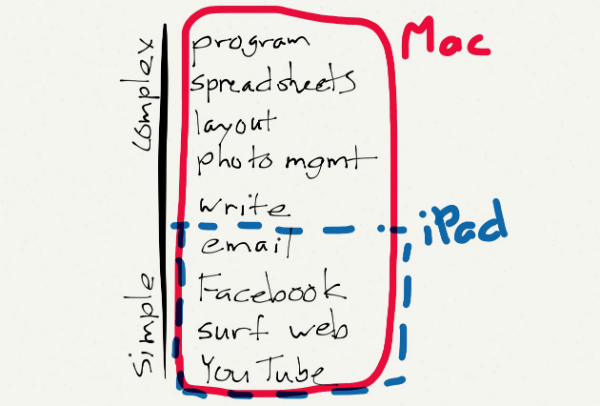
Apple: Still laser-focused on iterating great products that people love to use, but there are reasons for concern, particularly when it comes to the iPad. That’s not a surprise, actually: the iPhone and the Mac are operating in defined markets; while the iPad is defining a new one, and is thus more dependent on vision. This is precisely why I find recent iPad marketing so concerning; if Apple isn’t getting that right, is it for lack of vision? And if so, what does that mean for future products?
Facebook: The challenge for Facebook is not a lack of vision – clearly, they wish to connect everyone – but rather, that they have just about accomplished their founding goal. What’s next?
Twitter: Twitter is in many ways the exception that proves the rule. It’s not clear what vision, if any, the current management team has, but the product is so good that it hardly matters. Except, of course, it does, particularly now that Twitter is a public company. Will they maximize their potential?
Microsoft: Microsoft suffers from a more advanced case of Facebook’s malady: they have long since accomplished their goal of a PC on every desk. From Skating Towards the Goal:
But again, what is the new goal? What is Microsoft’s reason for being? What ends are achieved by a massive conglomerate spanning CRM systems to database software to gaming consoles? Microsoft, perhaps more than any other company, needs focus, vision, and a problem worth solving. To be sure, that falls on the next CEO, but the bigger question that must be asked is if such a problem – one suitable for the unwieldy behemoth that is Microsoft – even exists.
This uncertainty is why Microsoft’s impressive R&D arm is still rather irrelevant. How can you create something aligned to the company’s mission when said mission is so murky? And, of course, this is compounded by Microsoft’s tendency to overpromise and underdeliver
Yahoo: Marissa Mayer is nice, but does anyone yet know what the point is? At least Microsoft’s core business – enterprise software – seems more stable than Yahoo’s display advertising.
I could go on for quite some time, particularly with earlier stage companies, but the bigger conclusion is that vision at a minimum seems correlated with relevance on one hand, and stock performance on the other.
Unfortunately, by definition, it’s not something that can be learned through “best practices.”
As noted in my last post, my parents are here for the week and I’ve been rather busy entertaining.
I did want to take the time, though, to thank all of you for what has been an absolutely incredible first eight months for Stratechery. I know you’re not all American (and I’m not even in America), but Happy Thanksgiving to all of you just the same.
Normally, that would be unremarkable. She’s getting older, but isn’t that old, and surely an email isn’t that difficult of a task. This email, though, speaks volumes:
An email from my mom to me
Start with the subject. HK is Hong Kong. My parents are flying from Chicago to Taiwan to see their grandchildren, and while they’ve done it before, they’re not exactly tech savvy. They certainly don’t have an international data plan – heck, they don’t even have smart phones! They don’t see the point in paying that much every month.
What my mom does have, though, is an iPad – you can see it there in her signature. It’s likely she doesn’t know how to change it, but that’s kind of the point: that signature speaks volumes. What it says is that she managed to connect to the Hong Kong airport Wi-Fi, agree to the Wi-Fi agreement, get online, and then email her son – and after a 15 hour flight no less!
The very idea of her doing this on a PC – Windows or Mac – is laughable. I doubt she would even take said PC out of her bag. And that’s what’s so amazing! It’s not only that she was able to connect to Wi-Fi, but that she was even willing to try. That is the power of the iPad, that is the magic. That is the sort of life that the iPad enables and that surely appeals to millions around the world.
Yesterday, Apple released several short vignettes that accompanied the video they showed at the iPad introduction. The series is called Life on iPad. They are remarkable, both in presentation and content, and multiple people thoughtfully reached out to me suggesting this was the magic I was looking for.
I can see where they’re coming from: there’s no question the iPad has unlocked amazing new use cases. But – and this gets at the trouble I have with Apple’s messaging – how many people work on windmills? How many people are surgeons? Who are these vignettes for? What is more meaningful? Is it these impressive but rather obscure examples, or is it the confidence and ability to connect to Wi-Fi in a foreign country, to contact your son and let him know you’re almost there?
The magic of the iPad is twofold: one, it empowers all kinds of people who find a PC just a bit intimidating to have their own bicycle of the mind – and, let’s be honest, that’s almost everyone but us geeks. Two, the iPad does enable brand new use cases, which these vignettes get at, but what about these use cases resonates broadly? Where are the examples of making music, drawing, or designing – things that unlock the creativity I, naive as it may be, truly believe exists in all of us just waiting for the means to burst out?
What excites me, what makes me so passionate about this subject, is the deep belief that there are millions of people whose lives could be made genuinely better by the iPad, and who may see these vignettes, and have no thought beyond “that life isn’t me.”
One aside: what these “Life in iPad” does emphasize is the developer opportunity. While I argue Apple should be selling the value of the iPad to everyday consumers, truly lucrative apps are likely to be found serving niches like windmills, speedskating, etc. The only limit is the developer’s willingness to find the right niche.
I took another turn at my map of the social networking space I made for yesterday’s post The Multitudes of Social:
The Social/Communication Map
I made a few changes:
The primary change is relabeling the horizontal axis. Originally I had “Interest/Topic-
Based” on the left, and “Real-life Relationship-Based” on the right, but as Victor Pope pointed out on Twitter, the real difference is really about the symmetry of relationships.
Relabeling this axis necessitated moving email and Skype to the right, which I think makes sense and is an indication that this is a a good change.
I added Tumblr and YouTube, and removed Photostream and Facetime. The original was based on networks I personally use; this new drawing is more representative of usage worldwide. I did leave LINE, but consider that representative of WhatsApp, Kik, Kakao Talk, WeChat, etc.
Finally, I’ve changed the title to make the broader point: social is about communication, and communication is, and always has been, conducted through multiple mediums.
Some additional observations, beyond Facebook and Snapchat (which were the focus of the original post):
There are three primary means of communication: text, photo, and video/voice. Usually a particular service, beyond competing in a specific quadrant, will also specialize in one of these mediums, and then grow into an adjacent medium over time (e.g. Instagram video).1
It is not an accident that most of the companies towards the top of the graph – the more permanent type of content – were founded in the PC era. The PC itself has always been a destination-type device; normal people weren’t using a PC most of the time, but rather made a point to use it.
It’s the exact same with the type of content created for these PC-originated services: more permanent, thoughtful content is intentional; ephemeral content is much more whimsical and meaningful only at a specific moment in time. It follows that this type of content is really only possible in mobile on a device that is always with us.
The exception to the last point is Skype; in retrospect, it’s rather remarkable Skype was able to create such a foothold on the ephemeral side of the map despite its PC origins. It goes to show what value the original product had. Unfortunately, that value is fast disappearing as more and more apps like LINE incorporate VOIP, and Skype’s former strength – its network of users based on nicknames – is a liability relative to services like LINE or WhatsApp that ride along on phone numbers as unique identifiers.
The placement on these axis is not a technical description, but rather how users experience the particular services. For example, while tweets and Instagram photos have easily-accessible URLs, while Facebook posts don’t, the experience of Twitter and Instagram is more ephemeral from a user perspective relative to Facebook, which itself presents posts and videos as one specific moment in your lifelong timeline.
While I created this map in order to talk about Facebook, it turns out it is among the most difficult to categorize correctly. Facebook is, well, a book of faces; your permanent place on the network, centered on your identity and seen by those you connect with one-to-one. And yet, the primary mechanic on Facebook – the wall post – is a one-to-many medium. There is no question Facebook is good enough for a certain segment of the population that may have once upon a time started a blog or Tumblr.
Yet, the nature of Facebook, and its drive to capture everything, ultimately devalues everything as well, making your content ever more ephemeral and just more digital flotsam. Facebook is pulling itself in two different directions – to the left, and downwards – and it’s not good for the product long term. Being everything to everyone is, as they say, the best way to be nothing to no one.
Make no mistake: Facebook is a triumph. It completely dominates text, photo, and video sharing for the majority of the population, and it remains the most likely connection point for anyone I know in real life. What Facebook clearly is not, though, is something private or well-suited to conversations you may one day hope to forget. In other words, they’re not Snapchat, and wanting to be is to forget what makes it great.
One more point worth noting: Facebook remains the most valuable property on this chart, especially if they successfully crack effective brand advertising .2
The Social/Communications Map has been updated over time. This is the most recent version:
Vine is clearly aspiring to be in the bottom left corner, but I haven’t seen any indication it’s really gotten much traction ↩
YouTube is a clear second, with Twitter a very distant third ↩
Do I contradict myself?
Very well then I contradict myself,
(I am large, I contain multitudes.)
– Walt Whitman, Song of Myself
Last week Snapchat reportedly turned down a $3 billion dollar all-cash offer from Facebook. Apparently Facebook was worried about losing the teen demographic, or perhaps they were unnerved by the 350 million photos Snapchat claims to process per day. What seems clear, though, is that Facebook is intent on “owning social.”
The only problem with this strategy is that the very idea of owning social is a fool’s errand. To be social is to be human, and to be human is, as Whitman wrote, to contain multitudes. Multitudes of apps, in my case.
In the last two days I have used 10 apps you might characterize as “social”. In no particular order:
Twitter, for keeping up on news and commenting on tech and stratechery
Facebook, for posting personal status updates and checking in
LINE, for text messaging with my wife and friends in Taiwan
Snapchat, for exchanging photos with my wife
Skype, for instant messaging with my colleagues
Facetime, for talking with my wife and kids
Instagram, for posting cool photos
Email, for all types of content, both work and personal
In Mark Zuckerberg’s world, my behavior is at best nonsensical and inefficient, at worst a threat to Facebook in a zero-sum social face-off. After all, this isn’t the first time Facebook has tried to unify communications – that was the point of Facebook Messages, way back in November, 2010. From Wired:
Facebook is seeking to replace email with what it calls a “modern messaging system” that combines all the ways people send messages — including email, IM and SMS — into a single interface…
The new system, Facebook Messages, was announced Monday. It allows you to simply click on a friend’s face, type a message and hit Enter. Facebook handles the rest. And it comes with an optional “facebook.com” email address. But a new email address isn’t the point. Rather it is the unification of a variety of means of communication.
Unification, in 2010. Given the reality of what has happened since, it’s an idea that is positively quaint. However, for Facebook investors, $3 billion isn’t quaint at all: it would have been a massive waste of money for an app that is in fact not competitive with Facebook at all.
Look again at my list of apps: each of them has their own place. Some are for communicating with friends-and-family, others for a different audience centered around my interests. Some are more meaningful and permanent, others ephemeral and quickly forgotten. Some are for public consumption, and others are private. Some are photo-centric, others are about text. In fact, there is hardly any overlap at all – and none with Facebook:
Facebook has made their choice: they are the public record of your life and the best way to connect with your friends and family. Snapchat works with friends, but in every other respect it’s the exact opposite product.
Facebook would do better to continue investing in improving their advertising signal. As I’ve written previously, Facebook is sitting on a display ad gold mine; they just need the targeting to match. That’s why Waze was such a loss. If they want to buy out a competitor, better to focus on one that either threatens their public-permanent space, or others – like Instagram – that are a great fit for their display business.
Most of all, though, Facebook needs to appreciate that their dominance of social on the PC was an artifact of the PC’s lack of mobility and limited application in day-to-day life. Smartphones are with us literally everywhere, and there is so much more within us than any one social network can capture.
Disclosure: I work for Automattic, which owns WordPress.com. This article represents my personal views ↩
In June, in response to claims that nine Internet companies were willingly passing information to the NSA, Apple released Apple’s Commitment to Customer Privacy:
Apple has always placed a priority on protecting our customers’ personal data, and we don’t collect or maintain a mountain of personal details about our customers in the first place. There are certain categories of information which we do not provide to law enforcement or any other group because we choose not to retain it.
For example, conversations which take place over iMessage and FaceTime are protected by end-to-end encryption so no one but the sender and receiver can see or read them. Apple cannot decrypt that data. Similarly, we do not store data related to customers’ location, Map searches or Siri requests in any identifiable form.
We will continue to work hard to strike the right balance between fulfilling our legal responsibilities and protecting our customers’ privacy as they expect and deserve.
A Strategy Credit is an uncomplicated decision that makes a company look good relative to other companies who face much more significant trade-offs.
User information of this type isn’t important to Apple’s business model, so they “choose not to retain it.” There’s nothing worth praising here – or denigrating – but it’s worth acknowledging.
Apple admitted as such in their recent report on government information requests:
Unlike many other companies dealing with requests for customer data from government agencies, Apple’s main business is not about collecting information. As a result, the vast majority of the requests we receive from law enforcement seek information about lost or stolen devices, and are logged as device requests.
We have no interest in amassing personal information about our customers. We protect personal conversations by providing end-to-end encryption over iMessage and FaceTime. We do not store location data, Maps searches, or Siri requests in any identifiable form.
Many were quick to praise Apple for this very fact, but let’s be clear: there is nothing here worth praising. It’s an artifact of their business model.
The slogan that good business is profitable business is superficial – an attempt to make moral dilemmas dissolve in a warm bath of goodwill. When the right thing to do is also in your own self interest, you do not need advice from philosophers and theologians. Ethics are about what to do when good behaviour and profitable business are not necessarily the same thing.
Bishop Whately noted the difference between the honest man and the man for whom honesty is the best policy. When you deal with the man for whom honesty is the best policy, you never know when it might be the occasion on which honesty is no longer the best policy. Bankers, not bishops, deliver lectures extolling their own personal integrity; the man who repeatedly reminds us how honest he is rarely acquires, or deserves, our trust. The integrity we value is a personal or organisational characteristic, not a business strategy.
Apple, unlike Google, or Facebook, or even Microsoft, is not a services company (as long-suffering iCloud/MobileMe/.Mac/iTools customs can attest), and so, to prescribe any sort of goodness to their decision to not retain user data is much less useful than an examination of what actually matters to their bottom line. And, as a hardware company, that means the supply chain. And that means people like Bibek Dhong. From Bloomberg Businessweek:
Staffing production lines in Malaysia, where 28 plants run by 24 companies worked on Apple contracts last year, usually goes this way: Companies tap an informal, largely unregulated, and transnational network of thousands of recruiters. They fan out, often hiring subrecruiters, into the farm fields and impoverished cities of Indonesia, Cambodia, Myanmar, Vietnam, and even into the Himalayas in Nepal. The positions they’re trying to fill are so coveted that they’re not merely offered, they’re sold. The brokers take fees from families, representing as much as a year or more of wages; frequently the fees are paid with loans that can take years to pay off… The hunt reached then-27-year-old Bibek Dhong on his mobile phone, while he was packing milk crates at a Kathmandu dairy to support his wife, a newborn daughter, and his extended family. The call would change his life.
The entire article is worth a read, and, as you might suspect, it doesn’t end well.
I don’t come to sit in judgment on Apple. How can I? After all, the very next article I read was this piece by Rick Reilly on the carnage that is American Football:
I see too much sorrow and ugliness to love football like I used to.
I watch Indianapolis quarterback Andrew Luck take a brutal lick now and I think of former Packers quarterback Brett Favre, who told a Washington radio show the other day he can’t remember most of his daughter’s soccer games. “That’s a little bit scary to me,” Favre said. “… That put a little fear in me.” He’s 44 years old.
I watch New England tight end Rob Gronkowski get up from wreck after wreck, and I think of former Colts tight end Ben Utecht, who said the other day he couldn’t remember being at a friend’s wedding until the friend showed him the photo album. See, you were a groomsmen. And you sang, remember? He’s 32 years old.
I watch Minnesota running back Adrian Peterson fling himself into crashing whirlpools of men and I think of former Cowboys running back Tony Dorsett, who said he sometimes finds himself driving on a highway and can’t remember where he’s going. “I’m just hoping and praying I can find a way to cut it off at the pass,” Dorsett said recently. He’s 59 years old.
I immediately set out to write a self-righteous tweet on how I’ve given up football, conveniently ignoring the fact I’m in Taiwan (football is only good live – which is 2 in the morning), and the fact I watched when I was in America. And then, the iOS 7 task switcher really brought my hypocrisy home:
Setting my fantasy football lineup one moment, feeling smug about not watching football the next
Apparently the last thing I did before penning said self-righteous tweet was set my lineup for fantasy football, an activity that reduces flesh-and-blood humans risking their futures to the equivalent of Magic cards.
So much for a self-righteous screed.
I don’t know where morals and ethics sit in business, especially in technology, where we celebrate the idea of disruption and failure, giving no heed to the real world implications of what we are building, or how we are building it. Moreover, it’s not as if I’m going to give up my iPhone, or Google’s search, or any of the stuff I’d prefer to feel smug about. Heck, I can’t even give up fantasy football.
And yet, how will things change? How will they get better? How will technology be a force for good, instead of a tool for evil? I remain a technological optimist, but just. The power of software and the Internet is truly awesome, and we best start taking it – and our personal roles in that – seriously.