Stratechery Plus Update

  • Antitrust and Aggregation

    Fifteen years on, perhaps the most pertinent takeaway from Microsoft’s antitrust battles with both the United States and Europe is how little it seems to have mattered. From a financial perspective, Microsoft grew revenue unimpeded from $15 billion in 1998 when the case was initiated to $95 billion last year.1 Internet Explorer, meanwhile, peaked at 95% market share in 2004, two years after the U.S. case was settled; in Europe, Windows XP N, which excluded Windows Media Player, sold only a few thousand copies, and browser choice did nothing to change underlying market trends.

    What ultimately undid Microsoft — and why that $95 billion revenue figure was a peak; the current trailing twelve month number is $87 billion — was that even as Windows continued to have a monopoly on laptops and desktops the definition of a computer was dramatically expanded to include smartphones (and, to a lesser extent, tablets). And while many Microsoft partisans argue that the antitrust-related restrictions caused the company to miss mobile, the truth is Apple’s iPhone succeeded by being a very different product than Windows, and Android leveraged a very different business model; if anything Microsoft’s PC dominance meant their mobile failure was inevitable as the company was ill-equipped to think differently.

    Antitrust and the Google Play Store

    This history is pertinent in light of the news that the European Commission has sent a Statement of Objections to Google alleging antitrust violations in how the company has leveraged monopolies in smartphone operating systems (Android), app stores (the Google Play Store), and search (Google Search). As I detailed on Thursday my preliminary takeaway is that Google is very likely to lose the case, not necessarily because of Android’s dominance or even search, but rather because of the Google Play Store; that is the linchpin on which the Commission’s case turns. The Play Store is the one part of the Google Mobile Services suite that is irreplaceable and thus the leverage enforcing the various requirements the Commission objected to, like making Google Search and Chrome defaults, and forbidding AOSP forks.

    To be sure, Google Mobile Services has other world class apps. The difference, though, is that those other apps are products, not platforms. In the case of Google Maps, for example, the quality of the service is solely under the control of Google; by extension, the quality of a competitor like HERE Maps is similarly controlled by its owners. Presuming HERE invests sufficiently OEMs will have alternatives when it comes to mapping apps.

    What makes the Play Store indispensable, on the other hand, are the millions of apps that reside there; to build an equivalent is not simply a matter of will and resources but of network effects: the more customers who use a particular app store, the more likely developers are to put their apps in that store, which will attract more customers and thus more developers in a virtuous cycle. And while the biggest factor in Google Play Store achieving this dominant position was its default inclusion in Android from the beginning, the effect I just described is a familiar one: aggregation theory.

    Aggregation Theory and Antitrust

    To briefly recap, Aggregation Theory is about how business works in a world with zero distribution costs and zero transaction costs; consumers are attracted to an aggregator through the delivery of a superior experience, which attracts modular suppliers, which improves the experience and thus attracts more consumers, and thus more suppliers in the aforementioned virtuous cycle. It is a phenomenon seen across industries including search (Google and web pages), feeds (Facebook and content), shopping (Amazon and retail goods), video (Netflix/YouTube and content creators), transportation (Uber/Didi and drivers), and lodging (Airbnb and rooms, Booking/Expedia and hotels).

    The first key antitrust implication of Aggregation Theory is that, thanks to these virtuous cycles, the big get bigger; indeed, all things being equal the equilibrium state in a market covered by Aggregation Theory is monopoly: one aggregator that has captured all of the consumers and all of the suppliers.

    This monopoly, though, is a lot different than the monopolies of yesteryear: aggregators aren’t limiting consumer choice by controlling supply (like oil) or distribution (like railroads) or infrastructure (like telephone wires); rather, consumers are self-selecting onto the Aggregator’s platform because it’s a better experience. This has completely neutered U.S. antitrust law, which is based on whether or not there has been clear harm to the consumer (primarily through higher prices, but also decreased competition), and it’s why the FTC has declined to sue Google for questionable search practices.

    The European Commission, on the other hand, is much more concerned about protecting competitors with the assumption that will, in the long run, benefit consumers; it sounds like the same thing but as I noted last year, the way these approaches manifest themselves differ tremendously when it comes to aggregators:

    Given that [aggregators’] “monopoly” is based on consumer choice it is highly unlikely that any of them will ultimately have antitrust problems in the U.S. absent a substantial shift in antitrust doctrine. And, on the flipside, it is very possible that all of them will ultimately have problems in Europe: Europe’s doctrine of prioritizing competition isn’t so much challenging U.S. tech company dominance as it is challenging the very structure of Internet-enabled markets.

    That last line seems like an invitation to slam “Europe’s anti-tech thinking”, but actually I have a lot of sympathy for the Commission’s approach. One more implication of aggregation-based monopolies is that once competitors die the aggregators become monopsonies — i.e. the only buyer for modularized suppliers. And this, by extension, turns the virtuous cycle on its head: instead of more consumers leading to more suppliers, a dominant hold over suppliers means that consumers can never leave, rendering a superior user experience less important than a monopoly that looks an awful lot like the ones our antitrust laws were designed to eliminate.

    The Microsoft Remedy

    The problem is that by the time aggregators establish monopolies worth investigating under today’s antitrust laws there is little that can be done to change the facts on the ground. Whatever happens in this Android case, for example, will do nothing to diminish Google’s dominant position, just as prior action against Microsoft didn’t really diminish Windows, at least not in terms of browsers or media players.

    It should be noted, though, that there was one remedy from the European Commission settlement with Microsoft that actually worked out quite well: Windows was required to document interoperability protocols for work group servers, which while designed for the benefit of established competitors like Sun, was actually more important for the open-source Samba project. Samba made it possible for non-Windows PCs and servers to be fully compatible with Windows-based networks, making it viable to use a Mac or Linux machine in corporate environments, or (more importantly) in corporate data centers, one of the first areas where the Windows monopoly started to come apart.

    Of course Windows remained dominant on the desktop thanks to its application lock-in (i.e. a monopoly on suppliers); in an interesting what-if the U.S. nearly upended this as well. Originally the government demanded that Microsoft fully disclose and document all of its APIs, which would allow alternative operating systems to recreate them and thus run Windows applications with no modifications, removing the application lock-in. Instead the final settlement was much narrower:

    Microsoft shall disclose to [relevant developers and other industry participants] for the sole purpose of interoperating with a Windows Operating System Product, … the APIs and related Documentation that are used by Microsoft Middleware to interoperate with a Windows Operating System Product.

    Basically, Microsoft agreed to not favor their own software on Windows, leaving open source compatibility layers like Wine to reverse engineer Windows APIs, ensuring they would never achieve the degree of reliability Samba did.

    The Problem of Implementation

    Both of these approaches — interoperability and API disclosure — could be solutions when it comes to defusing the market power of aggregators:

    • Mandated interoperability would significantly reduce the switching costs for consumers as they could more easily compare services. For example, a meta ride-hailing app would significantly weaken Uber’s lockin, and the ability to export your social graph could better enable social competitors to arise.
    • API disclosure would have a similar effect on the supply side. Imagine if you could export your host ratings from Airbnb to a competitor, or your driver rating from Uber to Lyft (Albert Wenger has proposed something similar)

    What, though, should be the standard that ensure these measures are effective before it’s too late? Perhaps a 200 million user threshold would trigger interoperability and API disclosure, which leads to the question of how do you define a user? Who audits that? And shouldn’t different industries have different numbers? Who exactly is going to figure that out and what assurances do we have they won’t suffer from regulatory capture? And then there’s enforcement — who ensures that the aggregators are actually opening up in good faith? After all, it took years and hundreds of millions of Euros to extract the interoperability standards undergirding Samba from a recalcitrant Microsoft insistent its intellectual property rights were being violated. And to be fair, Microsoft had a point: the company was being asked to not simply stop bad behavior or pay a fine but to effectively empower a competitor with their own IP.

    Remember, though, that the entire point of enshrining intellectual property in the law is to spur innovation: as I’ve argued previously with regards to patents, technology with its high fixed costs and strong network effects has massive incentives that drive innovation; there is enough reward for being first that the preservation of intellectual property is less important than it may be in other industries. On the flipside, the danger of slow-moving regulators is even greater.

    Is This Necessary?

    Given that, perhaps the biggest question is whether or not we will look back in 15 years and wonder what the point was. Microsoft’s revenue may have had a long ways to grow back in 1998, but the truth is the company’s relevance to the industry had already peaked; that year their successor on top of the industry and — via the browser, on top of Windows — was founded in Palo Alto. It was named Google.

    Similar, I have made the case that while Google may still grow, the company has peaked in relevance as well, eclipsed by Facebook. So sure, the European Commission can prosecute Google, but it won’t dent Android’s dominance, and it won’t deter whoever else has the problematic monopoly in the future.2 The incentives and feedback loops that drive towards domination are simply too strong (one could make the case that the most effective monopoly killer is the next monopoly).

    To that end, there is no question that the broader point underlying Aggregation Theory holds: the (metaphorical) rules have changed, and it’s fair to believe that at some point the laws may have to as well. It won’t be easy, though, and the possibility of unintended consequences will be strong, particularly given the self-corrective resiliency tech has shown to date that provides a compelling argument for leaving well enough alone.


    1. Both figures on a trailing twelve-month basis 

    2. Maybe Facebook should hope that VR isn’t as mainstream as they claim it will be 


  • Apple’s Organizational Crossroads

    Apple is unique, and I mean that objectively.

    Forget about products for a moment, about which reasonable people can disagree. Leave aside the financial results, which certainly are unprecedented. And ignore the people you know so well: folks like Jony Ive or Jeff Williams or Phil Schiller, and the many talented workers underneath them. Rather, the very structure of Apple the organization — the way all those workers align to create those products that drive those exceptional results — is distinct from nearly all its large company peers.

    The Unitary Organizational Form

    Apple employs what is known as a “unitary organizational form” — U-form for short — which is also known as a “functional organization.” In broad strokes, a U-form organization is organized around expertise, not products: in the case of Apple, that means design is one group (under Ive), product marketing is another (under Schiller), and operations a third (under Williams, who is also Chief Operating Officer). Other areas of expertise represented by the members of Apple’s executive team include Software Engineering (Craig Federighi), Hardware Engineering (Dan Riccio), and Hardware Technologies (Johny Srouji).

    What is most striking about that list is what it does not include: the words iPhone, iPad, Mac, or Watch. Apple’s products instead cut across the organization in a way that enforces coordination amongst the various teams:

    functional

    The benefits of this approach are well-known at this point, and captured in the name itself: “unitary” is a synonym for “integrated”. CEO Tim Cook has repeatedly extolled Apple’s ability to create integrated products that deliver a superior user experience, and former CEO Steve Jobs made clear in one of his final keynotes that to do so required more than wishful thinking:

    [iPads] are post-PC devices that need to be even more intuitive and easier to use than a PC, and where the software and the hardware and the applications need to be intertwined in an even more seamless way than they are on a PC. We think we have the right architecture not just in silicon, but in our organization, to build these kinds of products.

    This is why the very first thing that Jobs did when he returned to Apple, even before he famously pared the product line down, was to reorganize the company functionally; then again, perhaps the distinction is meaningless — a functional organization and a simplified product line go hand-in-hand.

    Why the Multi-Divisional Form Was Invented

    Back in 2013 when Steve Ballmer reorganized Microsoft to be (somewhat more) functional, I criticized the move in a piece entitled Why Microsoft’s Reorganization is a Bad Idea;1 as an introduction I described how the “multi-divisional form” — M-form, or divisional organization — came about:

    DuPont, the famous chemical company, was actually built on gunpowder. Founded in the early 1800s, DuPont was a small family concern until the early 1900s, when Pierre DuPont modernized and organized the company around functions: primarily sales and manufacturing. The structure served DuPont well, particularly in World War I, when in response to overwhelming demand DuPont vertically integrated its supply chain, and grew to become one of the largest companies in the world.

    After the war, DuPont needed to diversify, and paint, which involved a similar compound to gunpowder, was the area they chose to focus on. Yet, despite the fact DuPont was perhaps the most professionally run corporation in America, losses soared. Eventually, a disconnect between sales and manufacturing was identified as the root cause, and the cure was a new organization around two separate gunpowder and paint divisions.

    The deeper details of Dupont are quite interesting, and worth getting into: in short, the entire reason Dupont started making paint was that the manufacturing process was very similar to gunpowder; the problem is that gunpowder sold on a tonnage basis to huge buyers (like the army), while paint was sold to individual customers in stores. The product may have been very similar but the business model was entirely different. The end result was that Dupont was using a sales and marketing organization that was built around selling to large customers to get their paint into retail stores, and it was massively inefficient; the more paint Dupont sold, the more money they lost.

    The solution was, as noted in the excerpt, divisions organized around gunpowder and paint, each with their own sales and marketing teams, their own manufacturing heads, and their own quasi-CEOs with their own profit-and-loss responsibilities. And, as you might suspect, it was a massive success that has since been copied by nearly every large organization.

    Except, of course, Apple.

    Apple the Services Company

    In January, in their Q1 2016 earnings call, the prepared remarks of Apple CEO Tim Cook and CFO Luca Maestri took a surprising turn: an extended amount of time was spent making the case that Apple was a services company. Cook stated:

    Especially during a period of economic uncertainty, we believe it is important to appreciate that a significant portion of Apple’s revenue recurs over time…a growing portion of our revenue is directly driven by our existing install base. Because our customers are very satisfied and engaged, they spend a lot of time on their devices and purchase apps, content, and other services.

    Maestri was much more to the point — these were the first words out of his mouth:

    Each quarter, we report results for our Services category, which includes revenue from iTunes, the App Store, AppleCare, iCloud, Apple Pay, licensing, and some other items. Today, we would like to highlight the major drivers of growth in this category, which we have summarized on page three of our supplemental material.

    That supplemental material is here, and the fact it even exists underscores how serious Apple is about this narrative. And frankly, they have reason to be: while the iPhone remains in a very strong position that I believe will return to growth next fiscal year, that growth will be far more tepid than it has been to date: all of the “low-hanging fruit” — new markets, new carriers, new screen-sizes — is gone, and the real competition for Apple are the still very-good iPhones their customers already have. To that end, making more and more money off of those preexisting customers is the natural next step in Apple’s growth.

    The problem for Apple is that while iPhones may be gunpowder — the growth was certainly explosive! — services are paint. And, just as Dupont learned that having a similar manufacturing process did not lead to similar business model, the evidence is quite clear in my mind that having iPhone customers does not mean Apple is necessarily well-equipped to offer those customers compelling services. At least not yet.

    The Difference Between Devices and Services

    I suggested at the beginning of this piece that to objectively claim that Apple is unique you needed to think beyond products, but in fact I do believe that Apple’s products — their devices anyways — are superior, particularly if you value the finer details of industrial design, build quality, and little UI details like scrolling and responsiveness that seem so simple but are so hard to get right.2 And, frankly, it’s not surprising that Apple is good at this stuff for the exact reasons laid out above: everything about the company is designed to produce integrated devices that don’t sacrifice perfection for the sake of modularity.

    The problem is that everything that goes into creating these jewel-like devices works against being good at services:

    • You only get one shot to get a device right, so all of Apple’s internal rhythms and processes are organized around delivering as perfect a product as possible at a specific moment in time.

      Services, on the other hand, which are subject to an effectively infinite number of variables ranging from bandwidth to device capability to hacking attempts to data integrity to power outages — the list goes on and on — can never be perfect; the ideal go-to-market is releasing a minimum viable product that is engineered for resiliency and then updated multiple times a week if not multiple times a day. The rhythms and processes are the exact opposite of what is required to build a great device.

    • As Apple is happy to tell you, a superior experience on a device comes from integration: the software can be tailored to the hardware, all the way down to the component level; this is why Apple designs their own system-on-a-chip hand-in-hand with iOS. Integration to this degree, though, is only possible when there is a static endpoint: the device that goes on sale to the public.

      In the case of services, though, which develop organically and iteratively, an integrated approach is unworkable: you can’t build everything from scratch multiple times a day. Rather, an effective set of services are modular in the extreme: different capabilities snap together like lego blocks to deliver different types of experiences, and each of those capabilities can be iterated on without disrupting the end product.

    • The fact that smartphones are such an important part of people’s lives, combined with the fact that physical objects can have additional consumer benefits like status, enables Apple to sell each iPhone with a huge amount of margin. However, not everyone values smartphones that much, or has the willingness to pay, which means Apple has to be ok with not serving the entire market; after all, to make a single iPhone costs money that has to be made up for in the purchase price.

      Services, though, have a very different business model. First, there is precious little evidence that consumers are willing to pay more than a nominal amount for services (if that!), which means the most profitable services make money through volume. Secondly, services are effectively free on a marginal basis; the real costs are fixed, which means that services business have a strong economic imperative to reach as many people as possible.

    These differences get at the very fundamental reasons why Apple struggles with services: it’s not that the company is incompetent, but rather that the company is brilliant — brilliant at making devices, which require completely different business structures and incentives.

    Apple’s Services Problem

    Late last week news broke that Apple was considering adding search ads to the App Store. I detailed yesterday why I think this is less of a big deal for the industry than either advocates or detractors believe, but I do think this is a very big deal for what is says about Apple: namely, that the company is serious about building out its services business.

    The question, though, is how serious; App Store search ads will be a relatively easy thing to implement, just as the App Store itself was in many respects an obvious — yet still revolutionary — addition to the iPhone.3 It’s worth noting, though, how poorly the App Store is generally run: Apple is not, in my estimation, deriving nearly the amount of strategic value they should be from the App Store. The iPhone and iPad should be home to an increasingly sophisticated and exclusive cadre of high-powered applications that make the idea of choosing another platform unthinkable, but sadly, such applications have no business model because of App Store policies.

    Apple Music is in worse shape: the extent to which the product is succeeding is largely due to its tie-in with Apple’s hardware; however, were the service held to the same ease-of-use, fit-and-finish, and profitability standards of said hardware there would be panic in Cupertino.

    Cloud services, meanwhile, are still less reliable than Apple’s competition, and the integration — Apple’s supposed strength! — with Apple’s software is at best a source of irritation and at worst very worrisome from a security perspective: little things like constantly being prompted to enter one’s password are not only annoying but also corrosive when it comes to what should be a healthy skepticism about sharing the keys to your life.

    The problem in all these cases is that Apple simply isn’t set up organizationally to excel in these areas:

    • Apple values integration and perfection, which results in too many services being over-built and thus more difficult to iterate on or reuse elsewhere
    • Service releases (and software) are not iterative but rather tied to hardware releases
    • Apple’s focus on secrecy means many teams end up building new services from scratch instead of reusing components

    The root problem in all these cases is the lack of accountability: as long as the iPhone keeps the money flowing and the captive customers coming, it doesn’t really matter if Apple’s services are as good as they could be. People will still use the App Store, Apple Music, and iCloud, simply because the iPhone is so good.

    What they won’t do, though, is use Apple Pay: an extension of Apple’s unitary vision (and another manifestation of the problems underlying my critique of the App Store) is a struggle to partner effectively, particularly with vast ecosystems driven by incentives, not backroom deals. Apple Pay could be the foundation for a tremendous amount of value but Apple isn’t doing the grunt work to get it off the ground (iMessage fits here as well).

    You can see the same pattern with HomeKit, or Siri: the Amazon Echo is quietly taking over the home automation market with a simple API that is easy-to-integrate with and easy-to-understand; Apple, meanwhile, has yet to announce a Siri API even as it struggles to deliver natural language interaction that is simply not what the company is good at.

    Both examples are even more worrisome when you consider Apple Watch: the Watch will truly realize its value when it becomes the key to interacting with your environment; getting there, though, means nailing services, partnerships, and APIs that are good, not perfect.

    How Apple Can Excel at Services

    The solution to all these problems — and the key to Apple actually delivering on its services vision — is to start with the question of accountability and work backwards: Apple’s services need to be separated from the devices that are core to the company, and the managers of those services need to be held accountable via dollars and cents.

    This last point is surely anathema to Apple: the company famously only has one P&L4 — the number it delivers to Wall Street — and I absolutely agree that is foundational to Apple’s success. Removing the position of Senior Vice President of iPod made it far easier to obsolete it with the iPhone,5 and the fact there was no Senior Vice President of the Mac made it easier to come out with the iPad. Apple has displayed a remarkable unity of purpose that is only truly possible with a unitary organization, which is exactly why restoring that structure was Jobs’ first move upon his return.

    But again, Jobs’ next move was slashing the product line, and that wasn’t only for reasons of focus and customer confusion: the fact is that unitary organizations do not scale to different business models, and if Apple is truly serious about services — and the existence of the relatively cheap yet full-featured iPhone SE suggests they are — they need to follow Dupont’s example.

    Apple will not fix the services it already has, or deliver on the promise of the services its hardware might yet enable, unless a new kind of organization is built around these services that has a fundamentally different structure, different incentives, and different rhythms from Apple’s device teams. You don’t make great products because you want to make great products; you make great products by creating the conditions where great products can be produced.

    Apple’s Dupont Moment

    To be honest, I’m not sure Apple has it in them; indeed, Dupont nearly didn’t. Listen to these passages from Richard Tedlow’s book Denial and see if they ring familiar:

    Irénée du Pont did not like this proposal [to organize the company by divisions], despite the fact that it came from his top people — seasoned executives all. It violated the “principle of specialization,” which had served DuPont so well. Irénée was still wedded to the idea of functional rather than product specialization…

    Middle management — the men closest to the problems and seeking practical solutions for them — felt one way. Top management — which had created the modern DuPont company and seen that creation grow to un-imagined wealth and size — felt another…

    Four years ago, Cook told a Goldman Sach’s investment conference:

    They’re not things where we run separate [profits and losses] on, because we don’t do that — we don’t believe in that. We manage the company at the top and just have one [profit and loss] and don’t worry about the iCloud team making money and the Siri team making money. We want to have a great customer experience, and we think measuring all these things at that level would never achieve such a thing…

    Apple is this unique company, unique culture that you can’t replicate. And I’m not going to witness or permit the slow undoing of it, because I believe in it so deeply. Steve grilled in all of us, over many years, that the company should revolve around great products, and that we should stay extremely focused on few things. Rather than try to do so many that we did nothing well.

    Unlike many, I’m not bothered that Apple sells multiple variations of iPhone, iPads, etc. Scaling to variations is simply a matter of money and experience, which Apple has in spades. Services, though, are a fundamentally different problem that require a fundamentally different organization. If Apple is serious about services, then Cook’s promise that Apple would stay “extremely focused” is an empty one, and the insistence on a single type of organizational structure changes from enhancing Apple’s quality to actively detracting.6

    Tedlow concluded:

    It is extraordinarily difficult to bring about change in a big company. Leadership, it has been said, consists of using minimum problems to create maximum positive change. By that standard, DuPont did well, but it could have done better. Only when the firm was on the brink of disaster, in the midst of a crisis produced by one of the worst years in its history, was it able to reconcile itself to the fact that yesterday’s structure was acting as a barrier against rather than an avenue toward tomorrow’s strategy.

    Something has to give: either what makes Apple Apple, or Apple’s newfound ambitions; the measure of Cook’s leadership will be how long it takes for him to stop straddling the fence.


    1. If you’re interested in this topic you can also read the followup: The Uncanny Valley of a Functional Organization  

    2. If you disagree, that’s ok! I also believe that if you value things like flexibility and integration with services — which I’m getting to — that Android phones (which I own and use regularly) are better; furthermore, I am well aware of and have written extensively about what I and many others perceive as Apple’s declining software quality. Please bear with me here. 

    3. To clarify, the implementation of the App Store was brilliant; the idea of allowing 3rd-party apps was obvious 

    4. Profit and loss, the metric on which divisional managers are measured 

    5. Tony Fadell left (with, reportedly, not much effort to keep him) after losing out to Scott Forstall’s vision of the iPhone, and it is telling that Apple has not had a product-centric executive member since 

    6. One important thing to note: Apple’s Retail division is a separate division with its own organizational structure and own P&L; Ron Johnson knew that was necessary to make the division work 


  • Facebook, Phones, and Phonebooks

    It was a bit surreal to see Facebook founder and CEO Mark Zuckerberg traipsing around the F8 stage carrying an “engine pod” for a Facebook drone designed to beam the Internet to the one billion people Zuckerberg said could not be online due to a lack of access. Zuckerberg himself clearly felt the same way, remarking that “If you had told me 12 years ago that one day Facebook was going to build a plane, I would have told you that you were crazy.”

    Still, it makes sense: Facebook has from day one been about getting people online.

    Thefacebook

    Twelve years ago Zuckerberg started Thefacebook — the company would switch its name a year later — at Harvard as the online version of the freshman facebook that Harvard distributed in print; to join you had to have a Harvard email address and use your own name. But of course you wanted to do exactly that: as Amelia Lester, who would go on to be the long-time managing editor of The New Yorker, wrote in a remarkably insightful column in The Harvard Crimson:

    The thefacebook.com scene includes reams of carefully coiffed, immaculately manicured, evening-garbed Harvard students grinning eagerly on page after page as we present our own ideal image of selfhood to fellow browsers…every profile is a carefully constructed artifice, a kind of pixelated Platonic ideal of our messy, all-too organic real-life selves who don’t have perfect hair and don’t spend their weekends snuggling up with the latest Garcia Marquez…There are plenty of other primal instincts evident at work here: an element of wanting to belong, a dash of vanity and more than a little voyuerism probably go a long way in explaining most addictions (mine included). But most of all it’s about performing — striking a pose, as Madonna might put it, and letting the world know why we’re important individuals.

    For the next several years, that’s all Thefacebook was: a collection of profile pages that gave individuals the opportunity to present their best selves for the perusal and approval of those in their network. And people could not get enough: Thefacebook methodically spread from college to college, usually signing up the vast majority of students in a matter of weeks if not days.

    The phenomenon, according to The Facebook Effect author David Kirkpatrick, was surprisingly one that didn’t appeal that much to Zuckerberg. Kirkpatrick wrote:

    Ironically, Zuckerberg was not a heavy user of Thefacebook. Nor, in fact, were any of its founders and early employees. [The summer of 2004] the interns, working with Moskovitz, started to gather data on how people actually used the site. They found that some users were looking at hundreds and even thousands of profiles every day. These were the users they were designing for.

    Kirkpatrick noted that Zuckerberg was splitting his time between Thefacebook and a service called Wirehog that enabled peer-to-peer sharing amongst Thefacebook users, something that Zuckerberg was much more interested in personally. Zuckerberg would eventually be persuaded to give up the side project, but this would not be the last time Zuckerberg’s interest in sharing would seem to run counter to Thefacebook’s focus on enabling people to put themselves — their best selves — online.

    The Power of Identity

    As Lester astutely noted, the identity we build for ourselves on Facebook is our own projection of how we want others to see us, and it has been core to the service from the beginning. Kirkpatrick writes:

    Perfecting the details of your own profile in order to make yourself a more attractive potential friend occupied a considerable amount of time for many of these newly networked Ivy Leaguers. Find exactly the right picture. Change it regularly. Consider carefully how you describe your interests. Since everyone’s classes were listed, some students even began selecting what they studied in order to project a certain image of themselves. And many definitely selected classes based on who Thefacebook indicated would be joining them there…Your “facebook,” as profiles on the service began to be called, increasingly became your public face. It defined your identity.

    Moreover, Zuckerberg was insistent from the beginning that said identity not be split. Kirkpatrick again:

    “You have one identity,” [Zuckerberg] says emphatically three times in a single minute during a 2009 interview. He recalls that in Facebook’s early days some argued the service ought to offer adult users both a work profile and a “fun social profile.” Zuckerberg was always opposed to that. “The days of you having a different image for your work friends or co-workers and for the other people you know are probably coming to an end pretty quickly.”

    The power of this approach cannot be overstated: as Lester observed, from a product perspective both vanity and voyeurism are powerful drivers of engagement. It’s also a goldmine when it comes to advertising: the lead that Facebook has over everyone, including Google, when it comes to targeting advertisements is huge. The service knows exactly who you are, exactly what you like, exactly where you live, work, and went to school, all because you told them yourself. And yes, some of your “interests”, particularly in those early days, may have been more aspirational than realistic, but from an advertiser’s perspective, all the better: aspiration is exactly what they sell.

    The News Feed Rubicon

    It was ten years ago, in September 2006, that Facebook became the product we know today: that is when the News Feed was introduced. Now, instead of needing to proactively visit the profile pages of all your friends to discover what had changed, Facebook would use an algorithm to proactively tell you what changes you might be interested in.

    The effect of the News Feed was massive: engagement immediately skyrocketed from already unseen levels, and I have previously argued that the algorithmic nature of Facebook’s feed was a core reason why the service squashed Twitter. Even more important is what the News Feed meant to the bottom line: a feed is the best place to place advertising, especially on mobile, and Facebook has spent the last several years drawing down its old display ad inventory even as News Feed ads continue to grow both in inventory and in price.

    The News Feed, though, came at a cost: while Facebook information had always been public to your network,1 the fact that what you posted was being pushed out to people who were “Facebook Friends” but not necessarily real friends was a wake-up call to Facebook users. There were immediate protests, which Facebook rather astutely tamped down, but the longer-term repercussions were real. Kirkpatrick notes:

    When people can see what you are doing, that can change how you behave. The reason the News Feed evoked something as intrusive as stalking was that each individual’s behavior was now more exposed. It was as if you could see every single person you knew over your backyard fence at all times. Now they could more easily be called to account for their actions.

    Over the next several years a rash of incidents in which people lost their jobs, were denied entry to college, or simply got in hot water with someone close to them were a common media trope. President Obama told a group of high school students in 2009, “I want everybody here to be careful about what you post on Facebook.”

    Facebook’s Closed Door

    The core of Facebook’s value is its ownership of identity of every person online. To that end, while a drone plane may have been unimaginable in 2004, it fits: the only thing lacking when it comes to Facebook’s role as the Internet phone book are the missing entries for the 4 billion people who are not yet online.

    In fact, the most unbelievable part of Zuckerberg’s presentation came a few minutes later, when he discussed Live Video:

    People love going live because it’s so unfiltered and person and you feel like you’re just there hanging out with your friends. In a funny way, we’ve found that Live takes some of the pressure off of having to find that perfect photo or video, because everyone knows that it’s live and it’s not curated.

    There is, in the subtext of Zuckerberg’s description, an acknowledgment of the need to project your best self that has always been at the root of Facebook, something the News Feed changed from an incentive to an imperative. It is the very thing that fueled the rise of Snapchat, and make no mistake, the selfie-sharing app has Facebook spooked.

    Last week The Information reported that Facebook was struggling to stop the decline in “original” sharing — content that users generate themselves, as opposed to sharing a link or a viral video. Bloomberg added a day later:

    People have been less willing to post updates about their lives as their lists of friends grow…Instead, Facebook’s 1.6 billion users are posting more news and information from other websites. As Facebook ages, users may have more than a decade’s worth of acquaintances added as friends. People may not always feel comfortable checking into a local bar or sharing an anecdote from their lives, knowing these updates may not be relevant to all their connections.

    According to one of the people familiar with the situation, Facebook employees working on the problem have a term for this decline in intimacy: “context collapse.” Personal sharing has shifted to smaller audiences on Snapchat, Facebook’s Instagram and other messaging services.

    This is the price of owning identity — of owning all the value that Facebook generates from advertising in its News Feed — and there is no going back.

    The Bifurcation of Social

    It is increasingly clear that there are two types of social apps: one is the phone book, and one is the phone. The phone book is incredibly valuable: it connects you to anyone, whether they be a personal friend, an acquaintance, or a business. The social phone book, though, goes much further: it allows the creation of ad hoc groups for an event or network, it is continually updated with the status of anyone you may know or wish to know, and it even provides an unlimited supply of entertaining professionally produced content whenever you feel the slightest bit bored.

    The phone, on the other hand, is personal: it is about communication between you and someone you purposely reach out to. True, telemarketing calls can happen, but they are annoying and often dismissed. The phone is simply about the conversation that is happening right now, one that will be gone the moment you hang up.

    In the U.S. the phone book is Facebook and the phone is Snapchat; in Taiwan, where I live, the phone book is Facebook and the phone is LINE. Japan and Thailand are the same, with a dash of Twitter in the former. In China WeChat handles it all, while Kakao is the phone in South Korea. For much of the rest of the world the phone is WhatsApp, but for everywhere but China the phone book is Facebook.

    This isn’t a bad thing; indeed, it is an incredibly valuable thing: Facebook’s status as a utility is exactly what makes the company so valuable. It has the data to target advertising and the feed in which to place it, and it is difficult to imagine any of the phone companies overtaking it in value.

    This is why I wrote almost exactly a year ago that Facebook should embrace its position as being something more than just a social network. From Facebook and the Feed:

    It’s not inconceivable that, at some point in the relatively near future, it is Facebook that is the default advertising medium, commanding dollars that exceed its already dominant share of attention. Still, this outcome depends on Facebook driving ever-more engagement, and I’m not convinced that more “content posted by the friends [I] care about” is the best path to success.

    Everyone loves to mock Paul Krugman’s 1998 contention about the limited economic impact of the Internet:

    The growth of the Internet will slow drastically, as the flaw in “Metcalfe’s law”–which states that the number of potential connections in a network is proportional to the square of the number of participants–becomes apparent: most people have nothing to say to each other!

    It’s worth considering, though, just how much users value what their friends have to say versus what professional media organizations produce…Was Krugman wrong because he didn’t appreciate the relative worth people put on what folks in their network wanted to say, or because he didn’t appreciate that people in their network may not have much to say but a wealth of information to share?

    I suspect that Zuckerberg for one subscribes to the first idea: that people find what others say inherently valuable, and that it is the access to that information that makes Facebook indispensable. Conveniently, this fits with his mission for the company. For my part, though, I’m not so sure. It’s just as possible that Facebook is compelling for the content it surfaces, regardless of who surfaces it. And, if the latter is the case, then Facebook’s engagement moat is less its network effects than it is that for almost a billion users Facebook is their most essential digital habit: their door to the Internet.

    In that piece I said that Facebook had a choice: try to restore its ownership of personal updates, or embrace its status as a utility. Here’s the funny thing about choices, though: all too often the choice is not about choosing one path or another, but about accepting reality sooner rather than later.

    The truth is that Facebook chose its path way back in 2004, and cemented it in 2006: it was the place you publicly shared your identity with the world, and you had best take care exactly what that identity was. No amount of live video or original sharing prompts will change that reality, and that’s ok. If anything the real danger to Facebook is that the act of banging their collective head on a closed door will start to damage the utility of, well, their utility.

    Clearly there are parts of Facebook that get this: David Marcus, for example, is pursuing a very smart strategy in his attempt to position Messenger as a transaction medium between businesses and individuals. It plays perfectly to Facebook’s strengths, and as WeChat has demonstrated in China, it can be very lucrative. Still, though, for all of the brilliance and strategic acumen he has shown to date, I worry about Zuckerberg. He opened his keynote with a surprisingly political plea to avoid the Trump-ian rhetoric around building walls:

    If the world starts to turn inwards, then our community will just have to work even harder to bring people together. That’s why I think that the work that we’re all doing is so important, because we can actually give more people a voice. Instead of building walls we can help people build bridges, and instead of dividing people we can help bring people together. We do it one connection at a time; one innovation at a time; day after day after day. And that’s why I think the work that we’re all doing together is more important now than it’s ever been before.

    Leaving aside the irony that Facebook has arguably played a role in Trump’s rise, the reality is that not everyone wants to build bridges all the time. Zuckerberg’s insistence that every individual on Facebook have one identity may have been a masterstroke when it comes to building value, but the truth is each of us contains multitudes: there are parts we want to show the world, and parts we want to show only our closest friends, and the sooner Facebook accepts they can’t have everything the more valuable the parts they own will become.


    1. And Facebook actually included relatively granular privacy controls from the start 


  • It’s a Tesla

    Let’s start with the caveats: no, Tesla did not sell 276,000 Model 3’s in three days;1 that is the number of fully refundable pre-orders that required a deposit of “only” $1,000.2 And yes, Tesla has a history of delivering cars late and with a higher price than expected. Moreover, given the fact that Tesla only delivered just over 50,000 cars last year, no matter how quickly Tesla scales it will almost certainly be years before this first week of reservations is fulfilled, and even then Tesla will only control a fraction of the car market.

    With that out of the way, can we marvel at what Tesla and CEO Elon Musk have accomplished? Nearly 300,000 people have willingly parted with $1,000 despite the fact they will not have a chance to purchase a car for years; an astounding 115,000 of them sent in their deposit before they even knew what the car looked like. A friend got in line to make his reservation at 6:45am and there were 123 people in front of him. This is, no matter how you measure it, a phenomenon that is nearly unprecedented; the only possible comparison is Apple and its iPhone.

    Long lines and fans committed to ordering new products sight-unseen are not the only things Tesla and Apple have in common: both companies have been doubted for allegedly not understanding Disruption Theory; both, though, are proving that Disruption Theory does not have all the answers, particularly when it comes to consumer markets.

    The iPhone and Disruption

    Back in 2013 I wrote What Clayton Christensen Got Wrong, specifically about Apple and the iPhone:

    Christensen’s theory is based on examples drawn from buying decisions made by businesses, not consumers. The reason this matters is that the theory of low-end disruption presumes:

    • Buyers are rational
    • Every attribute that matters can be documented and measured
    • Modular providers can become “good enough” on all the attributes that matter to the buyers

    All three of the assumptions fail in the consumer market, and this, ultimately, is why Christensen’s theory fails as well…

    My conclusion was that the iPhone was, contrary to the then-conventional wisdom, not likely to suffer from low-end disruption, and not only has that proven to be correct, Apple has in fact expanded its global marketshare. And now, with the iPhone SE, Apple is expanding the high end to a price point accessible to customers in developing markets who very much want an iPhone but simply don’t have the means to afford top-of-the-line prices.

    It’s this latter point — that a high-end approach can drive growth at lower price points — that seems particularly pertinent to the Model 3.

    Tesla’s Master Plan

    During Thursday’s Model 3 introduction Musk referenced Tesla’s “secret master plan,” which he laid out in a blog post back in 2006. Musk wrote:

    The initial product of Tesla Motors is a high performance electric sports car called the Tesla Roadster. However, some readers may not be aware of the fact that our long term plan is to build a wide range of models, including affordably priced family cars…Critical to making that happen is an electric car without compromises, which is why the Tesla Roadster is designed to beat a gasoline sports car like a Porsche or Ferrari in a head to head showdown. Then, over and above that fact, it has twice the energy efficiency of a Prius…

    The strategy of Tesla is to enter at the high end of the market, where customers are prepared to pay a premium, and then drive down market as fast as possible to higher unit volume and lower prices with each successive model…The second model will be a sporty four door family car at roughly half the $89k price point of the Tesla Roadster and the third model will be even more affordable.

    In keeping with a fast growing technology company, all free cash flow is plowed back into R&D to drive down the costs and bring the follow on products to market as fast as possible. When someone buys the Tesla Roadster sports car, they are actually helping pay for development of the low cost family car.

    Leaving aside the fact that the “sporty four door family car” costs $25,000 more than Musk’s promise,3 the strategy seems to have worked: Tesla, with a detour to build the Model X crossover along the way, has moved down the cost curve culminating in the announcement of the affordable Model 3.

    A closer look, though, suggests that Musk painted too rosy a picture when it comes to the Master Plan’s funding: while Tesla’s cars have, from 2009 on, been sold at a profit, the company has still lost significant amounts of money every year. The reality is the company’s significant research and development costs have been paid for by issuing stock and incurring debt, not the profits of high-end models.

    Low End Dogma

    Given Tesla’s finances, it’s tempting to ask why the company didn’t simply start with the low-end; indeed, researchers at Christensen’s Forum for Growth and Innovation argued last year that a better approach to the electric vehicle market would be exactly that. From a Harvard Business Review article entitled Tesla’s Not as Disruptive as You Might Think:

    It [is] clear that Tesla is not a disrupter. It’s a classic “sustaining innovation” — a product that, according to Christensen’s definition, offers incrementally better performance at a higher price…because it’s a sustaining innovation, theory predicts that competitors will emerge. Our analysis concludes that a competitive response won’t happen until Tesla expands outside its current niche of people who prefer electric vehicles to gas-powered cars — but if it expands by creating more variety (such as SUVs) and more-affordable vehicles, competition will be fierce.

    Instead the research team suggested the better route for electric vehicles would be “neighborhood electric vehicles”, which are pretty much the exact opposite of a Tesla: the article describes them as “a low-speed vehicle that resembles a souped-up golf cart.”

    Don’t feel bad if you haven’t heard of neighborhood electric vehicles: Global Electric Motorcars, featured in the article’s sidebar, have only sold 50,000 vehicles in 17 years, despite the fact they cost around a tenth as much as a Model S. Tesla, meanwhile, sold over 50,000 Model S’s last year alone; its growth rate relative to its competitors was especially impressive. This table about large luxury vehicles in the U.S. is from the company’s February 2016 letter to investors:

    Screen Shot 2016-04-05 at 9.08.36 PM

    One would think the other car companies in this table would be incentivized to respond, no? Yet Tesla is not being out-competed, and they sure as heck aren’t selling glorified golf carts:

    The truth is that the HBS Growth and Innovation Forum team is right: Tesla is not disruptive. Rather, their error was a repeat of the mistake Christensen made with the iPhone; first, they don’t understand why people buy Teslas, and two, they assume that disruption is the only viable strategy to enter a new market.

    The Power of Best

    When it comes to the iPhone I have argued that Apple’s smartphone was, relative to the phones on the market, Obsoletive: the iPhone effectively reduced the phones that came before it to apps on a general purpose computer, justifying a higher price even as it made cheaper incumbents obsolete.4

    This doesn’t quite work for Tesla: at the end of the day a Model S is still doing the same job as a traditional BMW or Mercedes-Benz. It just does it better: a Model S accelerates faster, it has more storage, it has innovative features like limited auto-pilot and a huge touch-screen interface, and you don’t have to stop at the gas station. Most importantly, though, it is a Tesla.

    The real payoff of Musk’s “Master Plan” is the fact that Tesla means something: yes, it stands for sustainability and caring for the environment, but more important is that Tesla also means amazing performance and Silicon Valley cool. To be sure, Tesla’s focus on the high end has helped them move down the cost curve, but it was Musk’s insistence on making “An electric car without compromises” that ultimately led to 276,000 people reserving a Model 3, many without even seeing the car: after all, it’s a Tesla.

    From Clean Slates to Free Passes

    Last month Wired wrote an article entitled How GM Beat Tesla to the First True Mass-Market Electric Car:

    The electric car business has taken the form of an old-fashioned race for a prize…but now it looks pretty clear who the winner will be. And it ain’t Tesla.

    General Motors first unveiled the Chevy Bolt as a concept car in January 2015, billing it as a vehicle that would offer 200 miles of range for just $30,000 (after a $7,500 federal tax credit). Barring any unforeseen delays, the first Bolts will roll off the production line at GM’s Orion Assembly facility in Michigan by the end of 2016. As Pam Fletcher, GM’s executive chief engineer for electric vehicles, recently put it to me with a confident grin: “Who wants to be second?”

    Good for GM, but I’m afraid the company — and Wired — missed the plot; as the article notes an optimistic goal for the Bolt is 50,000 units a year, and I’d bet the under: at the end of the day the company is still selling a relatively slow and ugly Chevrolet. Brand and reputation matters far more than being “first” to a product category where every model on the market has fallen short of expectations — except for Tesla.

    To that end, the significance of electric to Tesla is that the radical rethinking of a car made possible by a new drivetrain gave Tesla the opportunity to make the best car: there was a clean slate. More than that, Tesla’s lack of car-making experience was actually an advantage: the company’s mission, internal incentives, and bottom line were all dependent on getting electric right.

    Again the iPhone is a useful comparison: people contend that Microsoft lost mobile to Apple, but the reality is that smartphones required a radical rethinking of the general purpose computer: there was a clean slate. More than that, Microsoft was fundamentally handicapped by the fact Windows was so successful on PCs: the company could never align their mission, incentives, and bottom line like Apple could.

    To be sure, what Tesla and Apple have accomplished is not easy, and ongoing success is not guaranteed, particularly at lower price points. I think, though, Tesla, like Apple before them, has more control of their destiny than it may appear. Writing about Apple in an article called Best I said:

    As nearly every other consumer industry has shown, as long as there is a clear delineation between the top-of-the-line and everything else, some segment of the user base will pay a premium for the best. That’s the key to Apple’s future: they don’t need completely new products every other year (or half-decade); they just need to keep creating the best stuff in their categories. Easy, right?

    It is, in fact, devilishly hard; indeed Apple’s software quality has, in the eyes of many observers, declined the last few years. The company, though, has been synonymous with “best” for so long that they have time to get it right, and millions of new customers who can’t wait to buy their first iPhone; Tesla will likely receive similar grace when and if the Model 3 comes in late and over its promised price. After all, it will still be a Tesla.


    1. Elon Musk has promised an update on first week reservations tomorrow 

    2. Obviously $1,000 is a fairly substantial amount of money; it is, though, a mere 3% of the promised base price of $35,000 (before any applicable tax credits)  

    3. Although the Model S was originally available for $59,900, “only” $15,000 more than Musk’s promise; then again, the Tesla Roadster ended up costing $20,000 more too 

    4. Yes, smartphones were disruptive to PCs, as Christensen later acknowledged; this, though, does not explain why Nokia and Blackberry in particular were so devastated 


  • Snapchat’s Ladder

    The idea that Asian messaging apps are a model for Western social media companies is widespread at this point.1 As I noted two years ago in Messaging: Mobile’s Killer App:

    While the home telephone enabled real-time communication, and the web passive communication, messaging enables constant communication. Conversations are never ending, and friends come and go at a pace dictated not by physicality, but rather by attention. And, given that we are all humans and crave human interaction and affection, we are more than happy to give massive amounts of attention to messaging, to those who matter most to us, and who are always there in our pockets and purses.

    This, by extension, dictates that messaging is incredibly valuable: in a world of effectively infinite content and zero distribution costs the only scarce resource is attention, and if messaging is indeed the recipient of “massive amounts of attention” it has massive value.

    That excerpt may look familiar: I used it just a few months ago to discuss Slack. In the enterprise the application where workers live has an excellent opportunity to be the layer that ties increasingly disparate cloud services together, and there’s even an outside chance Slack could be the rare enterprise product that crosses over into the consumer space. Unless, of course, Snapchat gets there first.

    Messaging in the United States

    I wrote about Snapchat’s huge market opportunity just over a year ago in a piece called Old-Fashioned Snapchat. At that point Snapchat was already very entrenched with teens in the United States in particular, but over the last year — particularly the last few months — it seems the service has started to cross-over to a broader audience.

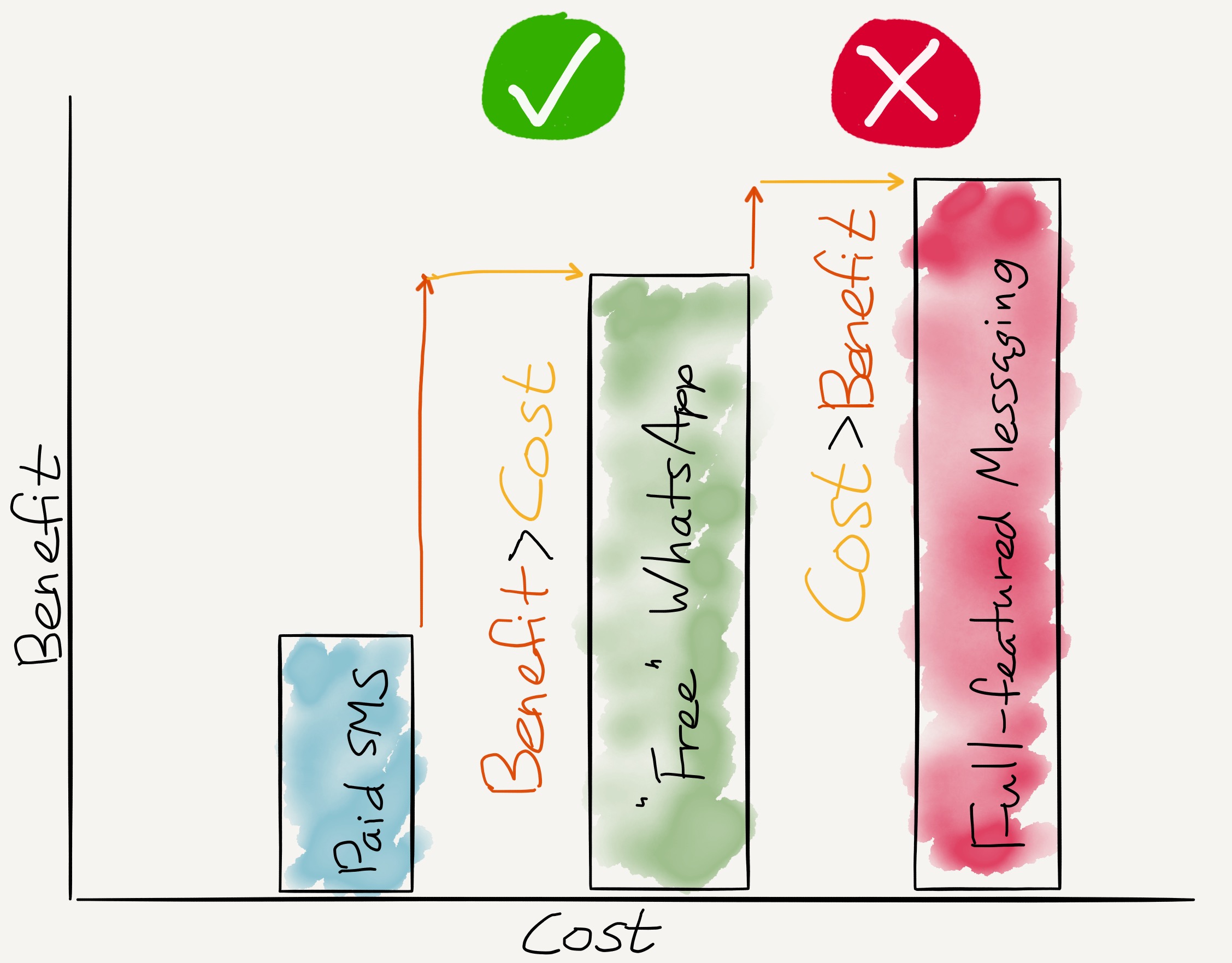
    The big challenge in getting a messaging service off the ground in the United States is that, unlike the rest of the world, text messaging has long been free. The reason this matters is that while it is very difficult to get even one person to change their habit or workflow, it is exponentially harder to get a critical mass of people to change all at the same time. However, if there is a fantastic benefit that appeals to everyone the challenge is a lot easier, and there is no better benefit than offering for free a service that used to cost money.

    This, above all, is why WhatsApp in particular was able to become the fastest growing social network of all time, even with a skeletal team of engineers: the company basically offered text messaging for free just as people were getting their first smartphones,2 which was a delta of improvement that significantly exceeded the cost of changing how you and your family and friends communicated. LINE and Kakao did the same in parts of Asia3, and WeChat quickly came to dominate China. Note too that the latter three services offer significantly more functionality than WhatsApp, but in fact little has changed when it comes to which service dominates which countries: whatever improvements the Asian apps offered relative to WhatsApp weren’t significant enough to overcome the barrier of changing people’s habits en masse.

    image

    Meanwhile, as I noted, the United States had free text messaging: it is not a coincidence that none of the messaging services have made much of an impact. Except, of course, Snapchat. You know, the teen sexting app.

    Snapchat’s Opening

    I obviously say “teen sexting app” tongue-in-cheek, but it’s worthwhile to understand just how it was that Snapchat got off the ground. In a world dominated by Facebook (and to a smaller extent Twitter) Snapchat offered something unique that couldn’t be easily copied by the existing services: chats that disappeared immediately.

    Beyond the fact this is much more akin to how we actually talk in the real world, disappearing messages were particularly attractive to teens put off by the prospect of their parents, future admissions officers, future employers, and whoever else spying on what they said.

    Moreover, the primary means of communication was not text but rather a picture, often a selfie. Again, this more closely corresponded to how people actually communicate — non-verbal communication with our face is even more important than verbal — and also appealed particularly strongly to teenagers: while everyone is ultimately mostly concerned about themselves, teenagers don’t even bother to pretend otherwise!

    These two factors worked together to magnify Snapchat’s initial differentiation: the fact snaps disappeared removed whatever reticence teenagers may have had about sending their pictures, and the result was messaging that was far more personal than Facebook’s preening or Twitter’s broadcasting.

    The problem, as pundits far and wide would tell you, is that disappearing chats do not an advertising platform make. Snapchat’s entire point was in not tracking you like Facebook, and who was going to put up with advertisements stuffed in your selfies?

    This brings me to Netflix. You know, the DVD-by-mail company.

    Netflix and the Ladder-Up Strategy

    In January, when Netflix expanded its service to an additional 130 countries with the flip-of-a-switch, I wrote how the company had expertly executed a “ladder-up” strategy:

    Netflix started by using content that was freely available (DVDs) to offer a benefit — no due dates and a massive selection — that was orthogonal to the established incumbent (Blockbuster). This built up Netflix’s user base, brand recognition, and pocketbook

    Netflix then leveraged their user base and pocketbook to acquire streaming rights in the service of a model that was, again, orthogonal to incumbents (linear television networks). This expanded Netflix’s user base, transformed their brand, and continued to increase their buying power

    With an increasingly high-profile brand, large user base, and ever deeper pockets, Netflix moved into original programming that was orthogonal to traditional programming buyers: creators had full control and a guarantee that they could create entire seasons at a time

    Each of these intermediary steps was a necessary prerequisite to everything that followed, culminating in yesterday’s announcement: Netflix can credibly offer a service worth paying for in any country on Earth, thanks to all of the IP it itself owns. This is how a company accomplishes what, at the beginning, may seem impossible: a series of steps from here to there that build on each other. Moreover, it is not only an impressive accomplishment, it is also a powerful moat; whoever wishes to compete has to follow the same time-consuming process.

    Back when Netflix first got traction it was easy to dismiss it: DVDs were not long for this world, and the company had a nice niche but would ultimately fade away. But that was to focus on the first rung of the ladder, even as founder and CEO Reed Hastings was thinking several rungs ahead.

    Snapchat’s Ladder

    What is so impressive about Snapchat’s rise has been how founder and CEO Evan Spiegel has shepherded the service along a similar path: today’s Snapchat, which received a major update yesterday, is a far different and richer product than it was when it launched, one that is appealing to far more people, that demands far more attention, and, critically, is far better placed to capture the value it generates.

    There have been three major rungs to date:

    Rung 1: Stories

    In October 2013, two years after the company’s founding, Snapchat added “Stories.” These collections of snaps (or short videos, added in 2012) were not exactly ephemeral — they lasted for 24 hours — but they weren’t permanent either: they were user-generated “shows” that forced you to use the app daily to not miss, and they could be private or public.

    Much like Netflix’s initial streaming service, stories were a natural extension of Snapchat’s original value proposition, but a fundamental change in the nature of the service all the same: whereas chats were reactive, based on notifications, consuming stories was more of a “sit-back” experience. I explained why these sorts of experiences are so valuable in The Facebook Epoch:

    Mobile is a great market. It is the greatest market the tech industry, or any industry for that matter, has ever seen, and the reason why is best seen by contrasting mobile with the PC: first, while PCs were on every desk and in every home, mobile is in every pocket of a huge percentage of the world’s population. The sheer numbers triple or quadruple the size, and the separation is increasing. Secondly, though, while using a PC required intent, the use of mobile devices occupies all of the available time around intent. It is only when we’re doing something specific that we aren’t using our phones, and the empty spaces of our lives are far greater than anyone imagined.

    Stories fill that void, and as I further recounted in that article, that void is particularly attractive to brand advertisers; add on the fact that, as I recounted last year, advertisers are desperate to reach teenagers, and suddenly Snapchat had the outline of a real money-making opportunity.

    Rung 2: Discover

    Fast forward a year-and-a-half and Snapchat launched Discover, a place for media companies to post professionally-produced content, specifically tailored for Snapchat. This too was a natural extension of what came before: Stories were by users, and Discover was by the professionals. Moreover, Discover doubled-down on the benefits brought by Stories: first, they were another way to occupy more and more attention, and second, they were an even more natural advertising vehicle.

    Both of these points were important for similar reasons: first, Discover provided instant benefit for new users who didn’t yet have friends on the service. In this respect Discover resembled Instagram’s filters: they gave a reason to use the app without a network in place. Secondly, Discover was a natural place to experiment with the brand advertising that is Snapchat’s future: professional content has long been associated with professional ads.

    Rung 3: Feeds and Optionality

    This brings us to yesterday’s release: Snapchat added (better) video chat, including an innovative one-way option; audio calls; audio notes; and stickers. The latter is particularly notable given that Snapchat just bought Bitmoji, an app that creates stickers that look like you.

    First off, many of the features Snapchat added build on the sort of functionality the company has added on previous rungs: specifically, video and audio calling not only cement Snapchat’s hold on communication but are also much more accessible to a much broader audience than inscrutable teenagers.

    Stickers, meanwhile, are a much bigger deal than people realize:

    • Stickers are a fantastic money-maker in their own right. LINE, the most famous sticker purveyor (and for good reason: they are fantastic) made around $212 million in revenue from sticker sales last year, including nearly $100 million from its “Creators Market” selling 3rd-party created sticker packs
    • Secondly, as I described in the afore-linked Messaging: Mobile’s Killer App article, the potential for stickers goes beyond direct sales. LINE made significantly more (~$318 million) from sponsored stickers, in which advertisers sponsor free sticker packs that can be acquired by following the company in question, thus establishing a direct marketing channel

    Granted, these revenue numbers are relatively small, but then again LINE is smaller than Snapchat already (in Daily Active Users), and its markets have significantly fewer advertising dollars available. On the other hand, no company has mastered stickers like LINE has (including Kakao and WeChat), but this is why the Bitmoji acquisition is so intriguing: from day one Snapchat has tapped into the fact that our perspective is fundamentally selfish,4 and the potential to create stickers that are predicated on the same idea could be a lot more powerful than folks realize.

    Regardless, rung three has further increased Snapchat’s optionality, both in regards to its potential user base and its revenue stream.

    Snapchat versus Facebook

    All of these rungs are climbing to a very lucrative destination: owning messaging in the United States. As I recounted above, unlike the rest of the world, there were no shortcuts to this market, which meant Snapchat has had to ladder its way up: first, by delivering an orthogonal product that appealed to an underserved market, and then leveraging that position into an array of products that have both expanded the addressable market and increased the service’s monetization potential.

    That’s not to say success is guaranteed: the development of the Snapchat product has been far more impressive than the development of Snapchat as a business. As I snarked a few weeks ago “‘turnover’ in the context of Snapchat has been more about executives than it has been about revenue.” Does Spiegel have the discipline and commitment to build a real business around his deeply considered app?

    It is here the parallel to Facebook is particularly interesting. What has made CEO Mark Zuckerberg’s leadership so exemplary is the degree to which the founder has been willing to not only surround himself with experienced executives but also learn and grow in areas in which he has no experience. The result is a company that not only delivers compelling products but is also deeply committed to its advertising business and, by extension, the success of those using Facebook to reach consumers.

    There’s no question Snapchat is a threat to Facebook: both trawl for attention, and that is a zero-sum game. Facebook, though, has become much more than a social network: it is the front-door to the Internet for one, and, as Alex Muir put it, the new Excel for any number of online activities. Anyone who uses Snapchat will also use Facebook, however begrudgingly, and that, in conjunction with Facebook’s already good and still improving targeting and tracking capabilities, ensures Facebook’s revenue potential is still in its adolescence.

    Moreover, Facebook is far stronger internationally than is Snapchat: all of those countries dominated by WhatsApp (a Facebook property) and LINE are equally dominated by Facebook;5 it seems there is a role for communications, a role for general browsing (which Facebook dominates), and a role for escapism (and here Instagram, another Facebook property, is a strong contender, albeit challenged by Snapchat).

    Still, that doesn’t make me bearish on Snapchat: as TV moves inexorably to a subscription-based on-demand model more and more advertising will move online, including lucrative brand advertising. Both Facebook and Snapchat will capture their fair share, and I’m with Zuckerberg: I’d love to own both.


    1. Although the concept was rather new when I first wrote about it in 2013  

    2. And, to the company’s credit, it bent over backwards to support non-iOS and non-Android devices as well 

    3. LINE in Japan, Thailand, and Taiwan, and Kakao in South Korea 

    4. This isn’t a criticism! 

    5. Japan is a bit of an exception here 


  • Andy Grove and the iPhone SE

    Andy Grove died yesterday. He is widely considered the greatest CEO in tech history.

    The Andy Grove Impact

    Grove’s remarkable backstory certainly plays a role in his reputation: a survivor of the Holocaust and the Soviet occupation of Hungary, Grove né Gróf arrived in the United States a penniless refugee and taught himself English while studying chemistry at the City College of New York; he later received his Ph.D. in chemical engineering from the University of California-Berkeley and then moved across the Bay to join Fairchild Semiconductor. When Robert Noyce and Gordon Moore (originally part of the Traitorous Eight who left transistor-inventor William Shockley) resigned from Fairchild Semiconductor to found Intel, Grove was their first hire1 and it fell to Grove to build the culture and processes that would scale to support the memory business upon which Intel would be built. And so it was that the Hungarian refugee became the poster child for Silicon Valley’s idealized view of itself: a place where anyone can make it thanks to nothing more than their talent and determination.

    Beyond Grove’s personal background, the importance of Intel to the technology industry — and, by extension, to the world — cannot be overstated. While Moore is immortalized for having created “Moore’s Law”, the truth is that the word “Law” is a misnomer: the fact that the number of transistors in an integrated circuit doubles approximately every two years is the result of a choice made first and foremost by Intel to spend the amount of time and money necessary to make Moore’s Law a reality. This choice, by extension, made everything else in technology possible: the PC, the Internet, the mobile phone. And, the person most responsible for making this choice was Grove (and, I’d add, his presence in management was the biggest differentiator between Intel and its predecessors, both of which included Noyce and Moore).

    That wasn’t Intel and Grove’s only contribution to Silicon Valley, either: Grove created a culture predicated on a lack of hierarchy, vigorous debate, and buy-in to the cause (compensated with stock). In other words, Intel not only made future tech companies possible, it also provided the template for how they should be run, and how knowledge workers broadly should be managed. Grove also helped establish the idea of “paying it forward”: the CEO was famous for his willingness to mentor young founders (most famously Steve Jobs), and he wrote multiple books as CEO focused on how to manage and dealing with strategic inflection points.

    Grove’s Most Famous Decision

    The basis of that latter book was Grove’s most famous decision and, by extension, the greatest contributor to his legendary status. Intel was founded as a memory company, and the company made its name by pioneering metal-oxide semiconductor technology in first SRAM2 and then in the first commercially available DRAM.3 It was memory that drove all of Intel’s initial revenue and profits, and the best employees and best manufacturing facilities were devoted to memory in adherence to Intel’s belief that memory was their “technology driver”, the product that made everything else — including their fledgling microprocessors — possible. As Grove wrote in Only the Paranoid Survive, “Our priorities were formed by our identity; after all, memories were us.”

    The problem is that by the mid-1980s Japanese competitors were producing more reliable memory at lower costs (allegedly) backed by unlimited funding from the Japanese government, and Intel was struggling to compete. Grove wrote:

    We tried a lot of things. We tried to focus on a niche of the memory market segment, we tried to invent special-purpose memories called value-added designs, we introduced more advanced technologies and built memories with them. What we were desperately trying to do was to earn a premium for our product in the marketplace as we couldn’t match the Japanese downward pricing spiral…as memories became a uniform worldwide commodity.

    Grove soon persuaded Moore, who was still CEO4 to get out of the memory business, and then proceeded on the even more difficult task of getting the rest of Intel on board; it would take nearly three years for the company to fully commit to the microprocessor, even though said microprocessor was already a smashing success thanks to IBM’s decision to use it in their first PC.

    Over the next two decades Intel would not only reap the benefits of IBM’s decision but also greatly increase their profits through more shrewd moves by Grove. As part of selecting Intel in the first place IBM insisted that Intel share their design with another chip manufacturer called Advanced Micro Devices (AMD) to ensure multiple suppliers, but once IBM’s position was weakened through the rise of IBM-compatible manufacturers like Compaq, Intel reneged and eventually renegotiated the deal, allowing the company to leverage its technical superiority5 into the sort of differentiation it had not been able to achieve in memory.

    Equally important was the groundbreaking “Intel Inside” campaign that recognized end users were increasingly the market for computer manufacturers, and that they could be persuaded to care more about who made their computer’s processor than who made the computer itself. It was again a move that resulted in increased differentiation and, by extension, increased profits. By the time Grove stepped down as CEO in 1998 Intel was earning $6.9 billion profit on $25.0 billion in revenue, thanks to a gross margin of 60.3%.

    Intel’s Big Miss

    Intel today is still a very profitable company: last year the chip-maker earned $11.4 billion on $55.4 billion in revenue, with a gross margin of 62.6%. There is a sense, though, that the company’s strategic position is much less secure than its financials indicate, thanks to Intel’s having missed mobile.6

    The critical decision came in 2005; Apple had just switched its Mac lineup to Intel x86 processors, but Steve Jobs was interested in another Intel product: the XScale ARM-based processor.7 The device it would be used for would be the iPhone. Then-CEO Paul Otellini told Alexis Madrigal at The Atlantic what happened:

    “We ended up not winning it or passing on it, depending on how you want to view it. And the world would have been a lot different if we’d done it,” Otellini told me in a two-hour conversation during his last month at Intel. “The thing you have to remember is that this was before the iPhone was introduced and no one knew what the iPhone would do…At the end of the day, there was a chip that they were interested in that they wanted to pay a certain price for and not a nickel more and that price was below our forecasted cost. I couldn’t see it. It wasn’t one of these things you can make up on volume. And in hindsight, the forecasted cost was wrong and the volume was 100x what anyone thought.”

    It was the opposite of Grove’s memory-to-microprocessor decision: Otellini prioritized Intel’s current business (x86 processors) instead of moving to what was next (Intel would go on to sell XScale to Marvell in 2006), much to the company’s long-term detriment.

    And yet, for all of the deserved praise that Grove has received over the years, and as difficult as his memory-to-microprocessor decision may have been, Otellini’s decision was in my estimation far more difficult. Grove had to change Intel’s culture and perception of itself, and that is incredibly difficult, but at the end of the day he was making the choice that made financial sense: microprocessors were already more profitable and offered far greater potential for sustainable differentiation. Otellini, on the other hand, was choosing between maintaining Intel’s margins and pursuing unknown volume, and while it’s easy to sit here in 2016 and say he got it wrong, it’s only right to wonder who in 2005 would have gotten it right.

    The Intel-Apple Parallel

    Coincidentally Grove passed away the same day that Apple held one of its oddest events in some time: the company introduced two new devices, both derivatives of products that are already on the market. The new 9.7″ iPad Pro is better than its larger sibling when it comes to the camera and display, but from the perspective of most consumers it’s the same device in a form factor that has been around for a while; the iPhone SE, meanwhile, is a clone of the two-and-a-half year-old 5S with mostly-iPhone 6S innards.

    There are definite parallels between Apple and Intel, particularly when it comes to Grove’s fateful decision: Apple’s biggest business shifted from computers to iPods, and shifted again from iPods to iPhones; the company even changed its name from Apple Computer to simply Apple. Both shifts are impressive in their own right: focusing on the iPod was to in some sense abandon Apple’s founding identity, while making the iPhone meant the cannibalization of Apple’s most profitable product ever.

    Still, just as Grove’s decision to abandon memory and focus on microprocessors was in some senses “easy” given the fact microprocessors was a growing business that offered more margin, not less, Apple’s shift to the iPhone has been an “easy” one as well: the iPhone is nearly as profitable on a gross margin basis as Intel’s processors are. Make no mistake, overruling internal culture and hierarchies is hard, but giving away margin tends to be a lot harder.

    The Celeron and the iPhone SE

    That’s why the Grove decision that actually impresses me the most is Intel’s launch of the Celeron processor in 1998.8 Grove had been introduced to a then-relatively-unknown Harvard Business School professor named Clayton Christensen, who told him about research for an upcoming book (The Innovator’s Dilemma) that explained how companies in their pursuit of margin allowed themselves to be beat on the low-end. Grove took the lesson to heart and directed Intel to create a low-end processor (Celeron) that certainly cannibalized Intel’s top-of-the-line processor to an extent but also dominated the low-end, quickly gaining 35% market share.

    To date Apple has declined to make a similar move; the iPhone 5C was thought, particularly before launch, to be the fabled “low-price iPhone,” but it turns out it was simply a substitute for an iPhone 5 that had significant manufacturing problems. It certainly wasn’t low-price: it started at $549, exactly where the year-old iPhone 5 would have been, and like every iPhone before it stepped down to $449 the following year before being discontinued.

    To me the pricing made perfect sense, and unlike Christensen, I wasn’t worried about the iPhone being disrupted by the low-end. Indeed, I’m still not worried: the iPhone’s hold on the top-end of the market is as strong as ever.

    The problem is growth: specifically, how many high-end customers are there, and how many of those customers find their current iPhones to be good-enough? And, if Apple believed their market to be increasingly saturated, would the company be willing to cannibalize its high-margin iPhone?

    The iPhone SE suggests the answer is yes, and that fact alone made yesterday’s event far more important than it seems.9 Specifically, Apple is offering top-of-the-line specs for an unprecedented price of $399. In other words, the SE is no 5C. In fact, it seems likely Apple learned some inadvertent lessons from the 5C: I am not at all surprised that the SE looks identical to a 5S;10 when an integral part of the iPhone value proposition is status what customer wants to advertise that they bought a model that was never a flagship?

    This price point will likely expand the market in the developed world, particularly given the replacement of subsidies with installment plans, but it’s most interesting in developing markets, especially India. It’s tempting to compare the second-largest phone market in the world to China, but in fact the latter is significantly richer and has a much larger high-end that primarily values status; the former, meanwhile, is very well-informed about things like processor and camera specifications, and is likely to be particularly appreciative of the SE’s aggressive feature set. I’m not at all surprised that the SE is going on sale in India only a week after the U.S., which is noteworthy considering the 6S launched in India in very limited quantities a full four weeks after the U.S.11

    The implications for Apple, though, are more profound than any one phone or any one market: the real long-term danger of occupying the high-end is falling in love with margin or average selling price at the expense of what makes sense strategically. Grove is to be admired for avoiding that trap, and it is encouraging that Apple CEO Tim Cook seems to be doing the same. And, fortunately for the Apple CEO, he, like Grove, can likely leave the truly devastating but ultimately understandable mistake for a successor.


    1. Due to an administrative error Grove was given employee number 4 instead of 3 which reportedly rankled Grove for years, not unlike Steve Jobs’ irritation at being employee number 2 behind Steve Wozniak 

    2. Static Random Access Memory, which is faster and more reliable than DRAM but more expensive, and is today used for on-processor cache 

    3. Dynamic Random Access Memory, which is simple and cheap relative to SRAM and is still used as the main memory for computers 

    4. It speaks of Grove’s influence on Intel that he is widely credited for this decision even though he was not yet CEO 

    5. Which AMD briefly interrupted by being the first to introduce a 64-bit extension to the x86 instruction set 

    6. This isn’t entirely fair: Intel supplies the overwhelming majority of server processors which power the cloud; the cloud is an integral part of mobile 

    7. Which was derived from one of Grove’s last deals as CEO (the acquisition via settlement of StrongARM from DEC)  

    8. The Celeron launched a month before Grove stepped down as CEO, although obviously the decision was made well before then 

    9. To be clear, I’m not saying the SE is a Celeron; the smartphone market is different. I’m just noting Apple is undercutting itself to a degree 

    10. Except for the matte-chamfered edges 

    11. The India pricing is interesting: in a rather bizarre screwup Apple first announced that the SE would cost Rs 30,000, only to issue a new press release correcting the cost to Rs 39,000. This seems unusually high given the fact the 6S is widely available at only Rs 49,500.

      In fact, though, the 6S official price is Rs 62,500, which is 1.44x as expensive as the U.S. retail price; Rs 39,000 is 1.46x the U.S. retail price for the SE, so that makes sense.

      What I suspect happened is that, given India’s unique retail market that is dominated by small shops, Apple has built in a cushion to the official retail price that it expects to disappear in the market. As I noted, the 6S is widely available for Rs 49,500, which translates to $742 US; this is 1.14x the U.S. price (which pays for import duties, sales taxes, etc.). It turns out that 1.14x the U.S. price for the SE is Rs 30,419, almost exactly what Apple first put in its press release.

      In other words, I think Apple is saying that the SE will cost Rs 39,000, but they expect to sell it for Rs 30,000; they just accidentally put the latter number in the press release 


  • The Amazon Tax

    Ten years ago yesterday Amazon evangelist Jeff Barr posted a 222-word post on the Amazon Web Services Blog1 that opened:

    Earlier today we rolled out Amazon S3, our reliable, highly scalable, low-latency data storage service.

    Until then Amazon Web Services had primarily been about providing developers with a way to tap into the Amazon retail store; S3, though, had nothing at all to do with retail,2 at least not directly.

    The Origin of AWS

    As Brad Stone detailed in The Everything Store, by the early 2000s Amazon was increasingly constrained by the fact the various teams in the company were all served by one monolithic technical team that had to authorize and spin up resources for every project. Stone wrote:

    At the same time, Bezos became enamored with a book called Creation, by Steve Grand, the developer of a 1990s video game called Creatures that allowed players to guide and nurture a seemingly intelligent organism on their computer screens. Grand wrote that his approach to creating intelligent life was to focus on designing simple computational building blocks, called primitives, and then sit back and watch surprising behaviors emerge.

    The book…helped to crystallize the debate over the problems with the company’s own infrastructure. If Amazon wanted to stimulate creativity among its developers, it shouldn’t try to guess what kind of services they might want; such guesses would be based on patterns of the past. Instead, it should be creating primitives — the building blocks of computing — and then getting out of the way. In other words, it needed to break its infrastructure down into the smallest, simplest atomic components and allow developers to freely access them with as much flexibility as possible.

    The “primitives” model modularized Amazon’s infrastructure, effectively transforming raw data center components into storage, computing, databases, etc. which could be used on an ad-hoc basis not only by Amazon’s internal teams but also outside developers:

    stratechery Year One - 274

    This AWS layer in the middle has several key characteristics:

    • AWS has massive fixed costs but benefits tremendously from economies of scale
    • The cost to build AWS was justified because the first and best customer is Amazon’s e-commerce business
    • AWS’s focus on “primitives” meant it could be sold as-is to developers beyond Amazon, increasing the returns to scale and, by extension, deepening AWS’ moat

    This last point was a win-win: developers would have access to enterprise-level computing resources with zero up-front investment; Amazon, meanwhile, would get that much more scale for a set of products for which they would be the first and best customer.

    The AWS Tax

    To say that AWS succeeded in its mission is a wild understatement: the impact on developers is exactly what AWS head Andy Jassy wrote in his vision statement. Stone summarized thusly:

    The paper laid out the expanded AWS mission: “to enable developers and companies to use Web services to build sophisticated and scalable applications”…

    “We tried to imagine a student in a dorm room who would have at his or her disposal the same infrastructure as the largest companies in the world,” Jassy says. “We thought it was a great playing-field leveler for startups and smaller companies to have the same cost structure as big companies.”

    It was, and nearly every startup of note to be founded in the last several years has started on AWS or one of its competitors. The true measure of AWS’ impact, though, was the way it transformed the ecosystem around developers, including venture capital.

    The effect on Amazon has been equally significant: I detailed last year how the revelation of AWS’ financial results was effectively a Facebook-level IPO, and subsequent earnings reports in which AWS has demonstrated the power of scale — increased revenue plus increased margins — have only solidified the fact that AWS will be a substantial driver of Amazon’s revenue and (eventual!) profits for a long time to come. Social+Capital Founder Chamath Palihapitiya, when asked what company he would invest in if he could only choose one, responded on Quora:

    AWS is a tax on the compute economy. So whether you care about mobile apps, consumer apps, IoT, SaaS etc, more companies than not will be using AWS vs building their own infrastructure. Ecommerce was AMZN’s way to dogfood AWS, and continue to do so so that it was mission grade. If you believe that over time the software industry is a multi, deca-trillion industry, then ask yourself how valuable a company would be who taxes the majority of that industry? 1%, 2%, 5% — it doesn’t matter because the numbers are so huge — the revenues, profits, profit margins etc. I don’t see any cleaner monopoly available to buy in the public markets right now.

    The monopoly Palihapitiya is referring to is based on the scale effects I noted above: the larger AWS becomes, the greater advantage Amazon has in pricing AWS’ services, which means they can earn ever more business, which increases their advantage even more. The net result is that for all but the largest cloud-based companies3 this advantage, combined with the flexibility AWS affords (which is critical both operationally and financially), will lead to the inevitable conclusion that Amazon ought to service all their infrastructure needs; the payments they make for this service are Palihapitiya’s “tax”.

    What is worth considering, though, is the possibility that just as AWS’ effect on developers spread out into the broader startup ecosystem, it increasingly seems that AWS’ impact on Amazon itself goes far beyond its already substantial contribution to the bottom line. Amazon may have started as, to use Stone’s title, “The Everything Store,” but its future is to be a tax collector for a whole host of industries that benefit from the economies of scale, and AWS is the model.

    The Transformation of Amazon’s E-Commerce Business

    Longtime readers will recall that I went through my Amazon bear phase4 back in 2014; it was AWS that led me to recant. Even when I recanted, though, I argued that my bearish analysis about Amazon’s e-commerce business had been sound:

    • Amazon’s “Media” business of books, CDs, DVDs, and video games was providing the vast majority of “profits”, but this business was shrinking as a percentage of Amazon’s total sales and, given secular trends in media, likely to continue to shrink on an absolute basis
    • “Electronics and General Merchandise”5 was growing rapidly, but the nature of goods being sold meant there was relatively little margin to be had

    What, though, if Amazon is content with making no margin on the sale of “Electronics and General Merchandise”? I don’t mean this in the Mathew Yglesias sense, that Amazon “is a charitable organization being run by elements of the investment community for the benefit of consumers”; rather, what if the business model of Amazon’s e-commerce business has changed to “tax” collection?

    Consider Costco: last year the wholesale retailer had net income of $2.3 billion on sales of $114 billion to its over 81 million members; the total sum of membership fees was $2.5 billion. In other words, Costco’s 11% gross margin didn’t even quite cover the cost of running the business; the difference, along with all of the profit, came from a “tax” levied on Costco customers.

    I would contend Prime memberships play the same role for Amazon: the non-AWS parts of the business last year generated $2.6 billion in operating profit;6 meanwhile, Consumer Intelligent Research Partners (CIRP) estimates that Amazon now has 54 million Prime members, which at $99/member would generate $5.3 billion in revenue; the difference in profitability for Amazon’s e-commerce business, such as it is, comes from a “tax” levied on Amazon’s best customers.

    In fact, though, I think even this analysis is too narrow: e-commerce is inexorably taking over more and more of the U.S. retail sector in particular, and Amazon is taking over 50% of that e-commerce growth. Combine this reality with the growth in Prime and Amazon is effectively on its way towards collecting a tax on all of retail.

    Again, though, just as is the case with AWS, this tax is one that consumers willingly embrace: Prime is a super experience with superior prices and superior selection, and it too feeds into a scale play. The result is a business that looks like this:

    stratechery Year One - 275

    That is, of course, the same structure as AWS — and it shares similar characteristics:

    • E-commerce distribution has massive fixed costs but benefits tremendously from economies of scale
    • The cost to build-out Amazon’s fulfillment centers was justified because the first and best customer is Amazon’s e-commerce business
    • That last bullet point may seem odd, but in fact 40% of Amazon’s sales (on a unit basis) are sold by 3rd-party merchants; most of these merchants leverage Fulfilled-by-Amazon, which means their goods are stored in Amazon’s fulfillment centers and covered by Prime. This increases the return to scale for Amazon’s fulfillment centers, increases the value of Prime, and deepens Amazon’s moat

    The “tax” analogy extends beyond Prime; for example, Amazon is taking a portion of these 3rd-party sales, and a greater portion of revenue from goods they sell directly. The effect, though, is consistent: Amazon is collecting a “tax” on a massive industry and no one minds because Amazon’s scale ensures the best prices and the best experience.

    Logistics and the Echo

    It seems increasingly clear that Amazon intends to repeat the model when it comes to logistics: after experimenting with six planes last year the company recently leased 20 more to flesh out its private logistics network; this is on top of registering its China subsidiary as an ocean freight forwarder. No surprise that, as the Wall Street Journal noted:

    In a securities filing, Amazon for the first time identified “companies that provide fulfillment and logistics services for themselves or for third parties, whether online or offline” as competition. And it referred to itself as a “transportation service provider.” In both cases, it marked the first time Amazon included such language in its annual report, known as a 10-K.

    So how might this play out?

    Well, start with the fact that Amazon itself would be this logistics network’s first-and-best customer, just as was the case with AWS. This justifies the massive expenditure necessary to build out a logistics network that competes with UPS, Fedex, et al, and most outlets are framing these moves as a way for Amazon to rein in shipping costs and improve reliability, especially around the holidays.

    However, I think it is a mistake to think that Amazon will stop there: just as they have with AWS and e-commerce distribution I expect the company to offer its logistics network to third parties, which will increase the returns to scale, and, by extension, deepen Amazon’s eventual moat.7

    The much-buzzed about Echo fits this model too: all of the usual suspects can build out the various pieces of the connected home; Amazon will simply provide the linchpin, the Echo’s cost a “tax” on the connected home.

    A Primitive Organization

    Bezos’ famed 1997 shareholder letter makes clear the roots of this model were in place from the beginning. Specifically, Bezos is very focused on the power of scale:

    The stronger our market leadership, the more powerful our economic model. Market leadership can translate directly to higher revenue, higher profitability, greater capital velocity, and correspondingly stronger returns on invested capital…we choose to prioritize growth because we believe that scale is central to achieving the potential of our business model.

    It’s equally clear, though, that Bezos didn’t then fully appreciate that his model would extend far beyond e-commerce; that, though, is why Amazon’s internal organization is such a strength. The company is organized with multiple relatively independent teams, each with their own P&L, accountabilities, and distributed decision-making. Stone explains an early Bezos initiative (emphasis mine):

    The entire company, he said, would restructure itself around what he called “two-pizza teams.” Employees would be organized into autonomous groups of fewer than ten people — small enough that, when working late, the team members could be fed with two pizza pies. These teams would be independently set loose on Amazon’s biggest problems…Bezos was applying a kind of chaos theory to management, acknowledging the complexity of his organization by breaking it down to its most basic parts in the hopes that surprising results might emerge.

    Stone later writes that two-pizza teams didn’t ultimately make sense everywhere, but as he noted in a follow-up article the company remains very flat with responsibility widely distributed. And there, in those “most basic parts”, are the primitives that lend themselves to both scale and experimentation. Remember the quote above describing how Bezos and team arrived at the idea for AWS:

    If Amazon wanted to stimulate creativity among its developers, it shouldn’t try to guess what kind of services they might want; such guesses would be based on patterns of the past. Instead, it should be creating primitives — the building blocks of computing — and then getting out of the way.

    Steven Sinofsky is fond of noting that organizations tend to ship their org chart, and while I began by suggesting Amazon was duplicating the AWS model, it turns out that the AWS model was in many respects a representation of Amazon itself (just as the iPhone in many respects reflects Apple’s unitary organization): create a bunch of primitives, get out of the way, and take a nice skim off the top.


    1. Hosted on Typepad 

    2. Contrary to popular myth, Amazon was not selling excess capacity 

    3. I will discuss Dropbox’s recent announcement that they are moving away from AWS in tomorrow’s Daily Update  

    4. It’s like puberty for tech analysts 

    5. This nomenclature is from Amazon’s financial reports 

    6. This isn’t comparable to the Costco number which was net income 

    7. To be sure, UPS, Fedex, et al have a big head start, but their networks and cost structures are focused on businesses; Amazon will focus on consumers 


  • Bitcoin and Diversity

    The Bitcoin community is in a bit of a civil war; I hope readers whose eyes glaze over at the crypto-currency’s mention will bear with me as I explain what is going on, and why some of the fundamental ideas in question matter broadly.

    The Block Size Debate

    Briefly — and let me say up front, I am both simplifying and not taking sides — Satoshi Nakamoto, the mysterious creator of Bitcoin, added a 1MB size limitation to “blocks”, which, if you think of the Bitcoin blockchain as a ledger, are individual pages. This, as you might expect, limits the number of transactions that can be verified per block (there is a new block created about every ten minutes or so).

    The current “war” is about whether or not this transaction size should be increased in the near future. Bitcoin Classic supporters are, contra their implementation’s name, advocating a “hard fork” of Bitcoin that would simply double the block size limit to 2MB; it’s called a “hard fork” because it is not backwards compatible. Meanwhile, Bitcoin Core supporters, which, naturally, include the core developers of Bitcoin, advocate a solution called “Segregated Witness” that would be a “soft fork”, i.e. backwards compatible, although it would take more development work not only for the core but for many other companies in the Bitcoin ecosystem.

    What makes this brouhaha so interesting is there in the word “fork”: after all, the solution to a dispute in most open-source communities like, say, Linux, is to simply fork the project and build your own version. That is why there are a seemingly endless number of Linux distributions with names like Mint, Debian, and Ubuntu.1 And indeed, there are scores of Bitcoin-like crypto-currencies like Ethereum, Ripple, and Dogecoin.

    Unitary Bitcoin

    Crucially, though, none of these “forks” work with Bitcoin; unlike an effectively self-contained Linux distribution that uses widely accepted protocols to communicate with other computers, Bitcoin is the network and all the component pieces of that network. This is why, even if a Bitcoin alternative may be technically superior, Bitcoin’s “market cap”2 is more than 8x that of the next most valuable crypto-currency: Satoshi’s creation benefits from the network effects of hundreds of thousands3 of Bitcoin owners, miners, node operators, wallet providers, exchanges, etc.

    It is this quality that makes this current dispute so charged: the loser in the block size debate can’t simply up and start their own currency without giving up millions of dollars in collective value. In short, the outcome is zero sum: one side will win, and the other will lose.

    In this the debate about Bitcoin mirrors what it is that makes Bitcoin and the blockchain technology on which it is based so interesting: the entire idea is that there is one — and only one — record of all transactions; said record is added to by miners (incented by Bitcoin and transaction fees) and stored by nodes (wallet-holders, although the number of nodes is decreasing as people increasingly use centralized services), each of which, through a delicate balance of incentives, continually agrees on what is in the master ledger and what is not. And, when it comes to adding to the blockchain, only one block will win.

    There are other parallels between Bitcoin broadly and this debate in particular. For example, while everyone agrees that the idea of the blockchain is brilliant and a real breakthrough in computer science (digital scarcity was thought to be impossible), there is a lot of disagreement about exactly what blockchains generally and Bitcoin specifically are good for: currency is the most cited application, but things like smart contracts and micro-exchanges are just as (if not more) interesting.

    Similarly, there are a surprisingly wide array of opinions surrounding the block size debate, many of which are directly linked to underlying beliefs of what Bitcoin’s purpose is. Some want faster or more transactions, others are worried about ensuring nodes remain distributed (bigger blocks need more bandwidth), still others have security concerns. And, just as some Bitcoin adherents see a digital currency as a desirable alternative to traditional fiat currencies, some of those opposing a change are simply opposed to change period, at least to changing anything specifically designed by Satoshi.

    Appealing to “Rules”

    When the block size debate was first heating up last summer, Bitcoin Core developer Gregory Maxwell put his finger on the philosophy of Bitcoin issue:

    Fundamentally this question exposes ideological differences between people interested in Bitcoin. Is Bitcoin more of a digital gold or is it more of a competitor to Square? Is Bitcoin something that should improve personal and commercial autonomy from central banks? From commercial banks? Or from just the existing status-quo commercial banks? What are people’s fundamental rights with Bitcoin? Do participants have a right to mine? How much control should third parties have over their transactions? How much security must be provided? Is there a deadline for world domination or bust? Is Bitcoin only for the developed world? Must it be totally limited by the most impoverished parts of the world? Bitcoin exists at the intersection of many somewhat overlapping belief systems.

    What I found most interesting, though, was what Maxwell stated in the previous paragraph:

    We’re talking about tuning one of the fundamental scarcities of the Bitcoin Economy and cryptosystem — leaving the comfort of “rule by math” — and venturing into the space of political decisions.

    Maxwell has made similar comments elsewhere, including in this forum thread:

    The rules are Bitcoin. The stability of Bitcoin’s rules is the soundness of the currency. If the rules can be easily rewritten against the will of some users by others according to political whim then what can be trusted? Is the supply fixed? Will coins be confiscated and awarded to others? If that gate is crossed then there is almost always some excuses which is “good enough” — as was lamented in some of Bitcoin’s earliest announcements…

    I think governance is incredibly hard and that the development history of fiat currencies shows that mankind is ill-equipped to create a strong and sound system via human governance — not through lack of trying, but because mankind is fundamentally not cut out for it: there is always some excuse that makes people feel justified in compromising the property rights of some for the benefit of (potentially many) others. Bitcoin was specifically created and promoted to replace that kind of subjectivity with machines, but it can’t do it if we go around undermining it.

    I find this perspective fascinating,4 and for reasons that have nothing to do with the block size debate (which, again, I’m not stating an opinion on!). I can certainly see the allure of a system that seeks to take all decision-making authority out of the hands of individuals: it’s math!

    The problem, though, is that the consequence of embracing this sort of “Them’s the rules” philosophy is itself the sort of political statement that Maxwell is so eager to avoid. After all, in the case of the block size, the implication of not changing Satoshi’s “rules” is to limit the number of transactions and support the “Bitcoin is digital gold” worldview. If humans made the rules, then appealing to the rules can never be non-political. Indeed, it’s arguably worse, because an appeal to “rules” forecloses debate on the real world effects of said rules.

    The Diversity Blind Spot

    Today is International Women’s Day; I’m tempted to cynically pretend that it was my idea all along to use this fact as a segue, but the fact of the matter is I’m an oblivious male who found out via Facebook:

    FullSizeRender 2

    Facebook has over the last few years self-documented just how unrepresentative they are when it comes to demographic diversity: only 16% of technical jobs and only 23% of senior positions are held by women, and only 9% of the work-force is not white or Asian. Other Silicon Valley giants are barely better — women hold 20% of technical jobs at Apple, 17% at Google and LinkedIn — while Twitter is significantly worse: only 10% of technical employees are women.5

    It was Twitter that exposed me to fact that I, despite my expressed support for women and diversity, had my own blind spots. Last spring in Twitter Needs New Leadership I painstakingly laid out how the service’s minuscule growth and seeming inability to evolve the product were a significant problem necessitating change; the next day I was called out on Twitter for not even mentioning Twitter’s abuse problem.

    The criticism was absolutely fair: a platform that is inhospitable for 50% of the world’s population will by definition have a growth problem, and while I still don’t think it’s the primary reason Twitter’s growth has stalled, to not even acknowledge the effect of abuse was a pretty bad oversight on my part that falls uncomfortably close to my International Women’s Day observance: being a male I had to be hit over the head by it.

    You could certainly say the same thing about Twitter the company: Dick Costolo, the CEO I was criticizing, did finally admit Twitter had an abuse problem, and current CEO Jack Dorsey has taken some steps to address it, but said problem may be intractable thanks to decisions made in the earliest days of Twitter, particularly the allowance of anonymous accounts that can @-mention anyone on the service.6 Does it come as any surprise that, if Nick Bilton’s Hatching Twitter is to be believed, the internal Odeo team that first developed Twitter was all male, and the first female on the service had spent her first few months at work fending off Dorsey despite her repeated protestations that she had a boyfriend?

    This is why diversity matters — and it arguably matters even more at new companies that are right now creating the “rules” of their products that, should they be successful, will be all but impossible to change. For years Twitter ignored that it had a problem, insisting it represented the “free speech wing of the free speech party”, ignorant of just how much speech was being suppressed by allegedly neutral “rules” that, by virtue of who made them, were blind to the impact they would have on women.7

    There Is No Neutral

    The importance of understanding the inherently political nature of rules goes deeper than simply saying diversity is important; it also gets at how we as an industry should think about solutions. It is tempting to argue that companies should simply double-down on meritocracy and ensure they are selecting the best possible candidate; remove human judgment to the greatest degree possible. But then it must be asked, on what criteria would hiring decisions be made? Specifically, who would be making these neutral “rules”?

    I get the allure of simply declaring that from now on everything is equal: men and women will be treated the same, we will be color-blind, etc. It’s neat, like math.8 It’s also unserious: foreclosing on measures that address past injustices ensures the effects of those injustices become cemented in place; to be “color-blind” or “gender-neutral” is neutral in language but fundamentally political when it comes to its effect.

    Ultimately, I don’t know what will happen to Bitcoin, but I’m skeptical of folks who are attracted to it because it allegedly removes humans from the equation: that is and always has been an idea that only makes sense in the very narrowest view of a single Bitcoin transaction, as we are seeing all too clearly in the community’s inability to address a relatively minor issue.9

    More broadly, I hope that the fundamental humanity that goes into any decision — product, policy, or otherwise — is appreciated by everyone in tech. Just as products and companies are either growing or dying, so too efforts to make the technology industry more accurately reflect, and thus better serve (and better monetize!) the diversity of the human race, are either explicitly improving the status quo or implicitly embracing it. There are no neutral “rules.”


    1. There are theoretically thousands if not millions of distributions, and effectively hundreds that are actively maintained 

    2. The value of all of the Bitcoins in your fiat money of choice 

    3. Probably not millions  

    4. To be clear, I completely disagree with it 

    5. Data from this article 

    6. I am aware that forcing real names has its own problems, including in cases of domestic abuse, stalkers, and more 

    7. This problem isn’t limited to GamerGate. Check out this story in Sports Illustrated about what women in the sports world have to deal with 

    8. I mean it when I say I sympathize with this position: in my younger years I used to write exactly that 

    9. And, I’d add, a relatively small number of miners actually have nearly complete power when it comes to deciding this 


  • The Voters Decide

    Stratechery is not a political blog, and this is not a political post. Rather, my focus is the business and strategy of technology, something that is inextricably linked with the effect technological change has and will have on society broadly — and that includes politics.

    To that end I read with interest Hans Noel’s op-ed in The New York Times on Tuesday. Noel is, along with Marty Cohen, David Karol and John Zaller, the author of the 2008 book The Party Decides, one of the most influential books in U.S. political science, and Noel opened his piece by summarizing the book’s central thesis:

    We argued that the leaders of party coalitions have great influence over the selection of a presidential nominee. Before [we wrote The Party Decides], the conventional wisdom was that such broad and diverse coalitions of politicians, activists and interest groups within parties were largely shut out of the nominating process by primaries and caucuses in the 1970s. This led to a free-for-all among narrowly factional candidates. In 1976, Jimmy Carter emerged from a crowded field to win the nomination despite having no connections to most leaders in the national party.

    We argued that since that 1976 contest, party leaders had been exerting influence by coordinating on their choice during the “invisible primary” — the period before any voting when the leaders observed, met with and vetted candidates — then supporting that candidate throughout the process. When party leaders work together, they nearly always win, we said…

    This year’s election has not followed our script. Mr. Trump is the clear front-runner, but is loathed by the party establishment.

    To Noel’s credit, the reason for writing the op-ed is to self-critically examine what he and his co-authors may have gotten wrong; he has three potential theses (beyond noting that the Republican establishment may yet rally, and that Democrats have largely fallen into line):

    • Maybe the political environment has changed
    • Maybe the party is falling apart
    • Maybe Mr. Trump just got in the way

    I think Noel’s scope is too narrow: politics is just the latest industry to be transformed by the Internet.

    The Evolution of Politics and the Web

    A few weeks ago Clay Shirky wrote a tweetstorm that is worth reading in full; for this post, though, I wanted to highlight the parts describing how the Internet has, election-by-election, fundamentally reshaped presidential campaigns:

    Social media is breaking the political ‘Overton Window’ — the ability of elites to determine the outside edges of acceptable conversation (link). These limits were enforced by party discipline, and mass media whose economics meant political centrism was the best way to make money (link). This was BC: Before Cable. One or two newspapers per town, three TV stations; all centrist, white, pro-business, respectful of authority (link). Cable changed things, allowing outsiders to campaign more easily. In ’92, Ross Perot, 3rd party candidate, campaigned through infomercials (link).

    After Cable but Before Web lasted only a dozen years. Cable added a new stream of media access. The web added a torrent (link). This started with Howard Dean (the OG) in ’03. Poverty was the mother of invention; Dean didn’t have enough $ to buy ads, even on cable (link) but his team had Meetup & blogs… (link). After webifying Perot’s media tactics, Dean pioneered online fundraising. Unfortunately for him, his Get Out The Vote operation didn’t (link). That took Obama. Obama was less of an outsider than Dean (though still regarded as unelectable in ’07) but used most of Dean’s playbook (link). And then there was vote-getting. Facebook and MyBarackObama let the Obama campaign run their own vote-getting machine out of Chicago (link).

    The new scale Facebook introduces into politics is this: all registered American voters, ~150M people, are now a medium-sized group (link). Reaching & persuading even a fraction of the electorate used to be so daunting that only two national orgs could do it. Now dozens can (link). This set up the current catastrophe for the parties. They no longer control any essential resource, and can no longer censor wedge issues (link)

    There are a few key concepts at the foundation of this analysis:

    • Previously information was gated by newspapers and TV stations with geographic monopolies; this began to break down with cable and was completely swept away by the web
    • The Internet made it possible to connect directly with voters to share information, collect money, and drive get-out-the-vote (GOTV) efforts
    • All of those voters are reachable via just a handful of platforms, especially Facebook

    Long-time readers should recognize the tell-tale signs of Aggregation Theory.

    Aggregation Theory Redux

    Facebook and newspapers is an excellent example of how Aggregation Theory plays out:

    • Previously newspapers integrated editorial and advertising copy into a bundle that was delivered to a geographically captive audience. Said newspapers’ market dominance was secured by their control of production and distribution, but their growth was capped by the challenges of scaling said production and distribution beyond said geographic area.
    • Facebook (like Google before it) built a powerful relationship directly with users by delivering content users cared the most about. This, then, made Facebook the front door to the Internet for most users.
    • Facebook’s direct connection with users was a double-whammy for newspapers: first, Facebook is better-positioned to serve advertising, and second, users increasingly find all their news and entertainment via Facebook

    Screen Shot 2016-03-03 at 12.35.22 AM

    The end result of this process is that newspapers have been modularized and commoditized into effective Facebook-filler, competing on an equal basis with everything from new media startups like BuzzFeed to personal blog posts to pictures of your cousin’s new baby. It’s hard for publishers to break through with content, and publisher-centric advertising is dying: better for ad buyers to get as close to the customer as possible and buy space on the service that has aggregated users on one side and leveraged that into commoditizing and modularizing suppliers on the other.

    There certainly is room for all the ads: thanks to the Internet reality of zero distribution costs and zero transaction costs, an aggregator can scale nearly perfectly to effectively every user on Earth, as we’ve seen with Google, Facebook, Amazon, and increasingly Netflix and Uber.

    Parties and Voters

    For a moment, though, step back to the world as it was: the one where newspapers (and TV stations, etc.) were gatekeepers thanks to their ownership of production and distribution. In this world any viable political campaign had to play nicely with those who ran the press in the hopes of gaining positive earned media, endorsements, etc. Just as important, though, was the need to buy advertising, as that was the only way to reach voters at scale. And advertising required lots of money, which meant donors. And then, once the actual election rolled around, a campaign needed an effective GOTV effort, which took not only money but also the sort of manpower that could only be rustled up by organizations like labor unions, churches, etc.

    It is all these disparate pieces: partisan media members, advertisers, donors, large associations, plus consultants and specialists to manage them that, along with traditional politicians, made up the “party” in The Party Decides. Noel and company asked in Chapter 1:

    Why tie parties so closely to party leadership as such? Why not view parties as larger coalitions that include not only top leaders but activists, fund-raisers, interest groups, campaign technicians, and others? Certainly the larger set of actors has great influence on party behavior. We therefore propose to theorize parties, and to study them in practice, as coalitions of the larger set of actors. Politicians will be important but not necessarily dominant; interest groups, activists, and other policy demanders will be permitted large roles in party decisions. Our theory will focus on why diverse political actors might attempt to form parties and what kinds of candidates they might seek to nominate.

    What is critical to understand when it comes to this more broad-based definition of a “party” is that its goals are not necessarily aligned with a majority of voters. The authors explain in Chapter 2 (emphasis mine):

    The most important party business is the nomination and election of office seekers who will serve the interests of the party’s intense policy demanders. The italicized phrase marks the key difference between our theory and most other contemporary theorizing about parties. In our theory, parties — that is, the groups that constitute parties — do not care about winning for the sake of winning office. They care about the policy gains. And they make those gains not simply by the election of someone nominally affiliated with their party. They make them by the election of someone committed to the maximum feasible achievement of group goals…

    It is natural to think of parties in a two-party system as majoritarian. Ours, however, are not. They want to win elections, but they do not necessarily wish to represent a majority of voters. As a by-product of their wish to govern, parties must offer a degree — perhaps a large degree — of responsiveness to popular majorities, but responsiveness to voters is not why parties exist. They exist to achieve the intense policy demands of their constituent groups. One might criticize parties for lack of deference to majority will, but their groups would not much care. Intense policy demanders nearly always believe their demands are just and that it is their duty to work for these demands whether or not most voters agree with them.

    To summarize: parties are not just politicians, but coalitions of actors who care intensely about certain policy outcomes. These actors work together to get politicians elected who will serve their interests; voter interests are a means, not an ends. And, according to Noel and company, such parties succeed because they control all of the apparatus necessary to win elections.

    Aggregation and Politics

    This brings us back to today’s world, and admittedly, the leap from a description of Facebook and Aggregation Theory to politics is not an obvious one: I’m not proposing that Donald Trump or anyone else is an aggregator. Indeed, given their power over what users see Facebook could, if it chose, be the most potent political force in the world. Until, of course, said meddling was uncovered, at which point the service, having so significantly betrayed trust, would lose a substantial number of users and thus its lucrative and privileged place in advertising, leading to a plunge in market value. In short, there are no incentives for Facebook to explicitly favor any type of content beyond that which drives deeper engagement; all evidence suggests that is exactly what the service does.

    Said reticence, though, creates a curious dynamic in politics in particular: there is no one dominant force when it comes to the dispersal of political information, and that includes the parties described in the previous section. Remember, in a Facebook world, information suppliers are modularized and commoditized as most people get their news from their feed. This has two implications:

    • All news sources are competing on an equal footing; those controlled or bought by a party are not inherently privileged
    • The likelihood any particular message will “break out” is based not on who is propagating said message but on how many users are receptive to hearing it. The power has shifted from the supply side to the demand side

    Screen Shot 2016-03-03 at 12.35.04 AM

    This is a big problem for the parties as described in The Party Decides. Remember, in Noel and company’s description party actors care more about their policy preferences than they do voter preferences, but in an aggregated world it is voters aka users who decide which issues get traction and which don’t. And, by extension, the most successful politicians in an aggregated world are not those who serve the party but rather those who tell voters what they most want to hear.

    In my initial description of Aggregation Theory I noted:

    This has fundamentally changed the plane of competition: no longer do distributors compete based upon exclusive supplier relationships, with consumers/users an afterthought. Instead, suppliers can be aggregated at scale leaving consumers/users as a first order priority. By extension, this means that the most important factor determining success is the user experience: the best distributors/aggregators/market-makers win by providing the best experience, which earns them the most consumers/users, which attracts the most suppliers, which enhances the user experience in a virtuous cycle.

    The term “user experience” obviously refers to a product; in the case of politics it is, apparently, at least in the case of some substantial number of Republican voters, “telling it like it is”, aka what voters, not parties, believe.1

    From The New York Times
    From The New York Times

    And so, without any of the apparatus traditionally provided by parties, much of it obsoleted by the Internet, and thanks to the ability to connect directly with voters (because of aggregation), Donald Trump is marching on in direct defiance of the Republican Party’s decision.2

    Voters (and users) decide.


    1. Note that this too is why the media covers Trump to such a significant degree: they are just as subservient to what their viewers want 

    2. And yes, Trump primarily communicates via Twitter, but he is dominating Facebook 


  • Apple, the FBI, and Security

    The dispute between Apple and the FBI is a much closer question than it is being framed as in most of the tech press. In large part this is because the dispute itself is being serially mischaracterized by both Apple supporters and detractors.

    Apple supporters are, in my estimation, too easily conflating the security issues at hand with the more fundamental debate about encryption; detractors are trivializing the significance of the FBI’s request by suggesting they simply want Apple to unlock the phone.

    My goal with this piece is to, in as plain language as possible, lay out the issues at hand, give a framework to think about them, and explain why I am ultimately supporting Apple’s decision.

    Three Debates

    The first thing to understand about the issue at hand is that there are three separate debates going on: the issue at hand, the encryption debate, and the PR battle. To understand the issue it is necessary to separate them, but to figure out which side may win it is equally critical to understand how they relate to each other.

    The Issue At Hand

    As I laid out last week, iPhones running iOS 8 or later have all of their contents encrypted on-disk with very strong encryption that is practically unbreakable. Therefore, the most realistic way to get access to the contents of the iPhone in question in this case is to brute force — i.e. try every possible combination — the passcode on the device. This passcode, in conjunction with the iPhone’s unique ID key (UID) that is embedded at manufacture and unknown by Apple, forms a “key” that unlocks the contents of the drive.

    Given that this is an obvious way to break into an iPhone, Apple has instituted a number of software-based protections against brute force attacks, specifically a (user-selected) option to delete the contents of the disk after 10 failed passcode entries1 and a five-second delay between passcode entries. In addition, the passcode must be entered on the device’s touchscreen.

    The FBI is asking Apple to remove these limitations: allow more than 10 passcode tries, remove the five-second delay (there would still be an 80-millisecond delay if the computation is done on the device due to a hardware limitation), and allow passcodes to be entered by a separate device instead of a human finger. The FBI cannot do this themselves because removing this limitation would require the installation of a new version of iOS, which itself requires its own key that is known only to Apple.

    Moreover, the FBI is insisting that this is a one-time ask for one device: Apple would be able to use the device’s Unique Device Identifier (UDID), which is different than the aforementioned UID and is known to Apple (and anyone else with the device), to ensure the custom version of iOS could only run on the device in question. In fact, the FBI is even offering to let Apple install the custom version of iOS themselves to ensure it does not leave Apple’s campus.

    The Encryption Debate

    What the FBI is not asking in this case is that Apple defeat the device’s on-disk encryption, and for good reason: as I noted above the iPhone’s on-disk encryption is practically unbreakable. Small wonder that when, in 2014 with the debut of iOS 8, Apple extended this encryption to all of an iPhone’s data, law enforcement agencies everywhere were aghast. FBI Director James Comey, in an October 2014 speech at the Brookings Institute stated:

    Encryption isn’t just a technical feature; it’s a marketing pitch. But it will have very serious consequences for law enforcement and national security agencies at all levels. Sophisticated criminals will come to count on these means of evading detection. It’s the equivalent of a closet that can’t be opened. A safe that can’t be cracked. And my question is, at what cost?…

    Cyber adversaries will exploit any vulnerability they find. But it makes more sense to address any security risks by developing intercept solutions during the design phase, rather than resorting to a patchwork solution when law enforcement comes knocking after the fact. And with sophisticated encryption, there might be no solution, leaving the government at a dead end—all in the name of privacy and network security.

    “Intercept solutions during the design phase” entail the creation of a so-called “golden key”: a built-in solution to an encryption algorithm that is independent of the user’s passcode. Basically, Comey has for a few years now been agitating for Apple’s on-disk encryption be designed like a TSA-compliant luggage lock: it opens with either the owner’s passcode or with a universal key owned by a government agency.

    This is an unacceptable outcome that has to date been rightly rejected by Congress. While a “golden key” can not, contrary to conventional wisdom, be guessed, it can be stolen (much like the TSA luggage key has been). Worse, once said key is stolen, every single device governed by said key would be vulnerable without anyone knowing any better: that includes not only devices that hold personal details, but also corporate secrets, classified information, in short, nearly everything of value that underpins the United States economy. And no one would know when and if the data was being stolen.

    Again, though, while Comey and the FBI have been the most outspoken advocates of this destructive golden key, that is not an issue in this current case. If it were, my support of Apple would be unequivocal, because a golden key is an issue where there is simply no compromise.

    The PR Battle

    Before I engage in such consideration, it’s important to acknowledge the PR aspect of this case: this is where details like the fact Apple helped the FBI bypass the passcode on non-encrypted iPhones goes, along with the fact that San Bernardino County, under direction from the FBI, reset the iCloud password associated with the iPhone in question. That’s not to say that PR doesn’t matter, but none of the surrounding details have anything to do with the substance of the question at hand: is Apple right to resist the FBI’s request to weaken software-based security measures (which do not entail breaking encryption)?

    Three Contexts

    As is the case with many contentious questions, the correct answer depends on the context with which you evaluate the problem.

    The Technology Industry’s Perspective

    Apple’s opposition to the FBI’s request, and the support they have received from most major technology companies, is completely understandable.

    First off, complying with this order would be a burden (the degree of said burden will be the critical factor on which the court’s decision will turn). Apple would need to design a new version of iOS, figure out a way to secure said version to ensure it doesn’t become widely available, and develop an infrastructure to deal with the inevitable flood of requests from law enforcement agencies seeking similar assistance to the FBI. It is not simply an issue of “unlocking” an iPhone: it is far more complex and dangerous than that.

    Secondly, Apple’s ability to resist government pressure in foreign countries — particularly China — will be severely compromised should Apple be forced to acquiesce in this case.

    Third, as much as it clearly irked Apple when the FBI framed the company’s opposition as a “marketing stunt,” there is no disputing the fact that the company has made privacy and security a core part of the iPhone value proposition. Forcing the company to actively undo its own security measures certainly works against that proposition.

    The FBI’s Perspective

    All that said, technologists do their case a disservice by dismissing the FBI’s position out of hand. The fact of the matter is that privacy of information is not an absolute: the Fourth Amendment both prohibits “unreasonable searches and seizures” and affirms an exception for warrants “upon probable cause”. Needless to say, the FBI has pretty damn compelling probable cause in this case,2 and I don’t doubt that future requests along these lines will be accompanied by warrants as well.

    Moreover, while it’s true the FBI and other law enforcement agencies have access to more information than ever before, both thanks to cloud services and also the expansion of the Communications Assistance for Law Enforcement Act (CALEA), which compels carriers and ISPs to provide the government with the capability to intercept communications, there very well may be information on devices that are never transmitted (or that is encrypted upon transmission).

    More broadly, while I argued an absolutists’ position above with regards to encryption, that is because absolutism is the only option: data is either securely encrypted or it’s not.3 Given that, one can certainly make the argument that given the inescapable reality that some amount of data will be “dark” because of encryption, it behooves the technology industry to cooperate on all requests that don’t entail compromising on something (encryption) that, by definition, cannot be compromised on. To put it another way, I can sympathize with law enforcement’s irritation that the position of companies like Apple when it comes to security leaves no room for the FBI’s enforcement of a different type of security: that of the public at large.

    The U.S. Perspective

    That noted, the FBI’s position itself is more limited than they themselves likely realize: the FBI is primarily concerned with domestic crimes, and their perspective is that of an investigator seeking to uncover a secret.

    However, the United States does not exist in a vacuum: there are plenty of entities that would like nothing more than to uncover American secrets, whether those be on the individual level (compromising information, identity, credit cards, etc.), corporate level (trade secrets, financial information, strategic documents, etc.), or government level (military information, government communications, counter-espionage, etc.). Moreover, given the fact the United States is the richest country in the world with the largest economy, powered by corporations overwhelmingly based on intellectual property, defended by the largest and most sophisticated military in the world, the United States collectively has by far the most to gain from strong security. This is why people like Michael Hayden, former director of the NSA — no civil liberties ideologue, to say the least! — say the FBI is wrong. From USA Today:

    “Look, I used to run the NSA, OK?” Hayden told USA TODAY’s weekly video newsmaker series. “Back doors are good. Please, please, Lord, put back doors in, because I and a whole bunch of other talented security services around the world — even though that back door was not intended for me — that back door will make it easier for me to do what I want to do, which is to penetrate.

    “But when you step back and look at the whole question of American security and safety writ large, we are a safer, more secure nation without back doors,” he says. With them, “a lot of other people would take advantage of it.”

    The fact that weaker security helps the FBI doesn’t change the fact that the United States has more to lose from weaker security than any other country on earth. By far.

    Winning the Security Game

    There’s one more way to look at the question of security in the context of the United States broadly. Consider a sports analogy: in a game like basketball you need to play both defense and offense; the FBI, given their responsibilities, is primarily concerned with offense — uncovering secrets. However, the agency’s haste to score buckets has the effect of weakening the United States’ defense.

    This is particularly unnecessary because the United States already has the best offense in the world! Consider the iPhone in question: the fact of the matter is that the data could be extracted without Apple’s help.

    • The first potential method would be to leverage a zero-day exploit that would allow the device to run code that is not signed by Apple;4 in other words, it is almost certainly possible that someone other than Apple could install the necessary software to bypass the 10 passcode entry limitation (the National Security Agency [NSA] is widely thought to possess several zero day exploits)
    • The second potential method would be to extract the data from the memory chips, and then de-cap the phone’s processor to uncover the device’s unknown UID and the algorithm used to encrypt the data, and then conduct a brute force attack on the passcode using a separate computer designed to do just that5

    Both of these processes are hugely difficult and expensive, which means they can only realistically be done by agencies with massive resources. Like, for example, the NSA — which is a big advantage for the United States. If there is strong security everywhere (i.e. everyone has the same defensive capability), then the country with the biggest advantage is the country with the most resources to overcome that security (i.e. not everyone has the same offensive capability). To lower the bar when it comes to defense is to give up one of the United States’ biggest strategic advantages.


    Note what I have not discussed in this article: privacy. In fact, I do agree that there are significant privacy concerns around the FBI’s insistence that Apple explicitly weaken iPhone security, and I would personally lean towards the privacy side of the debate when it comes to the privacy-security tradeoff.

    That said, as I articulated above, I understand the FBI’s concerns about going dark, and the agency could hardly have picked a more compelling example to make their case for tech company cooperation.6 I am not surprised that a majority of Americans say Apple “Should unlock the terror suspect’s iPhone.”

    That is why it is critical to make the argument that the FBI’s request weakens security by compelling something much deeper than merely “unlocking an iPhone.” In other words, given the context of the United States as a whole, an argument for privacy and an argument for security are not a tradeoff at all, but rather two paths to the same outcome: stronger, not weaker iPhones.7


    1. Specifically, the “key” for the disk is deleted, meaning the content is encrypted forever 

    2. Not to mention the explicit permission of San Bernardino County, the owner of the phone in question 

    3. It’s math: just as 2 + 2 can only equal 4, data is secure from everyone or no one 

    4. We know these exist: they are the foundation of jailbreaks 

    5. Which, thanks to Bitcoin, are cheaper than ever before 

    6. That this case is being leveraged is certainly not an accident  

    7. One final point: Apple may lose, and that will be ok. This case is a close one, and such an outcome — facilitated brute force attacks — may prove to be the compromise that brings law enforcement to peace with encryption. That would be the hope anyways, because legislation limiting encryption would be a devastating outcome for everyone. One hopes Apple’s resistance in this case doesn’t lay the groundwork for an even worse outcome in the future