Stratechery Plus Update

  • TensorFlow and Monetizing Intellectual Property

    Ten years ago Bill Gates suggested that open source software was the province of “modern-day sort of communists” whose views on intellectual property were hopelessly outdated:

    The idea that the United States has led in creating companies, creating jobs, because we’ve had the best intellectual property system — there’s no doubt about that in my mind, and when people say they want to be the most competitive economy, they’ve got to have the incentive system. Intellectual property is the incentive system for the products of the future.

    Gates’ perspective was understandable: he had built Microsoft into the biggest company in technology and one of the biggest in the world by, for all intents and purposes, selling licenses to text. Sure, that’s a dramatic over-simplification of Windows and the other software Microsoft sold, but that didn’t change what a seachange the Redmond-based company seemed to represent: one where the pure expression of ideas could make you the richest person in the world. Yet those antediluvian open-source zealots wanted to simply give it all away.

    The Open-Sourcing of TensorFlow

    Microsoft is still a big company — their market cap was $427 billion at yesterday’s market close — but an even bigger company today is Alphabet ($506 billion), which has a decidedly different approach:1 earlier this week its Google subsidiary announced it was open-sourcing TensorFlow, its formerly proprietary machine learning system. From the official Google blog:

    Just a couple of years ago, you couldn’t talk to the Google app through the noise of a city sidewalk, or read a sign in Russian using Google Translate, or instantly find pictures of your Labradoodle in Google Photos. Our apps just weren’t smart enough. But in a short amount of time they’ve gotten much, much smarter. Now, thanks to machine learning, you can do all those things pretty easily, and a lot more. But even with all the progress we’ve made with machine learning, it could still work much better.

    So we’ve built an entirely new machine learning system, which we call “TensorFlow.” TensorFlow is faster, smarter, and more flexible than our old system, so it can be adapted much more easily to new products and research. It’s a highly scalable machine learning system — it can run on a single smartphone or across thousands of computers in datacenters. We use TensorFlow for everything from speech recognition in the Google app, to Smart Reply in Inbox, to search in Google Photos. It allows us to build and train neural nets up to five times faster than our first-generation system, so we can use it to improve our products much more quickly.

    We’ve seen firsthand what TensorFlow can do, and we think it could make an even bigger impact outside Google. So today we’re also open-sourcing TensorFlow. We hope this will let the machine learning community — everyone from academic researchers, to engineers, to hobbyists — exchange ideas much more quickly, through working code rather than just research papers. And that, in turn, will accelerate research on machine learning, in the end making technology work better for everyone.

    Machine learning is super important to Google; just a couple of weeks ago, on Alphabet’s Q3 earnings call, Google CEO Sundar Pichai stated in his opening remarks, “I also want to point out that our investments in machine learning and artificial intelligence are a priority for us”, and followed that up with a series of examples where machine learning was serving as a differentiator for Google. Pichai later added, in response to a question:

    Machine learning is a core transformative way by which we are rethinking everything we are doing. We’ve been investing in this area for a while. We believe we are state-of-the-art here. And the progress particularly in the last two years has been pretty dramatic. And so we are thoughtfully applying it across all our products, be it search, be it ads, be it YouTube and Play et cetera. And we are in early days, but you will see us in a systematic manner, think about how we can apply machine learning to all these areas.

    At a superficial level, this doesn’t make sense: if machine learning is core to Google’s future, then what is the point of giving it away? Does the company not care about making money? Are they — gasp — communists, or more charitably, as former head of Google’s Webspam team Matt Cutts put it, “releasing technology so that the entire world can benefit, not just Google”?

    To be sure, there is a lovely PR angle to this news, but I think Google’s thinking is a lot more strategic than that. Open-sourcing TensorFlow makes a ton of sense, and the lessons as to why are broadly applicable.

    Differentiating Software

    Think carefully about what differentiates today’s technology companies. To take a few of the most prominent examples:

    • Apple’s devices are differentiated first and foremost by their software, but the company makes money by selling hardware. Or, to be more precise, they make money by selling devices at scale that integrate software, hardware, and services, and to do that requires not simply an operating system but also a world-class industrial design team and an all-but-impossible-to-replicate supply chain that stretches from well over 200 suppliers all over the world to almost 500 Apple retailer stores and tens of thousands of resellers
    • Amazon isn’t simply a website but also a massive logistics network that connects tens of thousands of vendors to customers via nearly 100 distribution and sortation centers in North America alone, while AWS probably has nearly another 100 data centers with millions of servers and an increasingly rich ecosystem of partners dedicated to getting companies onto AWS’ cloud
    • Facebook’s value comes not from its software but from the fact that the social network has over 1.5 billion monthly active users, over a billion of whom use the service daily, plus three other services (WhatsApp, Messenger, and Instagram) with active user bases numbering in the (high) hundreds of millions; all of those users are connected to each other

    The examples go on-and-on: companies that are built on software but differentiated by a difficult-to-replicate complement to said software. And this, I think, is the way to understand Google’s decision to open-source TensorFlow.

    Google’s Machine Learning Advantage

    I’m hardly qualified to judge the technical worth of TensorFlow, but I feel pretty safe in assuming that it is excellent and likely far beyond what any other company could produce. Machine learning, though, is about a whole lot more than a software system: specifically, it’s about a whole lot of data, and an infrastructure that can process that data. And, unsurprisingly, those are two areas where Google has a dominant position.

    Indeed, as good as TensorFlow might be, I bet it’s the weakest of these three pieces Google needs to truly apply machine learning to all its various business, both those of today and those of the future. Why not, then, leverage the collective knowledge of machine learning experts all over the world to make TensorFlow better? Why not make a move to ensure the machine learning experts of the future grow up with TensorFlow as the default? And why not ensure that the industry’s default machine learning system utilizes standards set in place by Google itself, with a design already suited for Google’s infrastructure?

    After all, contra Gates’ 2005 claim, it turns out the value of pure intellectual property is not derived from government-enforced exclusivity, but rather from the complementary pieces that surround that intellectual property which are far more difficult to replicate. Google is betting that its lead in both data and infrastructure are significant and growing, and that’s a far better bet in my mind than an all-too-often futile attempt to derive value from an asset that by its very nature can be replicated endlessly.

    The Android Example

    Indeed, Google has already demonstrated that this approach can be devastatingly effective. Gates was right to fear the open-source threat to Windows: in the smartphone era Google took Microsoft’s former position as the default operating system for the masses by open-sourcing Android. I absolutely believe that Android would not have achieved the dominant position that it has without that step, and Google was able to do so because its business model of advertising was a complement to its software, not because it sold software itself.

    It’s fair to object that open-sourcing Android ensured it would never be a real money-maker for Google; I’ve made that case myself. But remember, Android was originally intended as a defensive measure for Google’s search business. And, from that perspective, it wildly succeeded.

    I suspect open-sourcing TensorFlow will have a far more positive effect on Google’s bottom-line. Google is approaching machine learning from a position of strength: the company already has the most data and the most imposing infrastructure, and as noted open-sourcing TensorFlow accelerates the removal of the primary limitation to leveraging that advantage: the quality of the system itself.

    Broader Lessons

    There’s a parallel to be drawn to my piece last week about Grantland and the (Surprising) Future of Publishing. The fundamental nature of the Internet makes monetizing infinitely reproducible intellectual property akin to selling ice to an Eskimo: it can be done, but it better be some really darn incredible ice, and even then the market is limited. A far more attainable and sustainable strategy is to instead focus on monetizing complements to said intellectual property, resulting in an outcome where everyone wins: intellectual property consumers, intellectual property copiers, and above all intellectual property creators.


    1. Microsoft has since embraced open source 


  • Grantland and the (Surprising) Future of Publishing

    It’s dangerous, I suspect, to draw too many lessons from the ignominious end of Grantland, the high-brow sports and culture site that ESPN shuttered this weekend, several months after parting ways with Bill Simmons, the site’s founder and editor-in-chief. Much of what transpired seems to have clearly been personal, not only the rancorous way in which it ended but also how it began: was ESPN every truly committed to a brand-building endeavor that didn’t even have the ESPN name, or was Grantland a pet project meant to keep Simmons, the most influential and famous sportswriter of his generation, in the fold?

    Conventional wisdom is that both are worse off for having split: ESPN for having lost said writer and, in the end, a truly remarkable online magazine, while Simmons lost access to ESPN’s massive audience. Still, there is no question that the numbers didn’t add up: Deadspin reported in May that Grantland had 6 million unique visitors in March, a relatively meager sum that in no way shape or form could support a team of over 50 writers, editors, and back-end staff, even if Grantland had been much more aggressive in monetizing through advertisements (the site usually carried at most one banner ad plus a “You might be interested in…” block at the end of articles). And, so, as Chris Connelly, who replaced Simmons as interim editor-in-chief, noted in an interview with Sports Illustrated:

    When you are doing a site that you understand is not making money, you kind of understand when times get challenging or there is a new economic climate, you will be scrutinized very closely. I think the site continued to do fantastic editorial, for which I want to be sure not to take credit. That was the product of the editors and writers who were there every day of the week. But in this economic climate you will be very closely scrutinized if you are not a money-making operation.

    Indeed, Grantland was not the only cut at ESPN: the network also recently laid off around 300 people in the face of rising costs and declining subscriber numbers; there’s not much room for brand-building when you’re already showing valuable employees the door.

    Grantland’s Value

    There’s no question that Grantland was an editorial success, at least in terms of quality. The site garnered three National Magazine Award nominations, won a primetime Emmy, and was nominated for and won a number of Sports Emmys, Webby Awards, Eppy Awards, and more.1 Speaking personally, the site was one of only a handful I visited directly daily; if an article was on Grantland I presumed it was worth reading.

    To put it another way, Grantland was a “Destination Site.” I first defined this term in an article this spring about Facebook’s Instant Articles, and noted:

    It’s really hard to become a destination: you need compelling content of consistently high quality. Notice, though, that that is precisely the opposite of what most online publications have focused on: in their race for ever more content and ever more clicks most publications have lowered their quality bar.

    That right there is the rub, as Todd VanDerWerff lamented on Vox:

    The problem is scale. A larger, general-interest site can’t be built purely atop longform, because longform takes time — both for writers to produce and readers to read. Therefore, as both Buzzfeed and Gawker realized early on, well-done longform could be the steak, but it couldn’t be the meal. (Grantland perhaps realized this too late.)

    The non-steak portion of the “meal” that VanDerWerff refers to are those quick-hitting posts that, to use his employer (Vox.com) as an example, embed and summarize an interview with a pop singer, do the same embed and summarize routine about a $1500 sandwich, and rewrite a news story about Jon Stewart going to HBO that countless other sites covered as well. And that’s just (a small selection from) Tuesday! In fact, the majority of stories — including the most popular ones of the day — could have been written by anyone anywhere.

    As a reader this is frustrating: Vox stripped down to the political and policy coverage that is its raison d’être would almost certainly rate as a destination site for me; instead, faced with a deluge of rewrites and summarized videos, I miss most of the good stuff save for what I stumble across on social media. I’m certainly not going to waste my time wading through the filler on the homepage.

    Grantland’s Worth

    Still, the fact remains that Vox is by all accounts thriving while Grantland, which eschewed filler, is dead. Moreover, the only destination sites that really seem to be working either have massive brand equity that is being leveraged into subscriptions (The New York Times, The Wall Street Journal, The Financial Times), or are tiny one-person operations that leverage the Internet to keep costs sustainably low while monetizing through small-scale native advertising (e.g. Daring Fireball and the now-retired Dooce.com, for example) or subscriptions (e.g. The Timmerman Report and the site you’re reading). It certainly seems that the lesson of Grantland is that there is no room in the middle: not enough scale for advertising, and costs that are far too high for a viable subscription business.2

    The Publishing Curve Revisited

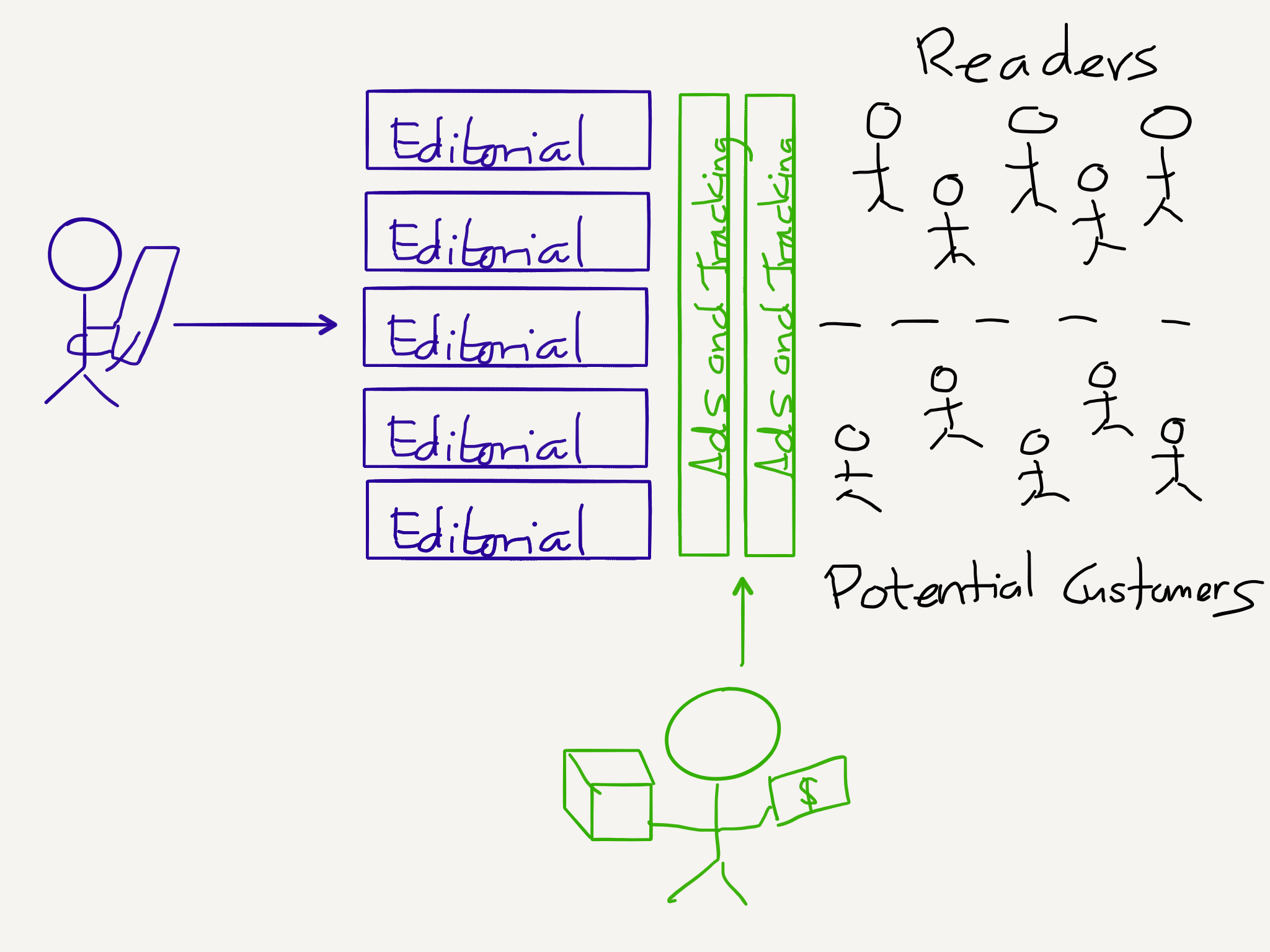
    But remember my initial warning: it’s possible to read too much into Grantland. Last year I wrote about Publishers and the Smiling Curve, characterizing publishers as being akin to original equipment manufacturers assembling computers and phones at cost, while profits flowed to aggregators on one side (Facebook, Google, etc.) and to “stars and focused publications” on the other.

    Publishers and the Smiling Curve
    Publishers and the Smiling Curve

    I certainly think I got the aggregator part right (several months later I generalized the concept to Aggregation Theory), but it wasn’t clear in the article — or ultimately to me — how exactly the “stars and focused publications” would profit outside of one-man operations.

    Simmons, though, just as he pioneered online sports writing, may be leading the way once again in demonstrating how writing can be monetized: by not even trying.

    Writing As Lead Generation

    Simmons is pursuing two endeavors post-ESPN: he’s creating a television show for HBO Now (although it will reportedly air on HBO proper as well) and he’s recording The Bill Simmons Podcast. The business models — and thus the incentives — for both couldn’t be more different than those for successful online publishers:

    • HBO Now, like all subscription services, has to surmount the far stiffer challenge of convincing customers to get out their credit cards, not just click a link (or, in television terms, watch an ad-supported show). This changes the focus from common-denominator low-cost fare like reality TV or game shows (or video summaries or news rewrites) to focused, expensive “destination shows” that fewer people watch, but those who do care intensely.

      One show in one niche isn’t enough though; the best balance between revenue and costs is found through bundling: people may be willing to pay a lot for one show and a little for several others, which means a well appointed bundle can ultimately get more revenue per customer from a wider base of customers. In the case of Simmons, he brings a younger male audience that cares about sports, and who may also be interested in, say, Game of Thrones or Hard Knocks, or perhaps a bit of comedy from, say, Jon Stewart; it’s the collection that makes said audience willing to pay $15/month, even though they may have been willing to pay Simmons alone less.

      Why, though, does Simmons have those fans in the first place? Because of his writing. The flipside of writing being hard to monetize is that it is the most digestible and sharable medium, allowing folks to accrue large audiences that they can leverage elsewhere.

    • Podcasts run on an advertising model, but said advertising is far more valuable than display ads in particular. They are truly native: Simmons, like most podcast hosts, reads the ads himself in the middle of his podcast, meaning they are more likely to be heard and are more engaging to boot.

      The trouble with podcasts is that they are difficult to grow: while text can be shared and consumed quickly, a podcast requires a commitment (which again, is why advertising in them is so valuable). Simmons, though, by virtue of his previous writing, is already averaging over 400,000 downloads per episode.3 Podcast rates are hard to come by, but I’m aware of a few podcasts a quarter the size that are earning somewhere in excess of $10,000/episode; presuming proportionally similar rates (which may be unrealistic, given the broader audience) The Bill Simmons Podcast, which publishes three times a week, could be on a >$6 million run rate, which, per my envelope math in the footnote above, could nearly pay for a 50-person staff a la Grantland.

    To be sure, as I noted above, Grantland was certainly much more expensive, and it’s not clear just how far podcasting can scale (but I think that’s only a matter of time), but Grantland actually had an entire stable of podcasts, several of which were quite popular because they featured writers whose writing was popular.4 Just as with HBO, it turns out writing is great lead generation for an actual monetizable business.

    The Grantland Lesson

    To be sure, it’s tempting to pull a “That’s Fine for Bill”; the guy has been writing online for eighteen years (and, technically, he’s not writing now).5 It’s a fair point but I think there’s room for another, equally compelling one: too much of the debate about monetization and the future of publishing in particular has artificially restricted itself to monetizing text. That constraint made sense in a physical world: a business that invested heavily in printing presses and delivery trucks didn’t really have a choice but to stick the product and the business model together, but now that everything — text, video, audio files, you name it — is 1’s and 0’s, what is the point in limiting one’s thinking to a particular configuration of those 1’s and 0’s?

    In fact, it’s more than possible that in the long-run the current state of publishing — massive scale driven by advertising on one hand,6 and one-person shops with low revenue numbers and even lower costs on the other — will end up being an aberration. Focused, quality-obsessed publications will take advantage of bundle economics to collect “stars” and monetize them through some combination of subscriptions (less likely) or alternate media forms. Said media forms, like podcasts, are tough to grow on their own, but again, that is what makes them such a great match for writing, which is perfect for growth but terrible for monetization.

    That’s why the lesson to be learned from Grantland may be the exact opposite of what it seems: the problem isn’t that ESPN spent too much money on a web site that couldn’t monetize, it’s that the web site should only have been step one to a multi-media endeavor that converted visitors to fans willing to invest time in formats that can actually pay the bills.7


    1. Via the afore-linked Deadspin article 

    2. Some back of the envelope figures:

      Presuming a cost per employee of $100,000 (which, including benefits, is probably on the low side):

      • A one person site needs $100,000 in revenue, which means 1,000 subscribers at $100/year
      • A two person site needs $200,000 in revenue, which means 2,000 subscribers at $100/year
      • A 50 person site (ignoring Simmons’ reported $5 million salary, plus the fact the site included former Pulitzer Prize winners) needs $5 million in revenue, which means 50,000 subscribers at $100/year. Add in Grantland’s other expenses and the number is likely double that

      Keep that $5 million figure in mind 

    3. I’ve heard the number now is actually closer to 500,000 

    4. The podcast point is the most legitimate of all of Simmons’ complaints about ESPN: there was clearly minimal effort made to monetize the B.S. Report or the other Grantland podcasts 

    5. This is also the part where I note that the reason I and so many other online writers revere him, despite his warts, is that he was a true pioneer: no one had made a career on the Internet before him, and now lots of us have 

    6. Indeed, I’ve not only written repeatedly that a traditional advertising model only works at scale, but also argued that Facebook and Google are on pace to capture ever more of it: the two Internet giants have better user data, better tracking, and better inventory, and relatively unlimited inventory (at least compared to a medium like TV, which certainly took a chunk of advertising revenue from traditional publishers, but only a chunk). 

    7. One more thing: I don’t think linear TV is that format. Fans want to read/see/listen to stars, but time is a constraint; on-demand a la HBO Now or podcasts is a much better fit 


  • In Defense of The New York Times

    Something rather amazing happened this week.

    On Monday, two months after The New York Times wrote a brutal exposé on Amazon’s workplace culture, Jay Carney, former White House press secretary for President Barack Obama and current Senior Vice President for Global Corporate Affairs at Amazon, wrote a blistering piece on Medium entitled What The New York Times Didn’t Tell You:

    When the story came out, we knew it misrepresented Amazon. Once we could look into the most sensational anecdotes, we realized why. We presented the Times with our findings several weeks ago, hoping they might take action to correct the record. They haven’t, which is why we decided to write about it ourselves.

    The Times got attention for their story, but in the process they did a disservice to readers, who deserve better. The next time you see a sensationalistic quote in the Times like “nearly every person I worked with, I saw cry at their desk”, you might wonder whether there’s a crucial piece of context or backstory missing — like admission of fraud — and whether the Times somehow decided it just wasn’t important to check.

    It was really something: Carney’s accusations were strong, disturbingly detailed (Amazon presented presumably confidential employee performance data), and perhaps most curiously of all, out of nowhere.1 The fact the response was on Medium was interesting as well: the placement helped guarantee attention from a certain segment of the public without tying it too explicitly to Amazon.

    Then, a few hours later, something even more surprising happened: the Executive Editor of The New York Times, Dean Baquet, responded, also on Medium:2

    In response to your posting on Medium this morning, I want to reiterate my support for our story about Amazon’s culture. In your posting — as well as in a series of recent email exchanges with me — you contested the article’s assertion that many employees found Amazon a tough place to work.

    As the story noted, our reporters spoke to more than a hundred current and former employees, at various levels and divisions, over many months. Many, including most of those you cited, talked about how they admired Amazon’s ambitions and urgency even as they described aspects of the workplace as troubling…and any reading of the responses leaves no doubt that this was an accurate portrait.

    Both pieces were remarkable for reasons that had little to do with their content.3

    Amazon Goes Public

    The importance of Amazon’s response is obvious: unlike days of old, when corporations or individuals in the news had to resort to letters to the editor (which may or may not have been printed) and angry calls to the editor-in-chief, Amazon can go straight to the public with their complaints; it may sound cliché to say that “everyone is a publisher” but for the fact it’s true. Moreover, like anything else on the Internet, Amazon’s response was immediately available to everyone in the world: we take that for granted today, but compared to not that long ago when distribution required printing presses and delivery trucks this is truly an astounding development.

    The New York Times Response

    Even more important, though, was the fact that Baquet responded, and on the same (small-m) medium as Amazon to boot. An unfortunate side effect of owning said printed presses and delivery trucks was that newspapers held themselves as the oracles of truth, none moreso than The New York Times. Consider the motto printed on every paper: All the News That’s Fit to Print; I criticized the mindset behind this motto in Why BuzzFeed Is the Most Important News Organization in the World:

    It’s important to appreciate that this was more than just a slogan and [the front-page meeting was more than just a] meeting; there are important assumptions underlying this conceit:

    • The first assumption is that there is a limited amount of space, which in the case of a physical product is quite obviously true. Sure, newspapers could and did change the length of their daily editions, but the line had to be drawn somewhere
    • The second assumption is that journalists, by choosing what to write about, are the arbiters of what is “news”
    • The third assumption is that the front page is an essential signal as to what news is important; more broadly, it’s an assumption that editors matter

    My point then was that none of these assumptions held on the Internet: there is an unlimited amount of space, news can come from anywhere or anybody, and that the front page is a lot less important in the age of social media. And, I noted, as long as The New York Times held to these assumptions, they would slowly but surely fall behind.

    This is why Baquet’s response is so significant:

    • His response was public, not private, and why not: an extra web page is free
    • His response was on the same medium as Carney’s post, which is fine, because Medium is just as accessible and potentially newsworthy as nytimes.com
    • His response was a part of a conversation, not a pronouncement

    Baquet actually made this conversation point himself in an interview with Kara Swisher and Peter Kafka at Recode’s Code/Media conference in September:

    The construct was, “It was true, it was important, we made the case there was something anomalous about Amazon.” And most importantly, and this to me is what the best journalism does, it sparked vibrant debate about the workplace.

    A vibrant debate about the workplace? That is journalism? Not printing the truth?

    The Nichification of the New York Times

    In fact, this was one of a whole host of very interesting things Baquet said in the interview. Several minutes prior he had attacked another journalism shibboleth, that of the necessity of a “wall” between the newsroom and the business side of the paper.

    I think our relationship with people outside the newsroom is different…in the world I grew up in, and in the world that created The New York Times…I think that that rule that there was a big fat wall between the news room and everybody else doesn’t make sense anymore in the modern era…I think that we now understand that that’s sort of nuts…I think that that was a comfortable position when we had a 30% profit margin, but it went on too long…

    I think of myself as primarily the executive editor whose job it is to ensure the quality and the integrity of the report. But I also think of myself as somebody whose job it is to preserve The New York Times which means I do think about advertising, I do think about The New York Times as a business. That does not mean that I drop the wall and sell ads. But it does mean that I think about the whole of the enterprise.

    Regular readers will know just how important I think this is. I wrote last month in Popping the Publishing Bubble:

    Publishers going forward need to have the exact opposite attitude from publishers in the past: instead of focusing on journalism and getting the business model for free, publishers need to start with a sustainable business model and focus on journalism that works hand-in-hand with the business model they have chosen. First and foremost that means publishers need to answer the most fundamental question required of any enterprise: are they a niche or scale business?

    What is exciting about the Amazon story is that, at least according to Baquet, it came from embracing the nichification of The New York Times.

    I think that people know that the Amazon story came from The New York Times. I think my job is to ensure that the percentage of stories we do is very different. My job is to do as many Amazon stories as possible and to do fewer and fewer of the traditional stories that don’t work as well as the bundle disintegrates. My job is to produce a lot of Amazons.

    In other words, the job of The New York Times is no longer to produce “All the News That’s Fit to Print”; rather, it is to invest in stories that make a difference — stories that start a conversation — and trust that readers will be willing to pay for quality. The content follows from the business model.

    Will the Niche Model Work?

    Of course, while this all sounds good on paper, the proof is in the numbers. And, it turns out, the numbers are pretty encouraging. Baquet wrote earlier this month:

    We recently passed one million digital-only subscribers, giving us far more than any other news organization in the world. We have another 1.1 million print-and-digital subscribers, so that in total, we have more subscribers than at any time in our 164-year history. Many news organizations, facing competition from digital outlets, have sharply reduced the size of their newsrooms and their investment in news gathering. But The New York Times has not.

    In the piece Baquet lists the qualifications of the New York Times’ reporters: a Yale-educated lawyer covering the Supreme Court, a former soldier covering abandoned chemical weapons in Iraq, a former Federal Reserve employee who wrote about income inequality. Sure, he’s almost certainly cherry-picking, but the broader point about a focus on quality and impact stories supported by readers directly is very much spot-on: it’s the exact approach niche publications need to pursue.

    To be clear, I don’t use the word “niche” as an insult, and it would be absurd to do so: the New York Times remains the most influential publication in the world. Rather, I’m referring to the choice all publications must make: to go broad and cross-platform with a goal of maximizing readership and monetizing through advertising, or to instead focus on maximizing revenue from the customers who actually care about your brand. To be niche.

    Encouragingly, there is more evidence beyond this interview that The New York Times has embraced this approach: the company released a strategy memo earlier this month that made clear the company’s goal was to double its digital revenue (from $400 million to $800 million) primarily through a niche strategy:

    “Many of our competitors focus primarily on attracting as many uniques as they can with a view to building an advertising-only business,” the memo said, referring to unique visitors to websites. “We see our business as a subscription service first, which requires us to offer journalism and products worth paying for.” That engagement, it said, will also help attract advertisers.

    Twelve percent of Times readers, the memo said, deliver 90 percent of its digital revenue. “To double our digital revenue, we need to more than double the number of these most loyal readers,” it said. “We will need to develop them increasingly from younger demographics and international audiences.”

    It’s not certain this strategy will succeed, to be sure, but it is a strategy that is at least coherent, and one that I celebrate.

    Journalism and the Search for Truth

    The fact of the matter is that The New York Times almost certainly got various details of the Amazon story wrong. The mistake most critics made, though, was in assuming that any publication ever got everything completely correct. Baquet’s insistence that good journalism starts a debate may seem like a cop-out, but it’s actually a far healthier approach than the old assumption that any one publication or writer or editor was ever in a position to know “All the News That’s Fit to Print.”

    I’d go further: I think we as a society are in a far stronger place when it comes to knowing the truth than we have ever been previously, and that is thanks to the Internet. It’s a good thing that Amazon can post to Medium, and it’s healthy that Baquet responded. My alma mater the University of Wisconsin declared back in 1894:

    Whatever may be the limitations which trammel inquiry elsewhere we believe the great state University of Wisconsin should ever encourage that continual and fearless sifting and winnowing by which alone the truth can be found.

    The New York Times doesn’t have the truth, but then again, neither do I, and neither does Amazon. Amazon, though, along with the other platforms that, as described by Aggregation Theory, are increasingly coming to dominate the consumer experience, are increasingly powerful, even more powerful than governments.4 It is a great relief that the same Internet that makes said companies so powerful is architected such that challenges to that power can never be fully repressed,5 and I for one hope that The New York Times realizes its goal of actually making sustainable revenue in the process of doing said challenging.

    So You Want to Change the World

    Note that I haven’t said much about the Amazon article in question; in fact, as I wrote at the time, the article bugged me quite a bit not because of its description of the environment (which, according to both my friends who work there and the company’s general reputation in the Seattle area, was broadly correct) but rather the article’s dismissive tone towards what Amazon has accomplished: the company is fundamentally changing enterprise IT, with all the knock-on effects that entails from disrupting tech companies to real estate to venture capital; changing commerce; and even changing how we consume ideas. There is an argument to be made that this sort of impact doesn’t happen if you only work 9-5.

    That’s why I’m an optimist though: all kinds of people did make that argument — this site, former employees, even Amazon itself — and the net result is that we are collectively closer to the truth than we were before that article. So it was good journalism, and given the increasing importance of technology, we as an industry should embrace it: you can’t claim you want to change the world and not appreciate that the more ambitious your goals, the more necessary the challenges to exactly what you’re trying to change, and how you’re trying to change it.


    1. Why is Amazon resuscitating this story? Is it hurting recruiting? Is there another story coming from The New York Times soon (my guess)? Do they simply want to send a message to journalists generally? 

    2. Unfortunately, Carney disabled the display of responses, which is pretty weak  

    3. Carney responded to Baquet’s response here  

    4. I still worry more about government’s collecting data though: they are the only institution capable of throwing you in prison 

    5. This is why my number one concern is about regulating access to the Internet; the Great Firewall is the most frightening thing in the world 


  • Venture Capital and the Internet’s Impact

    Much has been written of the difficulty in building “another Silicon Valley.” To be sure, many countries and regions have tried, seeking to assemble the perfect mix of willing investors, eager entrepreneurs, and ready-made markets that will produce the sort of self-perpetuating ecosystem that will lift the region, country, nay, the world to a new level of prosperity and modernity.1 The problem is that like most real-life systems Silicon Valley is non-linear: it is impossible to break it down into component parts that can be reproduced, and no one can know for sure what a small change in inputs will mean for the outputs.

    Moreover, one of the most important stories of the last several years is how the structure of Silicon Valley itself is changing, particularly when it comes to funding. Instead of traditional venture capital firms investing in startups from PowerPoint to IPO, there are angel investors and seed rounds on one end and traditional public market investors investing in private unicorn rounds on the other, with venture capital firms somewhere in the middle. And no company is more responsible for this radical transformation than Amazon: the company changed the inputs, and the butterfly effect is upending the entire system.

    Venture Capital as Arbitrage

    There’s a tendency in tech journalism to view venture capitalists as the moneymen (I always try to use gender-neutral terms on Stratechery, but it would be dishonest to even make an attempt here given the pathetic fact that only 4% of partner-level venture capitalists are women). In truth, though, middlemen is just as appropriate: the actual money comes from limited partners like family trusts, university endowments, pension funds, sovereign wealth funds, massively wealthy individuals, etc. Limited partners have highly diversified portfolios of which venture capital is only one part — the high-risk high-return part — and the reason they “hire” venture capitalists is for their skill in identifying and investing in new companies about which LPs have neither the expertise, time, or knowledge to invest in by themselves. Moreover, they pay handsomely for the help: venture capitalists usually charge around 2% of the fund per year2 in fees and keep about 20% of profits (fees are often but not always subtracted from the final payout; however, if the fund loses money the fees aren’t repaid).

    I point this out to highlight the fact that at a basic level venture capitalists are arbitrageurs: they have access to more information than those with the capital, and access to more capital than those with information, and they profit by exploiting the mismatch.3 And to be clear, this is not a bad thing! Our entire economy is predicated on middlemen: no one grows their own food, to take an extreme example; rather, we depend on an entire supply chain of middlemen that results in $4 toast from wheat that costs $4/bushel.

    In the case of startups, during the 45 years after Arthur Rock founded the first venture capital partnership in 1961, the vast majority of new firms needed significant funding from day one. Hardware startups of course needed specialized equipment, the funds to make prototypes, and then to set up actual manufacturing lines, but software startups, particularly those with any sort of online component, also needed to make significant hardware investments into servers, software that ran on said servers, and a staff to manage them. This was where the venture capitalists’ unique skill-set came into play: they identified the startups worthy of funding through little more than a PowerPoint and a person, and brought to bear the level of upfront capital necessary to make that startup a reality.

    Amazon Web Services and the Angels

    In 2006, though, something changed, and that something was the launch of Amazon Web Services.4 Because a company pays for AWS resources as they use them, it is possible to create an entirely new app for basically $0 in your spare time. Or, alternately, if you want to make a real go of it, a founder’s only costs are his or her forgone salary and the cost of hiring whomever he or she deems necessary to get a minimum viable product out the door. In dollar terms that means the cost of building a new idea has plummeted from the millions to the (low) hundreds of thousands.

    In turn this has led to an entirely new class of investor: angels. There are a lot of people in the San Francisco Bay Area especially who have millions in the bank — enough to live comfortably and take some chances, but nowhere close to the amount needed to be a traditional limited partner in a venture capital firm. On the flipside, though, these folks have a huge information advantage: they are still a part of the startup scene, both socially and professionally; they don’t need someone to make deals for them.

    Previously these individuals would have probably tried to join a VC firm and chip in some of their own money to a fund alongside traditional limited partners. However, thanks to AWS (and open-source software) and the fact starting companies no longer needs millions, these angels are able to compete for the opportunity to fund companies at the earliest — and thus, most potentially profitable — stage of investing.

    In fact, angels have nearly completely replaced venture capital at the seed stage, which means they are the first to form critical relationships with founders. True, this has led to an explosion in new companies far beyond the levels seen previously, which is entirely expected — lower barriers to entry to any market means more total entries — but this has actually made it even more difficult for venture capitalists to invest in seed rounds: most aren’t capable of writing massive numbers of seed checks; the amounts are just too small to justify the effort.

    Instead, venture capitalists have gone up-market: firms may claim they invest in Series’ A and B, but those come well after one or possibly two rounds of seed investment; in other words, today’s Series A is yesteryear’s Series C. This, by the way, is the key to understanding the so-called “Series A crunch”: it used to be that Series C was the make-or-break funding round, and in fact it still is — it just has a different name now. Moreover, the fact more companies can get started doesn’t mean that more companies will succeed; venture capitalists just have more companies to choose from.

    Indeed, one can absolutely make the argument that the advent of angels has been good for venture capitalists: now, instead of investing in little more than a Powerpoint and a person, firms can invest in real products that have demonstrated traction in the market. And to be sure, startups still need the money: it may be easy to get off the ground, but that means it’s just as easy for potential competitors. The new competition amongst startups is about scaling and marketing and sales, all of which are expensive and require expenditures months or years ahead of expected profits, which is exactly what venture capital makes possible.

    The Disruption of Venture Capital

    If you’ll forgive a brief digression, one topic I cover quite frequently is publishing. My reasons, though, go beyond the fact that’s the business I myself am in; publishing is ultimately about text, and text, by its very nature, translates perfectly from analog to digital. And so, from the very first days of the Internet, the publishing industry has been like a canary in the digital coal mine: whatever befell it is likely to portend what might befall other industries once some essential part of their business is impacted by the Internet.

    In the case of publishing, what happened is that the Internet was, at least at first, a huge boon: suddenly newspapers were reaching millions of people all over the world that they had previously had no access to. That breaking down of geographic barriers, though, ultimately undermined an entire business model predicated on arbitrage between readers seeking information and advertisers seeking attention.

    I think there are parallels to be drawn to venture capital: sure, it’s nice to be able to invest in products instead of PowerPoints, but the tradeoff is the loss of proprietary knowledge about which startups have outsized potential and which don’t, and the influence on founders when it comes to everything from hiring to follow-on funding to when is the right time to go public. That influence is now increasingly gained by those investing in the seed stage, whether it be angels or incubators like Y Combinator.

    Moreover, just this week came two pieces of evidence that some of these early stage investors are interested in encroaching further on venture capitalist turf:

    • First is AngelList, which just raised $400 million from CSC Venture Capital, the U.S. arm of China Science & Merchants Investment Management Group.

      AngelList is the most systematic effort to date to give structure to the world of angel investing. Angels who source a deal can form “syndicates” in which other angels invest in the sourced deal for a share of the investment’s returns commensurate with their investment. AngelList’s new fund aims to make this even easier: qualified investors can make firm offers knowing that AngelList will fill in the funding gap between sourcing a deal and recruiting other angels to join a syndicate. And, more importantly, AngelList can partner with syndicates to fund follow-on rounds in the best companies. In other words, Series A and beyond.

    • Second is the aforementioned Y Combinator, the incubator that has seed funded startups worth a combined $30 billion, including Airbnb, Dropbox, Stripe, and a whole host of other companies you’re probably familiar with. Just yesterday, Y Combinator reportedly led a Series B round in Checkr, which automates background checks. The funds were from Y Combinator’s new Continuity Fund, which supposedly would be making pro rata investments at <$250 million valuations in all of Y Combinator’s startups gaining additional funding, but the question as to whether or not Y Combinator has reversed its previously stated policy for the fund is less interesting than the fact the firm is also moving up market.

    It is, in some respects, a classic disruption story: angels and incubators were happy to get down in the mud with the huge number of new startups enabled by Amazon Web Services and open source software; meanwhile, said startups’ low up-front costs didn’t provide an adequate return on a venture capitalist’s time (or check). Instead venture capitalists fled up-market, only to find the folks they were so happy to benefit from moving on up into their space.

    The Venture Capital Squeeze

    The story doesn’t end there: the trouble for venture capitalists is that they are getting squeezed from the top of the funding hierarchy as well: a new class of growth investors, many of them made up of traditional limited partners like Fidelity and T. Rowe Price, are approaching unicorn companies on a portfolio basis. I wrote in a Daily Update last June:

    If you wait to invest until startups are already unicorns, or nearly so, you can be invested in a portfolio of unicorns! Just look at the portfolios of some well-known late-stage investors (all data from Crunchbase):

    • T. Rowe Price has invested in 16 unicorns, including 3 of the top 10, and 7 of the top 25
    • Fidelity has invested in 10 unicorns, including 5 of the top 10, and 8 of the top 25
    • Tiger Global has invested in 13 unicorns, including 1 of the top 10, and 3 of the top 25
    • DST Global, who in my opinion have the most responsibility for starting this trend, has invested in 10 unicorns, including 3 of the top 10 (and 5 of the top 12)…

    You could make the analogy about all of these growth investors to venture capitalists: they are investing relatively speaking small amounts of money into a portfolio of unicorns, and all they need is for one or two to make it to a major liquidity event to profit.

    Sure, this is relatively dumb money, but that’s where those angel and incubator relationships come in: if startups increasingly feel they have the relationships and advice they need, then growth funding is basically a commodity, so why not take dumb cheap money sooner rather than later?

    The Internet Impact

    Interestingly, just as in every other commodity market, the greatest defense for venture capitalists turns out to be brand: firms like Benchmark, Sequoia, or Andreessen Horowitz can buy into firms at superior prices because it matters to the startup to have them on their cap table.5 Moreover, Andreessen Horowitz in particular has been very open about their goal to offer startups far more than money, including dedicated recruiting teams, marketing teams, and probably most usefully an active business development team. Expect the venture capitalist return power curve to grow even steeper.

    The more important takeaway, though, is that this upheaval is happening at all: even a seemingly impenetrable clubby human interaction-driven industry like venture capital is susceptible to change that, in retrospect, is really quite radical. You see it in industry after industry: hotels presumed that people wouldn’t stay in strangers’ homes, television networks presumed that programming schedules were constrained by time, and, speaking of Amazon Web Services, enterprise technology companies presumed that servers and software would live on corporate premises. Once that premise is removed, though — ratings commoditized trust, streaming commoditized time, scale commoditized data centers — everything else that you didn’t think mattered does. Airbnb has better selection and often cheaper prices, Netflix is cheaper and has a broader selection, Amazon offer customizability and flexibility.

    So it is with venture capital: once startup funding requirements were reduced, the superior information and the willingness to hustle of angels and incubators earned the trust of the big companies of tomorrow, reducing more and more venture capitalists to dumb money hardly worth the 20% premium. The inputs to the Silicon Valley system have been changed, and we’re only now seeing the effects, and that should be a cautionary tale for just about everyone who thinks they and their industry are safe from the Internet’s impact.


    1. Or, as critics may counter, a new level of commercialism and intrusiveness. But I’m an optimist — and a realist 

    2. Usually for 10 years, the traditional life of a fund 

    3. To be sure, the best sort of VCs do more than generate “deal flow”, as it’s called: they offer advice, help with hiring, make connections, find additional investing partners, and perhaps most importantly, at least for the most well-known firms which capture an outsized share of venture capital returns, validate the startups they invest in with potential employees, customers, and partners 

    4. Obviously AWS in 2006 — which was just the S3 storage service — wasn’t capable of supporting a startup; it took several years to add the necessary services. Moreover, I am unfortunately giving short-shrift to the role of open-source software, which is the left hand to Amazon’s right 

    5. Semil Shah, who provided feedback on an early draft of this article, wrote about this in August 


  • Twitter’s Moment

    It’s Always Darkest Before the Dawn

    I try to save the most over-used of clichés for special moments, and that’s exactly what this week feels like for Twitter. You may disagree, of course — Wall Street does, having driven the stock down yesterday to just a dollar above its IPO price (and 38% down from its first day close) — but that’s why the cliché works: things may seem dark, but I’m optimistic that the horizon has just the slightest glimmer of light.

    Long time readers know that while I love and value the product, I’m no Twitter fanboy. The company’s user retention issues were apparent well before the IPO, and the company had a clear product problem that, ultimately and correctly, cost CEO Dick Costolo his job. Tack on a messy — and thus, unsurprising — CEO search that culminated in a part-time CEO in direct contradiction to the Board of Director’s public statements to the contrary,1 and no wonder the stock has been down-and-to-the-right, with all of the problems (especially around retention) that that entails. Again, this was predictable.

    I think, though, it’s time for a new prediction: that the summer of 2015 will be seen as the low point for Twitter, and that this week in particular will mark the start of something new and valuable. Crucially, the reasons why are directly related to why I was bearish for so long: the product, the CEO, and the stock.

    The Build-up

    It was a bit disconcerting when, during the conference call to announce the appointment of Jack Dorsey as CEO, Lead Independent Director Peter Currie, Dorsey, and newly promoted COO Adam Bain brought up Project Lightning, an internal project that was bizarrely revealed to BuzzFeed by Costolo just days before his departure; at the time it was hard to see the pre-announcement as anything other than a last ditch attempt to save his job, and one wondered if the mentions on the conference call had a similar motivation: give Wall Street something, anything, to hold onto, even if jacking up expectations would hurt the new product when it launched.

    Well, the product launched…and it’s fantastic. Moreover, it’s not only that it’s fantastic from a product perspective — actually, there is a lot to nitpick — but that it is fantastic from a strategic perspective.

    The Product

    Moments has three components:

    • When you first tap the Moments tab at the bottom of the Twitter app2 you’re dropped into the ‘Today’ view that lists a mishmash of stories that, well, happened today.

      IMG_0153

      Touch any of the stories to get a curated list of tweets that tell the story in question through videos, images, and sometimes just text. It’s a really great experience, and I found the sports stories with their combination of highlights and tweeted reactions particularly enjoyable3

    • For any Moment in progress, you can tap a button to add tweets about that Moment to your main timeline. Crucially, though, those tweets only persist for the duration of the event in question; the ‘Unfollow’, which is the most essential action when it comes to building a Twitter feed you actually read, is done for you

    • Finally, in what was probably the biggest surprise in the product, there is a carousel at the top leading to more focused categories:

      carousel

      Each of these categories includes not only ‘News’ or ‘Entertainment’ Moments that just happened, but also more timeless content, particularly in ‘Fun.’ Look carefully at those category titles, though — they sure look familiar:

      shutterstock_2569368

      That’s right, Twitter just reinvented the newspaper. It’s not just any newspaper though — it has the potential to be the best newspaper in the world.

    The Strategy

    This newspaper angle touches on the strategic aspect of Moments. The demise of newspapers is the most obvious example of Aggregation Theory and what happens when distribution becomes free. You go from a situation where geographic bundles are the only way to reach consumers to one where consumers can access any story from any publication — it’s those that control discovery that have all the power:

    aggregationpublishing

    Google was the first and biggest beneficiary of this shift, but, as I noted last week, Google has always been more about intentional discovery as opposed to directed browsing. On the flipside, Facebook excels at serendipitous discovery, but if you actually want to get informed about what is happening, without knowing what you want to know, then it’s not clear what is the best answer.

    True, you can go to a specific publication like the New York Times or USA Today, but you’re not getting the best possible content for every story, and besides, the fundamental format of their stories was designed for paper, not mobile. The NYT Now and BuzzFeed News apps do well to bring in stories from other apps, but the mixture is a bit haphazard and again, long-form text is good for some things but not all things.4 Snapchat, meanwhile, has Discovery — from which Twitter clearly took product inspiration, and for good reason5 — but that too is organized by publication, a decision that makes sense for business development reasons but not necessarily user experience ones. In other words, I think Twitter Moments’ organization is superior.

    What’s most interesting, though, and most exciting, is understanding how it is that Twitter can pull this off: the company doesn’t need stories from publications because it has nearly all of the originators of those stories already on its service. In other words, if the Internet broke down newspapers to their component stories, Twitter breaks down stories to their component moments,6 and those moments are chronicled not only by normal people on the ground but by the best news-gatherers on the planet.

    The fact that news is reported first via tweet has always been true of Twitter, and it’s a huge reason why so many are so devoted to the service. However, to become an effective aggregator you have to aggregate not just the source material but also the audience, and the problem for Twitter is that learning the product has simply been far too difficult for most new users. There is nothing difficult about Moments, however, and Twitter should make it the default screen for their app.7

    What is exciting is that Moments isn’t close to fulfilling its potential: imagine a tweet-based newspaper drawn not only from the best sources in a mobile-friendly format, but one perfectly customized to you. This is what Twitter is already like for power users, but again, getting to that state is simply too difficult. Figuring out how to do this systematically on users’ behalf should be Twitter’s chief aim.

    “Should” is probably a bit superfluous: the incentives for Twitter to focus on this type of customization are massive. Twitter is uniquely positioned to understand what its users are interested in, something that at least theoretically rivals Facebook’s imposing demographic information, SnapChat’s youth advantage, or Pinterest’s grasp of my aspirations. The reason customized Moments matter is because there are two payoffs: the user experience is better, and the advertising that will undoubtedly be sold in Moments will be better targeted and more effective.

    I do think the ads will be great, regardless. The placement opportunity within stories is obvious, and like the best sort of in-stream native advertising the brand in question will take over the entire screen, if only for a moment. And, like the other networks I just listed, Moment ads will be both unblockable and located where users live, not where they visit.

    The Content

    Certainly, as any number of articles have already breathlessly noted, Twitter Moments is built for basic users. It’s essential, though, that Twitter not forget about those living mostly happily with the company’s core product — they’re the ones that create Moments’ content (for free, I’d add). This is where Dorsey’s return as CEO has the potential to have the most impact, because the core product has stagnated horribly, particularly in regards to the 140-character limit and conversations.

    Specifically:

    • It remains inexplicable that tweet payloads, such as links, pictures, and videos, count against the 140-character limit. Any and all attachments should not count against the limit
    • There is one medium missing from the previous bullet point: text. Twitter cards can already handle the aforementioned videos or photos (or link previews), so why can’t they handle text? I’m not advocating for the removal of the 140-character limit for public tweets,8 simply a way for people to attach more fully-formed thoughts to the existing stream without needing to rely on obnoxious tweet storms. Links are great, but following a link is expensive for the user in time, bandwidth, and mental burden, and there’s no reason Twitter shouldn’t make it easy to keep ideas in its app
    • Twitter conversations, which often contain the very best content on Twitter, are horribly broken and nearly undiscoverable. First, it’s again ridiculous that @-names count against the 140-character limit, making conversations with more than one or two people untenable. Second, it is far too difficult to follow a conversation — Twitter should investigate folded conversations like on Sina Weibo, the old Friendster, or Facebook. Third, Twitter should make it easy to temporarily follow a conversation, just like a moment, or, on the flipside, easily drop out

    As far as I can tell, the primary reason none of this has been implemented is that no one at Twitter has had the authority to tamper with the sacred 140-character limit. This quote from a Recode story about potential changes to the limit was damning:

    “People have been very precious at Twitter about what Twitter can be and how much it can be evolved,” said one current senior employee. “Having Jack come in and say it’s okay makes all the difference in the world.”

    The fact of the matter is that 140 characters is an implementation detail; Twitter’s core value is in its interest graph, and it’s gotten to the point where fealty to that detail has had a material effect on said graph. If Dorsey really is able to just walk in and get people in line — even if only part-time — then I feel all the better about my endorsement of him for CEO:

    Twitter has long been captive to its best users [and apparently employees] who rail against any change on the margins, much less even a rumor of changes to the core product; I suspect this hesitancy has been in large part driven by the fact that everyone in Twitter’s leadership was ultimately a hired gun. Dorsey, though, is a founder, and however controversial his first stint at the company may have been, there is no denying the authority this fact gives him when it comes to making changes.

    Beyond Moments — indeed, for Moments to be successful — the core product has to evolve, and that’s why Dorsey is so important.

    The Company

    To be sure, most of this article has dealt with what Moments specifically and Twitter broadly can be, not what it is. The truth is Twitter still faces the challenges I and many others have documented endlessly:

    • The company faces the far more difficult task of convincing users who have tried and abandoned the product to return; getting new users, which is usually thought of as the most difficult problem in consumer tech, is far easier in comparison
    • The company faces far more competition when it comes to media consumption than it did a few years ago. Facebook is the 800-lb gorilla, but Snapchat, Instagram, Pinterest, and a whole host of other sites and apps are making the same bet Twitter is
    • That diminished stock price undoes rather nicely the golden handcuffs that are vesting stock grants, particularly when a seemingly endless supply of unicorns are flush with private money and, as is ever the case in Silicon Valley, circling Twitter looking to poach the employees most capable of turning Twitter around

    Per the first point, I absolutely think Moments is the right product to win users back, and I’m encouraged that Dorsey said on the investor call that the company would be launching an integrated marketing campaign around the product. Twitter should spare no expense.

    Secondly, the fact remains that Twitter has the best content in the world already in a format perfectly suited to mobile. For a long time the lack of product vision and execution has obscured that content from most users, but, in a fair fight, I like Twitter’s chances.

    Finally, the upside of a depressed stock is that, unlike most post-IPO companies, Twitter can actually offer new employees in particular the potential for real wealth gains from their stock grants. Anyone entering Twitter now is basically on the same footing as a pre-IPO employee at a unicorn; sure, the growth may never materialize, but there is a lot of upside and Twitter should leverage that. Moreover, there’s hope that Dorsey’s return and a renewed product vision could keep a lot of important folks in the fold.9

    Much has been made of the comparison between Dorsey and Steve Jobs; certainly his return to the company he helped found and was later banished from fits the mold. It’s easy to mock this comparison, particularly given the fact that Dorsey has at times seemed so eager to invite it, but in fact we should all hope the comparison holds. There’s just something different about Apple, a company that seems so full of contradictions yet one that has continued to lead the industry both financially and in key innovations. I’d argue the same about Twitter: it doesn’t make sense, hasn’t really ever made sense, and perhaps that’s the reason it, and the irreplaceable ideas it contains, are so important. I hope its moment — its dawn — has arrived.


    1. Hello shareholder lawsuit  

    2. Moments is not yet available worldwide; I got it to work by connecting to the U.S. via VPN 

    3. I thought this moment about the Seattle-Detroit American football game was particularly good, in part because Twitter has secured rights to extended video highlights from the NFL 

    4. In fact, BuzzFeed News does incorporate tweets and GIFs; it’s one of the reasons I prefer it 

    5. I’ve said this before and I’ll say it again: I believe that good ideas are discovered more than invented 

    6. I like Nuzzel for discovering long-form pieces, but half the allure is seeing a story’s associated tweets, and it doesn’t really help with anything live 

    7. The company can use a setting to let power users stick with the timeline 

    8. Thank goodness the company finally removed the limit on Direct Messages, which served little purpose beyond driving people and relationship information off of the platform 

    9. For reasons beyond me I original referred to repricing options in this paragraph; like nearly every other company in tech, Twitter now offers Restricted Stock Units, not options. I apologize for the mistake 


  • The Facebook Epoch

    I’m fond of saying that few companies are as underrated as Facebook is, especially in Silicon Valley. Admittedly, it seems strange to say such a thing about a $245 billion company with a trailing 12-month P/E ratio of 88, but that is Wall Street sentiment; in the tech bubble many seem to simply assume the company is ever on the brink of teetering “just like MySpace”, never mind the fact that the social network pioneer barely broke 100 million registered users, less than 10% of the number of active users Facebook attracted in a single day late last month. Or, as more sober minds may argue, sure, Facebook looks unstoppable today, but then again, Google looked unstoppable ten years ago when social seemingly came out of nowhere: surely the Facebook killer is imminent!

    Actually, I don’t think so: I believe the Age of Facebook has only just begun, and to truly understand why, you have to start with Microsoft back in the 80s.

    The PC and Internet Epochs

    I wrote last year in The State of Consumer Technology at the End of 2014 that there have been three epochs in consumer technology: the PC, the Internet, and Mobile. It’s important to note, though, that the PC and Internet epochs are interrelated. Specifically, the latter was built on top of the former.

    In the case of the PC, Microsoft’s dominance was captured by their iconic mission statement: A computer on every desk and in every home, running Microsoft software. And they succeeded! Moreover, those computers didn’t just run Microsoft software, they also supported an entire ecosystem of 3rd party software developers, systems integrators, OEMs, and more. Windows was a true platform: the company made billions, but, as their executives bragged repeatedly, that number was only a fraction (usually about a quarter) of the money generated by the ecosystem as a whole.

    The consumer Internet was a part of this ecosystem: through the 90s and into the 00s all of those desks and houses added first dial-up and then, more importantly, broadband connections to the Internet, setting the stage for Google, the winner of the second epoch. The Internet was infinitely vast, but Google search, by virtue of relying on links — the very structure of the web itself — not only scaled with the web but actually became stronger and more effective the larger the web became.

    Still, Google’s dominance was gated by the platform it operated on top of. This limitation had two forms: the first was the total number of PCs, the active number of which is measured in the hundreds of millions, and the second was the way in which users interacted with their PCs: with intent. People use PCs because they have a reason to use them, and Google’s traditional focus on search advertising is a particularly good fit in that regard: search ads are so valuable to advertisers precisely because the user’s intent is known.

    It may seem odd to view either of these as limitations, particularly a decade ago when, per my observation above, many assumed the company would rule the Internet forever. But, over the last several years, two things have happened to make Google’s natural habitat of the web seem like relatively small potatoes.

    Android and the Mobile Epoch

    The third epoch, as I noted, is mobile. But rather than being measured in the hundreds of millions, mobile users are measured in the billions. And, to Google’s credit, they saw mobile’s importance far earlier than their Internet peers: the company bought Android in 2005, and even more impressively, pivoted the entire project away from the Blackberry imitator it was originally designed to be into an iPhone alternative. And, in what was a masterstroke at the time, the company made it free, helping to assure its adoption by OEMs desperate to compete with Apple and, over time, jump starting an ecosystem that in user numbers dwarfs even Microsoft’s.

    I have said and continue to think that making Android free was one of the smartest strategic moves any tech company has ever made. As Bill Gurley noted in a prescient 2011 post:1

    AdWords is an highly respectable castle, and Google would clearly want to put a “unbreachable moat” around it. Warren himself is on record suggesting that Google’s moat is pretty good already. But where could you extend the moat? What are the potential threats to Google’s castle? Basically, any product that stands between the user and Google and has the potential to distract the choice of search destination is a threat…

    Android, as well as Chrome and Chrome OS for that matter, are not “products” in the classic business sense. They have no plan to become their own “economic castles.” Rather they are very expensive and very aggressive “moats,” funded by the height and magnitude of Google’s castle. Google’s aim is defensive not offensive. They are not trying to make a profit on Android or Chrome. They want to take any layer that lives between themselves and the consumer and make it free (or even less than free). Because these layers are basically software products with no variable costs, this is a very viable defensive strategy. In essence, they are not just building a moat; Google is also scorching the earth for 250 miles around the outside of the castle to ensure no one can approach it. And best I can tell, they are doing a damn good job of it.

    It’s only now that the downside of this approach is coming into focus for Google: its scorched earth Android strategy prevented anyone from making Microsoft-type money from Android the platform — and “anyone” includes Google. Even that would be ok, though, were Google to replicate its PC-era positioning as the front-door to the Internet, but that is how we get to Facebook.

    The Mobile Market

    Before he moved his blogging to Twitter, Marc Andreessen wrote a post on Product/Market Fit. Of those three words, though, the one that matters more than anything is market. Andreessen wrote:

    If you ask entrepreneurs or VCs which of team, product, or market is most important, many will say team…On the other hand, if you ask engineers, many will say product. This is a product business, startups invent products, customers buy and use the products…Personally, I’ll take the third position — I’ll assert that market is the most important factor in a startup’s success or failure.

    Why?

    In a great market — a market with lots of real potential customers — the market pulls product out of the startup. The market needs to be fulfilled and the market will be fulfilled, by the first viable product that comes along. The product doesn’t need to be great; it just has to basically work. And, the market doesn’t care how good the team is, as long as the team can produce that viable product. In short, customers are knocking down your door to get the product; the main goal is to actually answer the phone and respond to all the emails from people who want to buy. And when you have a great market, the team is remarkably easy to upgrade on the fly.

    Mobile is a great market. It is the greatest market the tech industry, or any industry for that matter, has ever seen, and the reason why is best seen by contrasting mobile with the PC: first, while PCs were on every desk and in every home, mobile is in every pocket of a huge percentage of the world’s population. The sheer numbers triple or quadruple the size, and the separation is increasing. Secondly, though, while using a PC required intent, the use of mobile devices occupies all of the available time around intent. It is only when we’re doing something specific that we aren’t using our phones, and the empty spaces of our lives are far greater than anyone imagined.

    Into this void — this massive market, both in terms of numbers and available time — came the perfect product: a means of following, communicating, and interacting with our friends and family. And, while we use a PC with intent, what we humans most want to do with our free time is connect with other humans: as Aristotle long ago observed, “Man is by nature a social animal.” It turned out Facebook was most people’s natural habitat, and by most people I mean those billions using mobile.

    Facebook’s Aligned Advertising

    Keep in mind the second part of Google’s dominance: it wasn’t simply that they were the front-door to the Internet, but also that their business model, search ads specifically, was perfectly aligned with how PCs were used — with intent. That allowed Google to gradually come to dominate direct response advertising, which is all about generating immediate sales or leads. Direct response advertising, though, is only between 10 to 15 percent of all advertising; as I noted in Peak Google, far more money is spent on brand advertising:

    The idea behind brand advertising is to build “affinity” among potential customers. For example, a company like Unilever will spend a lot of money to promote Axe or Dove, but the intent is not to make you order deodorant via e-commerce. Rather, when you’re rushing through the supermarket and just need to grab something, the idea is that you’ll gravitate to the brand you have developed an affinity for. And once a customer has picked a brand, they’re loyal for years. That adds up to a lot of lifetime value, which is why consumer-packaged goods companies, telecom companies, car companies, etc. are among the biggest brand advertisers.

    Brand advertising is a bit of a mysterious thing — the biggest sign that it works is that when companies don’t invest in it sales suffer — but at its core it is about engaging potential customers in the empty spaces when they aren’t too focused on any one thing, and thus more receptive to formation of subconscious affinities. There have traditionally been few better places to do brand advertising than TV: it offers a captive audience at scale that is in a laid back state of mind, not an active one. Advertising on TV, though, is in serious trouble: first came DVRs, and then subscription services, and, perhaps more importantly, that device in your pocket ever tempting you to do what is most natural: connect to others.

    To be clear, all of the brand advertising money on TV will go somewhere; the U.S. has had about the same amount of advertising — between 1.1% and 1.4% of GDP — for as long as we’ve been measuring. And, what better place for that advertising to go than to an app that, more than any other, fills the empty spaces in people’s days?

    To be sure, people don’t only use Facebook: Instagram is hugely popular, as is messaging. And, unsurprisingly Facebook has acquired the former and the biggest player in the latter (WhatsApp); I say “unsurprisingly” because here Facebook is following Google’s playbook as well: the former nailed search, but “borrowed” the concept for AdWords from Overture, acquired Applied Semantics to create AdSense, acquired YouTube, and, as noted above, Android. The company has a brilliant acquisition record (Motorola notwithstanding), and, in my estimation, created a model that ought to be followed: get your core right and acquire what you need to augment it. Facebook is doing the exact same thing.

    Why Facebook is Underrated

    This, then, is why I think Facebook is underrated: a company’s potential is first and foremost measured by its market, and Facebook’s potential market is, when you consider both sheer numbers and time spent, an order of magnitude greater than the PC-based Internet market ever was. Then, on top of that, you increasingly have brand advertising dollars — also an order of magnitude more than direct response dollars — looking for somewhere to go other than TV, and it just so happens that Facebook is the perfect brand advertising platform.2 The company has the right set of products in the right market at the right time.

    Notice that I have barely touched on the product or team at all, because, as Andreessen noted, market matters most. But Facebook is in very good shape on those two points as well; while I get that many in tech don’t use Facebook much — how many of us spent our younger years trying to get away from friends and family? — it is dominant for the vast majority of the population, and not just in the U.S.: here in Asia the app is used for not only friends and family but also professional connections, business pages, and even e-commerce (I don’t think it’s a coincidence that Asia also happens to be mobile first to a far greater degree than the U.S. as well). More impressively, no matter Facebook’s alleged struggles with youth, the reality is the company is part of the fabric of the Internet: you may not like email, but you have an email address, and you could say a similar thing about Facebook. If anything the fact some don’t like the product yet use it anyway is a testament to just how strong it is. And for everyone else there is Instagram and Messenger (or, in the developing world, WhatsApp).

    To be sure, Facebook won’t completely own the market: I’m bullish on Snapchat, for one, and Google is probably best placed to harvest whatever advertising money is left to be made on the web. But at least to this point Facebook has given no indication that they won’t own a big chunk of this massive market opportunity: their team’s disciplined execution, led by Mark Zuckerberg, is among the most impressive I’ve ever seen.

    Facebook and the Platform Siren Call

    There is one more curious acquisition Facebook has made, and that is Oculus Rift. Zuckerberg said at the time:

    Our mission is to make the world more open and connected. For the past few years, this has mostly meant building mobile apps that help you share with the people you care about. We have a lot more to do on mobile, but at this point we feel we’re in a position where we can start focusing on what platforms will come next to enable even more useful, entertaining and personal experiences.

    I’ve long argued that the shift to mobile gave Facebook no choice but to abandon its platform pretensions, and that it was the best possible thing that could have happened to the company. To be an ad company is inherently incompatible with being a platform company: the latter requires letting others share the spotlight — the same spotlight you want to sell to advertisers. Indeed, Google on the Internet has never been a platform either.

    Platforms, though, are tech’s most potent siren call. All companies — and perhaps more accurately, all founders — wish to build a dominant one, but their construction is the most difficult endeavor in the industry. Windows remains the ideal: Microsoft made billions, and crucially, so did everyone else. Apple is making even more than Microsoft ever did — see the bit about the size of the mobile market above — but perhaps not doing as good a job as they could sharing the proceeds with their ecosystem. Google, meanwhile, has their platform, but barely anything to show for it from a profit perspective, at least directly. And now, perhaps, Facebook has the seeds of their own platform: the company has learned so much from Google, to their immense benefit; it will be fascinating to see what lessons they end up applying to Oculus.

    Not that it matters for now, anyways: the truth is my list of epochs was incomplete: first came the PC, and on top of the PC was the Internet. Now we are on the mobile era, and on top of mobile is, well, Facebook. They are their own epoch, a reality that cannot be underrated.


    1. I made similar points in The Android Detour  

    2. It should be noted that to date Facebook has made most of its money from direct response advertising, especially app install ads; however, I expect the percentage of revenue from these ads to continue its steady decline as a percentage of Facebook’s revenue 


  • Disconfirming Ebooks

    UPDATE: There is a question as to whether The New York Times properly represented the state of ebooks. I address that and other questions in this Daily Update, the pertinent part of which is available for free.


    As I’ve noted repeatedly, I believe the impact of computing and the Internet on the world will ultimately rival the Industrial Revolution in importance. And, by extension, I think said impact has only just begun. For the first several decades of the high tech industry most firms were occupied by competing with each other; it’s only in the last half decade or so that attention has increasingly turned to industries which have at most leveraged computing and the Internet to do what they did previously slightly more efficiently.

    For example, you’ve been able to book hotels online for a long time, which meant the Internet was basically a super efficient travel agency. Airbnb, on the other hand, is challenging the fundamental assumptions that underly the existence of hotels in the first place. You can say the same thing about Uber and transportation, Amazon and retail (and infrastructure), and Netflix and TV.

    It’s no accident that these companies were my primary examples in Aggregation Theory. I know theory talk bores some of you, but there is a purpose: if there do turn out to be common elements to events that are happening in multiple industries, then perhaps we can build a predictive framework that anticipates what industries will be affected next, and how (or, on the flipside, identify opportunities for new companies and a plan of attack).

    In that light, while it is satisfying when the theory is seemingly borne out, what is most interesting — and most useful — is disconfirming evidence: industries that seem to prove the theory wrong. Like, say, book publishing.

    Ebook Expectations

    In a nutshell, Aggregation Theory states that:

    • The Internet has made distribution free, neutralizing the advantage that pre-Internet distributors leveraged to integrate with suppliers
    • The Internet has made transaction costs zero, making it viable for a new kind of aggregator to integrate forward with consumers at scale (their advantage will be a superior user experience)
    • Prior supplier/distributor relationships will be modularized, resulting in suppliers selling an increasing portion of their goods/services directly to the new aggregators, effectively resulting in a worldwide two-sided market due to winner-take-all effects (and a significant loss in value for the old distributors)

    stratechery Year One - 220

    Given this, what we should expect with ebooks is that because the Internet has made book distribution free, publishers should be at a significant disadvantage to an entity (i.e. Amazon) that, thanks to a superior user experience, owns consumer relationships at scale. And, over time, the previously integrated relationship between distributors (publishers) and suppliers (authors) should be broken apart as the latter sell directly through the aggregator (Amazon).

    However, that isn’t happening in practice.

    Ebook Reality

    Yesterday the The New York Times had a fascinating piece about how ebook sales, contra Aggregation Theory, are actually declining even as publishers and book stores are thriving on the back of print:1

    Five years ago, the book world was seized by collective panic over the uncertain future of print. As readers migrated to new digital devices, ebook sales soared, up 1,260 percent between 2008 and 2010, alarming booksellers that watched consumers use their stores to find titles they would later buy online. Print sales dwindled, bookstores struggled to stay open, and publishers and authors feared that cheaper ebooks would cannibalize their business…

    But the digital apocalypse never arrived, or at least not on schedule. While analysts once predicted that ebooks would overtake print by 2015, digital sales have instead slowed sharply. Now, there are signs that some ebook adopters are returning to print, or becoming hybrid readers, who juggle devices and paper. Ebook sales fell by 10 percent in the first five months of this year, according to the Association of American Publishers, which collects data from nearly 1,200 publishers. Digital books accounted last year for around 20 percent of the market, roughly the same as they did a few years ago.

    Ebooks’ declining popularity may signal that publishing, while not immune to technological upheaval, will weather the tidal wave of digital technology better than other forms of media, like music and television.

    First off, I’m not necessarily surprised that publishers haven’t all gone bankrupt en masse. Much like the music labels publishers have always provided more than distribution, including funding (using a venture capital-like process where one hit pays for a bunch of losers), promotion (discovery is the biggest challenge in a world of abundance, and breaking through is expensive), and expertise (someone needs to do the editing, layout, cover design, etc.). And, as long as there is any print business at all, distribution still matters to a degree given the economics of writing a book: very high fixed costs with minimal marginal costs, which dictates as wide a reach as possible.

    Still, none of this explains why ebooks have been stopped in their tracks, and that’s where this discussion gets interesting: not only is it worth thinking about the ebook answer specifically, but also are there broader takeaways that explain what the theory got wrong, and how it can be made better?

    Ebook Lessons to Be Learned

    I think there are three things to be learned from the plateau in ebook sales:

    • Price: The first thing to consider about ebooks — and the New York Times’ article touches on this — is that they’re not any cheaper than printed books; indeed, in many cases they are more expensive. The Wall Street Journal wrote earlier this month:

      When the world’s largest publishers struck ebook distribution deals with Amazon.com Inc. over the past several months, they seemed to get what they wanted: the right to set the prices of their titles and avoid the steep discounts the online retail giant often applies. But in the early going, that strategy doesn’t appear to be paying off. Three big publishers that signed new pacts with Amazon— Lagardere SCA’s Hachette Book Group, News Corp’s HarperCollins Publishers and CBS Corp.’s Simon & Schuster—reported declining ebook revenue in their latest reporting periods.

      Pricing is certainly an art — go too low and you leave money on the table, go too high and you lose too many customers — and there is obviously a case to be made (and Amazon has made it) that in the case of books there is significant elasticity (i.e. price has a significant impact on purchase decisions). Then again, while ebook sales have fallen, they’ve stayed the same percentage of overall book sales — about 20% — which potentially means that the price change didn’t really have an effect at all (more on this in a bit).

      What is more interesting about the pricing issue, though, is that the publishers have removed what is traditionally one of digital’s advantages: that it is cheaper. That means the chief advantage of ebooks is that they are more convenient to acquire and store, and that’s about it. And, by extension, that raises the question of just how much lower prices play a role in the success of other aggregators.

    • User Experience: Note what is lacking when it comes to ebook’s advantages: the user experience. True, some people certainly prefer an e-reader (or their phone or tablet), but a physical book has its advantages as well: relative indestructibility, and little regret if it is destroyed or lost; tangibility, both in regards to feel and in the ability to notate; the ability to share or borrow; and, of course, the fact a book is an escape from the screens we look at nearly constantly. At the very best the user experience comparison (excluding the convenience factor) is a push; I’d argue it tilts towards physical books.

      This is in marked contrast to many of the other industries mentioned above. When it comes to media, choosing a show on demand or an individual song is vastly preferable to a programming guide or a CD. Similarly, Uber is better than a taxi in nearly every way, particularly when it comes to payments; Airbnb offers far more selection and rooms that simply aren’t possible through hotel chains; Amazon has superior selection and superior prices, with delivery to your doorstep to boot. It’s arguable the user experience is undervalued in my Aggregation Theory analysis.

    • Modularization: Notice, though, that there is something in common to all of my user experience examples: what matters is not only that the aggregators are digital, but also that they broke up the incumbent offering to its atomic unit. Netflix offered shows, not channels; first iTunes then Spotify offered songs, not albums; Uber offered the ability to call individual cars on-demand; Airbnb offered rooms, not hotels; Amazon offers every product, not just the ones that will fit in a bricks-and-mortar retail store.

      Ebooks, on the other hand, well, they’re pretty much the same thing as physical books, except they need an expensive device to read them on, while books have their own built-in screen that is both disposable and of a superior resolution (no back-lighting though).

    Adjusting Aggregation Theory

    My ultimate takeaway — and this is very much subject to revision, as a static theory is a worthless one — is that that final point, modularization, is critical. For Aggregation Theory to fully transform an industry it is not only necessary that some core aspect of the incumbents’ offering be digitized, but also that it be modularized into something that is cheaper and lends itself to a better user experience. Ebooks are digital but beyond that they’re not much different than books, and so, at least for now, the industry is a lot less different than many of us expected.

    There is one more point though: books don’t exist in a vacuum. The implication of ebook sales falling while remaining 20% of the industry is that the industry itself is in decline. Ultimately, in the grand competition that is the market for consumer attention, the fact that books aren’t really improving while everything else is getting better means the publishers may in the end be celebrating the most pyrrhic of victories.


    1. I slightly edited this excerpt: if we collectively decided to write “email” instead of “e-mail” I don’t see why the New York Times insists on sticking with “e-book”, so I took matters into my own hands 🙂  


  • Popping the Publishing Bubble

    Over the last few weeks and months there has been increasing alarm that today, September 16, is a critical one for publishers — and by critical, I mean the diagnosis that most publishers will soon be in critical condition. After all, today Apple releases iOS 9 with support for “content blocking extensions” which will effectively enable ad blockers for Safari, iOS’s default web browser.

    That it’s Safari is important; the concern about ad blockers is, for now, a bit overwrought given that a much larger proportion of page views for most publishers comes from Facebook, which, along with Twitter and most other social networks, uses a classic web view controller that isn’t affected by the new content blockers.1 However, while the concern over ad-blockers may be too early, publisher angst is arguably too late: if iOS 9 ad blockers do end up causing serious harm it is only because the publishers have been living in an unsustainable bubble that is going to pop sooner rather than later.

    The Good Old Days

    In the pre-Internet era publishers had it easy: on one hand, they employed journalists whose goal it was to reach as many readers as possible. On the other, they were largely paid by advertisers, whose goal was to reach as many potential customers as possible. The alignment — reach as many X as possible — was obvious, and profitable for the publishers in particular.

    stratechery Year One - 238

    It was also a great gig for the journalists. Sure, most didn’t get rich, but they received a different sort of compensation: the dispensation from needing to worry about making money. As for the advertisers, where else were they going to go? Radio and TV took their share of advertising dollars from newspapers, but both formats had only limited inventory given the fact there were a finite number of channels (or stations) and only 24 hours in a day.

    The Internet Impact

    The shift from paper to digital meant publications could now reach every person on earth (not just their geographic area), and starting a new publication was vastly easier and cheaper than before. This had two critical implications:

    • There was now an effectively unlimited amount of ad inventory, which meant the price of an undifferentiated ad has drifted inexorably towards zero
    • “Readers” and “potential customers” became two distinct entities, which meant that publishers and advertisers were no longer in alignment

    This first point is obvious and well-known, but the importance of the second can not be overstated: publishers had long taken advertising for granted (or, as the journalists put it, had erected a “separation of church and state”) under the assumption they had a monopoly on reader attention. The increase in competition destroyed the monopoly, but it was the divorce of “readers” from “potential customers” that prevented even the largest publishers from profiting much from the massive amounts of new traffic they were receiving. After all, advertisers don’t really care about readers; they care about identifying, reaching, and converting potential customers. And, by extension, this meant that differentiating ad inventory depended less on volume and much more on the degree to which a particular ad offered superior targeting, a superior format, or superior tracking.

    This bifurcation in incentives has resulted in a plethora of ad networks: publishers collectively provide real estate in front of collated readers, while it is the responsibility of the ad networks to identify and track prospective customers on behalf of advertisers. Note, though, the orthogonality of this relationship: publishers and ad networks are working at cross-purposes.

    stratechery Year One - 239

    The result is that ad networks don’t really care about the readers — which is a big reason Why Web Pages Suck — and on the flip-side publishers don’t really care about the advertisers, resulting in click fraud, pixel stuffing, ad stacking, and a whole host of questionable behavior that is at best on the edge of legality and absolutely not in the advertisers’ interest.

    As with any other company or industry built on fundamentally misaligned incentives, this is unsustainable.

    The Imminent Advertiser Exodus

    The above graph shows the inefficiency of this arrangement: publishers and ad networks are locked in a dysfunctional relationship that doesn’t serve readers or advertisers, and it’s only a matter of time until advertisers — which again, care only about reaching potential customers, wherever they may be — desert the whole mess entirely for new, more efficient and effective advertising options that put them directly in front of the people they care about. That, first and foremost, is Facebook, but other social networks like Twitter, Snapchat, Instagram, Pinterest, and others will benefit as well:

    stratechery Year One - 240

    Notice that none of this depends on the adoption of ad-blockers. Indeed, ad blockers don’t really hurt advertisers that much anyways: an ad that is blocked is one that is not paid for, meaning the pain falls entirely on publishers. But, as I just noted, the truth is that advertising isn’t long for the majority of online publishing anyway.

    What Should Publishers Do?

    It is easy to feel sorry for publishers: before the Internet most were swimming in money, and for the first few years online it looked like online publications with lower costs of production would be profitable as well. The problem, though, was the assumption that advertising money would always be there, resulting in a “build it and they will come” mentality that focused almost exclusively on content production and far too little on sustainable business models.

    In fact, publishers going forward need to have the exact opposite attitude from publishers in the past: instead of focusing on journalism and getting the business model for free, publishers need to start with a sustainable business model and focus on journalism that works hand-in-hand with the business model they have chosen. First and foremost that means publishers need to answer the most fundamental question required of any enterprise: are they a niche or scale business?

    • Niche businesses make money by maximizing revenue per user on a (relatively) small user base
    • Scale businesses make money by maximizing the number of users they reach

    The truth is most publications are trying to do a little bit of everything: gain more revenue per user here, reach more users over there. However, unless you’re the New York Times (and even then it’s questionable), trying to do everything is a recipe for failing at everything; these two strategies require different revenue models, different journalistic focuses, and even different presentation styles:

    • Revenue Models:
      • For niche publications, given their need to maximize their revenue per user, the most obvious revenue model is subscriptions. However, niche publications are also a great fit for native advertising; to use a random example, what model railroad company wouldn’t want to place content on the premier model railroad blog? Sure, that may seem impossibly narrow and unscalable, but the point of niches is that while they are likely to be dominated by just one or two publications, there are a massive number of niches in the world, most of which are underserved both from a journalistic standpoint and especially an ad inventory standpoint
      • Broad-based publications will obviously be ad-driven; to reach the maximum number of people a publication must be free. However, while broad-based publishers will likely continue to garner as much revenue from their websites as possible, as time goes on more and more revenue is likely to come from places like Facebook’s Instant Articles or the recently-rumored initiative from Google and Twitter to build an open-source alternative2
    • Journalistic Focuses:
      • Niche publications will be extremely focused. The key to earning subscription revenue is to have a highly differentiated product that people are willing to pay for; similarly, the most effective native advertising model is placing content in a feed that people actively seek out and read to completion
      • Broad-based publications will be focused on stories that draw maximum interest, clicks, and especially shares. While much of this content will be about entertainment and amusement (the “Lifestyle” section has long been among the most profitable for newspapers) there will also be an incentive to create stories that have a wide-ranging impact
    • Presentation Styles:
      • Niche publications will be destination sites: places their readers visit intentionally. To that end it will make sense for niche publications to invest in site design or even per-story design that makes their sites stand out
      • Broad-based publications, on the other hand, should focus on keeping their presentation as simple as possible to better enable portability across the various customer touch points. Text and images work everywhere; custom layouts not so much

    The key thing about both of these models is that they fix the incentive problem: subscriptions tie niche publications to their readers in about as direct a way as possible, while a native advertising model is effective because, just like the old days, it ensures that the reader and the customer-to-be-reached by the advertiser are one and the same.

    As for broad-based publications, keep in mind what advertisers care about: reaching potential customers wherever they may be, which just so happens to be exactly what broad-based publications should do — be everywhere with their content, wherever their potential readers might be. No company has nailed this point like BuzzFeed: indeed, what makes their advertising agency business model so effective is that their editorial and advertising teams do the exact same thing the exact same way.3

    This didn’t happen by accident; to BuzzFeed founder and CEO Jonah Peretti’s credit, BuzzFeed was built from day one to be a business that earned money the old-fashioned way: by being better at what they do than any of their competitors.4 Publications that seek to imitate their success — and their growth — need to do so not simply by making listicles or by focusing on social. Fundamentally, like BuzzFeed, they need to start with their business model: the future of journalism depends on embracing what far too many journalists are proud to ignore.


    Discuss this article on the Stratechery Forum (members-only)


    1. Apps can use iOS 9’s new Safari view controller that basically uses Safari as the in-app browser, which would, as expected, utilize an installed and enabled content-blocking extension. 3rd-party Twitter apps Twitterrific and Tweetbot have already instituted the Safari view controller, but it’s unclear if Facebook and the other official social network apps will follow suit; note that Facebook, for example, has yet to institute iOS’s now year-old share sheet because the social network (understandably) prefers to control where content is shared 

    2. Or Apple News, another iOS 9 feature. However, I’m a bit skeptical: I think people who will seek out news are the exact types who will have favored publications that are likely to fall under the niche model 

    3. The elegance of this business model is why I have called BuzzFeed The Most Important News Organization in the World  

    4. Correction: BuzzFeed was an experiment until Peretti left the Huffington Post to make it into a business 


  • From Products to Platforms

    Yesterday’s Apple keynote was one of the company’s best in quite some time.1 One reason why was, as John Gruber noted, a certain sense of stagecraft, editing, and overall flow that has at times been missing in recent keynotes; I think a bigger reason, though, was the simple fact that Apple launched a whole bunch of new hardware products — the new iPad Pro, the new Apple TV, and, of course, updated iPhones — and new hardware makes for compelling keynotes.

    If the last decade-and-a-half has taught us anything, it is that Apple is really, really good at making hardware products, for a whole bunch of reasons. As CEO Tim Cook and his fellow presenters repeat at every opportunity, the fact the company controls both the hardware and software layers is critical; less remarked upon but just as important is the way in which Apple’s massive cash position enables the company to spare no expense when it comes to designing, producing, and scaling new products. Similarly, Apple’s scale gives them unmatched leverage in the global supply chain, ensuring Apple always has the best components made in the best factories for the best prices.

    More fundamentally, Apple is a company that is completely aligned and incentivized by said products. Start with the fact that designers — industrial designers in particular — are firmly in charge of product development. Ian Parker noted, in his New Yorker profile of Apple Chief Design Officer Jony Ive:

    Apple’s designers have long had an influence in the company which is barely imaginable to most designers elsewhere. This power “was anointed to them by Steve, and enforced by Steve, and has become embedded culturally,” in the description of Robert Brunner, who gave Ive his first job at Apple, and ran Apple’s design group in the first half of the nineteen-nineties, before this culture took hold. Jeremy Kuempel, an engineer who interned at the company a few years ago, and has since launched a coffee-machine startup, told me that when a designer joined a meeting at Apple it was “like being in church when the priest walks in.”

    It’s a lot easier to give the designers control when Apple’s business model is predicated on achieving high margin, not necessarily the lowest possible cost. Relatedly, all of the company’s software development, from operating systems to cloud services, exists to differentiate the hardware, not to make money in their own right,2 resulting in a virtuous cycle that means it is becoming more difficult to compete with Apple’s hardware products over time.

    stratechery Year One - 237

    This cycle of design, differentiation, profit-taking, and reinvestment is seen most clearly in the iPhone. While the processor has improved in every iPhone generation, that improvement has accelerated over recent generations; a similar rate of improvement has come to the iPhone’s cameras. Similarly, both the 5S and the 6S have added important new features like Touch ID and now 3D Touch, in contrast to the 3GS and 4S which were largely the same feature-wise as their predecessors. When you combine these improvements with the fact one’s phone is the most important and most used possession one has, the lure of an annual upgrade is very strong indeed.3

    That bit about one’s phone being one’s most important and most used possession is critical: Apple’s cycle of accelerating improvement only matters to the extent that iPhone customers perceive benefit from those improvements. It is easier, though, to perceive and value those benefits the more you use a device, and the more uses a device has; to put it another way, an infinite number of interactions with a slight improvement is even more valuable than a few interactions with a huge improvement. By extension, the mistake made by Apple bears who continually claim the iPhone is “good enough” is to underestimate just how much people use and value their phones.

    The Good Enough iPad

    The “good enough” critique, though, certainly applies to the iPad; while a smartphone and all of the social and communications apps that run on it are a necessity for nearly everyone, for many the iPad simply doesn’t have that many use cases beyond, perhaps, video, an activity that worked just fine on the original iPad. And so, most iPad owners have declined to upgrade, and just as many if not more iPhone owners haven’t even bothered to buy an iPad at all; as a result, sales have plummeted for several years now.

    This is the context for the new iPad Pro; Cook introduced the product as follows (emphasis mine):

    “Next up is iPad. iPad is the clearest expression of our vision of the future of personal computing. A simple multi-touch piece of glass that instantly transforms into virtually anything that you want it to be. In just five years the iPad has transformed the way we create, the way we learn, and the way we work. We’re partnering with the world’s leading enterprise companies, IBM and Cisco, to redefine and transform the way people work in the enterprise. As we’ve brought more and more capability and more and more power to the iPad we’ve been amazed at the new and unexpected things that our customers have done with the iPad. So we asked ourselves, how could we take iPad even further? Today, we have the biggest news in iPad since the iPad. And I am thrilled to show it to you.

    Note that phrase: “How could we take the iPad even further?” Cook’s assumption is that the iPad problem is Apple’s problem, and given that Apple is a company that makes hardware products, Cook’s solution is, well, a new product.

    My contention, though, is that when it comes to the iPad Apple’s product development hammer is not enough. Cook described the iPad as “A simple multi-touch piece of glass that instantly transforms into virtually anything that you want it to be”; the transformation of glass is what happens when you open an app. One moment your iPad is a music studio, the next a canvas, the next a spreadsheet, the next a game. The vast majority of these apps, though, are made by 3rd-party developers, which means, by extension, 3rd-party developers are even more important to the success of the iPad than Apple is: Apple provides the glass, developers provide the experience.

    That, then, means that Cook’s conclusion that Apple could best improve the iPad by making a new product isn’t quite right: Apple could best improve the iPad by making it a better platform for developers. Specifically, being a great platform for developers is about more than having a well-developed SDK, or an App Store: what is most important is ensuring that said developers have access to sustainable business models that justify building the sort of complicated apps that transform the iPad’s glass into something indispensable.

    That simply isn’t the case on iOS. Note carefully the apps that succeed on the iPhone in particular: either the apps are ad-supported (including the social networks that dominate usage) or they are a specific type of game that utilizes in-app purchasing to sell consumables to a relatively small number of digital whales. Neither type of app is appreciably better on an iPad than on an iPhone; given the former’s inferior portability they are in fact worse.

    A very small number of apps are better on the iPad though: Paper, the app used to create the illustrations on this blog, is a brilliantly conceived digital whiteboard that unfortunately makes no money; its maker, FiftyThree, derives the majority of its income from selling a physical stylus called the Pencil (now eclipsed in both name and function by Apple’s new stylus).4 Apple’s apps like Garageband and iMovie are spectacular, but neither has the burden of making money.

    The Developer Problem

    The problem for iPad developers is three-fold:

    • First, the lack of trials means that genuinely superior apps are unable to charge higher prices because there is no way to demonstrate to consumers prior to purchase why they should pay more. Some apps can hack around this with in-app purchases, but purposely ruining the user experience is an exceedingly difficult way to demonstrate that your experience is superior
    • Secondly, the lack of a simple upgrade path (and upgrade pricing) makes it difficult to extract additional revenue from your best customers; it is far easier to get your fans to pay more than it is to find completely new customers forever. Again, developers can hack around this by simply releasing completely new apps, but it’s a poor experience at best and there is no way to reward return customers with better pricing, or, more critically, to communicate to them why they should upgrade
    • That there is the third point: Apple has completely intermediated the relationship between developers and their customers. Not only can developers not communicate news about upgrades (or again, hack around it with inappropriate notifications), they also can’t gain qualitative feedback that could inspire the sort of improvements that would make an upgrade attractive in the first place

    These mechanisms work: they are the core of the Mac application ecosystem which has been thriving with a far smaller user base for years now.5 Absent their implementation it is simply foolhardy to invest the sort of time and resources necessary to transform the iPad’s glass into the experiences that make it worth owning, and by extension, overly optimistic to think that a form factor change will bend the iPad growth curve up and to the right.

    The Return of Microsoft

    There was obvious symbolism in Microsoft’s appearance during the iPad Pro’s introduction; after all, it was not the first time the company had made an appearance at an Apple keynote:6

    macworldboston

    These images are from MacWorld Boston in 1997, where Steve Jobs announced that Microsoft was investing money in the nearly bankrupt Apple and, more importantly, committing to a Mac version of Office.

    The reality for Jobs and Apple was that the company’s users needed Office (along with Adobe’s products) more than they needed a Mac. I’ve long argued that being in this position is a big reason why Apple hasn’t enabled sustainable apps: never again would a software developer hold Apple hostage. The irony, though, is that when it came time to launch the iPad Pro, Apple had no one else to turn to.

    Over the last several years both Microsoft and Adobe have altered their business models away from packaged software towards subscription pricing; while their users may have grumbled, they also had no choice given their dependence on the two software giants’ products. And, it’s that new model that justifies the expense of developing iPad apps and explains why it is Apple’s old nemeses who are doing by far the most interesting work on the iPad.7 Unfortunately, this isn’t a model that is readily replicable for the sort of development shops that Apple needs to invest significant time and resources in creating must-have iPad apps: what customer is going to sign up for a recurring payment for an app that doesn’t even have a service component and that the customer hasn’t even tried?

    What’s fascinating to consider is that it’s arguable the iPad would actually be in a much better position were it owned by Microsoft: the company is at its core a platform company that has long bent over backwards to accommodate its developers even at the expense of the user experience. That, though, is the rub: in consumer markets the only way to gain the prerequisite scale to be a platform is to first have a superior product, like Apple. More than ever each has what the other needs.

    The Need to Let Go

    Long-time readers know this isn’t the first time I’ve written about Apple’s inability to foster a healthy app ecosystem (again, beyond front-ends for ad-supported services, free-to-play games, or the most simple of apps) and how I believe that inability has held the iPad back. The concern, though, is that it is very possible to envision the Apple TV going down the iPad route. Apple’s declaration that “The Future of TV is Apps” is a very compelling one, but the degree to which that vision is realized is inextricably tied to the prospects developers have for making money.

    Ultimately, for Apple, as diligently as the company may have worked on the iPad Pro and Apple TV, the truly difficult part begins now: the company remains far ahead of nearly anyone else in the world at creating great products, in part by zealously controlling everything from core technology to the supply chain to the retail experience. Platforms, though, while established through product leadership, flourish and sustain themselves by empowering and entrusting developers to build something so compelling that customers fall in love with not just the hardware but the experience that runs on top of it. In short, they require sharing the customer relationship, and while that may go against Apple’s instincts, to not do so is increasingly against Apple’s interests.


    Tomorrow’s Daily Update will cover the specifics of yesterday’s event from beginning to end


    1. I think you have to go back to the 2013 iPhone 5S launch to find one of similar quality 

    2. Apple Music is the glaring exception 

    3. Conveniently, U.S. carriers have made giving in to that temptation much more viable thanks to their move away from subsidized contracts to direct phone financing and attractive buy-back programs, a shift that benefits Apple 

    4. Relatedly, FiftyThree just today announced Paper for iPhone 

    5. In fact, the biggest challenge I find in using Windows regularly is not the OS itself, which is quite solid and has several features I prefer over OS X; rather, I simply can’t do without many of my favorite Mac apps and utilities, several of which have been in active development for years 

    6. To be clear, Microsoft appeared at many Apple keynotes over the years 

    7. Although, word on the street is that at least one of them is increasingly frustrated at how little financial return their apps offer 


  • Uber 2.0: Human Self-Driving Cars

    There was one line that jumped out of the San Francisco Chronicle’s coverage of the decision of U.S. District Judge Edwin Chen to grant class-action status to drivers seeking tips they claim they are owed by Uber (emphasis mine):1

    In deciding whether workers are employees, courts look at how much control the company exerts over them, and how integral the workers are to the company’s business, [Maggie Grover, an Oakland employment attorney] said.

    Obviously, you can’t have Uber without drivers,” Grover said. “The court really hit on that.”

    That’s certainly the case today, but Uber CEO Travis Kalanick for one has been quite clear that the long-term future for Uber is driverless cars. At the 2014 Code Conference Kalanick had the following exchange with Kara Swisher:2

    KS: What did you think of the self-driving car?

    TK: Love it. All day long. I mean, look, I’m not going to be manufacturing cars. That’s not what I plan on doing. Somebody’s got to make them. And when those bad boys are made, look, the way to think about it, the magic of self-driving vehicles, is that the reason Uber [is] expensive is because you’re not just paying for the car, you’re paying for the other dude in the car.

    KS: Who’s driving.

    TK: Who’s driving, right. And so, when there’s no other dude in the car the cost of taking an Uber anywhere becomes cheaper than owning a vehicle. Even if you wanted to go on a road trip it would be cheaper. And so, the magic there is that you basically bring the cost down below the cost of ownership for everybody, and then car ownership goes away. And of course that means safer rides, that means more environmentally friendly, that means a lot of things.

    It’s an exciting vision, but even the most optimistic projections for self-driving cars put them several years into the future; today we are still served by what I’m calling Uber 1.0: cars driven by professional drivers. And, this lawsuit notwithstanding, there’s no question that Uber 1.0 is a huge success. I explained last fall why Uber was already on its way to dominating its competition with Lyft in particular, and the company has only pulled further ahead since then.

    Still, Uber 1.0 is basically a better, and sometimes cheaper, taxi that is primarily used for taxi-type use cases:3 moving around urban areas, getting home from the bar, going to the airport, etc. To Uber’s credit the service’s coverage and liquidity is often far better than taxis ever were, and the convenience of hailing and paying your driver makes it viable for those who live in urban areas to get rid of their cars completely (as Megan Quinn did).

    Trunks and Branches

    However, as Kalanick acknowledged, this isn’t a viable option for the vast majority of people. The problem is that there are two types of driving: call them “trunk” and “branch.” The latter happens when there is a critical mass of people and destinations — basically large cities. The former, on the other hand, is about much longer trips: think commuting from a suburb to said big city. It is critical to distinguish these different types of driving behavior for two reasons:

    • The average cost/mile is likely to vary significantly. Specifically, branch (urban) driving is much more expensive due to worse gas mileage, increased wear-and-tear, and especially much higher parking costs. Trunk (commute) driving, on the other hand, likely gets better gas mileage, reduced wear-and-tear, and likely has free parking on at least one end of the trip.
    • The relative cost of identical actions varies significantly due to different trip length. For example, suppose it takes 5 minutes to find parking; if that happens at the end of a 30-minute commute, that means 14% of your total trip time is spent finding parking. On the other hand, if you have to find parking after a 10-minute trip to lunch, that means 33% of your total trip time is spent finding parking.

    Given this, you can see why Uber is increasingly a viable alternative to private cars in urban areas: its cost-per-mile is much more competitive even as its convenience advantage increases significantly. But, on the flipside, you can also see why most can’t follow Quinn’s lead: Uber simply doesn’t work for commutes.

    Look at the commute data for the average American:4

    • The average American commutes 12.6 miles in 22.8 minutes each way5
    • The average American works 1,789 hours a year, which translates to 224 8-hour days; 224 days X 25.2 miles per day = 5,645 miles/year6
    • Private cars (not including parking costs) cost about $0.50/mile for the average American.7 Uber, meanwhile, prices based on a combination of per-trip flat-fees, a price/mile, and a price/minute; taking a basket of cities8 the cost-per-mile for an average commute is $1.80/mile

    Add it all up and commuting with a private car costs $2,823/year, while an Uber costs $10,161. However, this doesn’t include parking: the average American pays $1,300 a year for parking,9 which bumps up the cost of a private car to $4,123/year, which is still a lot less than Uber.

    UberPool

    To this point most folks, including those doing these cost analyses, seem to view UberPool as a bit of a novelty at best. Uber promises that the service can save you between 20% and 50% off your fare, which means an annual commute cost of between $5,081 and $8,129; the lower fare is at least in the ballpark of a private car, albeit nearly $1,000 more expensive (and that’s presuming you get the full 50% savings every trip). But seriously, do people really want to go out of their way to pick up another passenger?

    Actually, maybe yes, particularly for commutes: I noted above that searching for parking at the end of a long commute requires relatively less time (even if the absolute time is the same); the same principle applies to time spent picking up and dropping off another passenger. An extra minute or two tacked onto a 25 minute commute is much less of a problem relatively speaking than the same minute or two on a short trip. Moreover, the absolute cost savings of UberPool are significantly greater on long trips than they are on short ones. All things being equal I would expect UberPool to be more attractive on “trunk” routes than it is on “branch” routes.

    The problem, though, is that all things aren’t equal: UberPool by definition requires lots of riders, which means the service may be doing quite well in San Francisco where, as noted, Uber is already cost competitive with private cars; however, as long as Uber is too expensive for commuting there won’t be enough UberPool potential riders to make UberPool on commutes a reality.

    Maybe we’re stuck waiting for self-driving cars.

    Uber 2.0

    Here’s the thing, though: Uber could have self-driving cars within a year! It just depends on how you define a self-driving car. To a private car owner a self-driving car is a car that, well, drives itself, and as I noted above, the technology is several years off at best.

    Uber, though, has a different definition; look again at Kalanick’s comment to Swisher: “The reason Uber [is] expensive is because you’re not just paying for the car, you’re paying for the [driver] in the car.” In other words, from Uber’s perspective, a self-driving car is a car where they don’t have to pay for a driver; the implementation details don’t matter.

    With that in mind, think again about the commute problem: right now approximately 75% of Americans drive alone to work. Every one of those solo commuters is a potential UberPool driver, and not just that: because they are making the trip whether they are an UberPool driver or not, they are, from Uber’s perspective, self-driving cars. They are drivers Uber would not need to pay for. This, I believe, will be Uber 2.0: human-powered self-driving cars primarily focused on commutes.

    On the surface this is basically car-pooling, but there are some essential differences with this new kind of UberPool:

    • Uber has solved (or is solving) the coordination problem that plagues any highly dispersed set of actors; instead of finding a carpool rider and arranging pick-ups simply open the app
    • Uber has a ready-made network of potential drivers and riders who already use and, more importantly, already trust Uber. Moreover, the (human) self-driving UberPool network doesn’t need a huge number of riders to ensure liquidity: after all, all of those (human) self-driving cars are making the commute regardless
    • Uber 1.0 — the urban branch network — solves a major problem with carpooling: the fact that the rider doesn’t have a car at their destination. But as long as their destination is an urban area, that’s ok — they don’t want a private car anyways!

    What is even more impressive, though, are the economics of this potential service:

    • 80% of the cost of an Uber 1.0 ride goes to the driver. Take that away and Uber’s $1.80/mile cost plummets to $0.36/mile
    • Uber needs to then give some of those savings back to the UberPool self-driver, but significantly less than it needs to pay a professional driver. After all, the UberPool self-driver is making the drive anyways: whatever payments they receive from carpool passengers is effectively found money

    Let’s presume Uber pays UberPool self-drivers $0.36/mile (basically, Uber takes half of the total fare): that means for UberPool passengers the cost of a trip is $0.72/mile, or $4,064/year for their commute. That is less than the cost of a private car once you include parking!

    Moreover, Uber would likely be a lot more aggressive in pricing; after all, people who start using (human) self-driving UberPool cars are also more likely to use Uber 1.0 in the short-run, and completely give up private cars in the long run. Ultimately, the more that Uber can make (human) self-driving UberPool cars cheaper than private cars the more the company stands to gain in the long run.

    Whither Google?

    Back in February there were a flurry of stories about Google potentially competing with Uber, with the presumption that their self-driving cars would be the trump card. As I wrote at the time:

    Google could build their own Uber. True, they would start way behind when it comes to consumer liquidity, but if their cars are all driverless, that doesn’t matter. The entire reason consumer liquidity is important is because it attracts drivers to the service, but a driverless car simply does what it’s told. And, given that >70% of the cost of an Uber goes to the driver, Google’s service could have significantly lower prices right off the bat, and, as I noted in Why Uber Fights, truly lower prices are one of the ways that Uber’s network advantages could be overcome.

    Here’s the thing, though: a (human) self-driving UberPool car is cheaper than a Google self-driving car. Remember, all of the costs associated with a (human) self-driving UberPool car are sunk: the car and driver are making their commute whether or not they have a passenger, which means all of the various costs should not be ascribed to Uber (in contrast to a professional driver who should discount all of their depreciation, gas, and maintenance costs from their earnings). Basically, (human) self-driving UberPool cars have zero cost from Uber’s perspective (obviously, as noted above, Uber needs to provide an incentive to the driver to pick someone up, but it’s very reasonable to presume that could lower on a per-mile basis than Google’s costs).

    Google’s self-driving cars, on the other hand, would have all of the costs associated with professionally-driven cars: depreciation, gas, and maintenance. After all, those are costs that are accrued for the sole purpose of providing a transportation service. And while it’s true that Google could afford to eat those costs, they would still have to build cars at scale and overcome Uber’s built-in network.

    To be sure, self-driving cars would be a superior alternative to Uber 1.0’s professional drivers providing branch service; were Google to compete they could obviously start there. Ultimately, though, I expect them to back off: a technological advantage, which Google likely has, is by definition temporary; a network advantage, though, only grows with time.

    Public Transport?

    Last week BuzzFeed reported that Uber was experimenting with “smart routes”:

    The idea is drivers will be able to both pick up and drop off passengers along a specific route, which in turn allows them to quickly pick up their next passenger…Uber Smart Routes are similar to traditional bus routes in that they follow a predetermined path between two points, but they differ by allowing passengers to request rides on demand. The catch, of course, is that customers get themselves to a Smart Route before they can use it. So it’s not exactly door-to-door service. For this reason Uber is discounting Smart Route rides by $1 or more.

    First off, this concept is clearly applicable to the (human) self-driving UberPool network: one could imagine a 101 smart route down Silicon Valley, or another on El Camino Real. Many people, though, objected to the fact that, well, smart routes look like bus routes, and wouldn’t it be better if we spent more money on public transportation?

    The answer, in my opinion, is no. I am a long-time supporter of public transportation, and feel blessed to live in a city with an extensive, efficient, and reliable subway and bus system. I wish that the U.S. in particular had invested more over the years in its infrastructure. However, if everything in this article comes to pass — which in the long run, will mean scores of people giving up private cars — many of the benefits of public transportation will be a reality: less pollution, less need for parking, fewer drunk drivers. Moreover, there will be some real advantages to a car-based network: Uber will offer far better service to less dense suburbs and exurbs than would ever be feasible for public transportation.

    That leaves the less fortunate, which in itself is telling. Joseph Stromberg wrote a compelling piece on Vox that argued that the entire reason U.S. public transportation is so deficient is because the U.S. has treated public transportation investment as basically a welfare program, resulting in too-low fares that make efficient service impossible. Stromberg concludes:

    Nowadays, many local politicians don’t see transit as a vital transportation function — instead, they think of it as a government aid program to help poor people who lack cars.

    In the future I’m describing, though, no one owns cars! Wouldn’t it be much simpler and more efficient to simply subsidize the needy directly so they could use the same transportation network as everyone else?

    That, of course, gets to the ultimate Uber end-game: I more than ever believe they have the potential to completely transform transportation in the United States if not the world, and it’s difficult to see them doing so without extensive regulation. One suspects Uber’s courtroom drama is only beginning.


    1. Class-action status was not granted with regard to the question of expenses, although the plaintiffs can resubmit their request 

    2. If you’ve never watched the video, the exchange immediately after this about Google is genuinely funny. It’s at the 19:20 mark 

    3. I absolutely do not believe that Uber succeeds simply by being cheaper; the experience is significantly better 

    4. This post that attempted to model when it would be viable to go Uber-only was particularly helpful, especially when it came to linking to original sources. However, that article did double-count the commute distance, throwing off its conclusions 

    5. Source: U.S. Department of Transportation Federal Highway Administration (FHWA)  

    6. Source: OECD  

    7. Source: the American Automobile Association and FHWA 

    8. Specifically, Los Angeles, San Francisco, Houston, Chicago, and New York City 

    9. Although obviously significantly more in large cities: $4,500 in San Francisco, for example, and $2,520 in Los Angeles