Stratechery Plus Update

  • The End of Trickle-Down Technology

    One normally wouldn’t expect farmer psychology and technology to have much in common, but drawing unexpected connections is the mark of truly innovative thinkers, and Geoffrey A. Moore’s Crossing the Chasm is a truly innovative book.

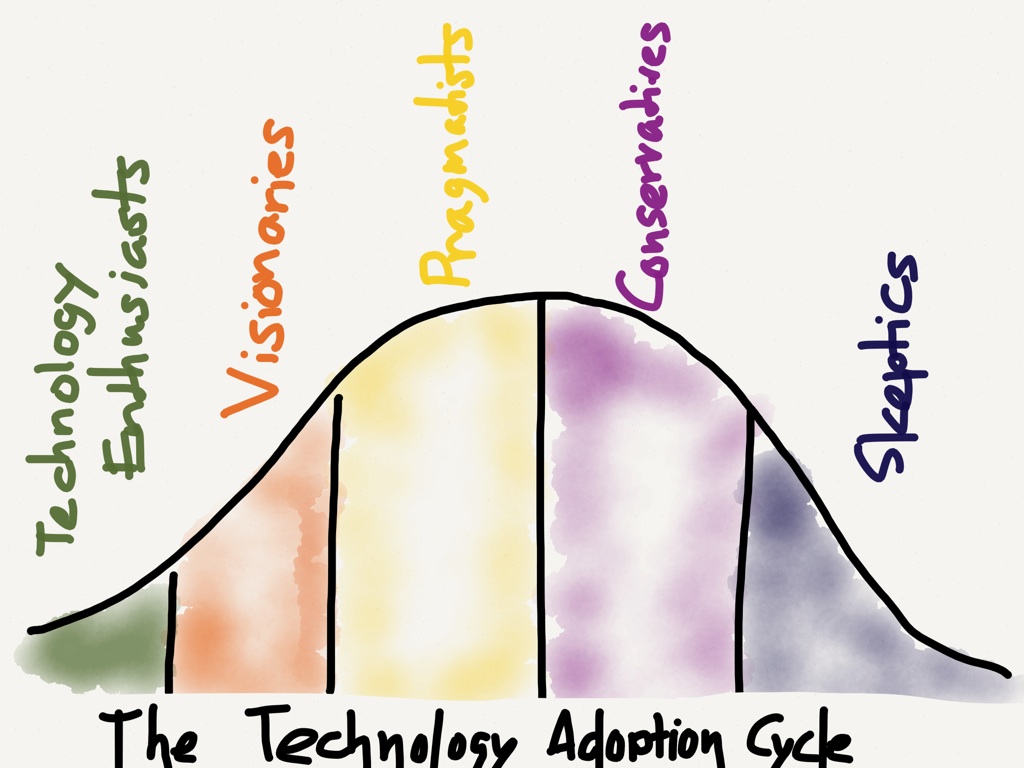
    Building on the work of three Iowa State professors studying the spread of hybrid seed corn, Moore developed the technology adoption cycle, which breaks the market for new technologies into five parts:

    image-26

    • Technology Enthusiasts love tech first and foremost, and are always looking to be on the cutting edge; they are the first to try a new product
    • Visionaries love new products as well, but they also have an eye on how those new products or technologies can be applied. They are the most price-insensitive part of the market
    • Pragmatists are a much larger segment of the market; they are open to new products, but they need evidence they will work and be worth the trouble, and they are much more price conscious
    • Conservatives are much more hesitant to accept change; they are inherently suspicious of any new technology and often only adopt new products when doing so is the only way to keep up. Because they don’t highly value technology, they aren’t willing to pay a lot
    • Skeptics are not just hesitant but actively hostile to technology

    Moore was primarily concerned with “crossing the chasm” from the early market – enthusiasts and visionaries – to the mainstream market – pragmatists and conservatives, and if there is one product that clearly crossed the chasm, it is the smartphone. There are an estimated two billion smartphones in use around the world, and in developed countries penetration is reaching the 80% mark – only the skeptics are left. Surely this is a mature market.

    That, though, makes the fates of the three biggest smartphone companies – Apple, Xiaomi, and Samsung – particularly interesting:

    • Apple offers by far the most expensive phones on the market, but even though the early price-insensitive market has presumably been saturated, the iPhone is actually growing
    • Samsung phones are widely available at multiple price points, making them an easy choice for low information customers on the right side of the cycle, yet the company is struggling
    • Xiaomi has very aggressive prices, but their brand proposition is very much tuned to the left side of the cycle

    All of this seems to fly in the face of Moore’s assumption that late-stage adoption would be driven by price and pragmatism (or, in the case of conservatives, necessity). Price and pragmatism might as well be Samsung’s motto, while Apple is super expensive and Xiaomi is avowedly geeky.1

    I suspect the problem is that while Moore has updated “Crossing the Chasm” (the third edition came out last January), the book is still a product of 1991 when nearly all technology buyers were businesses located in developed countries. Smartphones don’t have either qualification: people buy smartphones, not businesses, and developing countries are just as much a market as developed ones.

    Apple and the Conservatives

    According to Moore, high prices are only sustainable on the left side of the adoption curve:

    The first perspective to set on pricing is the customers’, and, as we noted in the section on discovering the chasm, that varies dramatically with their psychographics. Visionaries – the customers dominating the early market’s development – are relatively price-insensitive. Seeking a strategic leap forward, with an order-of-magnitude return on investment, they are convinced that any immediate costs are insignificant when compared with the end result. Indeed, they want to make sure there is, if anything, extra money in the price, because they know they are going to need special service, and they want their vendors to have the funding to provide it. There is even a kind of prestige in buying the high-priced alternative. All this is pure value-based pricing. Because of the high value placed on the end result, the product price has a high umbrella under which it can unfold.

    Certainly Apple has captured the visionaries, but how is it that the iPhone continues to grow? After all, Moore argues that conservatives will behave the exact opposite:

    At the other end of the market are the conservatives. They want low pricing. They have waited a long time before buying the product – long enough for complete institutionalization of the whole product, and long enough for prices to have dropped to only a small margin above cost. This is their reward for buying late. They don’t get competitive advantage, but they do keep their out-of-pocket costs way down. This is cost-based pricing, something that will eventually emerge in any mainstream market, once all the other margin-justifying elements have been exhausted.

    In this Moore’s thinking is not unlike Clayton Christensen’s: low-end disruption theory is also focused on performance and price. In a new market – the visionary market – when no product is good enough, the integrated provider can sell superior performance with a margin to match, but over time, as the technology becomes “good enough,” lower-priced modular competitors will take over the market.

    However, as I argued in Best, in consumer markets the user experience is just as important.

    The primary flaw in this conclusion, as I detailed last year, is that the Christensen evaluation of “good enough” only considers technical capabilities. Christensen did later add the idea of emotional jobs-to-be-done – this covers things like luxury bags, for example, which confer status – but that doesn’t fully explain Apple in particular. Instead, my position is there is a third component of product capability: the user experience. Moreover, the user experience is unique in that, like emotional jobs-to-be-done, a product can never be “too good,” and, like technical jobs-to-be-done, it is always possible to improve – or to fall behind.

    Moreover, if user experience matters generally, it matters the most to conservatives. Moore notes:

    The truth is, conservatives often fear high tech a little bit. Therefore, they tend to invest only at the end of a technology life cycle, when products are extremely mature, market-share competition is driving low prices, and the products themselves can be treated as commodities. Often their real goal in buying high-tech products is simply not to get stung. Unfortunately, because they are engaging with the low-margin end of the market, where there is little motive for the seller to build a high-integrity relationship with the buyer, they often do get stung. This only reinforces their disillusion with high tech and resets the buying cycle at an even more cynical level.

    If high-tech businesses are going to be successful over the long term, they must learn to break this vicious circle and establish a reasonable basis for conservatives to want to do business with them. They must understand that conservatives do not have high aspirations about their high-tech investments and hence will not support high price margins. Nonetheless, through sheer volume, they can offer great rewards to the companies that serve them appropriately.

    I think Moore was spot-on on the psychology of conservatives, but completely underestimated their willingness to pay for a solution that allays their fear. These customers don’t want leftover technology that barely works. They want technology that works better. Specifically, Apple’s focus on the user experience ought to be even more attractive to conservatives than it is to visionaries, and this very sizable group is potentially more willing to pay for a solution that is easier to use.

    If indeed Apple has broken through with conservatives, this has powerful implications for all kinds of companies: smartphones are the tip of the spear when it comes to the spread of technology into every part of society, and what Apple may be demonstrating is that there is real money to be made amongst late adopters if the user experience is demonstrably superior. To be sure, Apple’s powerful brand and reputation is hard to replicate,2 but the iPhone’s continued success offers hope that customers will pay for true differentiation, not trickle-down technology.

    Xiaomi and the Visionaries

    If Apple is doing surprisingly well on the right side of the adoption cycle, I think the best way to think about Xiaomi is that they are competing in a different market entirely. For much of China and especially India, price matters not because people don’t care, but simply because many don’t have very much money.

    This is a critical distinction: in Moore’s telling, pragmatists and conservatives pay attention to price simply because they aren’t willing to pay a premium. They have the capability, but not the desire. This, though, does not describe the typical Xiaomi customer. From an interview I conducted with Xiaomi Vice President of International Hugo Barra (members only):

    BT: Who is your target customer in China?

    HB: Our target customer in China are the 18 to 30 year olds, reasonably well educated, reasonably geeky, and value-orientated [i.e. not rich] and who appreciate the high spec. They are the ones who become the ambassadors for the brand to other audiences…

    BT: What about internationally?

    HB: Largely the same thing. I think we what we’re learning in India in particular is that the IT-educated is extremely large. I think a lot of that is a result of India’s tradition of being the IT back office of the world. In India, even the Red Mi product line attracts the IT-educated customer who just doesn’t have the money to buy one of our high-end products. But we find ourselves having a conversation about features and specs with a customer who bought Red Mi 1S that in other markets I would only have with someone who is buying a high end product. We’ve never experienced a level of scrutiny at a spec and performance level on a Red Mi product that we have in India.

    These customers are not conservative, or even pragmatists: they are enthusiasts and visionaries who simply don’t have very much money. The proper way to reach them, then, is not to sell them trickle-down technology: they will see right through that, and dismiss it out of hand. Rather, the solution to is develop new business models – indeed, in the case of Xiaomi, a new company – that is built from the ground-up to serve their specific needs.

    This, too, is a powerful opportunity: there are far, far more potential customers in developing countries than there are in developed ones, but just because they don’t have much money does not mean they are technological laggards. Indeed, many of these customers are even more advanced when it comes to being mobile first because of the lack of a PC legacy, and they will embrace a brand that lets them live on the cutting edge.


    To be sure, there is still innovation happening among rich consumers in the developed world – Uber is evidence of that! However, I suspect it is these two markets – conservatives in developed countries, and enthusiasts and visionaries in developing ones – that will provide some of the biggest opportunities over the next few years. The smartphone has opened the door: which companies will walk through it?


    1. Xiaomi Vice-President of International Hugo Barra told me in an interview (members-only) that Xiaomi is “a geeky lifestyle brand 

    2. Even if, as many fret, it is being damaged 


  • Mobile First

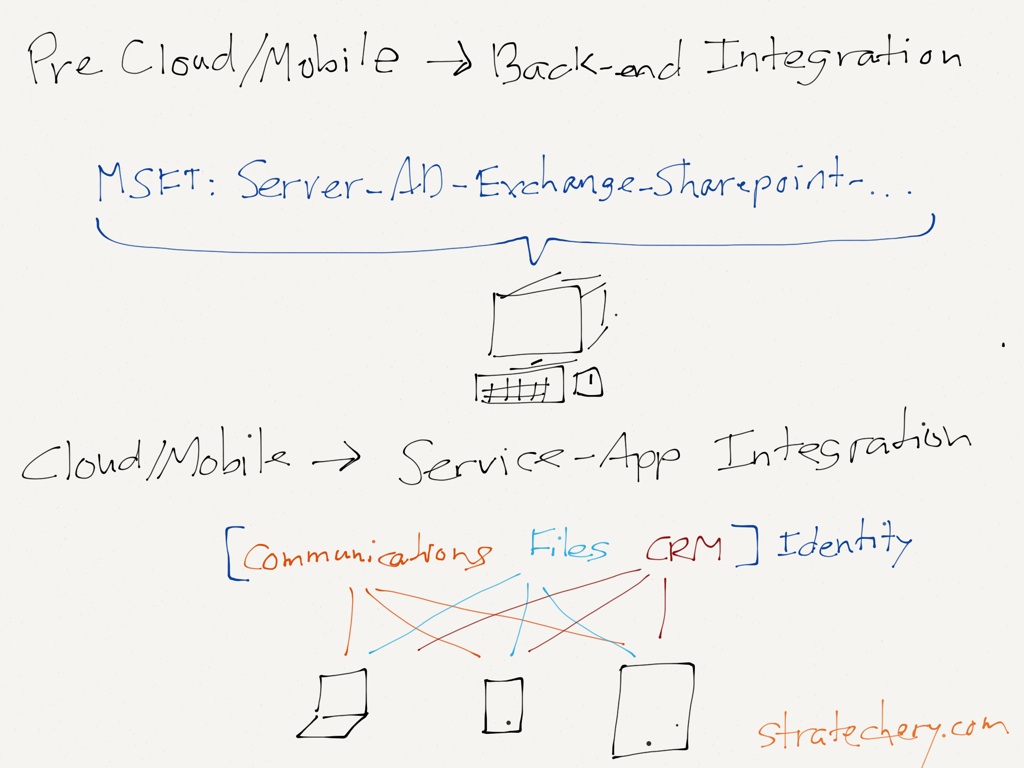
    Last Friday was the eight-year anniversary of the announcement of the iPhone, the event that began the mobile epoch. It was, though, an Apple rumor that to my mind illustrated just how much the world has changed.

    Mark Gurman is reporting at 9to5Mac that the next MacBook Air will have a radical redesign. The biggest surprise was about the ports, or lack thereof:

    The upcoming 12-inch Air has the fewest amount of ports ever on an Apple computer…On the right side is a standard headphone jack and dual-microphones for input and noise-canceling. On the left side is solely the new USB Type-C port. Yes, Apple is currently planning to ditch standard USB ports, the SD Card slot, and even its Thunderbolt and MagSafe charging standards on this new notebook…As we’ve reported on multiple occasions, the new USB Type-C connector is smaller, faster, and more capable than the standard USB 2.0 and 3.0 ports on existing computers. The connector is able to replace the Thunderbolt Display port on the current Apple laptops as USB Type-C actually has the technology to drive displays. Additionally, the latest specifications from the USB foundation indicate that USB Type-C can actually be used to power computers, which makes the standard MagSafe plugs unnecessary on this new device.

    The obvious caveat here is that this is a rumor; Gurman may have a great track record, but he could be wrong and the next MacBook Air could have more than one port. But I rather suspect he’s right, because the MacBook Air he describes is the first Apple PC1 that is Mobile First.

    The Origin of Mobile First

    As best I can tell, “Mobile First” was first used by Marc Davis, then Yahoo’s Chief Scientist and VP of Early Stage Products of Yahoo! Mobile.2 From ReadWriteWeb, reporting on the Web 2.0 Expo in April 2009:

    Yahoo’s Marc Davis spoke about the mobile internet and the future of the mobile industry. As the mobile web evolves, he said, it’s no longer good enough to simply port the PC experience to the phone’s small screen – it’s time to start building “mobile-first” products instead. What are “mobile-first” products? They’re services designed to take advantage of the strengths and abilities of the mobile devices themselves, leading to entirely unique creations that can only be found on the mobile web.

    Though it’s taken a few years, Mobile First is now gospel for most consumer tech companies in particular. Perhaps the most famous example is Facebook; in a shift akin to Microsoft’s 1995 embrace of the Internet, Facebook went from having a mere 20 people on its mobile team in 2012 to several hundred mobile-focused developers embedded in every team in the company. The results – both in product and to the top and bottom lines – have been stunning.

    A better example is Instagram: the photo-sharing social network launched as an iPhone app only, and for a long time its only web presence was direct photo links. Today there is a website, but it’s little more than a scaled up version of the app, and there is no tablet app at all. This should not be a surprise: while tablets mostly run mobile operating systems, they are not mobile devices; they do not go with you everywhere.

    This distinction is critical: what is essential to understand about Mobile First is that everything flows from, well, mobility. The relative importance of implementation details and even the underlying OS fade relative to the significance of nearly every person on earth having an Internet communicator with them at every single moment. Every single product and service must start with this fundamental assumption.

    The Implications of Mobile First

    In this reading of Mobile First – that it’s about presupposing that every potential consumer of your product or service has a smartphone – the implications apply far more broadly than social networks or app makers.

    Consider CES: over the last several years the show has seemed to fade as smartphones have subsumed all types of gadgets from cameras to music players to video recorders. This year, though, was all about the “Internet of Things,” and as annoying as that catchphrase may be, it’s something that only makes sense in a Mobile First world: now, instead of those old gadgets that make PC functions mobile, “Internet of Things” products assume the presence of a mobile smartphone. Thus the most interesting innovation is in things that don’t move: locks, light bulbs, garage door openers, and more, because they are designed with the assumption that the smartphone – and associated individual – comes to them.

    Even more interesting was Sling TV, the first service that, with its focus on sports, has the potential to actually make cord-cutting palatable for far more people than any service before it.3 Just as interesting, though, is that while the service is provided by Dish Network – a company that has invested millions in launching satellites – the service is provided through an app. In other words, while the old Dish Service – and every other pay-TV service – was delivered to an address, Sling TV is delivered to a person. It is Mobile First.

    As I noted in The State of Consumer Technology at the End of 2014, individual as service endpoint is an essential characteristic of one of the most important categories of emerging services, the so-called “sharing economy”. Uber is the easy example – the service quite literally goes to an individual’s exact location and picks them up – but it also applies to services like Instacart: without a smartphone coordinating shopping trips would be a logistical nightmare. The service is absolutely Mobile First.

    Mobile First is also upsetting lots of assumptions around the transition to digital: consider the surprising news that the prospects for bookstores are looking up. From the Financial Times:

    The plot has now twisted sharply, with publishers and book chains in the US, UK and Australia celebrating sales figures showing the resilience of physical editions and of bricks-and-mortar stores.

    Waterstones said its sales had risen 5 per cent in December compared to the previous year…The optimism was echoed in the US. Barnes & Noble appears to have ended a run of declining sales, and expects sales to be flat in 2014 and 2015. Its shares rose 5 per cent on the news.

    Fundamental shifts in consumer behaviour may also be helping the high street bookstore. “People are moving back to more frequent local shops. That’s when you can start popping in and buying books,” said Paul Lee, an analyst at Deloitte.

    That fundamental shift in behavior is mobile: the most interesting place to be is no longer in front of a computer, it’s to go out into the world with a computer in your hand. And in that view, it’s no surprise that “3rd-places” like bookstores are experiencing a renaissance – or that physical goods, a welcome break from that ever-present screen, are more desirable than ever.

    The impact will likely be felt far more broadly than bookstores: a decade ago, every small business thought they needed a website. Now many more businesses are simply focusing on their Facebook page, which is easier to find and use on mobile. Here China is light-years ahead: nearly every business has a WeChat account (you follow by scanning a QR code – they are ubiquitous) that includes not only the basics like addresses and hours but even ordering with delivery to wherever you’re sitting when you press the ‘Order’ button.

    Ordering dumplings in WeChat
    Ordering dumplings in WeChat

    Even dumplings are Mobile First.

    Why the Rumored MacBook Air is Mobile First

    And so, the story of the (rumored) MacBook Air starts not with the Mac, but rather with the iPhone. By virtue of its omnipresence it is the most important device in most consumers’ lives. It is the first choice for getting information, for communicating, for taking pictures. It is a device that a huge majority of people could live on exclusively, and it very much stands alone: all of its essential functions have cloud counterparts, but none assume a PC.4

    True, it would be nice to have a keyboard to type longer emails, reports or papers, or a larger screen to watch movies, but those capabilities – again, for most people, not all – are nice to have, not essential.5 Moreover, all of those capabilities depend on the same cloud services as the phone: email, social networking, photos, all of it comes over the (wireless) network, not a cable.

    In this world, a Mobile First world, what exactly is the point of a port?6


    1. Chromebooks were first 

    2. Seriously, that’s the title, according to this TechCrunch article reporting Davis’ exit a mere three months after coining the term “Mobile First”. I suspect there is a lot about Yahoo’s fate that can be gleaned from this footnote 

    3. I wrote about this extensively in the Daily Update here and here) (members-only links)  

    4. Microsoft’s “Mobile First Cloud First” strategy makes much more sense now, no? 

    5. To put it another way, a MacBook Air is in the same class as an iPad 

    6. If you need ports, buy a MacBook Pro. But if you care about rumors of unreleased products, you’re probably not a normal consumer! 


  • Xiaomi’s Ambition

    Xiaomi, the Chinese smart phone company that late last month raised $1.1 billion at a $45 billion valuation, sells way more than smartphones: Mi.com boasts over a thousand items, and it’s the third-largest e-commerce site in China. One item it doesn’t sell, though, is a AA battery charger. Only Apple:

    applebattery

    I clearly remember when this rather oddball product came out, not because it was particularly magical or revolutionary, but because a co-worker had one in his hand the very next day. He regaled us with tales of power efficiency and “vampire draw” (or the lack thereof), curiously neglecting to mention why it was he actually needed a battery charger. He bought it because it was made by Apple, and that was enough.

    What is Xiaomi?

    There’s come to be a bit of a cliché when it comes to writing about Xiaomi. The author declares that Xiaomi is known as the “Apple of China”, but actually, said author explains, they’re something very different: more like Amazon, or maybe a bit of Google, to use the words of Xiaomi CEO Lei Jun. They sell smartphones at cost, or close to it, and will make money through services.

    The trouble with a lot of this commentary surrounding Xiaomi1 comes in determining exactly what those “services” are. The easy assumption are traditional Internet services like those offered by Google, including an app store, online portals, so on and so forth. That, though, hardly validates a $45 billion valuation, particularly when most of the money to be made on mobile services in China is being vacuumed up by Tencent through their dominant WeChat app, with Baidu (search), Alibaba (e-commerce), Apple (the App Store), and the various Chinese App Stores’ capturing the rest (Xiaomi has their own app store, but it’s only the 5th most popular).

    Instead, the way to understand Xiaomi and why exactly they are so valuable is to more deeply understand what Lei Jun means by “services”, and, in the end, why Xiaomi actually is a lot like Apple after all.

    Horizontal versus Vertical

    Early in this blog’s life, I spent quite a bit of time discussing the differences between vertical business models – like Apple – as compared to horizontal business models – like Google. Apple provides services as a means of differentiating their hardware, which they sell for a profit; they are exclusive. Google, on the other hand, wants to reach everyone with their services, whether they be on iOS or Android.2

    It’s not immediately obvious where Xiaomi fits though. After all, MiUI, Xiaomi’s freely available Android ROM, itself a service that enables access to all of Xiaomi’s other services, is available for other manufacturers’ Android devices. That seems like a horizontal offering. On the other hand, the vast majority of Xiaomi’s revenue comes from handset sales, which suggests a vertical business model. Are they stuck in the messy middle?

    I don’t think so, and the answer comes back to my co-worker’s battery charger.

    Xiaomi’s Fans

    In 2013, Xiaomi shocked a lot of observers when they announced the MiTV. It was less surprising when Xiaomi released internet routers, but the shock returned with last fall’s announcement of an air purifier, and apparently a water purifier is on the way; all tie in to MiUI. At the time of the MiTV announcement, Lei Jun said something very interesting: “We want to build the first TV our fans will use.”

    Understanding Xiaomi’s fans is critical to understanding the company. The New York Times captured the fervor well in a profile of the company last month:

    Li Nan, vice president of the rival Meizu, which began in the early 2000s by making digital music players and aims at customers slightly older and wealthier than Xiaomi’s, likens the devotion of Xiaomi supporters to a religion.

    “Xiaomi fans have a high level of organization,” he said. “They love Xiaomi. It’s a form of idolatry.”

    Han Yu, a 24-year-old studying for his master’s degree, is one of those idolaters. He, with tens of thousands of others, helps Xiaomi test its user interface by looking for bugs and offering suggestions. Mr. Han moderates several pages on the company’s online forum, which averages 200,000 posts a day and is where fans interact with the company.

    Much of his personal life revolves around Xiaomi, and he says he has met many friends that way. He said he was honored when his suggestion to create a private photo folder was adopted on phones by Xiaomi.

    “I really enjoy the sense of participation,” Mr. Han said.

    Note Han’s age: 24. That fits with the data captured by Flurry last summer:

    Xiaomi consumers over-index on the 13-17, 18-24 and 25-34 segments and under-index on the 35-54 and 55+ segments. This data shows that the Xiaomi devices are very popular among the young population of China, especially college students and young adults who just entered the workforce.

    xiaomi_users_hires_v1

    The article doesn’t say where Han lives, but it’s highly likely he still lives with his parents. That’s the norm in China (and much of Asia): children will live with their parents until they are able to afford to buy a place of their own (renting is frowned upon). This actually makes these customers quite valuable: they tend to have more disposable cash than if they were paying for all of their own housing, utilities, food, etc, and certainly Xiaomi’s extensive accessory offerings take advantage of this.

    What is more interesting, though, is what will happen when Han and his peers finally do get places of their own. They will need to buy TVs, and air purifiers, and all kinds of (relatively) high renminbi goods. And which brand do you think they will choose? If Apple can sell a battery charger to my coworker, I’m pretty certain Xiaomi can sell an air purifier to Mr. Han, and, sooner rather than later, just about everything he needs for his new house (many of these products will be built by 3rd parties that Xiaomi invests in).

    Selling the Xiaomi Lifestyle

    This, then, is the key to understanding Xiaomi: they’re not so much selling smartphones as they are selling a lifestyle, and the key to that lifestyle is MiUI, Xiaomi’s software layer that ties all of these things together.

    In fact, you could argue that Xiaomi is actually the first “Internet of Things” company: unlike Google (Nest), Apple (HomeKit), or even Samsung (SmartThings), all of whom are offering some sort of open SDK to tie everything together (a necessity given that most of their customers already have appliances that won’t be replaced anytime soon) Xiaomi is integrating everything itself and selling everything one needs on Mi.com to a fan base primed to outfit their homes for the very first time. It’s absolutely a vertical strategy – the company is like Apple after all – it’s just that the product offering is far broader than anything even Gene Munster could imagine.3 The services Lei Jun talks about – MiUI and Mi.com especially – sell the products and tie them all together, but they are all Xiaomi products in the end.

    And, of course, that fan base is concentrated in the most populous country in the world.

    This strategy also explains Xiaomi’s international expansion strategy: India – the world’s 2nd largest population – is already well underway, and Indonesia – the 4th largest – just kicked off. Brazil (5th) is coming soon. True, the United States (3rd) isn’t coming any time soon, but why bother? Apple has the fans, everyone has appliances, and yes, there is a bit of an IP problem.

    Xiaomi’s Challenges

    Xiaomi’s ambitions are, I think, far more audacious than most realize. The company doesn’t just want to be a dominant player in smartphones, one of the largest and most lucrative product categories ever. They want the entire house, and I wouldn’t be surprised if even that is too limiting a description of Lei Jun’s ambition. There are significant challenges though, and many of them come back to product design.

    In the short run, it’s not actually a huge market problem if Xiaomi’s products too closely “compliment” other products on the market;4 the solemnity of intellectual property is rather unique to Western culture. In China, as in much of Asia, inventions and even pure acts of creation were thought to belong to the community; visit any Chinese museum and you can calculate the value of a scroll or painting by the number of seals applied by important people showing their appreciation:

    From Art-Virtue.com
    From Art-Virtue.com

    And, I might add, from my perspective it’s not a big moral problem either: the truth is the United States ran just as roughshod over intellectual property during its rise to power as China does today, and I’m more than sympathetic to the developing world’s position that the West is attempting to pull up the ladder behind it: no one was holding Europe or American to task for pollution or intellectual property or workers’ rights the way the West does the rest of the world. That doesn’t make it “right,” it just makes “right” a whole lot more gray than “Xiaomi-are-copycats” complainers are apt to admit.

    The problem with Xiaomi’s originality – or lack thereof – becomes more pronounced when you consider the company’s international prospects. The further you get from China, the less impactful are intangibles like Lei Jun’s celebrity, the rock-concert product announcements,5 Xiaomi’s powerful social media presence, etc. Moreover, the costs start to rise as well, as Xiaomi is increasingly forced to rely on 3rd-party retailers (although, even then, Xiaomi is going the online-only route). If Xiaomi wants to create the same sort of fans they have in China – the sort of fans that will make their house a Xiaomi house – they need to rely on their products. And copycat isn’t going to cut it.

    What is certain, though, is that Xiaomi isn’t going to the West anytime soon. Not only would the licensing fees be prohibitive,6 but the West already has fully furnished houses and powerhouse brands. The opportunity is simply so much greater elsewhere. It’s absolutely the truth that a company can be worth $45 billion – and, in the long run, probably a lot more – without ever targeting the United States or Western Europe.

    Xiaomi and China

    In the long run, though, the impact of Xiaomi may prove to be more intangible yet more significant than how much money the company ends up making its investors. There have been a lot of big Chinese companies, even some that have gone international, but there has never been a big Chinese consumer brand that has resonated beyond China, in part because few have resonated within China.

    In fact, there is more than what meets the eye when it comes to the age of Xiaomi’s fans. Older Chinese – the over-30s that under-index on Xiaomi ownership – have traditionally looked down on their own country’s brands, assuming them cheap and second-rate. This is the population to which Apple – and all of the Western luxury companies – are selling to with great success. There is a younger generation, though, the Xiaomi generation, that has grown up in a country that has been growing by near double digits every year they have been alive. To their minds of course China is a global power, and why wouldn’t they embrace Chinese brands? Xiaomi is tapping into that nationalistic bent, and the red star on their mascot’s hat couldn’t be less subtle:

    MIUIEs-Logo

    Make no mistake: it is the Chinese themselves that were always Xiaomi’s biggest challenge, and they’ve won and won handily. Don’t underestimate their potential – and China’s broadly – in the rest of the developing world, a world that is far, far bigger than the West.


    1. A notable exception is this excellent piece by Michael Vakulenko 

    2. As I laid out in The Android Detour, the entire reason Android exists is to preserve access to Google’s services 

    3. Munster is famous for predicting – for years now – that Apple will make an actual TV set 

    4. It’s not just Apple fans that gripe; even the air purifier faces charges of copying 

    5. There will be another one next week; I will be attending and documenting it for Daily Update subscribers  

    6. And again, many of these licensing fees go to companies that aren’t even competing in the smartphone space anyway; are these patents really making the world a better and more innovative place? 


  • The 2014 Stratechery Year in Review

    2014 was Stratechery’s second year, and what a momentous one it was! In April Stratechery became my full-time job, and although I made some quick changes to the model, it’s been a big success. It has certainly kept me busy: in 2014 I wrote 88 free articles, 169 Daily Updates, and recorded 41 podcasts (29 of them were Exponent episodes).

    Here are the highlights (the 2013 edition is here):

    Brand advertising is worth a lot more than search advertising; if it moves to the Internet, .Google's share of digital advertising would be dwarfed
    Peak Google

    The Five Most-Viewed Articles:

    1. Peak Google – Google owns search, and will continue to do so. But the online ad market is about to get a lot bigger, and it’s not clear that Google will win. They may be eclipsed like Microsoft before them
    2. Apple Watch: Asking Why and Saying No – Apple Watch is beautiful and has many compelling features, but Apple never said why it exists. Has that led them to do too much? (Note that I later changed my mind: see What I Got Wrong About Apple Watch and Why Now for Apple Watch)
    3. Smartphone Truths and Samsung’s Inevitable Decline – All of the reasons to buy high-end Samsung phones are disappearing; Apple, meanwhile, will always have software-based differentiation and a big market to address
    4. It’s Time to Kill Surface – It’s important to evaluate products – like the Xbox and Surface – in the light of their original goals. If you do that, then it’s clear Surface has failed
    5. Two Microsofts – Making Mobile Office (nearly) free bring a lot of clarity to MIcrosoft’s business: it’s actually two different ones – consumer and enterprise
    When a successful company seeks to address a new problem, they are often handicapped by their old incentive structure, leaving them susceptible to a startup able to fashion problem-specific incentives
    PayPal’s Incentive Problem, and Why Startups Win

    Five Big Ideas

    Apple's focus on creating a great user experience builds consumer loyalty. Consumers then put market pressure on Apple's potential partners, which result in concessions to Apple, further enhancing the user experience
    How Apple Creates Leverage and the Future of Apple Pay

    Five Company-Specific Posts

    • Twitter’s Marketing Problem – Twitter’s initial product was so good that they never went to the trouble of understanding their market, and now they are paying the price.
    • It’s Time to Split Up Microsoft – Satya Nadella is saying all of the right things, but Microsoft’s culture has always been Windows first. The solution is to get rid of Windows
    • How Apple Creates Leverage, and the Future of Apple Pay – How Apple Creates Leverage, and the Future of Apple Pay
    • Best – Apple avoids disruption by creating a superior user experience. That requires focus, and any advice to the contrary doesn’t make sense
    • Why Uber Fights – Big business is brutally competitive, and a very big business is exactly what Uber is fighting for. Their potential is absolutely massive
    Publishers and the Smiling Curve
    Publishers and the Smiling Curve

    Five Daily Updates

    (Please note that these are subscriber-only links – you can sign-up here)

    • August 5 – Xiaomi Wins on More than Price, Micromax and Local Taste, Local Brands and Scale
    • October 22 – The Disruption of IBM, An Alternate View of IBM’s 2015 Profit Goal, IMB Sells Fabs to Global Foundries
    • November 12 – Taylor Swift vs Daniel Elk, What Swift Gets Right, The Problem with Spotify
    • December 1 – Why Vox (and BuzzFeed) are Valuable, Outbrain Files for IPO
    • December 2 – The Solo Selfie and its Cool Factor, The Donut Selfie and its Creator
    App stores take 30% of in-app purchases; the remainder goes to free-to-play publishers like King. These publishers, in turn, drive the majority of Facebook mobile advertising, as that is the best channel to find more digital whales. And now, 3rd-party developers can get their piece.
    Dependent on Digital Whales

    Five Podcasts

    Happy New Year. I’m looking forward to a great 2015.


  • Christmas Gifts and the Meaning of Design

    This is a re-post from December, 2013

    Gifts are a funny thing.

    A year ago, for Christmas 2012, my wife “gave” me an iPad mini. I use quotes because I actually bought it; supply was constrained, and when we got a notification that there were models in stock, I quickly dashed over to my local Apple Store1 and picked one up. It was a great present, and I used it happily for the next year.

    Still, though, what really made me happy on that December 25 was a simple hat:

    One of my all-time favorite gifts (this isn't the exact hat, but it's close enough)
    One of my all-time favorite gifts (this isn’t the exact hat, but it’s close enough)

    Knowing my fondness for headware that makes me look like I’m 50, my wife had surreptitiously ordered another gift, and it totally made my day when I opened it. I was surprised, and I was delighted to receive something I loved but hadn’t even considered. It was a better gift than the iPad, even though any sort of “gift analysis” would suggest the exact opposite.

    I would imagine nearly all of you can relate to this story: we make lists of what we want, and hope our loved ones follow it, but truthfully, the presents we really love are things we never would have thought to ask for.

    However – and this is the rub – it’s a big risk to buy something unasked for. There’s always the chance that your gift will crash-and-burn; to give something that surprises and delights takes great thought, empathy, and a true understanding of the giftee, and most of us quickly retreat to the safety and ease of the list.

    Gift-giving is a great example of the “uncanny valley” framework I’ve referenced with regards to Microsoft and Twitter. The “good” option is buying off the list; the “great” option is buying something even better; the “bad” option is getting it wrong, and you have to risk just that to go from good to great.

    The Uncanny Valley of Gifts
    The Uncanny Valley of Gifts

    I also think gift-giving is a useful metaphor for thinking about the difference between design thinking and market research when it comes to the development of new products. “Marketing”, properly defined, is about a great deal more than just advertising. Rather, it’s about knowing and understanding your market, and developing products that fit that market. The traditional tools in this sort of work are what you might expect: surveys, interviews, focus groups, etc. After all, the best way to give the customer what they want is to, well, ask them what they want! Moreover, things like focus groups and survey results are really useful for winning arguments internally. If you want your vision of the product to win funding and support, there’s no greater weapon than a nicely presented chart showing that prospective customers demand such and such a feature.

    This is the way the vast majority of businesses, both within tech and without, operate when it comes to new products. And it’s successful! Customers ask for X, the company makes it, and the customer buys it – if it comes in at the right price, of course. Because that’s the downside of developing based on characteristics and features that can be articulated by your customers: they can articulate those same characteristics and features to your competitors, and let you duke it out with all of them until the marginal profit of your product approaches zero.

    Approaching a problem with a design thinking mindset, however, certainly takes into account what a customer says, but simply as one input among many. In this approach, observing the way people really live, developing a deep understanding of the real problems they have, and gaining an appreciation of the “hacks” they devise to overcome them can deliver an understanding of prospective customers’ needs that is more accurate than what any of those prospective customers could ever articulate on their own.

    And then, from that understanding, an entirely new, highly differentiated product can be delivered that surprises and delights.2 From a business perspective, the emotion and attachment said product inspires breaks down price sensitivity and builds brand attachment, and inspires the sort of viral marketing that can’t be bought.

    The brands that resonate, that people love – most famously Apple, of course, but there are other examples3 – are those that suprise and delight. In fact, those words are a central tenet at Apple, and one of the primary standards by which all products are measured. What few appreciate, though, is that when Steve Jobs bragged about not doing market research or not holding focus groups, he was not saying Apple did less than the competition; rather, they did so much more.

    It is this lack of understanding and appreciation for the very hard work and deep thinking required to surprise and delight that leads to countless companies and Steve-Jobs-wannabes crashing-and-burning, even as they declare their fealty to design. What they don’t understand is that design is not just about looking good, or working well, or even being easy-to-use. The most fundamental part of design is truly understanding your customers at a deeper level than they even understand themselves. Moreover, to truly be design-centric is harder than being market-centric. Things like surveys and focus groups persist because, while the products that result may not inspire love, they don’t inspire hate – or worse, apathy – either.

    It is wonderful to see so many new products that are beautiful and easy-to-use. But great designs are as rare as ever – just as rare as those gifts that occupy an outsized place in your memory relative to their monetary or symbolic worth simply because someone took the time and effort to truly understand you.

    Merry Christmas to all my readers, and a special thanks to all of the Daily Update subscribers. You make this site possible. Check back in next week for my year in review (here is the 2013 version)


    1. I was living in the US at the time 

    2. This is where I have a hard time with those who argue for the complete abolishment of patents; I want to preserve this reward 

    3. P&G is one of my favorites; the development of the Swiffer mop is a great example of this process 


  • The State of Consumer Technology at the End of 2014

    While the modern computing era in many respects began with the IBM System/360 mainframe and further expanded with the minicomputer, normal consumers didn’t start encountering computers until the personal computer. And, while mainframes are technically still around (while minicomputers are decidedly not), what is unique about the PC is that it is very much still a part of modern life.

    In fact, one of the defining characteristics of the three major epochs of consumer computing – PC, Internet, and mobile – is that they have been largely complementary: we didn’t so much replace one form of computing for another insomuch as we added forms on top of each other.1 That is why, as I argued in Peak Google, many of the major tech companies of the last thirty years haven’t so much been disrupted as they have been eclipsed by new companies built during new epochs. All of the attention and relevance in tech especially is focused on emerging and growing companies, even as mature giants reap massive profits.

    Every epoch has had four distinct arenas of competition that emerge in order:

    • The core technology
    • The operating system (i.e. the means by which the core technology is harnessed)
    • The killer use case for:
      • Work/Productivity
      • Communication

    Certainly computers can be used for more than work/productivity or communication, but those two use cases are universal and lead to the biggest winners and most important companies.

    Epoch One: The PC

    The PC epoch began on August 12, 1981. That is the day the IBM Personal Computer was released with an Intel 8088 processor running Microsoft DOS 1.0. This open design was the core technology; the only proprietary IBM chip inside was the BIOS, which was soon reverse-engineered by Compaq who released the first “PC compatible” computer 17 months later.

    The operating system for the PC has been owned by Microsoft from the beginning; the Mac has garnered a profitable share at times (including today), but Windows versus Mac wasn’t really a contest, because with DOS Microsoft had already won the game.

    The killer application for work/productivity on the PC was the spreadsheet specifically, and front-office general-purpose apps broadly, including the word processor and presentation software. While it took much longer, Microsoft eventually came to dominate this space as well with the Office suite.

    The killer communication application on the PC ended up being open as well: email. Still, even here the most dominant player, at least in the corporate space (which is what mattered), was Microsoft once again, with Exchange on Windows Server. For all you young folks that can’t understand why us old people looked at Microsoft for so long with a mix of reverence and fear, well, now you know: the company in the end owned nearly every component of the PC epoch, and for all their struggles to remain relevant, Microsoft has never struggled to be profitable.

    Epoch Two: The Internet

    The Internet epoch began 14 years after the PC epoch, nearly to the day, with the Netscape IPO on August 9, 1995. The core pieces of the Internet had been around for years, and the World Wide Web was developed by Tim Berners-Lee and formally announced in August 1991 (clearly August is an auspicious month), but it was the “Netscape Moment” that woke everyone up to the possibilities of the Internet.

    Here the battle for the OS – also known as the browser – was much more fraught. Netscape jumped out to a huge lead, holding over 90 percent usage share, but Microsoft fought back by bundling Internet Explorer for free with Windows, and, truthfully, from Internet Explorer 3 on, by having a better product. Eventually it was Internet Explorer that had over 90 percent market share, and Microsoft felt they had won the Internet.

    However, it ultimately turned out that the browser wasn’t what mattered. Instead, the Internet made information, which for so long had been a scarce resource, abundant. So abundant, in fact, that it seemed impossible to make sense of it all, at least until Google came along. Search was the killer work/productivity application on the Internet: now you could instantly find the answer to just about anything on Google, and the company rightly dominated the category.

    The killer communications app took even longer to appear, but it solved a problem not dissimilar to Google: Facebook didn’t just let you communicate with people you knew, it came to understand how nearly every single person online was connected. And, as the number of people online continued to grow, so did Facebook. For all the misguided talk of Facebook being under threat, the reality is that its position as the default interconnect between every person on earth is as secure as ever.

    Epoch Three: Mobile

    I would like to choose Google’s acquisition of Android as the beginning of the mobile epoch, just because it happened in August (2005, in this case), but the date that matters is January 9, 2007, when Steve Jobs announced Apple’s iPhone. The core technology was the smartphone; while Nokia, Palm and Blackberry had been building precursors, it was the iPhone with its multitouch screen, unfettered Internet access, and (eventual) App Store that defined the category.

    Unlike the previous two eras, there has not been a single winner when it comes to the OS. In contrast to the PC, Apple was first-to-market. More importantly, smartphone buyers and smartphone users are usually always the same person, which allows Apple to differentiate itself according to the user experience and thus retain the top slice of the market. Android, meanwhile, was not only the first credible alternative to iOS, but also free, making it the operating system of choice for desperate phone OEM’s everywhere, and over time, allowing the OS to gobble up the vast expanses of the market driven primarily by price.

    Right now the operating system war is roughly at equilibrium; with the iPhone 6 it seems likely that Apple is stealing some share back from Android, particularly at the high end, but Android is simultaneously pushing down and out into the developing world, expanding both its share of the market and the market as a whole. What is more interesting is looking at who will emerge in the communications and work/productivity space.

    The Mobile Work/Productivity Space

    If the PC epoch was about being omnipotent – computers can do everything, better! – and the Internet epoch about being omniscient – with Google, you can know everything – mobile is about being omnipresent. By virtue of being, well, mobile, smartphones extend computing to every aspect of our daily lives. That is why the killer applications and dominant companies in the mobile work/productivity space will be defined by how they bridge the online and offline worlds.

    Chief among these companies, at least in my opinion, is Uber: the long-term potential of the company is about being the physical network that connects everything. Their success, though, is by no means assured. Moreover, there are other interconnects, like Airbnb or Postmates or Instacart, which are targeting verticals instead of everything everywhere. These examples are all built on the “sharing” economy, the sheer logistics of which are only possible because of smartphones.

    Other work/productivity applications may continue to emerge – cameras are very interesting here – but I suspect the dominant companies have already been started.

    The Mobile Communications Space

    I’ve already made my case for the winning communications application back in February (the day before Facebook acquired WhatsApp) in an article called Messaging: Mobile’s Killer App:

    Still, it’s only recently that the killer app for this era, when the nodes of communication are smartphones, has become apparent, and it is messaging. While the home telephone enabled real-time communication, and the web passive communication, messaging enables constant communication. Conversations are never ending, and friends come and go at a pace dictated not by physicality, but rather by attention. And, given that we are all humans and crave human interaction and affection, we are more than happy to give massive amounts of attention to messaging, to those who matter most to us, and who are always there in our pockets and purses.

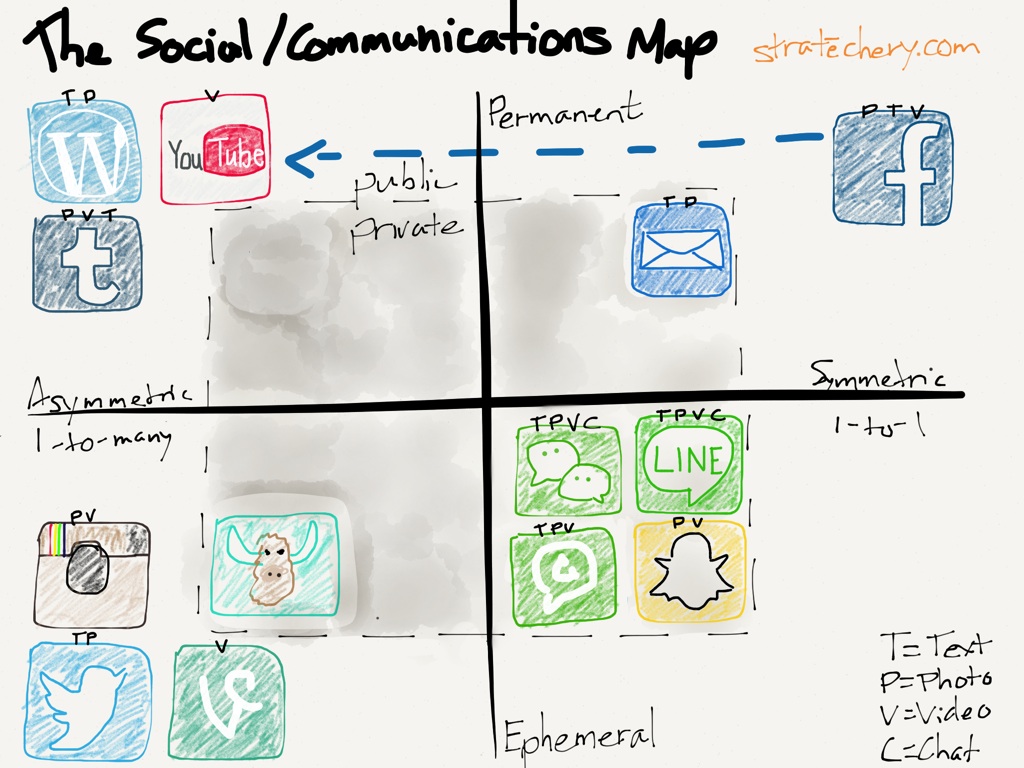
    As I note in that article, messaging is compelling not just because it enables a new kind of communication, but also because it is a platform in and of itself. Already LINE and WeChat are leveraging that platform to push applications, particularly games, and making money on the back end. In the future, I expect both to be major channels for direct marketing between companies and consumers, and in fact WeChat has pushed even further in China, offering e-commerce, taxi services, and more all through their messaging app.

    It seems likely that the messaging battle will result in multiple winners: LINE already owns Japan, Taiwan, and Thailand, and is competitive in Indonesia and (they claim) in Spain, while WeChat is dominant in China. WhatsApp has the largest share worldwide, but that product is the furthest from being a real platform and a real business.2 Messenger is clearly seeking to mimic LINE and WeChat, and is the likely winner in most Western countries.3

    threeepochs

    What’s Next

    While the introduction of the iPhone seems like it was just yesterday (at least it does to me!), we are quickly approaching seven years – about the midway point of this epoch, if the PC and Internet are any indication.4 I sense, though, that we may be moving a bit more quickly: the work/productivity and communications applications have really come into focus this year, and while the battle to see what companies ride those applications to dominance will be interesting, it’s highly likely that the foundation is being laid for the core technology of the next epoch:

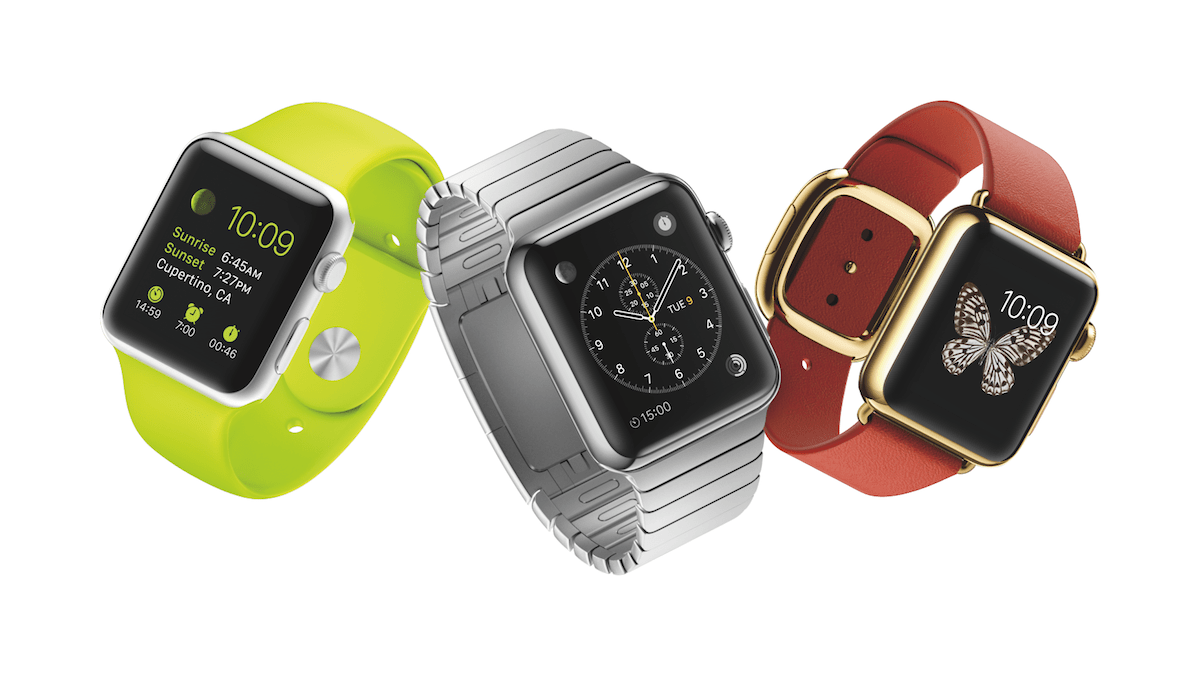
    • Wearables is a possibility, and it certainly seems that Apple is trying to accelerate the category with their ambitious Apple Watch rollout. However, no matter how good the Apple Watch is, I’m not sure it’s an epoch definer, especially if it cannot truly stand alone

    • Bitcoin is a definite possibility, particularly if there ends up being a “tick-tock” to epochs: device (PC), then protocol (Internet), device (smartphone), then protocol (Bitcoin). Blockstream, an attempt to create sidechains for non-monetary applications that run on top of Bitcoin, is particularly interesting in this regard5

    • Both of the mobile applications that I identified could be core technology for the next epoch: were Uber to become ubiquitous, could businesses be built on top of it? What would such an operating system look like? An out-there idea to be sure, but in the realm of possibility.

      More likely is that the messaging services become so dominant that they render the underlying mobile platform unimportant. This too would be similar to the effect of the Internet on the PC: the biggest reason the Mac was able to make a comeback from near death was because the Internet – and web apps – ran everywhere. It didn’t matter what browser6 or OS was on your actual PC. Similarly, if all essential apps and servers are routed through your messaging service, then the underlying OS – whether iOS or Android – is increasingly irrelevant. In fact, I strongly believe this is the future in China in particular, one more reason why Apple is investing so strongly in non-tangible qualities like fashion.

    What seems clearer is that today’s giants will continue owning their various categories in the context of their various epochs, even as they fade to – or continue in – irrelevance.

    • Microsoft still sells a lot of Windows licenses, and businesses especially still rely on Office. Still, it’s striking how unimportant Microsoft’s defensive move into browsers ended up being, especially when you think about…

    • Google seems strong, but as I’ve written previously, there is a lot about the company that feels like Microsoft: just as Microsoft jumped into the next epoch at the OS level for defensive reasons, Google too jumped ahead, also at the OS level, and also for defensive reasons. “Free” figured prominently in both strategies, and in the long run, it’s worth considering the possibility that Google’s Android dominance will have as much long term value to the company as Microsoft’s dominance of browsers – i.e., not very much at all. Ultimately, I expect an increasing amount of Google’s energy to go towards taking away what Microsoft has left: Chromebooks versus Windows, and Google Apps versus Office

    • Facebook is in a unique position: while they were started as an Internet company, they were an exceptionally young one, and have clearly made a successful jump to mobile. Their position in mobile, though, while secure, is by no means dominant, and it’s interesting that they are in fact following the Microsoft/Google playbook: both the WhatsApp and Oculus acquisitions were about securing a stake in the OS for the next epoch

    • Apple, as always, is following the beat of their own vertically-aligned drummer. They have (usually) good-enough services that work only on their exceptional hardware, and an OS advantage that matters to some number of people. More important in mobile is their ecosystem advantage: Apple has the best customers, devices, and OS, and thus gets the best apps, even though Apple isn’t exactly a benevolent ecosystem manager (members-only). I expect the company’s mobile position to be secure – they’re not going anywhere – and if wearables is the next epoch they are the best positioned: personal is what Apple is best at, and that’s exactly what wearables are

    • Amazon’s most important role in these epochs is AWS, where they are locked in increasingly fierce competition with Microsoft and to a lesser extent Google for cloud dominance. It’s worth noting that Amazon is attacking this space from a very different direction: AWS is another low-margin product in a company built on low-margins, while Microsoft and Google have tons of cash from their high margin core but little experience competing on price

    Do note, there are a lot of fascinating products and companies – Pinterest, Twitter, Instagram, even Xbox – that I have not covered: it’s not that they aren’t important, but they aren’t epochal (there’s a decent chance this is where Apple Watch ends up). And, of course, there is the whole enterprise world, itself undergoing real disruption (members-only) from software as a service and the explosion of mobile. What an industry!

    I have previously written Strengths-Weaknesses-Opportunities-Threats analyses for these five companies for Daily Update subscribers.

    If you would like to read these analyses and receive similar notes every day in your inbox, why not treat yourself to an early Christmas present and sign up for Stratechery Daily Updates?
    And have a very Merry Christmas!


    1. There is much confusion about this, largely because mobile is taking an ever greater percentage of time. However, most of that is additive. PC usage has in fact remained mostly static 

    2. Thanks to Facebook, of course, Jan Koum and company don’t need to worry about actually making money and can continue taunting competitors. Needless to say, I’m less impressed than Koum 

    3. iMessage is a good product and a great differentiator, but the fact it’s (rightly) not cross-platform means it’s not a player here 

    4. By the way, it’s worth noting that the midpoint of the previous two epochs – 1987 and 2000 – saw major crashes. Cross your fingers 

    5. I am still very concerned (members-only) about 51% attacks, and yes, I know all of the (ultimately trust-based) arguments against it 

    6. Mostly 


  • Docker and the Integrated Open Source Company

    It’s been a long time since an open source project has gotten as much buzz and attention as Docker. The easiest way to explain the concept is, well, to look at the logo of the eponymous1 company that created and manages the project:

    docker

    The reference in the logo is to shipping containers, one of the most important inventions of the 20th century. Actually, the word “invention” is not quite right: the idea of putting bulk goods into consistently-sized boxes goes back at least a few hundred years.2 What changed the world was the standardization of containers by a trucking magnate named Malcom McLean and Keith Tantlinger, his head engineer. Tantlinger developed much of the technology undergirding the intermodal container, especially its corner casting and Twistlock mechanism that allowed the containers to be stacked on ships, transported by trucks, and moved by crane. More importantly, Tantlinger convinced McLean to release the patented design for anyone to copy without license, knowing that the technology would only be valuable if it were deployed in every port and on every transport ship in the world. Tantlinger, to put it in software terms, open-sourced the design.

    Shipping containers really are a perfect metaphor for what Docker is building: standardized containers for applications.

    • Just as the idea of a container wasn’t invented by Tantlinger, Docker is building on a concept that has been around for quite a while. Companies like Oracle, HP, and IBM have used containers for many years, and Google especially has a very similar implementation to Docker that they use for internal projects. Docker, though, by being open source and community-centric, offers the promise of standardization
    • It doesn’t matter what is inside of a shipping container; the container itself will fit on any ship, truck, or crane in the world. Similarly, it doesn’t matter what app (and associated files, frameworks, dependencies, etc.) is inside of a docker container; the container will run on any Linux distribution and, more importantly, just about every cloud provider including AWS, Azure, Google Cloud Platform, Rackspace, etc.
    • When you move abroad, you can literally have a container brought to your house, stick in your belongings, and then have the entire thing moved to a truck to a crane to a ship to your new country. Similarly, containers allow developers to build and test an application on their local machine and have confidence that the application will behave the exact same way when it is pushed out to a server. Because everything is self-contained, the developer does not need to worry about there being different frameworks, versions, and other dependencies in the various places the application might be run

    The implications of this are far-reaching: not only do containers make it easier to manage the lifecycle of an application, they also (theoretically) commoditize cloud services through the age-old hope of “write once run anywhere.” More importantly, at least for now, docker containers offer the potential of being far more efficient than virtual machines. Relative to a container, using virtual machines is like using a car transport ship to move cargo: each unique entity on the ship is self-powered, which means a lot of wasted resources (those car engines aren’t very useful while crossing the ocean). Similarly, each virtual machine has to deal with the overhead of its own OS; containers, on the other hand, all share the same OS resulting in huge efficiency gains.3

    In short, Docker is a really big deal from a technical perspective. What excites me, though, is that the company is also innovating when it comes to their business model.


    The problem with monetizing open source is self-evident: if the software is freely available, what exactly is worth paying for? And, unlike media, you can’t exactly stick an advertisement next to some code!

    For many years the default answer has been to “be like Red Hat.” Red Hat is the creator and maintainer of the Red Hat Enterprise Linux (RHEL) distribution, which, like all Linux distributions, is freely available.4 Red Hat, however, makes money by offering support, training, a certification program, etc. for enterprises looking to use their software. It is very much a traditional enterprise model – make money on support! – just minus the up-front license fees.

    This sort of business is certainly still viable; Hortonworks is set to IPO with a similar model based on Hadoop, albeit at a much lower valuation than it received during its last VC round. That doesn’t surprise me: I don’t think this is a particularly great model from a business perspective.

    To understand why it’s useful to think about there being three distinct parts of any company that is based on open source: the open source project itself, any value-added software built on top of that project, and the actual means of making money:

    There are three parts of an open source business: the project itself, the value-added software on top of that project, and the means of monetization
    There are three parts of an open source business: the project itself, the value-added software on top of that project, and the means of monetization

    The problem with the “Red Hat” model is the complete separation of all three of these parts: Red Hat doesn’t control the core project (Linux), and their value-added software (RHEL) is free, leaving their money-making support program to stand alone. To the company’s credit they have pulled this model off, but I think a big reason is because utilizing Linux was so much more of a challenge back in the 90s.5 I highly doubt Red Hat could successfully build a similar business from scratch today.

    The three parts of Red Hat's business are separate and more difficult for the company to control and monetize
    The three parts of Red Hat’s business are separate and more difficult for the company to control and monetize

    GitHub, the repository hosting service, is exploring what is to my mind a more compelling model. GitHub’s value-added software is a hosting service based on Git, an open-source project designed by Linux creator Linus Torvalds. Crucially, GitHub is seeking to monetize that hosting service directly, both through a SaaS model and through an on-premise enterprise offering6. This means that, in comparison to Red Hat, there is one less place to disintermediate GitHub: you can’t get their value-added software (for private projects – public is free) unless you’re willing to pay.

    While GitHub does not control Git, their value-added software and means of monetization are unified, making the latter much easier and more sustainable
    While GitHub does not control Git, their value-added software and means of monetization are unified, making the latter much easier and more sustainable

    Docker takes the GitHub model a step further: the company controls everything from the open source project itself to the value-added software (DockerHub) built on top of that, and, just last week, announced a monetization model that is very similar to GitHub’s enterprise offering. Presuming Docker continues its present momentum and finds success with this enterprise offering, they have the potential to be a fully integrated open source software company: project, value-added software, and monetization all rolled into one.

    Docker controls all the parts of their business: they are a fully integrated open source company.
    Docker controls all the parts of their business: they are a fully integrated open source company.

    This is exciting, and, to be honest, a little scary. What is exciting is that very few movements have had such a profound effect as open source software, and not just on the tech industry. Open source products are responsible for end user products like this blog; more importantly, open source technologies have enabled exponentially more startups to get off the ground with minimal investment, vastly accelerating the rate of innovation and iteration in tech.7 The ongoing challenge for any open source project, though, is funding, and Docker’s business model is a potentially sustainable solution not just for Docker but for future open source technologies.

    That said, if Docker is successful, over the long run commercial incentives will steer the Docker open source project in a way that benefits Docker the company, which may not be what is best for the community broadly. That is what is scary about this: might open source in the long run be subtly corrupted by this business model? The makers of CoreOS, a stripped-down Linux distribution that is a perfect complement for Docker, argued that was the case last week:

    We thought Docker would become a simple unit that we can all agree on. Unfortunately, a simple re-usable component is not how things are playing out. Docker now is building tools for launching cloud servers, systems for clustering, and a wide range of functions: building images, running images, uploading, downloading, and eventually even overlay networking, all compiled into one monolithic binary running primarily as root on your server. The standard container manifesto was removed. We should stop talking about Docker containers, and start talking about the Docker Platform. It is not becoming the simple composable building block we had envisioned.

    This, I suppose, is the beauty of open source: if you disagree, fork, which is essentially what CoreOS did, launching their own “Rocket” container.8 It also shows that Docker’s business model – and any business model that contains open source – will never be completely defensible: there will always be a disintermediation point. I suspect, though, that Rocket will fail and Docker’s momentum will continue: the logic of there being one true container is inexorable, and Docker has already built up quite a bit of infrastructure and – just maybe – a business model to make it sustainable.


    1. For the grammar nerds, I subscribe to the notion that eponymous can be used in either direction  

    2. According to Wikipedia  

    3. Security is one of the biggest questions facing Docker: is it possible to guarantee that apps cannot interact or interfere with each other? Currently the conventional wisdom is that containers shouldn’t be used for multi-tenant applications, but that security is good enough for multiple applications from a single tenant 

    4. Technically, the source code is available, but any derivatives must strip-out all Red Hat trademarks 

    5. Fun fact: Red Hat was the first version of Linux I ever installed. It did not go well 

    6. BitBucket from Atlassian is similar; from a business model perspective the primary difference is that GitHub prices per repository while Atlassian prices per user 

    7. In fact, one could argue that open source is the number one argument against there being a bubble: there are so many startups not because there is an inordinate amount of money available, but because it is so damn cheap to get off the ground. Moreover, the standards for gaining meaningful funding are now way higher: because it is so much cheaper to build, test, and iterate on an idea, a startup needs traction before investors will write a check 

    8. It’s not precisely a fork; Rocket is new from the ground up but designed to do what Docker does and nothing more 


  • Best

    One of the challenges of writing on the Internet – of writing in general, in fact – is the understandable propensity of readers to draw but one conclusion from what you intend to be a nuanced piece. I was reminded of this the past few weeks as Philip Elmer-DeWitt wrote Apple and the Crisis of Disruption and Jean-Louis Gassée Clayton Christensen Becomes His Own Devil’s Advocate. Both cited my piece from last year What Clayton Christensen Got Wrong as a primary piece of evidence that the theory of disruption was fundamentally flawed.

    That, though, is the nuance. I do think the theory is flawed, but not fundamentally. It’s simply incomplete.


    As I’ve noted, I fully subscribe to the theory of new market disruption: the idea that new entrants can meet the needs of previously unaddressed customers with a seemingly inferior and cheaper solution. And, over time, that solution improves to the point where it meets the needs of the incumbent’s customers as well. A wonderful example of this is how cloud companies have eviscerated IBM (members-only) with solutions that IBM originally dismissed out of hand as being wildly impractical for their customers.

    It’s the other branch of disruption theory that I took – take – issue with, namely, low-end disruption (for long-time readers, forgive this brief digression). Briefly, the idea is that an integrated solution, where a single company makes all of the major components, will win in the market when a market is new. This is because, to put it bluntly, all of the solutions suck, but the integrated solution sucks less by virtue of being integrated and working better as a unit. However, over time, products improve in quality more quickly than customers add needs – or jobs-to-be-done, to use the preferred parlance. This means that the integrated solution soon becomes too good: it adds too many features, which means increased complexity and higher prices, while modular solutions, optimized at each layer through competition, deliver at first a “good-enough” cheaper product, and eventually, as they gain share, a superior one, still at lower prices. And thus, the integrated incumbent is doomed.

    In fact, I too find low-end disruption powerfully illuminating. The power of integration is why companies like BuzzFeed and Vox are remaking journalism (members-only), and the power of modularity is why Intel and Samsung are under so much pressure. My only beef is with that last sentence – the idea that integrated incumbents are inevitably doomed.1

    The primary flaw in this conclusion, as I detailed last year, is that the Christensen evaluation of “good enough” only considers technical capabilities. Christensen did later add the idea of emotional jobs-to-be-done – this covers things like luxury bags, for example, which confer status – but that doesn’t fully explain Apple in particular. Instead, my position is there is a third component of product capability: the user experience. Moreover, the user experience is unique in that, like emotional jobs-to-be-done, a product can never be “too good,” and, like technical jobs-to-be-done, it is always possible to improve – or to fall behind.

    Moreover, integrated solutions will just about always be superior when it comes to the user experience: if you make the whole thing, you can ensure everything works well together, avoiding the inevitable rough spots and lack of optimization that comes with standards and interconnects. The key, though, is that this integration and experience be valued by the user. That is why – and this was the crux of my criticism of Christensen’s development of the theory – the user experience angle only matters when the buyer of a product is also the user. Users care about the user experience (surprise), but an isolated buyer – as is the case for most business-to-business products, and all of Christensen’s examples – does not. I believe this was the root of Christensen’s blind spot about Apple, which persists. From an interview with Henry Blodget a month ago:

    You can predict with perfect certainty that if Apple is having that extraordinary experience, the people with modularity are striving. You can predict that they are motivated to figure out how to emulate what they are offering, but with modularity. And so ultimately, unless there is no ceiling, at some point Apple hits the ceiling. So their options are hopefully they can come up with another product category or something that is proprietary because they really are good at developing products that are proprietary. Most companies have that insight into closed operating systems once, they hit the ceiling, and then they crash.

    That’s the thing though: the quality of a user experience has no ceiling. As nearly every other consumer industry has shown, as long as there is a clear delineation between the top-of-the-line and everything else, some segment of the user base will pay a premium for the best. That’s the key to Apple’s future: they don’t need completely new products every other year (or half-decade); they just need to keep creating the best stuff in their categories. Easy, right?


    Last week Eric Jackson wrote a piece entitled, Apple’s $100 Billion Waste: Tim Cook’s Single Biggest Mistake As CEO.

    I believe the capital return program has been a total waste of Apple’s hard-earned $100 billion. I believe – although this is impossible to prove – that Apple’s stock price would be just as high as it is today (or more likely higher) had they spent that $100 billion on a combination of smart M&A and smart R&D that would have continued to extend Apple’s lead over other Android phone makers.

    Jackson’s shopping list includes Tesla, Twitter, Pinterest, battery R&D, and a cool $10 billion to make iCloud work.

    Altogether, this M&A and R&D spree would cost Apple $119 billion. Their cash levels would be $136 billion today instead of $155 billion. They wouldn’t have much revenue to show for that $119 billion but how much higher would Apple’s market cap be than the $700 billion it is today? If Apple owned Tesla, Twitter and Pinterest? That would be worth at least another $50 – 100 billion in stock value.

    Full disclosure: while we have not met in person, I like Jackson, and interact with him regularly on Twitter. He also did this nice interview with me back when I was just getting started, which I really appreciated. That said, this argument isn’t just wrong-headed, it’s wrong-headed on multiple levels, and would, in the long run, be the doom of Apple.

    The most basic mistake Jackson makes is the assumption that more R&D money would result in better batteries and better iCloud. While Apple’s percentage spend on R&D isn’t extraordinary, that’s a function of their extraordinary revenue: on an absolute basis Apple spends an incredible amount, and there are numerous examples of their willingness to spend ridiculous amounts of money to gain the slightest of improvements in their products. Were money the gating factor for battery technology, I’m fully confident Apple would already be spending it. As for iCloud, Jackson’s prescription sounds an awful lot like The Mythical Man Month; in fact, the issue there is a cultural and organizational one (more on this in a moment).

    At a deeper level, it’s not clear what on earth Apple would do with Twitter or Pinterest. You can certainly argue that Twitter especially isn’t reaching its potential, and can absolutely ascribe that to its current management, but it does not follow that Tim Cook and company would do a better job. In fact, Jackson is making the exact same mistake that most of Wall Street made when Steve Jobs died: too many assumed that Apple’s success was due solely to their charismatic founder, ergo, Apple’s success today must be because Cook is just as good a CEO as Jobs. And, given that he’s such a superhero, surely he can fix Twitter! It’s silly. Cook may be a good CEO, but he’s not a magician able to transmogrify a company different from Apple in nearly every respect.

    Most problematic of all, though, and the reason why Jackson’s advice would ultimately doom Apple, is something Jackson takes special pains to mock: focus. Jackson compares Apple’s refusal to make major acquisitions to an inability to walk and chew gum at the same time; leaving aside the absurdity of comparing the difficulty of integrating multiple companies with fundamentally different business models (as would be the case with any web services company), if you actually wanted to be the best gum chewer in the world, wouldn’t you actually be well advised to stand still and focus on chewing gum?

    This is the precise point that Jackson and so many others miss: the overriding value for Apple, and the fundamental reason the company has thrived even with Jobs’ untimely death, is the total commitment to building the best possible personal computers (all of the iOS devices, including the Watch, fit here). Being competent at wildly disparate businesses just because you have the financial wherewithal to do so is in direct opposition to this ethos. It is a perfect example of trying to kill the goose laying golden eggs.

    Because here’s the thing: the reason I started with disruption is because I think Christensen is 95% right. Low end disruption is real, and it is a threat, and Apple’s only defense is to be the best. And being the best at anything requires total dedication and yes, focus.


    What makes Jackson’s article intriguing and worth more than your average Apple clickbait is that he makes some very fair points: Apple spends time on iAds, so why not a real ad-based business?2 Apple stinks at cloud services, so why not buy a cloud company? And while stock buybacks increase a stock’s earnings-per-share one could make the argument that the stock price would be just as high had Apple not done a thing.

    My response, though, is to in fact argue that Apple should do the precise opposite of what Jackson suggests: they should do less. I still believe that, on balance, Apple offers superior products in their core product categories, and that their lead is still fairly substantial. Moreover, Apple benefits from the fact their main competitors – particularly Google – have horizontal business models that dictate they offer best-of-breed services on Apple’s own platform. That said, it’s hard to make the “best” argument when it comes to Apple’s web services and the quality of both Apple’s recent operating systems releases and their first-party software.

    • Apple’s web services suffer from Apple’s organizational dedication to building great products. Aligning teams and schedules around the big unveil makes sense for hardware, but it’s a disaster for web services (The Information recently confirmed many of the points I made in iCloud and Apple’s Founding Myth, specifically, cloud teams are siloed and constantly build everything from scratch on an outdated stack)
    • Similarly, iOS releases are tied to the device’s yearly update schedule, quality concerns be damned. And OS X releases are tied to iOS releases. Both iOS 8 and Yosemite have shown what happens when the controlling constraint for software is a ship date
    • First party software like the iWork and iLife suites is completely understaffed because of the number of folks needed to get the aforementioned OS releases out the door. Moreover, both teams have been forced to readjust their priorities from superior PC software to tablet-compatible software, to the original product’s detriment

    The answer is to do less:

    • Apple’s web services should be built on shared infrastructure that is primarily standards-based and conventional. The only “innovation” that should happen is in areas where it actually makes a difference that Apple owns the device as well. Fortunately, it seems that Apple is moving in this direction: CloudKit is a lot more “normal” than iCloud Core Data and similar services ever were, while many of the neatest Continuity features use the cloud in a way that only Apple can. Moreover, there are strong hints (members only) that Apple is building a centralized cloud team in a new Seattle office (as an aside, I love the fact that this team – if it exists – won’t be in Cupertino; a new location is one way to counteract the tremendous cultural issues working against Apple’s cloud teams)3
    • iOS releases – and thus OS X releases – should be decoupled from hardware releases, marketing be damned. Every crash, every failed rotation, every single bug chips away at that hard-to-measure-until-it’s-gone user experience that protects Apple from disruption, and we’re going on three years of disappointing software releases
    • Apple should disband the first party software teams, or spin them out into a different company. Both iLife and iWork – and the pro apps – served very important functions for Apple: they gave a reason to buy a Mac at a time when the lack of 3rd party software was the primary reason not to. Today, though, Apple has the best developer ecosystem in the world, and Apple is actually hurting themselves by competing with it. Not only are any resources spent on apps better spent on the OS, but also the presence of free Apple apps depresses the segments in which they compete. Instead Apple should look for ways to improve developer monetization and sustainability; to put it another way, Apple should focus on building a better platform, not on building on top of it

    As for the money, well, I think this advice would result in even more in the long run. And it’s not like Apple isn’t making smart purchases: TouchID, arguably Apple’s most important innovation in years and something that has put the company years ahead of Android was the result of an acquisition, as was Siri. Beyond that, well, sure, give it back to the shareholders: it ultimately is theirs. If I sound blasé, it’s only because I’m trying to channel the sentiment that Jony Ive in particular has articulated again and again:

    Our goal isn’t to make money. Our goal absolutely at Apple is not to make money. This may sound a little flippant, but it’s the truth…Our goal and what gets us excited is to try to make great products. We trust that if we are successful people will like them, and if we are operationally competent we will make revenue, but we are very clear about our goal.

    Here’s an idea for Jackson, and everyone else who thinks they know what Apple should do instead: what if you took Ive at his word? What if you realized that Apple, for its entire 38 year existence, has been focused on building the best possible personal computers?4 Sure, those computers have become ever more personal, but the drive to be the best is a constant. Would you really advocate something different?

    If so, then, I guess, and despite my reputation, you are a far greater skeptic of disruption than I.


    1. To be specific, Christensen wrote, “When that happens, the disruptors are on a path that will ultimately crush the incumbents.” 

    2. I actually don’t get to iAds, but I think Apple should dump it (members-only)  

    3. This is another area I agree with Jackson: Apple should have bought Dropbox. The fact that Jobs wasn’t willing to pay up (all companies can be had if the price is high enough) for a team that combined Apple’s consumer ethos with real cloud capabilities was the result of undervaluing what the cloud and the skills it takes to succeed there 

    4. This, more than anything, is why I think the Tesla argument is absurd. I suppose there are surface similarities – batteries, operational competence, software – but it’s a completely different industry 


  • Why Uber Fights

    In his, to my mind, fair defense of Uber, Mark Suster made a very important observation about the reality of business:

    Let’s put this into perspective. As somebody who has to rub shoulders with big tech companies often I can tell you that there is much blood spilled in the competitive trenches of Apple, Twitter, Facebook, Google and so on. Changes to algorithms. Clamping down on app ecosystems. Changing how third-parties monetize. Kicking ecosystem partners in the nuts.

    Be real.

    It’s a brutally competitive world out there because there are extreme amounts of money at stake. I’ve been on the sharp end of it and it doesn’t feel nice. And I pick myself back up, dust off and think to myself that I need to think through the realpolitik of power and money and competition and no matter how unpleasant it is – it’s a Hobbesian world out there. It ain’t pretty – but it’s all around us.

    This is particularly relevant to Uber: the company is looking to raise another $1 billion at a valuation of over $30 billion, and, as I wrote when the company raised its last billion, they are likely worth far more than that. Still, though, skeptics about both the size of the potential market and the prospects of Uber in particular are widespread, so consider this post my stake in the ground1 for why Uber – and their market – is worthy of so many sharp elbows. I expect to link to it often!


    There are three perspectives with which to examine the competitive dynamics of ride-sharing:

    1. Ride-sharing in a single city
    2. Ride-sharing in multiple cities
    3. Tipping points

    I will build up the model that I believe governs this market in this order; ultimately, though, they all interact extensively. In addition, for these models I am going to act as if there are only two players: Uber and Lyft. However, the same principles apply no matter how many competitors are in a given market.

    Ride Sharing in a Single City

    Consider a single market: Riderville. Uber and Lyft are competing for two markets: drivers and riders.

    uber

    There are a few immediate takeaways here:

    • The number of riders is far greater than the number of drivers (far greater, in fact, than the percentage difference depicted by this not-to-scale sketch)
    • On the flip side, drivers engage with Uber and Lyft far more frequently than do riders
    • Ride-sharing is a two-sided market, which means there are two places for Uber and Lyft to compete – and two potential opportunities for winner-take-all dynamics to emerge

    It’s important to note that drivers in-and-of-themselves do not have network dynamics, nor do riders: Metcalfe’s Law, which states that the value of a network is proportional to the square of the number of connected users, does not apply. In other words, Uber having more drivers does not increase the value of Uber to other drivers, nor does Lyft having more riders increase the value of Lyft to other riders, at least not directly.

    However, the driver and rider markets do interact, and it’s that interaction that creates a winner-take-all dynamic. Consider the case in which one of the two services – let’s say Uber – gains a majority share of riders (we’ll talk about how that might occur in the next section):

    • Uber has a majority of riders (i.e. more demand)
    • Drivers will increasingly serve Uber customers (i.e. more supply)
    • More drivers means that Uber’s service level (i.e. car liquidity) will improve
    • Higher liquidity means that Uber has a better service, which will gain them more riders

    In this scenario Lyft by necessity moves in the opposite direction:

    • Lyft has fewer riders (i.e. less demand)
    • Drivers will face increasing costs to serve Lyft riders:
      • If there are fewer Lyft riders, than the average distance to pick up a Lyft rider will be greater than the average distance to pick up an Uber driver; drivers may be better off ignoring Lyft pickups and waiting for closer Uber pickups
      • Every time a driver picks up a rider on one service, they need to sign out on the other; if the vast majority of rides are with one service, this, combined with the previous point, may make the costs associated with working for multiple services too high2
    • Drivers will increasingly be occupied serving Uber customers and be unavailable to serve Lyft customers (i.e. less supply)
    • Fewer drivers means that Lyft’s service level (i.e. car liquidity) will decrease
    • Lower liquidity means that Lyft has an inferior service, which will cause them to lose more riders

    The end result of this cycle, repeated over months, looks something like this:

    uber2

    There are three additional points to make:

    • It doesn’t matter that drivers may work for both Uber and Lyft. If the majority of the ride requests are coming from Uber, they are going to be taking a significantly greater percentage of driver time, and every minute a driver spends on a rider job is a minute that driver is unavailable to the other service. Moreover, this monopolization of driver time accelerates as one platform becomes ever more popular with riders. Unless there is a massive supply of drivers, it is very difficult for the 2nd-place car service to ever get its liquidity to the same level as the market leader (much less the 3rd or 4th entrants in a market)

    • The unshaded portion of the “Riders” pool are people who regularly use both Uber and Lyft. The key takeaway is that that number is small: most people will only use one or the other, because ride-sharing services are relatively undifferentiated. This may seem counterintuitive, but in fact in markets where:

      • Purchases are habitual
      • Prices are similar
      • Products are not highly differentiated

      …Customers tend to build allegiance to a brand and persist with that brand unless they are given a good reason to change; it’s simply not worth the time and effort to constantly compare services at the moment of purchase3 (in fact, the entire consumer packaged goods industry is based on this principle).

      In the case of Uber and Lyft, ride-sharing is (theoretically) habitual, both companies will ensure the prices are similar, and the primary means of differentiation is car liquidity, which works in the favor of the larger service. Over time it is reasonable to assume that the majority player will become dominant

    • I briefly mentioned price: clearly this is the easiest way to differentiate a service, particularly for a new entrant with relatively low liquidity (or the 2nd place player, for that matter). However, the larger service is heavily incentivized to at least price match. Moreover, given that the larger service is operating at greater scale, it almost certainly has more latitude to lower prices and keep them low for a longer period of time than the new entrant. Or, as is the case with ride-sharing, a company like Uber has as much investor cash as they need to compete at unsustainably low prices

    In summary, these are the key takeaways when it comes to competition for a single-city:

    • There is a strong “rich get richer” dynamic as drivers follow riders which increases liquidity which attracts riders. This is the network effect that matters, and is in many ways similar to app ecosystem dynamics (developers follow users which which increases the number and quality of apps which attracts users)

    • It doesn’t matter if drivers work for both services, because what matters is availability, and availability will be increasingly monopolized by the dominant service

    • Riders do not have the time and patience to regularly compare services; most will choose one and stick with it unless the alternative is clearly superior. And, because of the prior two points, it is almost certainly the larger player that will offer superior service

    Ride Sharing in a Multiple Cities

    It is absolutely true that all of the market dynamics I described in the previous section don’t have a direct impact on geographically disperse cities, which is another common objection to Uber’s potential. What good is a network effect between drivers and riders if it doesn’t travel?

    There is, however, a relationship between geographically disperse cities, and it occurs in the rider market, which, as I noted in the previous section, is the market where the divergence between the dominant and secondary services takes root. Specifically:

    • Pre-existing services launch with an already established brand and significant mindshare among potential riders. Uber is an excellent example here: the company is constantly in the news, and their launch in a new city makes news, creating a pool of riders whose preference from the get-go is for Uber

    • Travelers, particularly frequent business travelers, are very high volume users of ride-sharing services. These travelers don’t leave their preferences at home – when they arrive at an airport they will almost always first try their preferred service, just as if they were at home, increasing demand for that service, which will increase supply, etc. In this way preference acts as a type of contagion that travels between cities with travelers as the host organism

    Most important of all, though, is the first-mover effect. In any commodity-type market where it is difficult to change consumer preference there is a big advantage to being first. This means that when your competitor arrives, they are already in a minority position and working against all of the “rich get richer” effects I detailed above.

    uber3

    This explains Uber and Lyft’s crazy amounts of fundraising and aggressive roll-out schedules, even though such a strategy is incredibly expensive and results in a huge number of markets that are years away from profitability (Uber, for example, is in well over 100 cities but makes almost all its money from its top five). Starting out second is the surest route to finishing second, and, given the dynamics I’ve described above, that’s as good as finishing last.

    Tipping Points

    What I’ve described up to this point explain what has happened between Uber and Lyft to-date. Still, while I’ve addressed many common objections to Uber’s valuation in particular, there remains the question of just how much this market is worth in aggregate. After all, as Aswath Damodaran, the NYU Stern professor of finance and valuations expert detailed, the taxi market is worth at most $100 billion which calls into question Uber’s rumored $30 billion valuation.

    However, as Uber investor Bill Gurley and others have noted, Damodaran’s fundamental mistake in determining Uber’s valuation is to look at the world as it is, not as it might be.4 Moreover, this world that could be is intimately tied to the dynamics described above. I like to think of what might happen next as a series of potential tipping points (for this part of the discussion I am going to talk about Uber exclusively, as I believe they are – by far – the most likely company to reach these tipping points):

    • Tipping Point #1: Liquidity is consistently less than 5 minutes and surge pricing is rare – Once Uber becomes something you can count on both from a time and money perspective, rider behavior could begin to change in fundamental ways. Now, Uber is not just for a business meeting or a night out; instead, Uber becomes the default choice for all transportation. This would result in dramatically increased rider demand, resulting in complete Uber domination of driver availability. This would have several knock-on effects:
      • Driver utilization would increase significantly, increasing driver wages to a much more sustainable level
      • Competitor liquidity would decrease precipitously, leading to rider desertion and an Uber monopoly; this would allow Uber to raise rates to a level that is more sustainable for drivers, further increasing supply and liquidity

      By all accounts Uber is already close to this level in San Francisco, and there are lots of anecdotes of people all but giving up cars.5 The effect of this change in rider behavior cannot be overstated, especially when it comes to Uber’s potential valuation: taxis have a tiny share of the world’s transportation market, which means to base the company’s valuation on the taxis is to miss the vast majority of Uber’s future market opportunity

    • Tipping Point #2: Uber transports not just people – Uber has already done all kinds of experiments with delivering things other than people, including Christmas trees, lunch, a courier service, even drugstore items. However, any real delivery service would need to have some sort of service-level agreement when it comes to things like speed and price. Both of those rely on driver liquidity, which is why an Uber logistics service is ultimately waiting for the taxi business to tip as described above.

      However, once such a delivery service is launched, its effect would be far-reaching. First, driver utilization would increase even further, particularly when it comes to serving non centrally located areas. This would further accentuate Uber’s advantage vis-à-vis potential competitors: Uber service would be nearly instant, and drivers – again, even if they nominally work for multiple services – would be constantly utilized.

      Moreover, there is a very good chance that Uber could come to dominate same-day e-commerce and errands like grocery shopping: most entrants in this space have had a top-down approach where they set up a retail operation and then figure out how to get it delivered; the problem, though, is that delivery is the bottleneck. Uber, meanwhile, is busy building up the most flexible and far-reaching delivery-system, making it far easier to move up the stack if they so choose. More likely, Uber will become the delivery network of choice for an ecosystem of same-day delivery retailers. Needless to say, that will be a lucrative position to be in, and it will only do good things for Uber’s liquidity.

    Why Uber Fights

    The implications of this analysis cannot be underestimated: there is an absolutely massive worldwide market many times the size of the taxi market that has winner-take-all characteristics. Moreover, that winner is very unlikely to be challenged by a new entrant which will have far worse liquidity and an inferior cash position: Uber (presuming they are the winner) will simply lower prices and bleed the new entrant dry until they go out of business.

    To put it another way, I think that today’s environment where multiple services, especially Lyft, are competing head-on with Uber is a transitional one. Currently that competition is resulting in low prices and suppressed driver wages, but I expect Uber to have significant pricing power in the long run and to be more generous with drivers than they are now, not for altruistic reasons, but for the sake of increasing liquidity and consistent pricing.

    In short, Uber is fighting all out for an absolutely massive prize, and, as Suster noted, such fights are much more akin to Realpolitik. As Wikipedia defines it:

    Realpolitik is politics or diplomacy based primarily on power and on practical and material factors and considerations, rather than explicit ideological notions or moral or ethical premises

    It’s ethics – or, to be more precise, Uber’s alleged lack of them – that has been dominating the news most recently, and is what inspired Suster’s post. And, to be very clear, I can understand and share much of the outrage: in my Daily Update I have compared Uber to Wall Street and said that Emil Michael should be fired (both links members-only) for his comments suggesting Uber might investigate journalists – Sarah Lacy in particular – who disparage the company.6

    However – and one of the reasons I’m writing this article – I am also very aware of just how much is at stake in this battle. Lyft has raised $332.5 million from some very influential investors, and I don’t for a minute believe that they don’t want to win just as badly as Uber does. It’s perfectly plausible, if not probable, that Lyft and its backers, overmatched in a head-on battle with Uber, are conducting a guerrilla campaign with the aim of inspiring so much disgust in riders that Uber’s liquidity advantages start to slip (and to be clear, such a campaign – if it exists – is only possible because Uber’s management speaks and acts poorly frequently).7

    To be perfectly clear, I don’t know anything further about this situation – or other recent Uber PR fiascos, like this Verge piece about stealing Lyft drivers – beyond the size of the potential prize, as detailed here, and the reality of human beings and their incentives in the presence of such outsized rewards. In my experience the truth ends up being far more gray than the press – which really hates threats to journalists – has characterized this most recent episode.

    In fact, in some ways I’m actually far more concerned about Uber’s perceived lack of ethics than most, because if I’m right, then Uber is well on its way to having monopoly power over not just taxi services but a core piece of worldwide infrastructure, and nothing about this crisis gives me confidence in the company’s ability to manage that gracefully.8 I get that Uber’s willingness to fight unjust laws is what got them to this point, but as James Allworth and I discussed on the most recent episode of Exponent, there is a deeper moral code that ought to govern Uber’s actions. Moreover, Uber needs rider goodwill to prevail in the many markets where it is facing significant regulatory resistance: it is local citizens who determine whether or not local laws and regulations will be changed to accommodate Uber, and Uber is making it very difficult to rationalize advocating for them, or, if my Twitter account is any indication, to even ride with them.

    Ultimately, this blog generally seeks to analyze business, not render moral judgment or tell anyone what products or services they should or should not use. I myself am mixed: I plan on spending some time in the white part of that graph above, at a minimum. I hope, though, that you now appreciate exactly what is at stake and why so many elbows are being thrown.


    1. I’ve attempted to articulate Uber’s potential multiple times in the Daily Update – it’s one of my most frequent topics. This is my attempt to tie everything together that I have written there 

    2. Originally, this bullet stated “Drivers will increasingly be occupied serving Uber customers and be unavailable to serve Lyft customers (i.e. less supply).” However, this was incorrect because drivers utilized on any service are unavailable to every service, incurring no advantage 

    3. Lots of people have suggested to me that Uber will be doomed as soon as someone creates an app that serves as a front-end to all of the services allowing you to book the one with the lowest price and/or fastest availability; however, such an app would realistically need the cooperation of the largest player (which would not be forthcoming, and there is no public API) plus need to gain meaningful traction in a given market while competition still exists. It’s not happening 

    4. To Damodaran’s immense credit, he was very gracious in his response to Gurley’s post (which, to be clear, was respectful of Daodaran as well)  

    5. The broader effects of Uber on adjacent industries will have to wait for another post 

    6. That said, no reporting has suggested a threat to Lacy or her family as many seem to believe; that came from Lacy herself 

    7. I am not making any allegations, and it should be noted that Pando Daily shares investors with both Uber and Lyft 

    8. First off, Michael’s comments, whether in jest or not, were incredibly stupid. Secondly, Kalanick’s tweetstorm was a terrible idea. You can’t admit that Michael’s “remarks showed a lack of leadership, a lack of humanity, and a departure from our values and ideals” and not fire him. Either stand your ground and insist Michael was misrepresented or let him go 


  • Differentiation and Value Capture in the Internet Age

    It’s hard to have a conversation with anyone in tech without the word “scale” entering the conversation; “Internet scale” is a particularly popular variation of the term. Scale is a concept that is at the root of most venture investing: because software has zero marginal cost – one copy costs just as much as 100, or one million – there are massive profits to be gained from reaching huge numbers of customers on a uniform product or service.

    The idea of scale, though, isn’t something unique to the 21st century; in fact, it was the key driver of the 20th, and it all started with Henry Ford and the assembly line.1


    Henry Ford didn’t invent the car; before the Model T there were all kinds of automakers producing cars that were mostly custom-built and only available to the very wealthy. However, they were notoriously unreliable and very difficult to repair. Ford changed all that by building one model in one color with interchangeable parts at scale: this allowed Ford to charge a shockingly low price of $825 upon the Model T’s introduction in 1909 ($21,650 in today’s dollars). What was even more impressive was that, over the following years, Ford continued to decrease the price: a Model T in 1925 cost a mere $260 ($3,500 today). This had a massive impact on the adoption of the automobile, and the entire world began to adapt, paving roads, building gas stations, establishing diners and garages, etc.

    Over time, though, the Model T was very much a victim of its own success: by massively expanding the market for cars and triggering the development of car-friendly infrastructure, Ford created openings for other car manufacturers that previously didn’t exist. A company like General Motors didn’t need to compete with Ford by building a Model T clone; instead they could develop multiple brands at different price points to capture particular segments of the market. The market was so big that scale could be brought to bear in a much more finely-grained way.

    Today, few if any of us drive the exact same car with the exact same color with the exact same interchangeable parts. In the United States you can buy the Nissan Versa for $12,800 or a Lamborghini Veneno Roadster for $4.5 million. Admittedly, the latter isn’t produced at scale (there will be only 9 built in 2014), but the Mercedes-Benz CL-Class is, and it costs over $100,000. A huge percentage of people have a car that fits their preferences and lifestyle, and while they all do the same thing in a technical sense, you can pay for exactly the type of experience that you prefer.


    A few weeks ago I wrote about the smiling curve and how value would increasingly flow from publishers to aggregators operating at scale:

    The Smiling Curve for publishing
    The Smiling Curve for publishing

    However, I didn’t spend much time on the left side of this graph, beyond noting that readers will often be loyal to a specific writer, or to a focused publication. That writer or publication has one unique superpower: they are the only one of their kind. To use the strategic term, they are differentiated, and differentiated people – or products – can charge far more than their marginal cost. And no one is more differentiated than Taylor Swift.


    A few weeks ago, in a widely discussed move, Taylor Swift pulled her music off of Spotify, and then proceeded to become the first artist in history to sell more than 1 million records in a week three albums in a row.2 In an interview with Yahoo Music, Swift argued that Spotify devalued music:

    Music is changing so quickly, and the landscape of the music industry itself is changing so quickly, that everything new, like Spotify, all feels to me a bit like a grand experiment. And I’m not willing to contribute my life’s work to an experiment that I don’t feel fairly compensates the writers, producers, artists, and creators of this music. And I just don’t agree with perpetuating the perception that music has no value and should be free.

    The thing is, though, given that music has a marginal cost of zero – to create one more copy doesn’t cost a cent – its natural price is, well $0. Free by a different name. And, when you look at the industry from this perspective, Spotify is the positive force for music that its CEO, Daniel Ek, believes it is:

    Our whole reason for existence is to help fans find music and help artists connect with fans through a platform that protects them from piracy and pays them for their amazing work. Quincy Jones posted on Facebook that “Spotify is not the enemy; piracy is the enemy”. You know why? Two numbers: Zero and Two Billion. Piracy doesn’t pay artists a penny – nothing, zilch, zero. Spotify has paid more than two billion dollars to labels, publishers and collecting societies for distribution to songwriters and recording artists.

    It’s a compelling argument, and Ek is justified in making it. In fact, I’d go so far as to say he is completely correct when it comes to any random song. But here’s the thing: Swift is completely correct too, especially when it comes to her music in particular. Swift herself explained why earlier this year in an op-ed in the Wall Street Journal:

    In mentioning album sales, I’d like to point out that people are still buying albums, but now they’re buying just a few of them. They are buying only the ones that hit them like an arrow through the heart or have made them feel strong or allowed them to feel like they really aren’t alone in feeling so alone…There are always going to be those artists who break through on an emotional level and end up in people’s lives forever. The way I see it, fans view music the way they view their relationships. Some music is just for fun, a passing fling (the ones they dance to at clubs and parties for a month while the song is a huge radio hit, that they will soon forget they ever danced to). Some songs and albums represent seasons of our lives, like relationships that we hold dear in our memories but had their time and place in the past.

    However, some artists will be like finding “the one.” We will cherish every album they put out until they retire and we will play their music for our children and grandchildren. As an artist, this is the dream bond we hope to establish with our fans. I think the future still holds the possibility for this kind of bond, the one my father has with the Beach Boys and the one my mother has with Carly Simon.

    By all accounts, Swift is describing the relationship she herself has with her fans. Her deeply personal and well-written songs speak to adolescent girls in particular in a way few artists ever have; for her (many) fans, Swift is “the one.” She is, to put it in economic terms, highly differentiated.

    That’s why I loved her decision to pull out of Spotify.3 Taylor Swift is not some sort of Luddite futilely standing against the forces of modernity; rather, she is a highly differentiated content creator capturing the immense value she is creating instead of ceding it to an aggregator that treats every piece of content the same.


    There are other examples of content creators realizing and capturing their value. When it comes to publications, the Wall Street Journal has long led the way in putting much of its content behind a paywall, betting that its focus on finance and business would make its content worth paying for. Other examples are the Financial Times and more recently, the New York Times. To be fair, the results have been mixed, in part because all of the paywalls have varying degrees of leakiness. This, though, gets at one of the most important tradeoffs any content creator has to make: when it comes to capturing the value created through differentiation, reach and profit are inversely correlated.

    In fact, this is the exact dynamic that explains how Apple captures such a huge percentage of the profit in the markets they compete in, even as they have a relatively small market share. iPhones, Macs, etc. are differentiated by Apple’s software and ecosystem, and the company charges accordingly. Those higher prices, though, preclude Apple from ever being the majority player.4

    There are examples in software too. Developers have decried the App Store “race to the bottom”, when in reality the market is behaving exactly as you would expect: software, like music, has zero marginal cost, which means that absent differentiation the fair price of an app is $0. Omni Group, though, sells iOS apps for a whole lot more: OmniFocus for iPhone, for example, is $19.99; the iPad version is $29.99, and, according to founder and CEO Ken Case, Omni is more than satisfied with the company’s foray onto iOS.

    The math is obvious: one customer buying both versions of OmniFocus is worth 50 customers buying one copy at $0.99, and worth an order of magnitude more customers were the app free with ads. Moreover, fewer customers mean lower support costs on one hand, and more ardent evangelists on the other. Customers who are willing to pay for a superior product are valuable in all sorts of ways, and Omni is spot-on in pricing their highly-differentiated apps in such a way that they capture a good part of the value they create.

    It’s easy to wonder why more developers don’t take the same route as Omni – or singers like Swift, or publications like the Wall Street Journal – but the truth is creating differentiation is hard. Case told me:

    Not every app becomes profitable just because it’s priced reasonably with respect to its value. With OmniGraphSketcher, for example, we didn’t find as large a market as we were hoping to, and though its simplicity was great, as a simple app it didn’t offer enough value to justify raising its price to sustain development in its small market. So we stopped selling it (and released it to the public for free as open source, where it also hasn’t found much traction). The lesson I’ve drawn is that it’s important for us to build higher-value apps

    It’s a tough standard, to be sure, but as a consumer, it’s actually pretty great news. Only the best will succeed.


    It’s easy to think that the Internet Age is well-established, but the truth is we’re only getting started. Remember, it took nearly two decades for the Model T to develop the car ecosystem to the point where new opportunities emerged to offer differentiated vehicles at much higher prices and much greater per-unit profit (Mercedes-Benz, for example, wasn’t founded until 1926, right about the time that the Model T reached its lowest price). I strongly believe that we are at a similar turning point when it comes to Internet-enabled businesses.

    The thing about Internet scale is it doesn’t just have to mean you strive to serve the most possible people at the lowest possible price; individuals and focused publications or companies can go the other way and charge relatively high prices but with far better products or services than were possible previously. It’s working for Apple, it’s working for Taylor Swift, it’s working for Omni Software, and I can’t wait to see the sort of companies and products it will work for in the future.5


    1. I previously used Henry Ford and the Model T as an analogy here; I hope you’ll excuse the recycling as 1) I didn’t have any readers then and 2) The focus and takeaway here is totally different 

    2. I discussed Swift vs Spotify at length in this Daily Update (members-only)  

    3. According to the New Yorker, Swift would have stayed had Spotify been willing to limit her songs to the paid tier 

    4. Which, contra conventional wisdom, is ok, because absolute numbers matter more than percentages  

    5. I’m burying this in a footnote because I’m sheepish, but I’m hopeful that it’s working for me as well