Stratechery Plus Update

  • Blogging’s Bright Future

    Andrew Sullivan1 is, as undoubtedly you’ve heard, leaving his eponymous blog:

    I am saturated in digital life and I want to return to the actual world again. I’m a human being before I am a writer; and a writer before I am a blogger, and although it’s been a joy and a privilege to have helped pioneer a genuinely new form of writing, I yearn for other, older forms. I want to read again, slowly, carefully. I want to absorb a difficult book and walk around in my own thoughts with it for a while. I want to have an idea and let it slowly take shape, rather than be instantly blogged. I want to write long essays that can answer more deeply and subtly the many questions that the Dish years have presented to me. I want to write a book.

    In the hours and days after that post, it became a meme to say that “blogging is dead” (BuzzFeed’s Ben Smith has led the charge for a while now). You’ll be unsurprised to know that I disagree, but it seems Sullivan anyways wouldn’t understand why this rebuttal has taken four full days to appear. After all, according to Sullivan’s definition of blogging — “daily, hourly, always-on-deadline stress” consisting of “idea[s]…instantly blogged” — my having first enjoyed a weekend with my family while I turned over this debate in my head, and only then written what I hope is a thoughtful reply, means I’m doing it wrong.

    Unbundling the Blog

    The truth, though, is that blogging has evolved. It is absolutely true that the old Sullivan-style — tens of posts a day, mostly excerpts and links, with regular essays in immediate response to ongoing news — is mostly over. No one said it better than blogger extraordinaire Jason Kottke:

    Sometime in the past few years, the blog died. In 2014, people will finally notice. Sure, blogs still exist, many of them are excellent, and they will go on existing and being excellent for many years to come. But the function of the blog, the nebulous informational task we all agreed the blog was fulfilling for the past decade, is increasingly being handled by a growing number of disparate media forms that are blog-like but also decidedly not blogs.

    Instead of blogging, people are posting to Tumblr, tweeting, pinning things to their board, posting to Reddit, Snapchatting, updating Facebook statuses, Instagramming, and publishing on Medium…

    A month prior to Kottke’s piece I created the Social/Communications Map:2
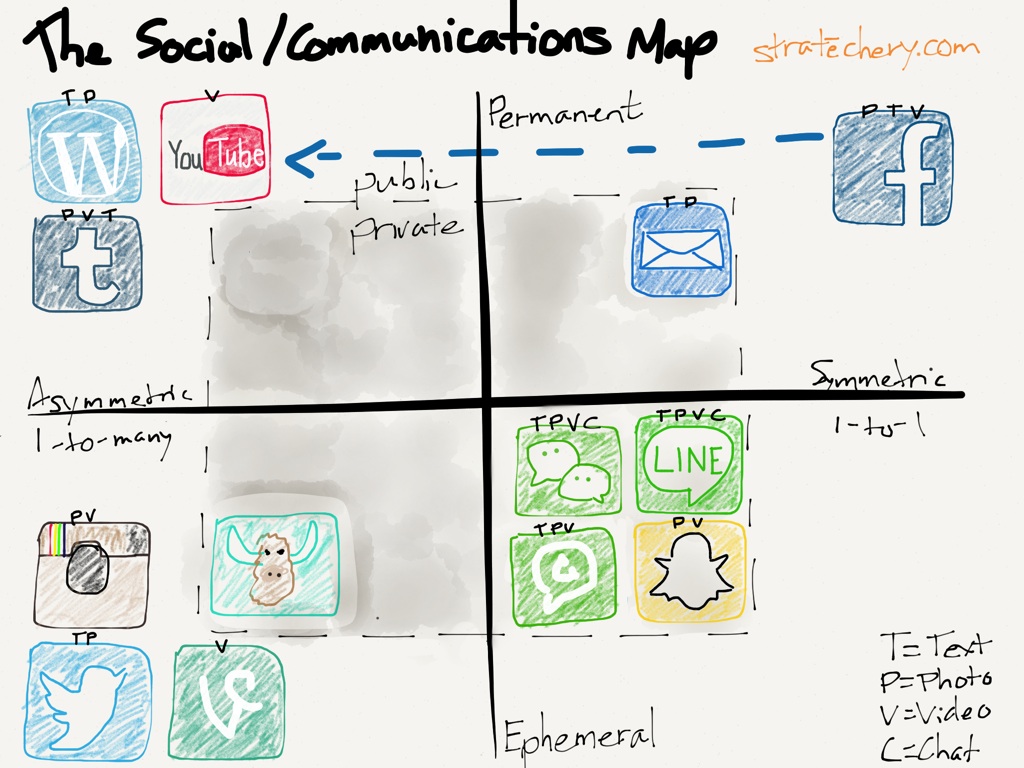
    image-23

    In many respects, this map — indeed, the entire history of social media, particularly the public-facing services — is a story of unbundling the old-school blog. Twitter has replaced link-posts and comments, Instagram has replaced pictures, and Facebook has replaced albums and blogrolls; now Medium is seeking to replace the essay. None of this is a bad thing: literally billions more people now have a much simpler way to express themselves online thanks to the ease-of-use that is characteristic of any service that seeks to focus on one particular aspect of communication, a big contrast to a blog’s ability to do anything and everything relatively poorly. It’s fair to ask just what a blog is good for anyway.

    Defining “Blog”

    A big problem with this entire discussion is that there really isn’t a widely agreed-upon definition of what a blog is, thanks in part to the rise of sites like TechCrunch that ran on WordPress and presented posts in reverse-chronological order and so, at least in the beginning, were called “blogs”; add to that the thinly-disguised PR-channels known as “company blogs” and it’s easy to get confused.

    And so, to be clear, when I speak of the “blog” I am referring to a regularly-updated site that is owned-and-operated by an individual (there is, of course, the “group blog,” but it too has a clearly-defined set of authors). And there, in that definition, is the reason why, despite the great unbundling, the blog has not and will not die: it is the only communications tool, in contrast to every other social service, that is owned by the author; to say someone follows a blog is to say someone follows a person (This applies both for amateur and professional bloggers; most of the rest of this post is concerned with the latter).

    Blogging and Business Models

    This is more than a semantic point; Ezra Klein, one of the first journalists to truly build his career through blogging, and now the editor-in-chief of Vox, wrote in What Andrew Sullivan’s exit says about the future of blogging:

    I think we’re getting better at serving a huge audience even as we’re getting worse at serving a loyal one.

    That, though, is good for Vox, given their dependence on advertising. As I’ve noted previously while writing about newspapers, your business model is your destiny, and an advertising business model demands huge amounts of inventory served to a large number of readers targeted with a massive amount of data.3 Note carefully those words: “huge,” “large”, and “massive” are antithetical to my definition of a blog – something defined by a single individual.

    It turns out, though, that there are more business models than simply advertising, as Sullivan himself sought to show. Sullivan was, for the last two years, supported by reader subscriptions to the tune of nearly one million dollars a year, and while many were skeptical of Sullivan’s efforts when he started, his ability to raise money shouldn’t have been a surprise: his is a singular voice — to put it in economic terms, Sullivan’s writing had a low elasticity of substitution — so people were happy to pay for something they couldn’t get anywhere else.4 Right there was the exact loyalty that Klein fears has been lost.

    Scale Versus Reach

    Moreover, Klein is wrong about blogging and scale:

    Sullivan was the closest we had to someone trying to run a blog with real scale. He was trying to make his blog — and its sizable audience — into a business. But blogging, for better or worse, is proving resistant to scale.

    But Sullivan did have a viable business, and it scaled wonderfully: it cost him the same amount of both time and money to serve 1,000 subscribers as it would have to serve 100,000, or 1 million,5 and he didn’t need to change a thing about himself or his content to do it. No, it’s not scale that is the problem, but rather reach.

    I am, of course, acutely aware that there is a tradeoff when it comes to the subscription business model: by making something scarce, and worth paying for, you are by definition limiting your number of readers.6 Stratechery, though, serves a niche, and niches are best served by making more from customers who really care than from milking pennies from everyone.

    Here’s the thing, though: the upside of my business model is that Stratechery has all of the things that Klein claims are being lost:

    • An assumption my readers (especially my subscribers) read everything I write7
    • A single voice
    • Loyalty

    It’s this last part that is the most rewarding: Vox, in its desire for reach, asks nothing of its readers beyond tolerance for posts they don’t care about, which means no one should be surprised the user experience of the site is increasingly annoying. I, on the other hand, ask for money and am heavily motivated to deliver value in return – the relationship is reciprocal. That means not wasting my readers’ time; it means focusing on quality over quantity; indeed, it means waiting four days to write something thoughtful (hopefully!) instead of simply trying to be first.8

    That Would Be Fine For Ezra

    Whenever I write about Stratechery’s business model I constantly hear objections along the lines of “That’s fine for Ben,” the insinuation being that what I do is not replicable. And, to be sure, I am by no means arguing that you can make money from a blog just because you want to. At the risk of humblebragging, you need to offer something unique, and at least 2,000 people believe I do.9

    Klein, though, is unique, and he has 732k Twitter followers and a history of success to show for it. That, more than anything, is why I found his piece in particular so frustrating to read: blogs are not dead, but Klein’s is, and while I don’t begrudge him his choice, I question the degree to which he knows he made one.10

    Moreover, there are reasons to be optimistic beyond Sullivan’s success, or my own:

    • While WordPress has long been an effective free option for managing the content-side of blogging, only recently are there useful tools for managing the business-side. First and foremost amongst these is Stripe which, for the first time makes managing subscription-payments simple and straight-forward. However, there are still holes, particularly when it comes to actually managing membership lists and communities
    • Klein is right that social media drives a huge amount of traffic; the key for the independent blogger, then, is not to treat social media as the primary source of traffic, but as a marketing channel for their free content.11 In my case, Twitter is to my marketing needs what WordPress is to my content-management needs: essential, incredibly powerful, and completely free
    • Perhaps most importantly, I believe that more and more consumers are coming to grips with the reality of online media: when everything is free, you too often end up getting exactly what you paid for. If you consider the time wasted reading clickbait, a few bucks a month for content you trust isn’t such a bad deal

    Forgive me if this article read a bit too much like an advertisement for Stratechery; the honest truth is my fervent belief in the individual blog not only as a product but also as a business is what led to my founding this site, not the other way around. And, after this past weekend’s “blogging-is-dead” overdose, I almost feel compelled to note that my conclusion — and experience — is the exact opposite of Klein’s and all the others’: I believe that Sullivan’s The Daily Dish will in the long run be remembered not as the last of a dying breed but as the pioneer of a new, sustainable journalism that strikes an essential balance to the corporate-backed advertising-based “scale” businesses that Klein (and the afore-linked Smith) is pursuing.12


    1. This post is about blogging, not Andrew Sullivan’s politics. Whatever your opinion on the latter, there is no denying his influence on the genre 

    2. This is the most-current version, last updated for this Daily Update (members-only); SnapChat – and all the chat services – are expanding into the broadcast space, and I need to add Medium  

    3. This last point is why Vox’s – and all the other new media sites’ – valuation is relatively modest 

    4. In fact, I would argue Sullivan earned far less from his blog than he could have; his paywall was quite leaky (you needed to read a relatively high number of full-length articles before you were cut off, and even then only for the rest of the month) and his rate ($19/year) quite low. 

    5. Hosting costs are an exception of course, but the marginal cost of one more subscriber is infinitesimal 

    6. In the case of Stratechery, surely my audience would be significantly larger were my Daily Updates broken up into their 8~10 component pieces and posted for free. More importantly, though, they would not exist because I would not reach nearly a large enough audience to pay for that attention through advertising, which means Stratechery wouldn’t be my job. 

    7. The Daily Update has a nearly 80% open rate, over triple the industry average  

    8. There is a third business model, as well, best personified by John Gruber and Daring Fireball. This entails being dominant within a niche such that you attract sponsors seeking to reach a highly targeted market. It works very well, both for Gruber and for sponsors, although it takes a much larger audience than a subscription-based model 

    9. After passing 1,000 late last year I passed 2,000 late last month. I didn’t plan on another numbers update, but my passion for this argument outweighs my Midwestern reticence 

    10. For what it’s worth, I bet Klein probably wouldn’t change a thing; reach is useful if you’re seeking to change the course of national politics. Personal ambition, though, isn’t grounds for saying blogs aren’t a viable business model 

    11. I post at least one free item a week and four members-only Daily Updates 

    12. As I noted, I’m optimistic about Vox (and especially BuzzFeed), poop posts notwithstanding. Sustainable, broad-based publications are important; in fact, that’s why I blog about them regularly (members-only)  


  • Bad Assumptions

    John Gruber is, as only he can, relishing the claim chowder – his collected bits of analyst wisdom sure, again and again, that Apple is doomed.

    Apple, of course, is not doomed. In fact, the company is the very opposite of doomed, having just posted the best quarter of any company, ever.1 The analysts Gruber mocks were not just wrong (and, as everyone knows, they are only a small part of a much larger sample), they were hilariously wrong, and cost their clients millions of dollars.

    And yet, the perception that Apple is somehow hanging on by the skin of their teeth persists. I was speaking to someone about Apple’s particularly excellent China results this afternoon, and was struck at how their questions were so focused on threats to Apple – “How will Apple respond to Xiaomi” for example. This is in stark contrast to the way most think about a company like Google, where their dominance in whatever field they choose to enter is assumed, just as Microsoft’s was a decade ago. Apple, though, is always a step away from catastrophe.

    It’s difficult to overstate just how absurd this is, but here’s my best attempt: last quarter Apple’s revenue was downright decimated by the strengthening U.S. dollar; currency fluctuations reduced Apple’s revenue by 5% – a cool $3.73 billion dollars. That, though, is more than Google made in profit last quarter ($2.83 billion).2 Apple lost more money to currency fluctuations than Google makes in a quarter. And yet it’s Google that is feared, and Apple that is feared for.

    I’ve previously, in one of the first ever posts on Stratechery, tried to figure out why it is that people keep getting Apple so wrong; I chalked it up to an over-reliance on modeling and magical manager syndrome. And, while I think that is still true, it’s hard to escape the conclusion that much of the reporting and analysis about Apple specifically and tech broadly is governed by bad assumption on top of bad assumption on top of bad assumption:

    Bad Assumption 1: Markets are monolithic

    If you look at a market monolithically, simple math dictates that the average will be most heavily influenced by the majority. And, income distributions being what they are, the majority of customers in any market will have less money, and likely be inclined to prioritize price. Ergo, monolithic market analysis necessarily concludes that customers prioritize price.

    Markets, though, are not monolithic. They are wildly disparate, able to be endlessly segmented not just by income, but by a whole host of demographic and psychographic factors. In every market there is a segment of people who have the means to buy nice things, and there is a segment that values a superior experience. These segments quite often overlap, to Apple’s benefit.

    Bad Assumption 2: Consumers only care about speeds, feeds, and price

    The old hoary chestnut that “Apple only wins because its advertising tricks people into paying too much” was raised in my Twitter feed last night, and while the holders of such an opinion are implicitly saying others are stupid, my take runs in the opposite direction: it’s not that people are irrational, it’s that human rationality is about more than what can be reduced to a number. Delight is a real thing, as is annoyance; not feeling stupid is worth so much more than theoretical capability. Knowing there is someone you can ask for help is just as important as never needing help in the first place.

    Apple spends an inordinate amount of time and resources on exactly these aspects of their products. Everything is considered, from the purchase to the unboxing to the way a webpage scrolls. Things are locked down and sandboxed, to the consternation of many geeks, but to the relief of someone who has long been conditioned to never install anything for fear of bad actors. Stores – with free support – are just a few miles away (at least in the US), a comfort blanket that you ideally never need. All of this is valuable, even though much of it is priceless, only glimpsed in an average selling price nearly triple the industry average.

    Bad Assumption 3: Apple’s talk about “making the best products” is for show

    Apple executives have again and again stated some variation of the line Tim Cook delivered during his prepared remarks on yesterday’s earnings call:

    Apple’s mission is to make the greatest products on earth and enrich the lives of others

    Surely it can’t be so simple! Surely to believe such tripe is the ultimate in fangirl-hood. And, in fact, I hesitate to write about stuff like this, for fear of the fanboy angle. This blog prides itself on calling things as I see them, not as I wish they were. At a more fundamental level, I’m much more concerned with the underlying strategies and trends that govern companies, and the incentives that ultimately decide how effective those strategies are.

    It’s incentives, though, that make Cook’s line so believable. If you believe, as I do, that there is a segment of the market that is not strictly governed by the lowest price, and if you further believe that customers value products that deliver more value than what can be reduced to a number, then you believe there is an opportunity to create best-in-breed experiences for a handsome price. In this view, Apple’s focus on “making the best products” is perfectly aligned with their market opportunity.

    To put it another way, is Apple concerned with making the best product, or with making the most money? The answer is yes.

    And so they have.


    1. My analysis of the earnings is here (members-only)  

    2. Google has since reported its 4Q 2014 results; its profit is $4.76 billion 


  • Dear Zoë Keating: Tell YouTube to Take a Hike

    Cellist Zoë Keating is asking What Should I Do About YouTube?:

    My Google Youtube rep contacted me the other day. They were nice and took time to explain everything clearly to me, but the message was firm: I have to decide. I need to sign on to the new Youtube music services agreement or I will have my Youtube channel blocked.

    This new music service agreement covers my Content ID account and it includes mandatory participation in Youtube’s new subscription streaming service, called Music Key [a Spotify-like service that costs $9.99/month], along with all that participation entails.

    Keating primarily focuses on the fact that YouTube is basically giving her no choice in the matter:

    The catalog commitment is the biggest issue for me. All these years I’ve yet to participate fully in any streaming service although I’ve chosen to give a handful of recordings to a few of them. If anyone wants more and they balk at paying for it, they can always stream all my music for free on Bandcamp or Soundcloud or they can torrent it (I uploaded my music to Pirate Bay myself many years ago). I’ve heard all the arguments about why artists should make all their music available for streaming in every possible service. I also know the ecosystem of music delivery made a shift away from downloading last year. Streaming is no longer advertising for something else, it is the end product. It’s convenient. Convenience is king. Yup, got all that, thanks.

    This is the important part: it is my decision to make.

    Certainly, YouTube owns their service, and they get to choose the terms they offer. And it’s easy to look at Keating – who uploaded her entire catalog to The Pirate Bay – and dismiss her as some sort of radical. I get the impression from Keating’s article that that is exactly how she is perceived:

    A year ago my Youtube rep let me know there was a new music service coming and she sent along a new agreement. I read it and raised my concerns and asked if I could return the contract with those particular terms struck out. Alas no but the product folks seemed genuinely curious about my concerns and I had a phone meeting with them. The meeting was similar to one I had with DA Wallach of Spotify a couple years ago. Similar in that I got the sense that no matter how I explained my hands-on fan-supported anti-corporate niche thing, I was an alien to them. I don’t think they understood me at all…

    In fact, while Keating may be a radical, I think she’s also entirely rational: I’m increasingly of the opinion that all-you-can-eat subscription services like YouTube Music Key or Spotify are a downright bad idea for niche artists.

    The Problem with Niche Artists and Subscription Services

    Stepping back, in one of my favorite episodes of Exponent, James Allworth and I coined the idea of The Internet Rainforest (although, now that I think about it, we mostly refer to it as the Internet jungle). The idea is that the economics of the Internet work for two types of businesses:

    • Massive businesses that can take advantage of the Internet’s scale to reach a huge number of people very cheaply and efficiently
    • Niche businesses that can take advantage of the super low costs involved in running an Internet business to reach a very narrow niche of people all over the world very cheaply and efficiently

    Think of any potential audience as following a power curve:

    The two business models on the Internet
    The two business models on the Internet

    With this audience there are two ways to maximize revenue:

    • You can try to make a little bit of money from a lot of people – this entails getting a little bit of money from everyone on the curve
    • You can try to make a lot of money from a few people – this entails maximizing the gain from the people on the left side of the curve

    Think about a company like Facebook: true, there may be some Facebook-aholics who live in the service and would love if Facebook would just go crazy on the features, but serving those customers would endanger the right side of the curve – the people who are more take-it-or-leave-it. Ultimately, because Facebook monetizes through advertising, more eyeballs are more important than more intensive ones, so their product decisions are made with an eye towards appealing to as many people as possible. Of course Facebook doesn’t stop here – you can think of targeting as a way for them to make more money from some consumers than from others. Still, the goal is more users, not fewer.

    A site like mine, on the other hand, or any number of niche-focused sites and services, is much more concerned with people on the left-side of the curve. We don’t want pennies from millions, but tens or hundreds of dollars from thousands. This, though, means that our motivations when it comes to our product are far different: if we appeal to everyone, we are necessarily loved by no one.

    True Differentiation

    Tim Wu has a piece in The New Yorker about the rise of small businesses, with a particular focus on craft brewers:

    Consider the story of craft beer. Large-scale breweries destroyed their smaller rivals in the twentieth century because they were able mass produce the stuff for cheaper (reaching wholesale prices of about fifty cents a beer or less) and because their fat margins allowed them to pay for things such as television advertising…

    But the small breweries came back. Their beers were not better advertised and certainly not better priced. Rather, the crafts went after an enormous blind spot for the big breweries—namely, flavor. I don’t entirely mean to be snide; more precisely, craft beer succeeded by opting not to compete directly, instead pursuing what can be called a “true differentiation” strategy. That means they established a product that, in the mind of the consumer, is markedly and undeniably different…

    Here’s the thing: a lot of people dislike many of these craft beers, or at least some of the more unique and radical brews. But that’s a good thing! You can only succeed against a low-cost competitor by being different, and to be different is to be polarizing. More than that, though, you need a different business model: craft breweries make money by charging more; big breweries make money by reducing costs.1

    The difference in business models is far more stark on the web; at scale, advertising is the obvious solution. For niches, though, I strongly believe that direct payment is superior. It’s simply easier to get a lot of money from your best fans than it is to get a little bit of money from many. This, though, is the problem with all-you-can-eat subscription services: they only afford the chance to make a little bit of money from any one customer, even as they increase the friction over free. And, I agree with Keating that the subscription services, including YouTube, don’t understand this:

    The Youtube music service was introduced to me as a win win and they don’t understand why I don’t see it that way. “We are trying to create a new revenue stream on top of the platform that exists today.” A lot of people in the music industry talk about Google as evil. I don’t think they are evil. I think they, like other tech companies, are just idealistic in a way that works best for them. I think this because I used to be one of them. The people who work at Google, Facebook, etc can’t imagine how everything they make is not, like, totally awesome. If it’s not awesome for you it’s because you just don’t understand it yet and you’ll come around.

    I think it’s more that nearly everyone at tech – and I’ve witnessed this first hand again and again – is deeply conditioned to think at scale. It is the first question out of anyone’s mouth when it comes to a new service or product – “Can it scale?” Niches, though, don’t scale; they go deep. More importantly, they go deep in a way that wasn’t possible previously. Note again this line:

    We are trying to create a new revenue stream on top of the platform that exists today.

    I suspect this was in reference to the monetization options already on YouTube, but I have a much more profound objection to this idea: the thing about craft brewers is that they didn’t even have the option to be different until 1978 when President Carter signed Senate Amendment 3534 which deregulated home brewing. Similarly, the vast majority of niches – particularly for rock-and-roll cello players – were economically unviable before the Internet drastically reduced the cost of both production and distribution. In other words, there is nothing to “build on top of.” Spotify and YouTube Music Key and other all-you-can-eat services are ultimately suited for music that is broadly appealing – the same sort of music that has ruled the radio for decades. For anything truly different, though, anything with a limited but intensely interested audience, they are nothing but a bad idea – a way to both limit your audience and limit the amount of money you can make from your best fans.

    The Proof is in the Revenue

    In fact, Keating is the best example of this: she revealed her revenue figures last year. From The Guardian:

    Keating’s biggest source of income last year was Apple’s iTunes Store, where sales of 32,170 single tracks and 3,862 albums netted her just over $38,195. Meanwhile, 185 tracks and 2,899 albums sold through her profile on direct-to-fan site Bandcamp earned a further $25,575, while a mixture of physical and MP3 sales on Amazon earned her a further $11,571.

    403,035 Spotify streams earned Keating $1,764, while more than 1.9m views of videos on YouTube – mostly those uploaded by other people featuring her music – earned her $1,248. US personal radio service Pandora generated $3,258 of royalties – but from an undisclosed number of streams.

    To be sure, downloads are dying broadly, but that’s my entire point: the mistake YouTube and Spotify and nearly everyone else makes when considering media of all types is to put everyone in the same boat. In fact, it’s the middle that is doomed but things are looking up for the truly differentiated. There are more ways to reach more fans who really care and who will relish the opportunity to pay.2

    So there’s your answer Zoë: tell YouTube to take a hike (but hey, keep it for marketing).


    1. As Joe Cieplinski noted on Twitter, “Your update today made me think of indie app devs. Most make craft beer and try to sell it at Bud Light prices.” 

    2. Concerts are one way to make money, but they’re really expensive especially for niche artists (and they’re obviously not an option for non-musicians). I don’t believe they are a sustainable answer 


  • The End of Trickle-Down Technology

    One normally wouldn’t expect farmer psychology and technology to have much in common, but drawing unexpected connections is the mark of truly innovative thinkers, and Geoffrey A. Moore’s Crossing the Chasm is a truly innovative book.

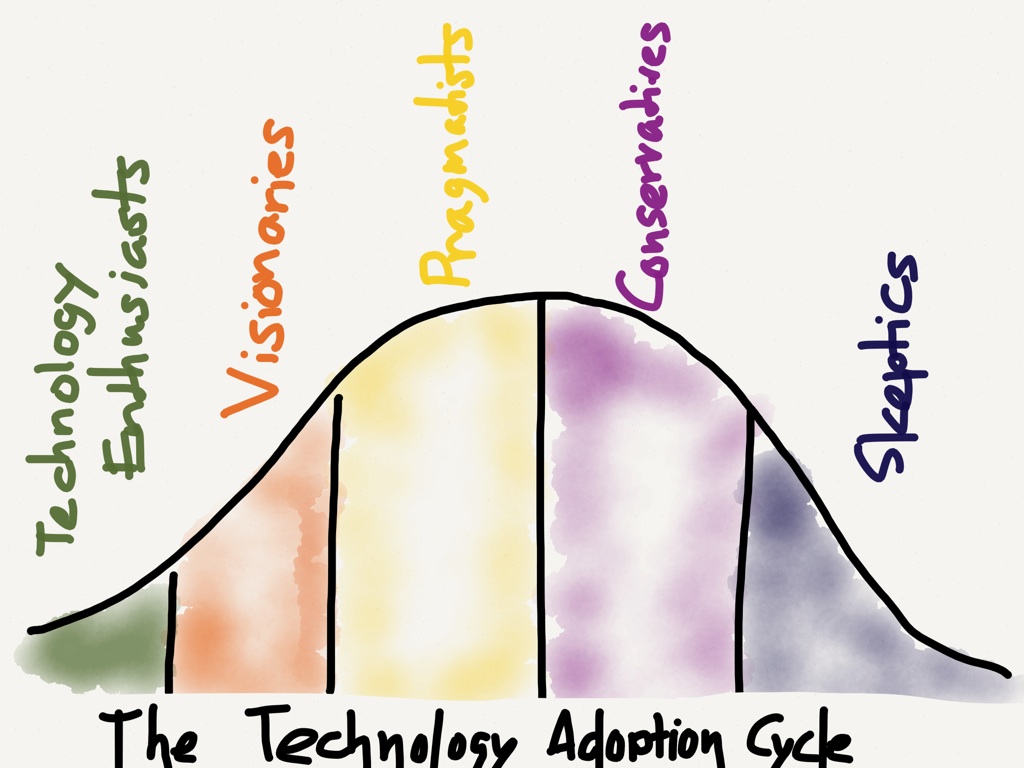
    Building on the work of three Iowa State professors studying the spread of hybrid seed corn, Moore developed the technology adoption cycle, which breaks the market for new technologies into five parts:

    image-26

    • Technology Enthusiasts love tech first and foremost, and are always looking to be on the cutting edge; they are the first to try a new product
    • Visionaries love new products as well, but they also have an eye on how those new products or technologies can be applied. They are the most price-insensitive part of the market
    • Pragmatists are a much larger segment of the market; they are open to new products, but they need evidence they will work and be worth the trouble, and they are much more price conscious
    • Conservatives are much more hesitant to accept change; they are inherently suspicious of any new technology and often only adopt new products when doing so is the only way to keep up. Because they don’t highly value technology, they aren’t willing to pay a lot
    • Skeptics are not just hesitant but actively hostile to technology

    Moore was primarily concerned with “crossing the chasm” from the early market – enthusiasts and visionaries – to the mainstream market – pragmatists and conservatives, and if there is one product that clearly crossed the chasm, it is the smartphone. There are an estimated two billion smartphones in use around the world, and in developed countries penetration is reaching the 80% mark – only the skeptics are left. Surely this is a mature market.

    That, though, makes the fates of the three biggest smartphone companies – Apple, Xiaomi, and Samsung – particularly interesting:

    • Apple offers by far the most expensive phones on the market, but even though the early price-insensitive market has presumably been saturated, the iPhone is actually growing
    • Samsung phones are widely available at multiple price points, making them an easy choice for low information customers on the right side of the cycle, yet the company is struggling
    • Xiaomi has very aggressive prices, but their brand proposition is very much tuned to the left side of the cycle

    All of this seems to fly in the face of Moore’s assumption that late-stage adoption would be driven by price and pragmatism (or, in the case of conservatives, necessity). Price and pragmatism might as well be Samsung’s motto, while Apple is super expensive and Xiaomi is avowedly geeky.1

    I suspect the problem is that while Moore has updated “Crossing the Chasm” (the third edition came out last January), the book is still a product of 1991 when nearly all technology buyers were businesses located in developed countries. Smartphones don’t have either qualification: people buy smartphones, not businesses, and developing countries are just as much a market as developed ones.

    Apple and the Conservatives

    According to Moore, high prices are only sustainable on the left side of the adoption curve:

    The first perspective to set on pricing is the customers’, and, as we noted in the section on discovering the chasm, that varies dramatically with their psychographics. Visionaries – the customers dominating the early market’s development – are relatively price-insensitive. Seeking a strategic leap forward, with an order-of-magnitude return on investment, they are convinced that any immediate costs are insignificant when compared with the end result. Indeed, they want to make sure there is, if anything, extra money in the price, because they know they are going to need special service, and they want their vendors to have the funding to provide it. There is even a kind of prestige in buying the high-priced alternative. All this is pure value-based pricing. Because of the high value placed on the end result, the product price has a high umbrella under which it can unfold.

    Certainly Apple has captured the visionaries, but how is it that the iPhone continues to grow? After all, Moore argues that conservatives will behave the exact opposite:

    At the other end of the market are the conservatives. They want low pricing. They have waited a long time before buying the product – long enough for complete institutionalization of the whole product, and long enough for prices to have dropped to only a small margin above cost. This is their reward for buying late. They don’t get competitive advantage, but they do keep their out-of-pocket costs way down. This is cost-based pricing, something that will eventually emerge in any mainstream market, once all the other margin-justifying elements have been exhausted.

    In this Moore’s thinking is not unlike Clayton Christensen’s: low-end disruption theory is also focused on performance and price. In a new market – the visionary market – when no product is good enough, the integrated provider can sell superior performance with a margin to match, but over time, as the technology becomes “good enough,” lower-priced modular competitors will take over the market.

    However, as I argued in Best, in consumer markets the user experience is just as important.

    The primary flaw in this conclusion, as I detailed last year, is that the Christensen evaluation of “good enough” only considers technical capabilities. Christensen did later add the idea of emotional jobs-to-be-done – this covers things like luxury bags, for example, which confer status – but that doesn’t fully explain Apple in particular. Instead, my position is there is a third component of product capability: the user experience. Moreover, the user experience is unique in that, like emotional jobs-to-be-done, a product can never be “too good,” and, like technical jobs-to-be-done, it is always possible to improve – or to fall behind.

    Moreover, if user experience matters generally, it matters the most to conservatives. Moore notes:

    The truth is, conservatives often fear high tech a little bit. Therefore, they tend to invest only at the end of a technology life cycle, when products are extremely mature, market-share competition is driving low prices, and the products themselves can be treated as commodities. Often their real goal in buying high-tech products is simply not to get stung. Unfortunately, because they are engaging with the low-margin end of the market, where there is little motive for the seller to build a high-integrity relationship with the buyer, they often do get stung. This only reinforces their disillusion with high tech and resets the buying cycle at an even more cynical level.

    If high-tech businesses are going to be successful over the long term, they must learn to break this vicious circle and establish a reasonable basis for conservatives to want to do business with them. They must understand that conservatives do not have high aspirations about their high-tech investments and hence will not support high price margins. Nonetheless, through sheer volume, they can offer great rewards to the companies that serve them appropriately.

    I think Moore was spot-on on the psychology of conservatives, but completely underestimated their willingness to pay for a solution that allays their fear. These customers don’t want leftover technology that barely works. They want technology that works better. Specifically, Apple’s focus on the user experience ought to be even more attractive to conservatives than it is to visionaries, and this very sizable group is potentially more willing to pay for a solution that is easier to use.

    If indeed Apple has broken through with conservatives, this has powerful implications for all kinds of companies: smartphones are the tip of the spear when it comes to the spread of technology into every part of society, and what Apple may be demonstrating is that there is real money to be made amongst late adopters if the user experience is demonstrably superior. To be sure, Apple’s powerful brand and reputation is hard to replicate,2 but the iPhone’s continued success offers hope that customers will pay for true differentiation, not trickle-down technology.

    Xiaomi and the Visionaries

    If Apple is doing surprisingly well on the right side of the adoption cycle, I think the best way to think about Xiaomi is that they are competing in a different market entirely. For much of China and especially India, price matters not because people don’t care, but simply because many don’t have very much money.

    This is a critical distinction: in Moore’s telling, pragmatists and conservatives pay attention to price simply because they aren’t willing to pay a premium. They have the capability, but not the desire. This, though, does not describe the typical Xiaomi customer. From an interview I conducted with Xiaomi Vice President of International Hugo Barra (members only):

    BT: Who is your target customer in China?

    HB: Our target customer in China are the 18 to 30 year olds, reasonably well educated, reasonably geeky, and value-orientated [i.e. not rich] and who appreciate the high spec. They are the ones who become the ambassadors for the brand to other audiences…

    BT: What about internationally?

    HB: Largely the same thing. I think we what we’re learning in India in particular is that the IT-educated is extremely large. I think a lot of that is a result of India’s tradition of being the IT back office of the world. In India, even the Red Mi product line attracts the IT-educated customer who just doesn’t have the money to buy one of our high-end products. But we find ourselves having a conversation about features and specs with a customer who bought Red Mi 1S that in other markets I would only have with someone who is buying a high end product. We’ve never experienced a level of scrutiny at a spec and performance level on a Red Mi product that we have in India.

    These customers are not conservative, or even pragmatists: they are enthusiasts and visionaries who simply don’t have very much money. The proper way to reach them, then, is not to sell them trickle-down technology: they will see right through that, and dismiss it out of hand. Rather, the solution to is develop new business models – indeed, in the case of Xiaomi, a new company – that is built from the ground-up to serve their specific needs.

    This, too, is a powerful opportunity: there are far, far more potential customers in developing countries than there are in developed ones, but just because they don’t have much money does not mean they are technological laggards. Indeed, many of these customers are even more advanced when it comes to being mobile first because of the lack of a PC legacy, and they will embrace a brand that lets them live on the cutting edge.


    To be sure, there is still innovation happening among rich consumers in the developed world – Uber is evidence of that! However, I suspect it is these two markets – conservatives in developed countries, and enthusiasts and visionaries in developing ones – that will provide some of the biggest opportunities over the next few years. The smartphone has opened the door: which companies will walk through it?


    1. Xiaomi Vice-President of International Hugo Barra told me in an interview (members-only) that Xiaomi is “a geeky lifestyle brand 

    2. Even if, as many fret, it is being damaged 


  • Mobile First

    Last Friday was the eight-year anniversary of the announcement of the iPhone, the event that began the mobile epoch. It was, though, an Apple rumor that to my mind illustrated just how much the world has changed.

    Mark Gurman is reporting at 9to5Mac that the next MacBook Air will have a radical redesign. The biggest surprise was about the ports, or lack thereof:

    The upcoming 12-inch Air has the fewest amount of ports ever on an Apple computer…On the right side is a standard headphone jack and dual-microphones for input and noise-canceling. On the left side is solely the new USB Type-C port. Yes, Apple is currently planning to ditch standard USB ports, the SD Card slot, and even its Thunderbolt and MagSafe charging standards on this new notebook…As we’ve reported on multiple occasions, the new USB Type-C connector is smaller, faster, and more capable than the standard USB 2.0 and 3.0 ports on existing computers. The connector is able to replace the Thunderbolt Display port on the current Apple laptops as USB Type-C actually has the technology to drive displays. Additionally, the latest specifications from the USB foundation indicate that USB Type-C can actually be used to power computers, which makes the standard MagSafe plugs unnecessary on this new device.

    The obvious caveat here is that this is a rumor; Gurman may have a great track record, but he could be wrong and the next MacBook Air could have more than one port. But I rather suspect he’s right, because the MacBook Air he describes is the first Apple PC1 that is Mobile First.

    The Origin of Mobile First

    As best I can tell, “Mobile First” was first used by Marc Davis, then Yahoo’s Chief Scientist and VP of Early Stage Products of Yahoo! Mobile.2 From ReadWriteWeb, reporting on the Web 2.0 Expo in April 2009:

    Yahoo’s Marc Davis spoke about the mobile internet and the future of the mobile industry. As the mobile web evolves, he said, it’s no longer good enough to simply port the PC experience to the phone’s small screen – it’s time to start building “mobile-first” products instead. What are “mobile-first” products? They’re services designed to take advantage of the strengths and abilities of the mobile devices themselves, leading to entirely unique creations that can only be found on the mobile web.

    Though it’s taken a few years, Mobile First is now gospel for most consumer tech companies in particular. Perhaps the most famous example is Facebook; in a shift akin to Microsoft’s 1995 embrace of the Internet, Facebook went from having a mere 20 people on its mobile team in 2012 to several hundred mobile-focused developers embedded in every team in the company. The results – both in product and to the top and bottom lines – have been stunning.

    A better example is Instagram: the photo-sharing social network launched as an iPhone app only, and for a long time its only web presence was direct photo links. Today there is a website, but it’s little more than a scaled up version of the app, and there is no tablet app at all. This should not be a surprise: while tablets mostly run mobile operating systems, they are not mobile devices; they do not go with you everywhere.

    This distinction is critical: what is essential to understand about Mobile First is that everything flows from, well, mobility. The relative importance of implementation details and even the underlying OS fade relative to the significance of nearly every person on earth having an Internet communicator with them at every single moment. Every single product and service must start with this fundamental assumption.

    The Implications of Mobile First

    In this reading of Mobile First – that it’s about presupposing that every potential consumer of your product or service has a smartphone – the implications apply far more broadly than social networks or app makers.

    Consider CES: over the last several years the show has seemed to fade as smartphones have subsumed all types of gadgets from cameras to music players to video recorders. This year, though, was all about the “Internet of Things,” and as annoying as that catchphrase may be, it’s something that only makes sense in a Mobile First world: now, instead of those old gadgets that make PC functions mobile, “Internet of Things” products assume the presence of a mobile smartphone. Thus the most interesting innovation is in things that don’t move: locks, light bulbs, garage door openers, and more, because they are designed with the assumption that the smartphone – and associated individual – comes to them.

    Even more interesting was Sling TV, the first service that, with its focus on sports, has the potential to actually make cord-cutting palatable for far more people than any service before it.3 Just as interesting, though, is that while the service is provided by Dish Network – a company that has invested millions in launching satellites – the service is provided through an app. In other words, while the old Dish Service – and every other pay-TV service – was delivered to an address, Sling TV is delivered to a person. It is Mobile First.

    As I noted in The State of Consumer Technology at the End of 2014, individual as service endpoint is an essential characteristic of one of the most important categories of emerging services, the so-called “sharing economy”. Uber is the easy example – the service quite literally goes to an individual’s exact location and picks them up – but it also applies to services like Instacart: without a smartphone coordinating shopping trips would be a logistical nightmare. The service is absolutely Mobile First.

    Mobile First is also upsetting lots of assumptions around the transition to digital: consider the surprising news that the prospects for bookstores are looking up. From the Financial Times:

    The plot has now twisted sharply, with publishers and book chains in the US, UK and Australia celebrating sales figures showing the resilience of physical editions and of bricks-and-mortar stores.

    Waterstones said its sales had risen 5 per cent in December compared to the previous year…The optimism was echoed in the US. Barnes & Noble appears to have ended a run of declining sales, and expects sales to be flat in 2014 and 2015. Its shares rose 5 per cent on the news.

    Fundamental shifts in consumer behaviour may also be helping the high street bookstore. “People are moving back to more frequent local shops. That’s when you can start popping in and buying books,” said Paul Lee, an analyst at Deloitte.

    That fundamental shift in behavior is mobile: the most interesting place to be is no longer in front of a computer, it’s to go out into the world with a computer in your hand. And in that view, it’s no surprise that “3rd-places” like bookstores are experiencing a renaissance – or that physical goods, a welcome break from that ever-present screen, are more desirable than ever.

    The impact will likely be felt far more broadly than bookstores: a decade ago, every small business thought they needed a website. Now many more businesses are simply focusing on their Facebook page, which is easier to find and use on mobile. Here China is light-years ahead: nearly every business has a WeChat account (you follow by scanning a QR code – they are ubiquitous) that includes not only the basics like addresses and hours but even ordering with delivery to wherever you’re sitting when you press the ‘Order’ button.

    Ordering dumplings in WeChat
    Ordering dumplings in WeChat

    Even dumplings are Mobile First.

    Why the Rumored MacBook Air is Mobile First

    And so, the story of the (rumored) MacBook Air starts not with the Mac, but rather with the iPhone. By virtue of its omnipresence it is the most important device in most consumers’ lives. It is the first choice for getting information, for communicating, for taking pictures. It is a device that a huge majority of people could live on exclusively, and it very much stands alone: all of its essential functions have cloud counterparts, but none assume a PC.4

    True, it would be nice to have a keyboard to type longer emails, reports or papers, or a larger screen to watch movies, but those capabilities – again, for most people, not all – are nice to have, not essential.5 Moreover, all of those capabilities depend on the same cloud services as the phone: email, social networking, photos, all of it comes over the (wireless) network, not a cable.

    In this world, a Mobile First world, what exactly is the point of a port?6


    1. Chromebooks were first 

    2. Seriously, that’s the title, according to this TechCrunch article reporting Davis’ exit a mere three months after coining the term “Mobile First”. I suspect there is a lot about Yahoo’s fate that can be gleaned from this footnote 

    3. I wrote about this extensively in the Daily Update here and here) (members-only links)  

    4. Microsoft’s “Mobile First Cloud First” strategy makes much more sense now, no? 

    5. To put it another way, a MacBook Air is in the same class as an iPad 

    6. If you need ports, buy a MacBook Pro. But if you care about rumors of unreleased products, you’re probably not a normal consumer! 


  • Xiaomi’s Ambition

    Xiaomi, the Chinese smart phone company that late last month raised $1.1 billion at a $45 billion valuation, sells way more than smartphones: Mi.com boasts over a thousand items, and it’s the third-largest e-commerce site in China. One item it doesn’t sell, though, is a AA battery charger. Only Apple:

    applebattery

    I clearly remember when this rather oddball product came out, not because it was particularly magical or revolutionary, but because a co-worker had one in his hand the very next day. He regaled us with tales of power efficiency and “vampire draw” (or the lack thereof), curiously neglecting to mention why it was he actually needed a battery charger. He bought it because it was made by Apple, and that was enough.

    What is Xiaomi?

    There’s come to be a bit of a cliché when it comes to writing about Xiaomi. The author declares that Xiaomi is known as the “Apple of China”, but actually, said author explains, they’re something very different: more like Amazon, or maybe a bit of Google, to use the words of Xiaomi CEO Lei Jun. They sell smartphones at cost, or close to it, and will make money through services.

    The trouble with a lot of this commentary surrounding Xiaomi1 comes in determining exactly what those “services” are. The easy assumption are traditional Internet services like those offered by Google, including an app store, online portals, so on and so forth. That, though, hardly validates a $45 billion valuation, particularly when most of the money to be made on mobile services in China is being vacuumed up by Tencent through their dominant WeChat app, with Baidu (search), Alibaba (e-commerce), Apple (the App Store), and the various Chinese App Stores’ capturing the rest (Xiaomi has their own app store, but it’s only the 5th most popular).

    Instead, the way to understand Xiaomi and why exactly they are so valuable is to more deeply understand what Lei Jun means by “services”, and, in the end, why Xiaomi actually is a lot like Apple after all.

    Horizontal versus Vertical

    Early in this blog’s life, I spent quite a bit of time discussing the differences between vertical business models – like Apple – as compared to horizontal business models – like Google. Apple provides services as a means of differentiating their hardware, which they sell for a profit; they are exclusive. Google, on the other hand, wants to reach everyone with their services, whether they be on iOS or Android.2

    It’s not immediately obvious where Xiaomi fits though. After all, MiUI, Xiaomi’s freely available Android ROM, itself a service that enables access to all of Xiaomi’s other services, is available for other manufacturers’ Android devices. That seems like a horizontal offering. On the other hand, the vast majority of Xiaomi’s revenue comes from handset sales, which suggests a vertical business model. Are they stuck in the messy middle?

    I don’t think so, and the answer comes back to my co-worker’s battery charger.

    Xiaomi’s Fans

    In 2013, Xiaomi shocked a lot of observers when they announced the MiTV. It was less surprising when Xiaomi released internet routers, but the shock returned with last fall’s announcement of an air purifier, and apparently a water purifier is on the way; all tie in to MiUI. At the time of the MiTV announcement, Lei Jun said something very interesting: “We want to build the first TV our fans will use.”

    Understanding Xiaomi’s fans is critical to understanding the company. The New York Times captured the fervor well in a profile of the company last month:

    Li Nan, vice president of the rival Meizu, which began in the early 2000s by making digital music players and aims at customers slightly older and wealthier than Xiaomi’s, likens the devotion of Xiaomi supporters to a religion.

    “Xiaomi fans have a high level of organization,” he said. “They love Xiaomi. It’s a form of idolatry.”

    Han Yu, a 24-year-old studying for his master’s degree, is one of those idolaters. He, with tens of thousands of others, helps Xiaomi test its user interface by looking for bugs and offering suggestions. Mr. Han moderates several pages on the company’s online forum, which averages 200,000 posts a day and is where fans interact with the company.

    Much of his personal life revolves around Xiaomi, and he says he has met many friends that way. He said he was honored when his suggestion to create a private photo folder was adopted on phones by Xiaomi.

    “I really enjoy the sense of participation,” Mr. Han said.

    Note Han’s age: 24. That fits with the data captured by Flurry last summer:

    Xiaomi consumers over-index on the 13-17, 18-24 and 25-34 segments and under-index on the 35-54 and 55+ segments. This data shows that the Xiaomi devices are very popular among the young population of China, especially college students and young adults who just entered the workforce.

    xiaomi_users_hires_v1

    The article doesn’t say where Han lives, but it’s highly likely he still lives with his parents. That’s the norm in China (and much of Asia): children will live with their parents until they are able to afford to buy a place of their own (renting is frowned upon). This actually makes these customers quite valuable: they tend to have more disposable cash than if they were paying for all of their own housing, utilities, food, etc, and certainly Xiaomi’s extensive accessory offerings take advantage of this.

    What is more interesting, though, is what will happen when Han and his peers finally do get places of their own. They will need to buy TVs, and air purifiers, and all kinds of (relatively) high renminbi goods. And which brand do you think they will choose? If Apple can sell a battery charger to my coworker, I’m pretty certain Xiaomi can sell an air purifier to Mr. Han, and, sooner rather than later, just about everything he needs for his new house (many of these products will be built by 3rd parties that Xiaomi invests in).

    Selling the Xiaomi Lifestyle

    This, then, is the key to understanding Xiaomi: they’re not so much selling smartphones as they are selling a lifestyle, and the key to that lifestyle is MiUI, Xiaomi’s software layer that ties all of these things together.

    In fact, you could argue that Xiaomi is actually the first “Internet of Things” company: unlike Google (Nest), Apple (HomeKit), or even Samsung (SmartThings), all of whom are offering some sort of open SDK to tie everything together (a necessity given that most of their customers already have appliances that won’t be replaced anytime soon) Xiaomi is integrating everything itself and selling everything one needs on Mi.com to a fan base primed to outfit their homes for the very first time. It’s absolutely a vertical strategy – the company is like Apple after all – it’s just that the product offering is far broader than anything even Gene Munster could imagine.3 The services Lei Jun talks about – MiUI and Mi.com especially – sell the products and tie them all together, but they are all Xiaomi products in the end.

    And, of course, that fan base is concentrated in the most populous country in the world.

    This strategy also explains Xiaomi’s international expansion strategy: India – the world’s 2nd largest population – is already well underway, and Indonesia – the 4th largest – just kicked off. Brazil (5th) is coming soon. True, the United States (3rd) isn’t coming any time soon, but why bother? Apple has the fans, everyone has appliances, and yes, there is a bit of an IP problem.

    Xiaomi’s Challenges

    Xiaomi’s ambitions are, I think, far more audacious than most realize. The company doesn’t just want to be a dominant player in smartphones, one of the largest and most lucrative product categories ever. They want the entire house, and I wouldn’t be surprised if even that is too limiting a description of Lei Jun’s ambition. There are significant challenges though, and many of them come back to product design.

    In the short run, it’s not actually a huge market problem if Xiaomi’s products too closely “compliment” other products on the market;4 the solemnity of intellectual property is rather unique to Western culture. In China, as in much of Asia, inventions and even pure acts of creation were thought to belong to the community; visit any Chinese museum and you can calculate the value of a scroll or painting by the number of seals applied by important people showing their appreciation:

    From Art-Virtue.com
    From Art-Virtue.com

    And, I might add, from my perspective it’s not a big moral problem either: the truth is the United States ran just as roughshod over intellectual property during its rise to power as China does today, and I’m more than sympathetic to the developing world’s position that the West is attempting to pull up the ladder behind it: no one was holding Europe or American to task for pollution or intellectual property or workers’ rights the way the West does the rest of the world. That doesn’t make it “right,” it just makes “right” a whole lot more gray than “Xiaomi-are-copycats” complainers are apt to admit.

    The problem with Xiaomi’s originality – or lack thereof – becomes more pronounced when you consider the company’s international prospects. The further you get from China, the less impactful are intangibles like Lei Jun’s celebrity, the rock-concert product announcements,5 Xiaomi’s powerful social media presence, etc. Moreover, the costs start to rise as well, as Xiaomi is increasingly forced to rely on 3rd-party retailers (although, even then, Xiaomi is going the online-only route). If Xiaomi wants to create the same sort of fans they have in China – the sort of fans that will make their house a Xiaomi house – they need to rely on their products. And copycat isn’t going to cut it.

    What is certain, though, is that Xiaomi isn’t going to the West anytime soon. Not only would the licensing fees be prohibitive,6 but the West already has fully furnished houses and powerhouse brands. The opportunity is simply so much greater elsewhere. It’s absolutely the truth that a company can be worth $45 billion – and, in the long run, probably a lot more – without ever targeting the United States or Western Europe.

    Xiaomi and China

    In the long run, though, the impact of Xiaomi may prove to be more intangible yet more significant than how much money the company ends up making its investors. There have been a lot of big Chinese companies, even some that have gone international, but there has never been a big Chinese consumer brand that has resonated beyond China, in part because few have resonated within China.

    In fact, there is more than what meets the eye when it comes to the age of Xiaomi’s fans. Older Chinese – the over-30s that under-index on Xiaomi ownership – have traditionally looked down on their own country’s brands, assuming them cheap and second-rate. This is the population to which Apple – and all of the Western luxury companies – are selling to with great success. There is a younger generation, though, the Xiaomi generation, that has grown up in a country that has been growing by near double digits every year they have been alive. To their minds of course China is a global power, and why wouldn’t they embrace Chinese brands? Xiaomi is tapping into that nationalistic bent, and the red star on their mascot’s hat couldn’t be less subtle:

    MIUIEs-Logo

    Make no mistake: it is the Chinese themselves that were always Xiaomi’s biggest challenge, and they’ve won and won handily. Don’t underestimate their potential – and China’s broadly – in the rest of the developing world, a world that is far, far bigger than the West.


    1. A notable exception is this excellent piece by Michael Vakulenko 

    2. As I laid out in The Android Detour, the entire reason Android exists is to preserve access to Google’s services 

    3. Munster is famous for predicting – for years now – that Apple will make an actual TV set 

    4. It’s not just Apple fans that gripe; even the air purifier faces charges of copying 

    5. There will be another one next week; I will be attending and documenting it for Daily Update subscribers  

    6. And again, many of these licensing fees go to companies that aren’t even competing in the smartphone space anyway; are these patents really making the world a better and more innovative place? 


  • The 2014 Stratechery Year in Review

    2014 was Stratechery’s second year, and what a momentous one it was! In April Stratechery became my full-time job, and although I made some quick changes to the model, it’s been a big success. It has certainly kept me busy: in 2014 I wrote 88 free articles, 169 Daily Updates, and recorded 41 podcasts (29 of them were Exponent episodes).

    Here are the highlights (the 2013 edition is here):

    Brand advertising is worth a lot more than search advertising; if it moves to the Internet, .Google's share of digital advertising would be dwarfed
    Peak Google

    The Five Most-Viewed Articles:

    1. Peak Google – Google owns search, and will continue to do so. But the online ad market is about to get a lot bigger, and it’s not clear that Google will win. They may be eclipsed like Microsoft before them
    2. Apple Watch: Asking Why and Saying No – Apple Watch is beautiful and has many compelling features, but Apple never said why it exists. Has that led them to do too much? (Note that I later changed my mind: see What I Got Wrong About Apple Watch and Why Now for Apple Watch)
    3. Smartphone Truths and Samsung’s Inevitable Decline – All of the reasons to buy high-end Samsung phones are disappearing; Apple, meanwhile, will always have software-based differentiation and a big market to address
    4. It’s Time to Kill Surface – It’s important to evaluate products – like the Xbox and Surface – in the light of their original goals. If you do that, then it’s clear Surface has failed
    5. Two Microsofts – Making Mobile Office (nearly) free bring a lot of clarity to MIcrosoft’s business: it’s actually two different ones – consumer and enterprise
    When a successful company seeks to address a new problem, they are often handicapped by their old incentive structure, leaving them susceptible to a startup able to fashion problem-specific incentives
    PayPal’s Incentive Problem, and Why Startups Win

    Five Big Ideas

    Apple's focus on creating a great user experience builds consumer loyalty. Consumers then put market pressure on Apple's potential partners, which result in concessions to Apple, further enhancing the user experience
    How Apple Creates Leverage and the Future of Apple Pay

    Five Company-Specific Posts

    • Twitter’s Marketing Problem – Twitter’s initial product was so good that they never went to the trouble of understanding their market, and now they are paying the price.
    • It’s Time to Split Up Microsoft – Satya Nadella is saying all of the right things, but Microsoft’s culture has always been Windows first. The solution is to get rid of Windows
    • How Apple Creates Leverage, and the Future of Apple Pay – How Apple Creates Leverage, and the Future of Apple Pay
    • Best – Apple avoids disruption by creating a superior user experience. That requires focus, and any advice to the contrary doesn’t make sense
    • Why Uber Fights – Big business is brutally competitive, and a very big business is exactly what Uber is fighting for. Their potential is absolutely massive
    Publishers and the Smiling Curve
    Publishers and the Smiling Curve

    Five Daily Updates

    (Please note that these are subscriber-only links – you can sign-up here)

    • August 5 – Xiaomi Wins on More than Price, Micromax and Local Taste, Local Brands and Scale
    • October 22 – The Disruption of IBM, An Alternate View of IBM’s 2015 Profit Goal, IMB Sells Fabs to Global Foundries
    • November 12 – Taylor Swift vs Daniel Elk, What Swift Gets Right, The Problem with Spotify
    • December 1 – Why Vox (and BuzzFeed) are Valuable, Outbrain Files for IPO
    • December 2 – The Solo Selfie and its Cool Factor, The Donut Selfie and its Creator
    App stores take 30% of in-app purchases; the remainder goes to free-to-play publishers like King. These publishers, in turn, drive the majority of Facebook mobile advertising, as that is the best channel to find more digital whales. And now, 3rd-party developers can get their piece.
    Dependent on Digital Whales

    Five Podcasts

    Happy New Year. I’m looking forward to a great 2015.


  • Christmas Gifts and the Meaning of Design

    This is a re-post from December, 2013

    Gifts are a funny thing.

    A year ago, for Christmas 2012, my wife “gave” me an iPad mini. I use quotes because I actually bought it; supply was constrained, and when we got a notification that there were models in stock, I quickly dashed over to my local Apple Store1 and picked one up. It was a great present, and I used it happily for the next year.

    Still, though, what really made me happy on that December 25 was a simple hat:

    One of my all-time favorite gifts (this isn't the exact hat, but it's close enough)
    One of my all-time favorite gifts (this isn’t the exact hat, but it’s close enough)

    Knowing my fondness for headware that makes me look like I’m 50, my wife had surreptitiously ordered another gift, and it totally made my day when I opened it. I was surprised, and I was delighted to receive something I loved but hadn’t even considered. It was a better gift than the iPad, even though any sort of “gift analysis” would suggest the exact opposite.

    I would imagine nearly all of you can relate to this story: we make lists of what we want, and hope our loved ones follow it, but truthfully, the presents we really love are things we never would have thought to ask for.

    However – and this is the rub – it’s a big risk to buy something unasked for. There’s always the chance that your gift will crash-and-burn; to give something that surprises and delights takes great thought, empathy, and a true understanding of the giftee, and most of us quickly retreat to the safety and ease of the list.

    Gift-giving is a great example of the “uncanny valley” framework I’ve referenced with regards to Microsoft and Twitter. The “good” option is buying off the list; the “great” option is buying something even better; the “bad” option is getting it wrong, and you have to risk just that to go from good to great.

    The Uncanny Valley of Gifts
    The Uncanny Valley of Gifts

    I also think gift-giving is a useful metaphor for thinking about the difference between design thinking and market research when it comes to the development of new products. “Marketing”, properly defined, is about a great deal more than just advertising. Rather, it’s about knowing and understanding your market, and developing products that fit that market. The traditional tools in this sort of work are what you might expect: surveys, interviews, focus groups, etc. After all, the best way to give the customer what they want is to, well, ask them what they want! Moreover, things like focus groups and survey results are really useful for winning arguments internally. If you want your vision of the product to win funding and support, there’s no greater weapon than a nicely presented chart showing that prospective customers demand such and such a feature.

    This is the way the vast majority of businesses, both within tech and without, operate when it comes to new products. And it’s successful! Customers ask for X, the company makes it, and the customer buys it – if it comes in at the right price, of course. Because that’s the downside of developing based on characteristics and features that can be articulated by your customers: they can articulate those same characteristics and features to your competitors, and let you duke it out with all of them until the marginal profit of your product approaches zero.

    Approaching a problem with a design thinking mindset, however, certainly takes into account what a customer says, but simply as one input among many. In this approach, observing the way people really live, developing a deep understanding of the real problems they have, and gaining an appreciation of the “hacks” they devise to overcome them can deliver an understanding of prospective customers’ needs that is more accurate than what any of those prospective customers could ever articulate on their own.

    And then, from that understanding, an entirely new, highly differentiated product can be delivered that surprises and delights.2 From a business perspective, the emotion and attachment said product inspires breaks down price sensitivity and builds brand attachment, and inspires the sort of viral marketing that can’t be bought.

    The brands that resonate, that people love – most famously Apple, of course, but there are other examples3 – are those that suprise and delight. In fact, those words are a central tenet at Apple, and one of the primary standards by which all products are measured. What few appreciate, though, is that when Steve Jobs bragged about not doing market research or not holding focus groups, he was not saying Apple did less than the competition; rather, they did so much more.

    It is this lack of understanding and appreciation for the very hard work and deep thinking required to surprise and delight that leads to countless companies and Steve-Jobs-wannabes crashing-and-burning, even as they declare their fealty to design. What they don’t understand is that design is not just about looking good, or working well, or even being easy-to-use. The most fundamental part of design is truly understanding your customers at a deeper level than they even understand themselves. Moreover, to truly be design-centric is harder than being market-centric. Things like surveys and focus groups persist because, while the products that result may not inspire love, they don’t inspire hate – or worse, apathy – either.

    It is wonderful to see so many new products that are beautiful and easy-to-use. But great designs are as rare as ever – just as rare as those gifts that occupy an outsized place in your memory relative to their monetary or symbolic worth simply because someone took the time and effort to truly understand you.

    Merry Christmas to all my readers, and a special thanks to all of the Daily Update subscribers. You make this site possible. Check back in next week for my year in review (here is the 2013 version)


    1. I was living in the US at the time 

    2. This is where I have a hard time with those who argue for the complete abolishment of patents; I want to preserve this reward 

    3. P&G is one of my favorites; the development of the Swiffer mop is a great example of this process 


  • The State of Consumer Technology at the End of 2014

    While the modern computing era in many respects began with the IBM System/360 mainframe and further expanded with the minicomputer, normal consumers didn’t start encountering computers until the personal computer. And, while mainframes are technically still around (while minicomputers are decidedly not), what is unique about the PC is that it is very much still a part of modern life.

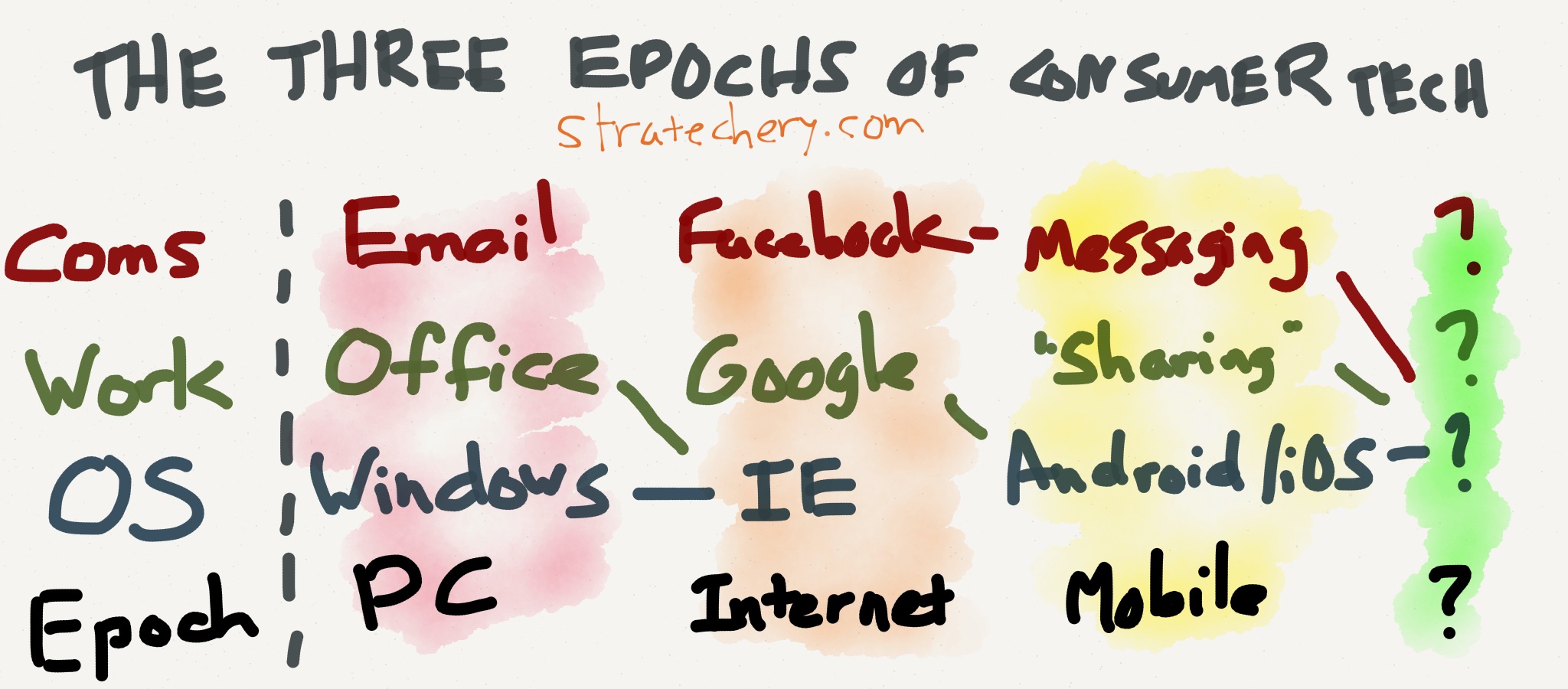
    In fact, one of the defining characteristics of the three major epochs of consumer computing – PC, Internet, and mobile – is that they have been largely complementary: we didn’t so much replace one form of computing for another insomuch as we added forms on top of each other.1 That is why, as I argued in Peak Google, many of the major tech companies of the last thirty years haven’t so much been disrupted as they have been eclipsed by new companies built during new epochs. All of the attention and relevance in tech especially is focused on emerging and growing companies, even as mature giants reap massive profits.

    Every epoch has had four distinct arenas of competition that emerge in order:

    • The core technology
    • The operating system (i.e. the means by which the core technology is harnessed)
    • The killer use case for:
      • Work/Productivity
      • Communication

    Certainly computers can be used for more than work/productivity or communication, but those two use cases are universal and lead to the biggest winners and most important companies.

    Epoch One: The PC

    The PC epoch began on August 12, 1981. That is the day the IBM Personal Computer was released with an Intel 8088 processor running Microsoft DOS 1.0. This open design was the core technology; the only proprietary IBM chip inside was the BIOS, which was soon reverse-engineered by Compaq who released the first “PC compatible” computer 17 months later.

    The operating system for the PC has been owned by Microsoft from the beginning; the Mac has garnered a profitable share at times (including today), but Windows versus Mac wasn’t really a contest, because with DOS Microsoft had already won the game.

    The killer application for work/productivity on the PC was the spreadsheet specifically, and front-office general-purpose apps broadly, including the word processor and presentation software. While it took much longer, Microsoft eventually came to dominate this space as well with the Office suite.

    The killer communication application on the PC ended up being open as well: email. Still, even here the most dominant player, at least in the corporate space (which is what mattered), was Microsoft once again, with Exchange on Windows Server. For all you young folks that can’t understand why us old people looked at Microsoft for so long with a mix of reverence and fear, well, now you know: the company in the end owned nearly every component of the PC epoch, and for all their struggles to remain relevant, Microsoft has never struggled to be profitable.

    Epoch Two: The Internet

    The Internet epoch began 14 years after the PC epoch, nearly to the day, with the Netscape IPO on August 9, 1995. The core pieces of the Internet had been around for years, and the World Wide Web was developed by Tim Berners-Lee and formally announced in August 1991 (clearly August is an auspicious month), but it was the “Netscape Moment” that woke everyone up to the possibilities of the Internet.

    Here the battle for the OS – also known as the browser – was much more fraught. Netscape jumped out to a huge lead, holding over 90 percent usage share, but Microsoft fought back by bundling Internet Explorer for free with Windows, and, truthfully, from Internet Explorer 3 on, by having a better product. Eventually it was Internet Explorer that had over 90 percent market share, and Microsoft felt they had won the Internet.

    However, it ultimately turned out that the browser wasn’t what mattered. Instead, the Internet made information, which for so long had been a scarce resource, abundant. So abundant, in fact, that it seemed impossible to make sense of it all, at least until Google came along. Search was the killer work/productivity application on the Internet: now you could instantly find the answer to just about anything on Google, and the company rightly dominated the category.

    The killer communications app took even longer to appear, but it solved a problem not dissimilar to Google: Facebook didn’t just let you communicate with people you knew, it came to understand how nearly every single person online was connected. And, as the number of people online continued to grow, so did Facebook. For all the misguided talk of Facebook being under threat, the reality is that its position as the default interconnect between every person on earth is as secure as ever.

    Epoch Three: Mobile

    I would like to choose Google’s acquisition of Android as the beginning of the mobile epoch, just because it happened in August (2005, in this case), but the date that matters is January 9, 2007, when Steve Jobs announced Apple’s iPhone. The core technology was the smartphone; while Nokia, Palm and Blackberry had been building precursors, it was the iPhone with its multitouch screen, unfettered Internet access, and (eventual) App Store that defined the category.

    Unlike the previous two eras, there has not been a single winner when it comes to the OS. In contrast to the PC, Apple was first-to-market. More importantly, smartphone buyers and smartphone users are usually always the same person, which allows Apple to differentiate itself according to the user experience and thus retain the top slice of the market. Android, meanwhile, was not only the first credible alternative to iOS, but also free, making it the operating system of choice for desperate phone OEM’s everywhere, and over time, allowing the OS to gobble up the vast expanses of the market driven primarily by price.

    Right now the operating system war is roughly at equilibrium; with the iPhone 6 it seems likely that Apple is stealing some share back from Android, particularly at the high end, but Android is simultaneously pushing down and out into the developing world, expanding both its share of the market and the market as a whole. What is more interesting is looking at who will emerge in the communications and work/productivity space.

    The Mobile Work/Productivity Space

    If the PC epoch was about being omnipotent – computers can do everything, better! – and the Internet epoch about being omniscient – with Google, you can know everything – mobile is about being omnipresent. By virtue of being, well, mobile, smartphones extend computing to every aspect of our daily lives. That is why the killer applications and dominant companies in the mobile work/productivity space will be defined by how they bridge the online and offline worlds.

    Chief among these companies, at least in my opinion, is Uber: the long-term potential of the company is about being the physical network that connects everything. Their success, though, is by no means assured. Moreover, there are other interconnects, like Airbnb or Postmates or Instacart, which are targeting verticals instead of everything everywhere. These examples are all built on the “sharing” economy, the sheer logistics of which are only possible because of smartphones.

    Other work/productivity applications may continue to emerge – cameras are very interesting here – but I suspect the dominant companies have already been started.

    The Mobile Communications Space

    I’ve already made my case for the winning communications application back in February (the day before Facebook acquired WhatsApp) in an article called Messaging: Mobile’s Killer App:

    Still, it’s only recently that the killer app for this era, when the nodes of communication are smartphones, has become apparent, and it is messaging. While the home telephone enabled real-time communication, and the web passive communication, messaging enables constant communication. Conversations are never ending, and friends come and go at a pace dictated not by physicality, but rather by attention. And, given that we are all humans and crave human interaction and affection, we are more than happy to give massive amounts of attention to messaging, to those who matter most to us, and who are always there in our pockets and purses.

    As I note in that article, messaging is compelling not just because it enables a new kind of communication, but also because it is a platform in and of itself. Already LINE and WeChat are leveraging that platform to push applications, particularly games, and making money on the back end. In the future, I expect both to be major channels for direct marketing between companies and consumers, and in fact WeChat has pushed even further in China, offering e-commerce, taxi services, and more all through their messaging app.

    It seems likely that the messaging battle will result in multiple winners: LINE already owns Japan, Taiwan, and Thailand, and is competitive in Indonesia and (they claim) in Spain, while WeChat is dominant in China. WhatsApp has the largest share worldwide, but that product is the furthest from being a real platform and a real business.2 Messenger is clearly seeking to mimic LINE and WeChat, and is the likely winner in most Western countries.3

    threeepochs

    What’s Next

    While the introduction of the iPhone seems like it was just yesterday (at least it does to me!), we are quickly approaching seven years – about the midway point of this epoch, if the PC and Internet are any indication.4 I sense, though, that we may be moving a bit more quickly: the work/productivity and communications applications have really come into focus this year, and while the battle to see what companies ride those applications to dominance will be interesting, it’s highly likely that the foundation is being laid for the core technology of the next epoch:

    • Wearables is a possibility, and it certainly seems that Apple is trying to accelerate the category with their ambitious Apple Watch rollout. However, no matter how good the Apple Watch is, I’m not sure it’s an epoch definer, especially if it cannot truly stand alone

    • Bitcoin is a definite possibility, particularly if there ends up being a “tick-tock” to epochs: device (PC), then protocol (Internet), device (smartphone), then protocol (Bitcoin). Blockstream, an attempt to create sidechains for non-monetary applications that run on top of Bitcoin, is particularly interesting in this regard5

    • Both of the mobile applications that I identified could be core technology for the next epoch: were Uber to become ubiquitous, could businesses be built on top of it? What would such an operating system look like? An out-there idea to be sure, but in the realm of possibility.

      More likely is that the messaging services become so dominant that they render the underlying mobile platform unimportant. This too would be similar to the effect of the Internet on the PC: the biggest reason the Mac was able to make a comeback from near death was because the Internet – and web apps – ran everywhere. It didn’t matter what browser6 or OS was on your actual PC. Similarly, if all essential apps and servers are routed through your messaging service, then the underlying OS – whether iOS or Android – is increasingly irrelevant. In fact, I strongly believe this is the future in China in particular, one more reason why Apple is investing so strongly in non-tangible qualities like fashion.

    What seems clearer is that today’s giants will continue owning their various categories in the context of their various epochs, even as they fade to – or continue in – irrelevance.

    • Microsoft still sells a lot of Windows licenses, and businesses especially still rely on Office. Still, it’s striking how unimportant Microsoft’s defensive move into browsers ended up being, especially when you think about…

    • Google seems strong, but as I’ve written previously, there is a lot about the company that feels like Microsoft: just as Microsoft jumped into the next epoch at the OS level for defensive reasons, Google too jumped ahead, also at the OS level, and also for defensive reasons. “Free” figured prominently in both strategies, and in the long run, it’s worth considering the possibility that Google’s Android dominance will have as much long term value to the company as Microsoft’s dominance of browsers – i.e., not very much at all. Ultimately, I expect an increasing amount of Google’s energy to go towards taking away what Microsoft has left: Chromebooks versus Windows, and Google Apps versus Office

    • Facebook is in a unique position: while they were started as an Internet company, they were an exceptionally young one, and have clearly made a successful jump to mobile. Their position in mobile, though, while secure, is by no means dominant, and it’s interesting that they are in fact following the Microsoft/Google playbook: both the WhatsApp and Oculus acquisitions were about securing a stake in the OS for the next epoch

    • Apple, as always, is following the beat of their own vertically-aligned drummer. They have (usually) good-enough services that work only on their exceptional hardware, and an OS advantage that matters to some number of people. More important in mobile is their ecosystem advantage: Apple has the best customers, devices, and OS, and thus gets the best apps, even though Apple isn’t exactly a benevolent ecosystem manager (members-only). I expect the company’s mobile position to be secure – they’re not going anywhere – and if wearables is the next epoch they are the best positioned: personal is what Apple is best at, and that’s exactly what wearables are

    • Amazon’s most important role in these epochs is AWS, where they are locked in increasingly fierce competition with Microsoft and to a lesser extent Google for cloud dominance. It’s worth noting that Amazon is attacking this space from a very different direction: AWS is another low-margin product in a company built on low-margins, while Microsoft and Google have tons of cash from their high margin core but little experience competing on price

    Do note, there are a lot of fascinating products and companies – Pinterest, Twitter, Instagram, even Xbox – that I have not covered: it’s not that they aren’t important, but they aren’t epochal (there’s a decent chance this is where Apple Watch ends up). And, of course, there is the whole enterprise world, itself undergoing real disruption (members-only) from software as a service and the explosion of mobile. What an industry!

    I have previously written Strengths-Weaknesses-Opportunities-Threats analyses for these five companies for Daily Update subscribers.

    If you would like to read these analyses and receive similar notes every day in your inbox, why not treat yourself to an early Christmas present and sign up for Stratechery Daily Updates?
    And have a very Merry Christmas!


    1. There is much confusion about this, largely because mobile is taking an ever greater percentage of time. However, most of that is additive. PC usage has in fact remained mostly static 

    2. Thanks to Facebook, of course, Jan Koum and company don’t need to worry about actually making money and can continue taunting competitors. Needless to say, I’m less impressed than Koum 

    3. iMessage is a good product and a great differentiator, but the fact it’s (rightly) not cross-platform means it’s not a player here 

    4. By the way, it’s worth noting that the midpoint of the previous two epochs – 1987 and 2000 – saw major crashes. Cross your fingers 

    5. I am still very concerned (members-only) about 51% attacks, and yes, I know all of the (ultimately trust-based) arguments against it 

    6. Mostly 


  • Docker and the Integrated Open Source Company

    It’s been a long time since an open source project has gotten as much buzz and attention as Docker. The easiest way to explain the concept is, well, to look at the logo of the eponymous1 company that created and manages the project:

    docker

    The reference in the logo is to shipping containers, one of the most important inventions of the 20th century. Actually, the word “invention” is not quite right: the idea of putting bulk goods into consistently-sized boxes goes back at least a few hundred years.2 What changed the world was the standardization of containers by a trucking magnate named Malcom McLean and Keith Tantlinger, his head engineer. Tantlinger developed much of the technology undergirding the intermodal container, especially its corner casting and Twistlock mechanism that allowed the containers to be stacked on ships, transported by trucks, and moved by crane. More importantly, Tantlinger convinced McLean to release the patented design for anyone to copy without license, knowing that the technology would only be valuable if it were deployed in every port and on every transport ship in the world. Tantlinger, to put it in software terms, open-sourced the design.

    Shipping containers really are a perfect metaphor for what Docker is building: standardized containers for applications.

    • Just as the idea of a container wasn’t invented by Tantlinger, Docker is building on a concept that has been around for quite a while. Companies like Oracle, HP, and IBM have used containers for many years, and Google especially has a very similar implementation to Docker that they use for internal projects. Docker, though, by being open source and community-centric, offers the promise of standardization
    • It doesn’t matter what is inside of a shipping container; the container itself will fit on any ship, truck, or crane in the world. Similarly, it doesn’t matter what app (and associated files, frameworks, dependencies, etc.) is inside of a docker container; the container will run on any Linux distribution and, more importantly, just about every cloud provider including AWS, Azure, Google Cloud Platform, Rackspace, etc.
    • When you move abroad, you can literally have a container brought to your house, stick in your belongings, and then have the entire thing moved to a truck to a crane to a ship to your new country. Similarly, containers allow developers to build and test an application on their local machine and have confidence that the application will behave the exact same way when it is pushed out to a server. Because everything is self-contained, the developer does not need to worry about there being different frameworks, versions, and other dependencies in the various places the application might be run

    The implications of this are far-reaching: not only do containers make it easier to manage the lifecycle of an application, they also (theoretically) commoditize cloud services through the age-old hope of “write once run anywhere.” More importantly, at least for now, docker containers offer the potential of being far more efficient than virtual machines. Relative to a container, using virtual machines is like using a car transport ship to move cargo: each unique entity on the ship is self-powered, which means a lot of wasted resources (those car engines aren’t very useful while crossing the ocean). Similarly, each virtual machine has to deal with the overhead of its own OS; containers, on the other hand, all share the same OS resulting in huge efficiency gains.3

    In short, Docker is a really big deal from a technical perspective. What excites me, though, is that the company is also innovating when it comes to their business model.


    The problem with monetizing open source is self-evident: if the software is freely available, what exactly is worth paying for? And, unlike media, you can’t exactly stick an advertisement next to some code!

    For many years the default answer has been to “be like Red Hat.” Red Hat is the creator and maintainer of the Red Hat Enterprise Linux (RHEL) distribution, which, like all Linux distributions, is freely available.4 Red Hat, however, makes money by offering support, training, a certification program, etc. for enterprises looking to use their software. It is very much a traditional enterprise model – make money on support! – just minus the up-front license fees.

    This sort of business is certainly still viable; Hortonworks is set to IPO with a similar model based on Hadoop, albeit at a much lower valuation than it received during its last VC round. That doesn’t surprise me: I don’t think this is a particularly great model from a business perspective.

    To understand why it’s useful to think about there being three distinct parts of any company that is based on open source: the open source project itself, any value-added software built on top of that project, and the actual means of making money:

    There are three parts of an open source business: the project itself, the value-added software on top of that project, and the means of monetization
    There are three parts of an open source business: the project itself, the value-added software on top of that project, and the means of monetization

    The problem with the “Red Hat” model is the complete separation of all three of these parts: Red Hat doesn’t control the core project (Linux), and their value-added software (RHEL) is free, leaving their money-making support program to stand alone. To the company’s credit they have pulled this model off, but I think a big reason is because utilizing Linux was so much more of a challenge back in the 90s.5 I highly doubt Red Hat could successfully build a similar business from scratch today.

    The three parts of Red Hat's business are separate and more difficult for the company to control and monetize
    The three parts of Red Hat’s business are separate and more difficult for the company to control and monetize

    GitHub, the repository hosting service, is exploring what is to my mind a more compelling model. GitHub’s value-added software is a hosting service based on Git, an open-source project designed by Linux creator Linus Torvalds. Crucially, GitHub is seeking to monetize that hosting service directly, both through a SaaS model and through an on-premise enterprise offering6. This means that, in comparison to Red Hat, there is one less place to disintermediate GitHub: you can’t get their value-added software (for private projects – public is free) unless you’re willing to pay.

    While GitHub does not control Git, their value-added software and means of monetization are unified, making the latter much easier and more sustainable
    While GitHub does not control Git, their value-added software and means of monetization are unified, making the latter much easier and more sustainable

    Docker takes the GitHub model a step further: the company controls everything from the open source project itself to the value-added software (DockerHub) built on top of that, and, just last week, announced a monetization model that is very similar to GitHub’s enterprise offering. Presuming Docker continues its present momentum and finds success with this enterprise offering, they have the potential to be a fully integrated open source software company: project, value-added software, and monetization all rolled into one.

    Docker controls all the parts of their business: they are a fully integrated open source company.
    Docker controls all the parts of their business: they are a fully integrated open source company.

    This is exciting, and, to be honest, a little scary. What is exciting is that very few movements have had such a profound effect as open source software, and not just on the tech industry. Open source products are responsible for end user products like this blog; more importantly, open source technologies have enabled exponentially more startups to get off the ground with minimal investment, vastly accelerating the rate of innovation and iteration in tech.7 The ongoing challenge for any open source project, though, is funding, and Docker’s business model is a potentially sustainable solution not just for Docker but for future open source technologies.

    That said, if Docker is successful, over the long run commercial incentives will steer the Docker open source project in a way that benefits Docker the company, which may not be what is best for the community broadly. That is what is scary about this: might open source in the long run be subtly corrupted by this business model? The makers of CoreOS, a stripped-down Linux distribution that is a perfect complement for Docker, argued that was the case last week:

    We thought Docker would become a simple unit that we can all agree on. Unfortunately, a simple re-usable component is not how things are playing out. Docker now is building tools for launching cloud servers, systems for clustering, and a wide range of functions: building images, running images, uploading, downloading, and eventually even overlay networking, all compiled into one monolithic binary running primarily as root on your server. The standard container manifesto was removed. We should stop talking about Docker containers, and start talking about the Docker Platform. It is not becoming the simple composable building block we had envisioned.

    This, I suppose, is the beauty of open source: if you disagree, fork, which is essentially what CoreOS did, launching their own “Rocket” container.8 It also shows that Docker’s business model – and any business model that contains open source – will never be completely defensible: there will always be a disintermediation point. I suspect, though, that Rocket will fail and Docker’s momentum will continue: the logic of there being one true container is inexorable, and Docker has already built up quite a bit of infrastructure and – just maybe – a business model to make it sustainable.


    1. For the grammar nerds, I subscribe to the notion that eponymous can be used in either direction  

    2. According to Wikipedia  

    3. Security is one of the biggest questions facing Docker: is it possible to guarantee that apps cannot interact or interfere with each other? Currently the conventional wisdom is that containers shouldn’t be used for multi-tenant applications, but that security is good enough for multiple applications from a single tenant 

    4. Technically, the source code is available, but any derivatives must strip-out all Red Hat trademarks 

    5. Fun fact: Red Hat was the first version of Linux I ever installed. It did not go well 

    6. BitBucket from Atlassian is similar; from a business model perspective the primary difference is that GitHub prices per repository while Atlassian prices per user 

    7. In fact, one could argue that open source is the number one argument against there being a bubble: there are so many startups not because there is an inordinate amount of money available, but because it is so damn cheap to get off the ground. Moreover, the standards for gaining meaningful funding are now way higher: because it is so much cheaper to build, test, and iterate on an idea, a startup needs traction before investors will write a check 

    8. It’s not precisely a fork; Rocket is new from the ground up but designed to do what Docker does and nothing more