Stratechery Plus Update

  • Apple’s Errors

    As rare as last week’s Apple revenue warning from CEO Tim Cook may have been — the company last issued a revenue warning in June 2002 — the company has had other bad quarters in the iPhone era. Look no further than the stock chart:

    Apple's stock price in the iPhone era

    Three troughs stand out:

    • In fiscal year 2013 (the iPhone 5 cycle),1 Apple’s year-over-year revenue growth slowed to 18%, then 11%, 1%, and 4%; this was a dramatic slowdown from 73%, 59%, 23%, and 27% the year before. Worse, net income growth actually went negative (0%, -18%, -22%, -9%) thanks to a significant drop in margin.
    • In fiscal year 2016 (the iPhone 6S cycle), Apple’s year-over-year revenue growth went negative (2%, -13%, -15%, -9%); again, net income was worse (2%, -22%, -27%, -19%), thanks in part to a $2 billion inventory write-off.
    • This year does project to be the worst first quarter of all three: a -5% revenue decline, and -1% net income decline; this decline comes after last quarter’s announcement that Apple would no longer disclose unit sales, which precipitated the current slide in the stock price.

    What makes this quarter seem so much worse was both the already negative sentiment surrounding the shift in Apple’s reporting (the presumption being the company wanted to hide declining unit sales), and also the fact that Apple’s management forecast was so off: here is CFO Luca Maestri on last quarter’s earnings call:

    As we move ahead into the December quarter, I’d like to review our outlook, which includes the types of forward-looking information that Nancy referred to at the beginning of the call. We have the strongest lineup ever as we enter the holiday season and we expect revenue to be between $89 billion and $93 billion, a new all-time record.

    In fact, the only record, such that there was, was the size of the miss. So what went wrong?

    On Confirmation Bias

    If you will forgive a brief aside, this article requires a few very large caveats: first, Apple has not yet released its final quarter numbers, had its earnings call, or filed it’s 10-Q; there is a lot of information still to come.

    Secondly, thanks in part to the lack of information, this miss is catnip for confirmation bias: everyone has their pet theory about what Apple is doing wrong or how they will ultimately fail, and it has been striking the degree to which this revenue warning has been breezily adapted to show that said critics were right all along (never mind that many of those critics trotted out the exact same explanations in 2013 and 2016).

    Third, well, I happen to think that I am right as well: I believe that Apple’s management made three critical errors in their forecast for this last quarter that were predictable precisely because they had made the same errors before — errors that I wrote about at the time. In other words, I am very much susceptible to confirmation bias as well.

    That noted, if indeed I am right, then that is good news for Apple: I suspect the company is in better shape than the last week of hysteria suggests.

    Error 1: China and ‘S’ Cycles

    The most important takeaway from the revenue warning is that the vast majority of the problem in Apple’s forecast comes from Greater China. From Cook’s letter:

    While we anticipated some challenges in key emerging markets, we did not foresee the magnitude of the economic deceleration, particularly in Greater China. In fact, most of our revenue shortfall to our guidance, and over 100 percent of our year-over-year worldwide revenue decline, occurred in Greater China across iPhone, Mac and iPad…

    The problem was specifically around the iPhone:

    Lower than anticipated iPhone revenue, primarily in Greater China, accounts for all of our revenue shortfall to our guidance and for much more than our entire year-over-year revenue decline. In fact, categories outside of iPhone (Services, Mac, iPad, Wearables/Home/Accessories) combined to grow almost 19 percent year-over-year.

    That this exact quarter would be challenging for Apple is exactly what I predicted in May 2017 in Apple’s China Problem; specifically:

    • In most of the world, Apple is differentiated first-and-foremost by its integration between hardware and software; the company has a “monopoly” on iOS, which allows it to sell its hardware at much higher prices than the competition.
    • However, in China iOS is much less of a lock-in, thanks to the dominance of cross-platform Chinese-specific services, particularly WeChat (WeChat, while the most important factor, is not the only one: indeed, given that Android in China is specifically tuned to the Chinese market by Chinese OEMs, iOS is if anything a hindrance).
    • The net result is that Apple in China competes not on the basis of integration, but rather on the attractiveness of its hardware; in other words, Apple is, to far greater degree in China than anywhere else, simply another OEM.

    I wrote at the time:

    For the day-to-day lives of Chinese there is no penalty to switching away from an iPhone. Unsurprisingly, in stark contrast to the rest of the world, according to a report earlier this year only 50% of iPhone users who bought another phone in 2016 stayed with Apple:

    This is still better than the competition, but compared to the 80%+ retention rate Apple enjoys in the rest of the world, it is shockingly low, and the result is that the iPhone has slid down China’s sales rankings: iPhone sales were only 9.6% of the market last year, behind local Chinese brands like Oppo, Huawei and Vivo. All of those companies sold high-end phones of their own; the issue isn’t that Apple was too expensive, it’s that the iPhone 6S and 7 were simply too boring.

    At the end I concluded that Apple’s next phone — what turned out to be the iPhone X — would return the company to growth in China, and so it did: Apple was up 11%, 21%, 19%, and 16% last fiscal year, after declining by double digits six of the previous eight quarters. The other half of that prediction, though, was that the next ‘S’ model, with only component upgrades in the same form factor, would struggle; that is exactly what appears to have happened.

    To be sure, there are absolutely other issues in China, particularly the country’s significant economic slowdown as well as the possibility of anti-U.S. company sentiment thanks to the ongoing trade war and the arrest of Huawei’s CFO. I strongly suspect, though, that those macroeconomic factors made what would have been a tough quarter for Apple regardless that much worse; to put it another way, Apple is far more exposed to challenging macroeconomic conditions in China than they are elsewhere thanks to their relative lack of a moat.

    There are two adjustments Apple needs to make to avoid this error in the future: first, and most obviously, the company needs to be far more pessimistic with regard to its China forecasts in ‘S’ model years. Second, management needs to appreciate that the plane of competition in China is different than the rest of the world: the company is a luxury brand, but only in terms of hardware. If anything, iOS in China needs to cater more to the local market; as far as hardware, perhaps it is time for the ‘S’ strategy to be retired.

    Error 2: Non-Flagship iPhones

    There is one complicating factor in the last piece of analysis: Apple’s provided their last forecast on November 1, a full month into the quarter; did they not see this massive China miss coming? Perhaps the economy simply crashed in the last two months?

    That may be true, but I don’t think it is the entire explanation; Apple also tripped itself up with the staggered release of iPhones both this year and last:

    • In September 2017 (FY2017 Q4) Apple released the non-flagship iPhones 8 and 8 Plus
    • In November 2017 (FY2018 Q1) Apple released the flagship iPhone X
    • In September 2018 (FY2018 Q4) Apple released the flagship iPhones XS and XS Max
    • In (late) October 2018 (FY2019 Q1) Apple released the iPhone XR

    This schedule resulted in two blind spots for Apple: first, the company’s FY2018 Q4 results in China were almost certainly artificially high, thanks to Error 1. Of course the iPhone XS should have a strong year-over-year comp to the iPhone 8, but that comp was likely particularly extreme in China.

    Second, to the extent that iPhone XS sales slowed in October, Apple likely expected the iPhone XR to pick up the slack;2 I strongly suspect the XR failed to live up to expectations.

    This too, though, should have been predictable: sure, from a feature perspective the XR seemed remarkably competitive with the XS, but we have ample evidence that iPhone buyers want the best possible iPhone. After this year’s iPhone keynote I wrote:

    There is, of course, the question of cannibalism: if the XR is so great, why spend $250 more on an XS, or $350 more for the giant XS Max? This is where the iPhone X lesson matters. Last year’s iPhone 8 was a great phone too, with the same A11 processor as the iPhone X, a high quality LCD screen like the iPhone XR, and a premium aluminum-and-glass case (and 3D Touch!). It also had Touch ID and a more familiar interface, both arguably advantages in their own right, and the Plus size that so many people preferred.

    It didn’t matter: Apple’s best customers, not just those who buy an iPhone every year, but also those whose only two alternatives are “my current once-flagship iPhone” or “the new flagship iPhone” are motivated first-and-foremost by having the best; price is a secondary concern. That is why the iPhone X was the best-selling smartphone, and the iPhone 8 — which launched two months before the iPhone X — a footnote.

    It remains to be seen the extent to which this is the case globally, but the market where having the flagship matters most has always been China. iPhone XS sales slowing and not being picked up by the just-launched XR certainly explain the timing of the missed forecast.

    Error 3: iPhone Destiny

    This gets at the third error made by Apple management, and arguably the most concerning: the assumption that iPhone growth is inevitable.

    This was seen most clearly during the iPhone 6 cycle, when Cook insisted on earnings call after earnings call — I documented his statements in this Daily Update — that Apple’s record-breaking sales were not an abnormally large number people buying new iPhones sooner than they would have thanks to the large screen. In fact, it turned out that is exactly what was happening, which is why 6S sales were such a disappointment. I concluded:3

    I know I’m kind of harping on this point, but in fact I find any possible explanation for this inconsistency very troubling: either Cook was purposely overselling the upgrade narrative last year, which would not only be duplicitous but also dumb, given that he would only be setting up Apple for a fall this cycle; or even as late as last year Cook was out of touch with how the iPhone upgrade cycle actually works, or how it may have changed over time.

    I strongly suspect it is the latter explanation, and while that is concerning, it’s also understandable; the implication of my ongoing contention that the iPhone has now picked all of the “low-hanging fruit” of growth is that iPhone growth had multiple causes: certainly the inherent quality and new features of each annual iPhone model played a role, but an arguably bigger factor was simply distribution — getting the iPhone onto more carriers in more countries. Indeed, I strongly suspect the predictable impact of increased distribution helps explain why Apple’s earnings forecasts were so eerily accurate for so many years.

    Apple, though, has been a lot less accurate for the last five quarters: the iPhone 6 sold better than they expected in nearly every quarter, and now the iPhone 6S is selling worse (note the Maestri forecast errors I highlighted above); along similar lines, Apple seems to have underestimated iPhone SE demand to a significant degree. Ultimately, while I think Apple still has the advantage when it comes selling people their second (or third or nth) smartphones, what I think we are seeing is that it’s a lot more difficult to determine when exactly that sale will occur, and Apple itself is only now coming to grips with that.

    This gets at the rest of the miss — the non-China parts, especially. Cook cited the end of carrier subsidies (largely an old story at this point, to be fair), a stronger U.S. dollar, and customers getting new batteries instead of new iPhones. It’s a bit of a hodgepodge with one primary takeaway: convincing customers to upgrade “good enough” phones is both challenging and unpredictable, and Apple can’t simply assume it will happen at the rate it has previously.

    Reasons for Optimism

    The good news for Apple is that, to the extent these errors really were predictable, there is nothing structurally different about the company’s competitive position today versus six months ago, when the current stock slide began.

    • The next iPhone hardware revision should sell better in China, simply by virtue of being new (and the implication of it being easy to switch away from iOS is that it’s easy to switch back).
    • Customers still prefer Apple’s flagship iPhones, no matter how expensive they are.
    • Headwinds like currency and battery replacement programs will go away, and phones, thanks to their centrality in people’s lives as well as the greater likelihood of harm, will always have a faster replacement cycle than PCs.

    Meanwhile, the company’s Services business continues to grow, along with its installed base (including in China); the company is clearly putting more strategic emphasis in this area, effectively abandoning also-ran hardware products like HomePod and Apple TV to increase the reach of its services. I would expect significant announcements in this area through 2019.

    That is not to say the company is finished with hardware: wearables are a huge area of growth, as both AirPods and Apple Watch are big successes, and it seems likely that an augmented reality product is coming in the next few years. Nothing will match the iPhone, but that’s ok; the sky is not falling, only the stock.

    I wrote a follow-up to this article in this Daily Update.


    1. Keep in mind that Apple’s fiscal years start on October 1st 

    2. The company had less than a week’s worth of data about how the XR was selling by the time management made its forecast 

    3. I first made the case for abandoning the ‘S’ strategy in this Daily Update, writing:

      To that end, I do question how much longer Apple can afford to stick with the ‘S’ strategy. Again, big screens were such an important feature that it’s difficult to take away too much from the 6S’ poor year-over-year comparisons, but it seems reasonable to wonder if the structural expansions that increased the iPhone’s addressable market papered over the fundamentally weaker value proposition presented by the ‘S’ lines. To put it another way, one could argue the ‘S’ lines are introducing a holiday quarter-like dynamic into Apple’s earnings but on a two-year basis: we may not really tell know the iPhone is doing until a completely new model that will drive upgrades comes out.

      In fact, if you look at a two-year comparison, Apple’s revenue last quarter was up 7%, a perfectly acceptable result 


  • Holiday/Vacation Break: Weeks of December 24 and December 31

    Stratechery is taking a holiday and vacation break the weeks of December 24 and December 31. There will be no Weekly Article or Daily Updates. The Daily Update will resume on January 7.

    All new subscriptions made since November 26, including during this break, will have two weeks added to their subscriptions. See you in 2019!


  • The 2018 Stratechery Year in Review

    In last year’s Stratechery Year in Review I noted that the predominant theme was the impact of tech on society; perhaps unsurprisingly, the dominant theme in 2018 was tech and regulation.

    This year I wrote 139 Daily Updates (including tomorrow) and 40 Weekly Articles, and, as per tradition, today I summarize the most popular and most important posts of the year; the question of regulating tech generally and Facebook’s foibles specifically figure prominently. Frankly, I plan on making an effort to spend more time elsewhere next year.

    In March I also launched Stratechery 4.0, with dramatically improved search; easier access to the archives via Concepts, Companies, and Topics; as well as a visual refresh and new logo.1

    You can find previous Stratechery Years in Review here: 2017 | 2016 | 2015 | 2014 | 2013

    A drawing of Amazon's Positioning as Healthcare Middleman

    Here is the 2018 list.

    The Five Most-Viewed Articles

    Stratechery once again had record traffic in 2018, and although none of the articles matched the juggernaut that was 2017’s Amazon’s New Customer, the first two articles on this list were the second and third-most popular articles all-time.

    1. The End of Windows — The Windows division no longer exists at Microsoft, marking the end to a four-year process of changing Microsoft’s culture.
    2. Amazon Health — Amazon Health doesn’t seem like much now, but there are hints it could be the ultimate application of Aggregation Theory.
    3. Lessons From Spotify — Spotify has a marginal cost problem, but while the cause is unique to Spotify, the challenges are more applicable than it seems.
    4. The Bill Gates Line — Understanding the differences between aggregators and platforms matters both for companies interacting with them and regulators considering antitrust.
    5. Amazon Go and the Future — Amazon Go exemplifies how Amazon is building its monopoly in three ways: horizontally, vertically, and financially. Plus, why automation is worth being optimistic about.

    A drawing of The Moat Map

    The Evolution of Aggregation Theory

    I am very pleased at the way I fleshed out Aggregation Theory this year, both in theoretical terms and also in its importance when it comes to thinking about regulation.

    • Zillow, Aggregation, and Integration explores why owning the customer relationship isn’t enough: an Aggregator also needs a way to transform a value chain. See also the afore-linked Lessons From Spotify.
    • Tech’s Two Philosophies, The Moat Map, and the afore-linked The Bill Gates Line explore the differences between platforms and Aggregators: the former facilitates a connection between suppliers and users, while the latter intermediates it. This distinction is critical for regulators.
    • Aggregators and Jobs-to-be-Done filled in a missing piece of Aggregation Theory: when I say that Aggregators win by having the best user experience, that means they are the best and most all-encompassing option to get a job done.

    A drawing of Platform Businesses Attract Customers by Third Parties

    Tech and Regulation

    There were three broad subcategories when it came to tech and regulation: the tendency of regulation to entrench incumbents, antitrust, and Facebook. Lots and lots of Facebook.

    Regulation:

    • Open, Closed, and Privacy — Just as encryption is only viable on closed systems, so it is that increased privacy regulations will only entrench walled gardens. That should affect thinking on regulation.
    • The European Union Versus the Internet — The EU is back to regulating tech companies, and getting the Internet wrong in the process. That, though, helps illuminate an approach that could work.
    • Data Factories — Facebook and Google and other advertising businesses are data factories, and regulation will be most effective if it lets users look inside.

    A drawing of The Facebook Data Factory

    Antitrust:

    • The European Commission Versus Android — Examining the history of Android explains why the European Commission may be right to fine Google for its actions around Android, even as the reasoning feels off.
    • Antitrust, the App Store, and Apple — Apple’s case before the Supreme Court is about standing; Apple has a strong case. That, though, doesn’t mean the App Store isn’t a monopoly — and that Apple isn’t increasingly predicated on rent-seeking.
    • The State of Technology at the End of 2018 — The State of Technology, at least in the enterprise space, is strong; consumer tech is another story, and it is time to question the dominance of big companies like Google.

    A drawing of How The Internet Undid Microsoft's Platform Advantage

    Facebook:

    Facebook at the center of data exchange

    The Old Guard

    This year several companies from the first generation of tech had their day in the sun, in many cases because of acquisitions.

    • The Cost of Developers — Microsoft paid a lot for GitHub, because it had to pay directly for access to developers. It doesn’t have the leverage of users the way that Apple does on the App Store.
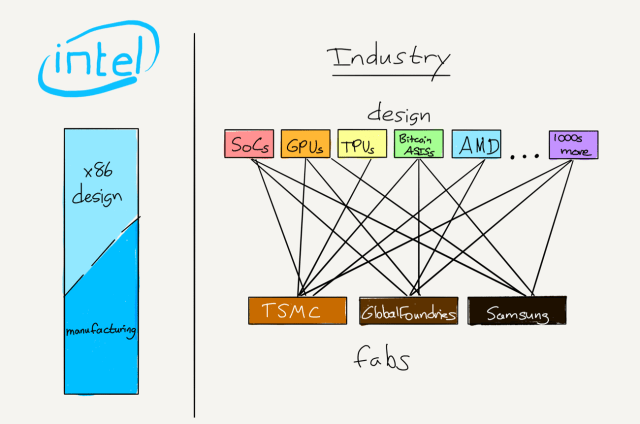
    • Intel and the Danger of Integration — Intel is in an increasingly bad position in part because it has been captive to its integrated model. Or, you could simply say they were disrupted.
    • IBM’s Old Playbook — IBM has bought Red Hat in an attempt to recreate its success in the 90s; it’s not clear, though, that the company or the market is the same.
    • The Experience Economy — SAP’s acquisition of Qualtrics shows how the shift in technology has changed business; it is a perfect example of using the Internet to one’s advantage.
    • Apple’s Middle Age — For Apple, hitting middle age means a strategy primarily focused on monetizing its existing customers. It makes sense, but one wonders what happens next (See also, The iPhone Franchise and Apple’s Social Network).

    Integrated intel was competing with a competitive modular ecosystem

    More Analysis

    There was still room for Stratechery staples: analysis of industries and companies in the context of the bigger picture.

    A drawing of The Asymptote Version of the User Experience

    The Year in Daily Updates

    This was another strong year for the Daily Update, which continued its trend towards being one fully-fledged topic with three areas of focus; the difference between Weekly Articles and Daily Updates is smaller than ever (you should subscribe!). Here are some of my favorites:

    A drawing of Apple, Microsoft, Google, and Facebook on tech's compass
    A special Daily Update drawing from Platforms Versus Aggregators, What About Amazon?, Walmart Buys Flipkart

    I also conducted three interviews for The Daily Update:


    I can’t say it enough: I am so grateful to Stratechery’s readers and especially subscribers for making all of these posts possible. I wish all of you a Merry Christmas and Happy New Year, and I’m looking forward to a great 2019!


    1. And merchandise!  


  • The State of Technology at the End of 2018

    This article is a bit of an annual tradition: in mid-December I summarize the state of technology,1 and appropriately enough, this year’s edition coincides with a tech executive testifying in front of Congress. This time the executive was Sundar Pichai, the CEO of Google, and on the surface, it was more of the same; Casey Newton wrote:

    From time to time the entire technology press corps gets together on Twitter, spends several hours live-tweeting the same event, and then writes a series of blog posts about how nothing important happened. This event is known as a Congressional hearing, and today we witnessed our final one of the year.

    Newton’s pithy summary, though, missed one essential part of the script: the Twitterati complaining about just how stupid members of Congress are:

    It’s hard to deny Ohanian the point: Congressman Lamar Smith’s line of questioning was — and I swear this is exactly what I wrote in my notes as I watched the hearing — “freaking delusional”.2

    Smith Versus Pichai

    Congressman Smith, like many of his Republican colleagues, was concerned about Google being biased against Conservatives;3 Congressman Smith stated:

    Google has revolutionized the world, though not entirely in the way I expected. Americans deserve the facts objectively reported. The muting of conservative voices by Internet platforms has intensified, especially during the Presidency of Donald Trump. More than 90% of all Internet searches take place on Google or YouTube and they are curating what we see. Google has long faced criticism for manipulating search results to censor Conservatives. Organizations have had pro-Trump content tagged as hate speech or had content reduced in search results. Enforcement of immigration laws has been tagged as hate speech as well. Such actions pose a grave threat to our democratic form of government. PJ Media found 96% of search results for Trump were from liberal media outlets. In fact, not a single right-leaning site appeared on the first page of results. This doesn’t happen by accident, but is baked into the algorithm. Google’s algorithms…It will require a herculean effort in senior management to change the political bias now programmed into the company’s culture.

    Pichai, as he did throughout the hearing, explained that Google did not manipulate search results for partisan ends, and that it would it not be in their business interest to do so.

    This is, to be clear, correct: Google’s business is perhaps the most perfect example of a capital-intensive tech company there has ever been. The company spends huge amounts of money on research-and-development and back-end infrastructure for the sake of offering services and advertisements that have zero marginal costs. It follows, then, that the company is heavily incentivized to serve as many users as possible; being purposely biased against approximately 50% of them would be illogical.

    Congressman Smith, though, was not convinced, leading to the exchange Ohanian highlighted:

    Congressman Smith: To my knowledge, you have never sanctioned any employee for any type of manipulating the search results whatsoever. Is that the case?

    Pichai: It’s not possible for an individual employee to manipulate the search results. We have a robust framework including many steps in the process.

    Congressman Smith: I disagree. I think they can manipulate the process.

    I mean, what are you supposed to say to that? Any person that works at Google — indeed, any person that has worked in any technology company of even the slightest scale — knows that it would be impossible for a rogue employee to manipulate search results. Good luck, though, convincing Congressman Smith.

    Google’s Impregnability

    Still, as a thought experiment, suppose Congressman Smith were right, and that Google’s search results, whether via managerial decree, general employee bias, or rogue employee, were gamed to disfavor Conservatives. The solution seems clear: create a competitor to serve the part of the market that is dissatisfied with Google. After all, this is a company that made $110 billion in revenue and $27 billion in pre-tax income;4 big profits mean a big opportunity for competitors, right? So what is Congressman Smith complaining about?

    The issue, of course, is that Google is, at least for a while (and more on this in a bit), impregnable: the company is an Aggregator with positive feedback loops everywhere:

    • A superior search product earns users, leading to more data and more supply that leads to better results, earning more users.
    • Superior ad inventory that attracts advertisers, leading to more data that, when combined with aggregated users, leads to more inventory that is (justifiably) more expensive than alternatives, resulting in outsized revenue and profits.
    • Outsized revenue and profits make it possible to acquire complementary companies (like DoubleClick), new sources of growth (like YouTube), and invest massively in research and development (for products like Android and TensorFlow), all of which serve to accelerate the first two feedback loops.

    The result is that consumers — whatever their political affiliation or feelings about bias — use Google because it is the best option, and, for all of Google’s technical brilliance, its insurmountable “bestness” is, at this point in the company’s history, more due to the frictionless structure of the Internet, with its zero distribution and transaction costs that make it possible for a company to achieve Google’s insurmountable scale, than it is due to any sort of unique innovation.

    The Cost of Dominance

    But still, so what? Google offers tremendously valuable services for no direct cost to consumers. What’s the problem? It is certainly hard for the American antitrust community to find any, thanks to the consumer welfare standard: Google is not raising prices for consumers, they are lowering them, in basically every market they enter.

    The question that must be asked, though, is at what cost? This year’s set of Congressional hearings suggest that one casualty is any sort of effective government oversight: a lack of competition for not just Google but also Facebook, particularly in terms of digital advertising, combined with an antitrust philosophy stripped of even a shred of suspicion about sheer size and the political and economic power that inevitably follow, means politicians are left with little recourse other than vague references to regulations that will only entrench the two consumer tech giants at best, and Smith-style conspiracy theories at worst (and, I’d note, it is not as if Progressives are thrilled about Google and Facebook’s content moderation policies and algorithms either).

    Equally concerning is the innovation that is not happening: venture investment in seed rounds and initial follow-ons is down considerably, and numerous studies (like here, here, and here) show that most of the decline is in the consumer space — i.e. the domain of Google, Facebook, Amazon, and Apple (I wrote about Apple’s problematic App Store two weeks ago).

    Moreover, the VC-backed tech industry knows better than anyone that this is not because large companies, with their top-down decision-making, are inherently better at innovation. The goal of venture capital is to make multiple bets on ideas with extremely uncertain outcomes, because the best way to figure out what works is to let the market decide, not mid-level managers. That strategy, though, isn’t nearly as successful if the market isn’t functioning correctly.

    In contrast, consider the enterprise software market: here the Internet has very much lived up to its billing, unleashing a torrent of innovative companies made possible by cloud computing, that are challenging lumbering incumbents up-and-down their product lines. And, to their credit, some of those incumbents, like Microsoft, are responding in kind, dramatically overhauling their core strategies and releasing new products and services that are innovative in their own right. Small wonder both venture capital investment and the IPO market are dominated by these enterprise startups: functioning markets have positive feedback loops of their own.

    The State of Technology

    This, then, is the state of technology in 2018: the enterprise market is thriving, and the consumer market is stagnant, dominated by the “innovations” that a few large behemoths deign to develop for consumers (probably by ripping off a smaller company). Meanwhile a backlash is brewing on both sides of the political spectrum, but with no immediately viable outlet through competition or antitrust action, the politics surrounding technology simply becomes ever more rancid.

    Still, some might argue, this moment may soon pass: just look at Microsoft. I praised them above for their new-found competitiveness, driven by the fundamental shift wrought by the combination of cloud computing and mobile that obviated their PC monopoly-based business model. Surely Google’s dominance will soon pass, just like Microsoft’s did, right?

    I’m not so sure.

    The Internet Age

    The single most important factor in the loosening of Microsoft’s monopoly was the Internet. Suddenly applications could be run and data could be stored in a way that was independent of the underlying operating system, undoing Microsoft’s platform lock-in.

    How the Internet undid Microsoft's platform advantage

    This didn’t affect Microsoft immediately — people were already accustomed to buying PCs (although it is not solely because of Steve Jobs’ return that the Mac’s fortunes increased in line with Internet penetration) — but it created an ecosystem that made a device like the iPhone, with its groundbreaking browsing capabilities, immediately useful in a way it wouldn’t have been otherwise. That attracted consumers, which attracted developers to the App Store, and the rest is history.

    That story extended to enterprise: not only were more and more line-of-business applications delivered via the cloud, but new companies providing services that competed with Microsoft were far quicker to support mobile, providing a compelling reason to switch, unwrapping Microsoft’s bundle and opening the door to new companies of all types.

    Again, though, all of this was because of the Internet, a paradigm shift that I have repeatedly likened to the Industrial Revolution in the profound impact I expect it to have when all is said-and-done. How often, though, do such paradigm shifts actually happen? Yes, the Internet saved the industry from Microsoft, but are we so sure another Internet-level shift, one that will upend Google’s dominance, is on the horizon?5 And how much foregone innovation and political dysfunction are we willing to suffer in the meantime?

    I wrote a follow-up to this article in this Daily Update.


    1. Here is 2014, 2015, and 2016; I skipped it last year in order to cover Disney’s acquisition of 21st Century Fox  

    2. OK, fine, I might have used a slightly different adjective 

    3. The capitalization is intentional, in reference to the distinct American political movement 

    4. Google took a special charge related to the recent tax law last year, artificially lowering its net income to $12.6 billion 

    5. Yes, the blockchain is fundamentally interesting, particularly its decentralized nature, along with the idea of digital scarcity; I suspect, though, that when and if blockchain applications achieve meaningful use cases they will be in areas fundamentally different than Google and Facebook, which are predicated on attractive user experiences 


  • Aggregators and Jobs-to-be-Done

    There were two developments in the scooter space over the last week. First, Bird announced the Bird Platform for entrepreneurs to start their own scooter services; from TechCrunch:

    The company will provide the independent operators with scooters, which they are given free rein to brand as they please, as well as access to the company’s marketplace of chargers and mechanics, in exchange for 20 percent of the cost of each ride. Bird says fleet managers, which may be independent entrepreneurs or local mom and pop bike rental shops, for example, can also collect and charge the scooters themselves.

    There is an optimistic view of Bird Platform: fleet operators on the Bird platform will allow the company to expand more rapidly than it would otherwise, even while Bird continues to (mostly) own the customer relationship (fleet operators will get their own app, but scooters will also appear in the Bird app). There is also a pessimistic view: Bird is offloading the risk involved in owning and managing scooters because their costs are unsustainably high, and moats unsustainably shallow.

    Then, a few days later, The Information reported that Uber was exploring the possibility of buying either Bird or Lime, their primary competitor:

    Uber, which already holds a minority stake in Lime, is evaluating both Bird and Lime as it looks to expand further into the fast-growing market for electric scooter services. A deal with either Bird or Lime could be reached before the end of the year, one of the people said, though there still is a possibility neither will happen. While financial terms of the talks couldn’t be learned, Bird was valued at $2 billion in its previous fundraising round, while Lime’s last valuation was $1.1 billion. Both have also been trying to raise more money at much higher valuations in recent months.

    There are still big questions about the financial viability of scooter rental services. For ride-hailing companies, the hope is that they and bike-rental services can be used to handle shorter trips in dense cities, though it is possible they could eat into their core car-based businesses.

    Once again, there are two ways to view this news; start with the pessimistic take in The Information (later reported by the Financial Times): dockless scooters are eating into traditional ride-sharing, which means Uber is interested in buying one of the leading scooter-sharing companies so that the company is at least cannibalizing itself. More optimistically, Uber is where scooter-sharing should have been all along.

    Uber’s Job-to-be-Done

    Theodore Levitt, the former Harvard Business School professor and editor of the Harvard Business Review, famously said “People don’t want to buy a quarter-inch drill. They want a quarter-inch hole.” The idea, which is at the core of well-known innovation frameworks like Outcome-Driven Innovation and Jobs-to-be-Done, is that effective customer segmentation relies not on easily measurable attributes like demographics or location — much less product features and prices — but rather on a deeper understanding of what the consumer is trying to accomplish.

    With this approach it quickly becomes obvious that, for all of the differences in their underlying businesses, Uber and the scooter companies are doing the same “job”: transporting users to a desired destination. Sure, the means are different — human-driven cars versus dockless scooters — which trickles down into the core mechanics and defensibility of their business models, but customers don’t care about all that: they just want to get to where they want to be.

    There was a time when the customer’s point of view might not have mattered quite so much; it used to be the case that success depended on controlling the supply of a good or service, or owning the distribution channels through which goods or services flow. The difference with the Internet — and it is a difference that, thanks to smartphones, very much affects real world goods like cars and scooters — is that goods and services can, at least in theory, reach anyone. Distribution is free, and in markets where supply is plentiful, value accrues to the companies that own demand — that is, those that have the most end users thanks to their superior user experience; I call them Aggregators.

    Aggregators and the User Experience

    I mentioned the importance of the user experience in my original formulation of Aggregation Theory:

    The fundamental disruption of the Internet has been to turn this dynamic on its head. First, the Internet has made distribution (of digital goods) free, neutralizing the advantage that pre-Internet distributors leveraged to integrate with suppliers. Secondly, the Internet has made transaction costs zero, making it viable for a distributor to integrate forward with end users/consumers at scale.

    This has fundamentally changed the plane of competition: no longer do distributors compete based upon exclusive supplier relationships, with consumers/users an afterthought. Instead, suppliers can be commoditized leaving consumers/users as a first order priority. By extension, this means that the most important factor determining success is the user experience: the best distributors/aggregators/market-makers win by providing the best experience, which earns them the most consumers/users, which attracts the most suppliers, which enhances the user experience in a virtuous cycle.

    What, though, makes for a good user experience? I have always been careful to distinguish between user interface and user experience: for example, many people find Facebook’s user interface to be confusing, but that is only one aspect of the user experience; another aspect is whether or not your friends or family are on the service, and here Facebook’s overall user experience is very strong indeed.

    This distinction underscores the importance of the virtuous cycle characteristic of all Aggregators: new suppliers — whether they be drivers on Uber, products on Amazon, content on Google or Facebook, shows on Netflix, apps on the App Store, etc. — attracted to the platform by the existing userbase enhance the user experience, even though have nothing to do with the user interface. Still, the user experience of what?

    Here the question of Uber and scooters perhaps provides some insight: the “user experience” for Uber is just how well the service does at transporting people where they wish to go. Along those lines, think about the virtuous cycle I’ve described between supply and demand and its impact on the user experience: the more riders there are, the more drivers come onto the platform (both in the short-term through higher prices and the long-term through reliable demand); the more drivers there are, the more reliable Uber is as a transportation service, increasing demand, and so it goes.

    Note, then, the similarities between my summary of the Uber user experience — how well the service does at transporting people where they wish to go — and my earlier description of the “job” that Uber does — transporting users to a desired destination. In short, the “user experience” that propels Aggregators is how well they do the “job” customers need in the space in which they compete. Or, to put it another way, if you want to know where in a value chain an Aggregator is likely to form, figure out what and where the “job” is.

    Aggregators and Jobs-to-be-Done

    Consider examples from Aggregators of all types:

    • Google is the best at doing the job of answering questions; that is how they gained their initial userbase, which attracted content suppliers of all types to formulate their content for Google, making Google even better at its job. Indeed, when it comes to answering questions, it is striking the degree to which Google has improved not simply in general queries but also in vertically-specific ones, thanks in large part to content suppliers willingly tuning their content to Google’s specifications.
    • Facebook started as the best place to find your friends and family, but, over time, evolved into being the best place to waste time. The former created an obvious virtuous cycle — more friends and family meant more users meant more friends and family — but so did the latter: more users meant more content suppliers eager for eyeballs, which made it that much more alluring a place to waste time, and for longer (some call this engagement).
    • Amazon is the best place to buy things; the company famously started by having more books than anyone, which attracted customers, which made it possible for the company to offer more products, and later merchants, which attracted more customers, eventually evolving into the hybrid store/merchant platform that Amazon.com is today.
    • Netflix is the best place to watch TV. The company gained its initial streaming userbase by licensing Starz’ 11,000 title movie library; while Starz’ effective library size was one (whatever was showing on the Starz channel), Netflix’s was 11,000. That attracted users, which gave Netflix the funding (and prospect for future funding, realized through debt) to buy more shows, attracting more users, providing funding to eventually make their own shows, attracting more users still.
    • YouTube is the best place to find video content about basically anything (for better or worse); the site started by being the only online video site willing to show copyrighted material, which attracted users, which attracted more video makers, and eventually, copyright owners themselves.

    All of these jobs are quite straightforward and understandable: answer questions, waste time, buy things, watch TV, find videos; the Aggregators are the ones that do the job the best, both initially through some valuable insight, technical (Google) or otherwise (Facebook), and presently thanks to the virtuous cycle that followed. The user experience is the quality of the job done.

    The Expansionary Nature of Aggregators

    To return to Uber, this formulation argues strongly for the sort of acquisition under discussion: a car isn’t always the best means of transportation, which means that Uber is not doing the job customers ask it as well as it can. And, on the flipside, a scooter company on its own doesn’t exactly fit the bill either; add in the fundamental indefensibility of dockless scooters and Uber’s very large userbase looks like a truly differentiating asset.1

    Another company worth considering is Airbnb: the home-sharing startup has resolutely stuck to, well, shared homes. One wonders, though, if “find a shared home” is the job customers are asking Airbnb to do; I suspect the better answer is “find a place to stay.” Doing that job well, though, means including hotels in Airbnb’s listings, a step the company has so far declined to make at scale.2 I can understand the reticence: shared homes are what the service is known for; then again, Uber was once thought of as being for black cars, and Amazon for books.

    More generally, that virtuous cycle characteristic of Aggregators, where more users attract more suppliers which attract more users, is likely most important in terms of the breadth with which a job is done. By doing more of a job, an Aggregator attracts more marginal users, which attract more suppliers on the edges of a space, which expands what jobs can be done for what users. In concrete terms, Amazon started by selling things to book buyers, then expanded to selling things to CD buyers, until it now sells everything to everyone; the job-to-be-done, though, was only ever selling things.

    This helps explain why it is there are a few large companies that dominate their space: Aggregators don’t simply get better at what they were already good at, they expand their purview into the broadest possible definition of their job. Google, for example, was once thought to be under threat by vertical search alternatives; it turns out vertical search alternatives were under threat by an expansionary Google. The only exception is shopping and Amazon, but frankly, that is a different job anyways; it seems job-to-be-done defines not only the aggregation opportunity, but its limit as well.

    I wrote a follow-up to this article in this Daily Update.


    1. Of course, lots of deals that make sense don’t happen, and this one, thanks to the sky-high valuations of both Uber and the scooter companies, will be particularly challenging 

    2. The company has added some boutique hotels  


  • Antitrust, the App Store, and Apple

    Yesterday the Supreme Court held a hearing in the case Apple Inc. v. Pepper. “Pepper” is Robert Pepper, an Apple customer who, along with three other plaintiffs, filed a class action lawsuit alleging that App Store customers have been overcharged for iOS apps, thanks to Apple’s 30% commission that Pepper alleges derives from Apple’s monopolistic control of the App Store.

    There are three points to make about this case, and they are captured in the title:

    • First, the specific antitrust doctrine at question
    • Second, the question of whether the App Store is a monopoly
    • Third, what the very existence of these questions says about Apple

    In my estimation, these three points move from less certain to more certain, and from less important to more important. In other words, whatever the Supreme Court decides matters less than what the very existence of this case says about the state of Apple and its future.

    Antitrust and Standing

    The question before the Supreme Court is whether or not Pepper et al. have standing to sue Apple for antitrust violations at all; in other words, the case — which was launched in 2011 — hasn’t even started yet. The Clayton Antitrust Act of 1914 stated that “any person who shall be injured in his business or property by reasons of anything forbidden in the antitrust laws” can bring an antitrust action, but in the 1977 case Illinois Brick Co. v. Illinois, the Supreme Court held that only direct purchasers of illegally priced goods had standing to sue.

    The specifics of the Illinois Brick case are helpful in parsing out what makes the Apple case complex; specifically, the Illinois Brick value chain was very straightforward: concrete block makers (including the eponymous Illinois Brick Company) were accused of colluding to fix prices for concrete blocks, which were bought by masonry contractors; masonry contractors in turn submitted bids to general contractors for construction projects, which were ultimately paid for by the State of Illinois. The State of Illinois sued for damages, alleging that the higher prices resulting from the price fixing had been passed through to the State of Illinois.

    The Illinois Block value chain

    In this value chain it is obvious who the direct purchasers were: masonry contractors; to the extent the State of Illinois suffered harm it was indirect pass-through harm. Thus, the Supreme Court ruled that the State of Illinois did not have standing; if every party in the value chain were to sue, the infringing party could be subject to duplicative recovery for damages (and parsing out the share of damages would be extremely difficult).

    Apple vs Pepper

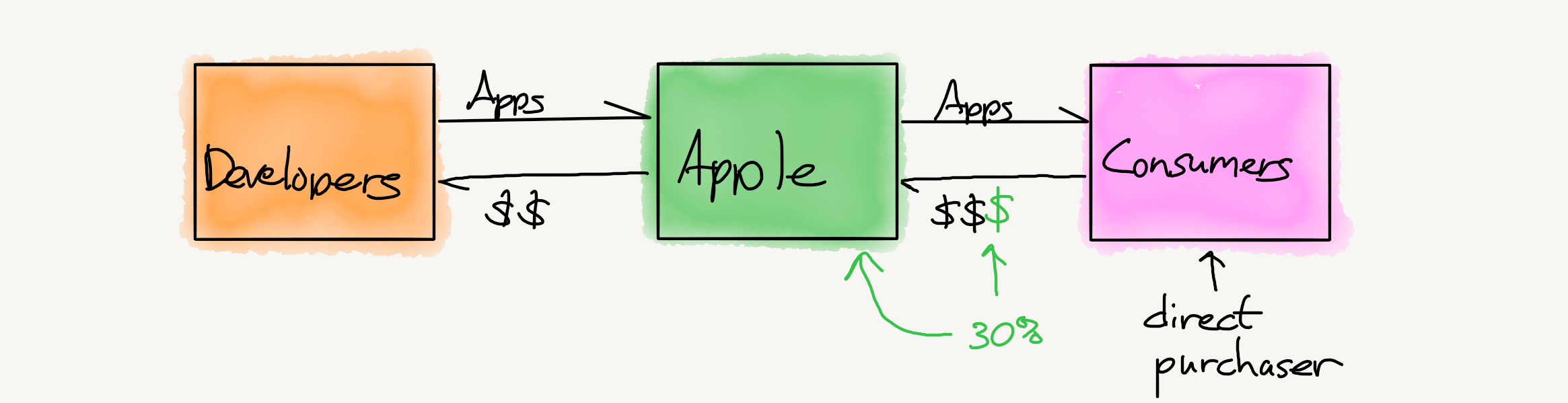
    The question in Apple vs. Pepper, then, is who is directly harmed by Apple’s alleged monopolistic practices. According to the plaintiffs, the value chain looks the same as the concrete block manufacturers:

    The plaintiff's characterization of the App Store value chain

    In this case Apple is in between developers and customers; the plaintiffs explain in their petition:

    Apple charges apps purchasers a 30% commission on each app sale (unless it is a free app). The price paid by purchasers for an app is the amount set by the apps developer, plus Apple’s own supra-competitive 30% markup, both of which are paid directly to Apple, the alleged monopolist, every time an app is purchased. Apple keeps the entire supra-competitive portion of the purchase price for itself and remits the balance to the apps developers. The apps developers do not sell their apps to iPhone customers or collect any payment from iPhone customers, and iPhone customers are the only purchasers in the entire chain of distribution.

    The plaintiffs argue that this makes consumers “direct purchasers”, giving them standing to sue:

    Since Illinois Brick was decided 40 years ago, courts throughout the nation have had no trouble applying its “direct purchaser” standing requirement to various factual settings, including cases in which some form of payment is made to an alleged monopolist prior to the monopolist’s sale of a product.

    Apple’s argument is that this misrepresents the transaction; the company wrote in its petition:

    There is no basis for Respondents’ argument that pass-through damages claims are permitted whenever there is direct interaction between the plaintiff and alleged antitrust violator. This argument openly exalts form over substance by turning entirely on the formal identification of a “direct purchaser” and prohibiting any “further inquiry into the specifics of a case.”

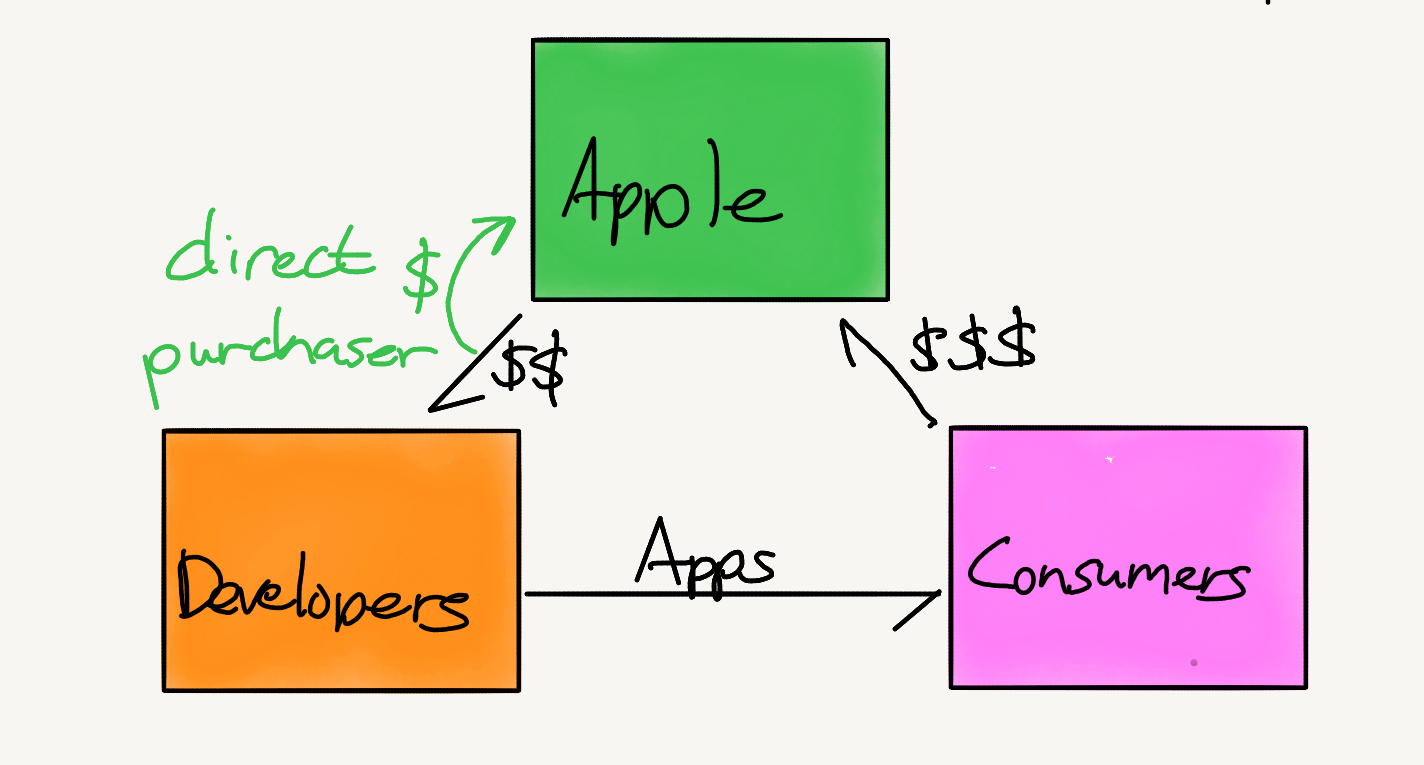
    Rather, Apple argues that the value chain looks like this:

    Apple's characterization of the App Store value chain

    Specifically, the company argues that “Apple does not buy and resell apps”:

    Respondents suggest for the first time that Apple “has adopted the role of a retailer functionally buying from developers as wholesalers and selling to iPhone owners as consumers.” But their complaint does not allege that. And Respondents have repeatedly acknowledged that only consumers buy apps; Apple does not. The Apple developer agreements cited by Respondents confirm this: developers “do[] not give Apple any ownership interest in [their] [a]pplications.” So Apple is fundamentally unlike a traditional retail store.

    Rather, Apple acts as an “agent” for developers:

    As Respondents note, [the Developer] Agreement confirms that “Apple acts as an agent for App Providers in providing the App Store and is not a party to the sales contract or user agreement between [the user] and the App Provider.” Thus, Respondents concede that the direct sale is actually between developers and consumers, facilitated by Apple as an agent and conduit.

    Along those lines, Apple argues that developers set the price of their apps, which determines Apple’s 30% cut, and to the extent developers set prices higher to compensate for that cut they are passing on alleged harm to consumers — which means consumers don’t have standing to sue.

    Why Apple is Right in his Case

    With the caveat that I am not a lawyer, I believe that Apple has the stronger position in this case for two reasons: the first are the arguments laid out above. The second, though, come back to Aggregation Theory: I believe that Apple has power over developers (supply) precisely because it has all of the consumers (demand); it follows, then, that it is far more likely that developers are pricing according to what the consumer market will bear and internalizing the App Store fee, as opposed to pricing their products artificially high in order to pass the cost of that fee on to customers.

    And, well, that goes back to the first point: even if they are pricing their products artificially high that is an ipso facto example of pass-through harm, which means consumers don’t have standing. The plaintiff’s case only makes sense in a world where there is a scarcity of apps with pricing power such that consumers are forced to bear 100% of Apple’s add-on; the reality is that apps are already as cheap as can be and it is developers that are being directly harmed by Apple’s policies (along those lines, the degree to which Apple owns the customer relationship — and associated data — does suggest something much more meaningful than an agent relationship with developers).

    That noted, many court observers felt yesterday’s oral arguments went the plaintiffs’ way; we won’t know if that is an indicator of the court’s decision until next year.1

    The App Store Monopoly

    If I am right, and the case is dismissed because the plaintiffs do not have standing, that does not mean Apple and the App Store are out of the antitrust hot water: first, developers can sue for antitrust damages, and second, most states — including California — do not follow the Illinois Brick precedent (this dual antitrust regime was upheld by the Supreme Court in California v. ARC America Corp). There is a decent chance the question of whether or not the App Store and Apple’s associated policies are an antitrust violation will make its way to court sooner or later.

    To that end, one of the more humorous aspect of yesterday’s oral arguments was the way discussion presumed that Apple was an abusive monopoly; this was a matter of convenience, as the question at hand was if Apple were an abusive monopoly, then who was harmed directly — which means it was easier to discuss the the latter question while assuming the former was true. To be frank, though, the language felt appropriate: Apple is an abusive monopoly in terms of iOS apps.

    Let’s review the facts:

    • The only way to install apps on an iOS device is through the App Store
    • All apps must use Apple’s purchase APIs for all digital transactions, which include a 30% fee paid to Apple
    • Apps are expressly forbidden from linking to or suggesting that users visit a website to acquire any sort of digital good or subscription

    This has been the state of affairs since 2011 when Amazon’s Kindle app gave in to Apple’s demand that it remove a link to Amazon’s online store. To be sure, Amazon is no shrinking violet in this fight, but Kindle is a useful example of just how absurd this policy is:

    • Apple is not responsible for any aspect of the Kindle ecosystem. Amazon hosts the books, runs the store, makes the readers, apps, etc.
    • Apple does make the device that ~45% of potential customers in Amazon’s largest market (the United States) carry with them every day.
    • Ergo, Apple demands that Amazon either give Apple 30% of all purchases on the Kindle app for iPhone or leave it to customers to figure out how to buy a new book.

    Amazon, of course, has chosen the latter option: they can do that because they are a brand just as well-known as Apple, and even more beloved. That’s not really an option for a whole host of smaller developers, who have no choice but to give Apple 30% of their revenue if they even want to build a business.

    That gets at the crux of the issue: Apple has every right to the outsized profits it makes on the iPhone. Consumers could buy cheaper Android devices but they don’t because they value Apple’s hardware, or iOS, or the integration between the two. I have a hard time believing, though, that anyone buys iOS because that makes it harder to buy ebooks!

    To put it another way, Apple profits handsomely from having a monopoly on iOS: if you want the Apple software experience, you have no choice but to buy Apple hardware. That is perfectly legitimate. The company, though, is leveraging that monopoly into an adjacent market — the digital content market — and rent-seeking. Apple does nothing to increase the value of Netflix shows or Spotify music or Amazon books or any number of digital services from any number of app providers; they simply skim off 30% because they can.

    To be clear, Apple absolutely did create the modern app marketplace, and, as the company loves to brag, an entire new economy full of new types of jobs. That, though, is precisely the problem: the App Store is not a fun side diversion; it is one of the largest platforms we have ever seen, on which hundreds of thousands of people are seeking to build real businesses, and that carries different types of responsibilities — and legal limitations — than an OS feature. It is bad for society generally and, I strongly believe, illegal for Apple to have crafted App Store rules such that it can leverage its smartphone share into monopoly profits on digital goods and services that are on iOS not because iOS is anything special, but because that is the only possible way to reach nearly 50% of the U.S. population.

    Apple and the Services Narrative

    Apple’s decision to embark on this strategy in 2011 was disappointing enough; the far more concerning development happened in January 2016. That was the first quarter when the iPhone basically stopped growing in terms of unit sales, and Apple’s response was the “Services Narrative”. CFO Luca Maestri opened his prepared remarks by covering a special supplemental document meant to emphasize that Apple had a thriving services business:

    Each quarter, we report results for our Services category, which includes revenue from iTunes, the App Store, AppleCare, iCloud, Apple Pay, licensing, and some other items. Today, we would like to highlight the major drivers of growth in this category, which we have summarized on page three of our supplemental material. The vast majority of the services we provide to our customers, for instance, apps, movies and TV shows, are tied to our installed base of devices, rather than to current quarter sales.

    For some of these services, such as content, we recognize revenue based on transaction value. For some of the services, such as the App Store, we share a portion of the value of each transaction with the app developer and only recognize revenue on the portion that we keep. To fully comprehend the scale of the services that we are delivering to our installed base and how fast this business is growing, we look at purchases in addition to revenue. When we aggregate the purchase value of services tied to our installed base during fiscal 2015, it adds up to more than $31 billion. That’s an increase of 23% over fiscal 2014.

    First off, it is striking that when Apple was facing one of its most challenging years in the stock market, its first response was to basically make the plaintiff’s point in Apple v Pepper: suddenly the company wanted to recognize all of the App Revenue, “a portion” of which is shared with developers. That sounds like a company in the middle!

    Secondly, though, the reason Apple wanted to include all app revenue is that the “Services Narrative” has always been first and foremost the App Store narrative. Apple makes a huge amount of money, with massive profit margins, by virtue of its monopolistic control of the App Store. It doesn’t make the games or the productivity applications or the digital content; it simply skims off 30%, and not because its purchasing experience is better,2 but because it is the only choice.

    This is, to be sure, a narrative worth telling, at least when it comes to the stock market: Apple’s PE ratio, even with the recent slide in the stock price, is up 50% from that January 2016 call (two months ago it was up 100%). Investors believe — for good reason — that Apple can earn sustainable profits from something other than new devices (the company’s recent stock slide, interestingly, seems to have come from Apple’s insistence that its reporting emphasize revenue over unit sales).

    At the same time, it seems incredibly worrisome to me anytime any company predicates its growth story on rent-seeking: it’s not that the growth isn’t real, but rather that the pursuit is corrosive on whatever it was that made the company great in the first place. That is a particularly large concern for Apple: the company has always succeeded by being the best; how does the company maintain that edge when its executives are more concerned with harvesting profits from other companies’ innovations?

    To that end, perhaps it is not a surprise that the company’s other big growth driver has been rising prices across its product line: Apple deserves credit for building up the sort of customer loyalty that it can extract ever more revenue from its user base; more cynically, given the hassle of switching, where else are its customers going to go?

    This is a view that is perhaps a tad pessimistic: Apple continues to show a lot of innovation in its wearables category, both Apple Watch and AirPods3, and the company is the best placed to make augmented reality a mainstream product. And, to be sure, the company has never been afraid of high prices.

    Still, it always seemed that for Apple high profit margins were a by-product of the pursuit of great products, not the goal; it is much harder to make that case when it comes to the “Services Narrative” and App Store policies that seek to leverage genuine innovation in one market (smartphones) into rent-seeking in another (digital content). The latter may not be illegal, at least not yet, but the biggest potential victim is not consumers, nor app developers, but the product culture that gave Apple market power in the first place.

    I wrote a follow-up to this article in this Daily Update.


    1. And, on the flipside, that the court granted certiorari at all suggests they may be looking to reverse the 9th Court of Appeals, which ruled in favor of the plaintiffs 

    2. In fact, its purchasing experience is better, particularly for free-to-play games; Apple should compete on the merits 

    3. Well, except for the mysterious disappearance of AirPods 2 


  • The Experience Economy

    The phrase “The Experience Economy”, like the worst sort of corporate speak, sounds less like a viable business plan than it does a discarded slogan for Las Vegas. Still, that was the explanation for SAP’s $8 billion acquisition for Qualtrics just days before the latter was set to IPO.

    Personally, I quite prefer the phrase “Experience Management”; it places this move by SAP very much in line with the enterprise software provider’s history.

    SAP and ERP

    SAP was founded in 1972 by five former IBM employees, who a year later launched an accounting system called RF; the ‘R’, which would christen all of SAP’s products for decades, stood for “real-time.” The idea was that, by leveraging databases, companies could get a “real-time” view of the state of their company. Three years later the company launched a purchasing, inventory management, and invoice verification system called RM. Over the ensuing years more and more modules would be developed to cover more and more back office functions; in 1990 Gartner christened the term ERP — Enterprise Resource Planning — to describe integrated software systems that managed nearly all of a company’s assets, allowing for, yes, “real-time” reports on how the company was operating.

    It makes sense that this is where enterprise computing really took hold: the logistics of managing large multinational companies were daunting, the exact sort of challenge at which computers were particularly adept. And, conveniently enough, those large enterprises had the capability to pay for what were expensive, time-consuming, and error-prone software installations and ongoing maintenance.

    That these systems were almost completely internally focused makes sense as well: there was no Internet, which meant data had to be entered manually in a centralized location. Computers certainly made tedious bookkeeping much easier, but there were physical limits to just how much of the business could be managed.

    The Rise of CRM

    By the 1990s the world was rapidly changing: the PC revolution and corporate intranets led to computers on every desk, dramatically increasing the utility and efficiency of ERP systems. Just as importantly, the emergence of the Internet made it increasingly possible to connect to centralized systems from locations other than the main office.

    The category of software that symbolized this shift, and which defined that decade of enterprise computing, was CRM: Customer Relationship Management software. CRMs allowed companies to manage outside relationships: not just who contacts were, but also the entire history of interactions with those contacts. This was in many respects a more complex job than ERP systems simply because there were so many more inputs, specifically global sales forces which actually interacted with customers.

    Thanks to the combination of PCs and the Internet, though, far-flung sales representatives could now input data from all over the world into a centralized piece of software that, like ERP, gave management a much more fine-grained view into how the business was actually operating. The big difference, though, is that while ERP gave a view into “what” was happening, CRM showed “who” it was happening with.

    The Consumer Era

    Fast forward another 20 years and the world has dramatically shifted yet again: not only are computing devices and Internet access ubiquitous, but critically, that ubiquity is not confined to businesses: customers, the ultimate endpoint of any business, are today just as connected as the employees of any large enterprise.

    This can be a rather frightening proposition for large businesses: look no further than social media, where seemingly every week some terrible story about a company with poor customer service goes viral; there are an untold number of similar sob stories shared instantly with friends and family.

    At the same time, competition is dramatically higher as well; customer choices used to be constrained by geography and limited channels for advertising: you could choose one mass-market product from conglomerate X, or a strikingly similar product from conglomerate Y. Today, though, you can find multiple products from any number of vendors, some large and many more small, the latter of which are particularly adept at using channels like Facebook to reach specific niches that were never well-served by large enterprises designed to serve everyone.

    Bill McDermott, the CEO of SAP, explained this challenge on an investor call about the Qualtrics acquisition:

    There are millions of complaints every day about disappointing customer experiences. This is called the experience gap. Businesses used to have time to sort this out, but in today’s unforgiving world, the damage is immediate, disruption is imminent. This has shifted the challenge from a running a business to guaranteeing great experiences for every single person.

    These shifts, though, afford an opportunity, which is exactly why SAP bought Qualtrics.

    Qualtrics and the Consumer Experience

    I actually have personal experience with Qualtrics: when I was an MBA student we used Qualtrics to create surveys for our marketing research course.1 My experience is not a surprise: Qualtrics, which was founded in 2002, was originally focused on the academic market. The company wrote in its S-1:

    Founded in 2002 with the goal of solving the most complex problems encountered by the most advanced academic researchers, we were forged in an environment that required rigorous analytical methods, ease of use, the versatility to address the broadest range of inquiries, and the scalability to reach millions of touch points globally. Our leading presence with academic institutions has introduced millions of students to Qualtrics and allowed them to become proficient in the use of our software. As these students have migrated into the workplace, they have often brought us with them, spawning a whole new class of commercial customers and developing new use cases for our XM Platform.

    Still, at first glance it seems kind of amazing that some survey software would be worth $8 billion! In fact, it’s not: after all, Survey Monkey IPO’d a couple of months ago, and is worth $1.3 billion. What makes Qualtrics different is what comes after the survey: a much more extensive toolbox of data analysis and reports that, at least in theory, give actionable insights into what exactly consumers think about a product or their interaction with a company.

    What makes this possible is the paradigm shift I just described: consumers are always connected, which means reaching them is dramatically cheaper than it used to be. Even seemingly basic channels like email are very effective at driving surveys that show exactly how consumers are feeling immediately after interacting with a company or buying their product.

    This gives an entirely new level of insight to management: while ERP showed what was happening in the main office, and CRM what was happening in offices all over the world, experience management promises the ability to understand what is happening with customers directly. It is a perfect example of businesses using new technology and paradigms to their advantage.

    SAP and Experience Management

    Still, experience management — which, the last few paragraphs notwithstanding, is still glorified surveys — has limited utility. When an ERP system shows a problem, it is very clear who is responsible, and what needs to be done to fix it; the situation is the same with CRM. What makes experience management into an actual tool of management is tying customer feedback to specific moments in time, whether those be customer service interactions or specific transactions.

    This is where SAP comes in: according to the company, SAP is at the center of 77% of transactions worldwide, thanks in large part to their dominance at point-of-sale (because of their strength in ERP). That means the company has massive amounts of what it calls operational data. CEO Bill McDermott explained on the call:

    To win in the experience economy there are two pieces to the puzzle. SAP has the first one: operational data, or what we call O-data, from the systems that run companies. Our applications portfolio is end-to-end, from demand chain to supply chain. The second piece of the puzzle is owned by Qualtrics. Experience data, or, X-data. This is actual feedback in real-time from actual people. How they’re engaging with a company’s brand. Are they satisfied with the customer experience that was offered. Is the product doing what they expected? What do they feel about the direction of their employer?

    Think of it this way: the O-data tells you what happened, the X-data tells you why it happened. At present, there is not technology company that brings these two worlds together. In particular, this exposes the structural weaknesses of CRM offerings, which are still back-office focused. Experience management is about helping every person outside of companies influence every person inside a company. So SAP and Qualtrics will do just that: the strategic value of this announcement is rivaled only by the business value.

    That business value is very much predicated on SAP’s nearly fifty year history: the real potential of this deal is tying data from consumers about their experience to actual transaction data, whether that be a purchase or a customer service interaction.

    The management opportunity afforded by Qualtrics and SAP

    In SAP’s vision, managers can react not simply to events after they show up on the balance sheet, but ideally before they, well, don’t: a constant refrain on the investors call was the important of limiting churn, which makes perfect sense. It is far more expensive to acquire a new customer than it is to retain an old one, and the combination of Qualtrics and SAP, uniquely enabled by the state of technology today, gives businesses an opportunity to do just that.


    The potential of the SAP + Qualtrics tie-up holds a lesson for businesses of all types: while it is always easy to see how the Internet screws up existing business models, it also presents completely new opportunities. Businesses that succeed will see the Internet as an opportunity; those that fail will frame it as the bogeyman in their demise. It is to SAP’s credit that they have embraced the former, and now it is on their customers to do the same.


    1. You have never known email pain until you have had several hundred classmates asking you to take their survey 


  • Apple’s Social Network

    While the saying goes that “No news is good news,” in the case of Apple it turns out that “News about no news is bad news.” From Bloomberg:

    Apple Inc. shares had their worst day since 2014 amid concerns that growth in its powerhouse product, the iPhone, is slowing. In the fiscal fourth quarter, Apple said iPhone unit sales barely grew from a year earlier, even though new flagship devices came out in the period. At the same time, Apple said it would stop providing unit sales for iPhones, iPads, and Macs in fiscal 2019, a step toward becoming more of a services business. While some pundits praised the move as a way to highlight a potent new business model, many analysts complained it was an attempt to hide the pain of a stagnant smartphone market.

    Apple has long been an exception in the smartphone space when it comes to reporting unit sales, so deciding not to is not that out of the ordinary; Apple, though, has always positioned itself as the extraordinary alternative — the best — and that approach paid off for years with sales numbers that were worth bragging about.

    A History of iPhone Unit and Revenue Growth

    The reality, though, is that unit sales in isolation have indeed misrepresented Apple’s business for the last several years; specifically, they have underestimated it. Consider the last six years of iPhone revenue growth and unit growth:

    iPhone unit growth and revenue growth over time

    iPhone unit growth and revenue were obviously highly correlated in the early years of the iPhone, when the only price difference in the line concerned the amount of storage on the flagship device. As Apple started keeping older models in the lineup, though, revenue growth was a bit slower than unit growth due to a slowly declining average selling price.

    Then the iPhone 6 happened: not only was the “big-screen iPhone” stupendously popular — and, it should be noted, was the first phone sold at launch on all of China’s mobile carriers — it also, for the first time, included a configuration — the $749 iPhone 6 Plus — that had a higher base price than the iPhone’s traditional $649. The result was revenue growth that, for the first time, significantly outpaced unit growth.

    The iPhone 6S was the opposite story: while Apple thought that iPhone 6 sales figures represented the new normal, in reality Apple had pulled forward a huge number of flagship phone buyers. Ultimately the company had to take a $2 billion inventory write-off on the iPhone 6S after over-forecasting sales; meanwhile, older model phones (including the iPhone 6) were still selling well, so again unit growth outpaced revenue growth.

    It turned out, though, that the 6S was the new normal: iPhone unit sales have been basically flat ever since:

    iPhone unit sales over time

    What has changed is Apple’s pricing: the iPhone 7 Plus cost $20 more than the iPhone 6S Plus. Then, last year, came the big jump: both the iPhones 8 and 8 Plus cost more than their predecessors ($50 and $30 respectively); more importantly, they were no longer the flagship. That appellation belonged to the $999 iPhone X, and given how many Apple fans will only buy the best, average selling price skyrocketed:

    iPhone average selling price over time

    Still, even though unit growth had been stagnant for a full three years (not just the last year, as many reports, including the one above, incorrectly stated), reporting those numbers helped Apple tell its story: after all, you needed unit numbers to calculate the average selling price.

    What the reports are right about, though, is that unit sales going forward are absolutely a story Apple would prefer to avoid: it is very unlikely that units will grow, and while Apple pushed pricing even higher with the iPhone XS Max, it probably can’t go much further, which means it is likely that the average selling price-based revenue growth story is drawing to an end as well.

    Today at Apple

    To this point I have focused on the iPhone, and for good reason: last quarter it made up 59% of Apple’s revenue; for the company’s holiday quarter it will likely approach 70%. However, the company will also stop reporting unit sales for Macs and iPads. This came on the heels of a product announcement last week where Apple introduced a new MacBook Air, Mac Mini, and iPads Pro; all were priced significantly higher than their predecessors.

    This isn’t a surprise: the Mac line has been increasing in price for years, while the iPads Pro are balanced by a strong entry-level product that starts at $329. The reality of both the Mac and iPads Pro is that they are niche products, and niche customers are willing to pay higher prices for products that better meet their needs.1

    What was more interesting about last week’s event though, and which casts more light on Apple’s new growth story than the products announced, was the ten minutes in the middle devoted to Apple Retail.

    This is how Apple CEO Tim Cook introduced the segment:

    Now there are ways that Apple aims to inspire creativity in our users, including in our stores. The mission of our stores has always been to enrich the lives of our customers by educating and inspiring them to go even further. One of the new ways that we’re taking their creativity even further is through our Today at Apple sessions.

    Today at Apple was announced with a press release in April, 2017, and received its first on-stage mention during the iPhone X keynote. Last week’s presentation, though, really highlighted how Today at Apple is perhaps the best way to understand the way Apple thinks about its growth opportunities going forward. Senior Vice President of Retail Angela Ahrendts explained:

    We started with the things that are core to Apple’s DNA, things people most use their devices for and trust us to teach them, like photography, music, gaming, and app development. And as Apple continues to develop curriculum like Everyone Can Code and Everyone Can Create, we embed these lessons and techniques into our Today at Apple programming for all customers, including educators and entrepreneurs. And we hold all of our sessions in all 505 retail locations, like at Apple Cotai Central in Macau, which opened a few months ago. Here, customers are attending a session called Photo Walks, where they learn new features, like portrait lighting and depth control, while exploring the city together in a real social way…

    And as we continue to push the design of our flagships to be even greater gathering places where everyone is welcome, we’re also creating global platforms for local talent. Photographers, musicians, developers, and artists share their creative gifts…

    Since the launch of Today at Apple, only 18 months ago, we have held over 18,000 sessions a week, attended by millions of curious creatives around the world. And with the newest release of the Apple Store app, we’ve made it even easier for you to find out what’s happening near you. Just tap on the Sessions tab and you’ll see a spotlight of the newest Today at Apple sessions in your city. It will also recommend sessions based on the products that you own, and signature programs like Music Labs, Kids Hour, and Photo Walks.

    What is striking about Today at Apple is the scale of its ambition combined with its price: free. Of course that is not true in practice, because one needs an Apple device to realistically participate (and an Apple ID to even sign up), but that raises the question as to what Apple customers are paying for when they buy an Apple product? Apple’s point in highlighting Today at Apple is that customers are not simply buying an iPhone or an iPad or a Mac, but rather buying into an ongoing relationship with Apple.

    Apple’s Social Network

    More broadly, this explains CFO Luca Maestri reasoning on the earnings call for no longer reporting unit sales:

    Third, starting with the December quarter, we will no longer be providing unit sales data for iPhone, iPad and Mac. As we have stated many times, our objective is to make great products and services that enrich people’s lives, and to provide an unparalleled customer experience so that our users are highly satisfied, loyal and engaged.

    “Engaged” is an interesting choice of words, as engagement is an objective normally associated with social networks like Facebook. The reasoning is obvious: the more engaged users are, the more they use a social network, which means the more ads they can be shown. Social networks accomplish this by aggregating content from suppliers as well as users themselves, and continually tweaking algorithms in an attempt to keep you swiping and tapping, and coming back to swipe and tap some more.

    This is a world that has always been foreign to Apple: its past attempts at facilitating social interaction on its platforms are memorable only as the butt of jokes (iTunes Ping anyone?). This isn’t a surprise: Apple’s culture and approach to products are antithetical to the culture and approach necessary to create and grow a traditional social network. Apple wants total control and to release as perfect a product it can; a social network requires an iterative approach that is designed to deal with constant variability and edge cases.

    This, though, is why Today at Apple is compelling, particular Ahrendts’ reference to bringing people together in a “real social way” — and she could not have emphasized the word “real” more strongly. Apple is in effect trying to build a social network in the real world, facilitated and controlled by Apple, and betting that customers will continue to pay to gain access.

    Apple’s Average Revenue per User

    To be perfectly clear, I am not arguing that Today at Apple is the answer to a saturated smartphone market or Apple reaching the limits of price increases. The company is clearly relying on “Services” revenue, which mostly means App Store revenue, a huge portion of which comes from in-app purchases for games, as well as a growing number of subscriptions, some provided by Apple (like Apple Music), but most by 3rd parties.

    What this framing of a “real world social network” does provide, though, is insight into where it is Apple’s new reporting falls short. It is all well and good that Apple will now separate Services revenue and its associated cost-of-sales starting next quarter; more insight into Apple’s growth driver is clearly appropriate.

    What is missing, though, is the equivalent of unit sales for Services, specifically, the number of active customers Apple has, and the associated revenue per user. This is the exact metric that matters to social media companies, and to the extent that Apple’s growth is derived from continually monetizing its existing user base over time, it makes sense here as well.

    To be sure, an accurate number would very much include device revenue: I laid out in Apple’s Middle Age that the company’s growth was based on getting more money from its existing user base through higher average selling prices, selling more devices (i.e. Apple Watch, AirPods, HomePod, etc.), and increased services revenue; to the extent Apple is correct that focusing on only devices misses the story, it is also correct that focusing on only Services is misleading as well.

    Apple’s Priorities

    Unfortunately Cook already declared on another earnings call last February that this number isn’t coming:

    We’re not releasing a user number, because we think that the proper way to look at it is to look at active devices. It’s also the one that is the most accurate for us to measure. And so that’s our thinking behind there.

    There are two problems with this: first, while an active devices number is helpful, the 1.3 billion number that Apple announced on that February earnings call was the first in two years; it has not been updated since. Second, the number of active devices may be easier for Apple to measure, but it simply isn’t as valuable to investors as the number of active users for reasons Cook stated himself last week:

    Our installed base is growing at double digits, and that’s probably a much more significant metric for us from an ecosystem point of view and customer loyalty, et cetera. The second thing is this is a little bit like if you go to the market and you push your cart up to the cashier and she says, or he says how many units you have in there? It doesn’t matter a lot how many units there are in there in terms of the overall value of what’s in the cart.

    It’s not just “overall value”, though: it’s how many customers there are total, and the ways in which their cart is changing — i.e. what is the installed base, and what is the rate of growth that Cook is referring to?

    Unfortunately Apple appears to be most concerned with the top and bottom line. Maestri said just before Cook’s comment:

    At the end of the day, we make our decisions from a financial standpoint to try and optimize our revenue and our gross margin dollars, and that we think is the focus that is in the best interest of our investors.

    It is certainly difficult for anyone, particularly Apple’s investors, to complain about Apple’s revenue and gross margin dollars, going on many years now. For all those years, though, said revenue and profit were based on unit sales.

    Now Apple is arguing that unit sales is the wrong way to understand its business, but refuses to provide the numbers that underlie the story it wants to tell. It is very fair for investors to be skeptical: both as to whether Apple can ever really be valued independently from device sales, and also whether the company, for all its fine rhetoric and stage presentations, is truly prioritizing what drives the revenue and profit instead of revenue and profit themselves. I do think the answer is the former; I just wish Apple would show it with its reporting.


    1. Well, theoretically anyways, in the case of the MacBook Pro 


  • IBM’s Old Playbook

    The best way to understand how it is Red Hat built a multi-billion dollar business off of open source software is to start with IBM. Founder Bob Young explained at the All Things Open conference in 2014:

    There is no magic bullet to it. It is a lot of hard work staying up with your customers and understanding and thinking through where are the opportunities. What are other suppliers in the market not doing for those customers that you can do better for them? One of the great examples to give you an idea of what inspired us very early on, and by very early on we’re talking Mark Ewing and I doing not enough business to pay the rent on our apartments, but yet we were paying attention to [Lou Gerstner and] IBM…

    Gerstner came into IBM and got it turned around in three years. It was miraculous…Gerstner’s insight was he went around and talked to a whole bunch IBM customers and found out that the customers didn’t actually like any of his products. They were ok, but whenever he would sit down with any given customer there was always someone who did that product better than IBM did…He said, “So why are you buying from IBM?” The customers were saying “IBM is the only technology company with an office everywhere that we do business,” and as a result Gerstner understood that he wasn’t selling products he was selling a service.

    He talked about that publicly, and so at Red Hat we go, “OK, we don’t have a product to sell because ours is open source and everyone can use our innovations as quickly as we can, so we’re not really selling a product, but Gerstner at IBM is telling us the customers don’t buy products, they buy services, things that make themselves more successful.” And so that was one of our early insights into what we were doing was this idea that we were actually in the services business, even back when we were selling shrink-wrapped boxes of Linux, we saw that as an interim step to getting us big enough that we could sign service contracts with real customers.

    Yesterday Young’s story came full circle when IBM bought Red Hat for $34 billion, a 60% premium over Red Hat’s Friday closing price. IBM is hoping it too to can come full circle: recapture Gerstner’s magic, which depended not only on his insight about services, but also a secular shift in enterprise computing.

    How Gerstner Transformed IBM

    I’ve written previously about Gerstner’s IBM turnaround in the context of Satya Nadella’s attempt to do the same at Microsoft, and Gerstner’s insight that while culture is extremely difficult to change, it is impossible to change nature. From Microsoft’s Monopoly Hangover:

    The great thing about a monopoly is that a company can do anything, because there is no competition; the bad thing is that when the monopoly is finished the company is still capable of doing anything at a mediocre level, but nothing at a high one because it has become fat and lazy. To put it another way, for a former monopoly “big” is the only truly differentiated asset. This was Gerstner’s key insight when it came to mapping out IBM’s future…In Gerstner’s vision, only IBM had the breadth to deliver solutions instead of products.

    A strategy predicated on providing solutions, though, needs a problem, and the other thing that made Gerstner’s turnaround possible was the Internet. By the mid-1990s businesses were faced with a completely new set of technologies that were nominally similar to their IT projects of the last fifteen years, but in fact completely different. Gerstner described the problem/opportunity in Who Says Elephants Can’t Dance:

    If the strategists were right, and the cloud really did become the locus of all this interaction, it would cause two revolutions — one in computing and one in business. It would change computing because it would shift the workloads from PCs and other so-called client devices to larger enterprise systems inside companies and to the cloud — the network — itself. This would reverse the trend that had made the PC the center of innovation and investment — with all the obvious implications for IT companies that had made their fortunes on PC technologies.

    Far more important, the massive, global connectivity that the cloud depicted would create a revolution in the interactions among millions of businesses, schools, governments, and consumers. It would change commerce, education, health care, government services, and on and on. It would cause the biggest wave of business transformation since the introduction of digital data processing in the 1960s…Terms like “information superhighway” and “e-commerce” were insufficient to describe what we were talking about. We needed a vocabulary to help the industry, our customers, and even IBM employees understand that what we saw transcended access to digital information and online commerce. It would reshape every important kind of relationship and interaction among businesses and people. Eventually our marketing and Internet teams came forward with the term “e-business.”

    Those of you my age or older surely remember what soon became IBM’s ubiquitous ‘e’:

    IBM's e-business marketing campaign

    IBM went on to spend over $5 billion marketing “e-business”, an investment Gerstner called “one of the finest jobs of brand positions I’ve seen in my career.” It worked because it was true: large enterprises, most of which had only ever interacted with customers indirectly through a long chain of wholesalers and distributors and retailers suddenly had the capability — the responsibility, even — of interacting with end users directly. This could be as simple as a website, or e-commerce, or customer support, not to mention the ability to tap into all of the other parts of the value chain in real-time. The technology challenges and the business possibilities — the problem set, if you will — were immense, and Gerstner positioned IBM as the company that could solve these new problems.

    It was an attractive proposition for nearly all non-tech companies: the challenge with the Internet in the 1990s was that the underlying technologies were so varied and quite immature; different problem spaces had different companies hawking products, many of them startups with no experience working with large enterprises, and even if they had better products no IT department wanted to manage and integrate a multitude of vendors. IBM, on the other hand, offered the proverbial “one throat to choke”; they promised to solve all of the problems associated with this new-fangled Internet stuff, and besides, IT departments were familiar and comfortable with IBM.

    It was also a strategy that made sense in its potential to squeeze profit out of the value chain:

    The actual technologies underlying the Internet were open and commoditized, which meant IBM could form a point of integration and extract profits, which is exactly what happened: IBM’s revenue and growth increased steadily — often rapidly! — over the next decade, as the company managed everything from datacenters to internal networks to external websites to e-commerce operations to all the middleware that tied it together (made by IBM, naturally, which was where the company made most of its profits). IBM took care of everything, slowly locking its customers in, and once again grew fat and lazy.

    When IBM Lost the Cloud

    In the final paragraph of Who Says Elephants Can’t Dance? Gerstner wrote of his successor Sam Palmisano:

    I was always an outsider. But that was my job. I know Sam Palmisano has an opportunity to make the connections to the past as I could never do. His challenge will be to make them without going backward; to know that the centrifugal forces that drove IBM to be inward-looking and self-absorbed still lie powerful in the company.

    Palmisano failed miserably, and there is no greater example than his 2010 announcement of the company’s 2015 Roadmap, which was centered around a promise of delivering $20/share in profit by 2015. Palmisano said at the time:

    [The consensus view is that] product cycles will drive industry growth. The industry is consolidating and at the end of the day consumer technology will obliterate all computer science over the last 20 years. I’m an East Coast guy. We’re going to have a slightly different view. Product cycles aren’t going to drive sustainable growth. Clients in the future will demand quantifiable returns on their investment. They are not going to buy fashion and trends. Enterprise will have its own unique model. You can’t do what we’re doing in a cloud.

    Amazon Web Services, meanwhile, had launched a full four years and two months before Palmisano’s declaration; it was the height of folly to not simply mock the idea of the cloud, but to commit to a profit number in the face of an existential threat that was predicated on spending absolutely massive amounts of money on infrastructure.1

    Gerstner identified exactly what it was that Palmisano got wrong: he was “inward-looking and self-absorbed” such that he couldn’t imagine an enterprise solution better than IBM’s customized solutions. That, though, was to miss the point. As I wrote in a Daily Update back in 2014 when the company formally abandoned the 2015 profit goal:

    The reality…is that the businesses IBM served — and the entire reason IBM had a market — didn’t buy customized technological solutions to make themselves feel good about themselves; they bought them because they helped them accomplish their business objectives. Gerstner’s key insight was that many companies had a problem that only IBM could solve, not that customized solutions were the end-all be-all. And so, as universally provided cloud services slowly but surely became good-enough, IBM no longer had a monopoly on problem solving.

    The company has spent the years since then claiming it is committed to catching up in the public cloud, but the truth is that Palmisano sealed the company’s cloud fate when he failed to invest a decade ago; indeed, one of the most important takeaways from the Red Hat acquisition is the admission that IBM’s public cloud efforts are effectively dead.

    IBM’s Struggles

    So what precisely is the point of IBM acquiring Red Hat, and what if anything does it have to do with Lou Gerstner?

    Well first off, IBM hasn’t been doing very well for quite some time now: last year’s annual revenue was the lowest since 1997, part-way through Gerstner’s transformation; of course, as this ZDNet article from whence this graph comes points out, $79 billion in 1997 is $120 billion today.

    IBM's declining revenue
    From ZDNet

    The company did finally return to growth earlier this year after 22 straight quarters of decline, only to decline again last quarter: IBM’s ancient mainframe business was up 2%, and its traditional services business, up 3%, but Technology Services and Cloud Platforms were flat, and Cognitive Solutions (i.e. Watson) was down 5%.

    Meanwhile, the aformentioned commitment to the cloud has mostly been an accounting fiction derived from re-classifying existing businesses; the more pertinent number is the company’s capital expenditures, which in 2017 were $3.2 billion, down from 2016’s $3.6 billion. Charles Fitzgerald writes on Platformonomics:

    Capex spending by cloud players

    We see IBM’s CAPEX slowly trailing off, like the company itself. IBM has always spent a lot on CAPEX (as high as $7 billion a year in their more glorious past), from well before the cloud era, so we can’t assume the absolute magnitude of spend is going towards the cloud. The big three all surpassed IBM’s CAPEX spend in 2012/13. In resisting the upward pull on CAPEX we see from all the other cloud vendors, IBM simply isn’t playing the hyper-scale cloud game.

    The Red Hat Acquisition

    This is where the Red Hat acquisition comes in: while IBM will certainly be happy to have the company’s cash-generating RHEL subscription business, the real prize is Openshift, a software suite for building and managing Kubernetes containers. I wrote about Kubernetes in 2016’s How Google is Challenging AWS:

    In 2014 Google announced Kubernetes, an open-source container cluster manager based on Google’s internal Borg service that abstracts Google’s massive infrastructure such that any Google service can instantly access all of the computing power they need without worrying about the details. The central precept is containers, which I wrote about in 2014: engineers build on a standard interface that retains (nearly) full flexibility without needing to know anything about the underlying hardware or operating system (in this it’s an evolutionary step beyond virtual machines).

    Where Kubernetes differs from Borg is that it is fully portable: it runs on AWS, it runs on Azure, it runs on the Google Cloud Platform, it runs on on-premise infrastructure, you can even run it in your house. More relevantly to this article, it is the perfect antidote to AWS’ ten year head-start in infrastructure-as-a-service: while Google has made great strides in its own infrastructure offerings, the potential impact of Kubernetes specifically and container-based development broadly is to make irrelevant which infrastructure provider you use. No wonder it is one of the fastest growing open-source projects of all time: there is no lock-in.

    This is exactly what IBM is counting on; the company wrote in its press release announcing the deal:

    This acquisition brings together the best-in-class hybrid cloud providers and will enable companies to securely move all business applications to the cloud. Companies today are already using multiple clouds. However, research shows that 80 percent of business workloads have yet to move to the cloud, held back by the proprietary nature of today’s cloud market. This prevents portability of data and applications across multiple clouds, data security in a multi-cloud environment and consistent cloud management.

    IBM and Red Hat will be strongly positioned to address this issue and accelerate hybrid multi-cloud adoption. Together, they will help clients create cloud-native business applications faster, drive greater portability and security of data and applications across multiple public and private clouds, all with consistent cloud management. In doing so, they will draw on their shared leadership in key technologies, such as Linux, containers, Kubernetes, multi-cloud management, and cloud management and automation.

    This is the bet: while in the 1990s the complexity of the Internet made it difficult for businesses to go online, providing an opening for IBM to sell solutions, today IBM argues the reduction of cloud computing to three centralized providers makes businesses reluctant to commit to any one of them. IBM is betting it can again provide the solution, combining with Red Hat to build products that will seamlessly bridge private data centers and all of the public clouds.

    IBM’s Unprepared Mind

    The best thing going for this strategy is its pragmatism: IBM gave up its potential to compete in the public cloud a decade ago, faked it for the last five years, and now is finally admitting its best option is to build on top of everyone else’s clouds. That, though, gets at the strategy’s weakness: it seems more attuned to IBM’s needs than potential customers. After all, if an enterprise is concerned about lock-in, is IBM really a better option? And if the answer is that “Red Hat is open”, at what point do increasingly sophisticated businesses build it themselves?

    The problem for IBM is that they are not building solutions for clueless IT departments bewildered by a dizzying array of open technologies: instead they are building on top of three cloud providers, one of which (Microsoft) is specializing in precisely the sort of hybrid solutions that IBM is targeting. The difference is that because Microsoft has actually spent the money on infrastructure their ability to extract money from the value chain is correspondingly higher; IBM has to pay rent:

    Perhaps the bigger issue, though, goes back to Gerstner: before IBM could take advantage of the Internet, the company needed an overhaul of its culture; the extent to which the company will manage to leverage its acquisition of Red Hat will depend on a similar transformation. Unfortunately, that seems unlikely; current CEO Ginni Rometty, who took over the company at the beginning of 2012, not only supported Palmisano’s disastrous Roadmap 2015, she actually undertook most of the cuts and financial engineering necessary to make it happen, before finally giving up in 2014. Meanwhile the company’s most prominent marketing has been around Watson, the capabilities of which have been significantly oversold; it’s not a surprise sales are shrinking after disappointing rollouts.

    Gerstner knew turnarounds were hard: he called the arrival of the Internet “lucky” in terms of his tenure at IBM. But, as the Louis Pasteur quote goes, “Fortune favors the prepared mind.” Gerstner had identified a strategy and begun to change the culture of IBM, so that when the problem arrived, the company was ready. Today IBM claims it has found a problem; it is an open question if the problem actually exists, but unfortunately there is even less evidence that IBM is truly ready to take advantage of it if it does.


    1. This footnote is a repeat from Microsoft’s Monopoly Hangover; Gerstner predicted the public cloud in the first appendix of his book, which was published in 2003, four years before AWS was launched:

      Put all of this together—the emergence of large-scale computing grids, the development of autonomic technologies that will allow these systems to be more self-managing, and the proliferation of computing devices into the very fabric of life and business—and it suggests one more major development in the history of the IT industry. This one will change the way IT companies take their products to market. It will change who they sell to and who the customer considers its “supplier.” This development is what some have called “utility” computing.

      The essential idea is that very soon enterprises will get their information technology in much the same way they get water or electric power. They don’t now own a waterworks or power plant, and soon they’ll no longer have to buy, house, and maintain any aspect of a traditional computing environment: The processing, the storage, the applications, the systems management, and the security will all be provided over the Net as a service—on demand.

      The value proposition to customers is compelling: fewer assets; converting fixed costs to variable costs; access to unlimited computing resources on an as-needed basis; and the chance to shed the headaches of technology cycles, upgrades, maintenance, integration, and management.

      Also, in a post-September 11, 2001, world in which there’s much greater urgency about the security of information and systems, on-demand computing would provide access to an ultra-secure infrastructure and the ability to draw on systems that are dispersed— creating a new level of immunity from a natural disaster or an event that could wipe out a traditional, centralized data center. 


  • The Problem with Facebook and Virtual Reality

    Facebook, believe it or not, has actually made virtual reality better, at least from one perspective.

    My first VR device was PlayStation VR, and the calculus was straightforward: I owned a PS4 and did not own a Windows PC, which means I had a device that was compatible with the PlayStation VR and did not have one that was compatible with the Oculus Rift or the HTC Vive.

    I used it exactly once.

    The PlayStation VR and all of its necessary accessories and cords

    The problem is that actually hooking up the VR headset was way too complicated with way too many wires, and given that I lived at the time in a relatively small apartment, it wasn’t viable to leave the entire thing hooked up when I wasn’t using it. I did finally move to a new place, but frankly, I can’t remember if I unpacked it or not.

    Then, earlier this year, Facebook came out with the Oculus Go.

    The Oculus Go is a standalone device

    The Go sported hardware that was about the level of a mid-tier smartphone, and priced to match: $199. Critically, it was a completely standalone device: no console or PC necessary. Sure, the quality wasn’t nearly as good, but convenience matters a lot, particularly for someone like me who only occasionally plays video games or watches TV or movies. Putting on a wingsuit or watching some NBA highlights is surprisingly fun, and critically, easy. At least as long as I have the Go out of course, and charged. It’s hard to imagine giving it a second thought otherwise.

    The Virtual Reality Niche

    That is the first challenge of virtual reality: it is a destination, both in terms of a place you go virtually, but also, critically, the end result of deliberative actions in the real world. One doesn’t experience virtual reality by accident: it is a choice, and often — like in the case of my PlayStation VR — a rather complicated one.

    That is not necessarily a problem: going to see a movie is a choice, as is playing a video game on a console or PC. Both are very legitimate ways to make money: global box office revenue in 2017 was $40.6 billion U.S., and billions more were made on all the other distribution channels in a movie’s typical release window; video games have long since been an even bigger deal, generating $109 billion globally last year.

    Still, that is an order of magnitude less than the amount of revenue generated by something like smartphones. Apple, for example, sold $158 billion worth of iPhones over the last year; the entire industry was worth around $478.7 billion in 2017. The disparity should not come as a surprise: unlike movies or video games, smartphones are an accompaniment on your way to a destination, not a destination in and of themselves.

    That may seem counterintuitive at first: isn’t it a good thing to be the center of one’s attention? That center, though, can only ever be occupied by one thing, and the addressable market is constrained by time. Assume eight hours for sleep, eight for work, a couple of hours for, you know, actually navigating life, and that leaves at best six hours to fight for. That is why devices intended to augment life, not replace it, have always been more compelling: every moment one is awake is worth addressing.

    In other words, the virtual reality market is fundamentally constrained by its very nature: because it is about the temporary exit from real life, not the addition to it, there simply isn’t nearly as much room for virtual reality as there is for any number of other tech products.

    Facebook’s Head-scratching Acquisition

    This, incidentally, includes Facebook: the strength of the social network is counterintuitive like virtual reality is counterintuitive, but in the exact opposite way. No one plans to visit Facebook: who among us has “Facebook Time” set on our calendar? And yet the vast majority of people who are able — over 2 billion worldwide — visit Facebook every single day, for minutes at a time.

    The truth is that everyone has vast stretches of time between moments of intentionality: standing in line, riding the bus, using the bathroom. That is Facebook’s domain, and it is far more valuable than it might seem at first: not only is the sheer amount of time available more than you might think, it is also a time when the human mind is, by definition, less engaged; we visit Facebook seeking stimulation, and don’t much care if that stimulation comes from friends and family, desperate media companies, or advertisers that have paid for the right. And pay they have, to the tune of $48 billion over the last year — more than the global box office, and nearly half of total video game revenue.

    What may surprise you is that Facebook landed on this gold mine somewhat by accident: at the beginning of this decade the company was desperately trying to build a platform, that is, a place where 3rd-party developers could build their own direct connections with customers. This has long been the stated goal of Silicon Valley visionaries, but generally speaking the pursuit of platforms has been a bit like declarations of disruption: widespread in rhetoric, but few and far between in reality.

    So it was with Facebook: the company’s profitability and dramatic rise in valuation — the last three months notwithstanding — have been predicated on the company not being a platform, at least not one for 3rd-party developers. After all, to give space to 3rd-party developers is to not give space to advertisers, at least on mobile, and it is mobile that has provided, well, the platform for Facebook to fill those empty spaces. And, as I noted back in 2013, the mobile ad unit couldn’t be better.

    This is why Facebook’s acquisition of Oculus back in 2014 was such a head-scratcher; I was immediately skeptical, writing in Face Is Not the Future:

    Setting aside implementation details for a moment, it’s difficult to think of a bigger contrast than a watch and an Occulus headset that you, in the words of [Facebook CEO Mark] Zuckerberg, “put on in your home.” What makes mobile such a big deal relative to the PC is the fact it is with you everywhere. A virtual reality headset is actually a regression in which your computing experience is neatly segregated into something you do deliberately.

    Zuckerberg, though, having first failed to build a platform on the PC, and then failing miserably with a phone, would not be satisfied with being merely an app; he would have his platform, and virtual reality would give him the occasion.

    Facebook’s Oculus Drama

    When the Oculus acquisition was announced Zuckerberg wrote:

    Our mission is to make the world more open and connected. For the past few years, this has mostly meant building mobile apps that help you share with the people you care about. We have a lot more to do on mobile, but at this point we feel we’re in a position where we can start focusing on what platforms will come next to enable even more useful, entertaining and personal experiences…

    This is a fascinating statement in retrospect. Of course there is the blithe dismissal of mobile, which would increase Facebook’s valuation tenfold, because Facebook was only an app, not a platform. More striking, though, is Zuckerberg’s evaluation that Facebook was now in a position to focus elsewhere: after the revelations of state-sponsored interference and legitimate questions about Facebook’s impact on society broadly it seems rather misguided.

    Oculus’s mission is to enable you to experience the impossible. Their technology opens up the possibility of completely new kinds of experiences. Immersive gaming will be the first, and Oculus already has big plans here that won’t be changing and we hope to accelerate. The Rift is highly anticipated by the gaming community, and there’s a lot of interest from developers in building for this platform. We’re going to focus on helping Oculus build out their product and develop partnerships to support more games. Oculus will continue operating independently within Facebook to achieve this.

    This is related to the reasons why Oculus and Facebook are in the news this week; TechCrunch reported that Oculus co-founder Brendan Iribe left the company because of a dispute about the next-generation of computer-based VR headsets; Facebook said that computer-based VR was still a part of future plans.

    But this is just the start. After games, we’re going to make Oculus a platform for many other experiences…This is really a new communication platform. By feeling truly present, you can share unbounded spaces and experiences with the people in your life. Imagine sharing not just moments with your friends online, but entire experiences and adventures. These are just some of the potential uses. By working with developers and partners across the industry, together we can build many more. One day, we believe this kind of immersive, augmented reality will become a part of daily life for billions of people.

    This, though, makes one think that TechCrunch was on to something. Microsoft, to its dismay, found out with the Xbox One that serving gamers and serving consumers generally are two very different propositions, and any move perceived by the former to be in favor of the latter will hurt sales specifically and the development of a thriving ecosystem generally. The problem for Facebook, though, is that the fundamental nature of the company — not to mention Zuckerberg’s platform ambitions — rely on serving as many customers as possible.

    I suspect that wasn’t the top priority of Oculus’s founders: virtual reality is a hard problem, one where even the best technology — which unquestionably, means connecting to a PC — is not good enough. To that end, given that their priority was virtual reality first and reach second, I suspect Oculus’ founders would rather be spending more time making PC virtual reality better and less time selling warmed over smartphone innards.

    The Problems with Facebook and Oculus

    Still, I can’t deny that the Oculus Go, underpowered though it may be, is nicer to use in important ways — particularly convenience — that are serially undervalued by technologists. As I noted at the beginning, Facebook’s influence, particularly its desire to reach as many users as possible and control the entire experience — two desires that are satisfied with a standalone device — may indeed make virtual reality more widespread than it might have been had Oculus remained an independent company.

    What is inevitable though — what was always inevitable, from the day Facebook bought Oculus — is that this will be one acquisition Facebook made that was a mistake. If Facebook wanted a presence in virtual reality the best possible route was the same it took in mobile: to be an app-exposed service, available on all devices, funded by advertising. I have long found it distressing that Zuckerberg, not just in 2014, but even today, judging by his comments in keynotes and on earnings calls, seems unable or unwilling to accept this fundamental truth about Facebook’s place in tech’s value chain.

    In fact, Zuckerberg’s rhetoric around virtual reality has betrayed more than a lack of strategic sense: his keynote at the Oculus developer conference in 2016, a month before the last election, was, in retrospect, an advertisement of the company’s naïveté regarding its impact on the world:

    We’re here to make virtual reality the next major computing platform. At Facebook, this is something we’re really committed to. You know, I’m an engineer, and I think a key part of the engineering mindset is this hope and this belief that you can take any system that’s out there and make it much much better than it is today. Anything, whether it’s hardware, or software, a company, a developer ecosystem, you can take anything and make it much, much better. And as I look out today, I see a lot of people who share this engineering mindset. And we all know where we want to improve and where we want virtual reality to eventually get…

    I wrote at the time:

    Perhaps I underestimated Zuckerberg: he doesn’t want a platform for the sake of having a platform, and his focus is not necessarily on Facebook the business. Rather, he seems driven to create utopia: a world that is better in every possible way than the one we currently inhabit. And, granted, owning a virtual reality company is perhaps the most obvious route to getting there…

    Needless to say, 2016 suggests that the results of this approach are not very promising: when our individual realities collide in the real world the results are incredibly destructive to the norms that hold societies together. Make no mistake, Zuckerberg gave an impressive demo of what can happen when Facebook controls your eyes in virtual reality; what concerns me is the real world results of Facebook controlling everyone’s attention with the sole goal of telling each of us what we want to hear.

    The following years have only borne out the validity of this analysis: of all the myriad of problems faced by Facebook — some warranted, and some unfair — the most concerning is the seeming inability of the company to even countenance the possibility that it is not an obvious force for good.

    Facebook’s Mismatch

    Again, though, Facebook aside, virtual reality is more compelling than you might think. There are some experiences that really are better in the fully immersive environment provided by virtual reality, and just because the future is closer to game consoles (at best) than to smartphones is nothing to apologize for. What remains more compelling, though, is augmented reality: the promise is that, like smartphones, it is an accompaniment to your day, not the center, which means its potential usefulness is far greater. To that end, you can be sure that any Facebook executive would be happy to explain why virtual reality and Oculus is a step in that direction.

    That may be true technologically, but again, the fundamental nature of the service and the business model are all wrong. Anything made by Facebook is necessarily biased towards being accessible by everyone, which is a problem when creating a new market. Before technology is mature integrated products advance more rapidly, and can be sold at a premium; it follows that market makers are more likely to have hardware-based business models that segment the market, not service-based ones that try and reach everyone.

    To that end, it is hard to not feel optimistic about Apple’s chances at eventually surpassing Oculus and everyone else. The best way to think about Apple has always been as a personal computer company; the only difference over time is that computers have grown ever more personal, moving from the desk to the lap to the pocket and today to the wrist (and ears). The face is a logical next step, and no company has proven itself better at the sort of hardware engineering necessary to make it happen.

    Critically, Apple also has the right business model: it can sell barely good-enough devices at a premium to a userbase that will buy simply because they are from Apple, and from there figure out a use case without the need to reach everyone. I was very critical of this approach with the Apple Watch — it was clear from the launch keynote that Apple had no idea what this cool piece of hardware engineering would be used for — but, as the Apple Watch has settled into its niche as a health and fitness device and slowly expanded from there, I am more appreciative of the value of simply shipping a great piece of hardware and letting the real world figure it out.

    That there gets at Facebook’s fundamental problem: the company is starting with a use case — social networking, or “connecting people” to use their favored phrase — and backing out to hardware and business models. It is an overly prescriptive approach that is exactly what you would expect from an app-enabled service, and the opposite of what you would expect from an actual platform. In other words, to be a platform is not a choice; it is destiny, and Facebook’s has always run in a different direction.