Stratechery Plus Update

  • Zenefits and Regulation

    From BuzzFeed:

    Parker Conrad has resigned as CEO of Zenefits, following a number of regulatory compliance failures at the richly valued human resources startup he co-founded, according to an email sent to employees on Monday.

    David Sacks, the chief operating officer, who formerly was an executive at PayPal and Yammer, is taking over as CEO. Zenefits also named Joshua Stein, a former federal prosecutor who is a vice president of legal affairs at the company, as its chief compliance officer. Sacks attributed Conrad’s departure to compliance failures by the startup.

    “The fact is that many of our internal processes, controls, and actions around compliance have been inadequate, and some decisions have just been plain wrong,” Sacks said in the email. “As a result, Parker has resigned.”

    I haven’t written about Zenefits before now, although the business model certainly is intriguing: the startup offers HR software-as-a-service for free and makes money by acting as an insurance broker for some number of companies using its service. In other words, the product is effectively a lead generation tool.

    What Went Right — And Wrong

    It’s easy-to-see why the company was so attractive to venture capitalists: Conrad and team created a unique two-sided offering in which Zenefits had an asymmetric advantage in both markets it competed in. On the product side the company was competing with paid solutions with the price of free; on the brokerage size the company could both forego expensive professional agents on the ground in favor of a call center model and explore different marketing channels beyond the ultra-expensive market for insurance keywords on Google.

    However, even in a call center agents needed to be licensed, and Conrad’s resignation came on the heels of a series of BuzzFeed reports about the company’s failure to ensure that was the case. The event that reportedly led to Conrad’s effective firing was also about licensing, specifically the discovery of a Zenefits-created program that helped Zenefits’ brokers cheat on the California licensing process (which required a user to be logged in to the training program for 52 hours).

    However, the company’s troubles aren’t just regulatory: between August and September Zeneifts $4.5 billion valuation suffered a 48% markdown by Fidelity, mere months after the mutual-fund giant invested in the company, and in November the Wall Street Journal reported that the company was falling well short of its revenue goals and suffering from high turnover and poor morale. Andreessen Horowitz, which counts Zenefits as its largest investment, may have a stated preference for founder CEOs, but I suspect the venture firm wasn’t particularly broken up about having such a clear-cut rationale for showing Conrad the door.

    Zenefits Versus Uber

    In the wake of Conrad’s departure there has been a bit of a meme about Silicon Valley needing to clean up its “move fast and break things” mentality, with most such think-pieces tying Zenefits screwups to Uber’s well-documented run-ins with regulators.

    In fact, I made a connection between the two startups on Exponent over a year ago: at the time Uber was in hot water for comments made by Emil Michaels about threatening a journalist (which I condemned), but I noted that the ride-sharing company by necessity had a certain level of scrappiness given the challenges it faced with regulators on the ground. And, as an example of how regulation could run amok, I discussed the fact that Zenefits had been banned in Utah because of its practice of giving away software for free in order to drum up insurance business, which was deemed an illegal rebate (the Utah law was later changed).

    I think that Utah episode is a useful way to understand why it is that, despite my having compared Zenefits and Uber a year ago, I don’t think today’s Uber comparisons hold water: specifically, just as is the case with regulations themselves, the validity and viability of “violating” them all comes down to context.

    Thinking About Regulation

    Here’s how I would think about dealing with regulations, using Zenefits’ prior experience in Utah, along with Uber, as an example:

    • Is the regulation unambiguous? Utah claimed that Zenefits’ offering of free software was the same thing as an insurance broker offering a rebate, which is absolutely not clear and would need to be litigated. Similarly, while Uber competes with taxis, the vast majority of laws deal with cars that are hailed from the street or from a central dispatcher, not coordination between two independent actors via an app.

    • Is the regulation business-critical? Zenefits entire model depends on offering the software for free, which makes it worth the risk of litigating the regulation; same thing with Uber’s skirting of taxi-specific regulations.

    • Is there a user-benefit to testing the regulation? The entire point of Zenefits’ model is that it provides significant consumer surplus to its users and thus places the company in a superior position to sell insurance. Similarly, Uber provides a superior experience with much better liquidity than taxis.

    • Is there recourse to adverse regulatory action? When Zenefits was banned in Utah the startup, in large part thanks to support from the active Twitter accounts of Andreessen Horowitz, mobilized much of the startup community in protest; this was particularly effective given Utah’s preexisting efforts to position itself as a startup-friendly state. Uber is especially effective on this point: the company famously mobilizes its users to put political pressure on regulators and elected officials (or, in the case of China, appeals to the leadership’s stated goals of fostering innovation)

    • Is it right? This is the fuzziest yet most important question, and frankly, it’s hard for any startup to answer honestly. Still, these examples are helpful: Zenefits arguably helps small businesses get started by offering a critical product for free; similarly, Uber takes cars off the road, reduces drunk driving, driver discrimination, etc.

    In contrast, note how Zenefits’ recent licensing violations fail every single test:

    • The regulations around needing a license to sell insurance are unambiguous
    • Zenefits’ core value proposition would not be affected by ensuring its salespeople were licensed
    • Users did not benefit from Zenefits’ violating these regulations
    • Zenefits’ has no recourse should regulators sanction these violations
    • It very well may be the case that licensing regulations are busywork, but not by abiding them isn’t “right”; it’s pure convenience

    In other words, these recent Zenefits’ violations are straight up bad business and emblematic of bad judgment; add on the company’s poor performance and internal strife and it seems clear Conrad’s exit was justified.

    Incentives

    It seems likely the aforementioned poor performance and these violations were interconnected: a company missing its revenue targets is one that is much more tempted to break the rules, and the creation of a tool specifically designed to skirt an unambiguous regulation speaks to the warping effect of Zenefits’ growth imperative.

    Moreover, Zenefits was primed to get this wrong: as clever as Zenefits’ model may have been on paper, it is always problematic when a company’s money-making apparatus is misaligned with its product focus. Either executives are focused on the product and provide too little oversight to the money-making side of things, leading to a bending of the rules in the drive to reach arbitrary goals, or executives focus too much on making money, and the product suffers.

    This incentive problem is especially problematic for companies operating in regulatory gray areas: it requires a lot of judgment to determine that pushing the limits in Utah is worth the risk but blatantly breaking licensing rules isn’t, but incentives have a funny way of ensuring that judgment calls always come down on one side or the other.

    The Problem with Regulations

    I know that some of you think this argument is gibberish: companies should follow the law as plainly understood and try to change regulation through the legislature, city council, etc. Making judgment calls based on context is a recipe for anarchy.

    I (unsurprisingly) disagree for several reasons:

    • Regulations are one of the most effective moats incumbents have because they already have the infrastructure and revenue streams to deal with them
    • Regulatory capture, in which incumbents have overdue influence on what the regulations actually say and do, is very much a real thing and inevitable the longer a regulation is on the books
    • Politicians and regulators respond to political pressure, which comes from mobilized constituents; this, by extension, requires an actual product providing actual consumer benefit, not a powerpoint presentation

    We are living in a time when technologies like the smartphone and the Internet are fundamentally changing what is possible, what is dangerous (or not), and incumbents in industries everywhere are threatened and heavily incentivized to exercise their influence on governments struggling to keep up with the pace of change. The last thing we need is companies voluntarily tying their own hands about something that is “right” simply because it’s legally gray.

    But, on the flip side, regulatory risk is a real thing, and companies operating in this area must have more judgement and better execution and only choose battles worth fighting. Conrad failed on all three counts, and I suspect it may ultimately doom the company he started.
  • The Reality of Missing Out

    When it comes to ad-supported services, pundits everywhere are fond of the adage “If you’re not the customer you’re the product”. It’s interesting, though, how quickly that adage is forgotten when it comes to evaluating the viability of said services.

    Twitter is a perfect example. In response to my piece How Facebook Squashed Twitter I got a whole host of responses along the lines of this from John Gruber:1

    I have argued for years that the fundamental problem is that Twitter is compared to Facebook, and it shouldn’t be. Facebook appeals to billions of people. “Most people”, it’s fair to say. Twitter appeals to hundreds of millions of people. That’s amazing, and there’s tremendous value in that — but it’s no Facebook. Cramming extra features into Twitter will never make it as popular as Facebook — it will only dilute what it is that makes Twitter as popular and useful as it is.

    From a user’s perspective, I completely agree. But remember the adage: it’s the customers that matter, and from an advertiser’s perspective Facebook and Twitter are absolutely comparable, which is the root of the problem for the latter. Digital advertising is becoming a rather simple proposition: Facebook, Google, or don’t bother.

    Consumer Service Carnage

    Last Friday LinkedIn suffered one of the worst days the stock market has ever seen, plummeting 40% despite the fact the company beat expectations for both revenue and adjusted earnings; the slide was prompted by significantly lower guidance than investors expected.

    The issue for LinkedIn is that a company’s stock price is not a scorecard;2 rather it is the market’s estimate of a company’s future earnings, and the ratio to which the stock price varies from current earnings is the degree to which investors expect said earnings to grow. In the case of LinkedIn, the company’s relatively mature core business serving recruiters continues to do well; that’s why the company beat estimates. That market, though, has a natural limit, which means growth must be found elsewhere, and LinkedIn hoped that elsewhere would be in advertising. The lower-than-expected estimates and shuttering of Lead Accelerator, LinkedIn’s off-site advertising program (which follows on the heels of LinkedIn’s previous decision to end display advertising), suggested that said growth may not materialize.

    Yelp, meanwhile, was only down 11% yesterday after releasing earnings (and issuing guidance) that weren’t that terrible.3 The company’s big hit came last summer when the stock plummeted 28% in a single day on, you guessed it, a lower-than-expected forecast, based in part on Yelp’s decision to end its brand advertising program.

    Yahoo’s core business, meanwhile, is practically worthless as revenues and earnings continue to decline, and the aforementioned Twitter has seen its valuation slump below $10 billion; both are in stark contrast to the companies each has traditionally been associated with: Google is worth $460 billion (and was briefly the most valuable company in the world) and Facebook is worth $267 billion.

    The reason for such a stark bifurcation is, ultimately, all about the “customer”: the advertiser actually buying the ads that underlie all of these “free” consumer services.

    A Brief History of Analog Advertising

    Newspapers are the oldest tool in the advertiser’s chest, and were for many years the only one. This wasn’t a problem because newspapers had the magical ability to expand or contract based on how much advertising was sold for a particular day; from a business perspective, editorial has always been filler.

    For the first half of the 20th century, U.S. aggregate newspaper revenue growth roughly tracked GDP, which is what you would expect given that advertising has always been around 1.2% of economic activity for as long as such things have been tracked. In the second half of the century, though, the rate of growth for newspapers slowed just a bit, thanks to the advent of first radio and then television.

    Both radio and television advertising had distinct advantages relative to newspaper advertising, both in terms of storytelling and especially their effectiveness in capturing potential consumers’ attention. Still, while newspapers were no longer capturing all of the advertising dollars, they still grew nicely because both radio and television had three important limitations:

    • Because both radio and television were programmed temporally, there was limited advertising inventory; thus, as you would expect in any situation where supply is scarce, prices were significantly higher
    • It was much more expensive to produce an effective radio or television advertising slot relative to a newspaper ad
    • It was difficult to measure the return-on-investment of radio and television advertising; newspapers weren’t that much better, although things like coupons could be tracked more closely

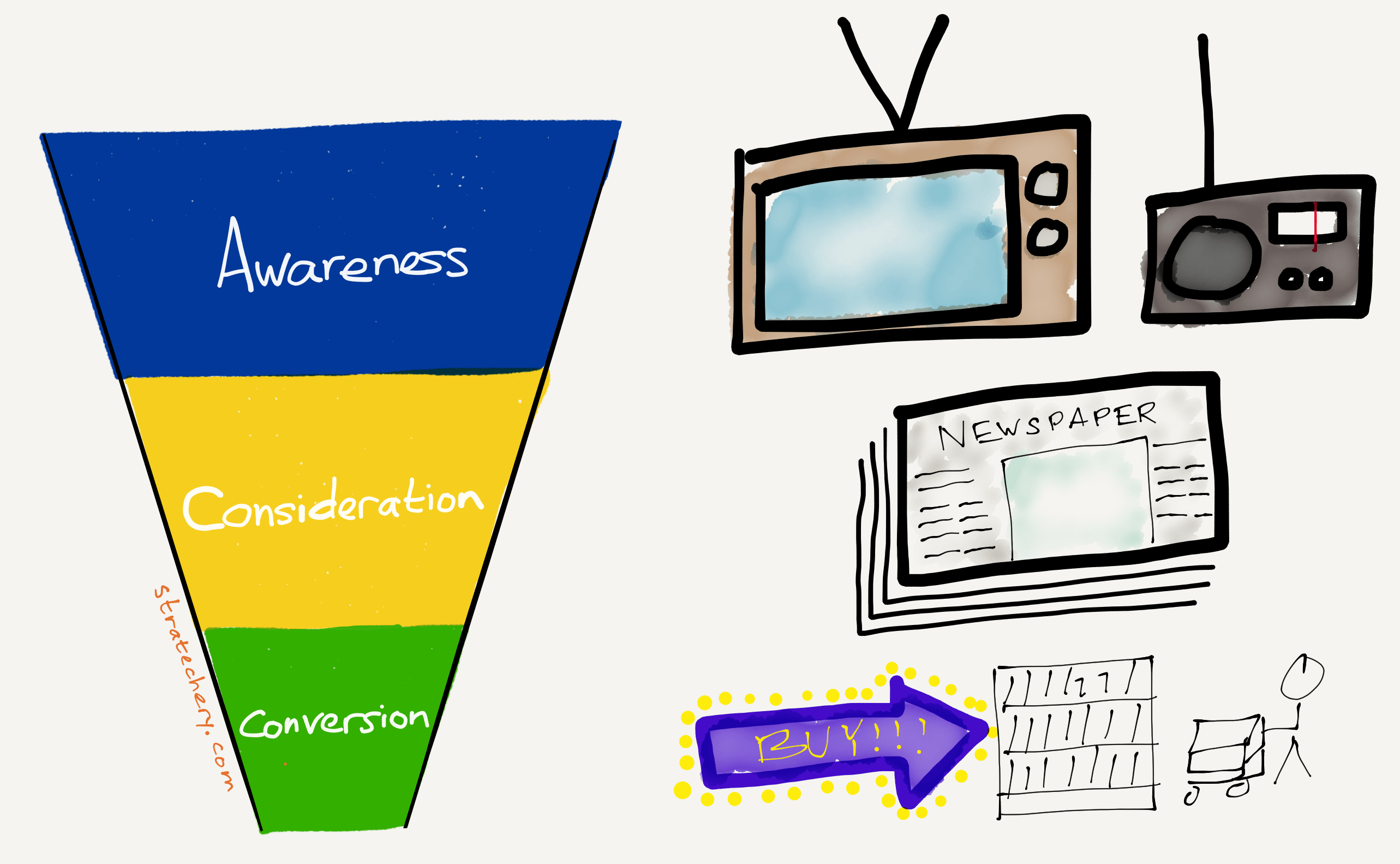
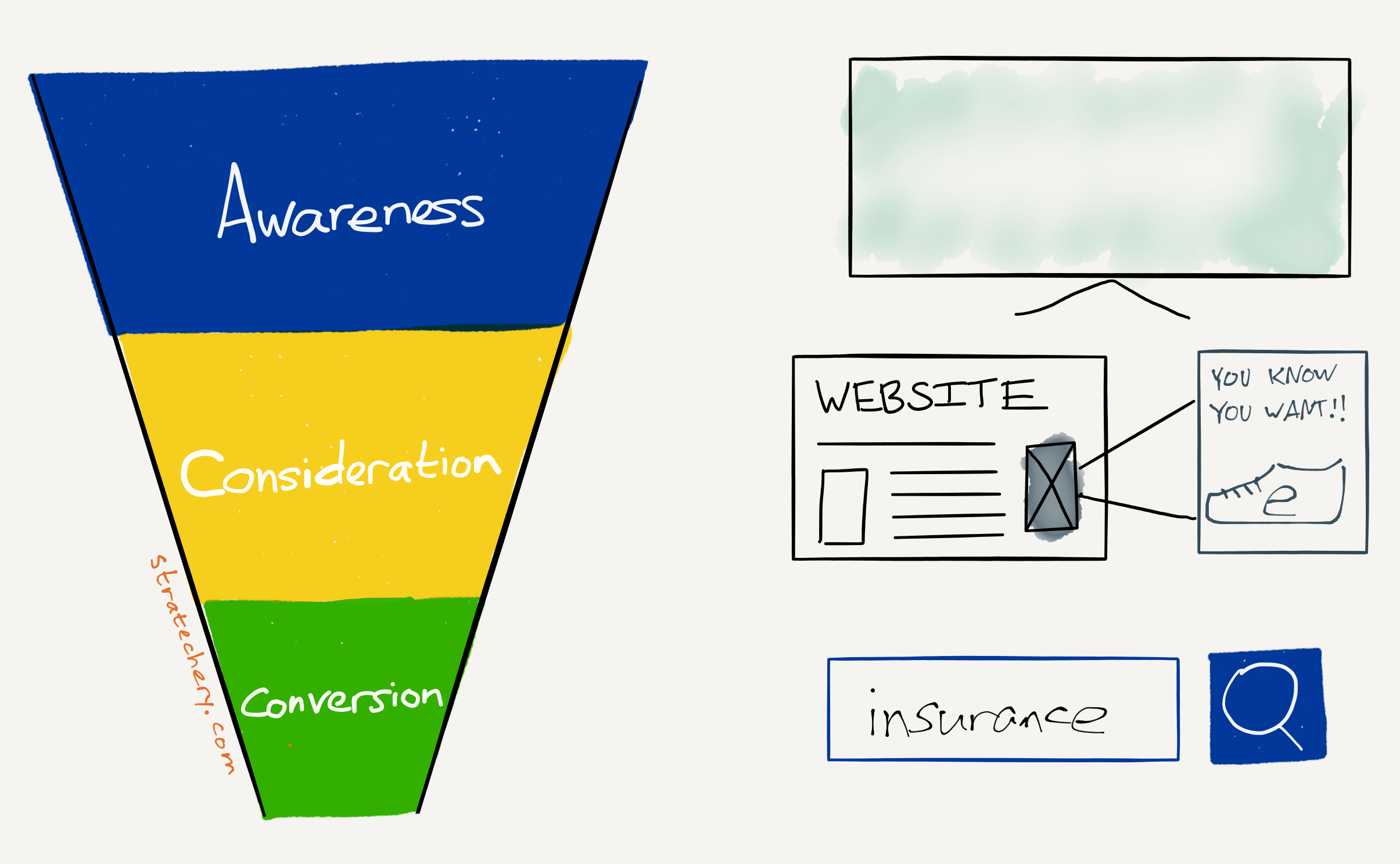
    Ultimately, advertisers (known as “brand managers” in the consumer-packaged goods industry, which pioneered these techniques) developed strategies that leveraged all three mediums, plus on-the-spot promotions at retailers, to move customers “down the funnel”:

    stratechery Year One - 269

    TV and radio were particularly effective at building awareness — making customers aware that your product existed — and also at building brand affinity — the subconscious preference for your product over a competing product at the moment of purchase. Newspapers, meanwhile, were useful when it came to “consideration”: helping consumers decide to buy the product they were now aware of (coupons were very useful here). Finally, brand managers spent a lot of time and money on their relationships with retailers to help pull consumers through the funnel to conversion, with the vague hope that said consumers would prove to be loyal.

    Digital Advertising 1.0

    The first wave of digital advertising took square aim at the bottom of the funnel: the fact that computers log everything made it easy to demonstrate when an advertisement led directly to a purchase (or a click), and no company benefitted more than Google. Search ads were so effective because consumers were entering the purchase funnel already at the bottom: they already wanted insurance, or to travel, or a lawyer, so Google could charge a lot of money for the right to put an ad for precisely those services right in front of a guaranteed lead and collect every time said lead clicked.

    Efforts to implement digital advertising further up the funnel were more mixed; retargeting ads that displayed items you looked at previously were the most blunt and probably most effective attempt to move customers through the consideration phase, even though said bluntness creeped a lot of people out. The top of the funnel, though, never really took off: it really wasn’t clear how to build awareness in a cost effective way on digital.

    stratechery Year One - 270

    There were two big problems with brand advertising on the Internet: first, there simply weren’t any good ad units. Banner ads were pale imitations of print ads, which themselves were inferior to more immersive media like radio and especially TV. Secondly, given the more speculative nature of brand advertising, it was much more cost effective to spread your bets over the maximum number of customers; in other words, it remained a better idea to spend your money on an immersive TV commercial that could be broadly targeted based on programming to a whole bunch of potential consumers at a single moment as opposed to spending much more time — which is money! — creating a whole bunch of banner ads that could be more finely targeted.

    Today, though, that is beginning to change.

    Digital Advertising 2.0

    Facebook COO Sheryl Sandberg relayed a fascinating anecdote on Facebook’s most recent earnings call:

    Leading up to Black Friday, Shop Direct, the UK’s second largest online retailer teased upcoming sales with a cinemagraph video to build awareness. They then retargeted people who saw the video with one day only deals. On Black Friday, they used our carousel and DPA ads to promote products people had shown interest in. They saw 20 times return on ad spend from this campaign, helping them achieve their biggest Black Friday and their most successful sales day ever.

    What Sandberg is detailing here is really quite extraordinary: Facebook helped Shop Direct move customers through every part of the funnel: from awareness through Instagram video ads to consideration through retargeting and finally to conversion with dynamic product ads on Facebook (and, in the not too distant future, a direct customer relationship to build loyalty via Messenger).

    stratechery Year One - 271

    Google is promising something similar: awareness via properties like YouTube, consideration via DoubleClick, and conversion via AdSense.4 Just as importantly, both companies are promising that leveraging their respective platforms will provide benefits on both sides of the ROI equation: the return will be better given the two companies superior targeting capabilities and ability to measure conversion, and the investment will be smaller because you can manage your entire funnel from a single ad-buying interface.

    Here’s the kicker, though, and the big difference from the era of analog advertising: the Facebook and Google platforms turn TV and radio’s disadvantages on their head:

    • Facebook and Google have the most inventory and are still growing in terms of both users and ad-load; there is no temporal limitation that works to the benefit of other properties (and Facebook in particular is ramping up efforts to advertise using Facebook data on non-Facebook properties)
    • It is cheaper to produce ads for only Facebook and Google instead of making something custom for every potential advertising platform
    • Facebook and Google have the best tracking, extending not only to digital purchases but increasingly to off-line purchases as well

    Both companies, particularly Facebook, have dominant strategic positions; they are superior to other digital platforms on every single vector: effectiveness, reach, and ROI. Small wonder that the smaller players I listed above — LinkedIn, Yelp, Yahoo, Twitter — are all struggling.

    The Implications of Winner-Takes-All

    I have been arguing for a while that in the aggregate the tech sector is fine, and the state of advertising-based services is a perfect example of what I mean: taken as a basket the six companies in this article (Google, Facebook, Yahoo, Twitter, LinkedIn, and Yelp) are up 19% over the last year, even though the latter four companies are down a collective 53%; the fact that Google and Facebook are up a combined 31% more than makes up for it.

    This makes sense: while advertising as a whole is a zero-sum game, there is a secular shift from not just print but also radio and TV to digital, which is why this basket of digital advertising companies is up. Digital, though, is subject to the effects of Aggregation Theory, a key component of which is winner-take-all dynamics, and Facebook and Google are indeed taking it all.

    I expect this trend to accelerate: first, in digital advertising, it is exceptionally difficult to see anyone outside of Facebook and Google achieving meaningful growth, with the possible exception of Snapchat, which just signed a deal with Viacom that is very much inline with my analysis of the company in Old-Fashioned Snapchat and has a hold on the powerful teen demographic).5 Everyone else will have an uphill battle to show why they are worth advertisers’ time.

    More broadly, the winner-take-all dynamics described by Aggregation Theory have inspired a powerful sense of FOMO (the Fear of Missing Out) amongst investors resulting in a host of unicorns intent on owning their respective industries; I think the recent chill in valuations and fundraising are about coming to terms with the fact that a lot of those unicorns are in the same boat as Facebook and Google’s advertising competitors: they have already missed out to the dominant player in their field (or, that their field was never viable to begin with).

    In some respects it is tech’s own inequality story: the average and median company and startup will increasingly bifurcate. It’s not a bubble, it’s a rebalancing, and the winners are poised to be bigger and richer than anything we have seen before.


    1. Gruber wasn’t responding to my piece directly, but his writing is so concise I couldn’t help but use his response to a recent Walt Mossberg piece on Twitter; it’s perfectly representative of those responses I alluded to 

    2. A point consistently missed by far too many AAPL stockholders, at least the ones on Twitter and in my mailbox 

    3. The company missed on earnings but revenue beat and guidance was in-line 

    4. I’m more bullish on Facebook for reasons I explained in Peak Google and The Facebook Epoch and reiterated yesterday  

    5. This piece about how teens use Snapchat is great 


  • How Facebook Squashed Twitter

    The idea of a “smartphone” that could connect to the Internet and run applications was around long before 2007; Apple, though, was the first to put the entire package together, including the device, user interface, and interaction paradigm, which is why the first iPhone is considered the start date of the mobile revolution.

    Similarly, the idea of a feed of information developed over many years; blogs were based on the format, and RSS allowed users to compile multiple news sources into a single stream. However, the introduction of Twitter in March of 2006, along with the Facebook News Feed, in September 2006, were the two seminal products that brought all the essential components together: users, content, and a place to read. I would argue it’s a date that is just as significant.

    Today, having a feed that users willingly return to day-after-day is the foundation of successful mobile advertising companies, especially Facebook. As I noted back in 2013 the feed allows for an advertising unit that is actually superior to anything found on the desktop: users have no choice but to at least visually engage with whatever is dominating the screen of the mobile device that is the center of their lives.

    In fact, I would argue that the feed is so important that its development — or lack thereof — is the core reason why Facebook has soared over the last ten years, while Twitter has slumped after a beginning that suggested the exact opposite sort of outcome.

    Twitter’s 2009 Slowdown

    In their 2013 S-1 Twitter released user numbers that only went back to Q1 2010; the best estimate of growth between 2006 and 2010 is found by looking at 3rd-party services reports on traffic to Twitter.com. The numbers, at least for the first three years, are very impressive. This is from comScore:1

    Screen Shot 2016-01-26 at 7.08.36 PM

    However, later that year something surprising happened: Twitter’s growth dramatically decelerated. Here’s a chart of Nielsen data:23

    Screen Shot 2016-01-26 at 7.13.46 PM

    That summer produced the first set of stories that have since come to dominate the Twitter narrative: Twitter’s Phenomenal Growth Suddenly Stops, Has Twitter Peaked?, Is Twitter in Trouble, Twitter’s Growth: Has It Peaked?, Twitter’s Global Growth Flattens. In retrospect, the answer is yes: as noted, Twitter reported user numbers starting in 2010 that never came close to the hockey stick growth the company enjoyed from 2006 to 2009.

    So what happened?

    Facebook Versus Twitter

    The counterpoint to Twitter’s declining growth numbers was, as noted, Facebook. While the company always had a big head start on the desktop, the story was quite a bit different in mobile. In the first quarter of 2009 Facebook only had 35 million active users on mobile, barely more than Twitter’s 30 million active user base (which was predominantly mobile) a year later. However, the trajectory from those starting points couldn’t be more different:

    Screen Shot 2016-01-26 at 9.10.49 PM

    I suspect the dramatic difference in Facebook and Twitter’s growth was due to three factors:

    • Facebook always had an inherent advantage over Twitter in that its network, at least in the beginning, was based on networks that already existed in the offline world, namely, people you already knew. That made the service immediately approachable and useful for basically everyone. Twitter, on the other hand, was more about following people you didn’t know based on your interests. This theoretically applied to everyone as well, but uncovering those interests and building an appropriate list of people to follow had to be done from scratch.

    • As any product moves down the diffusion curve from early adopters to the mass market, the marginal willingness of each new user to go through the effort of introducing said product into their daily life decreases: early adopters will jump through all kinds of hoops to take advantage of the product’s utility, but the 100 millionth user, to pick a number, is a lot less willing to go through the trouble. In retrospect it seems clear that in 2009 Twitter reached that marginal user: the service had tremendous visibility, but it was simply not worth the effort to get started for an increasing number of people.

    • Facebook, meanwhile, continued to add to the variety of posts available to their algorithmically generated feed.4 Yes, the early adopters who had gone to the trouble to tune their feed complained, but the real beneficiaries were users who didn’t want to go to the trouble of making sure they saw something interesting — whether related to friends and family or not — whenever they visited Facebook. And, starting in 2009, those users had even less motivation to get Twitter working: Facebook was good enough.

    It’s easy to pontificate on how Twitter and Facebook are fundamentally different services, or to argue that Twitter’s interest graph is potentially more valuable than Facebook’s social graph. Ultimately, though, the two services, along with every other form of media, are competing for the same scarce resource: attention. And, as of 2009, not only was it easier to get started with Facebook, but it was also more likely that the service had enough interesting content to ensure most users had no desire to look for something better.

    The rise of mobile accentuated this difference. I wrote in The Facebook Epoch:

    Mobile is a great market. It is the greatest market the tech industry, or any industry for that matter, has ever seen, and the reason why is best seen by contrasting mobile with the PC: first, while PCs were on every desk and in every home, mobile is in every pocket of a huge percentage of the world’s population. The sheer numbers triple or quadruple the size, and the separation is increasing. Secondly, though, while using a PC required intent, the use of mobile devices occupies all of the available time around intent. It is only when we’re doing something specific that we aren’t using our phones, and the empty spaces of our lives are far greater than anyone imagined.

    When it comes to “the empty spaces” most people don’t want to do work, but work is exactly what Twitter required. You had to know what you were interested in, know who to follow based on those interests, and then, to top it all off, you had to pick out the parts that you were interested in from a stream of unfiltered tweets; Facebook, in contrast, did the work for you.

    The Attention Market

    I have been a fierce critic of Twitter the company ever since they released their S-1, writing at the time that the service had strong monetization prospects but a real user growth problem. Accordingly, I criticized the service for what I perceived as a failure to evolve the product, culminating in a call for a change in leadership last spring; a few months later, consistent with my belief that evolving the product was the key to growth, I made the case for Jack Dorsey to be CEO.

    When that happened, and when Twitter released a new product — Moments — that finally abandoned the chronological timeline, I was thrilled, exulting in Twitter’s Moment:

    I think, though, it’s time for a new prediction: that the summer of 2015 will be seen as the low point for Twitter, and that this week in particular will mark the start of something new and valuable. Crucially, the reasons why are directly related to why I was bearish for so long: the product, the CEO, and the stock.

    Quite clearly that was wrong: the stock is down 38.38% since I wrote that article, including a 4.6% drop yesterday in the wake of a significant shake-up in the executive suite. As I wrote in the Stratechery Daily Update yesterday, I actually don’t think said shake-up is particularly surprising: if the point of bringing in Dorsey was to overhaul the product then it’s hardly a shock that the head of product and engineering from the previous regime are headed out the door. Still, there’s no question that the company is at an even lower point than they were last fall, but, perhaps there is still room for optimism?

    I don’t think so.5 Unfortunately for Twitter the attention market of 2016 is far different than it was back in 2009. When Dorsey states that he wants Twitter to “become the first thing everyone in the world checks to start their day and the first thing people turn to when they want to share ideas, commentary, or simply what’s happening”, he is no longer trying to capture an entirely new market, but rather to steal that market from well-established competitors, particularly Facebook, but also services like Snapchat, Instagram, and the messaging services, all of which have feeds of their own. And Facebook in particular has undergone its own evolution. I wrote in Facebook and the Feed:

    Facebook is compelling for the content it surfaces, regardless of who surfaces it. And, if the latter is the case, then Facebook’s engagement moat is less its network effects than it is that for almost a billion users Facebook is their most essential digital habit: their door to the Internet.

    Or, to put it in Twitter terms, Facebook has developed its own interest graph that is far more powerful and effective and easier-to-use than Twitter’s ever was. Yes, Twitter still owns niches like NBA Twitter, and news hounds like myself (and most of you reading this article) will continue to find it essential, but for nearly everyone else in the world6 it is Facebook that is the first thing people check, not just in the morning but in all of the empty spaces of their lives. In short, it’s not simply that Twitter needs to convince users to give the service a second-chance, something that is already far more difficult than getting users to sign up for the first time; it’s that even if the service magically had the perfect on-boarding experience leading to the perfect algorithmically-driven feed, it’s not clear why the users it needs7 would bother looking up from their Facebook feeds.

    In other words, my error last fall was not a misguided belief that Moments was a step in the right direction, or that Dorsey was the right person to overhaul Twitter’s product. Rather, I failed to appreciate not just then but in every single post I’ve written about Twitter that anything the company might do can’t make up for the failure to evolve in those critical few years when the attention unlocked by mobile was up for grabs.8


    1. Via Business Insider  

    2. via The Daily Mail  

    3. The number of visitors reported aren’t very consistent between the various 3rd-party services, but the trends are the same for all of them 

    4. This originally stated: “Facebook, meanwhile, in 2009 made perhaps the most significant change to their service since the introduction of the News Feed, and I don’t think it’s a coincidence that said change is roughly correlated with Twitter’s slowdown in growth: the News Feed added items beyond friends and family status updates, and it switched from being chronological to being algorithmic.” In fact, Facebook’s feed was algorithmically based from the beginning 

    5. With the caveat that I am wary of over-reacting in an attempt to compensate for getting this one wrong 

    6. Outside of China 

    7. I explained why Twitter needs more users here and here  

    8. So what should Twitter do now? Well, there is value there: Twitter occupies outsized influence when it comes to news in particular, and also specific niches like live events, African Americans, Japan (especially relative to Facebook), etc. That is certainly worth something to someone, but it’s hard to see the growth opportunities. The company’s user base is likely what it is, and any evaluations should be based on estimates of just how much revenue the company can extract from said user base (and, it should be noted, Twitter has done an excellent job of exactly that.

      In addition, there are very fundamental questions about the long-term viability of a public-oriented service that allows anonymity. Twitter abuse is a real issue that has driven away users. I address this issue here  


  • The FANG Playbook

    Jim Cramer, who coined the “FANG” acronym as a descriptor for the high-flying Facebook, Amazon, Netflix, and Google group of tech stocks that have dramatically outperformed the market, made clear yesterday that his endorsement wasn’t necessarily connected to the underlying companies:

    A note on these stocks. I picked them largely because over the years they have become anointed by a group of go-go managers, meaning managers who like to be affiliated with the stocks of companies with the most momentum. I by no means have said “buy these stocks” because they represent great value. What I have been saying is that because of the scarcity of actual high-growth stocks these have become default names that managers naturally gravitate to.

    It’s not an unreasonable position: the demand for growth in a low-interest-rate environment flooded with capital, plus a healthy dose of FOMO (Fear of Missing Out) has certainly played a role in the rise of unicorns; it makes sense that the same dynamics would play out in the stock market as well. It’s also a position that has had the good fortune of being right: in 2015 the FANG group accounted for more than the entire return of the S&P 500.1

    In fact, though, Cramer was more right than he apparently knows: the performance of the FANG group is entirely justified because of the underlying companies, or, to be more precise, because the underlying companies are following the exact same playbook. Sometimes the market does get it right.2

    The State of FANG

    Each of the FANG companies is in a similar position in their respective industries: they haven’t so much disrupted incumbents as they have subsumed them:

    • Facebook: The late David Carr, who first broke the news about Facebook’s Instant Articles initiative back in 2014, worried that “media companies would essentially be serfs in a kingdom that Facebook owns.” However, as I noted in The Facebook Reckoning, publishers already are. Facebook’s status as the Internet’s home page means that publishers have no choice but to accommodate themselves to the social network, whether that be Instant Articles or an increased focus on video.

    • Amazon: While the biggest driver of Amazon’s increased valuation has almost certainly been AWS, the e-commerce side of the business continues to grow like gangbusters as well, taking over half of every additional dollar spent by U.S. consumers online, and a quarter of all retail growth online or off. The vast majority of those sales are actually from 3rd-party merchants using Amazon as a discovery and fulfillment platform, but these merchants’ market power relative to Amazon is not unlike publishers relative to Facebook, because Amazon.com is where the buyers are.

      From a certain perspective this paradigm applies to AWS as well: the reason why AWS’s profitability increases along with growth is that Amazon achieves economies of scale, which is another way to say that AWS’s suppliers have no choice but to be squeezed in order to indirectly serve the customers they used to sell to directly

    • Netflix: The Internet — and Netflix — made fun of an NBC executive who claimed that “The reports of our death have been greatly exaggerated.” Here’s the thing, though: he’s right, in part thanks to Netflix. According to this February 2015 list, 42 past and present NBC shows are streamable on Netflix, for which the latter is certainly paying a material amount. Indeed, perhaps the most fascinating aspect of Netflix’s meteoric rise is the fact that the same content producers who are ultimately threatened in the battle for attention are increasingly unable to stop themselves from selling their content to Netflix: the streaming company has too many customers adding to a pile of content money that is too big to ignore.

    • Google: Google’s position is similar to Facebook’s: any business that wants to be discovered by potential customers has no choice but to follow the search company’s directives, whether that be cleaning up dubious SEO strategies, making their pages mobile-friendly, or soon, adopting Accelerated Mobile Pages. Every now and then someone, usually a set of publishers, tries to defy the search engine’s influence, only to come crawling back within weeks once traffic craters. The reality is that most people find most web pages through Google, which means Google calls the shots — and sells the most expensive advertising of all.

    There is a clear pattern for all four companies: each controls, to varying degrees, the entry point for customers to the category in which they compete. This control of the customer entry point, by extension, gives each company power over the companies actually supplying what each company “sells”, whether that be content, goods, video, or life insurance.

    How FANG Started

    There are also striking similarities to how each FANG company started, particularly when it comes to the pre-existing resources each leveraged:

    • Facebook: Facebook didn’t launch to the world: it launched to Harvard only. In other words, Facebook started with a preexisting network and, for all intents and purposes, a preexisting infrastructure (Harvard-provided Internet access).3 What Zuckerberg added was an entry point that provided a much more effective and enjoyable way to tap into and connect with that network.

    • Amazon: Amazon’s roots were equally humble: the company sold only books and held no inventory; when an order was placed Amazon would order the book from pre-existing book distributors and then ship it on using pre-existing parcel shippers to the end user. What Jeff Bezos and team added was an entry point to a far more extensive selection of books than any offline bookstore could provide and lower prices to boot. Once you bought from Amazon, why would you buy anywhere else?

    • Netflix: Netflix’s also began with pre-existing assets: off-the-shelf DVDs and the U.S. Postal Service, providing a benefit similar to Amazon’s — a wide selection and delivery to your doorstep. It took a year to figure out the subscription model, which meant lower prices for heavy users and less stress about things like late fees for everyone, and Netflix slowly became the gateway to entertainment for more and more customers.

    • Google: Google didn’t create any of the pages accessible through its search engine, nor the means of accessing those pages (the browser). Rather, by basing its algorithm on the link (instead of content) it offered a dramatically more effective way to find exactly what you were looking for, making it the natural first stop for anyone looking for anything on the Internet.

    None of the FANG companies created what most considered the most valuable pieces of their respective ecosystems; they simply made those pieces easier for consumers to access, so consumers increasingly discovered said pieces via the FANG home pages. And, given that Internet made distribution free, that meant the FANG companies were well on their way to having far more power and monetization potential than anyone realized.

    FANG and Aggregation Theory

    Last July I described the theoretical underpinning for this shift in power and monetization potential in Netflix and the Conservation of Attractive Profits. By owning the consumer entry point — the primary choke point — in each of their respective industries the FANG companies have been able to modularize and commoditize their suppliers, whether those be publishers, merchants and suppliers, content producers, or basically anyone who needs to be found on the Internet.

    Over time, each of the FANG companies has leveraged their ownership of the customer relationship to expand their arena of control, whether that be by expanding their offerings like Amazon or integrating backwards into the previously valuable components of their ecosystem (Facebook owns their network completely, Netflix creates their own content, and Google increasingly monetizes by keeping people on Google properties). All of those moves, though, were predicated on owning the customer relationship.

    Long-time readers know that I already summed up this phenomenon in Aggregation Theory, but in some respects I think my chosen name does this idea injustice: the word “theory” sounds abstract and disconnected from the real world, when in fact the elements of Aggregation Theory are not only very much real phenomena but also the connective tissue tying the FANG companies together.

    Moreover, understanding where these companies started and how they grew fleshes out the advice I gave at the end of last week’s article Cars and the Future:

    Startups looking to disrupt other decades or century old industries should take note: be patient, get your business model and core user base right, and wait for the fundamental changes wrought by the Internet and mobile to come to you.

    Each of the FANG companies was technically innovative in their own way (especially Google, the exception that proves the rule), but each of them — like Uber, which that paragraph referenced — also depended to an incredible degree on products and infrastructure that already existed. The key to their now or future dominance was their proximity to customers, superior user experience, and new business models that simply weren’t possible before the Internet.

    Note that none of these companies are “disruptors” in the Christensen sense. They are not offering low-margin good-enough products that appeal to customers who are over-served by incumbent companies. Rather, they are “aggregators” who start with the best customers and don’t really compete with incumbent companies, at least in the beginning. In fact, incumbents nearly universally benefit from the presence of aggregators, at least at first (publishers benefited from Facebook, merchants from Amazon, content makers from Netflix, web businesses of all types from Google). It is only when the aggregators’ consumer base becomes dominant that the inevitable squeeze on incumbents — specifically, on their profit margins — begins, and it is in the long-run irreversible.

    That, Mr. Cramer, represents incredible value.


    1. I.e. without these four stocks the S&P 500 would have been significantly more than barely down for the year 

    2. Actually, I think in the long run, it almost always does. As legendary investor Benjamin Graham said, “In the short run, the market is a voting machine but in the long run, it is a weighing machine.” 

    3. Facemash, the “hot-or-not” app that Mark Zuckerberg built even before Facebook, even included pre-existing content (photos of students)  


  • Cars and the Future

    Once again, a company, built around the hottest tech in the industry, stole the spotlight at CES. This time, though , the product was not a smartphone, and the company was not Apple. For my money the most interesting news of last week came from a most surprising source: General Motors.

    First up was the news that the century-old American car maker was investing $500 million in ride-sharing startup Lyft. Then, a few days later, the company formally introduced the Chevrolet Bolt, a (relatively-speaking) no-frills electric car that promises to go 200 miles on a charge for about $30,000.1 Perhaps it was the company in question, or simply the timing, but it reinforced the sense that fundamental change is coming to the world of transportation.

    What is interesting, though, is that while change is certainly coming, it is coming on multiple axes: The Lyft news is about the secular shift from individually owned-and-operated automobiles to transportation-as-a-service, while the Chevrolet Bolt is about how the cars themselves are made. Meanwhile, Google, Uber, Tesla, and others are working on obviating the need for a driver at all. To put it another way, when it comes to questioning the future of transportation, the “What?”, “How?”, and “Where?” are all in play.

    The Future is Here?

    It’s easy to predict a future where all of these trends coalesce: electrically-powered self-driving cars, summoned from our smartphones, take us where we need to go with plenty of time to finally beat Candy Crush. After all, the trends all reinforce each other:

    • The simpler drivetrain of an electric vehicle rearranges what matters when it comes to building a car: the engineering that matters is more software and less mechanical, opening the door to software companies that are vastly more suited to developing self-driving technology
    • Electrical vehicles have (relative to gas-powered cars) higher fixed costs but lower marginal costs. This is a natural fit with ride sharing services focused on reducing the average cost per ride. Range is a concern, but a car with an exchangeable battery based out of a central depot (much more viable for a transportation company than an individual) could work well
    • Similarly, self-driving cars remove the largest cost from ride-sharing services: the driver. This has import beyond any one ride in question: the big prize is consumers giving up cars completely, which would result in ride-sharing utilization increasing exponentially

    So it’s set then. Welcome to our carless future.

    Except for the small detail that car sales are headed in the wrong direction — they are skyrocketing. Last year saw a record 17.5 million cars and trucks sold in the United States; China sold a record 21.1 million (although growth is slowing), and India a record 2.03 million. The United Kingdom sold a record 2.6 million, Australia a record 1.6 million…are you sensing a theme?

    To be sure many of these purchases were the result of pent-up demand from the Great Recession, when sales plummeted below 10 million in the U.S.; the average car in the U.S is 11 years old. But that stat itself suggests that transportation, at least in the U.S., won’t be changed overnight: the biggest argument for things staying the way they are is the sunk cost in your driveway.

    This leads to three more questions: “When?”, “Who?”, and “Why?”.

    When Will the Future Arrive?

    What makes this moment in the transportation industry so fascinating is that while the three trends I described above are broadly related through their reliance on computers, each of them are independent of the other. An electric car could be owned and operated by its owner; a self driving car could be powered by an internal combustion engine and used exclusively by its owner; a ride-sharing network could rely on drivers operating gas-powered vehicles.

    Indeed, that’s exactly what the market looks like today: while self-driving cars are obviously not yet available, Tesla, Nissan, and soon General Motors sell electric vehicles to owner-operators, while Uber and its competitors utilize drivers operating traditional cars. Of course all of these taken together are only a fraction of the market: the majority of us still get around the old-fashioned way, by pointing our own cars in the direction we want to go with a stop at the gas station on the way.

    Moreover, each trend faces its own headwinds: the case for electric vehicles, particularly at the low, non status-concerned side of the market, was already hard to make given the propensity of buyers to anchor on the up-front price instead of the total cost of ownership. The task has only become more difficult with the plunge in oil prices. Add in the fact that low-price buyers are less able to make compromises to the car’s actual driving performance (someone buying a Chevrolet Bolt can’t take the family BMW to Grandma’s house 500 miles away) and I suspect the Bolt will end up like the Volt, General Motor’s disappointing electric+.2 Indeed, the drop in oil prices in particular has made Tesla’s decision to focus on the high-end consumer who buys the car for status and performance reasons look much smarter than most business theorists would admit.3 The same logic applies to Apple’s rumored entry.

    Self-driving cars, meanwhile, face significant challenges when it comes to technology, data, and regulation. As with most complex technologies, the first 90% — driving down a highway with decent visibility — is the easy part; It’s that last 10%, especially the last 1%, that is devilishly difficult. Google is attempting to solve the problem exactly the way you would expect them to: by gathering an overwhelming amount of data. The problem is that traffic conditions can change rapidly; as of last year, for example, Google’s cars couldn’t handle a temporary stoplight. In other words, it’s not simply that Google needs to map the entire world in far more detail than they have previously — after all, the fact they have already done it shows just how capable the company is! — but rather that the maps need to be updated far more frequently than Google Street view ever needed to be. Existing car companies, were they to leverage all of their cars on the road, have an advantage here, but nothing that compares to Google software expertise (I suspect this mismatch is behind Google’s rumored tie-up with Ford).

    Meanwhile California, the largest car market in the United States and the one who’s regulations are almost always copied by everyone else, has come out with proposed rules for self-driving cars that require a specially-licensed driver be capable of taking over a self-driving car in an emergency, a far cry from Google’s concept of cars that don’t even need a steering wheel. These regulations do, though, work well for the semi-autonomous driving capability focused on the 90% problem that is already being implemented by Tesla, Mercedes-Benz, and a host of other incumbent car companies (and, again, presumably Apple). Just like with electric cars, it seems likely the revolution will be gradual and from the high-end, at least for now.

    That leaves Uber and the other ride-sharing companies. An underappreciated strength of Uber is the fact it relies almost completely on technology — on phones, in the cloud, and especially in the car — that already exists. To be sure, the service is still too expensive to replace cars for most people, but were the company to ever crack true ridesharing — where the driver is a rider — the cost of going car-free could be competitive far more quickly than anyone expects, especially for those who have not yet bought a car.

    Who Will Drive the Future?

    These answers are vaguely unsatisfying: I want my future transportation network, not piecemeal implementations that I can’t afford! Indeed, there is an aspect of car talk that reminds me of TV: specifically, folks have been claiming that the traditional cable bundle is dead for well over a decade in large part because they wish it were so, yet the bundle has kept trucking along. Admittedly, over the past 12 months the same folks have worked themselves into a frenzy as cable subscribers have finally started to decline, but I for one am a little stingy with credit for any prediction made annually for years.

    What I suspect is happening with TV is a little more nuanced than long-standing cable customers getting fed up with the cost of bundled TV and cutting the cord. Rather, young people, who have grown up in a very different entertainment environment than their parents — i.e. an online one — are simply not signing up in the first place. The decline, slight as it is, is the older generation that was raised on TV dying off.

    This generational pattern of adoption will, in the history books, look sudden, even as it seems to unfold ever so slowly for those of us in the here and now — especially those of us working in technology. The pace of change in the technology industry4 — which is young, hugely driven by Moore’s Law, and which has largely catered to change-embracing geeks5 — is likely the true aberration. After all, the biggest mistake consistently made by technologists is forgetting that for most people technology is a means to an end, and for all the benefits we can list when it comes to over-the-top video or a network of on-demand self-driving vehicles, change and the abandonment of long-held ideals like the open road and a bit of TV after supper is an end most would prefer to avoid.

    Instead, the change is gradual. Netflix here, a bit of YouTube there. Or, in the case of cars, first hybrids and assisted parking, later electric vehicles that look and operate like normal cars, and the ability to take your hands off the wheel on the highway.

    Why the Future Will Come

    Make no mistake, though: change is happening, and as I hinted at above it’s of the morbid variety: people raised to value things like car ownership or sitting down to channel surf are, well, dying. Meanwhile, a new generation that doesn’t understand why you would want to sit behind the wheel — much less own the damn thing — when you could instead be on your smartphone is coming of age. It’s a bit over-used at this point but the Ernest Hemingway quote about bankruptcy seems appropriate:

    “How did you go bankrupt?”
    “Two ways. Gradually, then suddenly.”

    Netflix is instructive in this regard: sure, the company is primed to be the biggest beneficiary when and if the cable bundle falls apart, but its position was secured years before that through a series of moves (which I recounted in detail last week) that primed the company to have the right user base and the right business model for a future that would eventually arrive.

    Similarly, when it comes to evaluating who is in the best position to take advantage of future revolutionary changes in transportation — incumbents, technology leaders, big brands, startups — my money is on those that own the customers and have the right business models in place.6 Startups looking to disrupt other decades or century old industries should take note: be patient, get your business model and core user base right, and wait for the fundamental changes wrought by the Internet and mobile to come to you.


    1. After U.S. federal government electric vehicle subsidies 

    2. It has a gas engine that acts solely as a generator 

    3. I responded to the “Tesla isn’t disruptive” gripe here and here  

    4. IBM to Microsoft to Apple and Google in a career! 

    5. Tech Twitter basically devoting an entire day to David Bowie was no accident; rest in peace 

    6. I.e. Uber 


  • A Politics For Technology

    From a certain perspective, Uber’s surge-pricing, which was again in the headlines this past New Year’s Eve, is easy to defend: the only way to balance supply and demand is to adjust the price. In fact, there is a lot of fundamental economic theory behind this simple explanation, specifically the idea of a “price mechanism.” A price mechanism (i.e. the surge pricing) has three functions:

    • Signaling: A higher price tells suppliers to increase production, while a lower price tells suppliers to do the opposite; in the case of Uber surge prices signal drivers who might prefer to not work to that it is worth the inconvenience to get on the road
    • Rationing: If supply is insufficient, a higher price reduces demand and ensures those who most want the good in question can obtain it; in the case of Uber surge pricing ought to compel many riders to take alternative modes of transportation or to wait until there is more supply and/or less demand, while those who need a ride right now can be sure they get one
    • Transmission of preference: Signaling and rationing are all well and good, but what makes the price mechanism so amazing is that it ties the two together: disparate consumers inform disparate suppliers about how much supply is needed without the need for any coordination

    Key to the price mechanism is money; while barter works, it carries a huge information burden: who can quickly and easily compare the value of a cow to the value of a bushel of grain to the value of a piece of pottery to the value of an Uber ride? It is much easier to have an intermediary that easily transmits relative value, which is why Uber rides are priced in dollars and cents and not in ounces of meat.

    The end result is a system that ensures that those who need a ride are guaranteed to get one; those who really could do without self-select out of the system, at least until more drivers are compelled to increase the supply. It is much better than the alternative, where someone who could just as easily walk a couple of blocks might by pure chance grab the taxi needed by, say, a woman in labor. That’s an extreme example, but I use it to make the point: pricing ensures those who truly need a good can get it, and, on a holiday defined by champagne, we should all be grateful.

    The Problem with Money

    In the context of the price mechanism, money serves the role of a medium of exchange. The problem, though, is that money serves other functions as well: specifically, money is a unit of account and a store of value. It is the latter that is the rub when it comes to Uber and the idea of allocating rides based on price. To return to the extreme example above, what if the woman in labor is poor, and the person who only needs to travel a few blocks is rich? It very well may be that the latter’s ability-to-pay will trump the former’s willingness-to-pay; this is, to my mind anyways, the most valid reason to oppose surge pricing.

    What, though, are the alternatives? As I noted, the current taxi system basically reduces rides to a lottery: you either get an empty taxi or you don’t.1 That in itself is frustrating enough, but the bigger cost is the uncertainty of it all: if you are not sure whether or not you will be able to get a ride, you are less likely to depend on the ride service in question at all. This is especially problematic on occasions like New Year’s Eve: when those needing a ride are drunk, the last thing we as a society should hope for is that folks default to a ride that is guaranteed, i.e. their own car. And, frankly, those needing a ride should, in the grand scheme of things, be similarly grateful that surge pricing guarantees that rides are available: sure, an unexpected $200 fare is annoying, but a DUI with all its attendant cost is far worse (and that’s not even close to the worst-case scenario when it comes to driving drunk).

    It is also not realistic to expect traditional taxi companies to have sufficient supply for high demand times like New Year’s Eve: the problem is that all of the supply necessary to fulfill peak demand would sit idle the vast majority of the time. That idleness has a very real cost — specifically, opportunity cost. Any resource, whether it be vehicular or human, that is devoted to one activity is by definition not devoted to another. That may not seem like much when it comes to a few taxis, but in aggregate this makes the “pie”, which is the total pool of economic resources available, smaller for everyone.

    This gets at why Uber is a much bigger deal than any one New Year’s Eve: the way in which the service much more efficiently utilizes resources, both vehicular and human, actually grows the pie: indeed, the only possible way to grow gross domestic product is through increased efficiency, which frees up resources for new value-generating activities.

    Still, what of the poor woman in labor?

    In fact, the relative wealth of the woman in labor and the lazy rich person ought to have nothing to do with ride allocation at all: however, due to the fact that money works as both a medium of exchange and a store of value they are easily intermingled. The answer is to disentangle them; instead of ruining the brilliant mechanism by which rides are both distributed to those who signal the greatest need and through which resources are most efficiently allocated, It would be far better to focus on ensuring that everyone has the same opportunity to signal their preference. To contort Uber into a welfare provider is to ruin both.

    A New Politics For a New World

    At the heart of the Uber conundrum and its potential solution is a new political philosophy for technology. Mobile and ubiquitous connectivity have the potential to unlock efficiencies that were never before possible. Take taxis, to stick with the Uber theme: the justification for most taxi regulations were important ones like safety, dependability, and consumer protection. Given the fact that taxis would be out on the street unsupervised it made sense to tightly control entrance to the market. However, were it possible to address all those same concerns far more effectively, through, say, precise tracking and full histories of both drivers and passengers, as well as knowledge about pick-up and intended drop-off points, would not the regulations look significantly different?

    Similarly, in a world where the key to building a sustainable business was controlling distribution, the greatest gains naturally accrued to the biggest companies. And, by extension, it was reasonable to ask those companies to not only pay their workers well, but to also provide for needs beyond salary, like health insurance and disability insurance. But do those same assumptions hold in a world where distribution is free, and where preferences and needs can be distilled to an individual or gig basis?

    The money problem — the fact it is both a means of exchange and a store of value — is an allegory for the dysfunctional nature of what passes for a social safety net, particularly in the United States: things like health insurance and disability are intermingled with a salary or fee. This is problematic on both sides: new efficiencies that are unlocked through mobile and ubiquitous connectivity are not fully realized thanks to regulations from an era that operated on fundamentally different assumptions. This, ultimately, hurts everyone because it limits the growth of the economic pie,

    On the other side are the people actually doing these new jobs, or those who would like to. Given the fact many social safety nets are built by traditional companies, those not in those companies are left completely exposed. This is unacceptable both morally and economically: morally because to deny healthcare or basic insurance is to deny the humanity of those in need; economically both because of higher costs incurred because of treatments not received, but especially because of the cost of opportunities not pursued for fear of having no net.

    It would be far better — and a far better match for the reality of today’s labor market — to disentangle once-and-for-all employment from the social safety net. This should be the central political focus of technologists in particular. Outdated regulations forged under fundamentally different assumptions are one of the chief obstacles to the opportunities afforded by mobile and the Internet, particularly when it comes to the aggregation of consumers in markets that weren’t even imaginable 10 years ago.

    What Technology Owes

    Of course, to argue for less regulation is hardly controversial in Silicon Valley: what is missing is the necessary trade-off. Specifically, as the opportunities for technologists and their investors continue to grow, so should the willingness to pay: that pregnant woman still needs a ride.

    This is where articles like Paul Graham’s weekend piece Economic Inequality ring hollow. Graham’s defense of the broad-based gains that accrue from new technology is absolutely correct: increased efficiency, which technology is uniquely suited to deliver, is the only way to grow the pie for everyone’s benefit. But given that much of those efficiency gains also contribute to winner-take-all dynamics, it is reasonable to expect that those winners — and their investors — pay commensurately more. Imagine if Graham had written his article accompanied with a call to close the carried interest tax loophole, which allows venture capitalists to be taxed at the (significantly lower) capital gains rate on money they themselves did not invest: his defense of getting rich — which wasn’t necessarily wrong! — would have had much more gravitas.2

    Still, I’m glad Graham opened the debate. Technology is changing the world, and it is naive to not expect the world to begin to push back. Rather than always be reactionary, it is past time for the technology industry broadly and Silicon Valley in particular to get serious about what that world will look like in the future, especially given the fact there is actually a way forward that is a win for not just technology companies and their investors, but for those who are impacted — i.e. everyone. Just as we should separate the means by which Uber allocates drivers from the ability to pay for a ride, it makes sense to separate work from the provision of a social safety net, and those most able to capitalize on this new world order should be the most willing to pay.


    1. And the driver has far greater discretion to discriminate based on appearance 

    2. Not to say this would be sufficient, but it’s a place to start that would mean more coming from someone like Graham 


  • The 2015 Stratechery Year in Review

    2015 was Stratechery’s third year, and the first one I spent completely devoted to it full-time. This year I wrote 47 free Weekly Articles and 180 subscriber-only Daily Updates. Given that most were between 1800 and 2000 words, that’s the equivalent of about 6.5 books!

    Here are the highlights (here are the 2014 and 2013 editions):

    The Five Most-Viewed Articles:

    1. Why Web Pages Suck — Everyone complains about web pages that suck, but the reality is that it is advertisers who call the shots. This should, at a minimum, put Facebook’s Instant Articles and Apple’s News app in a new light
    2. Why BuzzFeed is the Most Important News Organization in the World — The key to sustainable, ethical journalism is aligning the business and editorial sides of a publication. No company has done a better job of doing that on the Internet then BuzzFeed
    3. Apple’s New Market — Apple is on the verge of leaving the narrowly-defined smartphone market behind entirely, instead making a play to be involved in every aspect of its consumers’ lives. And, if the importance of an integrated experience matter more with your phone than your PC, because you use it more, how much more important is an integrated experience that touches every detail of your life?
    4. Twitter’s Moment — Twitter has had a rough stretch, and most are pessimistic about its chances. I was previously, but I think the upside is looking much brighter than it did before this week
    5. Apple Watch and Continuous Computing — The Apple Watch’s success depends on three things: the physical design, the interaction model, and how it interacts with its environment. It’s on the right track
    Apple's services are extending the iPhone's impact to every part of our lives
    Apple’s services are extending the iPhone’s impact to every part of our lives

    Five Big Ideas

    • Aggregation Theory — The disruption caused by the Internet in industry after industry has a common theoretical basis described by Aggregation Theory
    • Netflix and the Conservation of Attractive Profits — Netflix has a lot more in common with Uber and Airbnb than you might think: it all comes back to the Law of Conservation of Attractive Profits, a core principle of disruption
    • Airbnb and the Internet Revolution — Airbnb gets less press than Uber, but in some respects its even more radical: understanding how it works leads one to question many of the premises of modern society from hotels to regulations. It’s an important marker in the Internet Revolution
    • Beyond Disruption — Clayton Christensen claims that Uber is not disruptive, and he’s exactly right. In fact, disruption theory often doesn’t make sense when it comes to understanding how companies succeed in the age of the Internet
    • The End of Trickle-Down Technology — Reaching developing markets depends on understanding that consumers with a small budget are very different from consumers who aren’t interested in spending much
    Aggregation Theory
    Aggregation Theory

    Five Company-Specific Posts

    • The Facebook Epoch — First came the PC, and on top of the PC the Internet. Then, mobile, but what will rule mobile?
    • From Products to Platforms — Apple was at its best in its most recent keynote: unveiling the sorts of products the company is uniquely capable of creating. The question, though, is whether the company has the vision and capability of making those products into platforms
    • The AWS IPO — AWS has long been a question mark when it comes to Amazon: it’s a good idea, and it makes money, but like it’s parent company, will it ever be profitable? The revelation that AWS is already very profitable indeed is a really big deal both for AWS but also for Amazon itself. (Related: Venture Capital and the Internet’s Impact)
    • Old-Fashioned Snapchat — How Snapchat is positioning itself to win an outsized share of television’s brand advertising
    • Slack and the State of Technology at the End of 2015 — Slack has announced the Slack Platform. It’s an obvious move, but it’s the obviousness that indicates what a huge opportunity it is
    The Facebook Epoch
    The Facebook Epoch

    Five Posts About the Media Business

    Popping the Publishing Bubble
    Popping the Publishing Bubble

    Five Daily Updates

    (Please note that these are subscriber-only links; you can sign-up here)

    • June 5 — Tim Cook’s Unfair and Unrealistic Privacy Speech, Strategy Credits, The Privacy Priority Problem
    • August 17 — The New York Times on Amazon, Jeff Bezos’ Email, Why Work for Amazon
    • August 31 — Ballmer’s Bad Bundle Economics, Netflix Loses Epix Movie Deal
    • September 21 — Malware Hits iOS, The Importance of the App Store, XcodeGhost: What Happened and What Now?
    • October 12 — AWS Re:invent, Pure Storage IPOs, Dell to Buy EMC; Enterprise Disruption; Dell’s Logic

    Plus five more:

    • October 27 — Chase Pay and the Payments Stack, Apple Pay and Opportunity Cost, Applying Aggregation Theory
    • October 28 — Stop Doubting the iPhone, The Macintosh Company
    • Novenber 17 — Marriott Acquires Starwood, Online Travel Agents and Aggregation, Surviving as an Incumbent
    • November 20 — Adele Won’t Stream 25, Windowing Versus Piracy
    • December 22 — SpaceX Makes History, SpaceX and Unicorns, Disney in the Age of Abundance
    Curation and Algorithms
    Curation and Algorithms

    Happy New Year. I’m looking forward to a great 2016!


  • Slack and the State of Technology at the End of 2015

    Last December I wrote an article entitled The State of Consumer Technology at the End of 2014. That article was more than a year-in-review though: in it I both defined the different epochs of computing — PC, Internet, and mobile — as well as the distinct arenas of competition within each epoch: the operating system and killer applications for productivity and communications.

    threeepochs

    The question I raised is what comes next?

    The Facebook Epoch

    The answer, at least when it comes to the consumer space (and excluding China) is Facebook. I laid out why in an article entitled, appropriately enough, The Facebook Epoch:

    Mobile is a great market. It is the greatest market the tech industry, or any industry for that matter, has ever seen, and the reason why is best seen by contrasting mobile with the PC: first, while PCs were on every desk and in every home, mobile is in every pocket of a huge percentage of the world’s population. The sheer numbers triple or quadruple the size, and the separation is increasing. Secondly, though, while using a PC required intent, the use of mobile devices occupies all of the available time around intent. It is only when we’re doing something specific that we aren’t using our phones, and the empty spaces of our lives are far greater than anyone imagined.

    Into this void — this massive market, both in terms of numbers and available time — came the perfect product: a means of following, communicating, and interacting with our friends and family. And, while we use a PC with intent, what we humans most want to do with our free time is connect with other humans: as Aristotle long ago observed, “Man is by nature a social animal.” It turned out Facebook was most people’s natural habitat, and by most people I mean those billions using mobile.

    Note that in that piece I rearranged the epochs slightly: specifically, I defined the “Internet Epoch” — which was dominated by Google — as sitting on top of PCs, which meant the relative size of this epoch was constrained by the fact that PCs were, relatively speaking, not mobile; rather, both PC usage and Google uses was defined by intent. Mobile, and by extension Facebook, were different: their usage was defined not only by increased availability, but also by the “empty spaces” in our lives.

    What, though, about enterprise computing? And what is the killer app when it comes to work and productivity on mobile?

    The Reorganization of the Enterprise Stack

    Microsoft has arguably dominated enterprise computing even more than they dominated the PC epoch generally, in part because they delivered an integrated solution that, to put it simply, made life easier for Chief Information Officers in particular. I wrote in Redmond and Reality:

    Consider your typical Chief Information Officer in the pre-Cloud era: for various reasons she has bought in to some aspect of the Microsoft stack (likely Exchange). So, in order to support Exchange, the CIO must obviously buy Windows Server. And Windows Server includes Active Directory, so obviously that will be the identity service. However, now that the CIO has parts of the Microsoft stack in place, she is likely to be much more inclined to go with other Microsoft products as well, whether that be SQL Server, Dynamics CRM, SharePoint, etc. True, the Microsoft product may not always be the best in a vacuum, but no CIO operates in a vacuum: maintenance and service costs are a huge concern, and there is a lot to be gained by buying from fewer vendors rather than more. In fact, much of Microsoft’s growth over the last 15 years can be traced to Ballmer’s cleverness in exploiting this advantage through both new products and also new pricing and licensing agreements that heavily incentivized Microsoft customers to buy ever more from the company.

    Microsoft’s dominance, though, has been chipped away via the one-two punch of the cloud and mobile. Cloud-based applications not only offered a payment model that was more attractive to many businesses, but they also removed the need for troublesome upkeep. This, then, allowed other aspects of the product to rise in relative importance when it came to the purchase decision, whether that be specific features or just the general user experience.

    It’s here that mobile mattered: for years Microsoft products were well behind the competition when it came to the mobile experience on non-Microsoft platforms like iOS and Android. This is the one-two punch I was referring to: the cloud removed one of Microsoft’s biggest lock-ins in the enterprise, while mobile gave enterprises a reason to try something different.

    The Cloud Epoch

    Indeed, the way in which cloud and mobile worked hand-in-hand to uproot Microsoft is no accident. When it comes to the enterprise side of computing, I would place the cloud as the fourth epoch, and just as the Internet (or in the case of enterprise, on-premise applications) rested on PCs, the cloud very much rests on a mobile foundation: not only do all workers, blue collar or white, have a phone, but they also have that phone in more and more places, and the fact you always have your phone with you means you are, effectively, always available to work.1

    To Satya Nadella’s credit, he has over the past two years strongly pushed Microsoft to be competitive on all those other platforms, and in fact the article I just quoted was written in the context of Office adding file picker support for Dropbox and Box, despite the fact both were direct competitors. The reality is that leveraging one piece of software to sell another is a strategy that simply doesn’t make sense in the cloud: there is no implementation advantage, so you have to simply compete on a feature and user experience basis.

    Still, that doesn’t mean integration isn’t desirable: what will tie all of these cloud services together? Back in 2014 I theorized that the key player — the “OS” of the cloud epoch — might be whoever owns a company’s data, like, for example, Box:

    Pure storage isn’t a great business. The cost is trending towards zero…Data, though, is priceless; it can’t be replaced, and it’s the essence of what makes a particular organization unique. For this reason, and for regulatory ones, there are all kinds of specialized controls that IT departments need for data. This is where Box has worked diligently to differentiate themselves from consumer-focused competitors like Dropbox…

    Just because the operating system is no longer the platform does not mean that the need — and opportunity — for a platform does not exist. Something needs to tie together all those computing devices, and data, which needs to be everywhere, is the logical place to start.

    I think, in retrospect, I outsmarted myself: companies aren’t made of data, they’re made of people, just like every other single institution on earth. And, as I noted in the context of Facebook, what people love to do, more than anything else in the world, is communicate. Why wouldn’t you start there?

    Enter messaging broadly, and Slack (and its competitors like HipChat) specifically.

    Messaging: The Cloud’s OS

    I have been writing about the importance of messaging ever since this blog started, most notably in Messaging: Mobile’s Killer App.2 Messaging, in conjunction with mobile, is one of the most powerful platforms this industry has ever seen:

    Still, it’s only recently that the killer app for this era, when the nodes of communication are smartphones, has become apparent, and it is messaging. While the home telephone enabled real-time communication, and the web passive communication, messaging enables constant communication. Conversations are never ending, and friends come and go at a pace dictated not by physicality, but rather by attention. And, given that we are all humans and crave human interaction and affection, we are more than happy to give massive amounts of attention to messaging, to those who matter most to us, and who are always there in our pockets and purses.

    Those words are an awfully close match to the words I used to describe the cloud epoch just a couple of paragraphs ago: everyone, everywhere, always available. Indeed, combined with the human desire to connect and communicate, how could the operating system of the cloud be anything but messaging? This is what makes Slack’s announcement yesterday of the Slack Platform so compelling — obvious, even.3 From the company’s blog:

    We live in an exciting time for work. Instead of three or four big vendors providing end-to-end software suites, we have a variety of top notch products at our fingertips ready to make us more powerful and productive in our jobs. But all of these great products come with a small cost: the tools we use every day don’t always play well together. Progress and productivity can end up in silos instead of being reviewed and tracked by the whole team.

    The Slack Platform aims to make your experience with apps even better. We know that just a fraction of improvement in everyday interactions between the business services you use makes a world of difference. And so today we’re taking a few bigs steps forward in bringing them all together.

    Right now, the Slack Platform consist of a new Slack App Directory, already populated with over 160 apps, a Slack Fund, to invest in new apps, and Botkit, a new framework to easily build new apps. Just as important, though, is Slack’s business model of paid licensing: I’ve noted previously in the context of Facebook that advertising-based businesses don’t make good platform providers:

    It’s better for an advertising business to not be a platform. There are certain roles and responsibilities a platform must bear with regards to the user experience, and many of these work against effective advertising. That’s why, for example, you don’t see any advertising in Android, despite the fact it’s built by the top advertising company in the world. [On the other hand,] a Facebook app owns the entire screen, and can use all of that screen for what benefits Facebook, and Facebook alone.

    That’s actually ideal for a consumer-focused company: after all, consumers don’t pay for software. Enterprises, though, are a different story: they don’t tolerate advertising, and are eager to pay for a service that provides a real return on investment. Indeed, going forward, outside of Apple (which makes money through selling hardware), I suspect the vast majority of profitable platforms will be primarily enterprise-focused.

    Slack’s Opportunity

    That said, it’s hard to see anyone — including Microsoft — having a bigger opportunity than Slack.4 The trend in every aspect of computing is higher and higher levels of abstraction, and that doesn’t apply just to things like programming languages. In the case of platforms, the operating system of the PC used to really matter, and then the Internet came along and it didn’t. Similarly, in mobile, the operating system, whether that be iOS or Android, used to really matter, but now it doesn’t. In the consumer space, Facebook or WeChat runs on both, and that is far more important to the day-to-day experience of the vast majority of people.

    It turns out that “mobile” is not about devices, but rather, at a fundamental level, about computing anywhere; to differentiate between PCs or phones is an ultimately meaningless exercise. They are simply different form factors of effectively identical devices, the purpose of which is to connect us to the cloud (consumer or enterprise). And, by extension, if the device is simply an implementation detail, then the operating system that runs on that device is a detail of a detail.

    What matters — what always matters! — is what actual users want to do, and what jobs they want to accomplish. And, whatever they want to do almost certainly involves communicating, which means Slack and its competitors are the best-placed to be the foundational platform of the cloud epoch. More broadly, humans are social creatures: why should we be surprised that social networks are primed to be the most important businesses of all?


    1. Whether or not this is a good thing is a subject for another article 

    2. Rather fortuitously, I posted that article exactly one day before Facebook shocked the world by buying WhatsApp 

    3. HipChat, Slack’s biggest competitor, actually beat Slack to the punch, having announced their development platform last month 

    4. Note that I said “opportunity”; opportunity means it’s possible, not that it’s necessarily going to happen 


  • Beyond Disruption

    I share Professor Clayton Christensen’s consternation about the overuse of the term “disruption.” In this month’s issue of the Harvard Business Review, Christensen and his co-authors Michael Raynor and Rory McDonald write:

    Disruption theory is in danger of becoming a victim of its own success. Despite broad dissemination, the theory’s core concepts have been widely misunderstood and its basic tenets frequently misapplied…

    As the article notes, disruption is a bottom-up process:

    “Disruption” describes a process whereby a smaller company with fewer resources is able to successfully challenge established incumbent businesses. Specifically, as incumbents focus on improving their products and services for their most demanding (and usually most profitable) customers, they exceed the needs of some segments and ignore the needs of others. Entrants that prove disruptive begin by successfully targeting those overlooked segments, gaining a foothold by delivering more-suitable functionality—frequently at a lower price. Incumbents, chasing higher profitability in more-demanding segments, tend not to respond vigorously. Entrants then move upmarket, delivering the performance that incumbents’ mainstream customers require, while preserving the advantages that drove their early success. When mainstream customers start adopting the entrants’ offerings in volume, disruption has occurred.

    In fact, many of technology’s most successful companies, both old and new, have started (or remain) at the high end — the opposite of a Christensen disruptor. Apple is the most famous example, and both the rise and durability of the iPhone in particular point to two big holes in the theory:

    • First, Christensen categorizes all innovations as being either “disruptive” or “sustaining”; according to disruption theory the former are ignored by incumbents, giving space for new companies to develop, while the latter are adopted by incumbents who eventually crush new entrants. This is why Christensen was infamously bearish on the iPhone: it was a superior product that Nokia et al would surely respond to.

      In reality, though, the iPhone was not disruptive nor sustaining: it was Obsoletive, a term I coined back in 2013:

      The problem for Nokia and BlackBerry was that their specialties – calling, messaging, and email – were simply apps: one function on a general-purpose computer. A dedicated device that only did calls, or messages, or email, was simply obsolete.

      An even cursory examination of tech history makes it clear that “obsoletion” – where a cheaper, single-purpose product is replaced by a more expensive, general purpose product – is just as common as “disruption” – even more so, in fact.

      Disruption is a bottom-up strategy; obsoletion is a top-down one.

    • Secondly, Christensen still thinks the iPhone is ultimately in trouble because it is an integrated offering competing against modular competitors. However, as I noted in What Clayton Christensen Got Wrong, it’s not clear that “good enough” always wins in consumer markets:

      Modularization incurs costs in the design and experience of using products that cannot be overcome, yet cannot be measured. Business buyers — and the analysts who study them — simply ignore them, but consumers don’t. Some consumers inherently know and value quality, look-and-feel, and attention to detail, and are willing to pay a premium that far exceeds the financial costs of being vertically integrated.

      Indeed, eight years on the iPhone is stronger than its ever been; skeptics may be concerned about growth, but no one (rightly) expects Apple to lose customers to Android.

    Still, neither critique is incompatible with disruption theory; they were, and are, presented as ways the theory could be made better, part of an endeavor Christensen himself has been engaged in for the last twenty years. However, understanding the success of Uber, the company at the center of Christensen’s latest article, is another matter entirely.

    Disruption: A One Way Street

    As noted, disruption is a bottom-up process, and from The Innovator’s Dilemma on Christensen has made clear disruption always starts on the low-end. Christensen wrote in a chapter entitled “What Goes Up, Can’t Go Down”:

    Three factors — the promise of upmarket margins, the simultaneous upmarket movement of many of a company’s customers, and the difficulty of cutting costs to move downmarket profitably — together create powerful barriers to downward mobility. In the internal debates about resource allocation for new product development, therefore, proposals to pursue disruptive technologies generally lose out to proposals to move upmarket. In fact, cultivating a systematic approach to weeding out new product development initiatives that would likely lower profits is one of the most important achievements of any well-managed company.

    Indeed, for all that the iPhone has done to confound Christensen’s theory, it has, as predicted, never gone down-market. Christensen makes the same critique about Uber, claiming the company is not disruptive because it didn’t start out by undercutting taxis:

    A disruptive innovation, by definition, [originates in low-end or new-market footholds] footholds. But Uber did not originate in either one. It is difficult to claim that the company found a low-end opportunity: That would have meant taxi service providers had overshot the needs of a material number of customers by making cabs too plentiful, too easy to use, and too clean. Neither did Uber primarily target nonconsumers—people who found the existing alternatives so expensive or inconvenient that they took public transit or drove themselves instead: Uber was launched in San Francisco (a well-served taxi market), and Uber’s customers were generally people already in the habit of hiring rides.1

    In fact, Christensen understates his case: Uber started by offering black car service at a price significantly higher than taxis; it was only with the introduction of UberX a full three years after the company was founded that the service became competitive with taxis on a price basis. Now, though, UberX is not only often cheaper, UberPool always is; the company is actually moving in the exact opposite direction of a disruptor, which means Christensen is quite justified in claiming that Uber is not disruptive.

    And yet, the devastating impact Uber is having on the industries it is competing with looks an awful lot like disruption’s aftermath: the market for ride-sharing is far larger than the taxi-market ever was (a la new market disruption), and incumbents are not only losing riders but are also seeing the value of their most prized assets (taxi medallions) plummeting. To simply say that Uber is a sustaining innovation is to dramatically undersell what is happening.

    Top-Down Aggregation

    Disruptive Technologies: Catching the Wave, the Harvard Business Review article where Christensen first laid out disruption theory, came out 20 years ago; it was, in my estimation, the pinnacle of management theory. Christensen’s core insight was that the managers of disrupted companies were not stupid, but rather exceedingly rational:

    Using the rational, analytical investment processes that most well-managed companies have developed, it is nearly impossible to build a cogent case for diverting resources from known customer needs in established markets to markets and customers that seem insignificant or do not yet exist. After all, meeting the needs of established customers and fending off competitors takes all the resources a company has, and then some.

    A manager’s calculus looked something like this:

    IMG_0010

    Every additional customer accrued a cost, whether that be the marginal cost of serving them or the opportunity cost of not serving a different customer. Given that, it was, as Christensen noted, perfectly rational to focus on the most profitable ones.

    However, something else momentous happened around 20 years ago: the emergence of the Internet. As I’ve written repeatedly, including two weeks ago in Selling Feelings and this summer in Aggregation Theory, the Internet has completely transformed business by making both distribution and transaction costs effectively free. In turn, this has completely changed the calculus when it comes to adding new customers: specifically, it is now possible to build businesses where every incremental customer has both zero marginal costs and zero opportunity costs.

    This has profound implications: instead of some companies serving the high end of a market with a superior experience while others serve the low-end with a “good-enough” offering, one company can serve everyone. And, given the choice between a superior experience and one that is “good-enough,” of course the superior experience will win.

    To be sure, it takes time to scale such a company, but given the end game of owning the entire market, the rational approach is not to start on the low-end, but rather the exact opposite. After all, while marginal costs may be zero, providing a superior experience in the age of the Internet entails significant upfront (fixed) costs, and while those fixed costs are minimized on a per-customer basis at scale, they can have a significant impact with a small customer base. Therefore, it makes sense to start at the high-end with customers who have a greater willingness-to-pay, and from there scale downwards, decreasing your price along with the decrease in your per-customer cost base (because of scale) as you go (and again, without accruing material marginal costs).

    IMG_0011

    This is exactly what Uber has done: the company spent its early years building its core technology and delivering a high-end experience with significantly higher prices than incumbent taxi companies. Eventually, though, the exact same technology was deployed to deliver an lower-priced experience to a significantly broader customer base; said customer base was brought on board at zero marginal cost (to be sure, there is more to Uber’s success than that; I laid out in Why Uber Fights how Uber’s aggregation of riders gives them leverage in bringing drivers onto their platform in a virtuous cycle).

    Disrupting Disruption

    I stated above that disruption was the pinnacle of management theory, and I chose my tense carefully: the truth is that Christensen’s attempt to demarcate what is and isn’t disruption perhaps has far deeper implications for the theory than he realized. Many of the most important new companies, including Google, Facebook, Amazon, Netflix, Snapchat, Uber, Airbnb and more are winning not by giving good-enough solutions to over-served low-end customers, but rather by delivering a superior experience that begins at the top of a market and works its way down until they have aggregated consumers, giving them leverage over their suppliers and the potential to make outsized profits.

    And, by extension, incumbent companies are actually in far more trouble than they were 20 years ago: the issue isn’t that they are constrained by the profit motive from going down-market, but rather that the distinction between up-market and down-market is, from a cost basis anyways, increasingly non-existent. All that matters is the quality of the experience and the ability to scale, two skills that companies founded on controlling distribution and segmenting customers are fundamentally deficient in.

    That’s not to say that disruption theory doesn’t still have its place: while the iPhone may not have been disruptive to phones (it obsoleted them), Christensen has noted that the iPhone did in fact disrupt the PC. Similarly, while I agree that Uber is not disruptive to taxis (it is winning through aggregation), what could potentially happen to the personal automobile industry happily fits the theory perfectly.

    I wrote a follow-up to this article in this Daily Update.


    1. Note: I think that calling San Francisco a “well-served taxi market” is overstating things, but that actually strengthens the point that Uber was a superior offering 


  • Selling Feelings

    One of the more famous marketing frameworks is the Marketing Mix, also known as “The Four P’s.” According to the framework there are four key components to a marketing plan:

    • Product (what is actually sold)
    • Price (how much the product is sold for)
    • Promotion (how customers find out about the product)
    • Place (where the product can be found)

    Of these four the most difficult and expensive — and thus, the greatest barrier to entry (i.e. the biggest moat) — was place. Actually getting your product in front of customers required relationships with wholesales and retailers, not to mention significant investments in logistics. Indeed, the companies who controlled distribution were often the most profitable of all.

    Consider the media industry: broadcast networks had rights to the airwaves, cable networks needed to get carriage (which itself was offered by private companies, earning them tremendous profits), newspapers owned printing presses and delivery trucks, music companies printed albums and got them into stores, publishers did the same with books. From a business-model perspective all of these companies were similar: by controlling distribution they collected rents on what was actually distributed.

    It’s not just media, though. Selling anything — clothes, shoes, pots and pans — depended on actually getting your product on the shelves, which meant dealing with wholesalers, retailers, shippers, etc., all of whom extracted their chunk of flesh. Your typical manufacturer would be lucky to get 40% of the retail price of an item, and often far less — and that is if said manufacturer could get their item in a store in the first place.

    The Good Old Days

    In short, starting a new business in any industry was really, really hard: simply getting your foot in the door required not just a great product but also a massive investment in getting that product in front of customers, and we haven’t even gotten to promotion (much less a price that pays for it all).

    This ultimately benefited the largest players: Proctor & Gamble, for example, could leverage its relationships with retailers who already sold Tide laundry detergent and Pampers diapers to get shelf space for a new product line. Big department store chains could demand exclusivity for new apparel or drive down the price. Media companies could pick and choose who to feature, and on their terms. The payoff for actually getting a business off the ground was that once you made it things got a lot easier:

    FullSizeRender 3

    This is what the “good old days” looked like: pre-existing businesses at best competed with a known set of peer companies, or as was often the case, dominated individual markets, limited only by their ability to scale. Of course things weren’t so good for the folks who couldn’t manage to get distribution: at best they could throw their product over the wall and hope for whatever crumbs got tossed back for their trouble, while customers had to settle for products that tended to serve the lowest common denominator.

    The Connection Between Price and Place

    This context is why I tend to roll my eyes at, for example, complaints about the 30% commission charged by app stores. It used to be that publishing a piece of software was only partially about creating said software: just as important, if not more, was getting said software onto shelves where customers could actually pick them up, and a publisher was lucky to keep 30% of the retail cost for the privilege.

    App stores changed everything: now anyone with a developer account could publish an app on the exact same terms as anyone else; Apple and Google could afford to do that because the Internet made shelf space effectively infinite. The wall was gone!

    FullSizeRender 2

    The problem, as App Store developers have increasingly realized, is that the existence of that old distribution wall was directly tied to the existence of profits on the other side: when anyone can sell software — when the place is open to all — no one can make a profit, because the price goes to zero.

    The Problem With Selling Apps

    I’ve been a longstanding critic of Apple’s approach to the App Store, most recently in From Products to Platforms. Specifically, I think the App Store’s refusal to support trials makes it difficult for superior products to differentiate themselves and thus charge a higher price, and the absence of upgrade pricing and customer data makes it difficult to get more money from a developer’s existing user base.

    Still, I’ve long been cognizant that even were Apple to change its policies developers would be rolling the proverbial rock uphill. Back in 2013 I noted in Open Source Apps:

    What makes the software market so fascinating from an economic perspective is that the marginal cost of software is $0. After all, software is simply bits on a drive, replicated at the blink of an eye. Again, it doesn’t matter how much effort was needed to create said software; that’s a sunk cost. All that matters is how much it costs to make one more copy: $0.

    The implication for apps is clear: any undifferentiated software product, such as your garden variety app, will inevitably be free. This is why the market for paid apps has largely evaporated. Over time substitutes have entered the market at ever lower prices, ultimately landing at their marginal cost of production: $0.

    Still, that doesn’t mean it’s impossible to make money.

    Differentiated Games

    Note the key adjective there: “undifferentiated.” What does it mean to be differentiated? There’s no question it has something to do with that first ‘P’, product. A differentiated product is “better” in some way, but all too often putting your finger on exactly what is better is a frustrating exercise. It just “feels” better, or, to switch that around, it’s about how it makes you feel. I’ve written extensively about the importance of the user experience and this gets at the same point: delivering an experience is less about features than it is the entirety of the experience, including approachability, usability, and even things like status or fitting in.

    Consider the one app category that continues to succeed wildly on the App Store: free-to-play games like Candy Crush or Clash of Clans. Critics complain that they are manipulative, extracting money from culpable players in exchange for a worthless digital good that delivers little more than a sense of accomplishment to the buyer — a shot of dopamine, basically. But, if I may put on my contrarian hat, so what? Is said shot of dopamine any different than that obtained by any number of other means, many of which cost money? If differentiation is more about how something makes you feel and less about features then why the special bias simply because one particular something happens to be created in software? And, I’d add, digital dopamine results in a far more equitable business model for the developer: the more a user plays the more money a developer earns.

    An even more extreme example is free-to-win games that are increasingly popular on the PC (yes, it’s still a thing!). Chris Dixon wrote a must-read post entitled Lessons From the PC Video Game Industry that described this business model:

    The PC gaming world has taken the freemium model to the extreme. In contrast to smartphone games like Candy Crush that are “free-to-play,” PC games like Dota 2 are “free-to-win.” You can’t spend money to get better at the game — that would be seen as corrupting the spirit of fair competition. (PC gamers, like South Park, generally view the smartphone gaming business model as cynical and manipulative). The things you can buy are mostly cosmetic, like new outfits for your characters or new background soundtracks. League of Legends (the most popular PC game not on Steam) is estimated to have made over $1B last year selling these kinds of cosmetic items.

    I know many of you are rolling your eyes — selling digital clothes for a digital avatar, and to the tune of a billion dollars? How silly must you be? Well, how silly must you be to carry a $5,000 handbag with far less functionality than another a fraction of the price, or wear a $10,000 watch or $200 necktie? What about flying first class or staying in a five-star hotel — you can’t take either with you! It’s completely irrational.

    Or, rather, it’s irrational if you only look at features. The entire point is how these purchases make you feel, and it’s that feeling, whether it be an appreciation for craftsmanship, status, or simply being pampered, that provides the sort of differentiation that makes all of these products profitable. One could argue that an insistence on limiting the calculation of value to items that are permanent, physical, and easily listed on a spreadsheet is the real irrationality.

    Make Your Market

    In the case of those PC games, what the developers have done is actually exceptionally impressive, and something that should serve as a model for all sorts of businesses. Instead of trying to make money in a market — paid PC games — where making money is all but impossible thanks to the competition unleashed by the Internet, the developers effectively created an entirely new market — a virtual world filled with people lured in through free access and quality gameplay — and then leveraged their ownership of that market to fulfill the same sort of needs that fashion-focused businesses have been fulfilling forever. The need to look cool, or the need to stand out. The need to impress your friends, or simply to like how you look.

    It doesn’t matter that it’s digital, by the way: any one person’s reality is ultimately wherever they choose to focus their attention and time, which makes games like League of Legends far more real to their inhabitants than the fashion boutiques in Paris would ever be — and far more exclusive. After all, there is only one seller.

    FullSizeRender

    Plus, just as is the case with free-to-play games, the economics are all in alignment: creating the market is a fixed cost which means it has no impact on the marginal cost of one more player. Why not add the maximum number of players (by making it free) and then develop a different revenue stream that pays out continuously the longer a player plays the game, ensuring the developer captures value as it is realized? Sure, said value may only be captured from some, and in relatively tiny increments, but remember we’re dealing with the Internet: you can make it up in volume.

    Moreover, I think the model is broadly applicable. I wrote two weeks ago about how the future of publishing will not be about monetizing pure words but rather about using words to gain fans that can be monetized through other harder-to-discover media. Time and attention remain precious commodities and earning trust in one area gives you the right to make money from it in another. Similarly, as I wrote last week, software generally should be seen as a lever to solutions that are much more meaningful to customers, and much more difficult to copy. After all, as noted above, software is infinitely copyable: better to use that quality to your advantage than to base your business model on fighting gravity.1

    More broadly, the fact remains that business is difficult — it was difficult before the Internet, and it’s difficult now — but the nature of the difficulty has changed. Distribution used to be the hardest thing, but now that distribution is free the time and money saved must instead be invested in getting even closer to customers and more finely attuned to exactly why they are spending their money on you. Any sort of software — or writing, or music, or video, or clothing, or anything else — has never been purchased for its intrinsic value but rather because of what it did for the buyer — how it made them feel (informed, happy, relaxed, etc.). Create the conditions where the need might manifest itself and then meet that need, and not only will your business succeed, it will, in all likelihood, succeed to an even greater extent than the physically-limited lowest common denominator winners from the “good old days.”


    1. Like me…